flat tire DODGE JOURNEY 2009 1.G Owner's Manual
[x] Cancel search | Manufacturer: DODGE, Model Year: 2009, Model line: JOURNEY, Model: DODGE JOURNEY 2009 1.GPages: 523
Page 399 of 523
Spare Tire Location
The spare tire is stowed underneath the rear of the
vehicle and is held in place by means of a cable winch
mechanism.
Preparations For Jacking
1. Park the vehicle on a firm level surface as far from the
edge of the roadway as possible. Avoid icy or slippery
areas.
2.Set the parking brake and place the shift lever in
PARK.
3. Turn OFF the ignition.
4. Turn ON the hazard warning flashers.
5. Passengers should not remain in the vehicle when the
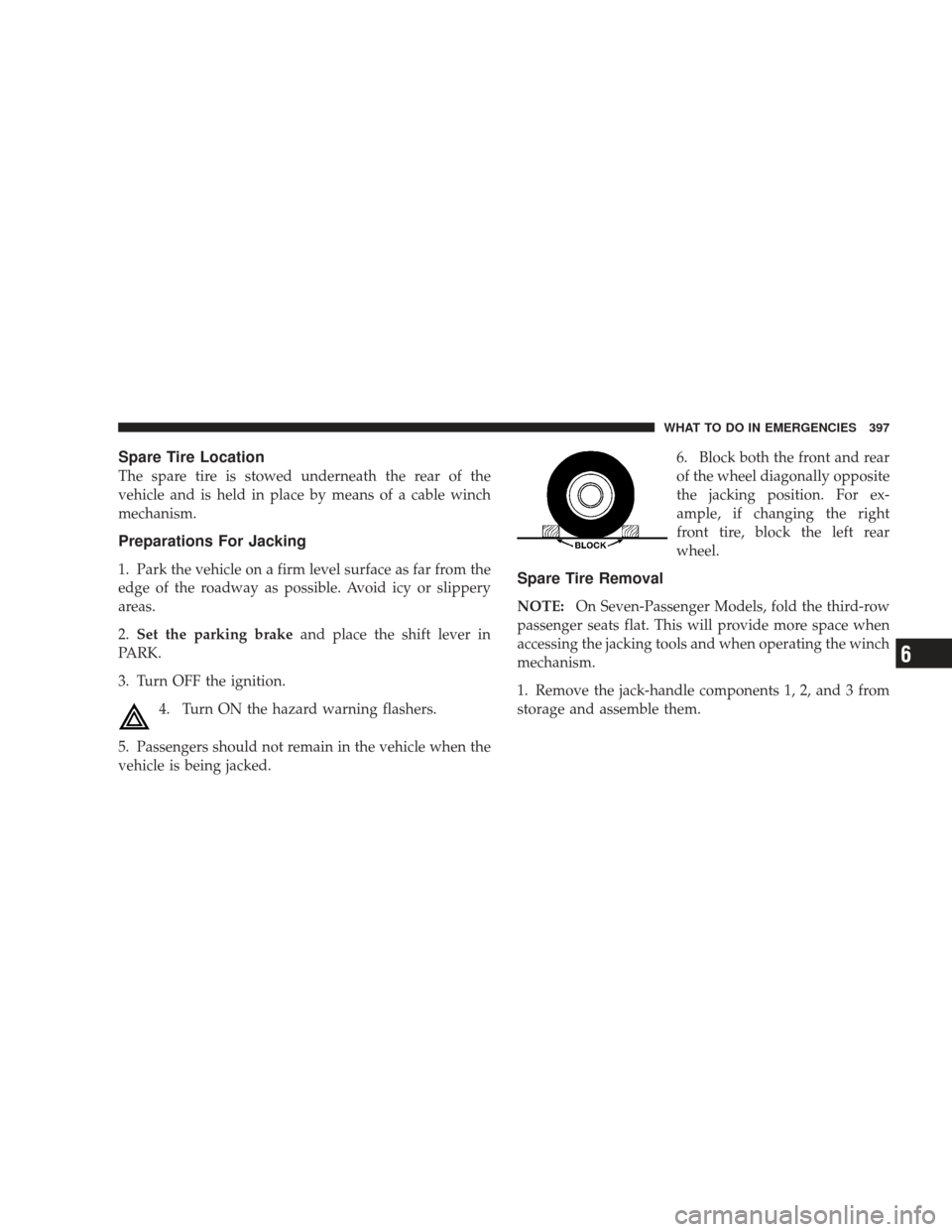
vehicle is being jacked. 6. Block both the front and rear
of the wheel diagonally opposite
the jacking position. For ex-
ample, if changing the right
front tire, block the left rear
wheel.Spare Tire Removal
NOTE:
On Seven-Passenger Models, fold the third-row
passenger seats flat. This will provide more space when
accessing the jacking tools and when operating the winch
mechanism.
1. Remove the jack-handle components 1, 2, and 3 from
storage and assemble them.
WHAT TO DO IN EMERGENCIES 397
6
Page 401 of 523
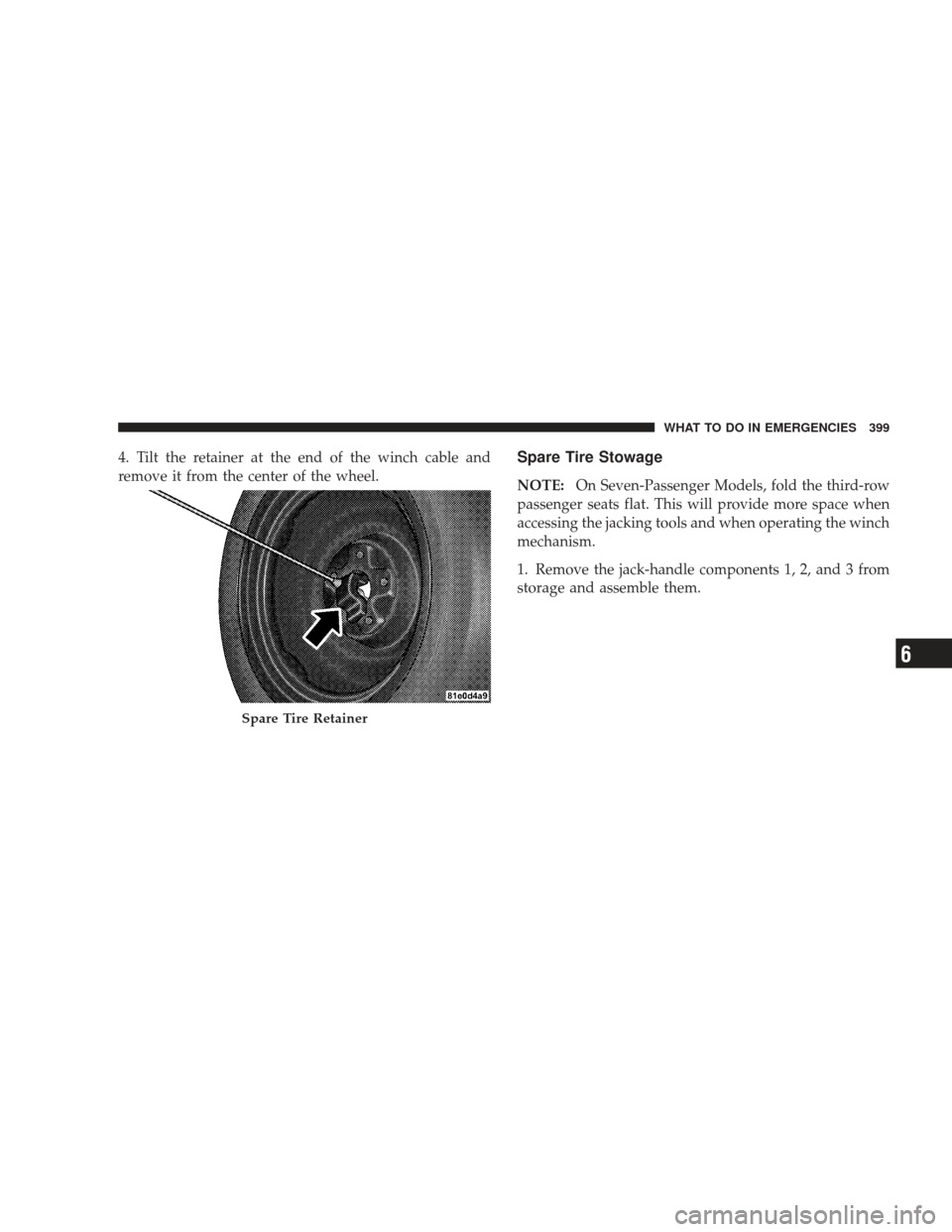
4. Tilt the retainer at the end of the winch cable and
remove it from the center of the wheel.Spare Tire Stowage
NOTE:On Seven-Passenger Models, fold the third-row
passenger seats flat. This will provide more space when
accessing the jacking tools and when operating the winch
mechanism.
1. Remove the jack-handle components 1, 2, and 3 from
storage and assemble them.
Spare Tire Retainer
WHAT TO DO IN EMERGENCIES 399
6
Page 404 of 523
WARNING!
Carefully follow these tire changing warnings to help prevent
personal injury or damage to your vehicle:
•Always park on a firm, level surface as far from the edge of
the roadway as possible before raising the vehicle.
• Block the wheel diagonally opposite the wheel to be raised.
• Set the parking brake firmly and set an automatic transaxle
in PARK; a manual transaxle in REVERSE.
• Never start or run the engine with the vehicle on a jack.
• Do not let anyone sit in the vehicle when it is on a jack.
• Do not get under the vehicle when it is on a jack.
• Only use the jack in the positions indicated and for lifting
this vehicle during a tire change.
• If working on or near a roadway, be extremely careful of
motor traffic.
• To assure that spare tires, flat or inflated are securely stowed,
spares must be stowed with the valve stem facing the
ground.
• Turn on the Hazard warning flasher.
1. Remove the spare tire, jack, and jack-handle from
stowage.
2. Loosen, but do not remove, the wheel nuts on the
wheel with the flat tire. Turn the wheel nuts counter-
clockwise one turn while the wheel is still on the ground.
3. Place the jack underneath the lift area that is closest to
the flat tire. Turn the jack screw clockwise to firmly
engage the jack saddle with the lift area of the sill flange.
402 WHAT TO DO IN EMERGENCIES
Page 407 of 523
•Refer to “Compact Spare Tire” and to “Limited-Use
Spare” under “Tires — General Information” in Sec-
tion 5 for additional warnings, cautions, and informa-
tion about the spare tire, its use, and operation.
7. Install the wheel nuts with the cone shaped end of the
nut toward the wheel. Lightly tighten the wheel nuts.
WARNING!
To avoid the risk of forcing the vehicle off the jack,
do not tighten the wheel nuts fully until the vehicle
has been lowered. Failure to follow this warning may
result in personal injury or death.
8. Lower the vehicle by turning the jack screw counter-
clockwise with the jack handle. 9. Finish tightening the wheel nuts. Push down on the
wrench while tightening for increased leverage. Alternate
wheel nuts until each nut has been tightened twice.
Correct wheel nut tightness is 95 ft lbs (130 N·m). If in
doubt about the correct tightness, have them checked
with a torque wrench by your authorized dealer or at a
service station.
10. Lower the jack to its fully closed position.WARNING!
A loose tire or jack, thrown forward in a collision or
hard stop could endanger the occupants of the ve-
hicle. Always stow the jack parts and the spare tire in
the places provided. Have the deflated (flat) tire
repaired or replaced immediately.
WHAT TO DO IN EMERGENCIES 405
6
Page 408 of 523
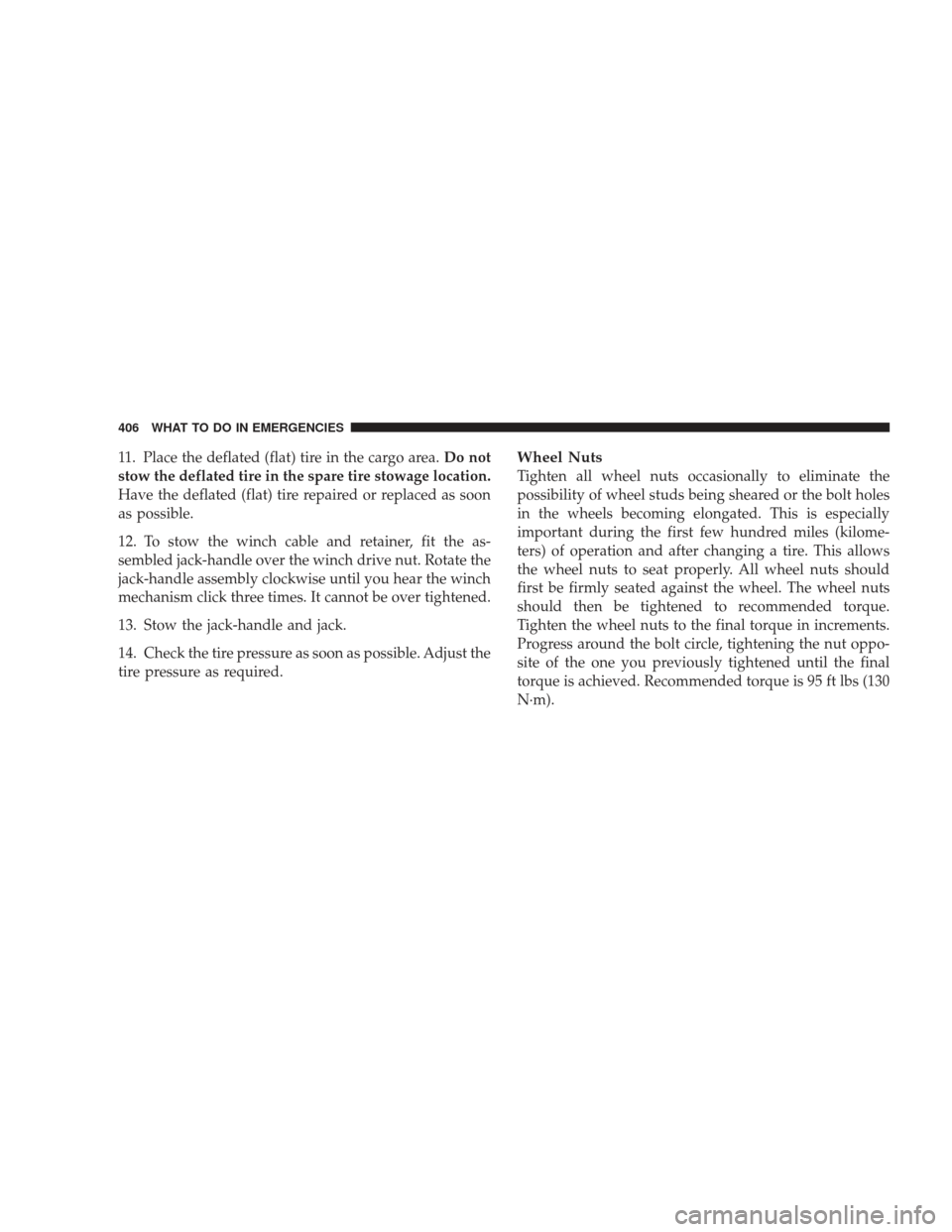
11. Place the deflated (flat) tire in the cargo area.Do not
stow the deflated tire in the spare tire stowage location.
Have the deflated (flat) tire repaired or replaced as soon
as possible.
12. To stow the winch cable and retainer, fit the as-
sembled jack-handle over the winch drive nut. Rotate the
jack-handle assembly clockwise until you hear the winch
mechanism click three times. It cannot be over tightened.
13. Stow the jack-handle and jack.
14. Check the tire pressure as soon as possible. Adjust the
tire pressure as required.Wheel Nuts
Tighten all wheel nuts occasionally to eliminate the
possibility of wheel studs being sheared or the bolt holes
in the wheels becoming elongated. This is especially
important during the first few hundred miles (kilome-
ters) of operation and after changing a tire. This allows
the wheel nuts to seat properly. All wheel nuts should
first be firmly seated against the wheel. The wheel nuts
should then be tightened to recommended torque.
Tighten the wheel nuts to the final torque in increments.
Progress around the bolt circle, tightening the nut oppo-
site of the one you previously tightened until the final
torque is achieved. Recommended torque is 95 ft lbs (130
N·m).
406 WHAT TO DO IN EMERGENCIES
Page 496 of 523
WARNING!
The traction grade assigned to this tire is based on
straight-ahead braking traction tests, and does not
include acceleration, cornering, hydroplaning, or
peak traction characteristics.
Temperature Grades
The temperature grades are A (the highest), B, and C,
representing the tire’s resistance to the generation of heat
and its ability to dissipate heat, when tested under
controlled conditions on a specified indoor laboratory
test wheel. Sustained high temperature can cause the
material of the tire to degenerate and reduce tire life, and
excessive temperature can lead to sudden tire failure. The
grade C corresponds to a level of performance, which all
passenger car tires must meet under the Federal MotorVehicle Safety Standard No. 109. Grades B and A repre-
sent higher levels of performance on the laboratory test
wheel, than the minimum required by law.
WARNING!
The temperature grade for this tire is established for
a tire that is properly inflated and not overloaded.
Excessive speed, under-inflation, or excessive load-
ing, either separately or in combination, can cause
heat buildup and possible tire failure.
494 IF YOU NEED CONSUMER ASSISTANCE
Page 501 of 523
Cargo Tie-Downs........................ 189
Cargo (Vehicle Loading) ................188,375
Catalytic Converter ...................... 429
CD (Compact Disc) Player ...............234,266
CD (Compact Disc) Player Maintenance ........ 284
Cellular Phone ..................... 93,266,267
Certification Label ....................... 375
Chains, Tire ............................ 355
Changing A Flat Tire ..................... 396
Charging System Light .................... 212
Chart, Tire Sizing ........................ 338
Check Engine Light
(Malfunction Indicator Light) ............... 422
Checking Your Vehicle For Safety ............. 78
Checks, Safety ........................... 78
Child Booster Seat ........................ 67
Child Restraint .................. 65,67,69,73,75
Child Restraint Tether Anchors .............71,73
Child Safety Locks ........................ 32 Clean Air Gasoline
....................... 369
Cleaning Wheels ............................. 454
Windshield Wiper Blades ................. 437
Climate Control ......................... 285
Clock ........................ 236,240,255,267
Coin Holder ........................... 183
Cold Weather Operation ................... 309
Compact Disc (CD) Maintenance ............. 284
Compact Spare Tire ...................... 349
Compass .............................. 227
Compass Calibration .................. 219,228
Compass Variance .................... 219,229
Computer, Trip/Travel .................... 226
Connector UCI ................................ 278
Universal Consumer Interface (UCI) ......... 278
Conserving Fuel ........................ 226
Console, Floor .......................... 183
INDEX 499
10
Page 508 of 523
Key ...............................12,14
Ignition Key Removal ..................... 14
Illuminated Entry ........................ 20
Immobilizer (Sentry Key) ................... 15
Indicator, Traction Control ................. 215
Infant Restraint ........................ 65,66
Inflation Pressure Tires .................... 213
Information Center, Vehicle ................. 221
Inside Rearview Mirror .................... 88
Instrument Cluster .................... 204,205
Instrument Panel and Controls .............. 203
Instrument Panel Cover ................... 454
Instrument Panel Lens Cleaning ............. 456
Integrated Power Module (Fuses) ............ 457
Interior Appearance Care .................. 454
Interior Lighting ...................... 146,151
Interior Lights .......................... 152
Intermittent Wipers (Delay Wipers) ........... 155
Introduction ............................. 4 Inverter, Power
......................... 176
Jack Location ........................... 396
Jack Operation ....................... 396,401
Jacking Instructions ...................... 401
Jump Starting .......................... 407
Key, Programming ........................ 17
Key, Replacement ........................ 16
Key, Sentry (Immobilizer) ................... 15
Key-In Reminder ......................... 15
Keyless Entry System ...................... 20
Keys ................................. 12
Knee Bolster ............................ 50
Lane Change and Turn Signals .............. 149
Lap/Shoulder Belts ....................... 41
LATCH
(Lower Anchors and Tether for CHildren) .....71,73
506 INDEX
Page 518 of 523
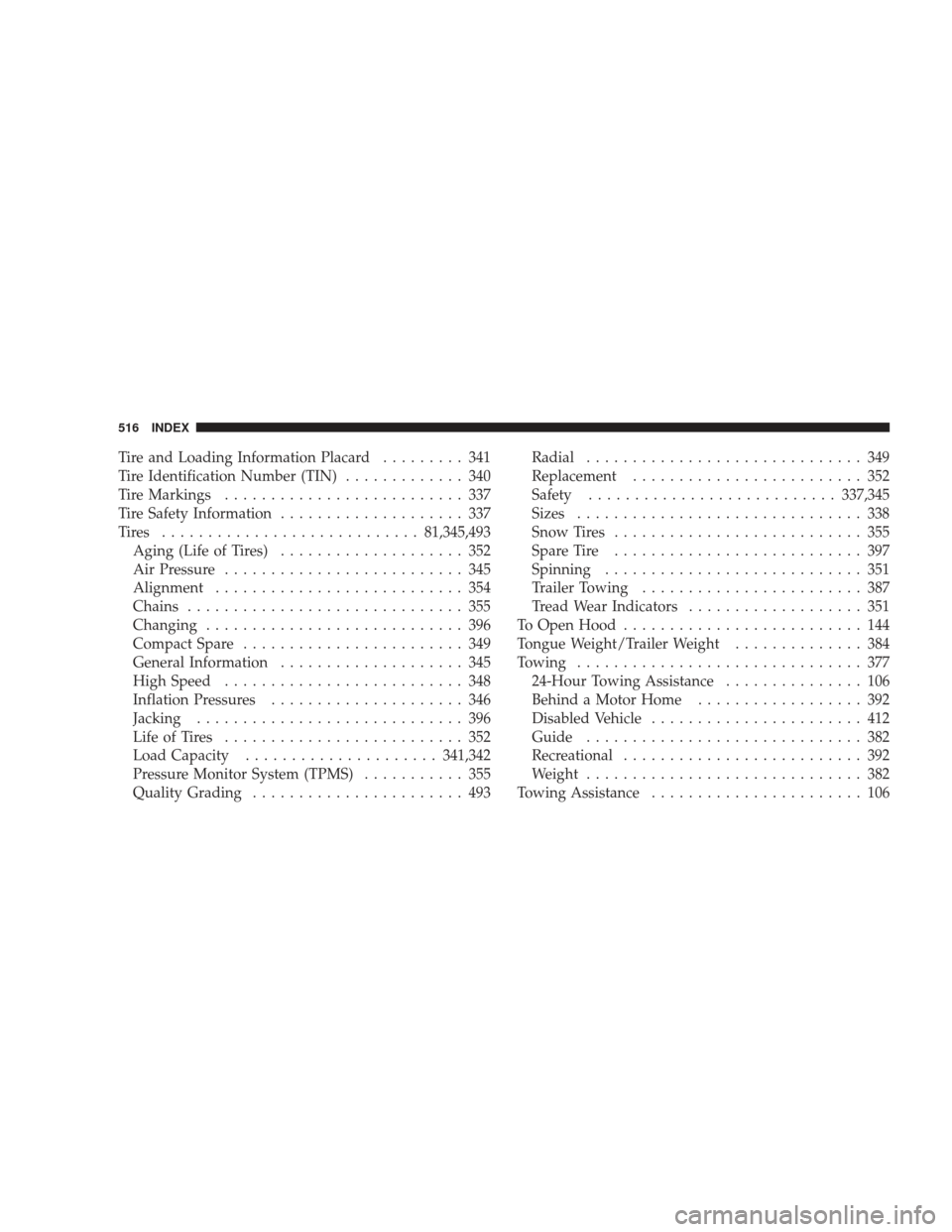
Tire and Loading Information Placard......... 341
Tire Identification Number (TIN) ............. 340
Tire Markings .......................... 337
Tire Safety Information .................... 337
Tires ............................ 81,345,493
Aging (Life of Tires) .................... 352
Air Pressure .......................... 345
Alignment ........................... 354
Chains .............................. 355
Changing ............................ 396
Compact Spare ........................ 349
General Information .................... 345
High Speed .......................... 348
Inflation Pressures ..................... 346
Jacking ............................. 396
Life of Tires .......................... 352
Load Capacity ..................... 341,342
Pressure Monitor System (TPMS) ........... 355
Quality Grading ....................... 493 Radial
.............................. 349
Replacement ......................... 352
Safety ........................... 337,345
Sizes ............................... 338
Snow Tires ........................... 355
Spare Tire ........................... 397
Spinning ............................ 351
Trailer Towing ........................ 387
Tread Wear Indicators ................... 351
To Open Hood .......................... 144
Tongue Weight/Trailer Weight .............. 384
Towing ............................... 377
24-Hour Towing Assistance ............... 106
Behind a Motor Home .................. 392
Disabled Vehicle ....................... 412
Guide .............................. 382
Recreational .......................... 392
Weight .............................. 382
Towing Assistance ....................... 106
516 INDEX