oil light DODGE JOURNEY 2009 1.G Owners Manual
[x] Cancel search | Manufacturer: DODGE, Model Year: 2009, Model line: JOURNEY, Model: DODGE JOURNEY 2009 1.GPages: 523
Page 82 of 523
Whenever a change is noticed in the sound of the exhaust
system, when exhaust fumes can be detected inside the
vehicle, or when the underside or rear of the vehicle is
damaged, have a competent mechanic inspect the com-
plete exhaust system and adjacent body areas for broken,
damaged, deteriorated, or mispositioned parts. Open
seams or loose connections could permit exhaust fumes
to seep into the passenger compartment. In addition,
inspect the exhaust system each time the vehicle is raised
for lubrication or oil change. Replace as required.
Safety Checks You Should Make Inside The
Vehicle
Seat Belts
Inspect the seat belt system periodically, checking for
cuts, frays, and loose parts. Damaged parts must be
replaced immediately. Do not disassemble or modify the
system.Front seat belt assemblies must be replaced after a
collision. Rear seat belt assemblies must be replaced after
a collision if they have been damaged (i.e., bent retractor,
torn webbing, etc.). If there is any question regarding belt
or retractor condition, replace the seat belt.
Airbag Warning Light
The light should turn on and remain on for four to six
seconds as a bulb check when the ignition switch is first
turned ON. If the light is not lit during starting, or if the
light stays on, flickers, or turns on while driving, have the
system checked by an authorized dealer.
Defroster
Check operation by selecting the defrost mode and place
the blower control on high speed. You should be able to
feel the air directed against the windshield. See your
authorized dealer for service if your defroster is inoper-
able.
80 THINGS TO KNOW BEFORE STARTING YOUR VEHICLE
Page 83 of 523
Periodic Safety Checks You Should Make Outside
The Vehicle
Tires
Examine tires for excessive tread wear and uneven wear
patterns. Check for stones, nails, glass, or other objects
lodged in the tread. Inspect the tread and sidewall for
cuts and cracks. Check the wheel nuts for tightness.
Check the tires (including spare) for proper pressure.
Lights
Have someone observe the operation of exterior lights
while you work the controls. Check Turn Signal and High
Beam Indicator Lights on the instrument panel.
Door Latches
Check for positive closing, latching, and locking.
Fluid Leaks
Check area under vehicle after overnight parking for fuel,
engine coolant, oil, or other fluid leaks. Also, if gasoline
fumes are detected or if fuel, power steering fluid, or
brake fluid leaks are suspected, the cause should be
located and corrected immediately.
THINGS TO KNOW BEFORE STARTING YOUR VEHICLE 81
2
Page 209 of 523
WARNING!
A hot engine cooling system is dangerous. You or
others could be badly burned by steam or boiling
coolant. You may want to call a service center if your
vehicle overheats. If you decide to look under the
hood yourself, refer to Section 7 and follow the
warnings under the Cooling System Pressure Cap
paragraph.
5. Front Fog Light Indicator Light — If Equipped This light shows when the fog lights are ON. (See
page 148 for more information.)
6. Low Fuel Warning Light This indicator lights when the fuel level drops to
approximately one-eighth tank. (See page 372 for
more information.) 7. Turn Signal Indicator Light
The left or right arrow will flash in unison with the
corresponding front and rear turn signal lights when
the turn signal switch is operated. (See page 149 for more
information.)
NOTE: A chime will sound if the vehicle is driven more
than 1 mi (1.6 km) with either turn signal on.
NOTE: Check for an inoperative outside light bulb if
either indicator flashes at a rapid rate.
8. High Beam Indicator Light This light shows that the headlights are on high
beam. Pull the multifunction lever on the left side
of the steering column toward you to switch to low beam.
(See page 150 for more information.)
9. Speedometer
Shows the vehicle speed.
UNDERSTANDING YOUR INSTRUMENT PANEL 207
4
Page 213 of 523
16. Electronic Throttle Control (ETC) Warning Light —
If EquippedThis light will turn on briefly as a bulb check
when the ignition switch is turned ON. This
light will also turn on while the engine is
running if there is a problem with the Elec-
tronic Throttle Control (ETC) system.
If the light turns on while the engine is running, safely
bring the vehicle to a complete stop as soon as possible,
place the shift lever in PARK, and cycle the ignition key.
The light should turn off. If the light remains lit with the
engine running, your vehicle will usually be drivable.
However, see your authorized dealer for service as soon
as possible.
If the light is flashing when the engine is running,
immediate service is required. In this case, you may
experience reduced performance, an elevated/rough idle
or engine stall, and your vehicle may require towing. Also, have the system checked by an authorized dealer if
the light does not turn on during starting.
17. Oil Pressure Warning Light
This light shows low engine oil pressure. The light
will turn on and remain on when the ignition
switch is turned from the LOCK or ACC position to the
ON position. The light will turn off after the engine is
started.
If the light does not turn on during starting, have the
system checked by an authorized dealer.
If the light turns on and remains on while driving, safely
bring the vehicle to a stop and shut off the engine. DO
NOT OPERATE THE VEHICLE UNTIL THE CAUSE IS
CORRECTED. This light does not show the quantity of
oil in the engine. The engine oil level must be checked
using the proper procedure. (See page 424 for more
information.)
UNDERSTANDING YOUR INSTRUMENT PANEL 211
4
Page 227 of 523
•Coolant Low
•Key in Ignition
•Lights On
Oil Change Required
Your vehicle is equipped with an engine oil change
indicator system. The “Oil Change Required” message
will display in the EVIC for approximately 5 seconds
after a single chime has sounded to indicate the next
scheduled oil change interval. The engine oil change
indicator system is duty cycle based, which means the
engine oil change interval may fluctuate dependent upon
your personal driving style.
Unless reset, this message will continue to display each
time you turn the ignition switch to the ON position. To
turn off the message temporarily, press and release theMENU button. To reset the oil change indicator system
(after performing the scheduled maintenance) perform
the following procedure:
1. Turn the ignition switch to the ON position (Do not
start the engine).
2. Fully depress the accelerator pedal slowly three times
within 10 seconds.
3. Turn the ignition switch to the LOCK position.
NOTE:
If the indicator message illuminates when you
start the vehicle, the oil change indicator system did not
reset. If necessary, repeat this procedure.
UNDERSTANDING YOUR INSTRUMENT PANEL 225
4
Page 354 of 523
These indicators are molded into the bottom of the tread
grooves. They will appear as bands when the tread depth
becomes 1/16 in (2 mm). When the tread is worn to the
tread wear indicators, the tire should be replaced.
Many states have laws requiring tire replacement at this
point.
Life of Tire
The service life of a tire is dependent upon varying
factors including, but not limited to:
•Driving style
•Tire pressure
•Distance driven
WARNING!
Tires and the spare tire should be replaced after six
years, regardless of the remaining tread. Failure to
follow this warning can result in sudden tire failure.
You could lose control and have an accident resulting
in serious injury or death.
Keep dismounted tires in a cool, dry place with as little
exposure to light as possible. Protect tires from contact
with oil, grease, and gasoline.
Replacement Tires
The tires on your new vehicle provide a balance of many
characteristics. They should be inspected regularly for
wear and correct cold tire inflation pressure. The manu-
facturer strongly recommends that you use tires equiva-
lent to the originals in size, quality and performance
when replacement is needed. (Refer to the paragraph on
352 STARTING AND OPERATING
Page 449 of 523
Ensure nylon tubing in these areas has not melted or
collapsed.
Inspect all hose clamps and couplings to make sure they
are secure and no leaks are present.
NOTE:
•Often, fluids such as oil, power steering fluid, and
brake fluid are used during assembly plant operations
to ease the assembly of hoses to couplings. Therefore,
oil wetness at the hose-coupling area is not necessarily
an indication of leakage. Actual dripping of hot fluid
when systems are under pressure (during vehicle
operation) should be noted before a hose is replaced
based on leakage.
•Inspect the brake hoses whenever the brake system is
serviced and at every engine oil change. Inspect hy-
draulic brake hoses for surface cracking, scuffing, or
worn spots. If there is any evidence of cracking,
scuffing, or worn spots, the hose should be replacedimmediately. Eventual deterioration of the hose can
take place, resulting in a possibility of a burst failure.
WARNING!
Worn brake hoses can burst and cause brake failure.
You could have an accident. If you see any signs of
cracking, scuffing, or worn spots, have the brake
hoses replaced immediately.
Master Cylinder - Brake Fluid Level Check
Check the fluid level in the master cylinder immediately
if the Brake System Warning Light indicates system
failure.
Check the fluid level in the master cylinder when per-
forming underhood services.
MAINTAINING YOUR VEHICLE 447
7
Page 469 of 523
CAUTION!
Do not touch the new bulb with your fingers. Oil
contamination will severely shorten bulb life. If the
bulb comes in contact with any oily surface, clean the
bulb with rubbing alcohol.
4. Install the bulb and connector assembly into the
headlight housing and rotate it
14turn clockwise to lock
it in place.
Front Fog Light
NOTE: Turn the steering wheel to the right if replacing
the left front fog light or to the left if replacing the right
front fog light to allow for easier access to the front of the
wheel well.
1. Remove the fasteners retaining the front lower wheel
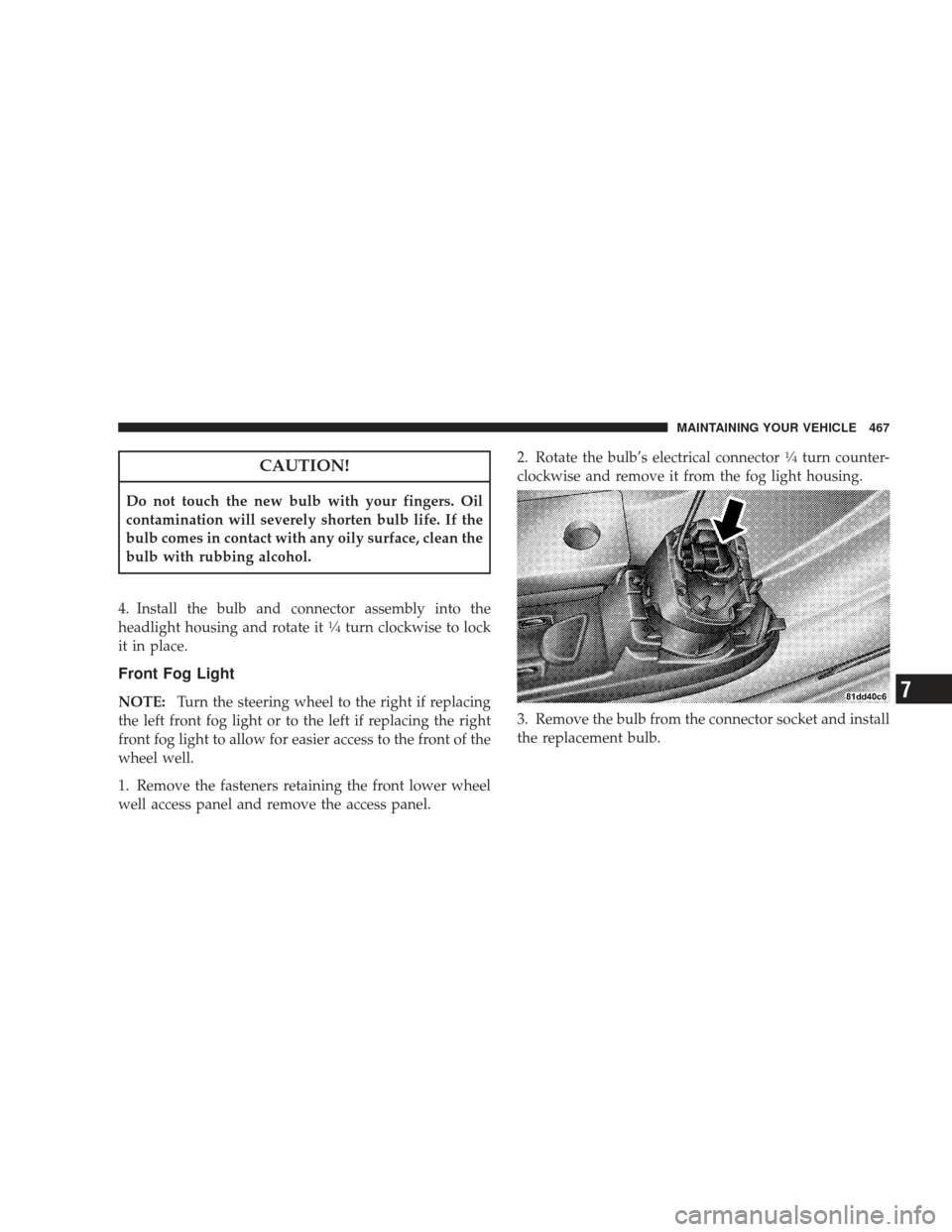
well access panel and remove the access panel. 2. Rotate the bulb’s electrical connector
14turn counter-
clockwise and remove it from the fog light housing.
3. Remove the bulb from the connector socket and install
the replacement bulb.
MAINTAINING YOUR VEHICLE 467
7
Page 470 of 523
CAUTION!
Do not touch the new bulb with your fingers. Oil
contamination will severely shorten bulb life. If the
bulb comes in contact with an oily surface, clean the
bulb with rubbing alcohol.
4. Install the bulb and connector assembly into the fog
light housing and rotate the connector
14turn clockwise
to lock it in place.
5. Reinstall the front lower wheel well access panel and
fasteners.
Tail/Stop Light, Rear Turn Signal Light, Tail Light,
Backup Light
The taillights are a two-piece design. The tail/stop lights
and rear turn signal lights are located in the rear corner
body panels. The tail and backup lights are located in the
liftgate.
Changing the Tail/Stop Light or Rear Turn Signal
Light
1. Open the liftgate.
2. Remove the two fasteners from the inboard side of the
taillight housing.
3. Carefully insert a trim stick (plastic flat-blade tool)
between the body panel and the outboard side of the
taillight housing with one hand and grasp the flange on
the inboard side of the taillight housing with the other
hand. Use the trim stick and hand pressure together to
disengage the taillight housing from the vehicle.
468 MAINTAINING YOUR VEHICLE
Page 482 of 523
At Each Stop for Fuel
•Check the engine oil level. Refer to “Engine Oil” under
“Maintenance Procedures” in Section 7.
•Check the windshield washer solvent and add if
required.
Once a Month
•Check tire pressure and look for unusual wear or
damage.
•Inspect the battery, and clean and tighten the terminals
as required.
•Check the fluid levels of coolant reservoir, brake
master cylinder, power steering, and transaxle, and
add as needed.
•Check all lights and other electrical items for correct
operation. At Each Oil Change
•Change the engine oil filter.
•Inspect the brake hoses and lines.
CAUTION!
Failure to perform the required maintenance items
may result in damage to the vehicle.
480 MAINTENANCE SCHEDULES
8
M
A I
N T
E
N A
N CE
S
C
H E
D
U L
E
S