child lock DODGE JOURNEY 2010 1.G User Guide
[x] Cancel search | Manufacturer: DODGE, Model Year: 2010, Model line: JOURNEY, Model: DODGE JOURNEY 2010 1.GPages: 512
Page 60 of 512
The system includes side impact sensors adjacent to both
front and rear seat occupants that are calibrated to deploy
the SABIC airbags during impacts that require airbag
occupant protection.
WARNING!
•If your vehicle is equipped with left and right
Supplemental Side Airbag Inflatable Curtain
(SABIC), do not stack luggage or other cargo up
high enough to block the location of the SABIC.
The area where the SABIC is located should re-
main free from any obstructions.
•Do not use accessory seat covers or place objects
between you and the side airbags; the performance
could be adversely affected and/or objects could
be pushed into you, causing serious injury.
Knee Impact Bolsters
The Knee Impact Bolsters help protect the knees of the
driver and the front passenger, and position front occu-
pants for the best interaction with the Advanced Front
Airbags.
Along with seat belts and pretensioners, Advanced Front
Airbags work with the knee bolsters to provide improved
protection for the driver and front passenger. Side airbags
also work with seat belts to improve occupant protection.
Here are some simple steps you can take to minimize the
risk of harm from a deploying airbag:
Children 12 years old and under should always ride
buckled up in a rear seat.
2
THINGS TO KNOW BEFORE STARTING YOUR VEHICLE 59
Page 75 of 512
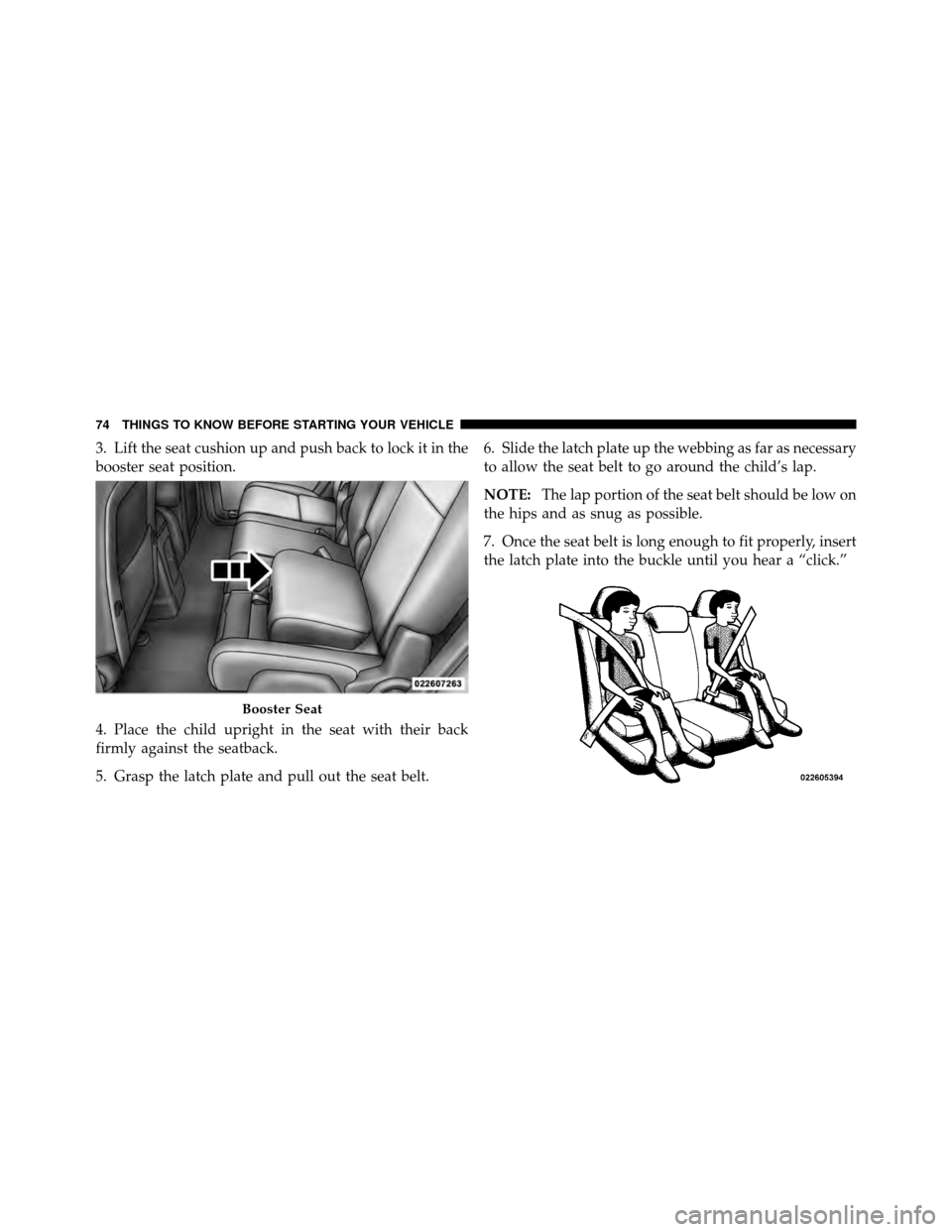
3. Lift the seat cushion up and push back to lock it in the
booster seat position.
4. Place the child upright in the seat with their back
firmly against the seatback.
5. Grasp the latch plate and pull out the seat belt.6. Slide the latch plate up the webbing as far as necessary
to allow the seat belt to go around the child’s lap.
NOTE:
The lap portion of the seat belt should be low on
the hips and as snug as possible.
7. Once the seat belt is long enough to fit properly, insert
the latch plate into the buckle until you hear a “click.”
Booster Seat
74 THINGS TO KNOW BEFORE STARTING YOUR VEHICLE
Page 76 of 512
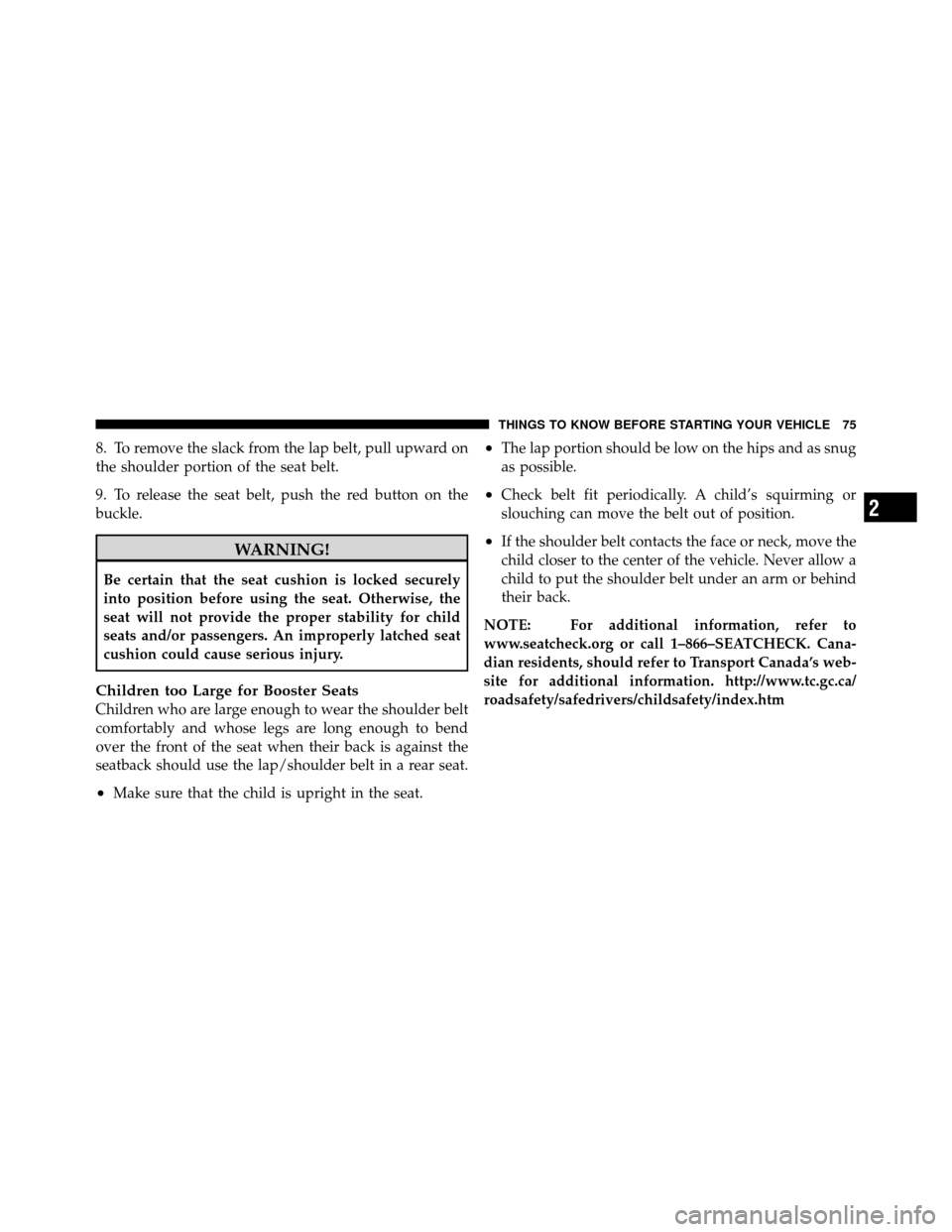
8. To remove the slack from the lap belt, pull upward on
the shoulder portion of the seat belt.
9. To release the seat belt, push the red button on the
buckle.
WARNING!
Be certain that the seat cushion is locked securely
into position before using the seat. Otherwise, the
seat will not provide the proper stability for child
seats and/or passengers. An improperly latched seat
cushion could cause serious injury.
Children too Large for Booster Seats
Children who are large enough to wear the shoulder belt
comfortably and whose legs are long enough to bend
over the front of the seat when their back is against the
seatback should use the lap/shoulder belt in a rear seat.
•Make sure that the child is upright in the seat.
•The lap portion should be low on the hips and as snug
as possible.
•Check belt fit periodically. A child’s squirming or
slouching can move the belt out of position.
•If the shoulder belt contacts the face or neck, move the
child closer to the center of the vehicle. Never allow a
child to put the shoulder belt under an arm or behind
their back.
NOTE: For additional information, refer to
www.seatcheck.org or call 1–866–SEATCHECK. Cana-
dian residents, should refer to Transport Canada’s web-
site for additional information. http://www.tc.gc.ca/
roadsafety/safedrivers/childsafety/index.htm
2
THINGS TO KNOW BEFORE STARTING YOUR VEHICLE 75
Page 82 of 512
WARNING!
Improper installation of a child restraint to the
LATCH anchorages can lead to failure of an infant or
child restraint. The child could be badly injured or
killed. Follow the manufacturer’s directions exactly
when installing an infant or child restraint.
Installing Child Restraints Using the Vehicle Seat
Belt
The seat belts in the passenger seating positions are
equipped with either an Automatic Locking Retractor
(ALR) or a cinching latch plate or both. Both types of seat
belts are designed to keep the lap portion of the seat belt
tight around the child restraint so that it is not necessary
to use a locking clip. The ALR will make a ratcheting
noise if you extract the entire belt from the retractor andthen allow the belt to retract into the retractor. For
additional information on ALR, refer to “Automatic
Locking Mode”.
To install a child restraint, first, pull enough of the seat
belt webbing from the retractor to route it through the
belt path of the child restraint and slide the latch plate
into the buckle. Next, extract all the seat belt webbing out
of the retractor and then allow the belt to retract into the
retractor. Finally, pull on any excess webbing to tighten
the lap portion around the child restraint. Any seat belt
system will loosen with time, so check the belt occasion-
ally, and pull it tight if necessary.
NOTE:
When installing a child restraint, if it interferes
with the Head Restraint, recline the seatback slightly to
remove the interference.
2
THINGS TO KNOW BEFORE STARTING YOUR VEHICLE 81
Page 112 of 512
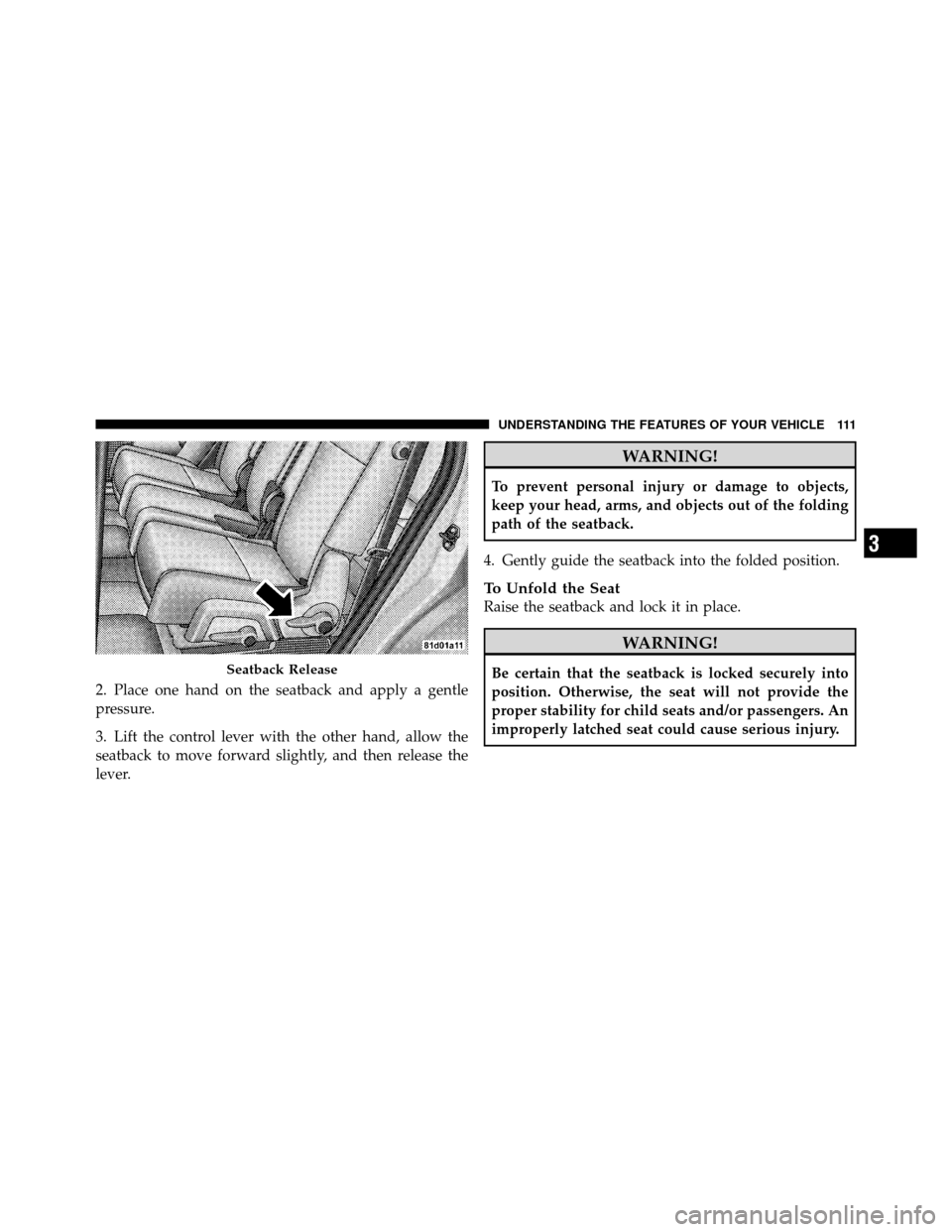
2. Place one hand on the seatback and apply a gentle
pressure.
3. Lift the control lever with the other hand, allow the
seatback to move forward slightly, and then release the
lever.
WARNING!
To prevent personal injury or damage to objects,
keep your head, arms, and objects out of the folding
path of the seatback.
4. Gently guide the seatback into the folded position.
To Unfold the Seat
Raise the seatback and lock it in place.
WARNING!
Be certain that the seatback is locked securely into
position. Otherwise, the seat will not provide the
proper stability for child seats and/or passengers. An
improperly latched seat could cause serious injury.Seatback Release
3
UNDERSTANDING THE FEATURES OF YOUR VEHICLE 111
Page 115 of 512
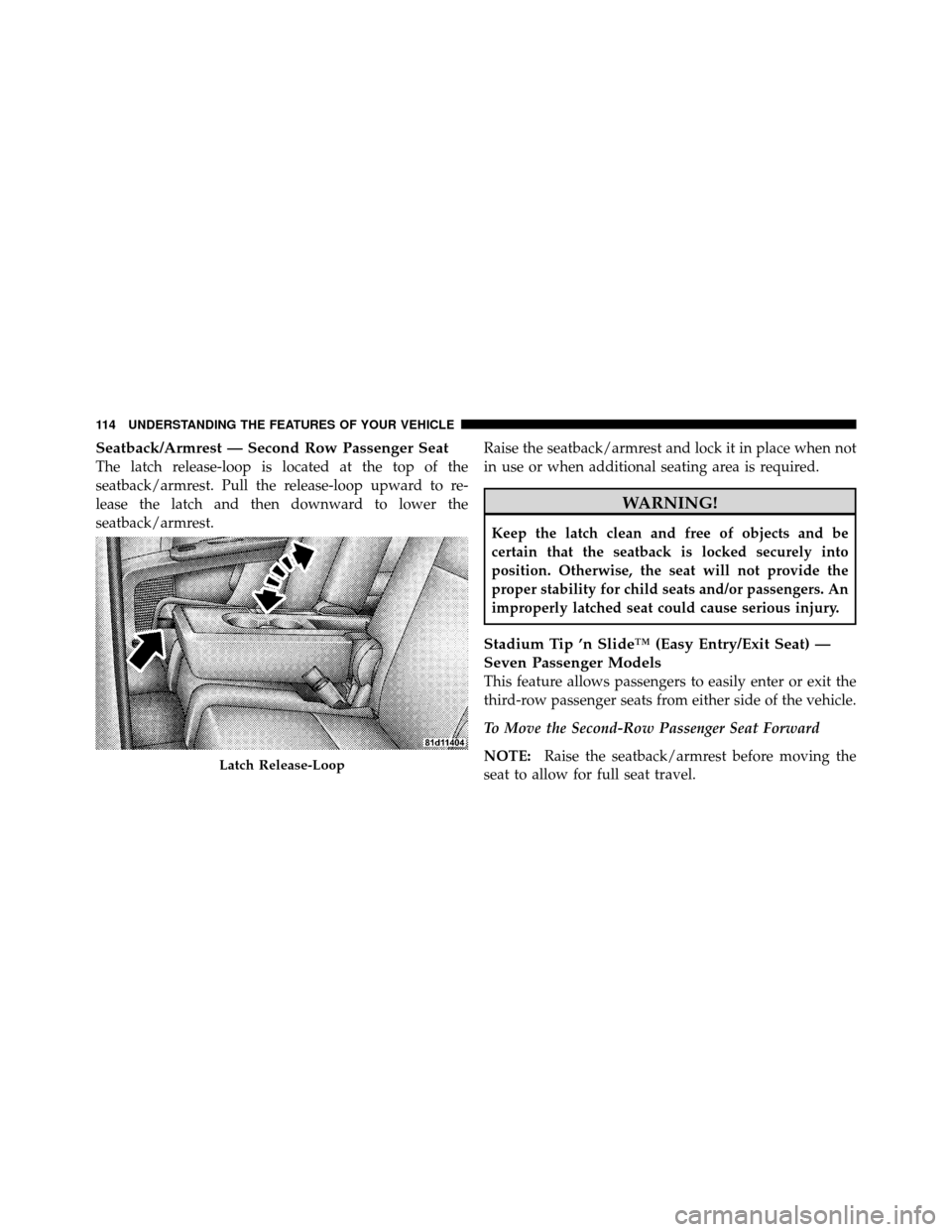
Seatback/Armrest — Second Row Passenger Seat
The latch release-loop is located at the top of the
seatback/armrest. Pull the release-loop upward to re-
lease the latch and then downward to lower the
seatback/armrest.Raise the seatback/armrest and lock it in place when not
in use or when additional seating area is required.
WARNING!
Keep the latch clean and free of objects and be
certain that the seatback is locked securely into
position. Otherwise, the seat will not provide the
proper stability for child seats and/or passengers. An
improperly latched seat could cause serious injury.
Stadium Tip ’n Slide™ (Easy Entry/Exit Seat) —
Seven Passenger Models
This feature allows passengers to easily enter or exit the
third-row passenger seats from either side of the vehicle.
To Move the Second-Row Passenger Seat Forward
NOTE:
Raise the seatback/armrest before moving the
seat to allow for full seat travel.
Latch Release-Loop
114 UNDERSTANDING THE FEATURES OF YOUR VEHICLE
Page 118 of 512
WARNING!
Be certain that the seatback and seat are locked
securely into position. Otherwise, the seat will not
provide the proper stability for child seats and/or
passengers. An improperly latched seat could cause
serious injury.
50/50 Split Third-Row Passenger Seats with
Fold-Flat Feature — Seven Passenger Models
To provide additional storage area, each third-row pas-
senger seat can be folded flat. This allows for extended
cargo space and still maintains some rear seating room if
needed.
NOTE:Prior to folding the third-row passenger seat,
make sure the second-row passenger seat is not in a
reclined position. This will allow the seat to fold easily.
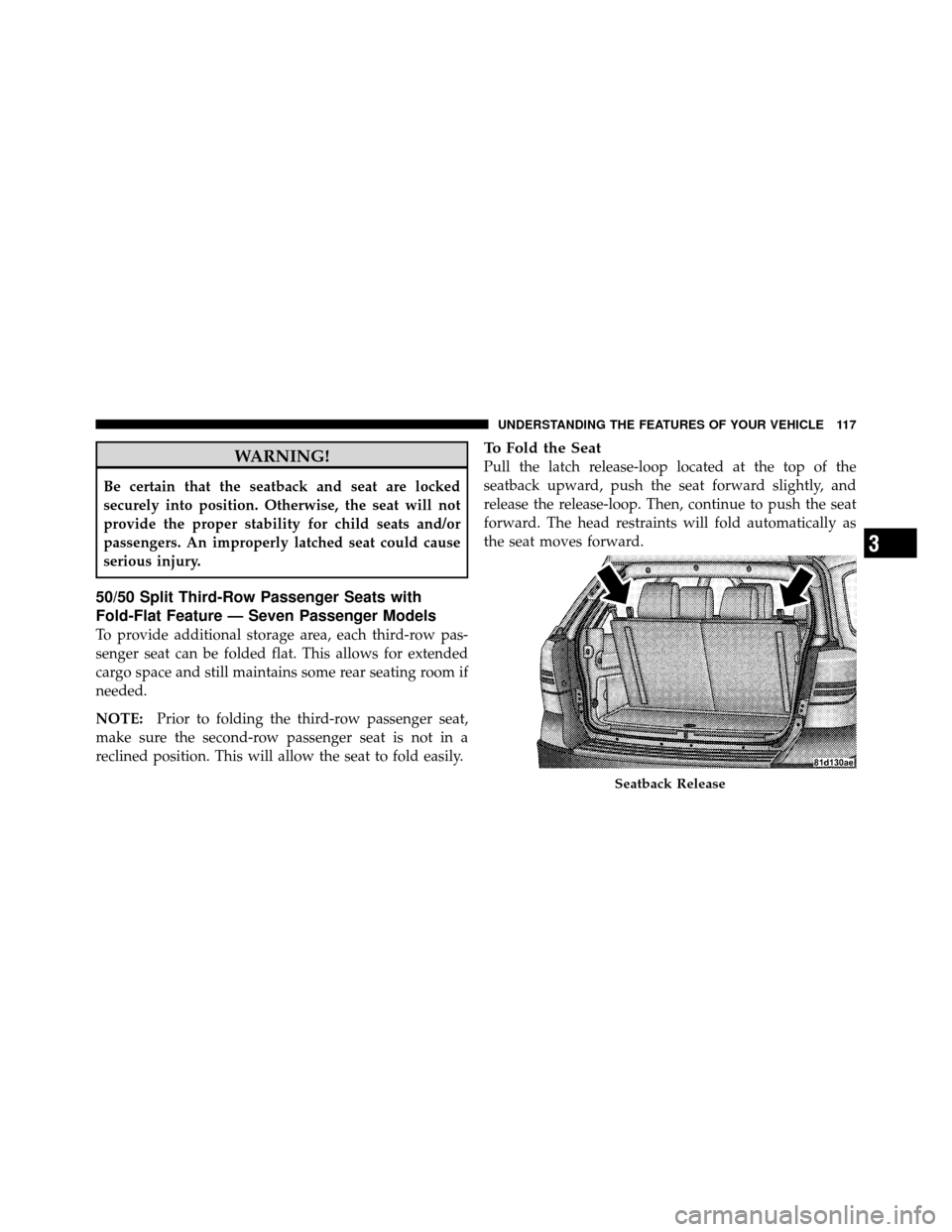
To Fold the Seat
Pull the latch release-loop located at the top of the
seatback upward, push the seat forward slightly, and
release the release-loop. Then, continue to push the seat
forward. The head restraints will fold automatically as
the seat moves forward.
Seatback Release
3
UNDERSTANDING THE FEATURES OF YOUR VEHICLE 117
Page 300 of 512
WARNING!
•It is dangerous to move the shift lever out of PARK
or NEUTRAL if the engine speed is higher than
idle speed. If your foot is not firmly on the brake
pedal, the vehicle could accelerate quickly forward
or in reverse. You could lose control of the vehicle
and hit someone or something. Only shift into
gear when the engine is idling normally and when
your right foot is firmly on the brake pedal.(Continued)
WARNING! (Continued)
•Unintended movement of a vehicle could injure
those in and near the vehicle. As with all vehicles,
you should never exit a vehicle while the engine is
running. Before exiting a vehicle, you should
always shift the vehicle into PARK, remove the
key fob from the ignition switch, and apply the
parking brake. Once the key fob is removed from
the ignition switch, the shift lever is locked in the
PARK position, securing the vehicle against un-
wanted movement. Furthermore, you should never
leave unattended children inside a vehicle.
5
STARTING AND OPERATING 299
Page 303 of 512
When parking on a flat surface, place the shift lever in the
PARK position first, and then apply the parking brake.
When parking on a hill, it is important to set the parking
brake before placing the shift lever in PARK, otherwise
the load on the transmission locking mechanism may
make it difficult to move the shift lever out of PARK. As
an added precaution, turn the front wheels toward the
curb on a downhill grade and away from the curb on an
uphill grade.
WARNING!
•Never use the PARK position as a substitute for
the parking brake. Always apply the parking
brake fully when parked to guard against vehicle
movement and possible injury or damage.(Continued)
WARNING! (Continued)
•Never leave children in the vehicle alone. Leaving
unattended children in a vehicle is dangerous for a
number of reasons. The child or others could be
seriously or fatally injured. They could operate the
windows, other vehicle controls or move the
vehicle.
CAUTION!
DO NOT race the engine when shifting from PARK
or NEUTRAL positions into another gear range as
this can damage the drivetrain.
REVERSE
This range is for moving the vehicle backward. Shift into
REVERSE only after the vehicle has come to a complete
stop.
302 STARTING AND OPERATING
Page 492 of 512
Checking Your Vehicle For Safety............. 84
Checks, Safety ........................... 84
Child Booster Seat ........................ 73
Child Restraint .................. 71,72,75,79,81
Child Restraint Tether Anchors .............77,79
Child Safety Locks ........................ 32
Clean Air Gasoline ....................... 354
Cleaning Wheels ............................. 437
Windshield Wiper Blades ................ 418
Climate Control ......................... 269
Clock ........................ 215,231,240,252
Coin Holder ........................... 158
Cold Weather Operation ................... 296
Compact Disc (CD) Maintenance ............. 268
Compact Spare Tire ...................... 338
Compass ........................ 198,201,208
Compass Calibration .................. 201,209
Compass Variance .................... 200,209Computer, Trip/Travel
.................... 206
Connector UCI ................................ 263
Universal Consumer Interface (UCI) ......... 263
Conserving Fuel ........................ 206
Console, Floor .......................... 158
Console, Overhead ....................... 139
Contract, Service ........................ 481
Coolant Pressure Cap (Radiator Cap) .......... 427
Cooling System ......................... 424
Adding Coolant (Antifreeze) .............. 426
Coolant Capacity ...................... 455
Coolant Level ...................... 424,428
Disposal of Used Coolant ................ 428
Drain, Flush, and Refill .................. 425
Inspection ........................... 428
Points to Remember .................... 428
Pressure Cap ......................... 427
Radiator Cap ......................... 427
10
INDEX 491