panel DODGE JOURNEY 2012 1.G Owner's Manual
[x] Cancel search | Manufacturer: DODGE, Model Year: 2012, Model line: JOURNEY, Model: DODGE JOURNEY 2012 1.GPages: 603
Page 70 of 603
The Advanced Front Air Bags and Supplemental Driver
Side Knee Air Bag will not deploy in all frontal collisions,
including some that may produce substantial vehicle
damage — for example, some pole collisions, truck
underrides, and angle offset collisions. On the other
hand, depending on the type and location of impact,
Advanced Front Air Bags may deploy in crashes with
little vehicle front-end damage but that produce a severe
initial deceleration.
The side air bags will not deploy in all side collisions.
Side air bag deployment will depend on the severity and
type of collision.
Because air bag sensors measure vehicle deceleration
over time, vehicle speed and damage by themselves are
not good indicators of whether or not an air bag should
have deployed.Seat belts are necessary for your protection in all acci-
dents, and also are needed to help keep you in position,
away from an inflating air bag.
The ORC monitors the readiness of the electronic parts of
the air bag system whenever the ignition is in the
ON/RUN position. If the ignition is in the OFF position,
or in the ACC position, the air bag system is not on and
the air bags will not inflate.
The ORC contains a backup power supply system that
may deploy the air bags even if the battery loses power or
it becomes disconnected prior to deployment.
Also, the ORC turns on the Air Bag Warning
Light in the instrument panel for approxi-
mately four to eight seconds for a self-check
when the ignition is first turned on. After the
self-check, the Air Bag Warning Light will turn off. If the
ORC detects a malfunction in any part of the system, it
68 THINGS TO KNOW BEFORE STARTING YOUR VEHICLE
Page 71 of 603
turns on the Air Bag Warning Light, either momentarily
or continuously. A single chime will sound if the light
comes on again after initial startup.
It also includes diagnostics that will illuminate the instru-
ment cluster Air Bag Warning Light if a malfunction is
noted that could affect the air bag system. The diagnos-
tics also record the nature of the malfunction.
WARNING!
Ignoring the Air Bag Warning Light in your instru-
ment panel could mean you won’t have the air bags
to protect you in a collision. If the light does not come
on as a bulb check when the ignition is first turned
on, stays on after you start the vehicle, or if it comes
on as you drive, have an authorized dealer service the
air bag system immediately.
Driver And Passenger Advanced Front Air Bag
Inflator Units
The Driver and Passenger Advanced Front Air Bag
Inflator Units are located in the center of the steering
wheel and on the right side of the instrument panel.
When the ORC detects a collision requiring the Ad-
vanced Front Air Bags, it signals the inflator units. A large
quantity of non-toxic gas is generated to inflate the
Advanced Front Air Bags. Different air bag inflation rates
are possible, based on the collision type and severity. The
steering wheel hub trim cover and the upper right side of
the instrument panel separate and fold out of the way as
the air bags inflate to their full size. The air bags fully
inflate in about 50 to 70 milliseconds. This is about half of
the time it takes to blink your eyes. The air bags then
quickly deflate while helping to restrain the driver and
front passenger.
2
THINGS TO KNOW BEFORE STARTING YOUR VEHICLE 69
Page 72 of 603
The Advanced Front Air Bag gas is vented through the
vent holes in the sides of the air bag. In this way, the air
bags do not interfere with your control of the vehicle.
Supplemental Driver Side Knee Air Bag Inflator
Unit
The Supplemental Driver Side Knee Air Bag unit is
located in the instrument panel trim beneath the steering
column. When the ORC detects a collision requiring the
air bag, it signals the inflator units. A large quantity of
non-toxic gas is generated to inflate the Supplemental
Driver Side Knee Air Bag. The trim cover separates and
folds out of the way allowing the air bag to inflate to the
full size. The air bag fully inflates in about 15 to 20
milliseconds.
Supplemental Seat-Mounted Side Air Bag (SAB)
Inflator Units
The Supplemental Seat-Mounted Side Air Bags (SAB) are
designed to activate only in certain side collisions.The ORC determines if a side collision requires the side
air bags to inflate, based on the severity and type of
collision.
Based on the severity and type of collision, the side air
bag inflator on the crash side of the vehicle may be
triggered, releasing a quantity of non-toxic gas. The
inflating SAB exits through the seat seam into the space
between the occupant and the door. The SAB fully inflate
in about 10 milliseconds. The side air bag moves at a very
high speed and with such a high force that it could injure
you if you are not seated properly, or if items are
positioned in the area where the side air bag inflates. This
especially applies to children.
Supplemental Side Air Bag Inflatable Curtain
(SABIC) Inflator Units
During collisions where the impact is confined to a
particular area of the side of the vehicle, the ORC may
deploy the SABIC air bags, depending on the severity
70 THINGS TO KNOW BEFORE STARTING YOUR VEHICLE
Page 75 of 603
WARNING!
Deployed air bags and seat belt pretensioners cannot
protect you in another collision. Have the air bags,
seat belt pretensioners, and the front seat belt retrac-
tor assemblies replaced by an authorized dealer im-
mediately. Also, have the Occupant Restraint Con-
troller (ORC) system serviced as well.
Maintaining Your Air Bag System
WARNING!
•Modifications to any part of the air bag system
could cause it to fail when you need it. You could
be injured if the air bag system is not there to
protect you. Do not modify the components or
wiring, including adding any kind of badges or
stickers to the steering wheel hub trim cover or the
upper right side of the instrument panel. Do not
modify the front bumper, vehicle body structure,
or add aftermarket side steps or running boards.
•It is dangerous to try to repair any part of the air
bag system yourself. Be sure to tell anyone who
works on your vehicle that it has an air bag system.(Continued)
2
THINGS TO KNOW BEFORE STARTING YOUR VEHICLE 73
Page 96 of 603
WARNING! (Continued)
•Always make sure that objects cannot fall into the
driver footwell while the vehicle is moving. Ob-
jects can become trapped under the brake pedal
and accelerator pedal causing a loss of vehicle
control.
•If required, mounting posts must be properly
installed, if not equipped from the factory.
Failure to properly follow floor mat installation or
mounting can cause interference with the brake
pedal and accelerator pedal operation causing loss
of control of the vehicle.
Periodic Safety Checks You Should Make Outside
The Vehicle
Tires
Examine tires for excessive tread wear and uneven wear
patterns. Check for stones, nails, glass, or other objectslodged in the tread or sidewall. Inspect the tread for cuts
and cracks. Inspect sidewalls for cuts, cracks and bulges.
Check the wheel nuts for tightness. Check the tires
(including spare) for proper cold inflation pressure.
Lights
Have someone observe the operation of exterior lights
while you work the controls. Check Turn Signal and High
Beam Indicator Lights on the instrument panel.
Door Latches
Check for positive closing, latching, and locking.
Fluid Leaks
Check area under vehicle after overnight parking for fuel,
engine coolant, oil, or other fluid leaks. Also, if gasoline
fumes are detected or if fuel, power steering fluid, or
brake fluid leaks are suspected, the cause should be
located and corrected immediately.
94 THINGS TO KNOW BEFORE STARTING YOUR VEHICLE
Page 105 of 603
WARNING!
Vehicles and other objects seen in the passenger side
convex mirror will look smaller and farther away
than they really are. Relying too much on your
passenger side convex mirror could cause you to
collide with another vehicle or other object. Use your
inside mirror when judging the size or distance of a
vehicle seen in the passenger side convex mirror.
Failure to follow this warning may result in serious
injury or death.
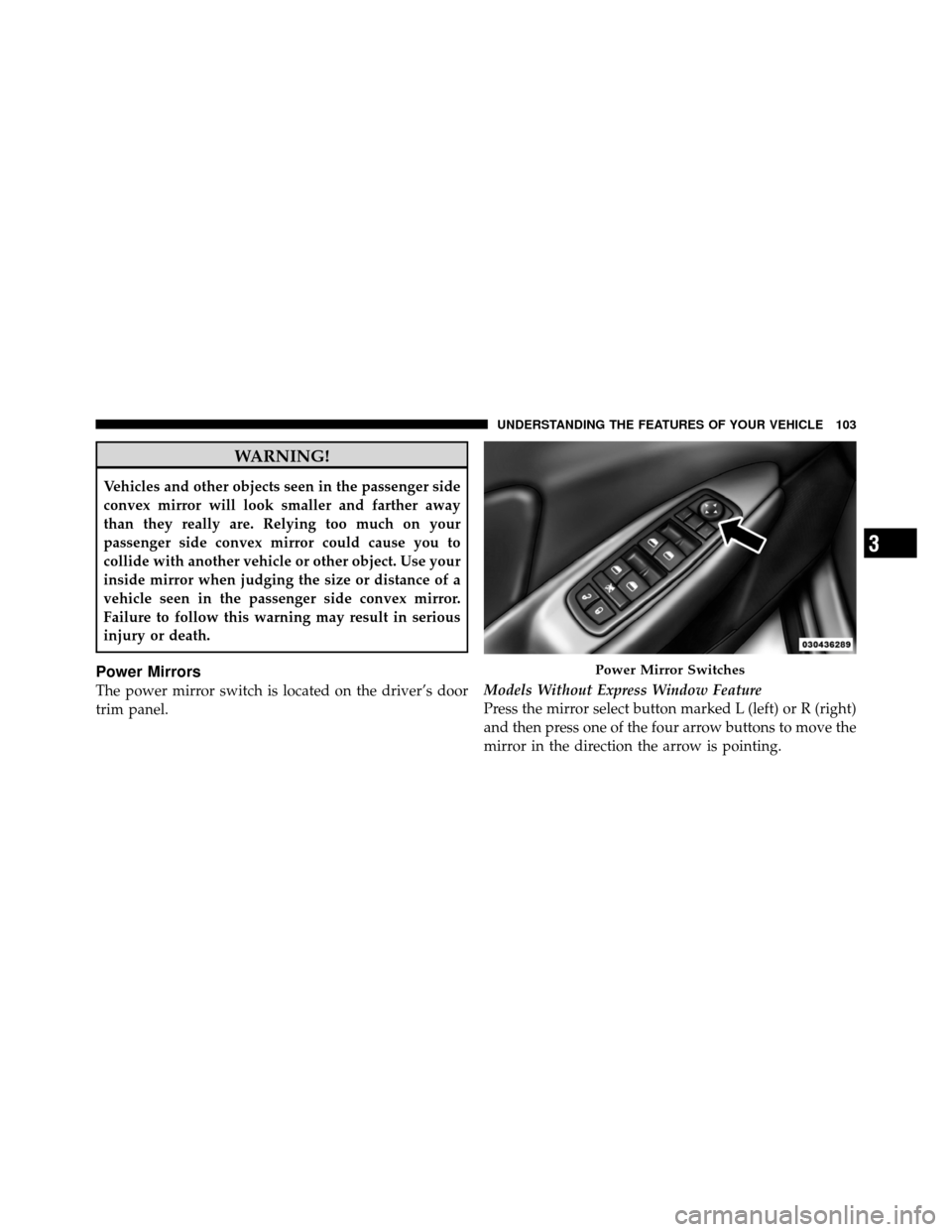
Power Mirrors
The power mirror switch is located on the driver’s door
trim panel.Models Without Express Window Feature
Press the mirror select button marked L (left) or R (right)
and then press one of the four arrow buttons to move the
mirror in the direction the arrow is pointing.
Power Mirror Switches
3
UNDERSTANDING THE FEATURES OF YOUR VEHICLE 103
Page 186 of 603
WARNING!
•Adjusting a seat while the vehicle is moving is
dangerous. The sudden movement of the seat
could cause you to lose control. The seat belt might
not be adjusted properly and you could be injured.
Adjust the seat only while the vehicle is parked.
•Do not ride with the seatback reclined so that the
shoulder belt is no longer resting against your
chest. In a collision you could slide under the seat
belt and be seriously or even fatally injured. Use
the recliner only when the vehicle is parked.
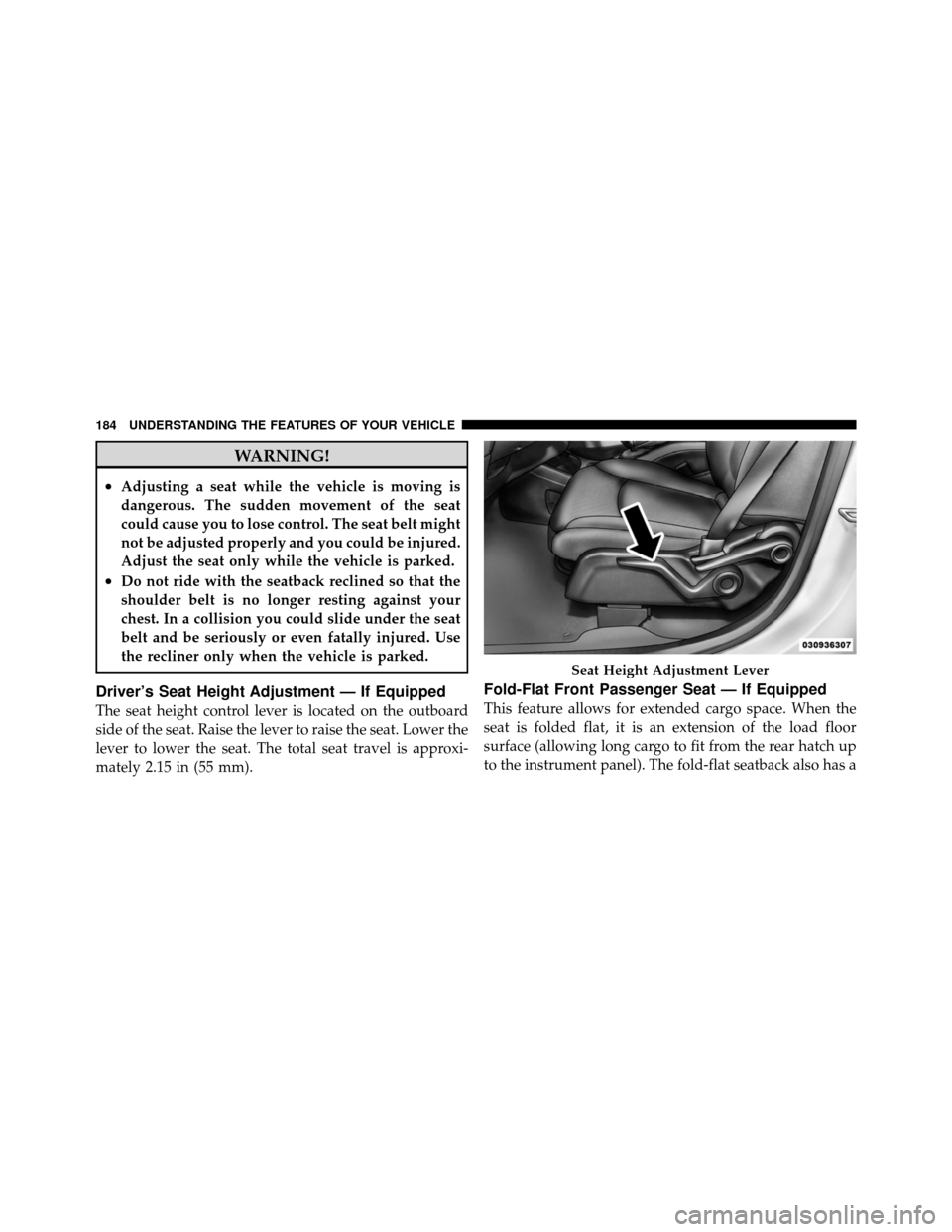
Driver’s Seat Height Adjustment — If Equipped
The seat height control lever is located on the outboard
side of the seat. Raise the lever to raise the seat. Lower the
lever to lower the seat. The total seat travel is approxi-
mately 2.15 in (55 mm).
Fold-Flat Front Passenger Seat — If Equipped
This feature allows for extended cargo space. When the
seat is folded flat, it is an extension of the load floor
surface (allowing long cargo to fit from the rear hatch up
to the instrument panel). The fold-flat seatback also has a
Seat Height Adjustment Lever
184 UNDERSTANDING THE FEATURES OF YOUR VEHICLE
Page 198 of 603
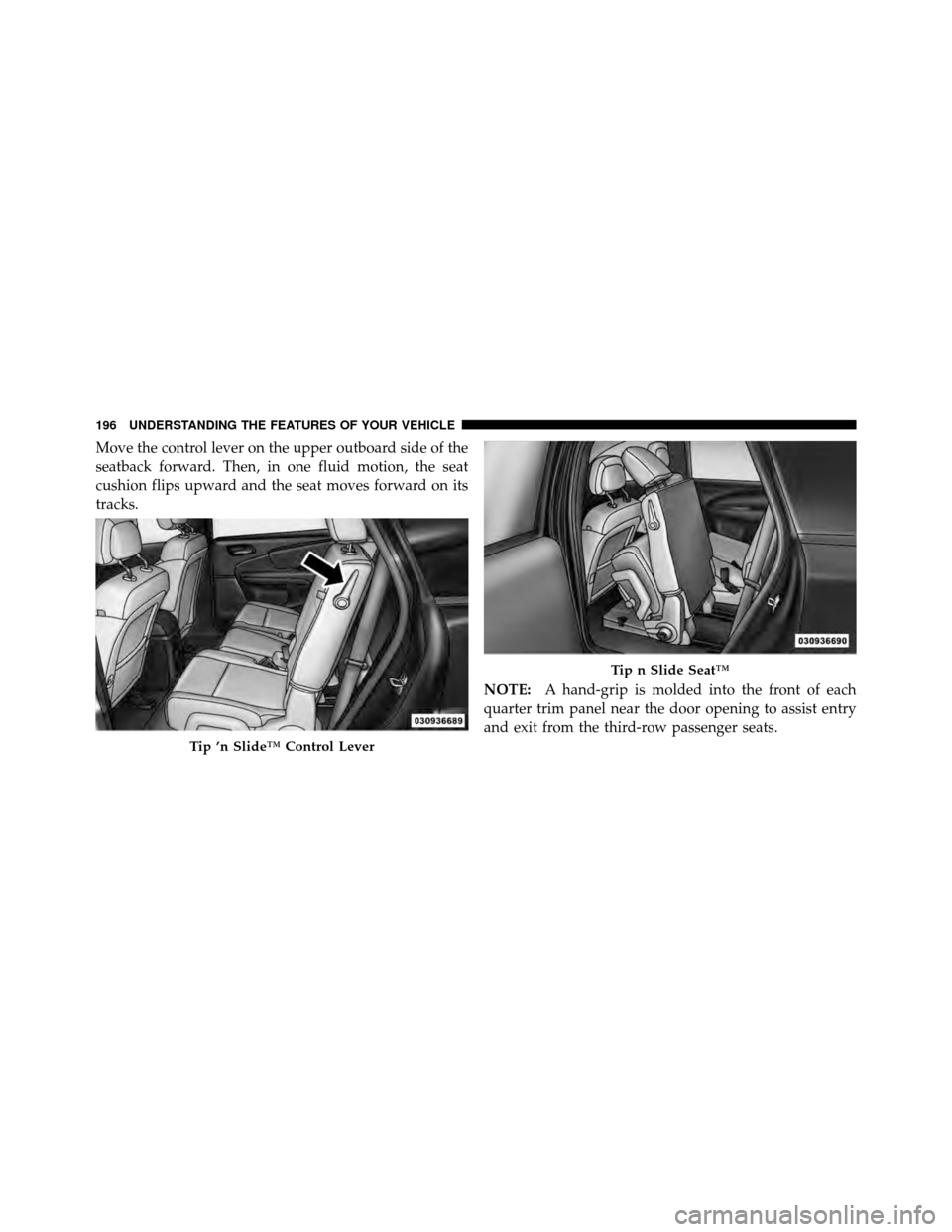
Move the control lever on the upper outboard side of the
seatback forward. Then, in one fluid motion, the seat
cushion flips upward and the seat moves forward on its
tracks.NOTE:A hand-grip is molded into the front of each
quarter trim panel near the door opening to assist entry
and exit from the third-row passenger seats.
Tip ’n Slide™ Control Lever
Tip n Slide Seat™
196 UNDERSTANDING THE FEATURES OF YOUR VEHICLE
Page 202 of 603
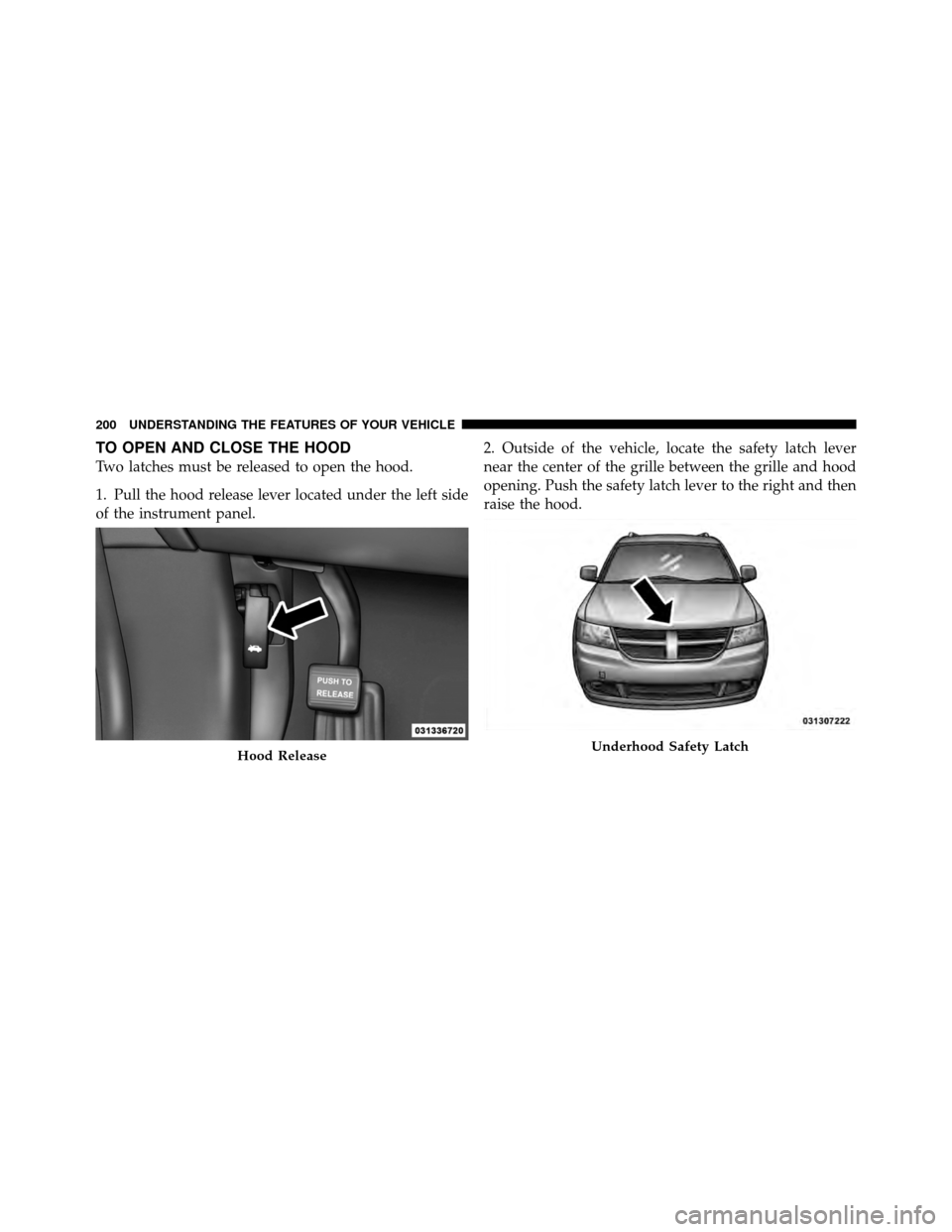
TO OPEN AND CLOSE THE HOOD
Two latches must be released to open the hood.
1. Pull the hood release lever located under the left side
of the instrument panel.2. Outside of the vehicle, locate the safety latch lever
near the center of the grille between the grille and hood
opening. Push the safety latch lever to the right and then
raise the hood.
Hood ReleaseUnderhood Safety Latch
200 UNDERSTANDING THE FEATURES OF YOUR VEHICLE
Page 204 of 603
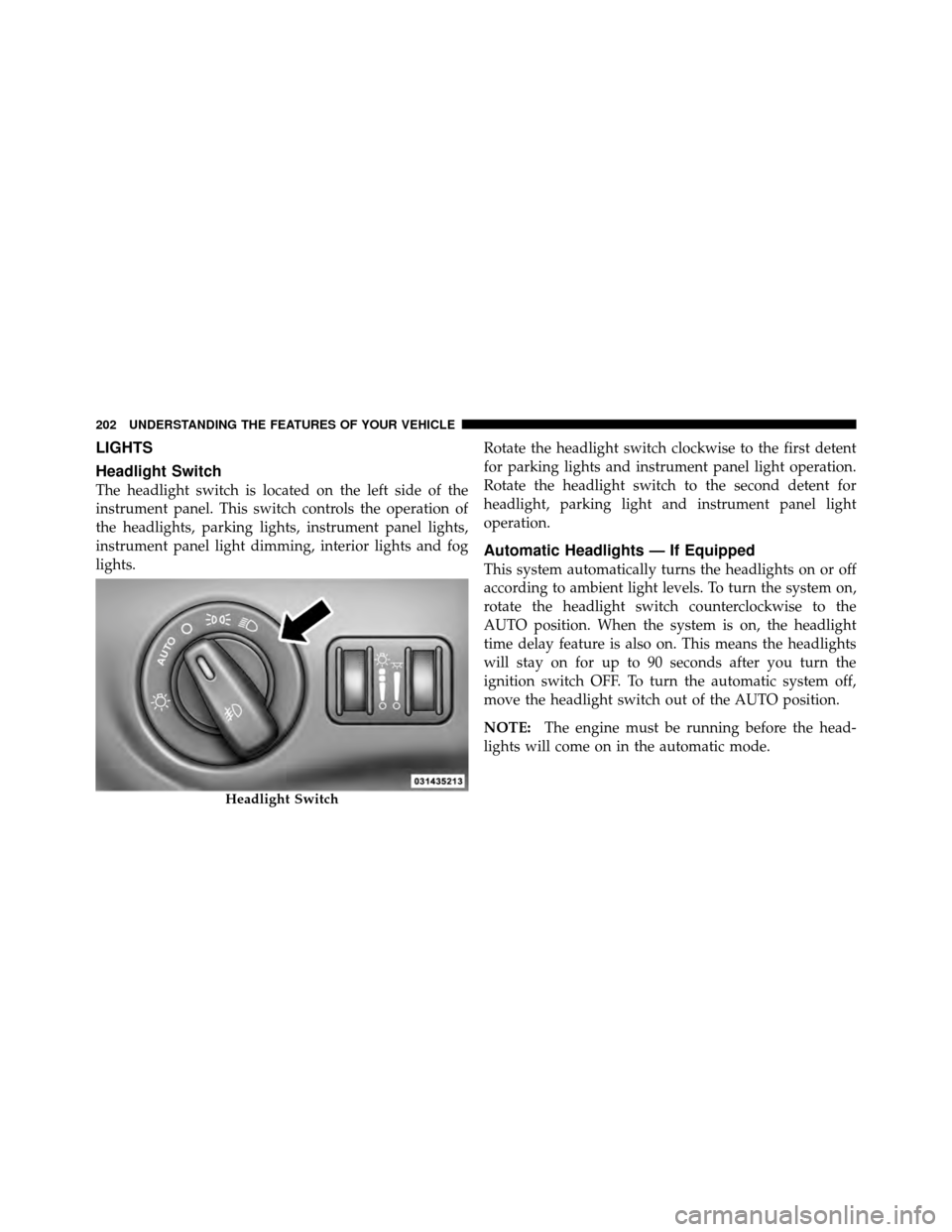
LIGHTS
Headlight Switch
The headlight switch is located on the left side of the
instrument panel. This switch controls the operation of
the headlights, parking lights, instrument panel lights,
instrument panel light dimming, interior lights and fog
lights.Rotate the headlight switch clockwise to the first detent
for parking lights and instrument panel light operation.
Rotate the headlight switch to the second detent for
headlight, parking light and instrument panel light
operation.
Automatic Headlights — If Equipped
This system automatically turns the headlights on or off
according to ambient light levels. To turn the system on,
rotate the headlight switch counterclockwise to the
AUTO position. When the system is on, the headlight
time delay feature is also on. This means the headlights
will stay on for up to 90 seconds after you turn the
ignition switch OFF. To turn the automatic system off,
move the headlight switch out of the AUTO position.
NOTE:
The engine must be running before the head-
lights will come on in the automatic mode.
Headlight Switch
202 UNDERSTANDING THE FEATURES OF YOUR VEHICLE