lock DODGE JOURNEY 2012 1.G Service Manual
[x] Cancel search | Manufacturer: DODGE, Model Year: 2012, Model line: JOURNEY, Model: DODGE JOURNEY 2012 1.GPages: 603
Page 89 of 603
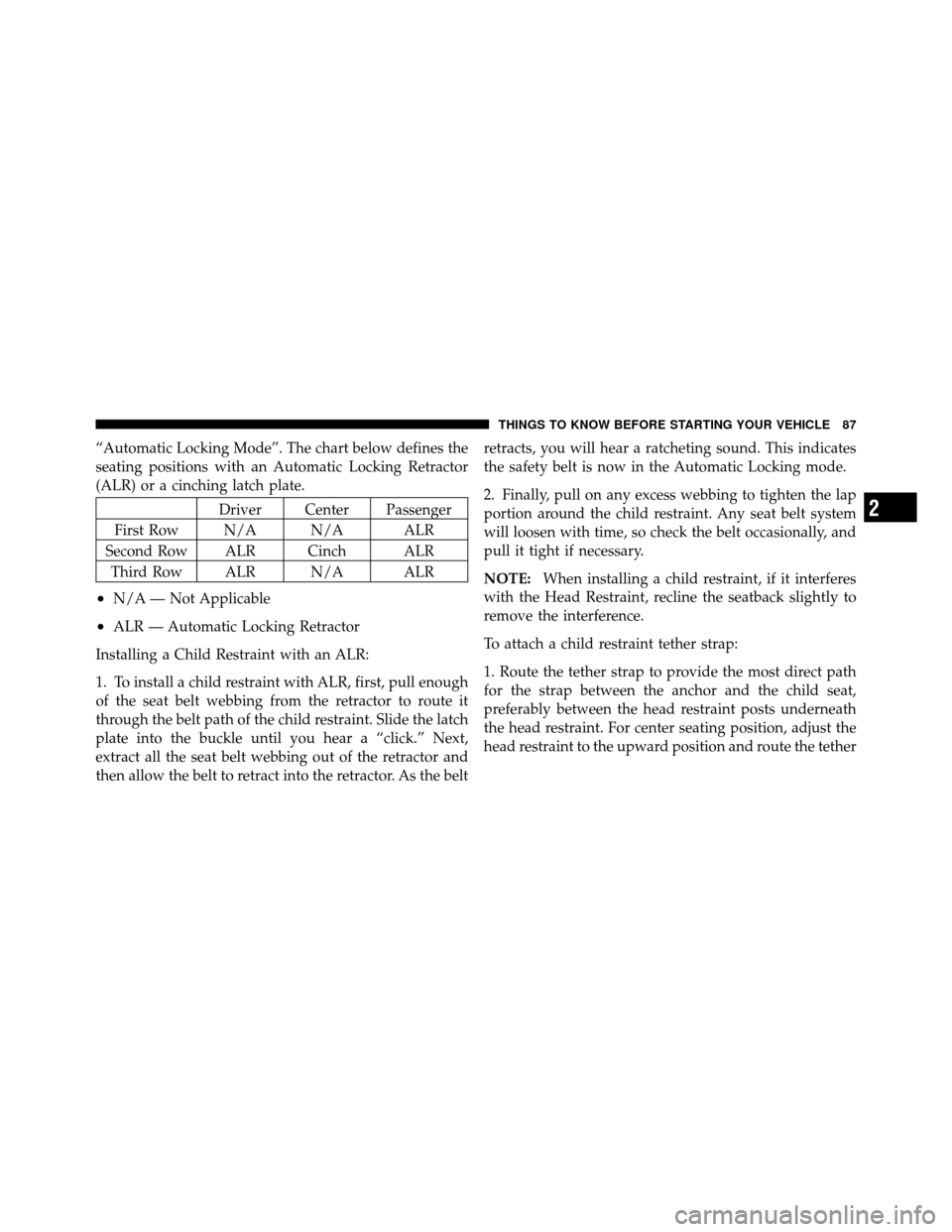
“Automatic Locking Mode”. The chart below defines the
seating positions with an Automatic Locking Retractor
(ALR) or a cinching latch plate.
Driver Center Passenger
First Row N/A N/A ALR
Second Row ALR Cinch ALR Third Row ALR N/A ALR
•N/A — Not Applicable
•ALR — Automatic Locking Retractor
Installing a Child Restraint with an ALR:
1. To install a child restraint with ALR, first, pull enough
of the seat belt webbing from the retractor to route it
through the belt path of the child restraint. Slide the latch
plate into the buckle until you hear a “click.” Next,
extract all the seat belt webbing out of the retractor and
then allow the belt to retract into the retractor. As the belt retracts, you will hear a ratcheting sound. This indicates
the safety belt is now in the Automatic Locking mode.
2. Finally, pull on any excess webbing to tighten the lap
portion around the child restraint. Any seat belt system
will loosen with time, so check the belt occasionally, and
pull it tight if necessary.
NOTE:
When installing a child restraint, if it interferes
with the Head Restraint, recline the seatback slightly to
remove the interference.
To attach a child restraint tether strap:
1. Route the tether strap to provide the most direct path
for the strap between the anchor and the child seat,
preferably between the head restraint posts underneath
the head restraint. For center seating position, adjust the
head restraint to the upward position and route the tether
2
THINGS TO KNOW BEFORE STARTING YOUR VEHICLE 87
Page 96 of 603
WARNING! (Continued)
•Always make sure that objects cannot fall into the
driver footwell while the vehicle is moving. Ob-
jects can become trapped under the brake pedal
and accelerator pedal causing a loss of vehicle
control.
•If required, mounting posts must be properly
installed, if not equipped from the factory.
Failure to properly follow floor mat installation or
mounting can cause interference with the brake
pedal and accelerator pedal operation causing loss
of control of the vehicle.
Periodic Safety Checks You Should Make Outside
The Vehicle
Tires
Examine tires for excessive tread wear and uneven wear
patterns. Check for stones, nails, glass, or other objectslodged in the tread or sidewall. Inspect the tread for cuts
and cracks. Inspect sidewalls for cuts, cracks and bulges.
Check the wheel nuts for tightness. Check the tires
(including spare) for proper cold inflation pressure.
Lights
Have someone observe the operation of exterior lights
while you work the controls. Check Turn Signal and High
Beam Indicator Lights on the instrument panel.
Door Latches
Check for positive closing, latching, and locking.
Fluid Leaks
Check area under vehicle after overnight parking for fuel,
engine coolant, oil, or other fluid leaks. Also, if gasoline
fumes are detected or if fuel, power steering fluid, or
brake fluid leaks are suspected, the cause should be
located and corrected immediately.
94 THINGS TO KNOW BEFORE STARTING YOUR VEHICLE
Page 107 of 603
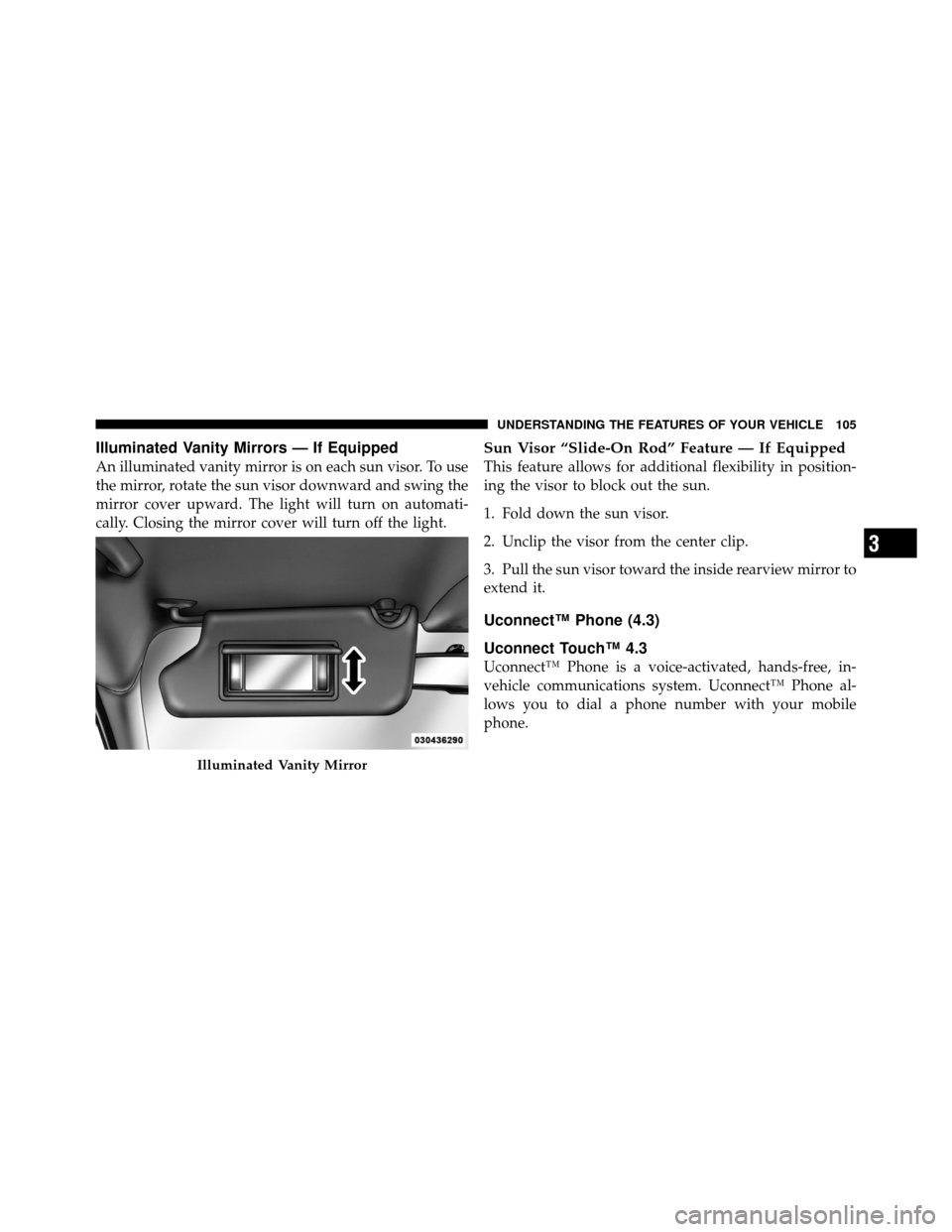
Illuminated Vanity Mirrors — If Equipped
An illuminated vanity mirror is on each sun visor. To use
the mirror, rotate the sun visor downward and swing the
mirror cover upward. The light will turn on automati-
cally. Closing the mirror cover will turn off the light.
Sun Visor “Slide-On Rod” Feature — If Equipped
This feature allows for additional flexibility in position-
ing the visor to block out the sun.
1. Fold down the sun visor.
2. Unclip the visor from the center clip.
3. Pull the sun visor toward the inside rearview mirror to
extend it.
Uconnect™ Phone (4.3)
Uconnect Touch™ 4.3
Uconnect™ Phone is a voice-activated, hands-free, in-
vehicle communications system. Uconnect™ Phone al-
lows you to dial a phone number with your mobile
phone.
Illuminated Vanity Mirror
3
UNDERSTANDING THE FEATURES OF YOUR VEHICLE 105
Page 192 of 603
•For proper routing of a Child Seat Tether, refer to
“Occupant Restraints” in “Things To Know Before
Starting Your Vehicle”.
WARNING!
Driving a vehicle with the head restraints removed or
improperly adjusted could cause serious injury or
death in the event of a collision. The head restraints
should be checked prior to operating the vehicle and
never adjusted while the vehicle is in motion.
Third Row Passenger Seats — Seven Passenger
Models
These head restraints are non-adjustable and non-
removable. However, you can fold them forward when
they are not in use by passengers. Refer to “50/50 Split
Third-Row Passenger Seats With Fold-Flat Feature —
Seven Passenger Models” for further information.
WARNING!
Do not allow a passenger to sit in a third row seat
without having the head restraint unfolded and
locked in place. Failure to follow this warning may
result in personal injury to the passenger in the event
of a collision.
60/40 Split Second-Row Passenger Seats
To provide additional storage area, each second-row
passenger seat can be folded flat. This allows for ex-
tended cargo space and still maintains some seating room
if needed.
NOTE:Prior to folding the second-row passenger seat,
make sure the front seatback is not in a reclined position.
This will allow the second-row seat to fold easily.
190 UNDERSTANDING THE FEATURES OF YOUR VEHICLE
Page 194 of 603
3. Lift the control lever with the other hand, allow the
seatback to move forward slightly, and then release the
lever.
WARNING!
To prevent personal injury or damage to objects,
keep your head, arms, and objects out of the folding
path of the seatback.
4. Gently guide the seatback into the folded position.
To Unfold The Seat
Raise the seatback and lock it in place.
WARNING!
Be certain that the seatback is locked securely into
position. Otherwise, the seat will not provide the
proper stability for child seats and/or passengers. An
improperly latched seat could cause serious injury.
Forward And Rearward Adjustment
The control lever is on the outboard side of the seat. Lift
the lever to move the seat forward or rearward. Release
the lever once the seat is in the desired position. Then,
using body pressure, move forward and rearward on the
seat to be sure that the seat adjusters have latched.
192 UNDERSTANDING THE FEATURES OF YOUR VEHICLE
Page 197 of 603
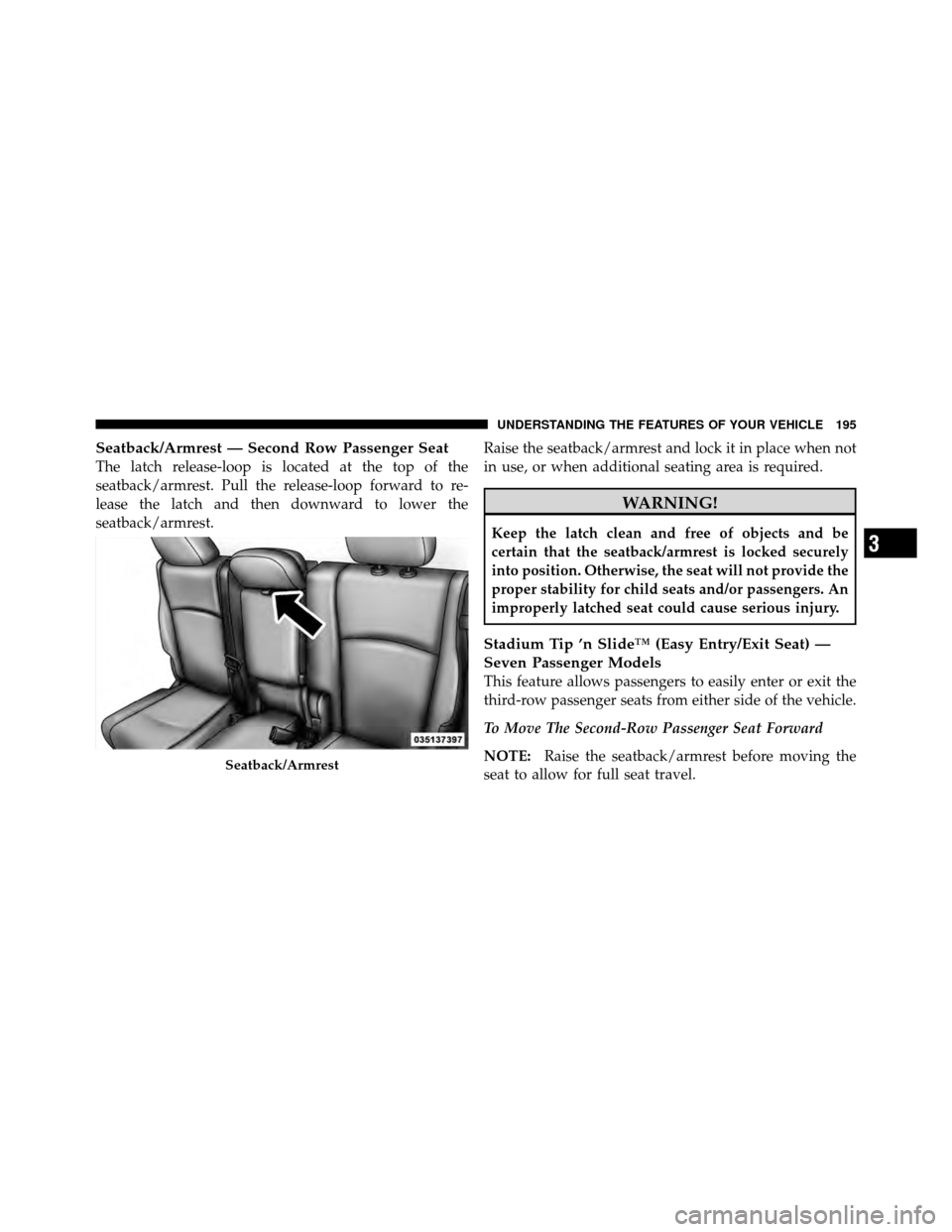
Seatback/Armrest — Second Row Passenger Seat
The latch release-loop is located at the top of the
seatback/armrest. Pull the release-loop forward to re-
lease the latch and then downward to lower the
seatback/armrest.Raise the seatback/armrest and lock it in place when not
in use, or when additional seating area is required.
WARNING!
Keep the latch clean and free of objects and be
certain that the seatback/armrest is locked securely
into position. Otherwise, the seat will not provide the
proper stability for child seats and/or passengers. An
improperly latched seat could cause serious injury.
Stadium Tip ’n Slide™ (Easy Entry/Exit Seat) —
Seven Passenger Models
This feature allows passengers to easily enter or exit the
third-row passenger seats from either side of the vehicle.
To Move The Second-Row Passenger Seat Forward
NOTE:
Raise the seatback/armrest before moving the
seat to allow for full seat travel.
Seatback/Armrest
3
UNDERSTANDING THE FEATURES OF YOUR VEHICLE 195
Page 199 of 603
WARNING!
Do not drive the vehicle with the seat in this posi-
tion, as it is only intended for entering and exiting
the third row seats. Failure to follow this warning
may result in personal injury.
To Unfold And Move The Second-Row Passenger Seat
Rearward
1. Move the seatback rearward until it locks in place and
then continue sliding the seat rearward on its tracks until
it locks in place.
2. Push the seat cushion downward to lock it in place.
3. Adjust the seat track position as desired. Using body
pressure, move forward and rearward on the seat to be
sure that the seat adjusters have latched.
WARNING!
Be certain that the seatback and seat are locked
securely into position. Otherwise, the seat will not
provide the proper stability for child seats and/or
passengers. An improperly latched seat could cause
serious injury.
50/50 Split Third-Row Passenger Seats With
Fold-Flat Feature — Seven Passenger Models
To provide additional storage area, each third-row pas-
senger seatback can be folded flat. This allows for ex-
tended cargo space and still maintains some rear seating
room if needed.
NOTE: Prior to folding the third-row passenger seat-
back, make sure the second-row passenger seatback is
not in a reclined position. This will allow the seatback to
fold easily.
3
UNDERSTANDING THE FEATURES OF YOUR VEHICLE 197
Page 200 of 603
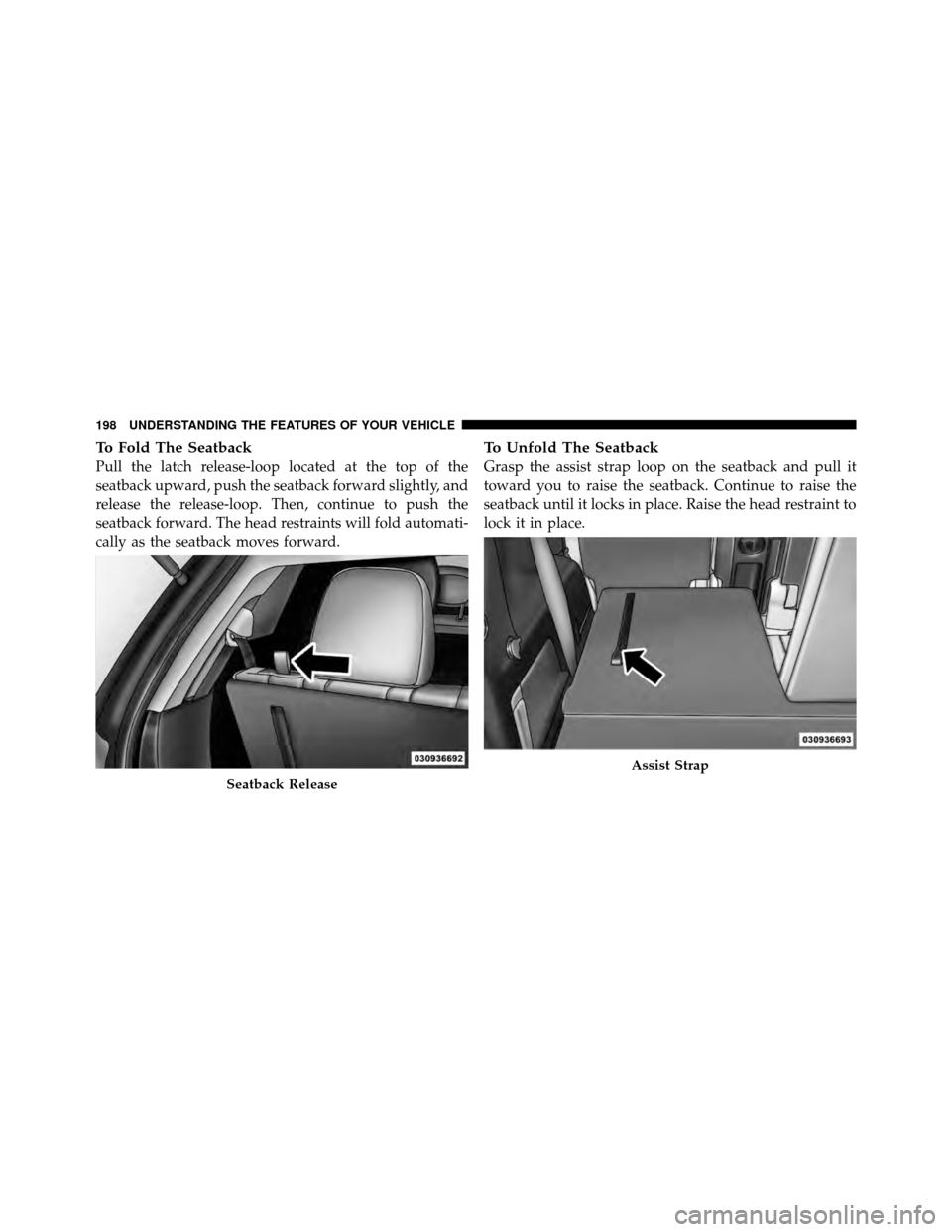
To Fold The Seatback
Pull the latch release-loop located at the top of the
seatback upward, push the seatback forward slightly, and
release the release-loop. Then, continue to push the
seatback forward. The head restraints will fold automati-
cally as the seatback moves forward.
To Unfold The Seatback
Grasp the assist strap loop on the seatback and pull it
toward you to raise the seatback. Continue to raise the
seatback until it locks in place. Raise the head restraint to
lock it in place.
Seatback Release
Assist Strap
198 UNDERSTANDING THE FEATURES OF YOUR VEHICLE
Page 201 of 603
The seatback can also be locked in the reclined position.
To do so, pull the latch release-loop located at the top of
the seatback upward, allow the seatback to recline, and
release the release-loop.
WARNING!
•Be certain that the seatback is locked securely into
position. Otherwise, the seat will not provide the
proper stability for passengers. An improperly
latched seat could cause serious injury.(Continued)
WARNING! (Continued)
•Do not allow a passenger to sit in a third row seat
without having the head restraint unfolded and
locked in place. Failure to follow this warning may
result in personal injury to the passenger in the
event of a collision.
•Do not allow a passenger to sit in a third row seat
with the second row seatback(s) folded flat. In a
collision, the passenger could slide underneath the
seat belt and be seriously or even fatally injured.
3
UNDERSTANDING THE FEATURES OF YOUR VEHICLE 199
Page 203 of 603
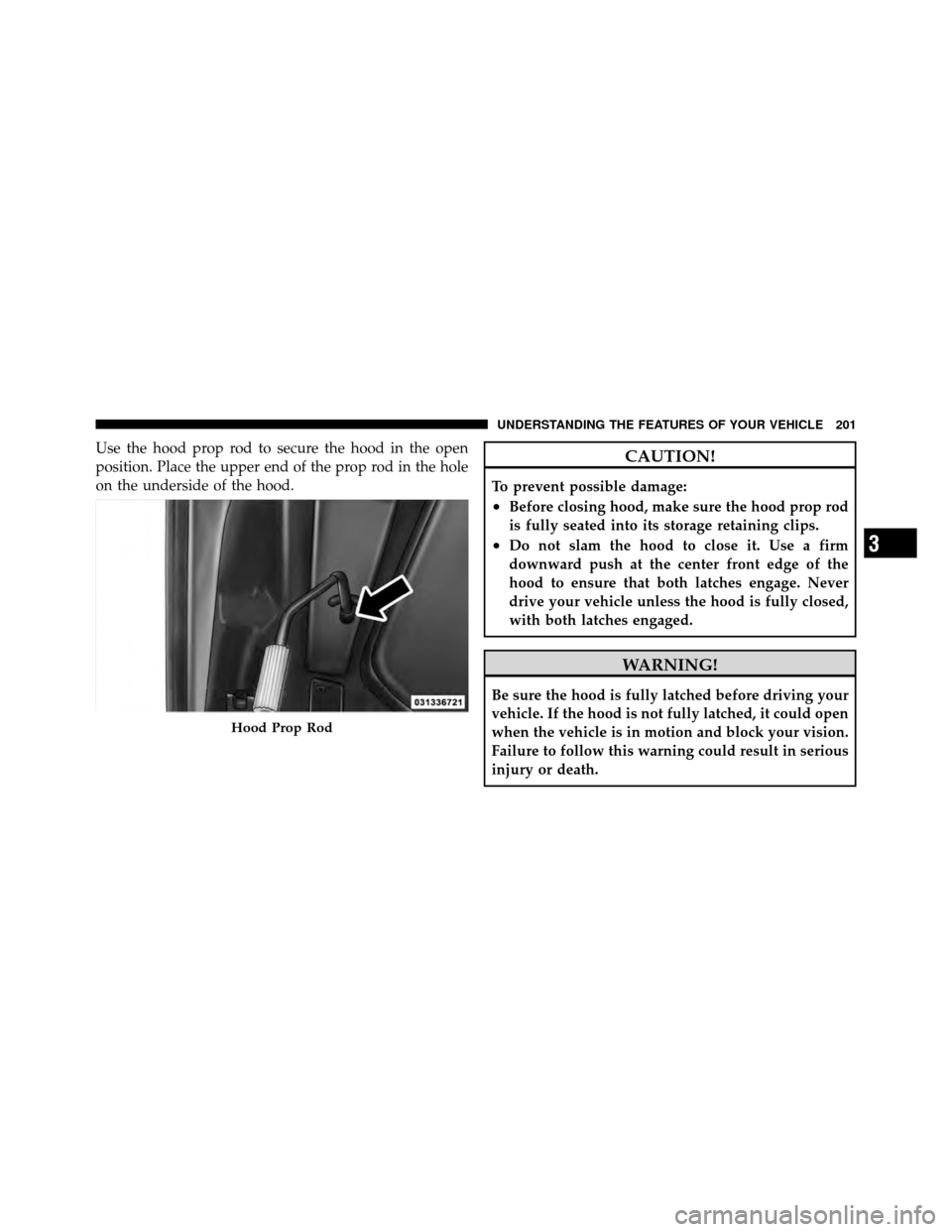
Use the hood prop rod to secure the hood in the open
position. Place the upper end of the prop rod in the hole
on the underside of the hood.CAUTION!
To prevent possible damage:
•Before closing hood, make sure the hood prop rod
is fully seated into its storage retaining clips.
•Do not slam the hood to close it. Use a firm
downward push at the center front edge of the
hood to ensure that both latches engage. Never
drive your vehicle unless the hood is fully closed,
with both latches engaged.
WARNING!
Be sure the hood is fully latched before driving your
vehicle. If the hood is not fully latched, it could open
when the vehicle is in motion and block your vision.
Failure to follow this warning could result in serious
injury or death.
Hood Prop Rod
3
UNDERSTANDING THE FEATURES OF YOUR VEHICLE 201