climate control DODGE JOURNEY 2013 1.G User Guide
[x] Cancel search | Manufacturer: DODGE, Model Year: 2013, Model line: JOURNEY, Model: DODGE JOURNEY 2013 1.GPages: 630
Page 376 of 630
11. Blower Control
Blower control is used to regulate the amount of air
forced through the climate system. There are seven
blower speeds available. Adjusting the blower will cause
automatic mode to switch to manual operation. The
speeds can be selected using either hard-keys or soft-keys
as follows:
NOTE:For vehicles equipped with Remote Start, the
climate controls will not function during Remote Start
operation if the blower control is left in the “O” (Off)
position. Blower control should be left in the “ON”
position to allow the climate control to either warm or
cool the vehicle.
Hard-key
The blower speed increases as you turn the control
clockwise from the lowest blower setting. The blower
speed decreases as you turn the knob counter-clockwise.Soft-key
Use the small blower icon to reduce the blower setting
and the large blower icon to increase the blower setting.
Blower can also be selected by pressing the blower bar
area between the icons.
12. Modes
The airflow distribution mode can be adjusted so air
comes from the instrument panel outlets, floor outlets,
demist outlets and defrost outlets. The Mode settings are
as follows:
•Panel Mode
Air comes from the outlets in the instrument
panel. Each of these outlets can be individually
adjusted to direct the flow of air. The air vanes of
the center outlets and outboard outlets can be moved up
and down or side to side to regulate airflow direction.
374 UNDERSTANDING YOUR INSTRUMENT PANEL
Page 377 of 630
There is a shut off wheel located below the air vanes to
shut off or adjust the amount of airflow from these
outlets.
•Bi-Level Mode
Air comes from the instrument panel outlets and
floor outlets. A slight amount of air is directed
through the defrost and side window demister
outlets.
NOTE:BI-LEVEL mode is designed under comfort con-
ditions to provide cooler air out of the panel outlets and
warmer air from the floor outlets.
•Floor Mode
Air comes from the floor outlets. A slight amount
of air is directed through the defrost and side
window demister outlets.•Mix Mode
Air comes from the floor, defrost and side window
demist outlets. This mode works best in cold or
snowy conditions.
•Defrost Mode
Air comes from the windshield and side window
demist outlets. Use Defrost mode with maximum
temperature settings for best windshield and side win-
dow defrosting and defogging. When the defrost mode is
selected, the blower level may will increase.
13. Climate Control OFF Button
Press and release this button to turn the Climate Control
ON/OFF.
14. Driver Temperature Control Down Button
Provides the driver with independent temperature con-
trol. Push the button for cooler temperature settings.
4
UNDERSTANDING YOUR INSTRUMENT PANEL 375
Page 378 of 630
NOTE:In Sync mode, this button will also automatically
adjust the passenger temperature setting at the same time.
15. Driver Temperature Control Up Button
Provides the driver with independent temperature con-
trol. Push the button for warmer temperature settings.
NOTE:
In Sync mode, this button will also automatically
adjust the passenger temperature setting at the same time.
16. Temperature Control (Manual Temperature Control
Only)
Press the temperature soft-key to regulate the tempera-
ture of the air inside the passenger compartment. Moving
the temperature bar into the red area, indicates warmer
temperatures. Moving the temperature bar into the blue
area indicates cooler temperatures.
Climate Control Functions
A/C (Air Conditioning)
The Air Conditioning (A/C) button allows the operator
to manually activate or deactivate the air conditioning
system. When the air conditioning system is turned on,
cool dehumidified air will flow through the outlets into
the cabin. For improved fuel economy, press the A/C
button to turn off the air conditioning and manually
adjust the blower and airflow mode settings. Also, make
sure to select only Panel, Bi-Level or Floor modes.
NOTE:
•For Manual Climate Controls, if the system is in Mix,
Floor or Defrost Mode, the A/C can be turned off, but
the A/C system shall remain active to prevent fogging
of the windows.
376 UNDERSTANDING YOUR INSTRUMENT PANEL
Page 381 of 630
The blower fan speed can be set to any fixed speed by
adjusting the blower control. The fan will now operate at
a fixed speed until additional speeds are selected. This
allows the front occupants to control the volume of air
circulated in the vehicle and cancel the Auto mode.
The operator can also select the direction of the airflow
by selecting one of the available mode settings. A/C
operation and Recirculation control can also be manually
selected in Manual operation.
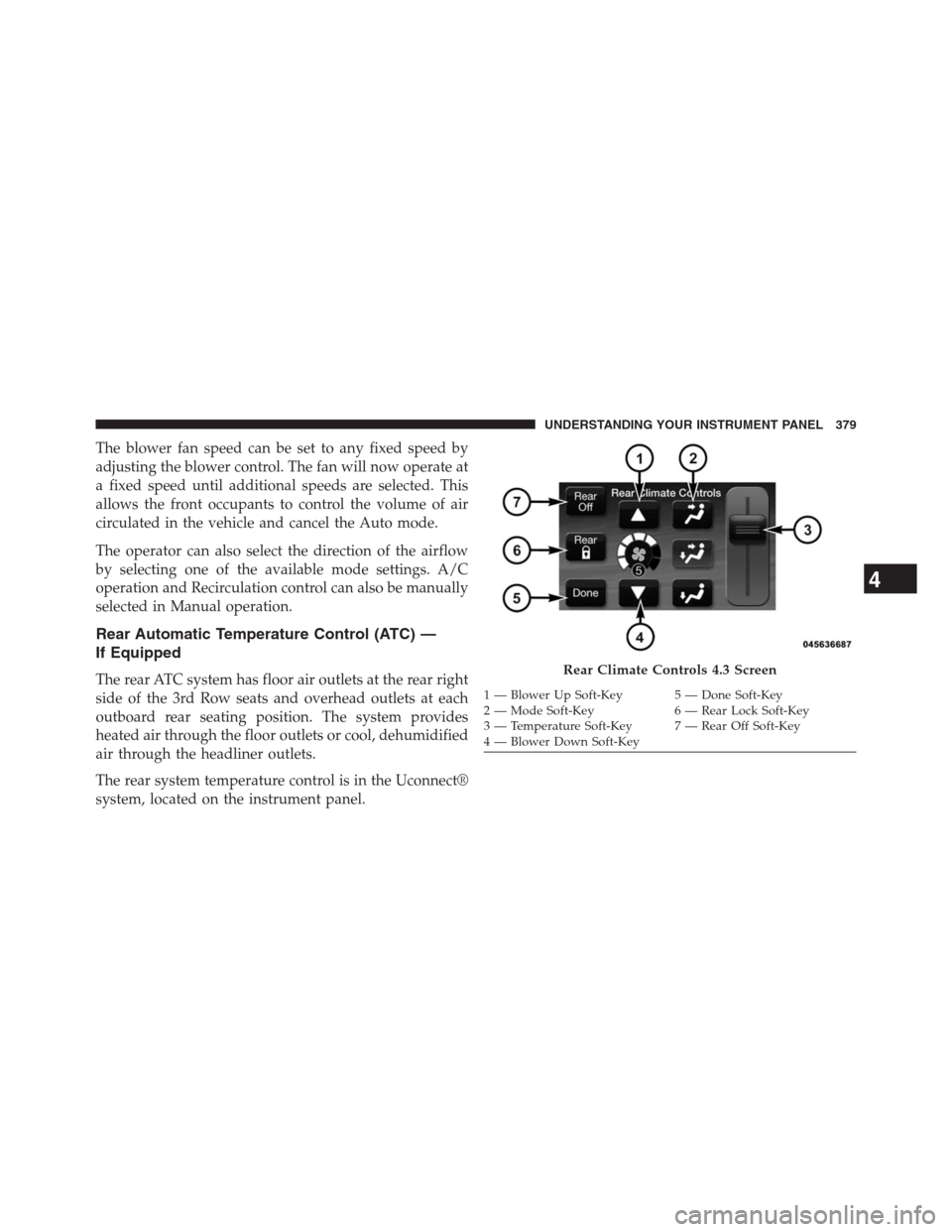
Rear Automatic Temperature Control (ATC) —
If Equipped
The rear ATC system has floor air outlets at the rear right
side of the 3rd Row seats and overhead outlets at each
outboard rear seating position. The system provides
heated air through the floor outlets or cool, dehumidified
air through the headliner outlets.
The rear system temperature control is in the Uconnect®
system, located on the instrument panel.Rear Climate Controls 4.3 Screen
1 — Blower Up Soft-Key 5 — Done Soft-Key
2 — Mode Soft-Key 6 — Rear Lock Soft-Key
3 — Temperature Soft-Key 7 — Rear Off Soft-Key
4 — Blower Down Soft-Key
4
UNDERSTANDING YOUR INSTRUMENT PANEL 379
Page 382 of 630
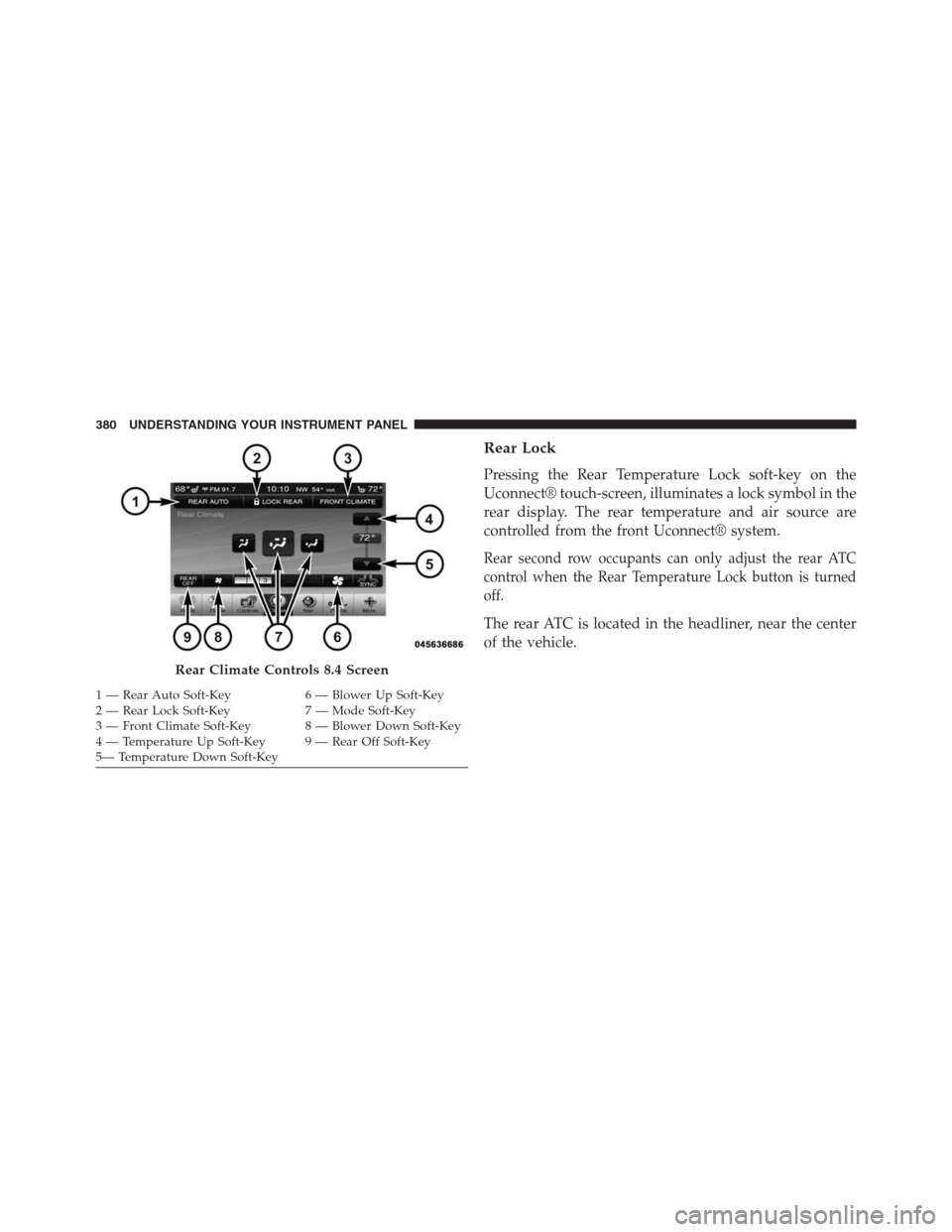
Rear Lock
Pressing the Rear Temperature Lock soft-key on the
Uconnect® touch-screen, illuminates a lock symbol in the
rear display. The rear temperature and air source are
controlled from the front Uconnect® system.
Rear second row occupants can only adjust the rear ATC
control when the Rear Temperature Lock button is turned
off.
The rear ATC is located in the headliner, near the center
of the vehicle.
Rear Climate Controls 8.4 Screen
1 — Rear Auto Soft-Key 6 — Blower Up Soft-Key
2 — Rear Lock Soft-Key 7 — Mode Soft-Key
3 — Front Climate Soft-Key 8 — Blower Down Soft-Key
4 — Temperature Up Soft-Key 9 — Rear Off Soft-Key
5— Temperature Down Soft-Key 380 UNDERSTANDING YOUR INSTRUMENT PANEL
Page 386 of 630
Winter Operation
Use of the air Recirculation mode during Winter months
is not recommended because it may cause window
fogging.
Vacation Storage
Any time you store your vehicle or keep it out of service
(i.e., vacation) for two weeks or more, run the air
conditioning system at idle for about five minutes in the
fresh air and high blower setting. This will ensure
adequate system lubrication to minimize the possibility
of compressor damage when the system is started again.
Window Fogging
Interior fogging on the windshield can be quickly removed
by turning the mode selector to Defrost. The Defrost/Floor
mode can be used to maintain a clear windshield and
provide sufficient heating. If side window fogging becomesa problem, increase the blower speed. Vehicle windows
tend to fog on the inside in mild but rainy or humid
weather.
NOTE:Recirculation mode without A/C should not be
used for long periods, as fogging may occur.
Outside Air Intake
Make sure the air intake, located directly in front of the
windshield, is free of obstructions such as leaves. Leaves
collected in the air intake may reduce airflow, and if they
enter the plenum, they could plug the water drains. In
winter months, make sure the air intake is clear of ice,
slush, and snow.
A/C Air Filter
The climate control system filters outside air containing
dust, pollen and some odors. Strong odors cannot be totally
filtered out. Refer to “Maintenance Procedures” in “Main-
taining Your Vehicle” for filter replacement instructions.
384 UNDERSTANDING YOUR INSTRUMENT PANEL
Page 433 of 630
ESC Operating Modes
The ESC system has two available operating modes.
Full On
This is the normal operating mode for ESC. Whenever the
vehicle is started the system will be in this mode. This
mode should be used for most driving situations. ESC
should only be turned to “Partial Off” for specific reasons
as noted. Refer to “Partial Off” for additional information.
Partial Off
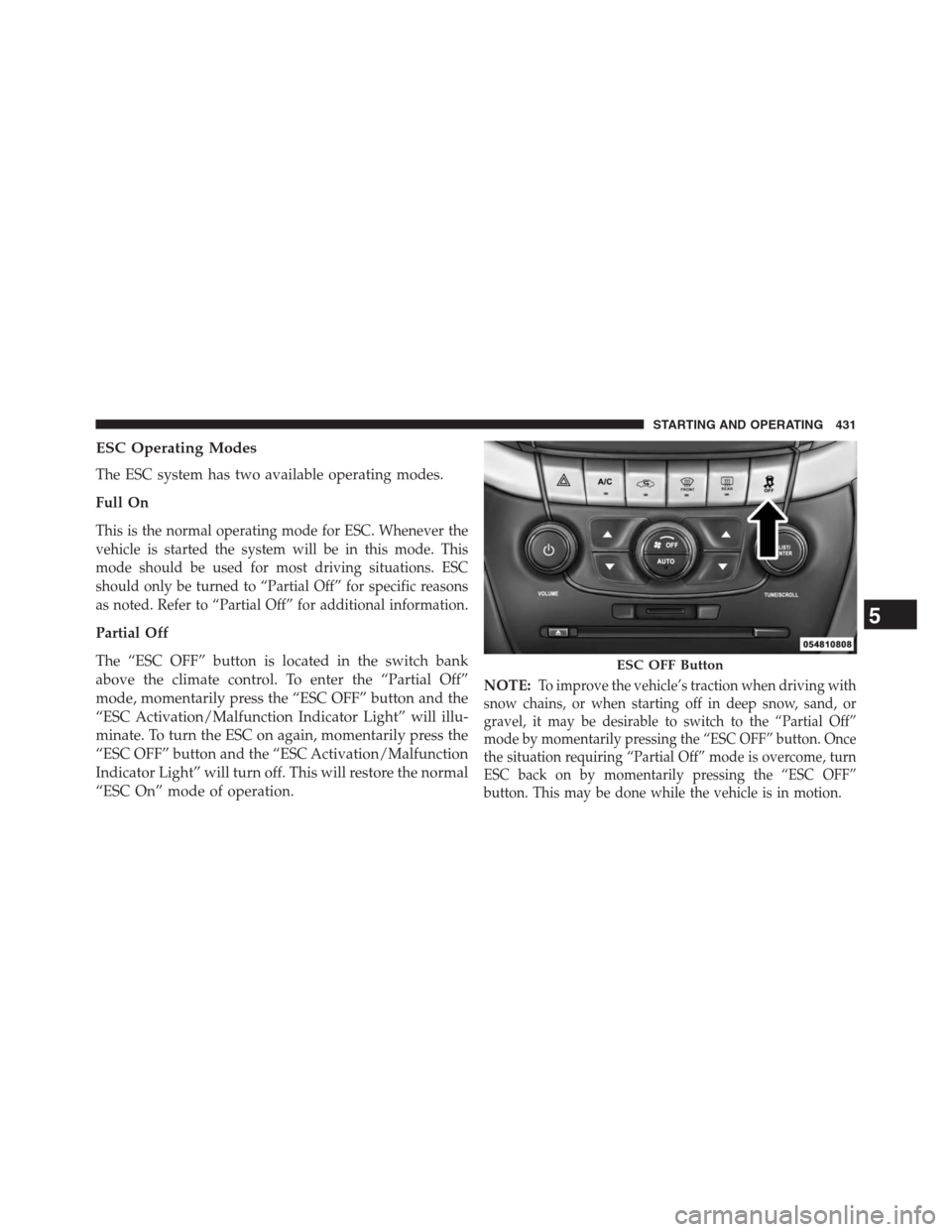
The “ESC OFF” button is located in the switch bank
above the climate control. To enter the “Partial Off”
mode, momentarily press the “ESC OFF” button and the
“ESC Activation/Malfunction Indicator Light” will illu-
minate. To turn the ESC on again, momentarily press the
“ESC OFF” button and the “ESC Activation/Malfunction
Indicator Light” will turn off. This will restore the normal
“ESC On” mode of operation.NOTE:
To improve the vehicle’s traction when driving with
snow chains, or when starting off in deep snow, sand, or
gravel, it may be desirable to switch to the “Partial Off”
mode by momentarily pressing the “ESC OFF” button. Once
the situation requiring “Partial Off” mode is overcome, turn
ESC back on by momentarily pressing the “ESC OFF”
button. This may be done while the vehicle is in motion.
ESC OFF Button
5
STARTING AND OPERATING 431
Page 500 of 630
HAZARD WARNING FLASHERS
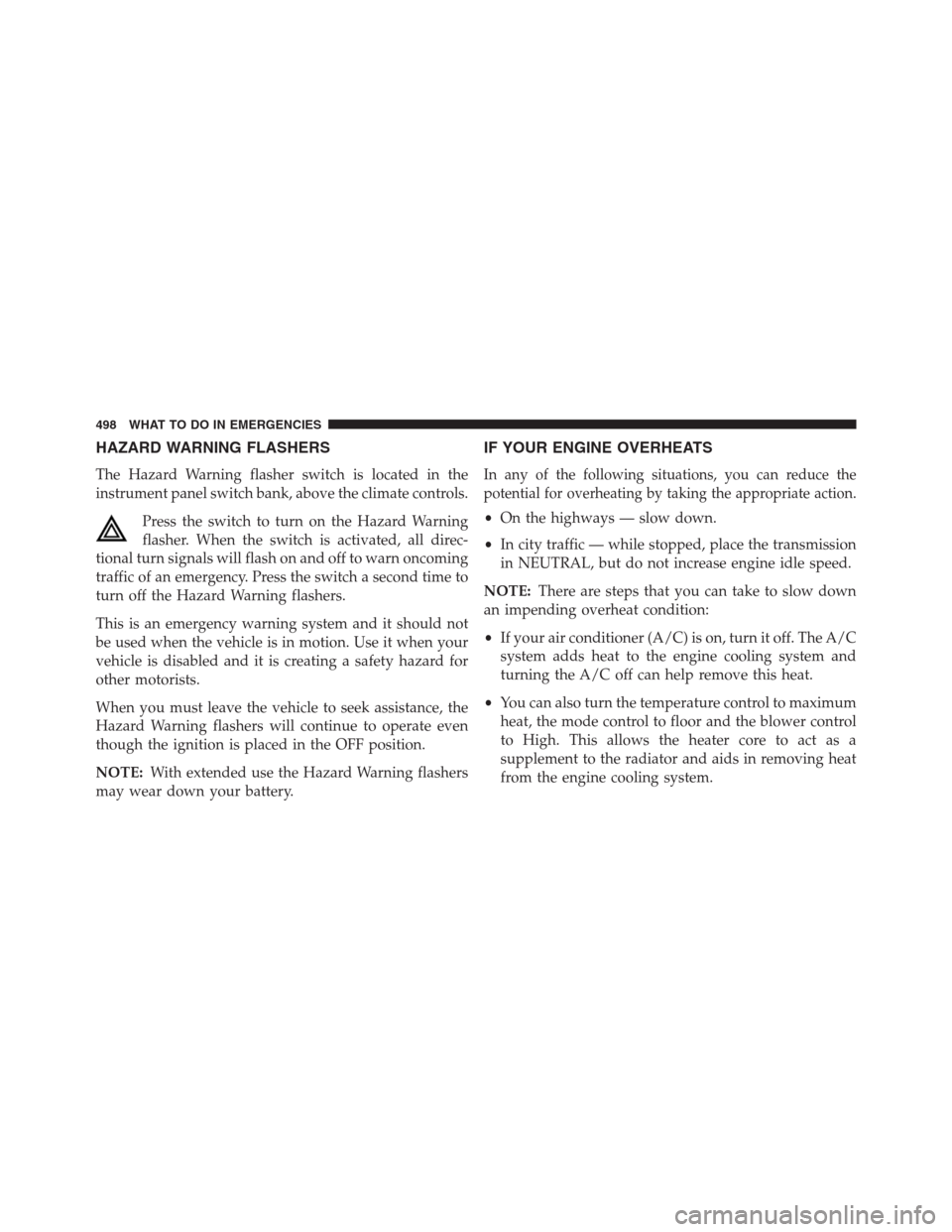
The Hazard Warning flasher switch is located in the
instrument panel switch bank, above the climate controls.
Press the switch to turn on the Hazard Warning
flasher. When the switch is activated, all direc-
tional turn signals will flash on and off to warn oncoming
traffic of an emergency. Press the switch a second time to
turn off the Hazard Warning flashers.
This is an emergency warning system and it should not
be used when the vehicle is in motion. Use it when your
vehicle is disabled and it is creating a safety hazard for
other motorists.
When you must leave the vehicle to seek assistance, the
Hazard Warning flashers will continue to operate even
though the ignition is placed in the OFF position.
NOTE:With extended use the Hazard Warning flashers
may wear down your battery.
IF YOUR ENGINE OVERHEATS
In any of the following situations, you can reduce the
potential for overheating by taking the appropriate action.
•On the highways — slow down.
•In city traffic — while stopped, place the transmission
in NEUTRAL, but do not increase engine idle speed.
NOTE:There are steps that you can take to slow down
an impending overheat condition:
•If your air conditioner (A/C) is on, turn it off. The A/C
system adds heat to the engine cooling system and
turning the A/C off can help remove this heat.
•You can also turn the temperature control to maximum
heat, the mode control to floor and the blower control
to High. This allows the heater core to act as a
supplement to the radiator and aids in removing heat
from the engine cooling system.
498 WHAT TO DO IN EMERGENCIES
Page 568 of 630
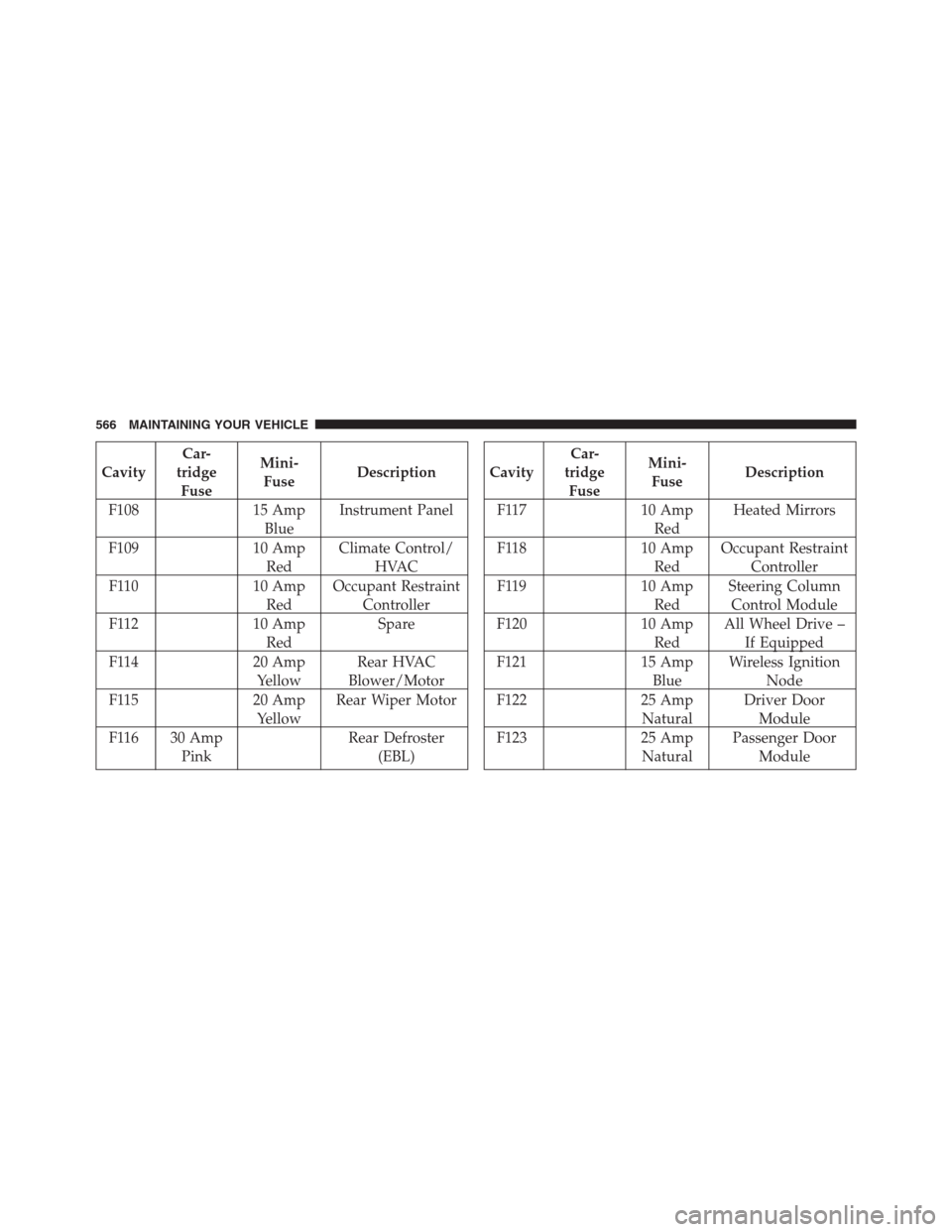
CavityCar-
tridge
FuseMini-
FuseDescription
F108 15 Amp
BlueInstrument Panel
F109 10 Amp
RedClimate Control/
HVAC
F110 10 Amp
RedOccupant Restraint
Controller
F112 10 Amp
RedSpare
F114 20 Amp
YellowRear HVAC
Blower/Motor
F115 20 Amp
YellowRear Wiper Motor
F116 30 Amp
PinkRear Defroster
(EBL)CavityCar-
tridge
FuseMini-
FuseDescription
F117 10 Amp
RedHeated Mirrors
F118 10 Amp
RedOccupant Restraint
Controller
F119 10 Amp
RedSteering Column
Control Module
F120 10 Amp
RedAll Wheel Drive –
If Equipped
F121 15 Amp
BlueWireless Ignition
Node
F122 25 Amp
NaturalDriver Door
Module
F123 25 Amp
NaturalPassenger Door
Module
566 MAINTAINING YOUR VEHICLE
Page 569 of 630
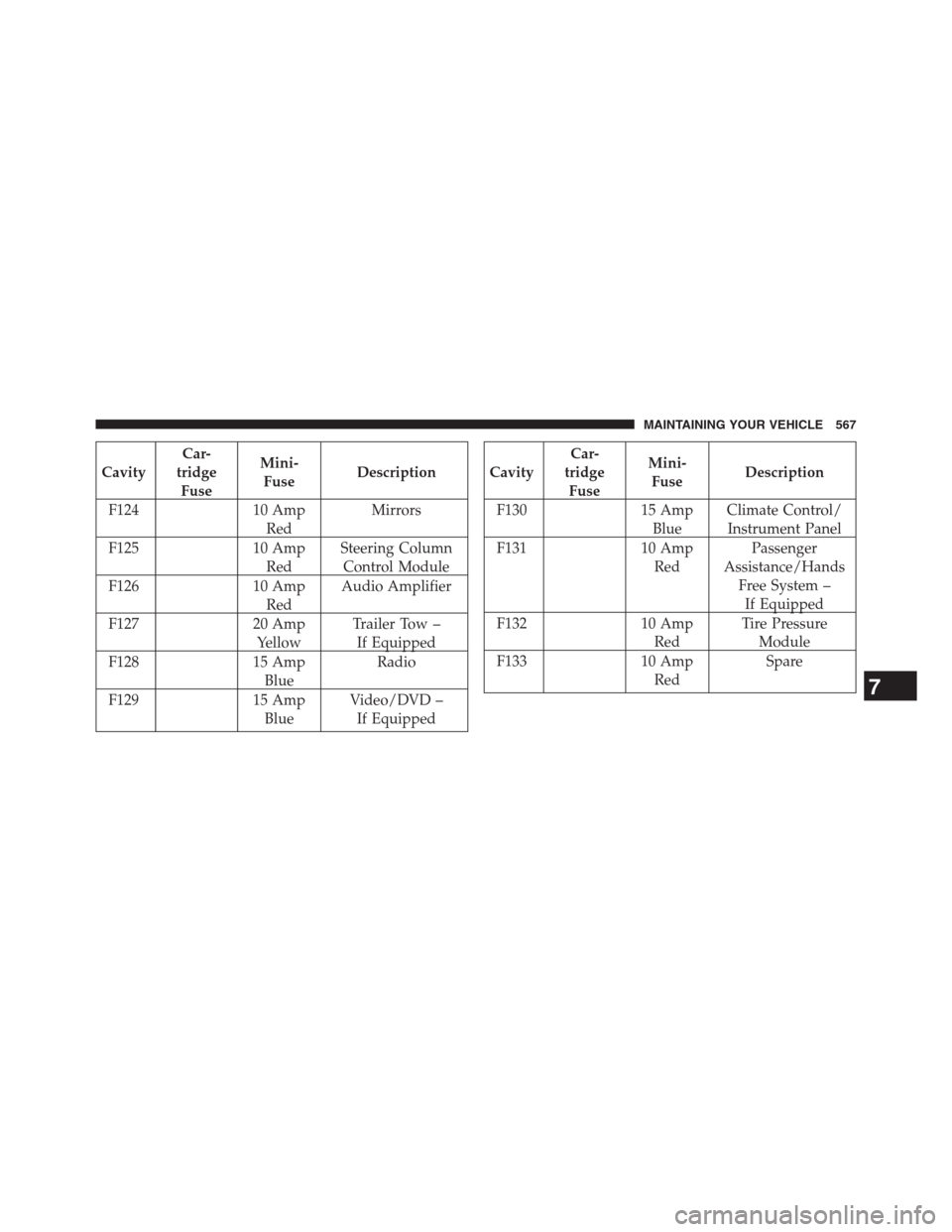
CavityCar-
tridge
FuseMini-
FuseDescription
F124 10 Amp
RedMirrors
F125 10 Amp
RedSteering Column
Control Module
F126 10 Amp
RedAudio Amplifier
F127 20 Amp
YellowTrailer Tow –
If Equipped
F128 15 Amp
BlueRadio
F129 15 Amp
BlueVideo/DVD –
If EquippedCavityCar-
tridge
FuseMini-
FuseDescription
F130 15 Amp
BlueClimate Control/
Instrument Panel
F131 10 Amp
RedPassenger
Assistance/Hands
Free System –
If Equipped
F132 10 Amp
RedTire Pressure
Module
F133 10 Amp
RedSpare
7
MAINTAINING YOUR VEHICLE 567