lock DODGE JOURNEY 2014 1.G Workshop Manual
[x] Cancel search | Manufacturer: DODGE, Model Year: 2014, Model line: JOURNEY, Model: DODGE JOURNEY 2014 1.GPages: 651
Page 126 of 651
Sun Visor “Slide-On Rod” Feature — If Equipped
This feature allows for additional flexibility in position-
ing the visor to block out the sun.
1. Fold down the sun visor.
2. Unclip the visor from the center clip.
3. Pull the sun visor toward the inside rearview mirror toextend it.
Uconnect® PHONE (4.3)
Uconnect® 4.3
Uconnect® Phone is a voice-activated, hands-free, in-
vehicle communications system. Uconnect® Phone al-
lows you to dial a phone number with your mobile
phone. Uconnect® Phone supports the following features:
Voice Activated Features:
•
Hands Free dialing via Voice (“Call John Smith Mo-
bile” or, “Dial 248-555-1212”)
• Redialing last dialed numbers (“Redial”)
• Calling Back the last incoming call number (“Call
Back”)
• View Call logs on screen (“Show incoming calls,”
“Show Outgoing calls,” “Show missed Calls,” “Show
Recent Calls”)
• Searching Contacts phone number (“Search for John
Smith Mobile”)
124 UNDERSTANDING THE FEATURES OF YOUR VEHICLE
Page 216 of 651
WARNING!
Do not allow a passenger to sit in a third row seat
without having the head restraint unfolded and
locked in place. Failure to follow this warning may
result in personal injury to the passenger in the event
of a collision.
60/40 Split Second-Row Passenger Seats
To provide additional storage area, each second-row
passenger seat can be folded flat. This allows for ex-
tended cargo space and still maintains some seating room
if needed.
NOTE:Prior to folding the second-row passenger seat,
make sure the front seatback is not in a reclined position.
This will allow the second-row seat to fold easily.
WARNING!
• It is extremely dangerous to ride in a cargo area,
inside or outside of a vehicle. In a collision, people
riding in these areas are more likely to be seriously
injured or killed.
• Do not allow people to ride in any area of your
vehicle that is not equipped with seats and seat
belts.
• Be sure everyone in your vehicle is in a seat and
using a seat belt properly.
• On seven passenger models, do not allow a passen-
ger to sit in a third row seat with the second row
seatback(s) folded flat. In a collision, the passenger
could slide underneath the seat belt and be seri-
ously or even fatally injured.
214 UNDERSTANDING THE FEATURES OF YOUR VEHICLE
Page 218 of 651
To Unfold The Seat
Raise the seatback and lock it in place.
WARNING!
Be certain that the seatback is locked securely into
position. Otherwise, the seat will not provide the
proper stability for child seats and/or passengers. An
improperly latched seat could cause serious injury.
Forward And Rearward Adjustment
The control lever is on the outboard side of the seat. Lift
the lever to move the seat forward or rearward. Release
the lever once the seat is in the desired position. Then,
using body pressure, move forward and rearward on the
seat to be sure that the seat adjusters have latched.Manual Seat Adjustment
216 UNDERSTANDING THE FEATURES OF YOUR VEHICLE
Page 220 of 651
WARNING!
•Adjusting a seat while the vehicle is moving is
dangerous. The sudden movement of the seat could
cause you to lose control. The seat belt might not be
adjusted properly and you could be injured. Adjust
the seat only while the vehicle is parked.
• Do not ride with the seatback reclined so that the
shoulder belt is no longer resting against your
chest. In a collision you could slide under the seat
belt and be seriously or even fatally injured. Use
the recliner only when the vehicle is parked.
Seatback/Armrest — Second Row Passenger Seat
The latch release-loop is located at the top of the
seatback/armrest. Pull the release-loop forward to re-
lease the latch and then downward to lower the
seatback/armrest. Raise the seatback/armrest and lock it in place when not
in use, or when additional seating area is required.
Seatback/Armrest
218 UNDERSTANDING THE FEATURES OF YOUR VEHICLE
Page 221 of 651
WARNING!
Keep the latch clean and free of objects and be
certain that the seatback/armrest is locked securely
into position. Otherwise, the seat will not provide the
proper stability for child seats and/or passengers. An
improperly latched seat could cause serious injury.
Stadium Tip ’n Slide™ (Easy Entry/Exit Seat) —
Seven Passenger Models
This feature allows passengers to easily enter or exit the
third-row passenger seats from either side of the vehicle.
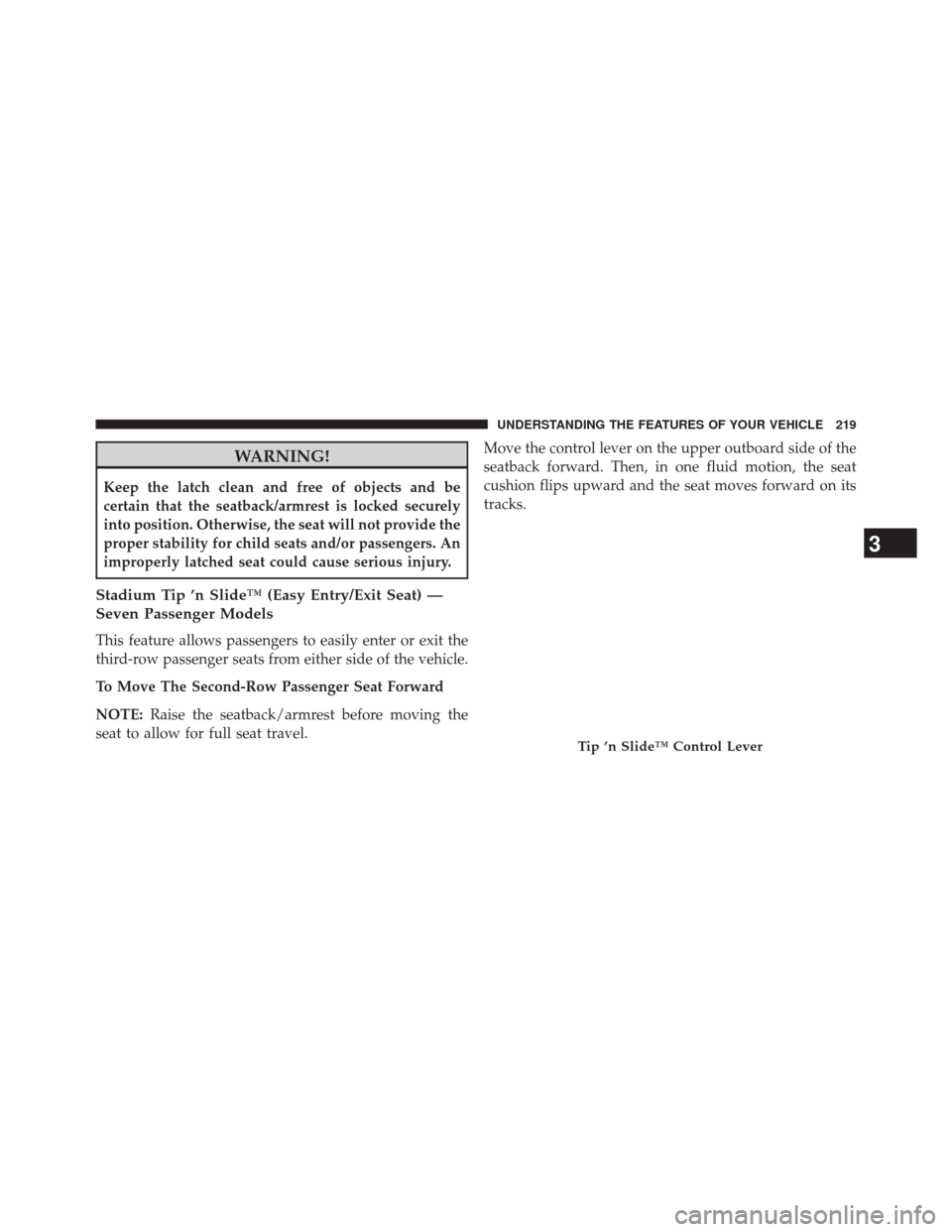
To Move The Second-Row Passenger Seat Forward
NOTE:Raise the seatback/armrest before moving the
seat to allow for full seat travel. Move the control lever on the upper outboard side of the
seatback forward. Then, in one fluid motion, the seat
cushion flips upward and the seat moves forward on its
tracks.
Tip ’n Slide™ Control Lever
3
UNDERSTANDING THE FEATURES OF YOUR VEHICLE 219
Page 222 of 651
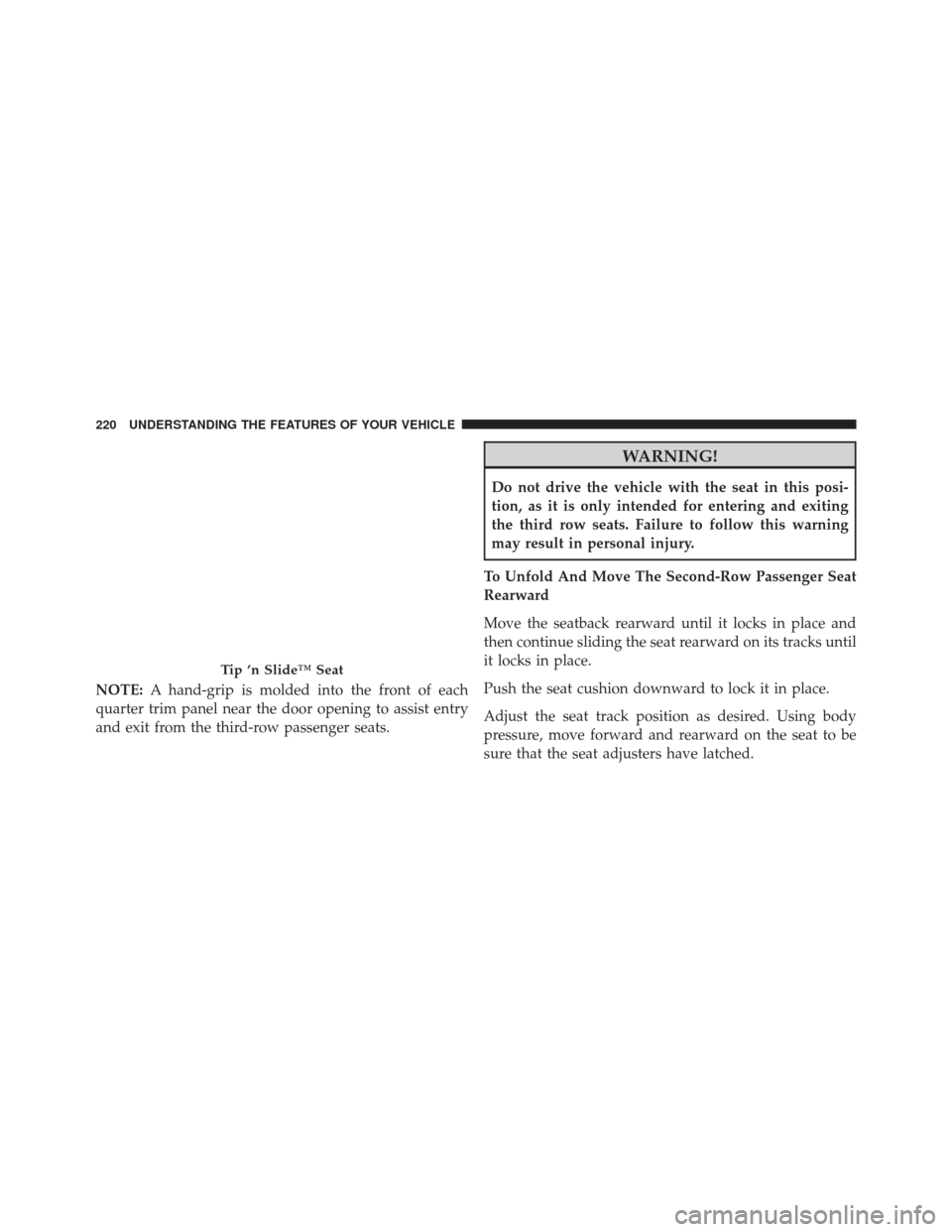
NOTE:A hand-grip is molded into the front of each
quarter trim panel near the door opening to assist entry
and exit from the third-row passenger seats.
WARNING!
Do not drive the vehicle with the seat in this posi-
tion, as it is only intended for entering and exiting
the third row seats. Failure to follow this warning
may result in personal injury.
To Unfold And Move The Second-Row Passenger Seat
Rearward
Move the seatback rearward until it locks in place and
then continue sliding the seat rearward on its tracks until
it locks in place.
Push the seat cushion downward to lock it in place.
Adjust the seat track position as desired. Using body
pressure, move forward and rearward on the seat to be
sure that the seat adjusters have latched.
Tip ’n Slide™ Seat
220 UNDERSTANDING THE FEATURES OF YOUR VEHICLE
Page 223 of 651
WARNING!
Be certain that the seatback and seat are locked
securely into position. Otherwise, the seat will not
provide the proper stability for child seats and/or
passengers. An improperly latched seat could cause
serious injury.
50/50 Split Third-Row Passenger Seats With
Fold-Flat Feature — Seven Passenger Models
To provide additional storage area, each third-row pas-
senger seatback can be folded flat. This allows for ex-
tended cargo space and still maintains some rear seating
room if needed.
NOTE:Prior to folding the third-row passenger seat-
back, make sure the second-row passenger seatback is
not in a reclined position. This will allow the seatback to
fold easily.
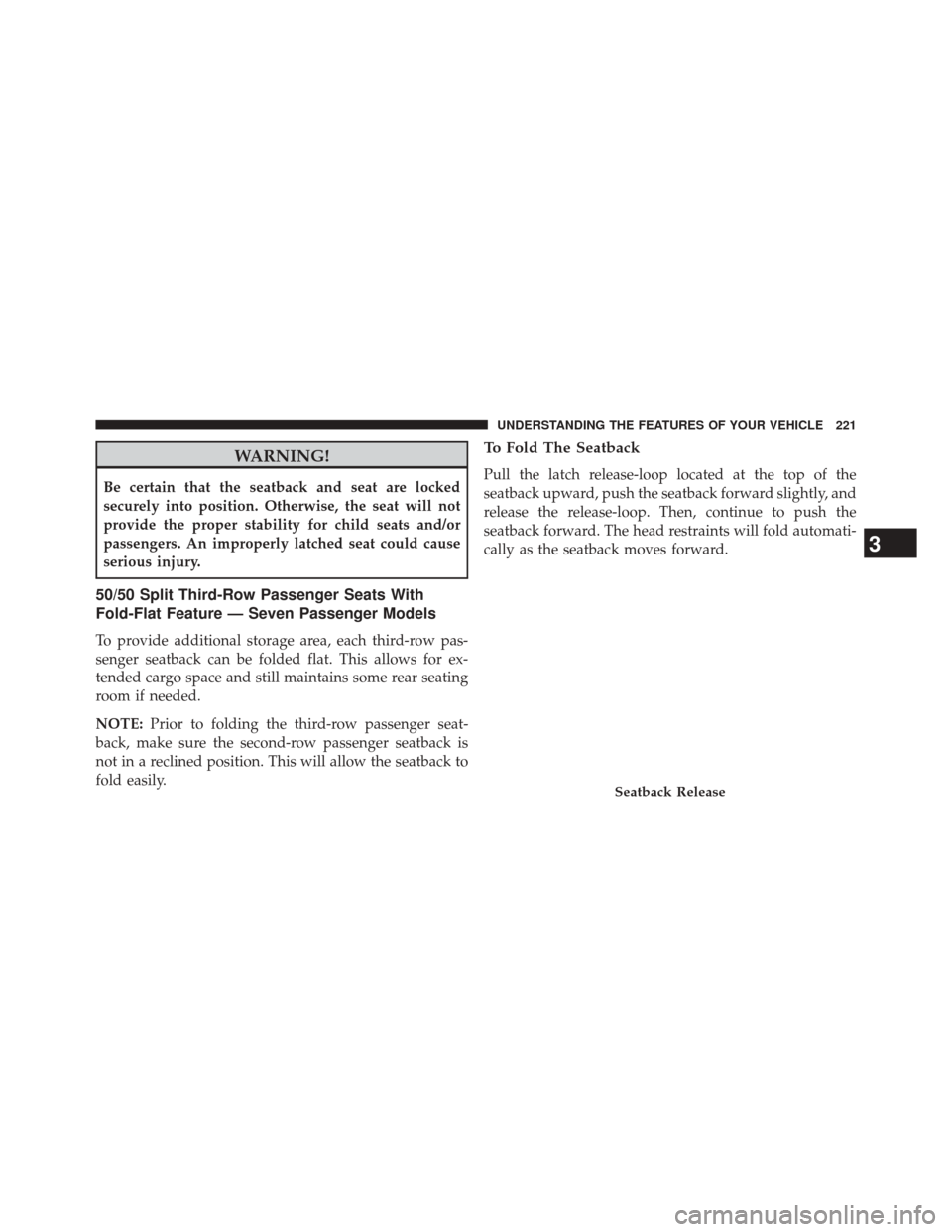
To Fold The Seatback
Pull the latch release-loop located at the top of the
seatback upward, push the seatback forward slightly, and
release the release-loop. Then, continue to push the
seatback forward. The head restraints will fold automati-
cally as the seatback moves forward.
Seatback Release
3
UNDERSTANDING THE FEATURES OF YOUR VEHICLE 221
Page 224 of 651
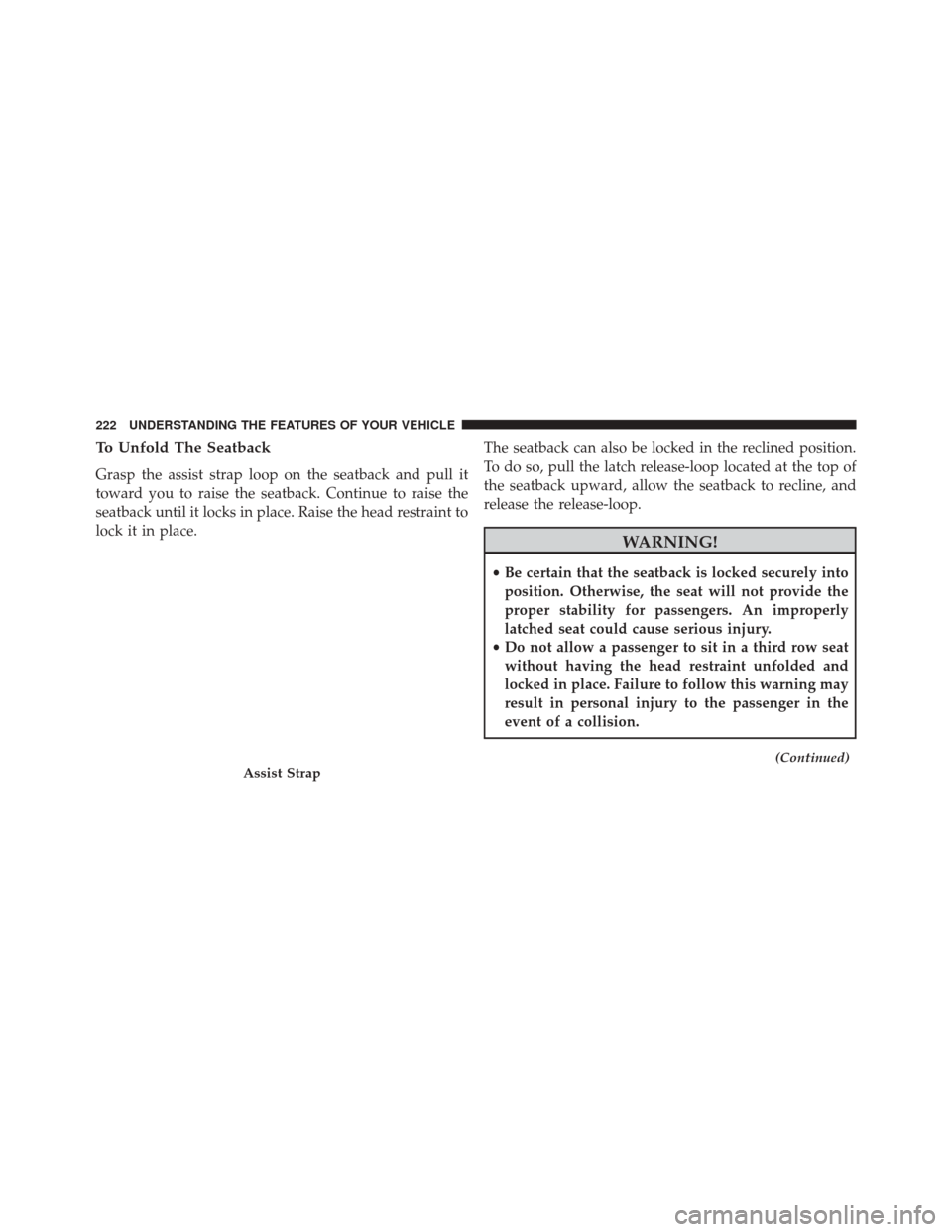
To Unfold The Seatback
Grasp the assist strap loop on the seatback and pull it
toward you to raise the seatback. Continue to raise the
seatback until it locks in place. Raise the head restraint to
lock it in place.The seatback can also be locked in the reclined position.
To do so, pull the latch release-loop located at the top of
the seatback upward, allow the seatback to recline, and
release the release-loop.
WARNING!
•
Be certain that the seatback is locked securely into
position. Otherwise, the seat will not provide the
proper stability for passengers. An improperly
latched seat could cause serious injury.
• Do not allow a passenger to sit in a third row seat
without having the head restraint unfolded and
locked in place. Failure to follow this warning may
result in personal injury to the passenger in the
event of a collision.
(Continued)Assist Strap
222 UNDERSTANDING THE FEATURES OF YOUR VEHICLE
Page 227 of 651
CAUTION!
To prevent possible damage:
•Before closing hood, make sure the hood prop rod
is fully seated into its storage retaining clips.
• Do not slam the hood to close it. Use a firm
downward push at the center front edge of the
hood to ensure that both latches engage. Never
drive your vehicle unless the hood is fully closed,
with both latches engaged.
WARNING!
Be sure the hood is fully latched before driving your
vehicle. If the hood is not fully latched, it could open
when the vehicle is in motion and block your vision.
Failure to follow this warning could result in serious
injury or death.
LIGHTS
Headlight Switch
The headlight switch is located on the left side of the
instrument panel. This switch controls the operation of the
headlights, parking lights, instrument panel lights, instru-
ment panel light dimming, interior lights and fog lights.
Headlight Switch
3
UNDERSTANDING THE FEATURES OF YOUR VEHICLE 225
Page 228 of 651
Rotate the headlight switch clockwise to the first detent
for parking lights and instrument panel light operation.
Rotate the headlight switch to the second detent for
headlight, parking light and instrument panel light op-
eration.
Automatic Headlights — If Equipped
This system automatically turns the headlights on or off
according to ambient light levels. To turn the system on,
rotate the headlight switch counterclockwise to the
AUTO position. When the system is on, the headlight
time delay feature is also on. This means the headlights
will stay on for up to 90 seconds after you place the
ignition into the OFF position. To turn the automatic
system off, move the headlight switch out of the AUTO
position.
NOTE:The engine must be running before the headlights
will come on in the automatic mode.
Headlights On With Wipers (Available With
Automatic Headlights Only)
When this feature is active, the headlights will turn on
approximately 10 seconds after the wipers are turned on
if the headlight switch is placed in the AUTO position. In
addition, the headlights will turn off when the wipers are
turned off if they were turned on by this feature.
NOTE: The Headlights On with Wipers feature can be
turned on or off using the Uconnect® System, refer to
“Uconnect® Settings” in “Understanding Your Instru-
ment Panel” for further information.
226 UNDERSTANDING THE FEATURES OF YOUR VEHICLE