service DODGE JOURNEY 2014 1.G Manual PDF
[x] Cancel search | Manufacturer: DODGE, Model Year: 2014, Model line: JOURNEY, Model: DODGE JOURNEY 2014 1.GPages: 651
Page 559 of 651
Air Conditioner Maintenance
For best possible performance, your air conditioner should
be checked and serviced by an authorized dealer at the
start of each warm season. This service should include
cleaning of the condenser fins and a performance test.
Drive belt tension should also be checked at this time.
WARNING!
•Use only refrigerants and compressor lubricants
approved by the manufacturer for your air condi-
tioning system. Some unapproved refrigerants are
flammable and can explode, injuring you. Other
unapproved refrigerants or lubricants can cause the
system to fail, requiring costly repairs. Refer to
Warranty Information Book, located on the DVD,
for further warranty information.
(Continued)
WARNING! (Continued)
•The air conditioning system contains refrigerant
under high pressure. To avoid risk of personal
injury or damage to the system, adding refrigerant
or any repair requiring lines to be disconnected
should be done by an experienced technician.
CAUTION!
Do not use chemical flushes in your air conditioning
system as the chemicals can damage your air condi-
tioning components. Such damage is not covered by
the New Vehicle Limited Warranty.
7
MAINTAINING YOUR VEHICLE 557
Page 560 of 651
Refrigerant Recovery And Recycling
R-134a Air Conditioning Refrigerant is a hydrofluoro-
carbon (HFC) that is endorsed by the Environmental
Protection Agency and is an ozone-saving product. How-
ever, the manufacturer recommends that air conditioning
service be performed by authorized dealer or other
service facilities using recovery and recycling equipment.
NOTE:Use only manufacturer approved A/C system
PAG compressor oil and refrigerants.
A/C Air Filter — If Equipped
Refer to the “Maintenance Schedule” for the proper
maintenance intervals.
WARNING!
Do not remove the A/C air filter while the blower is
operating or personal injury may result.
The A/C air filter is located in the fresh air inlet behind
the glove box. Perform the following steps to replace the
filter:
1. Open the glove box and remove all contents.
2. Push the retaining tab on each side of the glove box inward while gently pulling the glove box door out-
ward until both tabs clear the door opening in the
instrument panel.
558 MAINTAINING YOUR VEHICLE
Page 562 of 651
6. Install the A/C air filter with the arrow on the filterpointing toward the floor. When installing the filter
cover, make sure the retaining tabs fully engage the
cover.
CAUTION!
The A/C air filter is identified with an arrow to
indicate airflow direction through the filter. Failure
to install the filter properly will result in the need to
replace it more often.
7. Reinstall the glove box door. Make sure that the hinges are seated fully as you raise the door. Otherwise, the
door latch will not align properly.
Body Lubrication
Locks and all body pivot points, including such items as
seat tracks, door hinge pivot points and rollers, liftgate,
tailgate, decklid, sliding doors and hood hinges, should
be lubricated periodically with a lithium based grease,
such as MOPAR® Spray White Lube to assure quiet, easy
operation and to protect against rust and wear. Prior to
the application of any lubricant, the parts concerned
should be wiped clean to remove dust and grit; after
lubricating excess oil and grease should be removed.
Particular attention should also be given to hood latching
components to ensure proper function. When performing
other underhood services, the hood latch, release mecha-
nism and safety catch should be cleaned and lubricated.
The external lock cylinders should be lubricated twice a
year, preferably in the Fall and Spring. Apply a small
amount of a high quality lubricant, such as MOPAR®
Lock Cylinder Lubricant directly into the lock cylinder.
560 MAINTAINING YOUR VEHICLE
Page 567 of 651
CAUTION!
•The catalytic converter requires the use of un-
leaded fuel only. Leaded gasoline will destroy the
effectiveness of the catalyst as an emissions control
device and may seriously reduce engine perfor-
mance and cause serious damage to the engine.
• Damage to the catalytic converter can result if your
vehicle is not kept in proper operating condition.
In the event of engine malfunction, particularly
involving engine misfire or other apparent loss of
performance, have your vehicle serviced promptly.
Continued operation of your vehicle with a severe
malfunction could cause the converter to overheat,
resulting in possible damage to the converter and
vehicle. Under normal operating conditions, the catalytic con-
verter will not require maintenance. However, it is im-
portant to keep the engine properly tuned to assure
proper catalyst operation and prevent possible catalyst
damage.
NOTE:
Intentional tampering with emissions control
systems can result in civil penalties being assessed
against you.
In unusual situations involving grossly malfunctioning
engine operation, a scorching odor may suggest severe
and abnormal catalyst overheating. If this occurs, stop
the vehicle, turn off the engine and allow it to cool.
Service, including a tune-up to manufacturer’s specifica-
tions, should be obtained immediately.
7
MAINTAINING YOUR VEHICLE 565
Page 573 of 651
Disposal Of Used Engine Coolant
Used ethylene glycol-based engine coolant (antifreeze) is
a regulated substance requiring proper disposal. Check
with your local authorities to determine the disposal
rules for your community. To prevent ingestion by ani-
mals or children, do not store ethylene glycol-based
engine coolant in open containers or allow it to remain in
puddles on the ground. If ingested by a child or pet, seek
emergency assistance immediately. Clean up any ground
spills immediately.
Coolant Level
2.4L Engine —The coolant bottle provides a quick visual
method for determining that the coolant level is ad-
equate. With the engine idling and warm to normal
operating temperature, the level of the coolant in the
bottle should be between the “ADD” and “FULL” lines,
shown on the bottle. 3.6L Engine —
The level of the coolant in the pressurized
coolant bottle should be between the “COLD” and
“FULL” range on the bottle when the engine is cold.
The radiator normally remains completely full, so there is
no need to remove the radiator cap unless checking for
coolant freeze point or replacing engine coolant (anti-
freeze). Advise your service attendant of this. As long as
the engine operating temperature is satisfactory, the
coolant bottle need only be checked once a month. When
additional engine coolant (antifreeze) is needed to main-
tain the proper level, it should be added to the coolant
bottle. Do not overfill.7
MAINTAINING YOUR VEHICLE 571
Page 575 of 651
Brake System
In order to assure brake system performance, all brake
system components should be inspected periodically.
Refer to the “Maintenance Schedule” for the proper
maintenance intervals.
WARNING!
Riding the brakes can lead to brake failure and
possibly a collision. Driving with your foot resting or
riding on the brake pedal can result in abnormally
high brake temperatures, excessive lining wear, and
possible brake damage. You would not have your full
braking capacity in an emergency.
Master Cylinder — Brake Fluid Level Check
Check the fluid level in the master cylinder immediately
if the “Brake Warning Light” indicates system failure.
Check the fluid level in the master cylinder when per-
forming underhood services.
Clean the top of the master cylinder area before removing
the cap. If necessary, add fluid to bring the fluid level up to
the requirements described on the brake fluid reservoir.
Overfilling of fluid is not recommended because it may
cause leaking in the system.
Fluid level can be expected to fall as the brake pads wear.
Brake fluid level should be checked when pads are
replaced. However, low fluid level may be caused by a
leak and a checkup may be needed.
7
MAINTAINING YOUR VEHICLE 573
Page 580 of 651
CAUTION!(Continued)
•Dirt and water in the transmission can cause seri-
ous damage. To prevent dirt and water from enter-
ing the transmission after checking or replenishing
fluid, make sure that the dipstick cap is re-seated
properly.
Fluid Level Check — Six-Speed Automatic
Transmission
The fluid level is preset at the factory and does not require
adjustment under normal operating conditions. Routine
fluid level checks are not required, therefore the transmis-
sion filler tube is capped and no dipstick is provided. Your
authorized dealer can check your transmission fluid level
using a special service dipstick. If you notice fluid leakage
or transmission malfunction, visit your authorized dealer
immediately to have the transmission fluid level checked. Operating the vehicle with an improper fluid level can
cause severe transmission damage.
CAUTION!
If a transmission fluid leak occurs, visit your autho-
rized dealer immediately. Severe transmission dam-
age may occur. Your authorized dealer has the proper
tools to adjust the fluid level accurately.
Fluid And Filter Changes
Refer to the “Maintenance Schedule” for the proper
maintenance intervals.
In addition, change the fluid and filter if the fluid
becomes contaminated (with water, etc.), or if the trans-
mission is disassembled for any reason.
578 MAINTAINING YOUR VEHICLE
Page 588 of 651
Replace the belts if they appear frayed or worn or if the
buckles do not work properly.
WARNING!
A frayed or torn belt could rip apart in a collision and
leave you with no protection. Inspect the belt system
periodically, checking for cuts, frays, or loose parts.
Damaged parts must be replaced immediately. Do
not disassemble or modify the system. Seat belt
assemblies must be replaced after a collision if they
have been damaged (i.e., bent retractor, torn web-
bing, etc.).
Cleaning The Cupholders
Clean with a damp cloth or towel using a mild detergent.
FUSES
WARNING!
•When replacing a blown fuse, always use an appro-
priate replacement fuse with the same amp rating as
the original fuse. Never replace a fuse with another
fuse of higher amp rating. Never replace a blown
fuse with metal wires or any other material. Failure
to use proper fuses may result in serious personal
injury, fire and/or property damage.
•Before replacing a fuse, make sure that the ignition
is off and that all the other services are switched off
and/or disengaged.
• If the replaced fuse blows again, contact an autho-
rized dealer.
(Continued)
586 MAINTAINING YOUR VEHICLE
Page 596 of 651
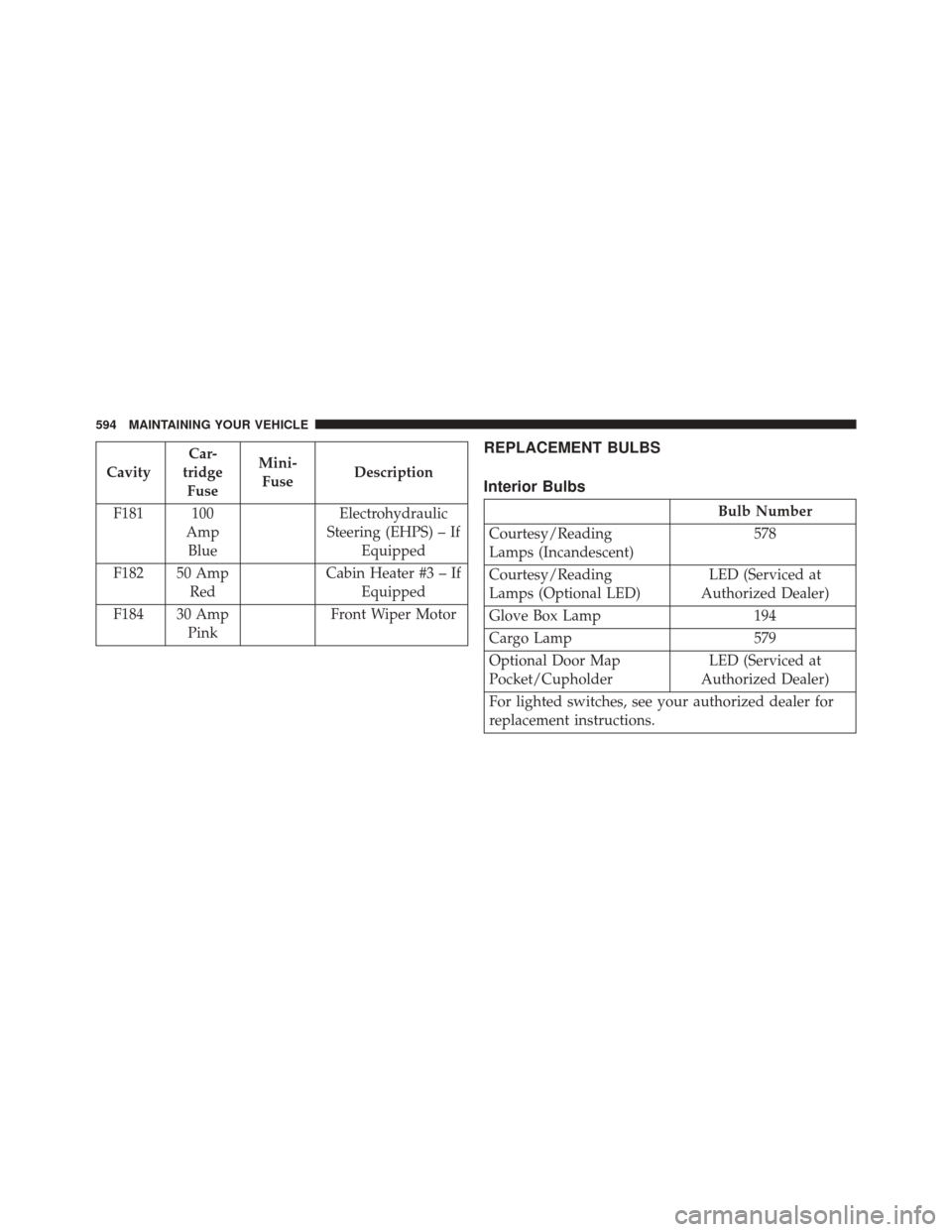
CavityCar-
tridge Fuse Mini-
Fuse Description
F181 100 AmpBlue Electrohydraulic
Steering (EHPS) – If Equipped
F182 50 Amp Red Cabin Heater #3 – If
Equipped
F184 30 Amp Pink Front Wiper Motor
REPLACEMENT BULBS
Interior Bulbs
Bulb Number
Courtesy/Reading
Lamps (Incandescent) 578
Courtesy/Reading
Lamps (Optional LED) LED (Serviced at
Authorized Dealer)
Glove Box Lamp 194
Cargo Lamp 579
Optional Door Map
Pocket/Cupholder LED (Serviced at
Authorized Dealer)
For lighted switches, see your authorized dealer for
replacement instructions.
594 MAINTAINING YOUR VEHICLE
Page 597 of 651
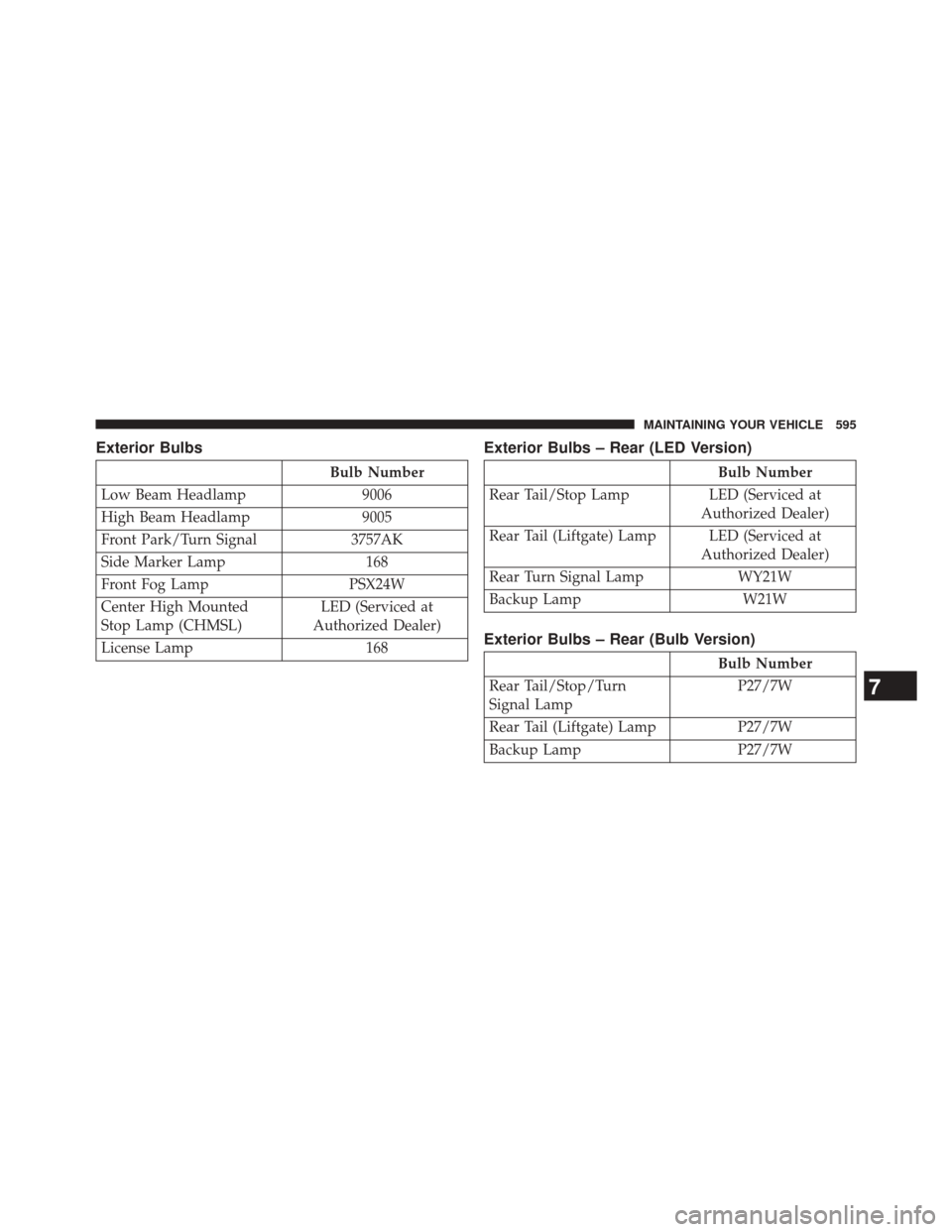
Exterior Bulbs
Bulb Number
Low Beam Headlamp 9006
High Beam Headlamp 9005
Front Park/Turn Signal 3757AK
Side Marker Lamp 168
Front Fog Lamp PSX24W
Center High Mounted
Stop Lamp (CHMSL) LED (Serviced at
Authorized Dealer)
License Lamp 168
Exterior Bulbs – Rear (LED Version)
Bulb Number
Rear Tail/Stop Lamp LED (Serviced at
Authorized Dealer)
Rear Tail (Liftgate) Lamp LED (Serviced at Authorized Dealer)
Rear Turn Signal Lamp WY21W
Backup Lamp W21W
Exterior Bulbs – Rear (Bulb Version)
Bulb Number
Rear Tail/Stop/Turn
Signal Lamp P27/7W
Rear Tail (Liftgate) Lamp P27/7W
Backup Lamp P27/7W
7
MAINTAINING YOUR VEHICLE 595