Engine DODGE JOURNEY 2015 1.G Owners Manual
[x] Cancel search | Manufacturer: DODGE, Model Year: 2015, Model line: JOURNEY, Model: DODGE JOURNEY 2015 1.GPages: 648
Page 517 of 648
WARNING!(Continued)
•Being under a jacked-up vehicle is dangerous. The
vehicle could slip off the jack and fall on you. You
could be crushed. Never put any part of your body
under a vehicle that is on a jack. If you need to get
under a raised vehicle, take it to a service center
where it can be raised on a lift.
•Never start or run the engine while the vehicle is
on a jack.
•The jack is designed to be used as a tool for
changing tires only. The jack should not be used to
lift the vehicle for service purposes. The vehicle
should be jacked on a firm level surface only.
Avoid ice or slippery areas.
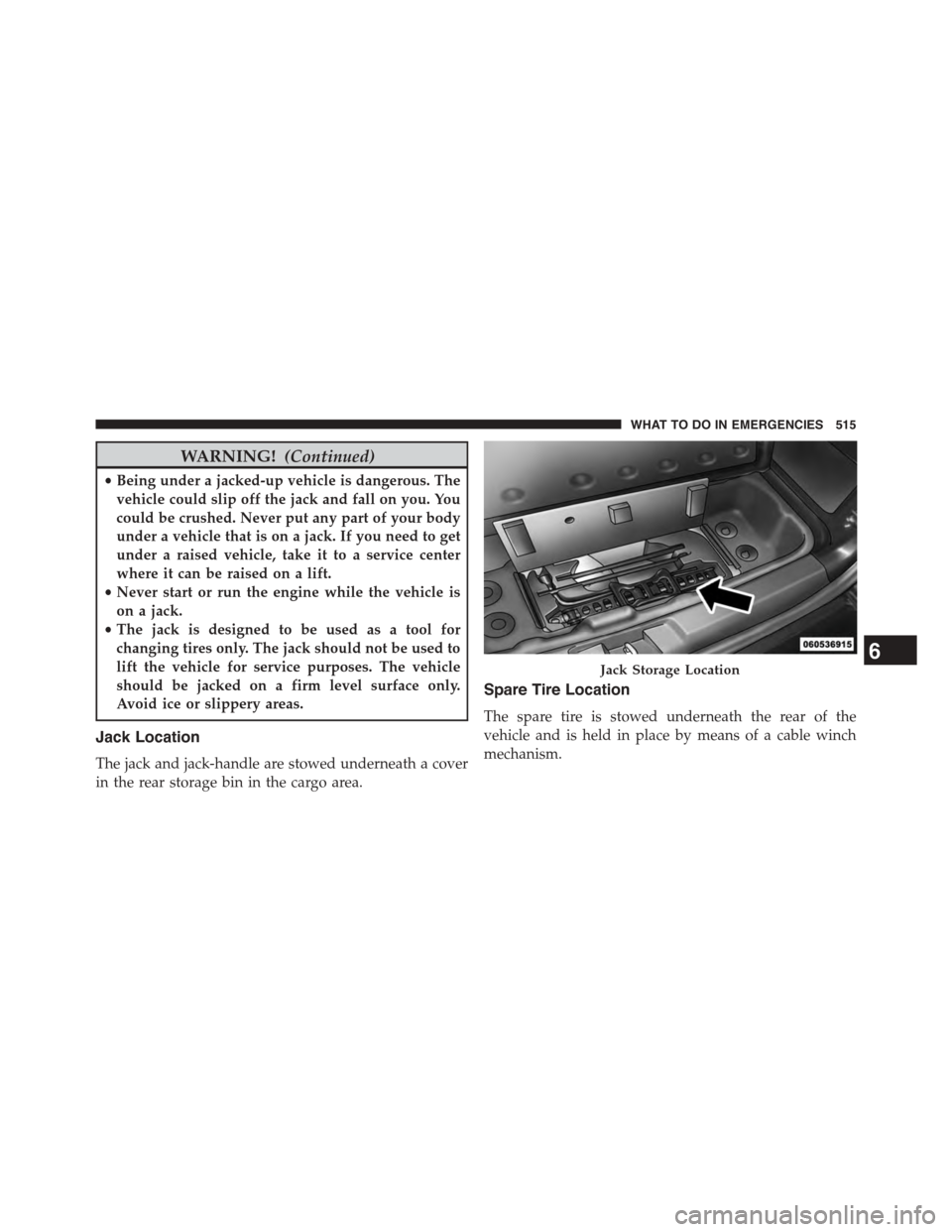
Jack Location
The jack and jack-handle are stowed underneath a cover
in the rear storage bin in the cargo area.
Spare Tire Location
The spare tire is stowed underneath the rear of the
vehicle and is held in place by means of a cable winch
mechanism.
Jack Storage Location6
WHAT TO DO IN EMERGENCIES 515
Page 521 of 648
Jacking Instructions
WARNING!
Carefully follow these tire changing warnings to
help prevent personal injury or damage to your
vehicle:
•Always park on a firm, level surface as far from the
edge of the roadway as possible before raising the
vehicle.
•Turn on the Hazard Warning flasher.
•Block the wheel diagonally opposite the wheel to
be raised.
•Set the parking brake firmly and set an automatic
transmission in PARK.
•Never start or run the engine with the vehicle on a
jack.
(Continued)
WARNING!(Continued)
•Do not let anyone sit in the vehicle when it is on a
jack.
•Do not get under the vehicle when it is on a jack. If
you need to get under a raised vehicle, take it to a
service center where it can be raised on a lift.
•Only use the jack in the positions indicated and for
lifting this vehicle during a tire change.
•If working on or near a roadway, be extremely
careful of motor traffic.
•To assure that spare tires, flat or inflated, are
securely stowed, spares must be stowed with the
valve stem facing the ground.
6
WHAT TO DO IN EMERGENCIES 519
Page 530 of 648
5. After 25 miles (40 km) check the lug nut torque with a
torque wrench to ensure that all lug nuts are properly
seated against the wheel.
JUMP-STARTING
If your vehicle has a discharged battery it can be jump-
started using a set of jumper cables and a battery in
another vehicle or by using a portable battery booster
pack. Jump-starting can be dangerous if done improperly
so please follow the procedures in this section carefully.
WARNING!
Do not attempt jump-starting if the battery is frozen.
It could rupture or explode and cause personal injury.
CAUTION!
Do not use a portable battery booster pack or any
other booster source with a system voltage greater
than 12 Volts or damage to the battery, starter motor,
alternator or electrical system may occur.
NOTE:When using a portable battery booster pack
follow the manufacturer’s operating instructions and
precautions.
Preparations For Jump-Start
The battery in your vehicle is located between the left
front headlight assembly and the left front wheel splash
shield. To allow jump-starting, there are remote battery
posts located on the left side of the engine compartment.
528 WHAT TO DO IN EMERGENCIES
Page 533 of 648
3. Connect the negative end(-)of the jumper cable to the
negative(-)post of the booster battery.
4. Connect the opposite end of the negative(-)jumper
cable to the remote negative(-)post of the vehicle with
the discharged battery.
WARNING!
Do not connect the jumper cable to the negative (-)
post of the discharged battery. The resulting electri-
cal spark could cause the battery to explode and
could result in personal injury. Only use the specific
ground point, do not use any other exposed metal
parts.
5. Start the engine in the vehicle that has the booster
battery, let the engine idle a few minutes, and then
start the engine in the vehicle with the discharged
battery.
6. Once the engine is started, remove the jumper cables
in the reverse sequence:
Disconnecting The Jumper Cables
1. Disconnect the negative(-)jumper cable from the
remote negative(-)post of the vehicle with the dis-
charged battery.
2. Disconnect the negative end(-)of the jumper cable
from the negative(-)post of the booster battery.
3. Disconnect the opposite end of the positive(+)jumper
cable from the positive(+)post of the booster battery.
4. Disconnect the positive(+)end of the jumper cable
from the remote positive(+)post of the discharged
vehicle.
5. Reinstall the protective cover over the remote positive
(+)battery post of the discharged vehicle.
6
WHAT TO DO IN EMERGENCIES 531
Page 534 of 648
If frequent jump-starting is required to start your vehicle,
you should have the battery and charging system in-
spected at your authorized dealer.
CAUTION!
Accessories plugged into the vehicle power outlets
draw power from the vehicle’s battery, even when not
in use (i.e., cellular phones, etc.). Eventually, if
plugged in long enough without engine operation,
the vehicle’s battery will discharge sufficiently to
degrade battery life and/or prevent the engine from
starting.
FREEING A STUCK VEHICLE
If your vehicle becomes stuck in mud, sand, or snow, it
can often be moved using a rocking motion. Turn the
steering wheel right and left to clear the area around the
front wheels. Then shift back and forth between DRIVE
and REVERSE while gently pressing the accelerator
pedal. Use the least amount of accelerator pedal pressure
that will maintain the rocking motion, without spinning
the wheels or racing the engine.
CAUTION!
Racing the engine or spinning the wheels may lead to
transmission overheating and failure. Allow the en-
gine to idle with the transmission in NEUTRAL for at
least one minute after every five rocking-motion
cycles. This will minimize overheating and reduce
the risk of transmission failure during prolonged
efforts to free a stuck vehicle.
532 WHAT TO DO IN EMERGENCIES
Page 535 of 648
NOTE:Press the#ESC Off#switch, to place the Electronic
Stability Control (ESC) system in#ESC Partial
Off#mode, before rocking the vehicle. Refer to
“Electronic Brake Control” in “Starting And
Operating” for further information. Once the
vehicle has been freed, press the#ESC Off#switch again
to restore#ESC On#mode.
CAUTION!
•When “rocking” a stuck vehicle by shifting be-
tween DRIVE and REVERSE, do not spin the
wheels faster than 15 mph (24 km/h), or drivetrain
damage may result.
•Revving the engine or spinning the wheels too fast
may lead to transmission overheating and failure.
It can also damage the tires. Do not spin the wheels
above 30 mph (48 km/h) while in gear (no trans-
mission shifting occurring).
WARNING!
Fast spinning tires can be dangerous. Forces gener-
ated by excessive wheel speeds may cause damage, or
even failure, of the axle and tires. A tire could
explode and injure someone. Do not spin your vehi-
cle’s wheels faster than 30 mph (48 km/h) or for
longer than 30 seconds continuously without stop-
ping when you are stuck and do not let anyone near
a spinning wheel, no matter what the speed.
SHIFT LEVER OVERRIDE
If a malfunction occurs and the shift lever cannot be
moved out of the PARK position, you can use the
following procedure to temporarily move the shift lever:
1. Turn the engine OFF.
2. Firmly apply the parking brake.
6
WHAT TO DO IN EMERGENCIES 533
Page 541 of 648
MAINTAINING YOUR VEHICLE
CONTENTS
!ENGINE COMPARTMENT — 2.4L..........541
!ENGINE COMPARTMENT — 3.6L..........542
!ONBOARD DIAGNOSTIC SYSTEM — OBD II . .543
▫Loose Fuel Filler Cap Message............543
!EMISSIONS INSPECTION AND MAINTENANCE
PROGRAMS..........................544
!REPLACEMENT PARTS..................545
!DEALER SERVICE......................545
!MAINTENANCE PROCEDURES...........546
▫Engine Oil..........................547
▫Engine Oil Filter......................550
▫Engine Air Cleaner Filter................550
▫Maintenance-Free Battery...............551
▫Air Conditioner Maintenance.............552
▫A/C Air Filter — If Equipped............554
▫Body Lubrication.....................555
▫Windshield Wiper Blades...............556
▫Adding Washer Fluid..................558
▫Exhaust System......................559
▫Cooling System......................561
7
Page 542 of 648
▫Brake System........................567
▫Automatic Transmission................570
▫Rear Drive Assembly (RDA) –
AWD Models Only....................574
▫Power Transfer Unit (PTU) –
AWD Models Only....................574
▫Appearance Care And Protection From
Corrosion...........................575
▫Cleaning The Cupholders...............581
!FUSES..............................581
▫Interior Fuses........................582
▫Underhood Fuses (Power Distribution Center) . .585
!REPLACEMENT BULBS.................589
!BULB REPLACEMENT..................591
▫Front Low/High Beam Headlamp, Turn
Signal/Park Lamp, And Side Marker Lamp . .591
▫Front Fog Lamp......................592
▫Rear Turn Signal And Backup Lamp........593
▫License Plate Lamp....................596
!FLUID CAPACITIES....................597
!FLUIDS, LUBRICANTS AND GENUINE
PA R T S . . . . . . . . . . . . . . . . . . . . . . . . . . . . ..598
▫Engine.............................598
▫Chassis............................601
540 MAINTAINING YOUR VEHICLE
Page 543 of 648
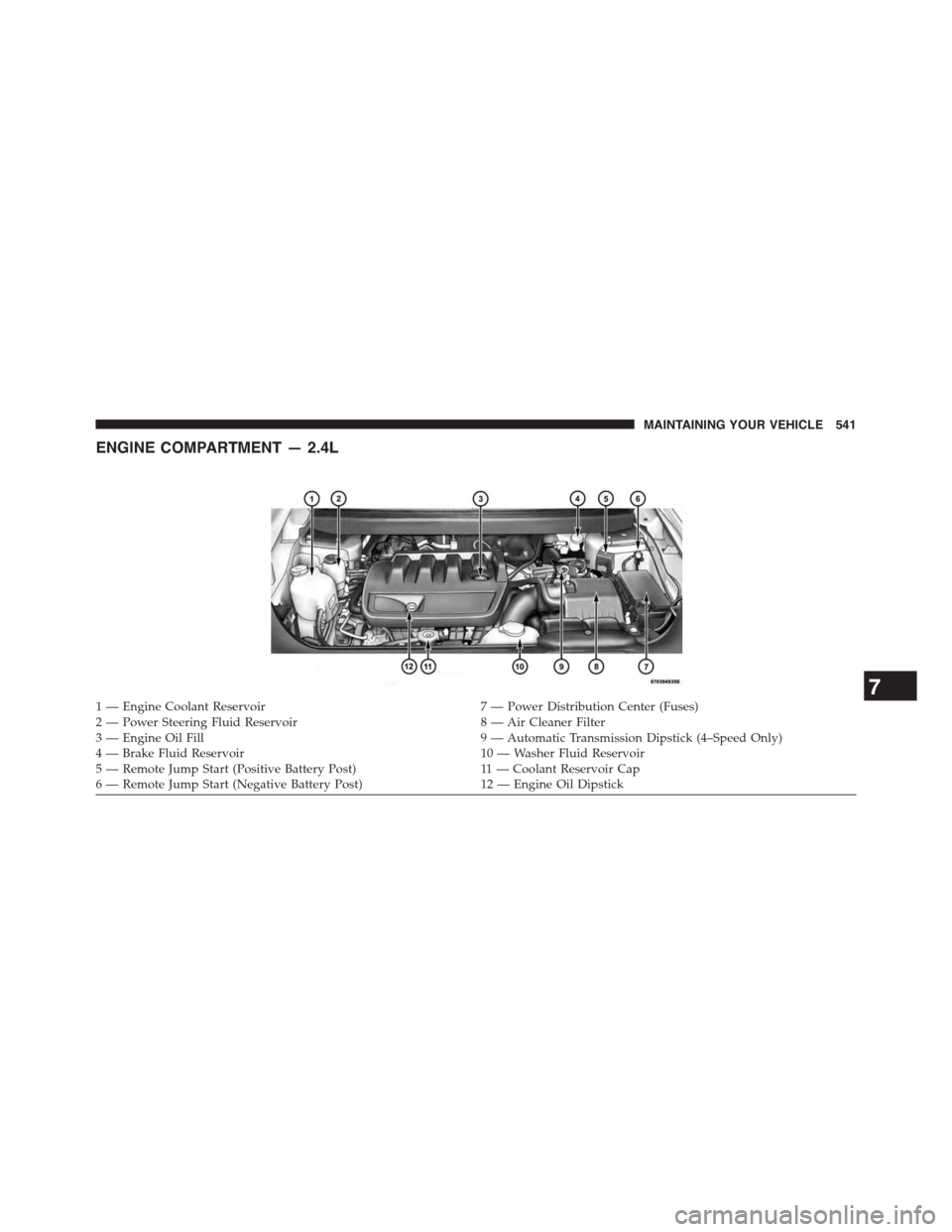
ENGINE COMPARTMENT — 2.4L
1 — Engine Coolant Reservoir7 — Power Distribution Center (Fuses)2 — Power Steering Fluid Reservoir8 — Air Cleaner Filter3 — Engine Oil Fill9 — Automatic Transmission Dipstick (4–Speed Only)4 — Brake Fluid Reservoir10 — Washer Fluid Reservoir5 — Remote Jump Start (Positive Battery Post)11 — Coolant Reservoir Cap6 — Remote Jump Start (Negative Battery Post)12 — Engine Oil Dipstick
7
MAINTAINING YOUR VEHICLE 541
Page 544 of 648
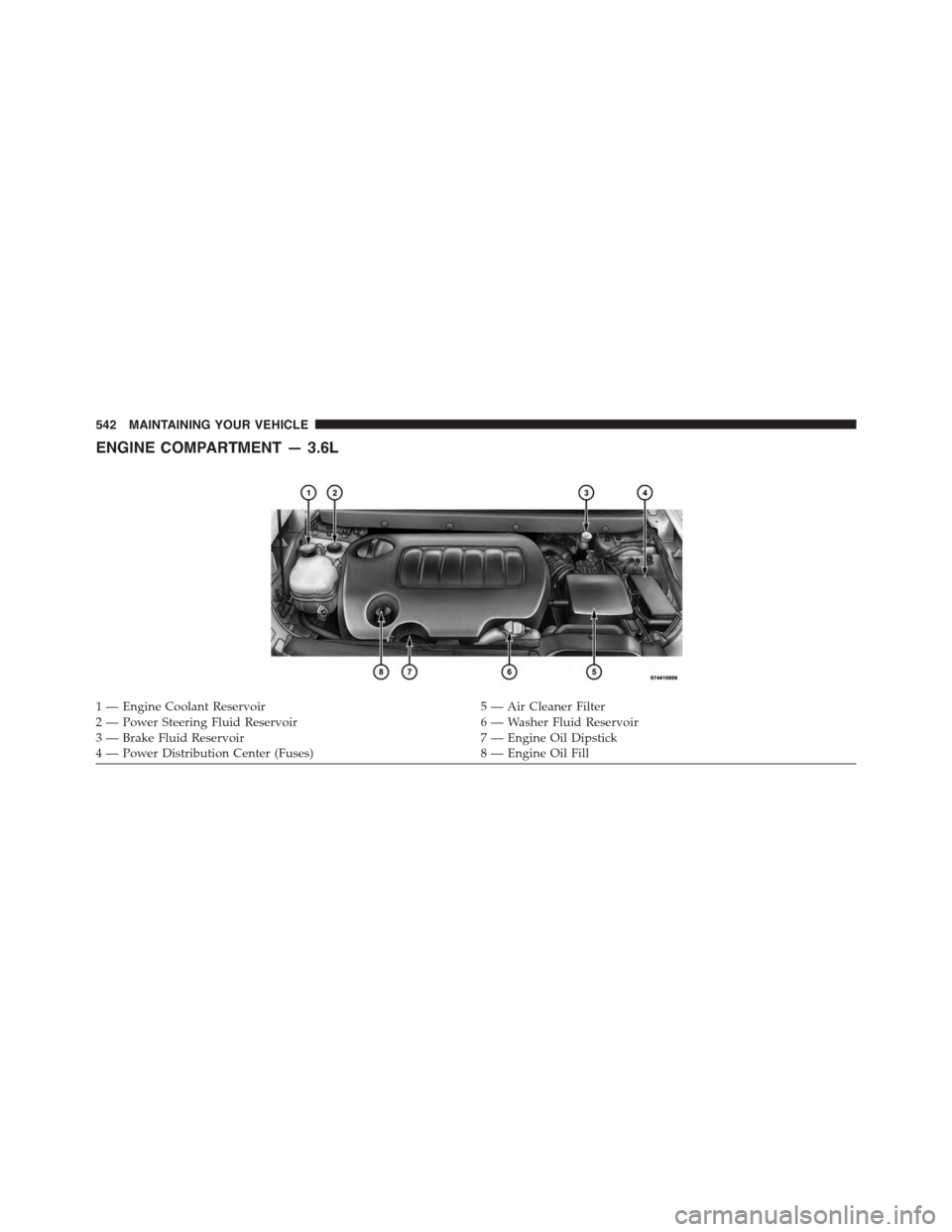
ENGINE COMPARTMENT — 3.6L
1 — Engine Coolant Reservoir5 — Air Cleaner Filter2 — Power Steering Fluid Reservoir6 — Washer Fluid Reservoir3 — Brake Fluid Reservoir7 — Engine Oil Dipstick4 — Power Distribution Center (Fuses)8 — Engine Oil Fill
542 MAINTAINING YOUR VEHICLE