automatic transmission DODGE JOURNEY 2015 1.G Owner's Manual
[x] Cancel search | Manufacturer: DODGE, Model Year: 2015, Model line: JOURNEY, Model: DODGE JOURNEY 2015 1.GPages: 648
Page 531 of 648
WARNING!
•Take care to avoid the radiator cooling fan when-
ever the hood is raised. It can start anytime the
ignition switch is ON. You can be injured by
moving fan blades.
•Remove any metal jewelry such as rings, watch
bands and bracelets that could make an inadvertent
electrical contact. You could be seriously injured.
•Batteries contain sulfuric acid that can burn your
skin or eyes and generate hydrogen gas which is
flammable and explosive. Keep open flames or
sparks away from the battery.
1. Set the parking brake, shift the automatic transmission
into PARK and turn the ignition to LOCK.
2. Turn off the heater, radio, and all unnecessary electri-
cal accessories.
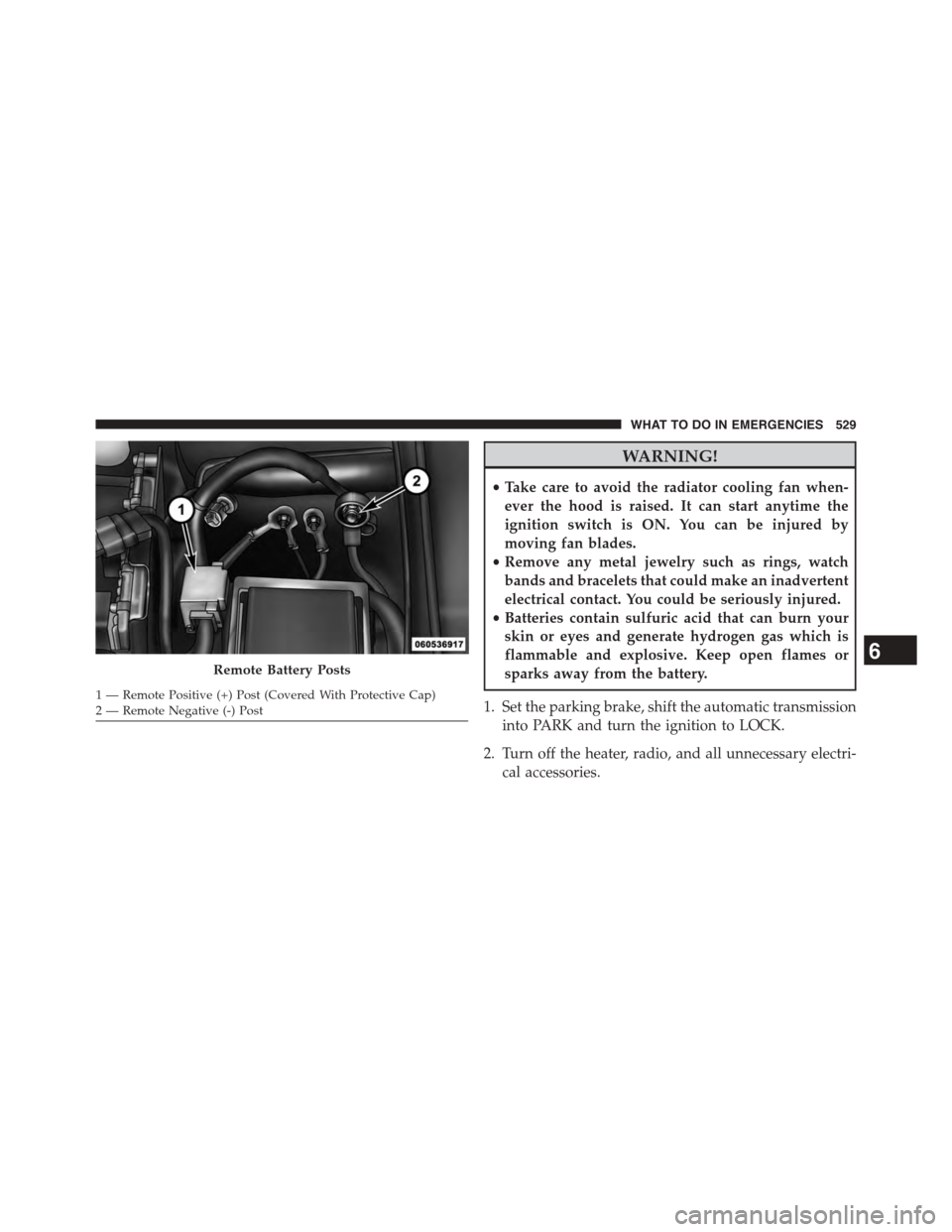
Remote Battery Posts
1—RemotePositive(+)Post(CoveredWithProtectiveCap)2 — Remote Negative (-) Post
6
WHAT TO DO IN EMERGENCIES 529
Page 542 of 648
▫Brake System........................567
▫Automatic Transmission................570
▫Rear Drive Assembly (RDA) –
AWD Models Only....................574
▫Power Transfer Unit (PTU) –
AWD Models Only....................574
▫Appearance Care And Protection From
Corrosion...........................575
▫Cleaning The Cupholders...............581
!FUSES..............................581
▫Interior Fuses........................582
▫Underhood Fuses (Power Distribution Center) . .585
!REPLACEMENT BULBS.................589
!BULB REPLACEMENT..................591
▫Front Low/High Beam Headlamp, Turn
Signal/Park Lamp, And Side Marker Lamp . .591
▫Front Fog Lamp......................592
▫Rear Turn Signal And Backup Lamp........593
▫License Plate Lamp....................596
!FLUID CAPACITIES....................597
!FLUIDS, LUBRICANTS AND GENUINE
PA R T S . . . . . . . . . . . . . . . . . . . . . . . . . . . . ..598
▫Engine.............................598
▫Chassis............................601
540 MAINTAINING YOUR VEHICLE
Page 543 of 648
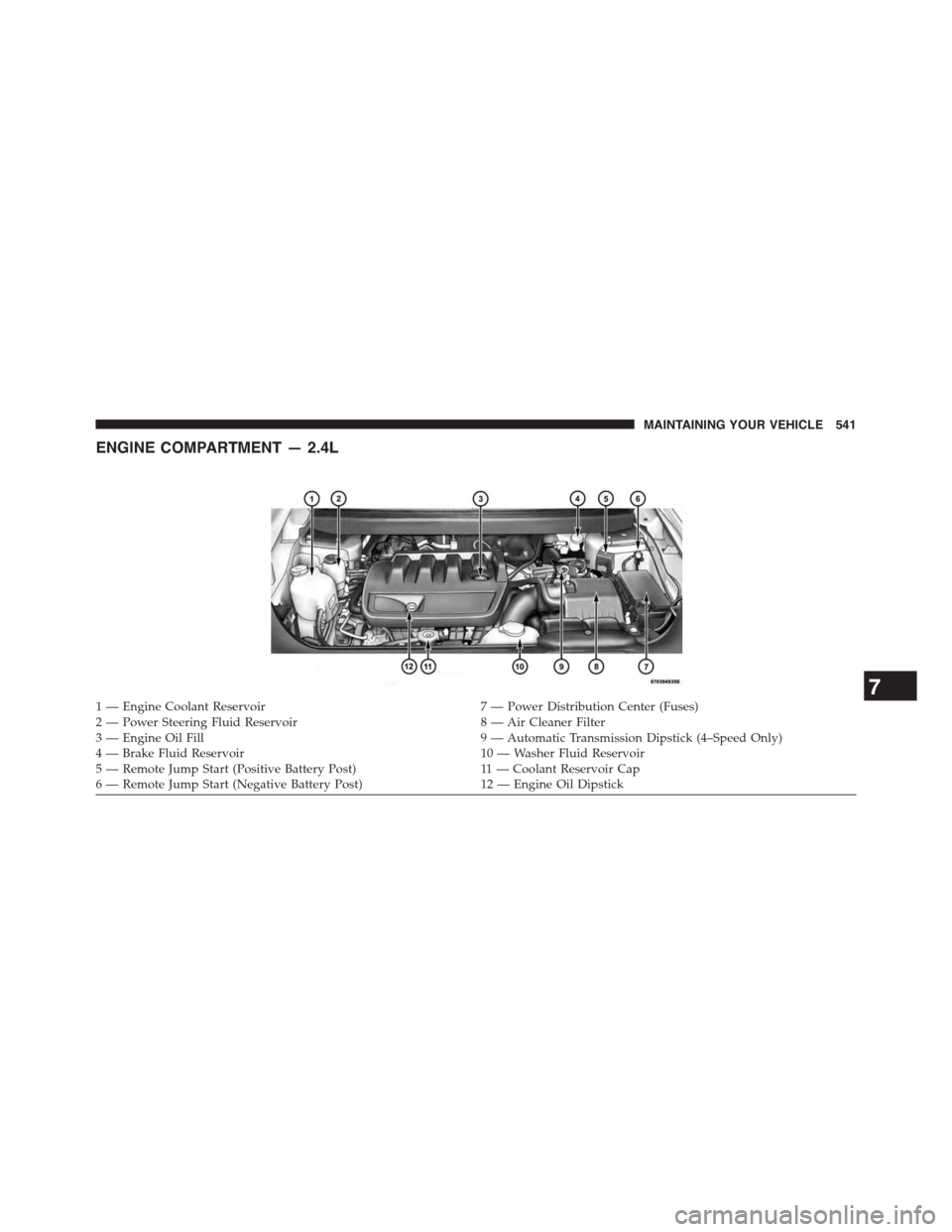
ENGINE COMPARTMENT — 2.4L
1 — Engine Coolant Reservoir7 — Power Distribution Center (Fuses)2 — Power Steering Fluid Reservoir8 — Air Cleaner Filter3 — Engine Oil Fill9 — Automatic Transmission Dipstick (4–Speed Only)4 — Brake Fluid Reservoir10 — Washer Fluid Reservoir5 — Remote Jump Start (Positive Battery Post)11 — Coolant Reservoir Cap6 — Remote Jump Start (Negative Battery Post)12 — Engine Oil Dipstick
7
MAINTAINING YOUR VEHICLE 541
Page 545 of 648
ONBOARD DIAGNOSTIC SYSTEM — OBD II
Your vehicle is equipped with a sophisticated onboard
diagnostic system called OBD II. This system monitors
the performance of the emissions, engine, and automatic
transmission control systems. When these systems are
operating properly, your vehicle will provide excellent
performance and fuel economy, as well as engine emis-
sions well within current government regulations.
If any of these systems require service, the OBD II system
will turn on the “Malfunction Indicator Light” (MIL). It
will also store diagnostic codes and other information to
assist your service technician in making repairs. Al-
though your vehicle will usually be drivable and not
need towing, see your authorized dealer for service as
soon as possible.
CAUTION!
•Prolonged driving with the MIL on could cause
further damage to the emission control system. It
could also affect fuel economy and driveability.
The vehicle must be serviced before any emissions
tests can be performed.
•If the MIL is flashing while the engine is running,
severe catalytic converter damage and power loss
will soon occur. Immediate service is required.
Loose Fuel Filler Cap Message
If the vehicle diagnostic system determines that the fuel
filler cap is loose, improperly installed, or damaged, the
word “gASCAP” will display in the odometer. If this
occurs, tighten the fuel filler cap until a “clicking” sound
is heard and press the TRIP ODOMETER button to turn
off the message. If the problem persists, the message will
appear the next time the vehicle is started.
7
MAINTAINING YOUR VEHICLE 543
Page 572 of 648
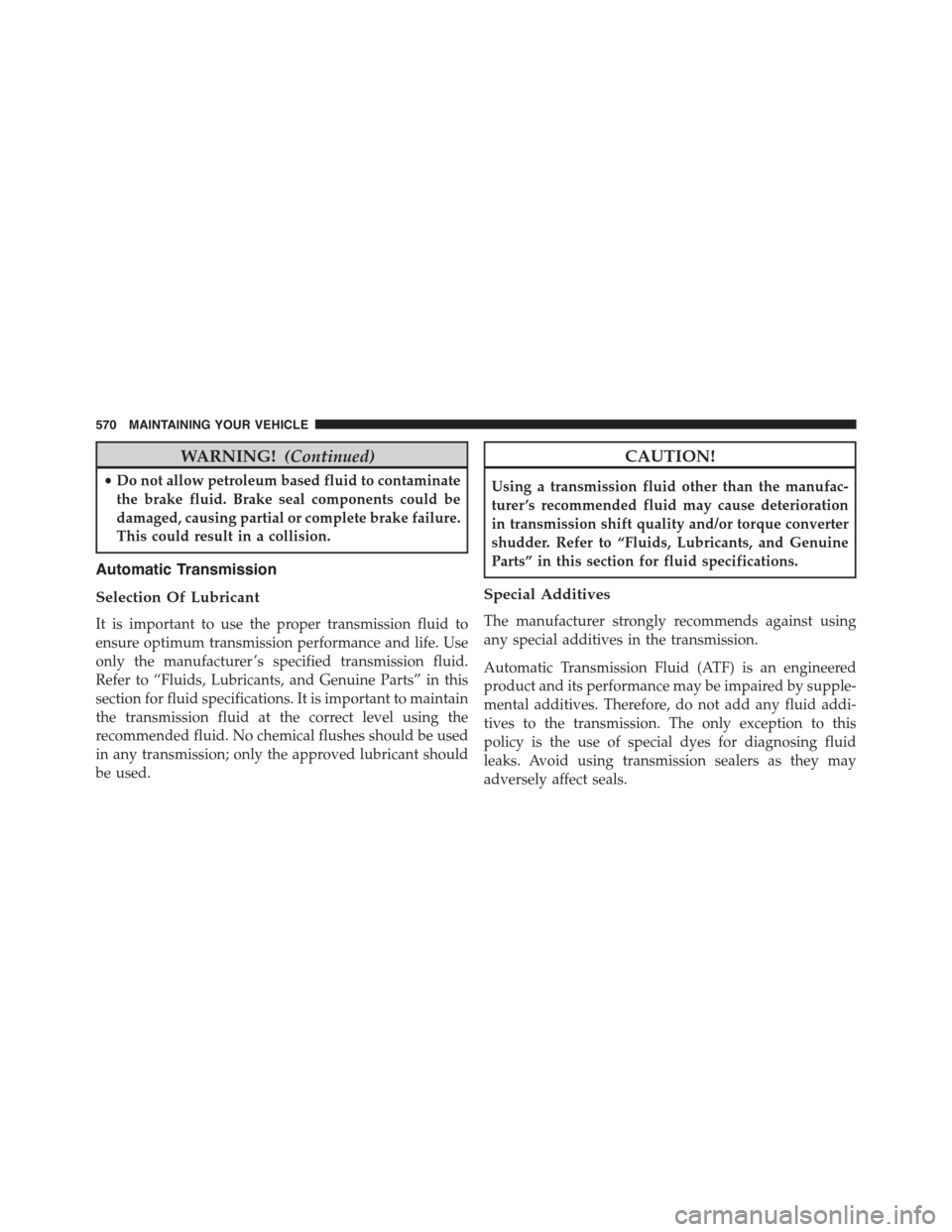
WARNING!(Continued)
•Do not allow petroleum based fluid to contaminate
the brake fluid. Brake seal components could be
damaged, causing partial or complete brake failure.
This could result in a collision.
Automatic Transmission
Selection Of Lubricant
It is important to use the proper transmission fluid to
ensure optimum transmission performance and life. Use
only the manufacturer ’s specified transmission fluid.
Refer to “Fluids, Lubricants, and Genuine Parts” in this
section for fluid specifications. It is important to maintain
the transmission fluid at the correct level using the
recommended fluid. No chemical flushes should be used
in any transmission; only the approved lubricant should
be used.
CAUTION!
Using a transmission fluid other than the manufac-
turer ’s recommended fluid may cause deterioration
in transmission shift quality and/or torque converter
shudder. Refer to “Fluids, Lubricants, and Genuine
Parts” in this section for fluid specifications.
Special Additives
The manufacturer strongly recommends against using
any special additives in the transmission.
Automatic Transmission Fluid (ATF) is an engineered
product and its performance may be impaired by supple-
mental additives. Therefore, do not add any fluid addi-
tives to the transmission. The only exception to this
policy is the use of special dyes for diagnosing fluid
leaks. Avoid using transmission sealers as they may
adversely affect seals.
570 MAINTAINING YOUR VEHICLE
Page 573 of 648
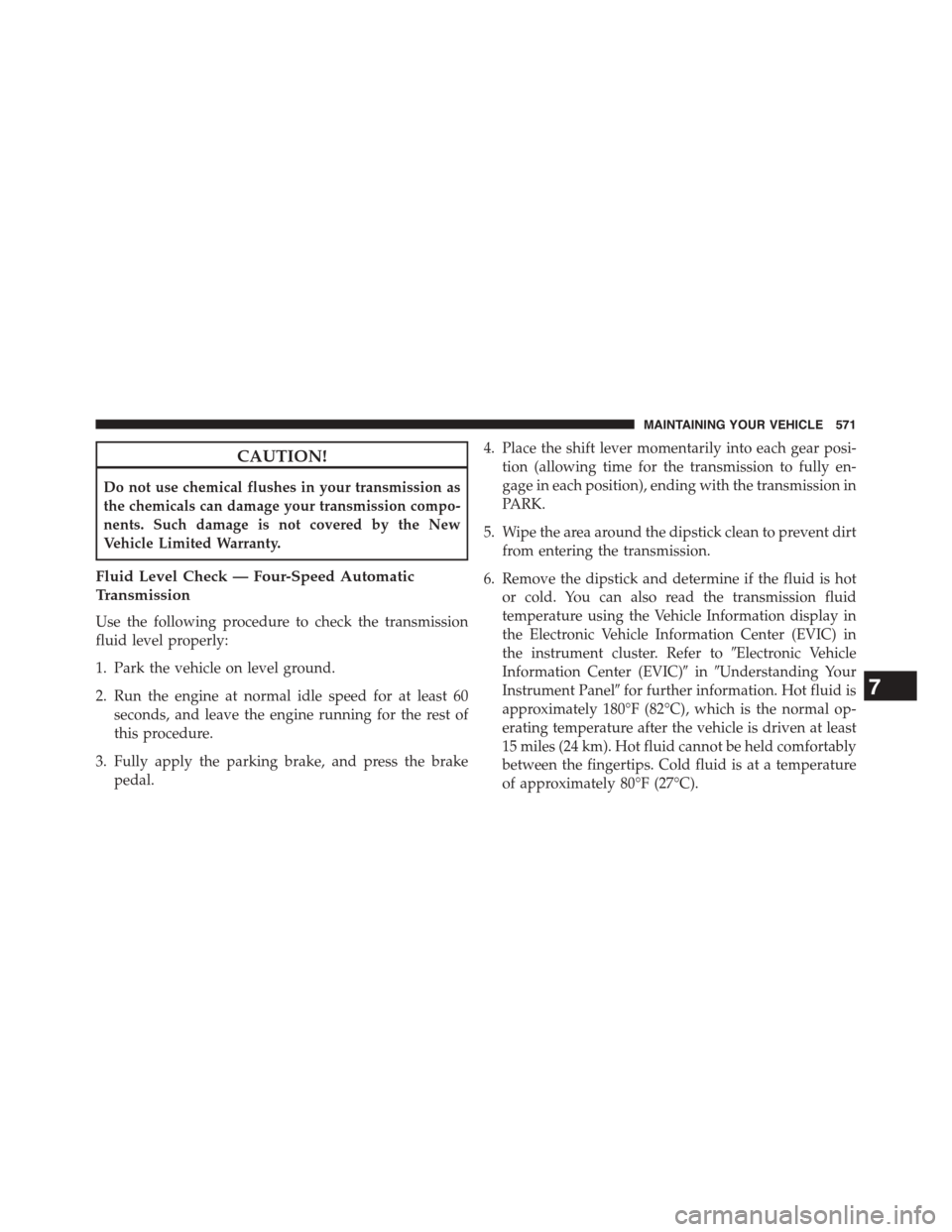
CAUTION!
Do not use chemical flushes in your transmission as
the chemicals can damage your transmission compo-
nents. Such damage is not covered by the New
Vehicle Limited Warranty.
Fluid Level Check — Four-Speed Automatic
Transmission
Use the following procedure to check the transmission
fluid level properly:
1. Park the vehicle on level ground.
2. Run the engine at normal idle speed for at least 60
seconds, and leave the engine running for the rest of
this procedure.
3. Fully apply the parking brake, and press the brake
pedal.
4. Place the shift lever momentarily into each gear posi-
tion (allowing time for the transmission to fully en-
gage in each position), ending with the transmission in
PARK.
5. Wipe the area around the dipstick clean to prevent dirt
from entering the transmission.
6. Remove the dipstick and determine if the fluid is hot
or cold. You can also read the transmission fluid
temperature using the Vehicle Information display in
the Electronic Vehicle Information Center (EVIC) in
the instrument cluster. Refer to#Electronic Vehicle
Information Center (EVIC)#in#Understanding Your
Instrument Panel#for further information. Hot fluid is
approximately 180°F (82°C), which is the normal op-
erating temperature after the vehicle is driven at least
15 miles (24 km). Hot fluid cannot be held comfortably
between the fingertips. Cold fluid is at a temperature
of approximately 80°F (27°C).
7
MAINTAINING YOUR VEHICLE 571
Page 575 of 648
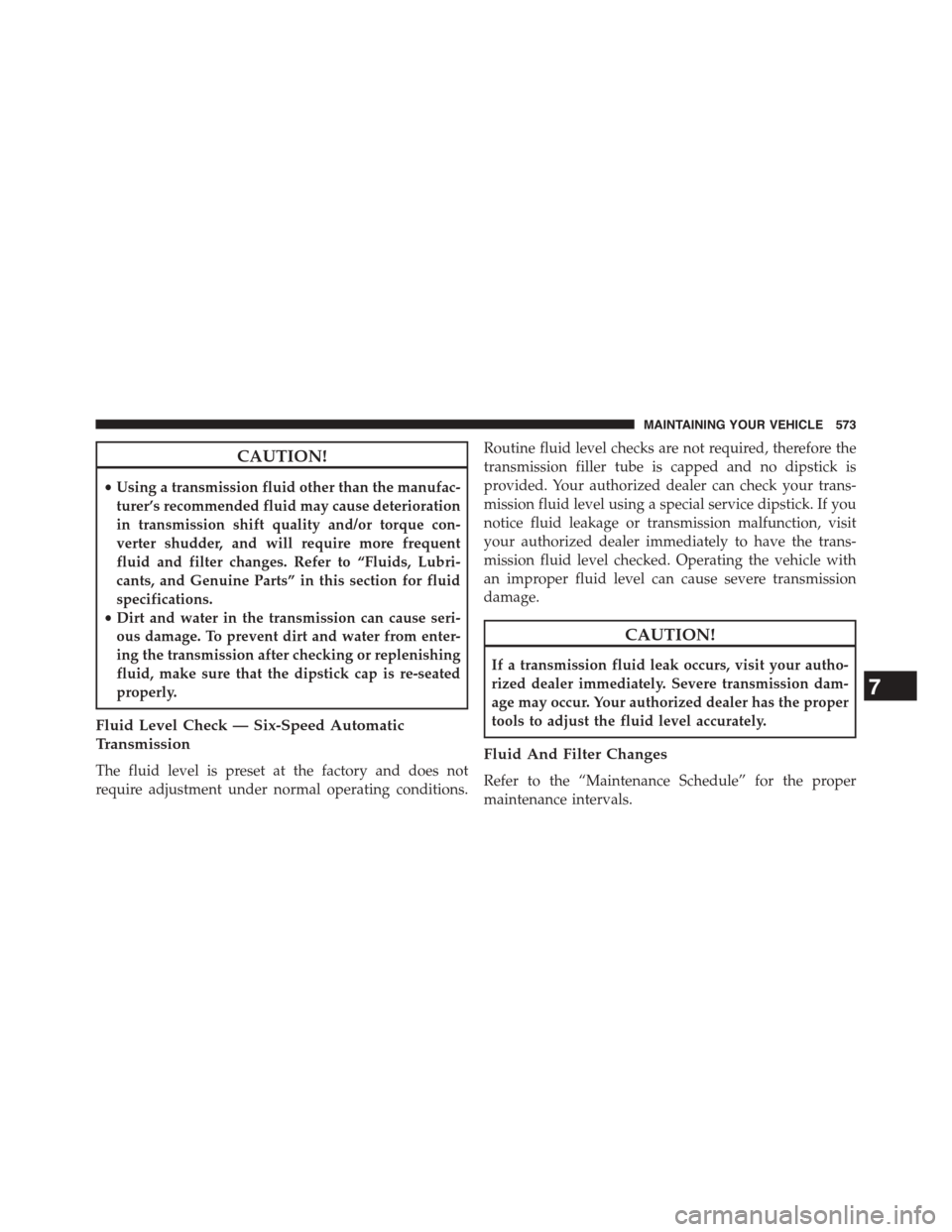
CAUTION!
•Using a transmission fluid other than the manufac-
turer’s recommended fluid may cause deterioration
in transmission shift quality and/or torque con-
verter shudder, and will require more frequent
fluid and filter changes. Refer to “Fluids, Lubri-
cants, and Genuine Parts” in this section for fluid
specifications.
•Dirt and water in the transmission can cause seri-
ous damage. To prevent dirt and water from enter-
ing the transmission after checking or replenishing
fluid, make sure that the dipstick cap is re-seated
properly.
Fluid Level Check — Six-Speed Automatic
Transmission
The fluid level is preset at the factory and does not
require adjustment under normal operating conditions.
Routine fluid level checks are not required, therefore the
transmission filler tube is capped and no dipstick is
provided. Your authorized dealer can check your trans-
mission fluid level using a special service dipstick. If you
notice fluid leakage or transmission malfunction, visit
your authorized dealer immediately to have the trans-
mission fluid level checked. Operating the vehicle with
an improper fluid level can cause severe transmission
damage.
CAUTION!
If a transmission fluid leak occurs, visit your autho-
rized dealer immediately. Severe transmission dam-
age may occur. Your authorized dealer has the proper
tools to adjust the fluid level accurately.
Fluid And Filter Changes
Refer to the “Maintenance Schedule” for the proper
maintenance intervals.
7
MAINTAINING YOUR VEHICLE 573
Page 603 of 648
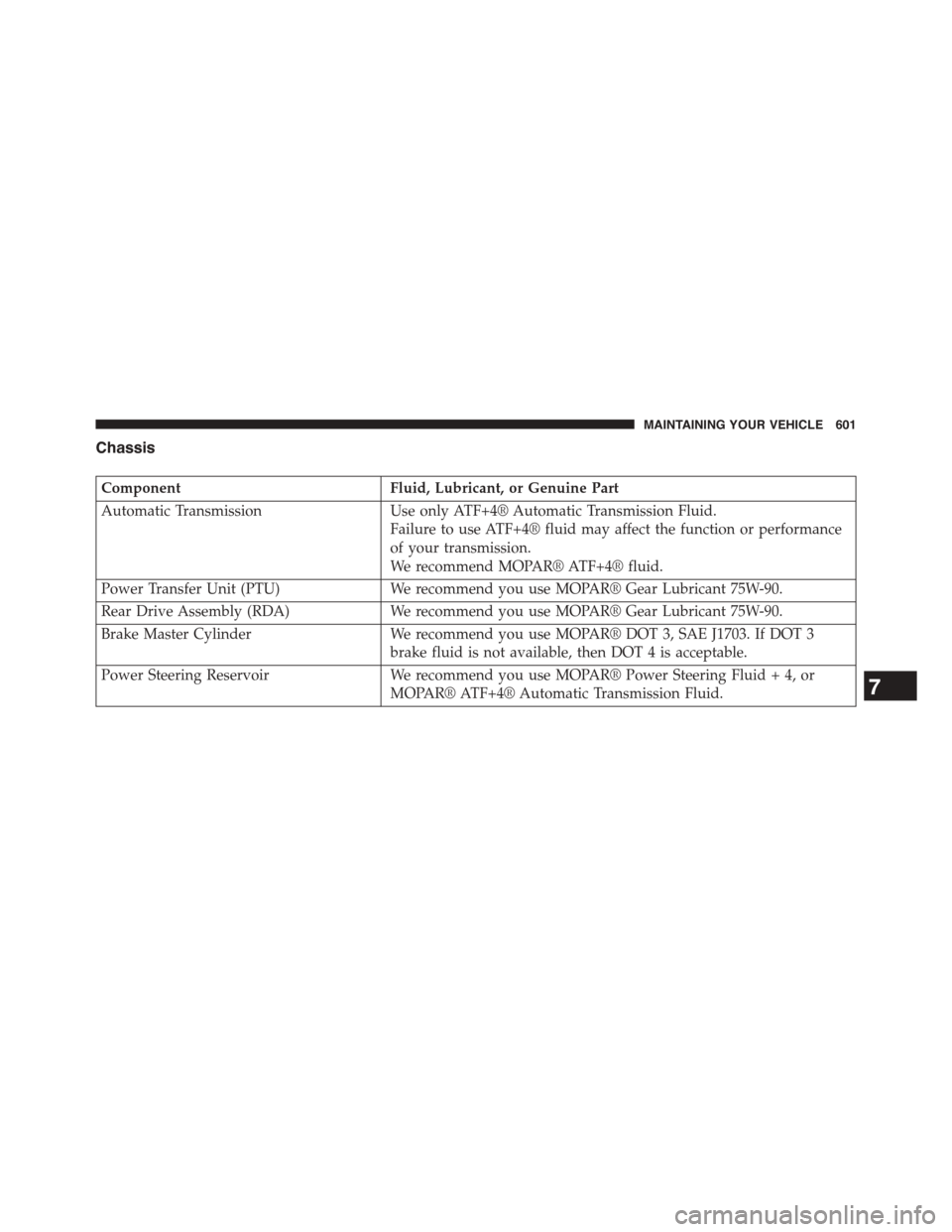
Chassis
ComponentFluid, Lubricant, or Genuine Part
Automatic TransmissionUse only ATF+4® Automatic Transmission Fluid.
Failure to use ATF+4® fluid may affect the function or performance
of your transmission.
We recommend MOPAR® ATF+4® fluid.
Power Transfer Unit (PTU)We recommend you use MOPAR® Gear Lubricant 75W-90.
Rear Drive Assembly (RDA)We recommend you use MOPAR® Gear Lubricant 75W-90.
Brake Master CylinderWe recommend you use MOPAR® DOT 3, SAE J1703. If DOT 3
brake fluid is not available, then DOT 4 is acceptable.
Power Steering ReservoirWe recommend you use MOPAR® Power Steering Fluid + 4, or
MOPAR® ATF+4® Automatic Transmission Fluid.7
MAINTAINING YOUR VEHICLE 601
Page 607 of 648
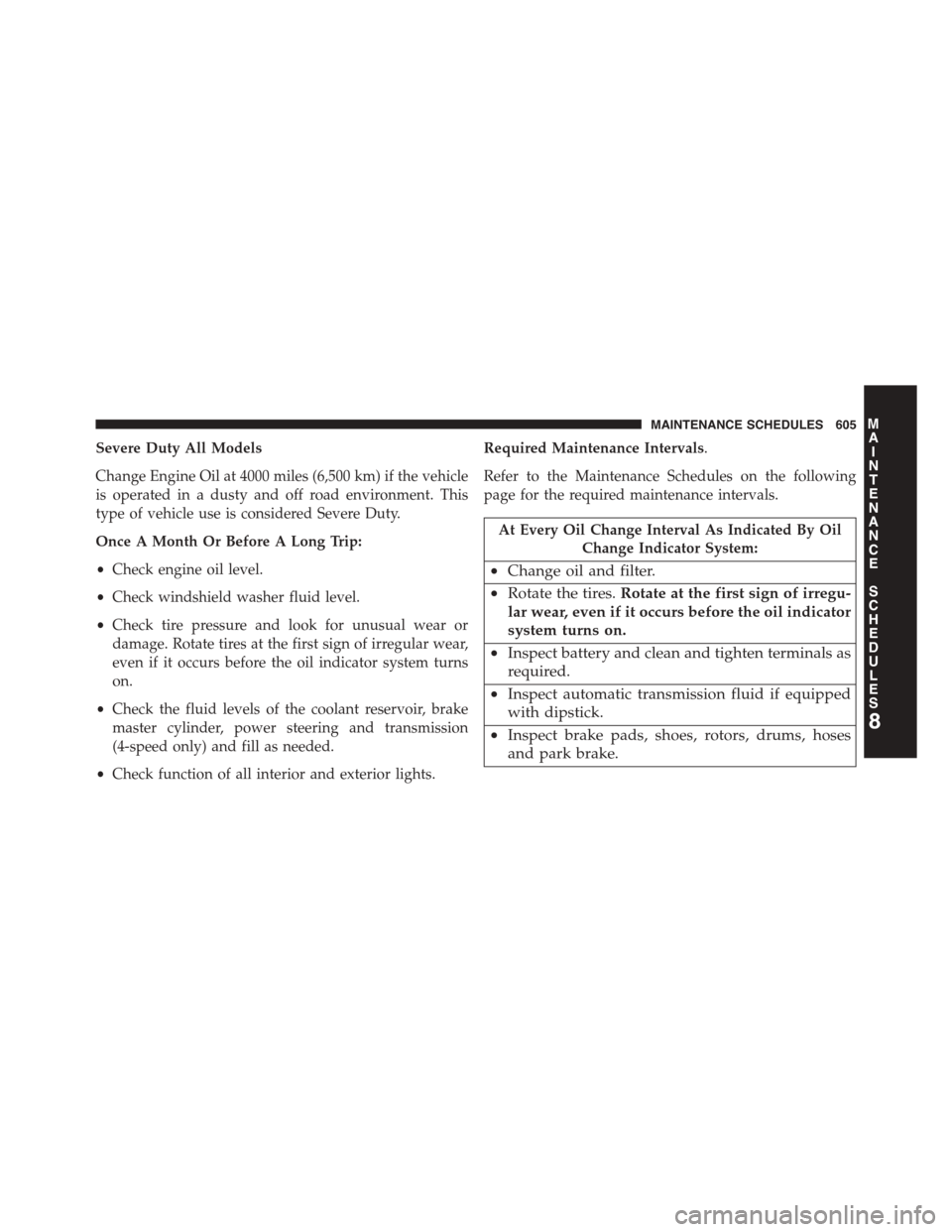
Severe Duty All Models
Change Engine Oil at 4000 miles (6,500 km) if the vehicle
is operated in a dusty and off road environment. This
type of vehicle use is considered Severe Duty.
Once A Month Or Before A Long Trip:
•Check engine oil level.
•Check windshield washer fluid level.
•Check tire pressure and look for unusual wear or
damage. Rotate tires at the first sign of irregular wear,
even if it occurs before the oil indicator system turns
on.
•Check the fluid levels of the coolant reservoir, brake
master cylinder, power steering and transmission
(4-speed only) and fill as needed.
•Check function of all interior and exterior lights.
Required Maintenance Intervals.
Refer to the Maintenance Schedules on the following
page for the required maintenance intervals.
At Every Oil Change Interval As Indicated By Oil
Change Indicator System:
•Change oil and filter.
•Rotate the tires.Rotate at the first sign of irregu-
lar wear, even if it occurs before the oil indicator
system turns on.
•Inspect battery and clean and tighten terminals as
required.
•Inspect automatic transmission fluid if equipped
with dipstick.
•Inspect brake pads, shoes, rotors, drums, hoses
and park brake.
8
MAINTENANCE
SCHEDULES
MAINTENANCE SCHEDULES 605
Page 610 of 648
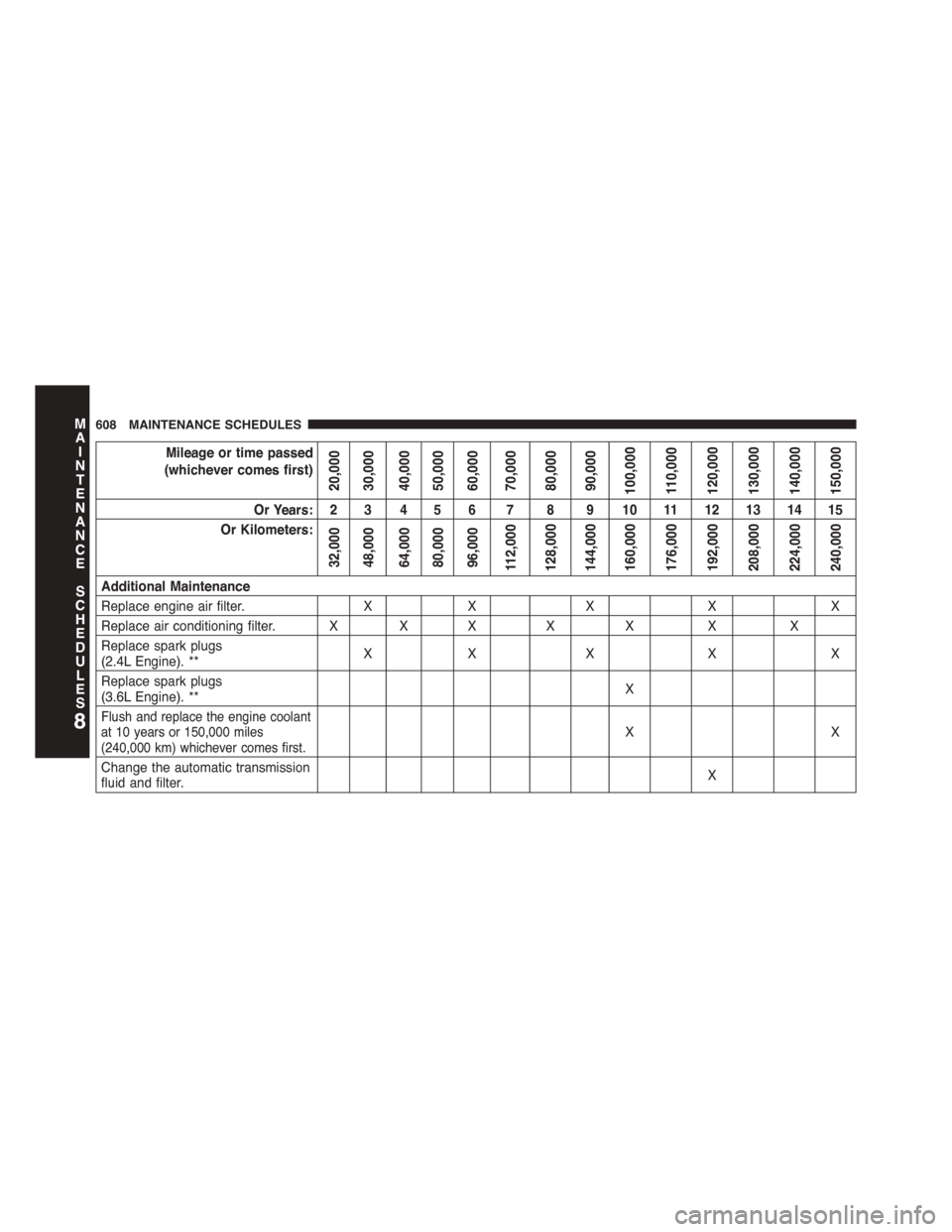
Mileage or time passed
(whichever comes first)
20,00030,00040,00050,00060,00070,00080,00090,000100,000110,000120,000130,000140,000150,000
Or Years: 2 3 4 5 6 7 8 9 10 11 12 13 14 15
Or Kilometers:
32,00048,00064,00080,00096,000112,000128,000144,000160,000176,000192,000208,000224,000240,000
Additional Maintenance
Replace engine air filter.XXXXX
Replace air conditioning filter. X X XXXXX
Replace spark plugs(2.4L Engine). **XX X X X
Replace spark plugs(3.6L Engine). **X
Flush and replace the engine coolantat 10 years or 150,000 miles(240,000 km) whichever comes first.XX
Change the automatic transmissionfluid and filter.X
8
MAINTENANCE
SCHEDULES
608 MAINTENANCE SCHEDULES