climate control DODGE JOURNEY 2015 1.G Owner's Manual
[x] Cancel search | Manufacturer: DODGE, Model Year: 2015, Model line: JOURNEY, Model: DODGE JOURNEY 2015 1.GPages: 648
Page 403 of 648
Window Fogging
Interior fogging on the windshield can be quickly re-
moved by turning the mode selector to Defrost. The
Defrost/Floor mode can be used to maintain a clear
windshield and provide sufficient heating. If side win-
dow fogging becomes a problem, increase the blower
speed. Vehicle windows tend to fog on the inside in mild
but rainy or humid weather.
NOTE:
•Recirculation mode without A/C should not be used
for long periods, as fogging may occur.
•Automatic Temperature Controls (ATC) will automati-
cally adjust the climate control settings to reduce or
eliminate window fogging on the front windshield.
When this occurs, recirculation will be unavailable.
Outside Air Intake
Make sure the air intake, located directly in front of the
windshield, is free of obstructions such as leaves. Leaves
collected in the air intake may reduce airflow, and if they
enter the plenum, they could plug the water drains. In
winter months, make sure the air intake is clear of ice,
slush, and snow.
A/C Air Filter
The climate control system filters outside air containing
dust, pollen and some odors. Strong odors cannot be
totally filtered out. Refer to “Maintenance Procedures” in
“Maintaining Your Vehicle” for filter replacement instruc-
tions.
4
UNDERSTANDING YOUR INSTRUMENT PANEL 401
Page 442 of 648
ESC Operating Modes
The ESC system has two available operating modes.
Full On
This is the normal operating mode for ESC. Whenever
the vehicle is started the system will be in this mode. This
mode should be used for most driving situations. ESC
should only be turned to “Partial Off” for specific reasons
as noted. Refer to “Partial Off” for additional informa-
tion.
Partial Off
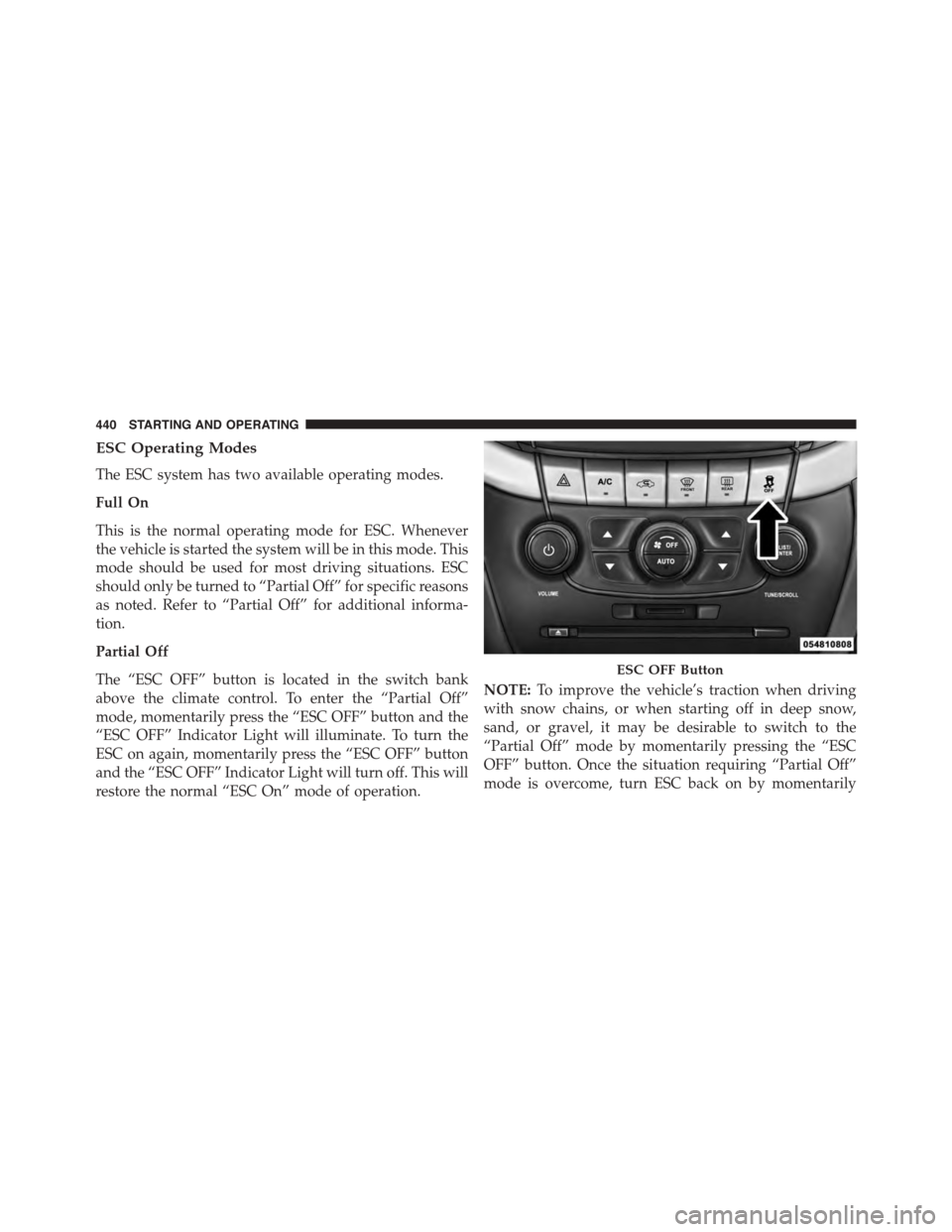
The “ESC OFF” button is located in the switch bank
above the climate control. To enter the “Partial Off”
mode, momentarily press the “ESC OFF” button and the
“ESC OFF” Indicator Light will illuminate. To turn the
ESC on again, momentarily press the “ESC OFF” button
and the “ESC OFF” Indicator Light will turn off. This will
restore the normal “ESC On” mode of operation.
NOTE:To improve the vehicle’s traction when driving
with snow chains, or when starting off in deep snow,
sand, or gravel, it may be desirable to switch to the
“Partial Off” mode by momentarily pressing the “ESC
OFF” button. Once the situation requiring “Partial Off”
mode is overcome, turn ESC back on by momentarily
ESC OFF Button
440 STARTING AND OPERATING
Page 513 of 648
HAZARD WARNING FLASHERS
The Hazard Warning flasher switch is located in the
instrument panel switch bank, above the climate controls.
Press the switch to turn on the Hazard Warning
flasher. When the switch is activated, all direc-
tional turn signals will flash on and off to warn oncoming
traffic of an emergency. Press the switch a second time to
turn off the Hazard Warning flashers.
This is an emergency warning system and it should not
be used when the vehicle is in motion. Use it when your
vehicle is disabled and it is creating a safety hazard for
other motorists.
When you must leave the vehicle to seek assistance, the
Hazard Warning flashers will continue to operate even
though the ignition is placed in the OFF position.
NOTE:With extended use the Hazard Warning flashers
may wear down your battery.
IF YOUR ENGINE OVERHEATS
In any of the following situations, you can reduce the
potential for overheating by taking the appropriate ac-
tion.
•On the highways — slow down.
•In city traffic — while stopped, place the transmission
in NEUTRAL, but do not increase engine idle speed.
NOTE:There are steps that you can take to slow down
an impending overheat condition:
•If your air conditioner (A/C) is on, turn it off. The A/C
system adds heat to the engine cooling system and
turning the A/C off can help remove this heat.
•You can also turn the temperature control to maximum
heat, the mode control to floor and the blower control
6
WHAT TO DO IN EMERGENCIES 511
Page 585 of 648
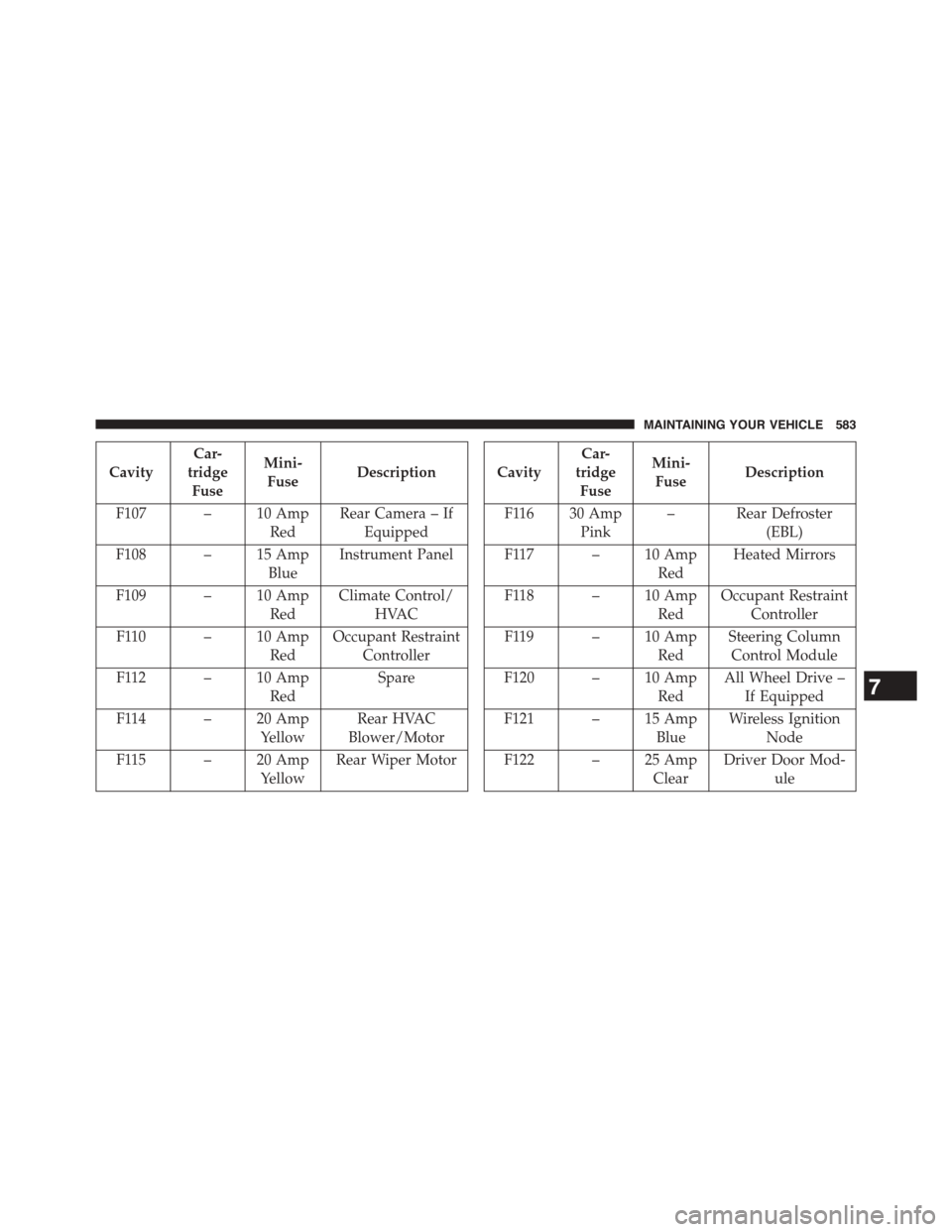
Cavity
Car-
tridge
Fuse
Mini-
FuseDescription
F107 – 10 Amp
Red
Rear Camera – If
Equipped
F108 – 15 Amp
Blue
Instrument Panel
F109 – 10 Amp
Red
Climate Control/
HVAC
F110 – 10 Amp
Red
Occupant Restraint
Controller
F112 – 10 Amp
Red
Spare
F114 – 20 Amp
Yellow
Rear HVAC
Blower/Motor
F115 – 20 Amp
Yellow
Rear Wiper Motor
Cavity
Car-
tridge
Fuse
Mini-
FuseDescription
F116 30 Amp
Pink
– Rear Defroster
(EBL)
F117 – 10 Amp
Red
Heated Mirrors
F118 – 10 Amp
Red
Occupant Restraint
Controller
F119 – 10 Amp
Red
Steering Column
Control Module
F120 – 10 Amp
Red
All Wheel Drive –
If Equipped
F121 – 15 Amp
Blue
Wireless Ignition
Node
F122 – 25 Amp
Clear
Driver Door Mod-
ule
7
MAINTAINING YOUR VEHICLE 583
Page 586 of 648
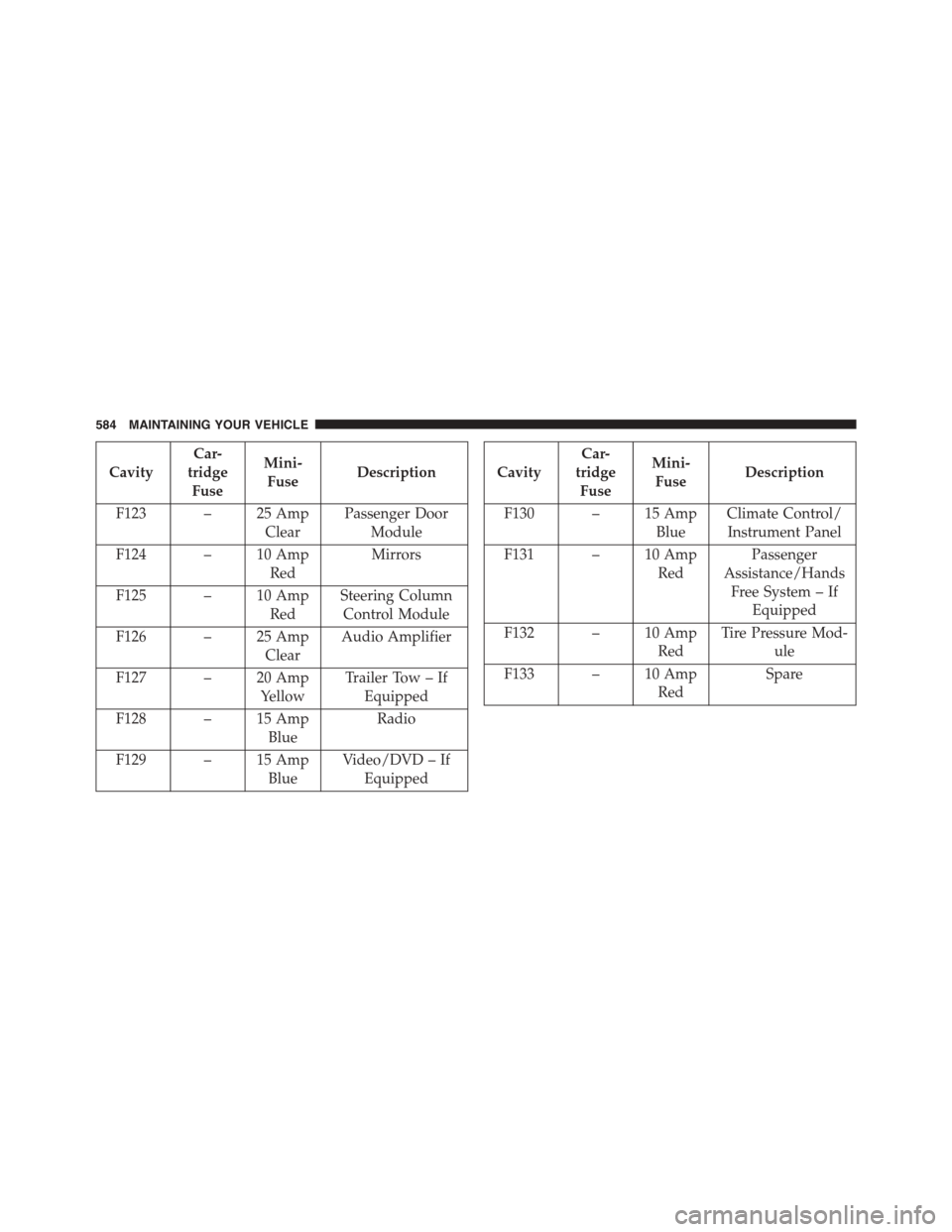
Cavity
Car-
tridge
Fuse
Mini-
FuseDescription
F123 – 25 Amp
Clear
Passenger Door
Module
F124 – 10 Amp
Red
Mirrors
F125 – 10 Amp
Red
Steering Column
Control Module
F126 – 25 Amp
Clear
Audio Amplifier
F127 – 20 Amp
Yellow
Trailer Tow – If
Equipped
F128 – 15 Amp
Blue
Radio
F129 – 15 Amp
Blue
Video/DVD – If
Equipped
Cavity
Car-
tridge
Fuse
Mini-
FuseDescription
F130 – 15 Amp
Blue
Climate Control/
Instrument Panel
F131 – 10 Amp
Red
Passenger
Assistance/Hands
Free System – If
Equipped
F132 – 10 Amp
Red
Tire Pressure Mod-
ule
F133 – 10 Amp
Red
Spare
584 MAINTAINING YOUR VEHICLE
Page 588 of 648
Cavity
Car-
tridge
Fuse
Mini-
FuseDescription
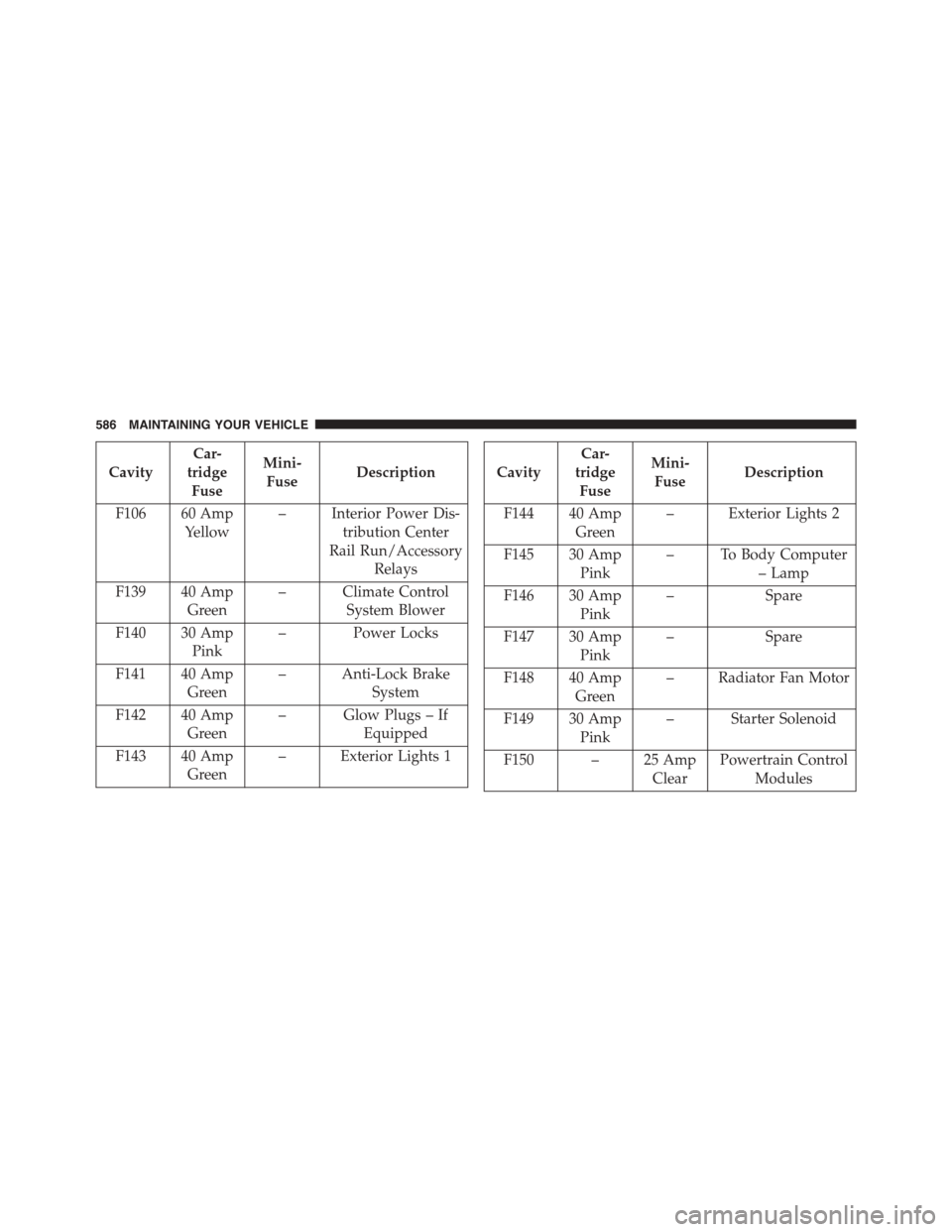
F106 60 Amp
Yellow
– Interior Power Dis-
tribution Center
Rail Run/Accessory
Relays
F139 40 Amp
Green
– Climate Control
System Blower
F140 30 Amp
Pink
– Power Locks
F141 40 Amp
Green
– Anti-Lock Brake
System
F142 40 Amp
Green
– Glow Plugs – If
Equipped
F143 40 Amp
Green
– Exterior Lights 1
Cavity
Car-
tridge
Fuse
Mini-
FuseDescription
F144 40 Amp
Green
– Exterior Lights 2
F145 30 Amp
Pink
– To Body Computer
– Lamp
F146 30 Amp
Pink
– Spare
F147 30 Amp
Pink
– Spare
F148 40 Amp
Green
– Radiator Fan Motor
F149 30 Amp
Pink
– Starter Solenoid
F150 – 25 Amp
Clear
Powertrain Control
Modules
586 MAINTAINING YOUR VEHICLE
Page 599 of 648
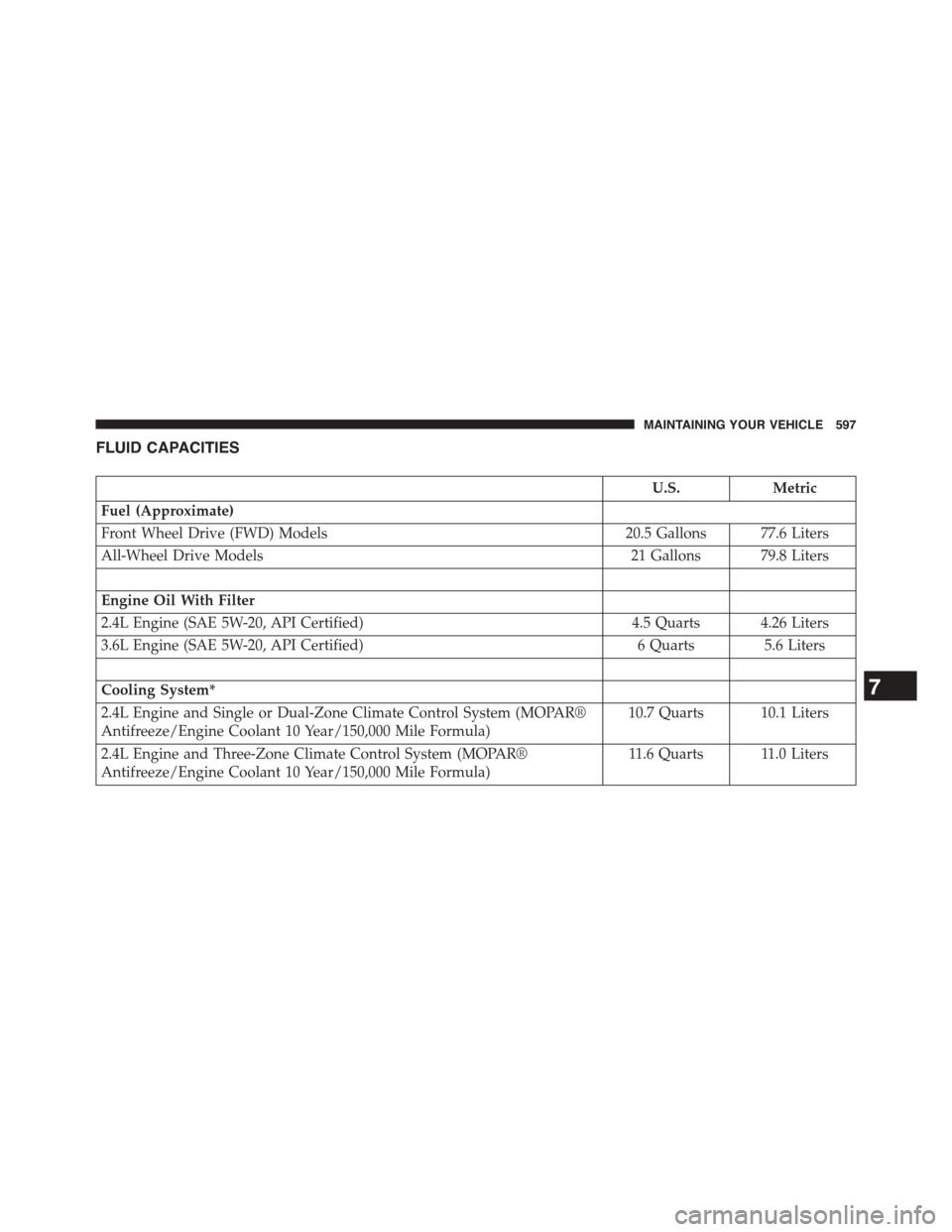
FLUID CAPACITIES
U.S.Metric
Fuel (Approximate)
Front Wheel Drive (FWD) Models20.5 Gallons 77.6 Liters
All-Wheel Drive Models21 Gallons 79.8 Liters
Engine Oil With Filter
2.4L Engine (SAE 5W-20, API Certified)4.5 Quarts 4.26 Liters
3.6L Engine (SAE 5W-20, API Certified)6 Quarts 5.6 Liters
Cooling System*
2.4L Engine and Single or Dual-Zone Climate Control System (MOPAR®
Antifreeze/Engine Coolant 10 Year/150,000 Mile Formula)
10.7 Quarts 10.1 Liters
2.4L Engine and Three-Zone Climate Control System (MOPAR®
Antifreeze/Engine Coolant 10 Year/150,000 Mile Formula)
11.6 Quarts 11.0 Liters
7
MAINTAINING YOUR VEHICLE 597
Page 600 of 648
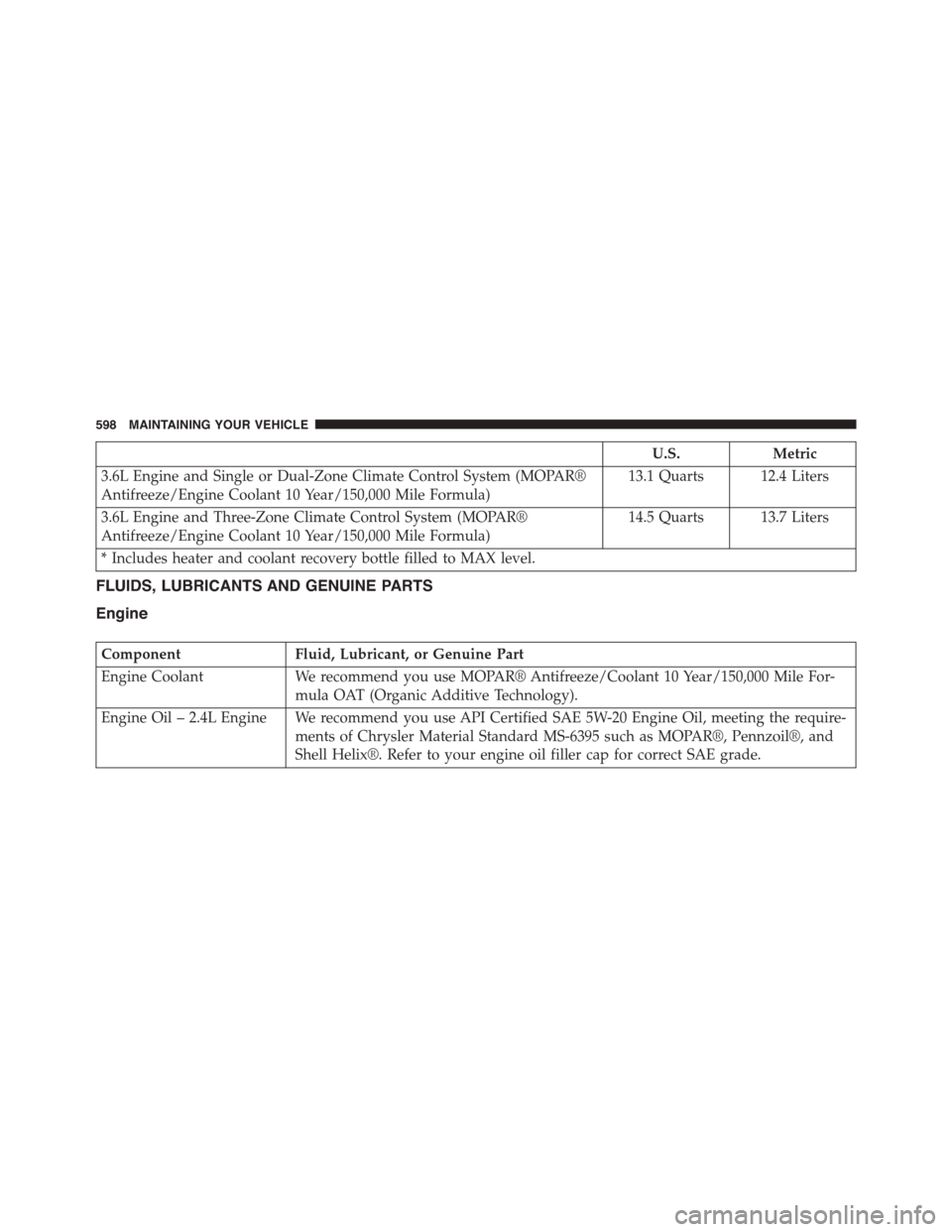
U.S.Metric
3.6L Engine and Single or Dual-Zone Climate Control System (MOPAR®
Antifreeze/Engine Coolant 10 Year/150,000 Mile Formula)
13.1 Quarts 12.4 Liters
3.6L Engine and Three-Zone Climate Control System (MOPAR®
Antifreeze/Engine Coolant 10 Year/150,000 Mile Formula)
14.5 Quarts 13.7 Liters
* Includes heater and coolant recovery bottle filled to MAX level.
FLUIDS, LUBRICANTS AND GENUINE PARTS
Engine
ComponentFluid, Lubricant, or Genuine Part
Engine CoolantWe recommend you use MOPAR® Antifreeze/Coolant 10 Year/150,000 Mile For-
mula OAT (Organic Additive Technology).
Engine Oil – 2.4L Engine We recommend you use API Certified SAE 5W-20 Engine Oil, meeting the require-
ments of Chrysler Material Standard MS-6395 such as MOPAR®, Pennzoil®, and
Shell Helix®. Refer to your engine oil filler cap for correct SAE grade.
598 MAINTAINING YOUR VEHICLE
Page 621 of 648
Call toll free at:
•1–800–890–4038 (U.S.)
•1–800–387–1143 (Canada)
Or
Visit us on the Worldwide Web at:
•www.techauthority.com
DEPARTMENT OF TRANSPORTATION UNIFORM
TIRE QUALITY GRADES
The following tire grading categories were established by
the National Highway Traffic Safety Administration. The
specific grade rating assigned by the tire’s manufacturer
in each category is shown on the sidewall of the tires on
your vehicle.
All passenger car tires must conform to Federal safety
requirements in addition to these grades.
Treadwear
The Treadwear grade is a comparative rating, based on
the wear rate of the tire when tested under controlled
conditions on a specified government test course. For
example, a tire graded 150 would wear one and one-half
times as well on the government course as a tire graded
100. The relative performance of tires depends upon the
actual conditions of their use, however, and may depart
significantly from the norm due to variations in driving
habits, service practices, and differences in road charac-
teristics and climate.
Traction Grades
The Traction grades, from highest to lowest, are AA, A, B,
and C. These grades represent the tire’s ability to stop on
wet pavement, as measured under controlled conditions
on specified government test surfaces of asphalt and9
IF YOU NEED CONSUMER ASSISTANCE 619