engine oil DODGE JOURNEY 2015 1.G Owner's Manual
[x] Cancel search | Manufacturer: DODGE, Model Year: 2015, Model line: JOURNEY, Model: DODGE JOURNEY 2015 1.GPages: 648
Page 558 of 648
operation and to protect against rust and wear. Prior to
the application of any lubricant, the parts concerned
should be wiped clean to remove dust and grit; after
lubricating excess oil and grease should be removed.
Particular attention should also be given to hood latching
components to ensure proper function. When performing
other underhood services, the hood latch, release mecha-
nism and safety catch should be cleaned and lubricated.
The external lock cylinders should be lubricated twice a
year, preferably in the Fall and Spring. Apply a small
amount of a high quality lubricant, such as MOPAR®
Lock Cylinder Lubricant directly into the lock cylinder.
Windshield Wiper Blades
Clean the rubber edges of the wiper blades and the
windshield periodically with a sponge or soft cloth and a
mild nonabrasive cleaner. This will remove accumula-
tions of salt or road film.
Operation of the wipers on dry glass for long periods
may cause deterioration of the wiper blades. Always use
washer fluid when using the wipers to remove salt or dirt
from a dry windshield.
Avoid using the wiper blades to remove frost or ice from
the windshield. Keep the blade rubber out of contact with
petroleum products such as engine oil, gasoline, etc.
NOTE:Life expectancy of wiper blades varies depend-
ing on geographical area and frequency of use. Poor
performance of blades may be present with chattering,
marks, water lines or wet spots. If any of these conditions
are present, clean the wiper blades or replace as neces-
sary.
Rear Wiper Blade Removal/Installation
1. Lift the pivot cap on the rear wiper arm upward, this
will allow the rear wiper blade to be raised off of the
liftgate glass.
556 MAINTAINING YOUR VEHICLE
Page 561 of 648
Exhaust System
The best protection against carbon monoxide entry into
the vehicle body is a properly maintained engine exhaust
system.
If you notice a change in the sound of the exhaust system;
or if the exhaust fumes can be detected inside the vehicle;
or when the underside or rear of the vehicle is damaged;
have an authorized technician inspect the complete ex-
haust system and adjacent body areas for broken, dam-
aged, deteriorated, or mispositioned parts. Open seams
or loose connections could permit exhaust fumes to seep
into the passenger compartment. In addition, have the
exhaust system inspected each time the vehicle is raised
for lubrication or oil change. Replace as required.
WARNING!
•Exhaust gases can injure or kill. They contain
carbon monoxide (CO), which is colorless and
odorless. Breathing it can make you unconscious
and can eventually poison you. To avoid breathing
CO, refer to “Safety Tips/Exhaust Gas” in “Things
To Know Before Starting Your Vehicle” for further
information.
•A hot exhaust system can start a fire if you park
over materials that can burn. Such materials might
be grass or leaves coming into contact with your
exhaust system. Do not park or operate your ve-
hicle in areas where your exhaust system can con-
tact anything that can burn.
7
MAINTAINING YOUR VEHICLE 559
Page 571 of 648
WARNING!
•Use only manufacturer’s recommended brake
fluid. Refer to “Fluids, Lubricants, and Genuine
Parts” in “Maintaining Your Vehicle” for further
information. Using the wrong type of brake fluid
can severely damage your brake system and/or
impair its performance. The proper type of brake
fluid for your vehicle is also identified on the
original factory installed hydraulic master cylinder
reservoir.
(Continued)
WARNING!(Continued)
•To avoid contamination from foreign matter or
moisture, use only new brake fluid or fluid that has
been in a tightly closed container. Keep the master
cylinder reservoir cap secured at all times. Brake
fluid in a open container absorbs moisture from the
air resulting in a lower boiling point. This may
cause it to boil unexpectedly during hard or pro-
longed braking, resulting in sudden brake failure.
This could result in a collision.
•Overfilling the brake fluid reservoir can result in
spilling brake fluid on hot engine parts, causing
the brake fluid to catch fire. Brake fluid can also
damage painted and vinyl surfaces, care should be
taken to avoid its contact with these surfaces.
(Continued)
7
MAINTAINING YOUR VEHICLE 569
Page 599 of 648
FLUID CAPACITIES
U.S.Metric
Fuel (Approximate)
Front Wheel Drive (FWD) Models20.5 Gallons 77.6 Liters
All-Wheel Drive Models21 Gallons 79.8 Liters
Engine Oil With Filter
2.4L Engine (SAE 5W-20, API Certified)4.5 Quarts 4.26 Liters
3.6L Engine (SAE 5W-20, API Certified)6 Quarts 5.6 Liters
Cooling System*
2.4L Engine and Single or Dual-Zone Climate Control System (MOPAR®
Antifreeze/Engine Coolant 10 Year/150,000 Mile Formula)
10.7 Quarts 10.1 Liters
2.4L Engine and Three-Zone Climate Control System (MOPAR®
Antifreeze/Engine Coolant 10 Year/150,000 Mile Formula)
11.6 Quarts 11.0 Liters
7
MAINTAINING YOUR VEHICLE 597
Page 600 of 648
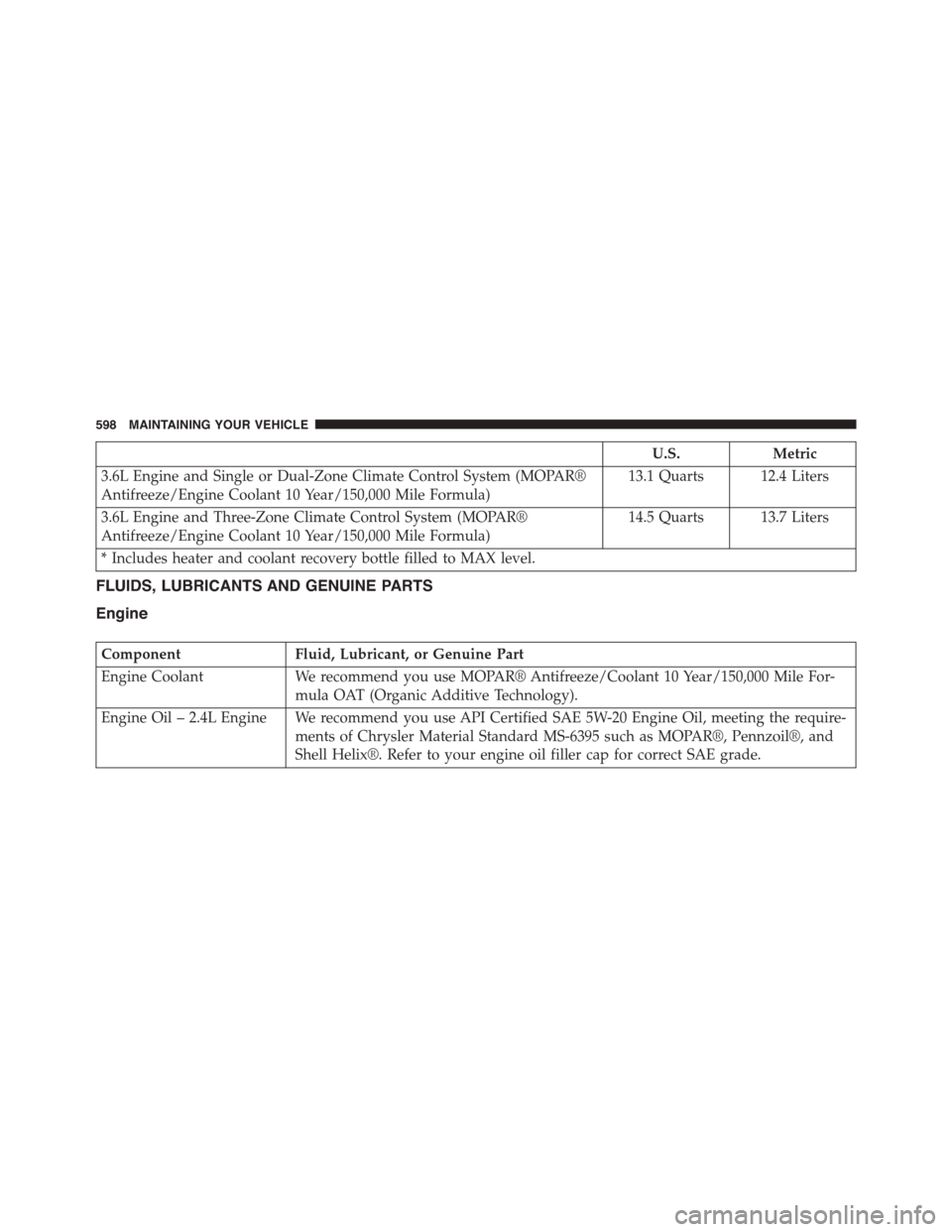
U.S.Metric
3.6L Engine and Single or Dual-Zone Climate Control System (MOPAR®
Antifreeze/Engine Coolant 10 Year/150,000 Mile Formula)
13.1 Quarts 12.4 Liters
3.6L Engine and Three-Zone Climate Control System (MOPAR®
Antifreeze/Engine Coolant 10 Year/150,000 Mile Formula)
14.5 Quarts 13.7 Liters
* Includes heater and coolant recovery bottle filled to MAX level.
FLUIDS, LUBRICANTS AND GENUINE PARTS
Engine
ComponentFluid, Lubricant, or Genuine Part
Engine CoolantWe recommend you use MOPAR® Antifreeze/Coolant 10 Year/150,000 Mile For-
mula OAT (Organic Additive Technology).
Engine Oil – 2.4L Engine We recommend you use API Certified SAE 5W-20 Engine Oil, meeting the require-
ments of Chrysler Material Standard MS-6395 such as MOPAR®, Pennzoil®, and
Shell Helix®. Refer to your engine oil filler cap for correct SAE grade.
598 MAINTAINING YOUR VEHICLE
Page 601 of 648
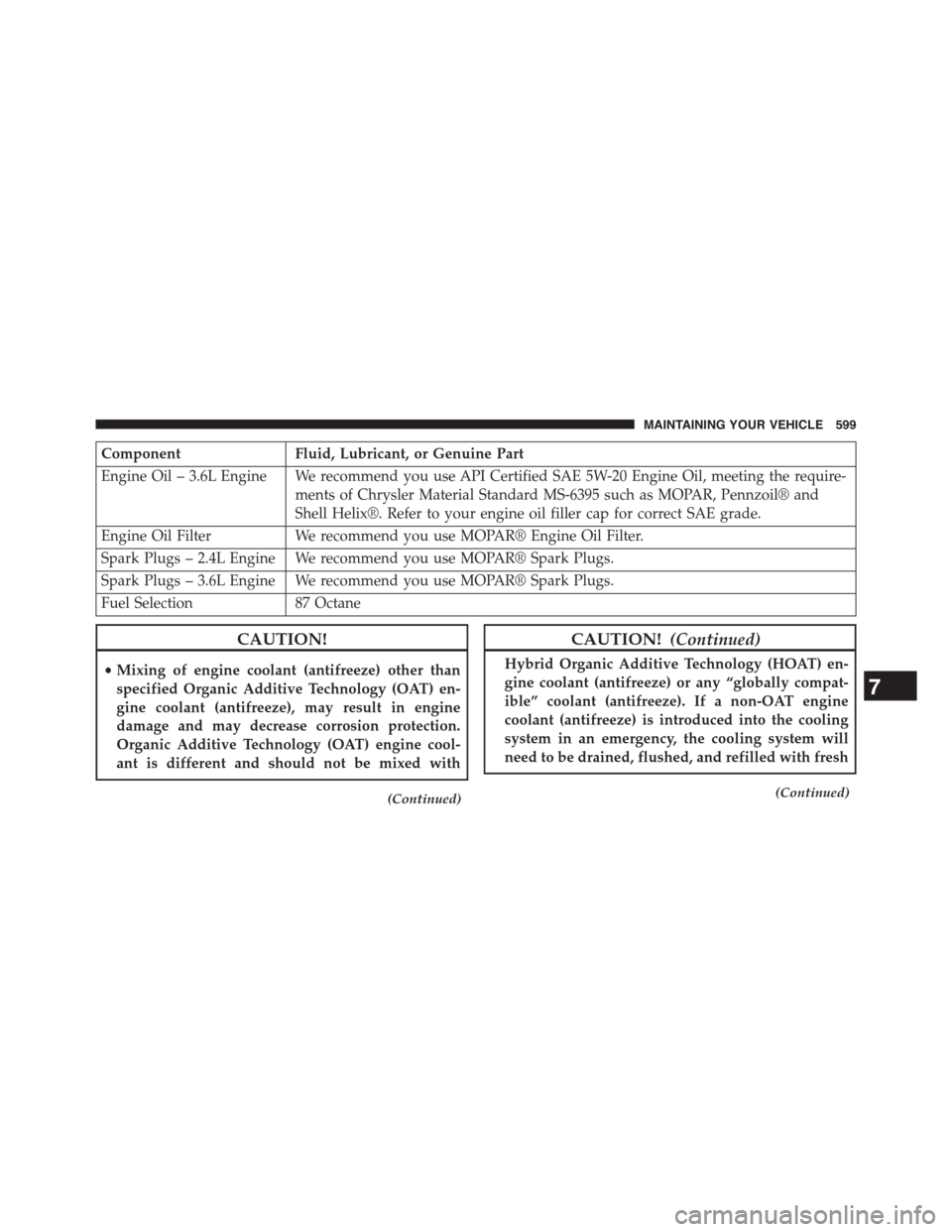
ComponentFluid, Lubricant, or Genuine Part
Engine Oil – 3.6L Engine We recommend you use API Certified SAE 5W-20 Engine Oil, meeting the require-
ments of Chrysler Material Standard MS-6395 such as MOPAR, Pennzoil® and
Shell Helix®. Refer to your engine oil filler cap for correct SAE grade.
Engine Oil FilterWe recommend you use MOPAR® Engine Oil Filter.
Spark Plugs – 2.4L Engine We recommend you use MOPAR® Spark Plugs.
Spark Plugs – 3.6L Engine We recommend you use MOPAR® Spark Plugs.
Fuel Selection87 Octane
CAUTION!
•Mixing of engine coolant (antifreeze) other than
specified Organic Additive Technology (OAT) en-
gine coolant (antifreeze), may result in engine
damage and may decrease corrosion protection.
Organic Additive Technology (OAT) engine cool-
ant is different and should not be mixed with
(Continued)
CAUTION!(Continued)
Hybrid Organic Additive Technology (HOAT) en-
gine coolant (antifreeze) or any “globally compat-
ible” coolant (antifreeze). If a non-OAT engine
coolant (antifreeze) is introduced into the cooling
system in an emergency, the cooling system will
need to be drained, flushed, and refilled with fresh
(Continued)
7
MAINTAINING YOUR VEHICLE 599
Page 606 of 648
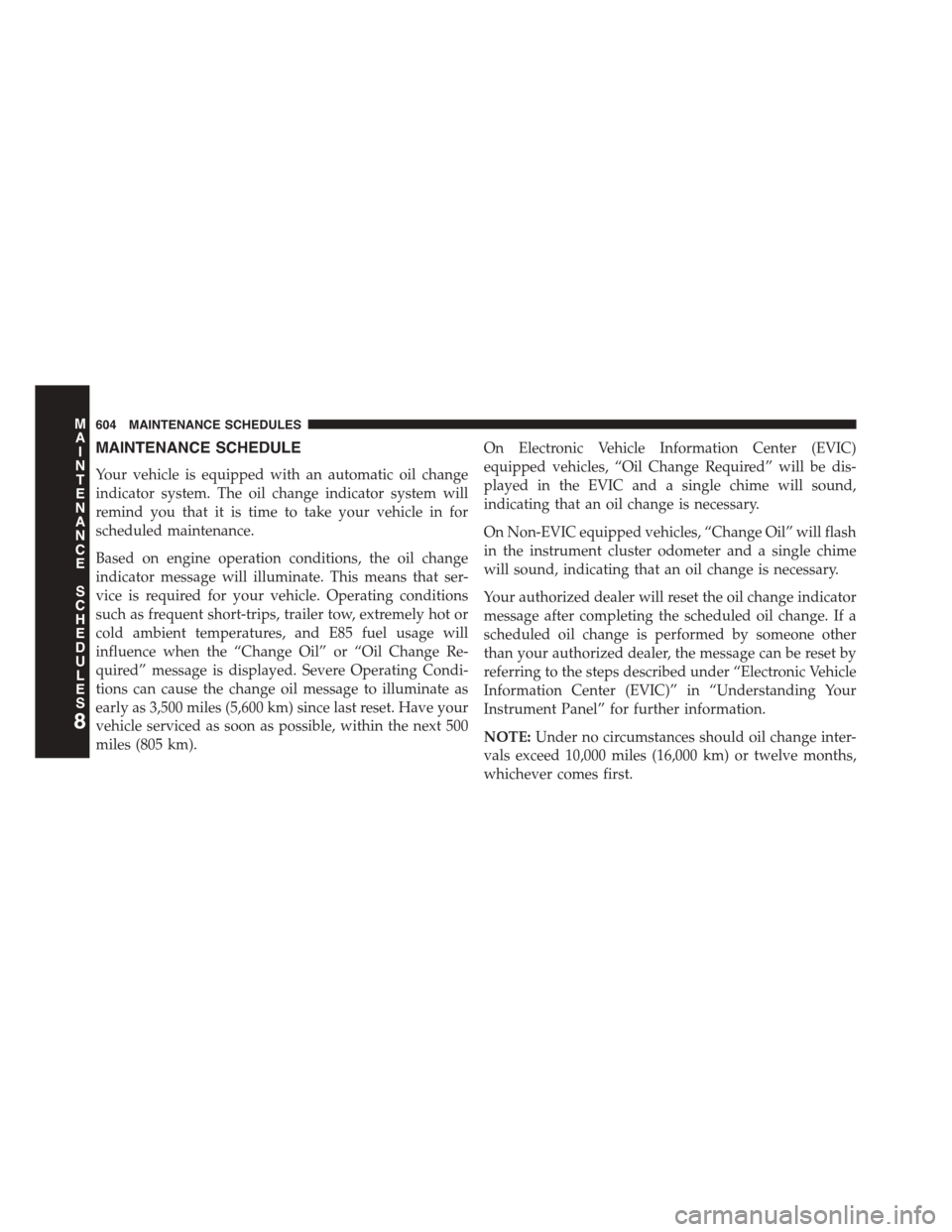
MAINTENANCE SCHEDULE
Your vehicle is equipped with an automatic oil change
indicator system. The oil change indicator system will
remind you that it is time to take your vehicle in for
scheduled maintenance.
Based on engine operation conditions, the oil change
indicator message will illuminate. This means that ser-
vice is required for your vehicle. Operating conditions
such as frequent short-trips, trailer tow, extremely hot or
cold ambient temperatures, and E85 fuel usage will
influence when the “Change Oil” or “Oil Change Re-
quired” message is displayed. Severe Operating Condi-
tions can cause the change oil message to illuminate as
early as 3,500 miles (5,600 km) since last reset. Have your
vehicle serviced as soon as possible, within the next 500
miles (805 km).
On Electronic Vehicle Information Center (EVIC)
equipped vehicles, “Oil Change Required” will be dis-
played in the EVIC and a single chime will sound,
indicating that an oil change is necessary.
On Non-EVIC equipped vehicles, “Change Oil” will flash
in the instrument cluster odometer and a single chime
will sound, indicating that an oil change is necessary.
Your authorized dealer will reset the oil change indicator
message after completing the scheduled oil change. If a
scheduled oil change is performed by someone other
than your authorized dealer, the message can be reset by
referring to the steps described under “Electronic Vehicle
Information Center (EVIC)” in “Understanding Your
Instrument Panel” for further information.
NOTE:Under no circumstances should oil change inter-
vals exceed 10,000 miles (16,000 km) or twelve months,
whichever comes first.
8
MAINTENANCE
SCHEDULES
604 MAINTENANCE SCHEDULES
Page 607 of 648
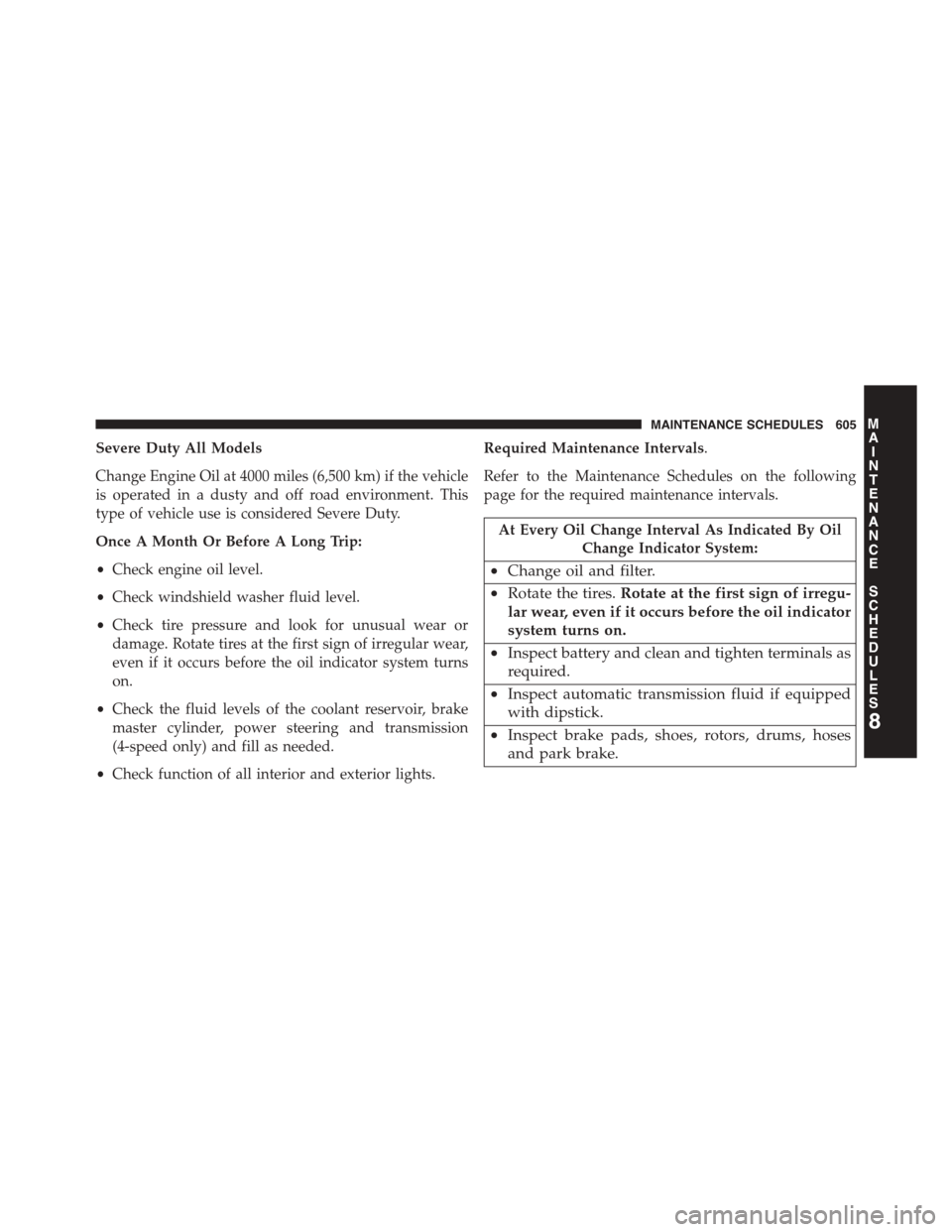
Severe Duty All Models
Change Engine Oil at 4000 miles (6,500 km) if the vehicle
is operated in a dusty and off road environment. This
type of vehicle use is considered Severe Duty.
Once A Month Or Before A Long Trip:
•Check engine oil level.
•Check windshield washer fluid level.
•Check tire pressure and look for unusual wear or
damage. Rotate tires at the first sign of irregular wear,
even if it occurs before the oil indicator system turns
on.
•Check the fluid levels of the coolant reservoir, brake
master cylinder, power steering and transmission
(4-speed only) and fill as needed.
•Check function of all interior and exterior lights.
Required Maintenance Intervals.
Refer to the Maintenance Schedules on the following
page for the required maintenance intervals.
At Every Oil Change Interval As Indicated By Oil
Change Indicator System:
•Change oil and filter.
•Rotate the tires.Rotate at the first sign of irregu-
lar wear, even if it occurs before the oil indicator
system turns on.
•Inspect battery and clean and tighten terminals as
required.
•Inspect automatic transmission fluid if equipped
with dipstick.
•Inspect brake pads, shoes, rotors, drums, hoses
and park brake.
8
MAINTENANCE
SCHEDULES
MAINTENANCE SCHEDULES 605
Page 608 of 648
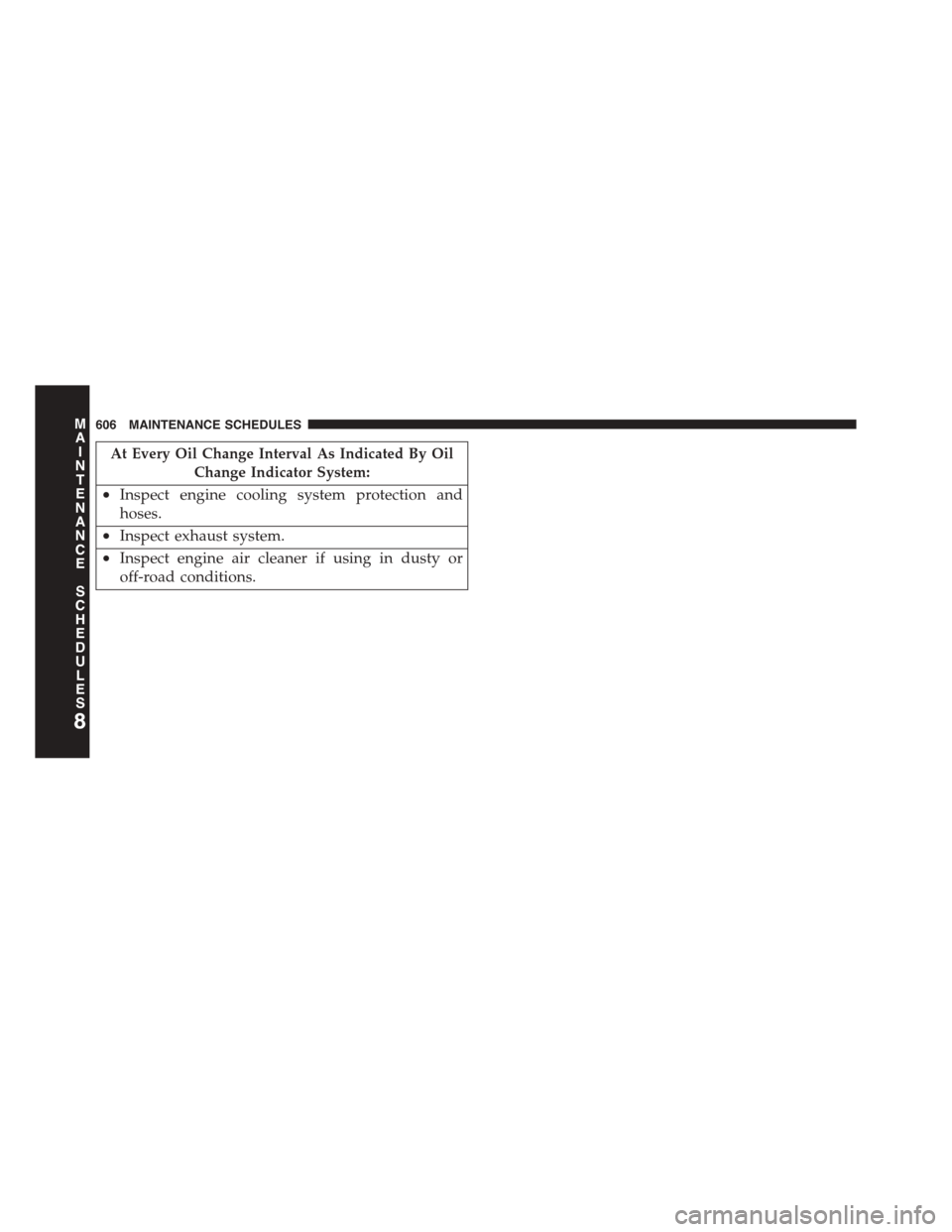
At Every Oil Change Interval As Indicated By Oil
Change Indicator System:
•Inspect engine cooling system protection and
hoses.
•Inspect exhaust system.
•Inspect engine air cleaner if using in dusty or
off-road conditions.
8
MAINTENANCE
SCHEDULES
606 MAINTENANCE SCHEDULES
Page 626 of 648
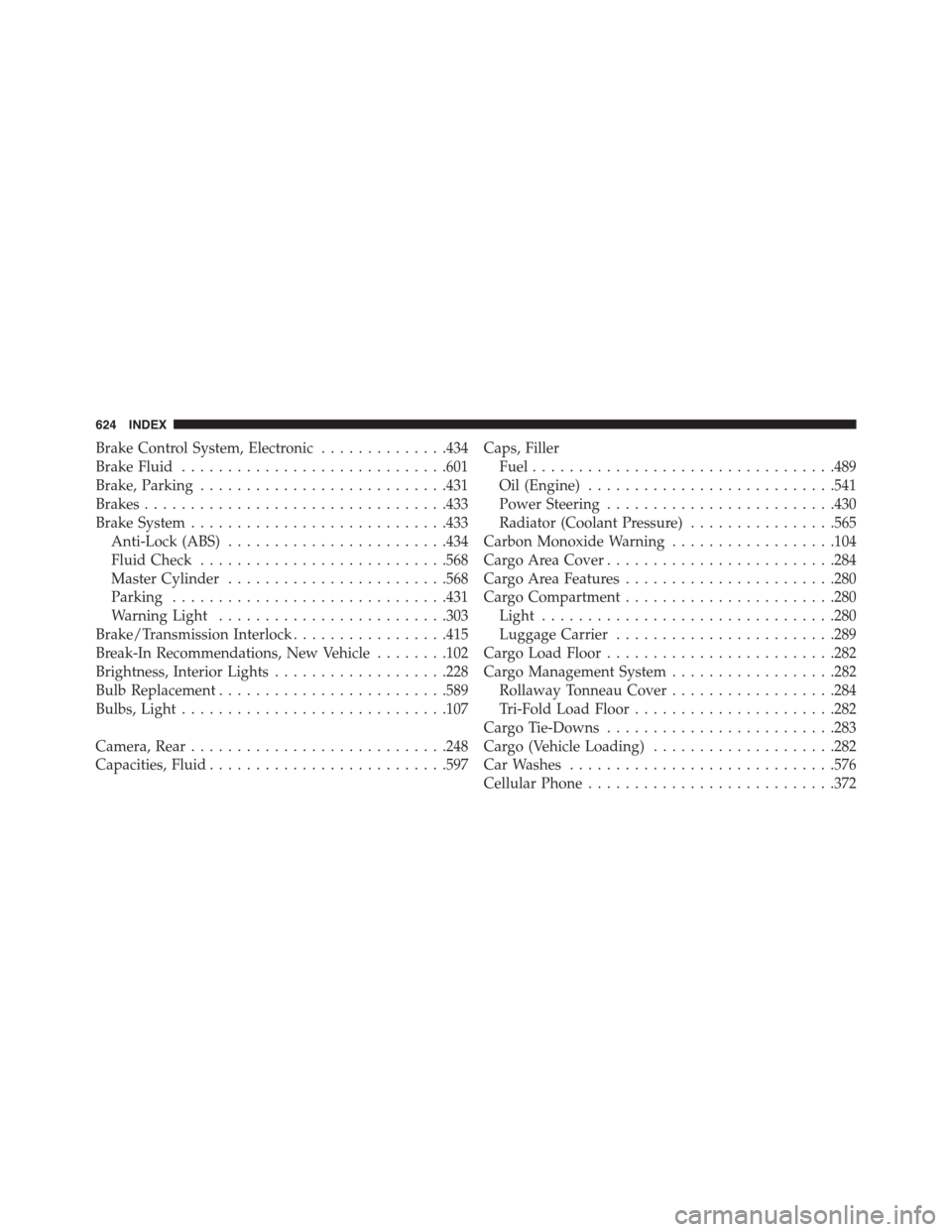
Brake Control System, Electronic..............434
Brake Fluid.............................601
Brake, Parking...........................431
Brakes.................................433
Brake System............................433
Anti-Lock (ABS)........................434
Fluid Check...........................568
Master Cylinder........................568
Parking..............................431
Warning Light.........................303
Brake/Transmission Interlock.................415
Break-In Recommendations, New Vehicle........102
Brightness, Interior Lights...................228
Bulb Replacement.........................589
Bulbs, Light.............................107
Camera, Rear............................248
Capacities, Fluid..........................597
Caps, Filler
Fuel.................................489
Oil (Engine)...........................541
Power Steering.........................430
Radiator (Coolant Pressure)................565
Carbon Monoxide Warning..................104
Cargo Area Cover.........................284
Cargo Area Features.......................280
Cargo Compartment.......................280
Light................................280
Luggage Carrier........................289
Cargo Load Floor.........................282
Cargo Management System..................282
Rollaway Tonneau Cover..................284
Tri-Fold Load Floor......................282
Cargo Tie-Downs.........................283
Cargo (Vehicle Loading)....................282
Car Washes.............................576
CellularPhone...........................372
624 INDEX