climate control DODGE JOURNEY 2017 1.G Owner's Manual
[x] Cancel search | Manufacturer: DODGE, Model Year: 2017, Model line: JOURNEY, Model: DODGE JOURNEY 2017 1.GPages: 510
Page 350 of 510
•If disabling HSA using Uconnect Settings, refer to
“Uconnect Settings” in “Understanding Your Instrument
Panel” for further information.
For vehicles not equipped with the instrument cluster
display, perform the following steps:
1. Center the steering wheel (front wheels pointing straight forward).
2. Shift the transmission into PARK.
3. Apply the parking brake.
4. Start the engine.
5. Rotate the steering wheel slightly more than one-half turn to the left.
6. Push the “ESC Off” button located in the lower switch bank below the climate control four times within twenty
seconds. The “ESC Off Indicator Light” should turn on
and turn off two times.
7. Rotate the steering wheel back to center and then an additional slighty more than one-half turn to the right. 8. Turn the ignition switch to the OFF position and then
back to the ON position. If the sequence was completed
properly, the “ESC Off Indicator Light” will blink sev-
eral times to confirm HSA is disabled.
9. Repeat these steps if you want to return this feature to its previous setting.
Traction Control System (TCS)
This system monitors the amount of wheel spin of each of
the driven wheels. If wheel spin is detected, the TCS may
apply brake pressure to the spinning wheel(s) and/or
reduce engine power to provide enhanced acceleration and
stability. A feature of the TCS, Brake Limited Differential
(BLD), functions similar to a limited slip differential and
controls the wheel spin across a driven axle. If one wheel
on a driven axle is spinning faster than the other, the
system will apply the brake of the spinning wheel. This
will allow more engine torque to be applied to the wheel
that is not spinning. BLD may remain enabled even if TCS
and ESC are in a reduced mode.
Electronic Stability Control (ESC)
This system enhances directional control and stability of
the vehicle under various driving conditions. ESC corrects
348 STARTING AND OPERATING
Page 375 of 510
The suggested rotation method is the “forward cross” shown in
the following diagram. This rotation pattern does not apply to
some directional tires that must not be reversed.
DEPARTMENT OF TRANSPORTATION UNIFORM
TIRE QUALITY GRADES
The following tire grading categories were established by the
National Highway Traffic Safety Administration. The specific
grade rating assigned by the tire’s manufacturer in each
category is shown on the sidewall of the tires on your vehicle.
All passenger vehicle tires must conform to Federal safety
requirements in addition to these grades.
Treadwear
The Treadwear grade is a comparative rating, based on the
wear rate of the tire when tested under controlled condi-
tions on a specified government test course. For example, a
tire graded 150 would wear one and one-half times as well
on the government course as a tire graded 100. The relative
performance of tires depends upon the actual conditions of
their use, however, and may depart significantly from the
norm due to variations in driving habits, service practices,
and differences in road characteristics and climate.
Traction Grades
The Traction grades, from highest to lowest, are AA, A, B,
and C. These grades represent the tire’s ability to stop on
wet pavement, as measured under controlled conditions on
specified government test surfaces of asphalt and concrete.
A tire marked C may have poor traction performance.
WARNING!
The traction grade assigned to this tire is based on
straight-ahead braking traction tests, and does not
include acceleration, cornering, hydroplaning, or peak
traction characteristics.
Tire Rotation
5
STARTING AND OPERATING 373
Page 406 of 510
HAZARD WARNING FLASHERS
The Hazard Warning flasher switch is located in the
instrument panel switch bank, above the climate controls.Push the switch to turn on the Hazard Warning
flasher. When the switch is activated, all directional
turn signals will flash on and off to warn oncoming traffic
of an emergency. Push the switch a second time to turn off
the Hazard Warning flashers.
This is an emergency warning system and it should not be
used when the vehicle is in motion. Use it when your
vehicle is disabled and it is creating a safety hazard for
other motorists.
When you must leave the vehicle to seek assistance, the
Hazard Warning flashers will continue to operate even
though the ignition is placed in the OFF position.
NOTE: With extended use the Hazard Warning flashers
may wear down your battery.
IF YOUR ENGINE OVERHEATS
In any of the following situations, you can reduce the
potential for overheating by taking the appropriate action.
• On the highways — slow down. •
In city traffic — while stopped, place the transmission in
NEUTRAL, but do not increase engine idle speed.
NOTE: There are steps that you can take to slow down an
impending overheat condition:
• If your air conditioner (A/C) is on, turn it off. The A/C
system adds heat to the engine cooling system and
turning the A/C off can help remove this heat.
• You can also turn the temperature control to maximum
heat, the mode control to floor and the blower control to
High. This allows the heater core to act as a supplement
to the radiator and aids in removing heat from the
engine cooling system.
WARNING!
You or others can be badly burned by hot engine
coolant (antifreeze) or steam from your radiator. If you
see or hear steam coming from under the hood, do not
open the hood until the radiator has had time to cool.
Never try to open a cooling system pressure cap when
the radiator or coolant bottle is hot.
404 WHAT TO DO IN EMERGENCIES
Page 462 of 510
Interior Fuses
The interior fuse panel is located on the passenger side
under the instrument panel.
CavityCartridge Fuse Mini-Fuse Description
F100 30 Amp Pink –110V AC Inverter – If Equipped
F101 –10 Amp Red Interior Lights
F102 –20 Amp Yellow Cigar Lighter in Instrument Panel/Left Rear
Power Outlet
F103 –20 Amp Yellow Power Outlet in Console Bin/Power Outlet
in Rear of Console
F105 –20 Amp Yellow Heated Seats – If Equipped
F106 –20 Amp Yellow Rear Power Outlet
F107 –10 Amp Red Rear Camera – If Equipped
F108 –15 Amp Blue Instrument Panel
F109 –10 Amp Red Climate Control/HVAC
F110 –10 Amp Red Occupant Restraint Controller
F112 –10 Amp Red Spare
F114 –20 Amp Yellow Rear HVAC Blower/Motor
F115 –20 Amp Yellow Rear Wiper Motor
F116 30 Amp Pink –Rear Defroster (EBL)
460 MAINTAINING YOUR VEHICLE
Page 463 of 510
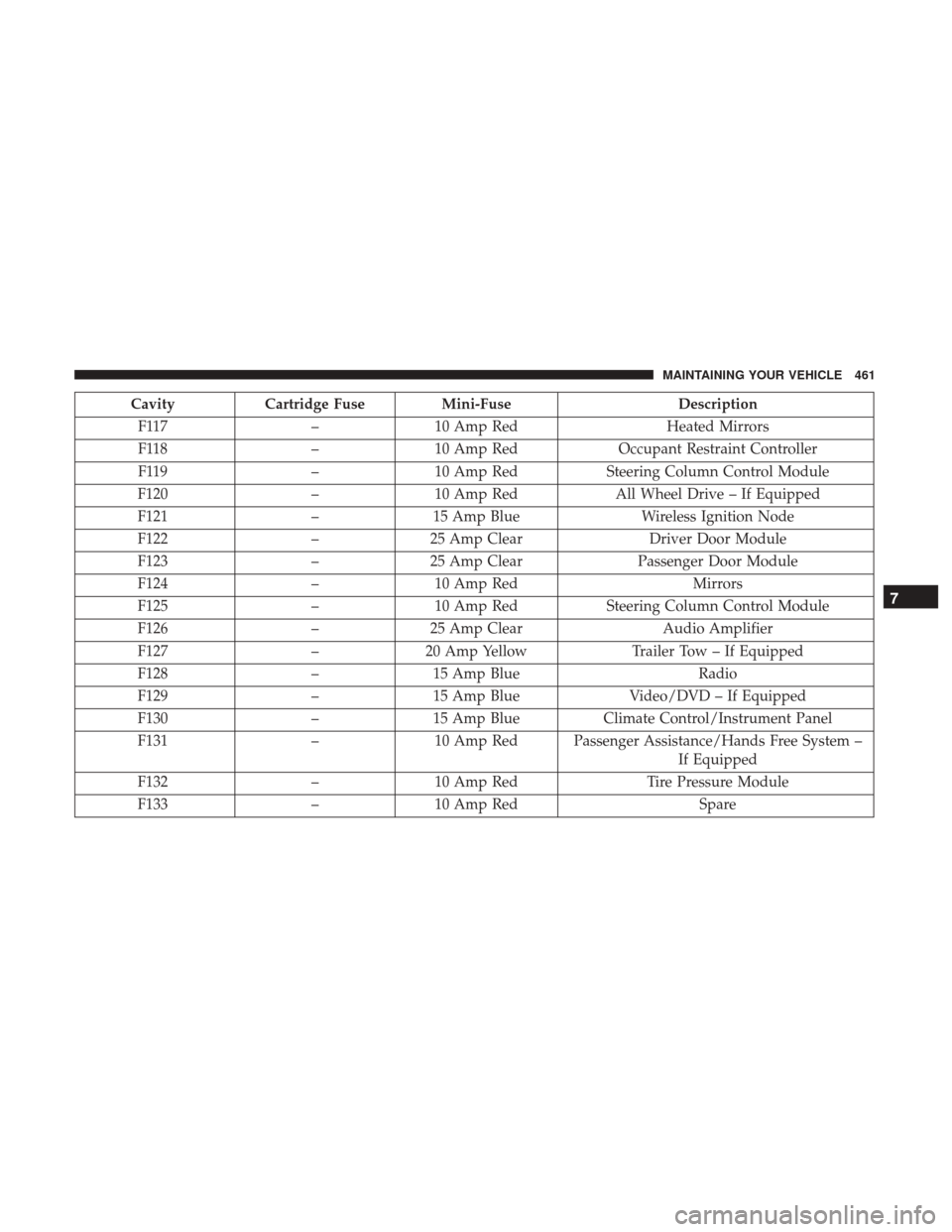
CavityCartridge Fuse Mini-Fuse Description
F117 –10 Amp Red Heated Mirrors
F118 –10 Amp Red Occupant Restraint Controller
F119 –10 Amp Red Steering Column Control Module
F120 –10 Amp Red All Wheel Drive – If Equipped
F121 –15 Amp Blue Wireless Ignition Node
F122 –25 Amp Clear Driver Door Module
F123 –25 Amp Clear Passenger Door Module
F124 –10 Amp Red Mirrors
F125 –10 Amp Red Steering Column Control Module
F126 –25 Amp Clear Audio Amplifier
F127 –20 Amp Yellow Trailer Tow – If Equipped
F128 –15 Amp Blue Radio
F129 –15 Amp Blue Video/DVD – If Equipped
F130 –15 Amp Blue Climate Control/Instrument Panel
F131 –10 Amp Red Passenger Assistance/Hands Free System –
If Equipped
F132 –10 Amp Red Tire Pressure Module
F133 –10 Amp Red Spare
7
MAINTAINING YOUR VEHICLE 461
Page 464 of 510
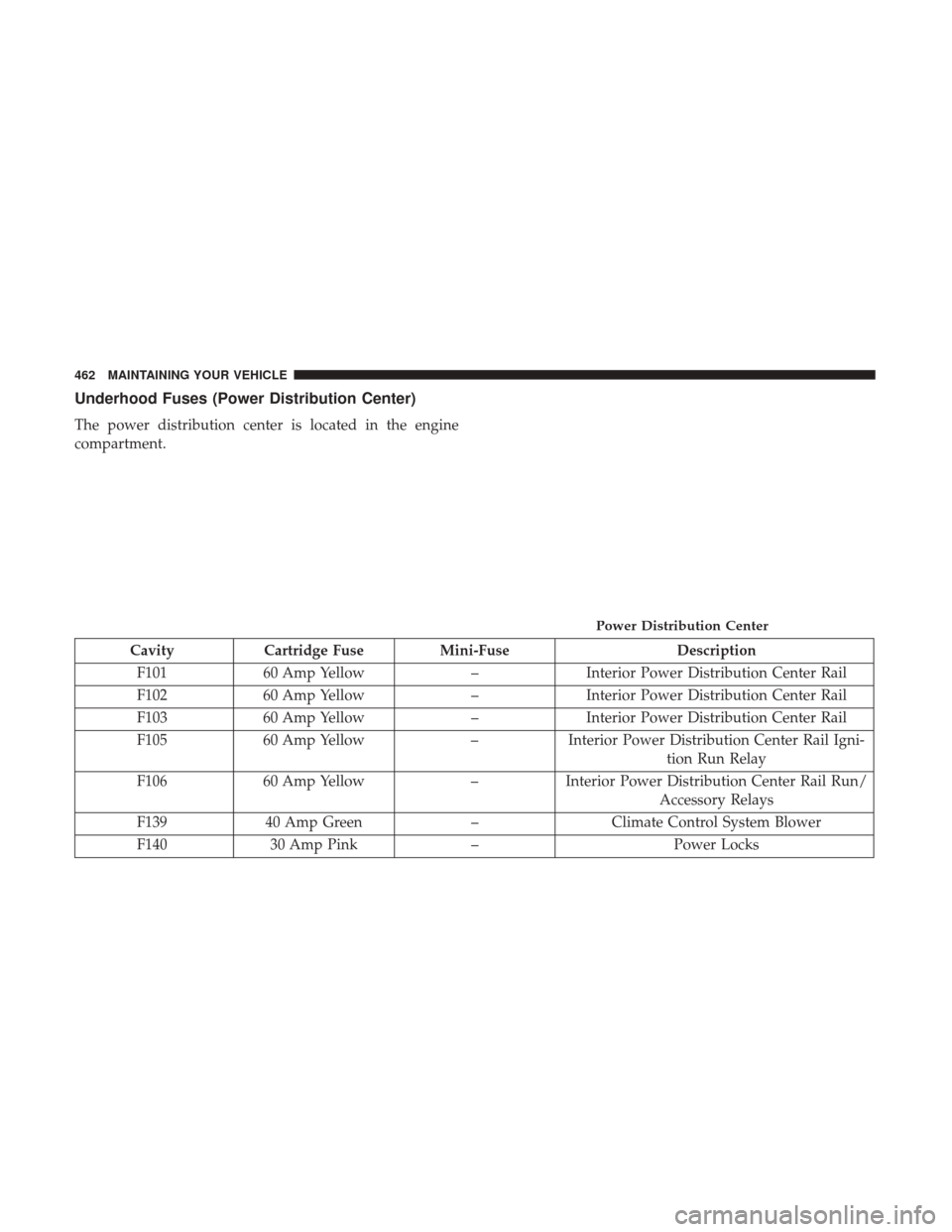
Underhood Fuses (Power Distribution Center)
The power distribution center is located in the engine
compartment.
CavityCartridge Fuse Mini-Fuse Description
F101 60 Amp Yellow –Interior Power Distribution Center Rail
F102 60 Amp Yellow –Interior Power Distribution Center Rail
F103 60 Amp Yellow –Interior Power Distribution Center Rail
F105 60 Amp Yellow –Interior Power Distribution Center Rail Igni-
tion Run Relay
F106 60 Amp Yellow –Interior Power Distribution Center Rail Run/
Accessory Relays
F139 40 Amp Green –Climate Control System Blower
F140 30 Amp Pink – Power Locks
Power Distribution Center
462 MAINTAINING YOUR VEHICLE
Page 474 of 510
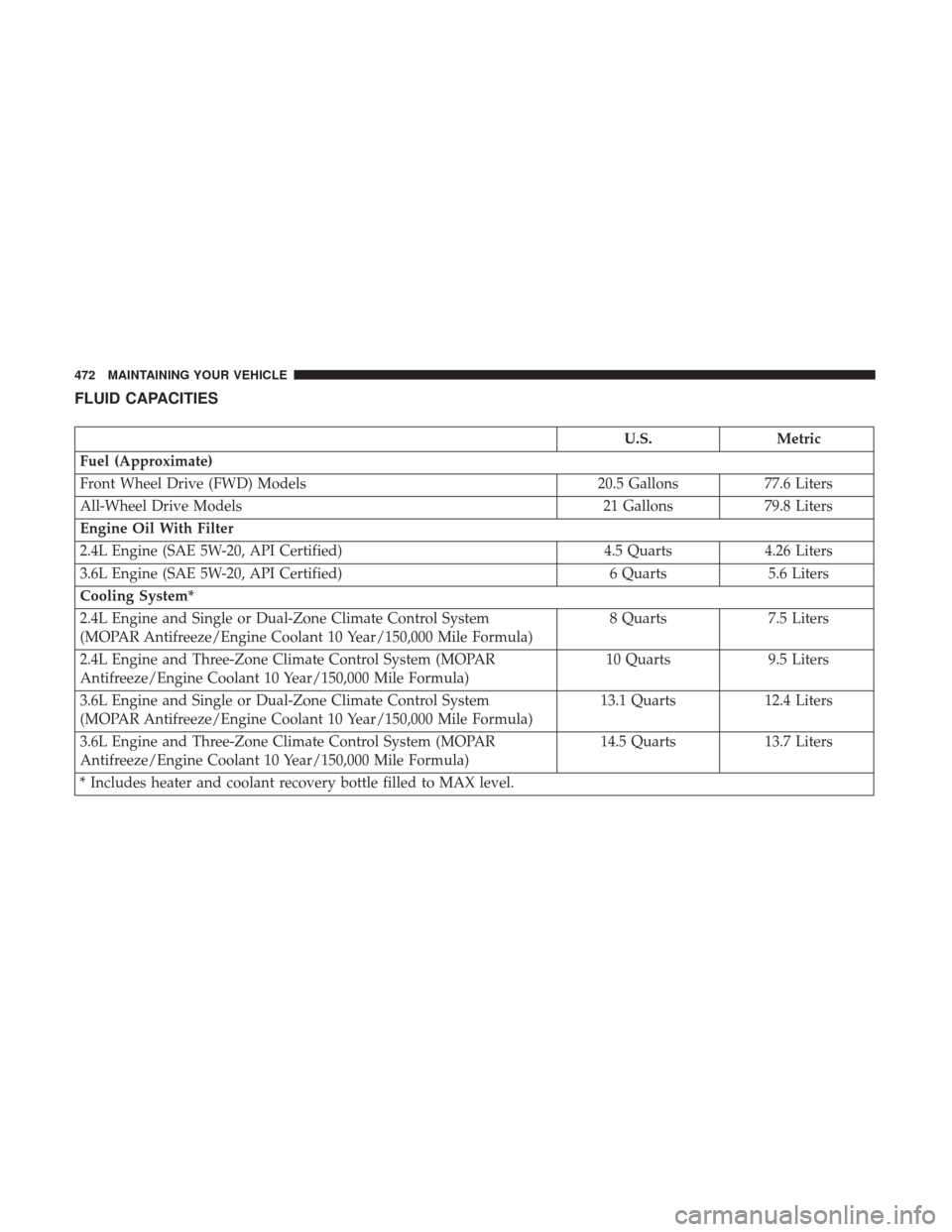
FLUID CAPACITIES
U.S.Metric
Fuel (Approximate)
Front Wheel Drive (FWD) Models 20.5 Gallons77.6 Liters
All-Wheel Drive Models 21 Gallons79.8 Liters
Engine Oil With Filter
2.4L Engine (SAE 5W-20, API Certified) 4.5 Quarts4.26 Liters
3.6L Engine (SAE 5W-20, API Certified) 6 Quarts5.6 Liters
Cooling System*
2.4L Engine and Single or Dual-Zone Climate Control System
(MOPAR Antifreeze/Engine Coolant 10 Year/150,000 Mile Formula) 8 Quarts
7.5 Liters
2.4L Engine and Three-Zone Climate Control System (MOPAR
Antifreeze/Engine Coolant 10 Year/150,000 Mile Formula) 10 Quarts
9.5 Liters
3.6L Engine and Single or Dual-Zone Climate Control System
(MOPAR Antifreeze/Engine Coolant 10 Year/150,000 Mile Formula) 13.1 Quarts
12.4 Liters
3.6L Engine and Three-Zone Climate Control System (MOPAR
Antifreeze/Engine Coolant 10 Year/150,000 Mile Formula) 14.5 Quarts
13.7 Liters
* Includes heater and coolant recovery bottle filled to MAX level.
472 MAINTAINING YOUR VEHICLE