heating DODGE JOURNEY 2019 User Guide
[x] Cancel search | Manufacturer: DODGE, Model Year: 2019, Model line: JOURNEY, Model: DODGE JOURNEY 2019Pages: 524, PDF Size: 5.29 MB
Page 332 of 524
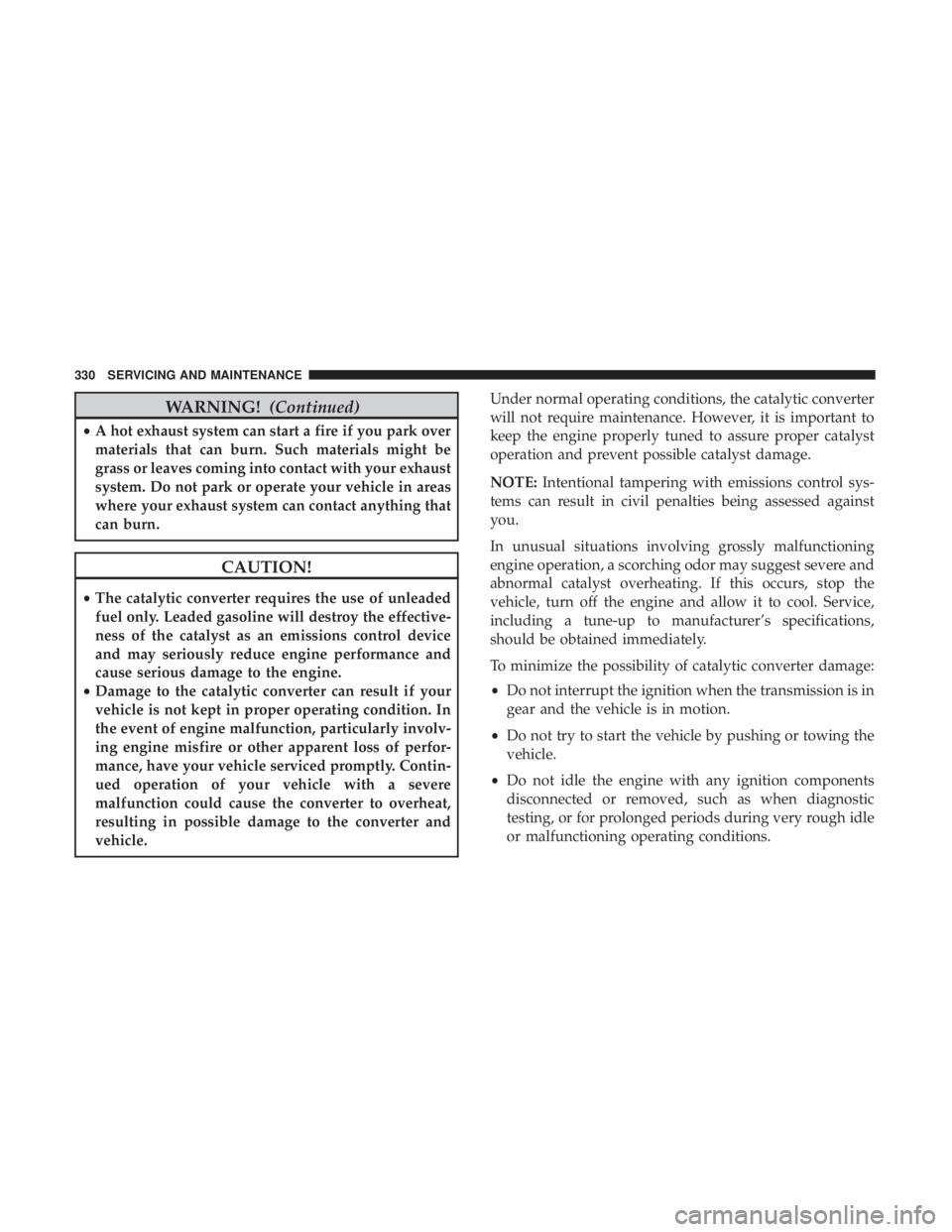
WARNING!(Continued)
•A hot exhaust system can start a fire if you park over
materials that can burn. Such materials might be
grass or leaves coming into contact with your exhaust
system. Do not park or operate your vehicle in areas
where your exhaust system can contact anything that
can burn.
CAUTION!
• The catalytic converter requires the use of unleaded
fuel only. Leaded gasoline will destroy the effective-
ness of the catalyst as an emissions control device
and may seriously reduce engine performance and
cause serious damage to the engine.
• Damage to the catalytic converter can result if your
vehicle is not kept in proper operating condition. In
the event of engine malfunction, particularly involv-
ing engine misfire or other apparent loss of perfor-
mance, have your vehicle serviced promptly. Contin-
ued operation of your vehicle with a severe
malfunction could cause the converter to overheat,
resulting in possible damage to the converter and
vehicle. Under normal operating conditions, the catalytic converter
will not require maintenance. However, it is important to
keep the engine properly tuned to assure proper catalyst
operation and prevent possible catalyst damage.
NOTE:
Intentional tampering with emissions control sys-
tems can result in civil penalties being assessed against
you.
In unusual situations involving grossly malfunctioning
engine operation, a scorching odor may suggest severe and
abnormal catalyst overheating. If this occurs, stop the
vehicle, turn off the engine and allow it to cool. Service,
including a tune-up to manufacturer’s specifications,
should be obtained immediately.
To minimize the possibility of catalytic converter damage:
• Do not interrupt the ignition when the transmission is in
gear and the vehicle is in motion.
• Do not try to start the vehicle by pushing or towing the
vehicle.
• Do not idle the engine with any ignition components
disconnected or removed, such as when diagnostic
testing, or for prolonged periods during very rough idle
or malfunctioning operating conditions.
330 SERVICING AND MAINTENANCE
Page 353 of 524
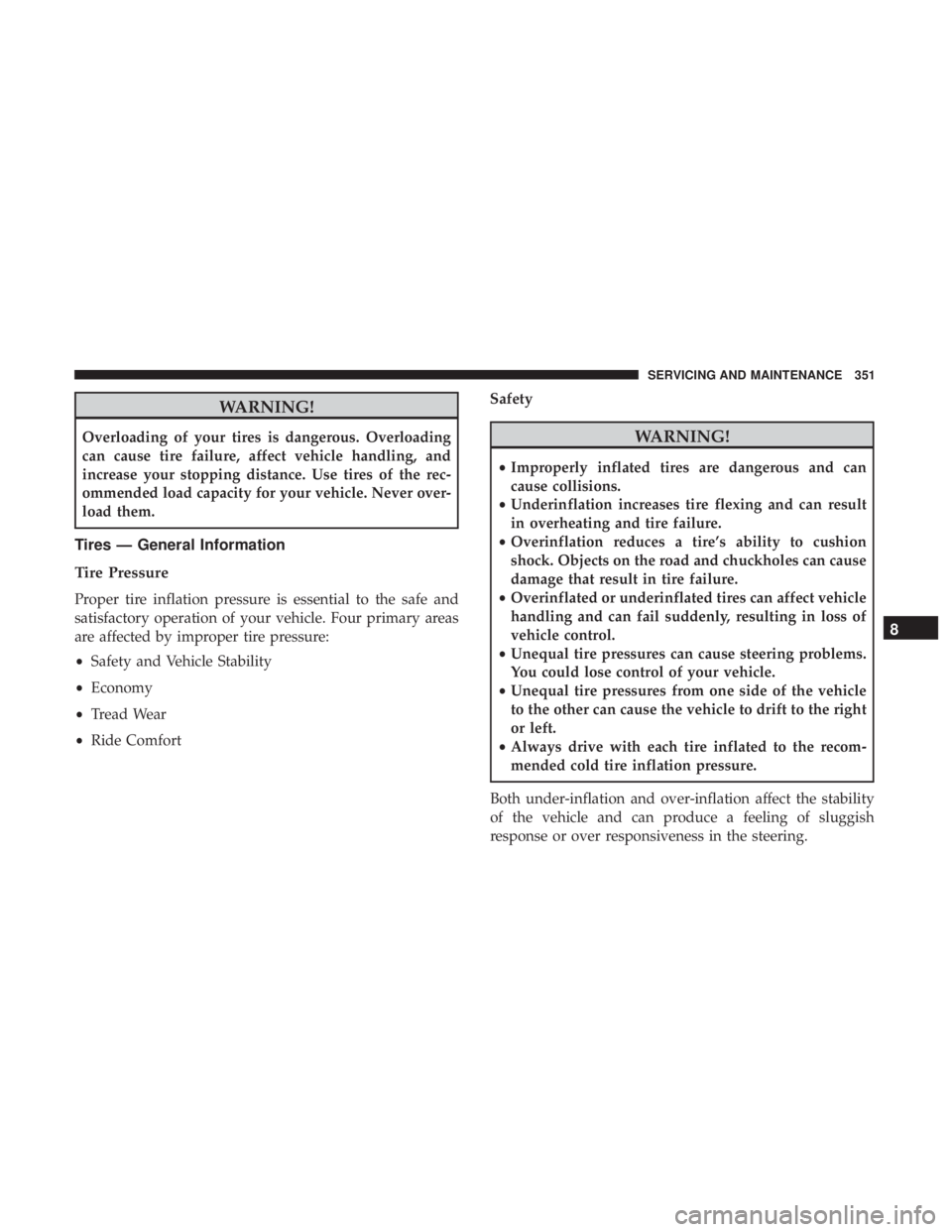
WARNING!
Overloading of your tires is dangerous. Overloading
can cause tire failure, affect vehicle handling, and
increase your stopping distance. Use tires of the rec-
ommended load capacity for your vehicle. Never over-
load them.
Tires — General Information
Tire Pressure
Proper tire inflation pressure is essential to the safe and
satisfactory operation of your vehicle. Four primary areas
are affected by improper tire pressure:
•Safety and Vehicle Stability
• Economy
• Tread Wear
• Ride Comfort Safety
WARNING!
•
Improperly inflated tires are dangerous and can
cause collisions.
• Underinflation increases tire flexing and can result
in overheating and tire failure.
• Overinflation reduces a tire’s ability to cushion
shock. Objects on the road and chuckholes can cause
damage that result in tire failure.
• Overinflated or underinflated tires can affect vehicle
handling and can fail suddenly, resulting in loss of
vehicle control.
• Unequal tire pressures can cause steering problems.
You could lose control of your vehicle.
• Unequal tire pressures from one side of the vehicle
to the other can cause the vehicle to drift to the right
or left.
• Always drive with each tire inflated to the recom-
mended cold tire inflation pressure.
Both under-inflation and over-inflation affect the stability
of the vehicle and can produce a feeling of sluggish
response or over responsiveness in the steering.
8
SERVICING AND MAINTENANCE 351
Page 508 of 524
Break-In Recommendations.................233
Checking Oil Level ...................... .320
Compartment ....................... .318, 319
Compartment Identification .................319
Coolant (Antifreeze) ...................331, 382
Cooling .............................. .331
Exhaust Gas Caution ...................223, 378
Fails To Start ........................... .232
Flooded, Starting ........................ .232
Fuel Requirements ....................... .375
Jump Starting .......................... .300
Oil ........................... .322, 381, 382
Oil Filler Cap ....................... .318, 323
Oil Filter .............................. .324
Oil Reset ............................. .139
Oil Selection ........................ .322, 381
Oil Synthetic ........................... .324
Overheating ........................... .303
Starting ........................... .229, 230
Engine Oil Viscosity ........................ .323
Engine Oil Viscosity Chart ....................323
Enhanced Accident Response Feature .........198, 309
Ethanol ............................. .376, 378
Exhaust Gas Cautions ....................223, 378
Exhaust System ....................... .223, 329Exterior Lights
...................... .63, 64, 226
Filters Air Cleaner ............................ .324
Air Conditioning ........................ .101
Engine Oil ......................... .324, 382
Engine Oil Disposal ...................... .324
Flashers ................................ .278
Hazard Warning ........................ .278
Turn Signals ..................... .66, 154, 226
Flash-To-Pass ..............................64
Flexible Fuel Vehicles Cr
uising Range ......................... .380
Engine Oil ............................ .380
Fuel Requirements ....................378, 379
Maintenance ........................... .380
Replacement Parts ....................... .380
Starting .............................. .380
Flooded Engine Starting ..................... .232
Floor Console ............................ .122
Fluid, Brake ............................. .384
Fluid Capacities ........................... .381
Fluid Leaks .............................. .226
Fluid Level Checks Automatic Transmission ................338, 339
506 INDEX
Page 513 of 524
New Vehicle Break-In Period..................233
Occupant Restraints ........................ .174
Octane Rating, Gasoline (Fuel) ..............375, 382
Oil, Engine ........................... .322, 382
Capacity .............................. .381
Change Interval ........................ .322
Checking ............................. .320
Dipstick .............................. .320
Disposal .............................. .324
Filter ............................. .324, 382
Filter Disposal .......................... .324
Identification Logo ...................... .323
Materials Added To ...................... .324
Pressure Warning Light ....................149
Recommendation .....................322, 381
Synthetic ............................. .324
Viscosity .......................... .323, 381
Oil Filter, Change ......................... .324
Oil Filter, Selection ......................... .324
Oil Pressure Light ......................... .149
Oil Reset ................................ .139
Onboard Diagnostic System ...................155
Operating Precautions ...................... .155Operator Manual
Owner’s Manual .......................5,500
Outlet Power ............................... .126
Outside Rearview Mirrors .....................59
Overheating, Engine ....................... .303
Owner ’s Manual (Operator Manual) ...............5
Paint Care ............................... .366
Panic Alarm ...............................19
Parking Brake ............................ .234
ParkSense System, Rear ..................... .249
Passenger Seat Easy Entry ..............................44
Passive Entry ..............................33
Pets ................................... .222
Phone Bluetooth .......................... .435,
436
Pairing ............................ .435, 453
Phonebook .....................437, 439, 457, 461
Phone (Uconnect) ...................... .431, 449
Placard, Tire And Loading Information ...........347
Power Brakes ............................... .373
Distribution Center (Fuses) ..................286
12
INDEX 511