oil change DODGE JOURNEY 2019 User Guide
[x] Cancel search | Manufacturer: DODGE, Model Year: 2019, Model line: JOURNEY, Model: DODGE JOURNEY 2019Pages: 524, PDF Size: 5.29 MB
Page 324 of 524

CAUTION!
•It is essential when replacing the cables on the
battery that the positive cable is attached to the
positive post and the negative cable is attached to the
negative post. Battery posts are marked positive (+)
and negative (-) and are identified on the battery
case. Cable clamps should be tight on the terminal
posts and free of corrosion.
• If a “fast charger” is used while the battery is in the
vehicle, disconnect both vehicle battery cables before
connecting the charger to the battery. Do not use a
“fast charger” to provide starting voltage.
DEALER SERVICE
An authorized dealer has the qualified service personnel,
special tools, and equipment to perform all service opera-
tions in an expert manner. Service Manuals are available
which include detailed service information for your ve-
hicle. Refer to these Service Manuals before attempting any
procedure yourself.
NOTE: Intentional tampering with emissions control sys-
tems may void your warranty and could result in civil
penalties being assessed against you.
WARNING!
You can be badly injured working on or around a
motor vehicle. Only do service work for which you
have the knowledge and the proper equipment. If you
have any doubt about your ability to perform a service
job, take your vehicle to a competent mechanic.
Engine Oil
Change Engine Oil
The oil change indicator system will remind you that it is
time to take your vehicle in for scheduled maintenance.
Refer to the “Maintenance Plan” for further information.
NOTE: Under no circumstances should oil change inter-
vals exceed 10,000 miles (16,000 km), twelve months or 350
hours of engine run time, whichever comes first. The 350
hours of engine run or idle time is generally only a concern
for fleet customers.
Engine Oil Selection
For best performance and maximum protection under all
types of operating conditions, the manufacturer only rec-
ommends engine oils that are API Certified and meet the
requirements of FCA Material Standard MS-6395.
322 SERVICING AND MAINTENANCE
Page 326 of 524
Lubricants which do not have both the engine oil certifi-
cation mark and the correct SAE viscosity grade number
should not be used.
Synthetic Engine Oils
You may use synthetic engine oils provided the recom-
mended oil quality requirements are met, and the recom-
mended maintenance intervals for oil and filter changes are
followed.
Synthetic engine oils which do not have both the engine oil
certification mark and the correct SAE viscosity grade
number should not be used.
Materials Added To Engine Oil
The manufacturer strongly recommends against the addi-
tion of any additives (other than leak detection dyes) to the
engine oil. Engine oil is an engineered product and its
performance may be impaired by supplemental additives.
Disposing Of Used Engine Oil And Oil Filters
Care should be taken in disposing of used engine oil and
oil filters from your vehicle. Used oil and oil filters,
indiscriminately discarded, can present a problem to theenvironment. Contact an authorized dealer, service station
or governmental agency for advice on how and where used
oil and oil filters can be safely discarded in your area.
Engine Oil Filter
The engine oil filter should be replaced with a new filter at
every engine oil change.
Engine Oil Filter Selection
This manufacturer’s engines have a full-flow type dispos-
able oil filter. Use a filter of this type for replacement. The
quality of replacement filters varies considerably. Only
high quality filters should be used to assure most efficient
service. Mopar engine oil filters are high quality oil filters
and are recommended.
Engine Air Cleaner Filter
Refer to the “Maintenance Plan” in this section for the
proper maintenance intervals.
NOTE:
Be sure to follow the “Severe Duty Conditions”
maintenance interval if applicable.
324 SERVICING AND MAINTENANCE
Page 331 of 524
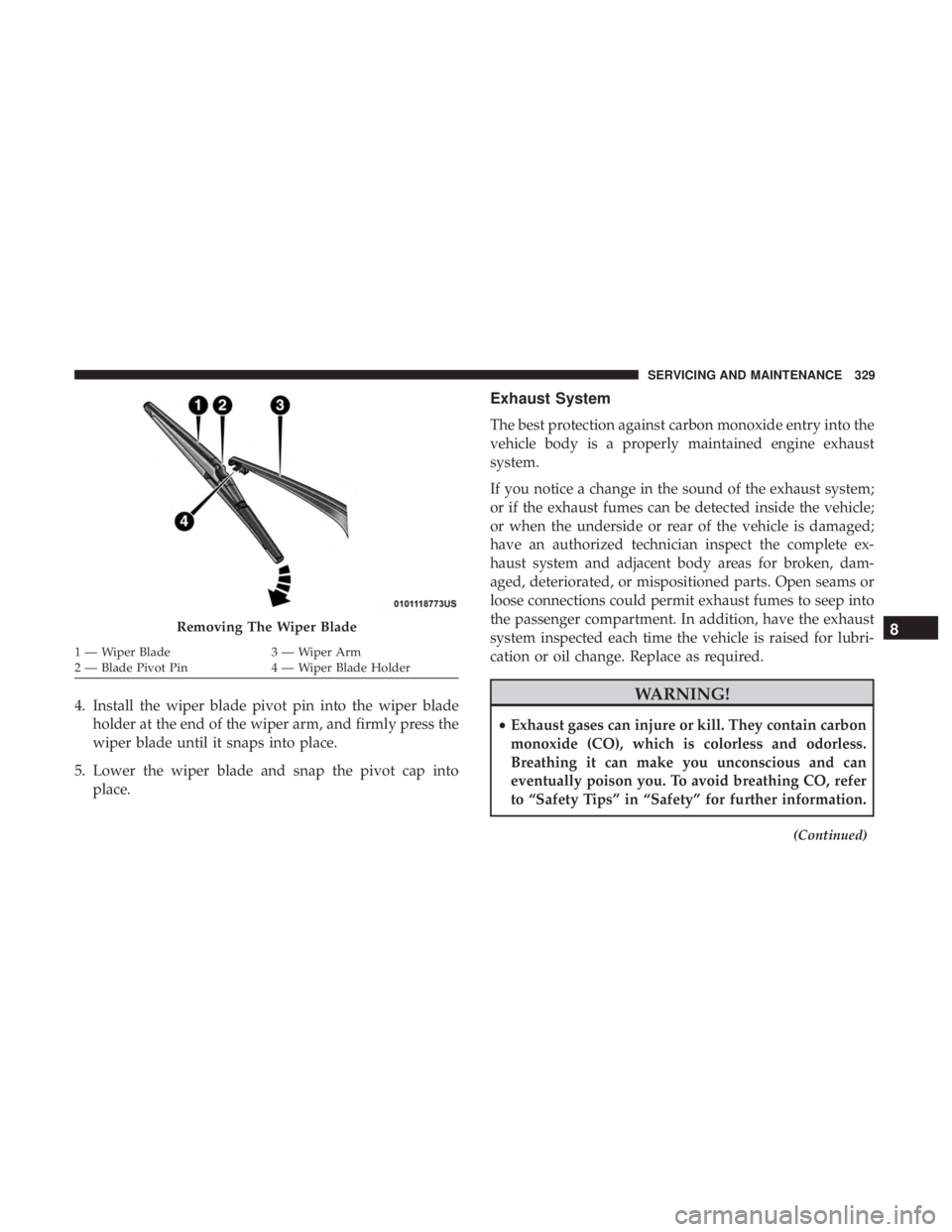
4. Install the wiper blade pivot pin into the wiper bladeholder at the end of the wiper arm, and firmly press the
wiper blade until it snaps into place.
5. Lower the wiper blade and snap the pivot cap into place.
Exhaust System
The best protection against carbon monoxide entry into the
vehicle body is a properly maintained engine exhaust
system.
If you notice a change in the sound of the exhaust system;
or if the exhaust fumes can be detected inside the vehicle;
or when the underside or rear of the vehicle is damaged;
have an authorized technician inspect the complete ex-
haust system and adjacent body areas for broken, dam-
aged, deteriorated, or mispositioned parts. Open seams or
loose connections could permit exhaust fumes to seep into
the passenger compartment. In addition, have the exhaust
system inspected each time the vehicle is raised for lubri-
cation or oil change. Replace as required.
WARNING!
•Exhaust gases can injure or kill. They contain carbon
monoxide (CO), which is colorless and odorless.
Breathing it can make you unconscious and can
eventually poison you. To avoid breathing CO, refer
to “Safety Tips” in “Safety” for further information.
(Continued)
Removing The Wiper Blade
1 — Wiper Blade 3 — Wiper Arm
2 — Blade Pivot Pin 4 — Wiper Blade Holder
8
SERVICING AND MAINTENANCE 329
Page 339 of 524
WARNING!(Continued)
•To avoid contamination from foreign matter or mois-
ture, use only new brake fluid or fluid that has been
in a tightly closed container. Keep the master cylin-
der reservoir cap secured at all times. Brake fluid in
a open container absorbs moisture from the air
resulting in a lower boiling point. This may cause it
to boil unexpectedly during hard or prolonged brak-
ing, resulting in sudden brake failure. This could
result in a collision.
• Overfilling the brake fluid reservoir can result in
spilling brake fluid on hot engine parts, causing the
brake fluid to catch fire. Brake fluid can also damage
painted and vinyl surfaces, care should be taken to
avoid its contact with these surfaces.
• Do not allow petroleum based fluid to contaminate
the brake fluid. Brake seal components could be
damaged, causing partial or complete brake failure.
This could result in a collision.
Automatic Transmission
Selection Of Lubricant
It is important to use the proper transmission fluid to
ensure optimum transmission performance and life. Use only the manufacturer’s specified transmission fluid. Refer
to “Fluids And Lubricants” in “Technical Specifications”
for fluid specifications. It is important to maintain the
transmission fluid at the correct level using the recom-
mended fluid.
NOTE:
No chemical flushes should be used in any trans-
mission; only the approved lubricant should be used.
CAUTION!
Using a transmission fluid other than the manufactur-
er ’s recommended fluid may cause deterioration in
transmission shift quality and/or torque converter
shudder, and will require more frequent fluid and
filter changes. Refer to “Fluids And Lubricants” in
“Technical Specifications” for fluid specifications.
Special Additives
The manufacturer strongly recommends against using any
special additives in the transmission. Automatic Transmis-
sion Fluid (ATF) is an engineered product and its perfor-
mance may be impaired by supplemental additives. There-
fore, do not add any fluid additives to the transmission.
The only exception to this policy is the use of special dyes
8
SERVICING AND MAINTENANCE 337
Page 341 of 524
If the fluid level is low, add fluid through the dipstick tube
to bring it to the proper level. Do not overfill. After adding
any quantity of oil through the dipstick tube, wait at least
two minutes for the oil to fully drain into the transmission
before rechecking the fluid level.
NOTE:If it is necessary to check the transmission below
the operating temperature, the fluid level should be be-
tween the two COLD (lower) holes on the dipstick with the
fluid at approximately 80°F (27°C). If the fluid level is
correctly established at 80°F (27°C), it should be between
the HOT (upper) reference holes when the transmission
reaches 180°F (82°C). Remember it is best to check the level
at the normal operating temperature.
8. Check for leaks. Release the parking brake.
CAUTION!
• Using a transmission fluid other than the manufac-
turer ’s recommended fluid may cause deterioration
in transmission shift quality and/or torque converter
shudder, and will require more frequent fluid and
filter changes. Refer to “Fluids And Lubricants” in
“Technical Specifications” for fluid specifications.
(Continued)
CAUTION! (Continued)
•Dirt and water in the transmission can cause serious
damage. To prevent dirt and water from entering the
transmission after checking or replenishing fluid,
make sure that the dipstick cap is re-seated properly.
Fluid Level Check — Six-Speed Automatic
Transmission
The fluid level is preset at the factory and does not require
adjustment under normal operating conditions. Routine
fluid level checks are not required, therefore the transmis-
sion filler tube is capped and no dipstick is provided. An
authorized dealer can check your transmission fluid level
using a special service dipstick. If you notice fluid leakage
or transmission malfunction, visit an authorized dealer
immediately to have the transmission fluid level checked.
Operating the vehicle with an improper fluid level can
cause severe transmission damage.
8
SERVICING AND MAINTENANCE 339
Page 342 of 524
CAUTION!
If a transmission fluid leak occurs, visit an authorized
dealer immediately. Severe transmission damage may
occur. An authorized dealer has the proper tools to
adjust the fluid level accurately.
Fluid And Filter Changes
Refer to the “Maintenance Plan” in this section for the
proper maintenance intervals.
In addition, change the fluid and filter if the fluid becomes
contaminated (with water, etc.), or if the transmission is
disassembled for any reason.
Rear Drive Assembly (RDA) – AWD Models Only
Lubricant Selection
Use only the manufacturer’s recommended fluid. Refer to
“Fluids And Lubricants” in “Technical Specifications” for
further information.
Fluid Level Check
Visually inspect the unit at each oil change for leakage. If
leakage is detected, check the fluid level by removing thefill plug. The fluid level should be maintained between the
bottom of the fill hole to 1/8 inch (4 mm) below the fill
hole.
Add fluid, if necessary, to maintain the proper level.
Frequency Of Fluid Change
Refer to the “Maintenance Plan” in this section for the
proper maintenance intervals.
Power Transfer Unit (PTU) – AWD Models Only
Lubricant Selection
Use only the manufacturer’s recommended fluid. Refer to
“Fluids And Lubricants” in “Technical Specifications” for
further information.
Fluid Level Check
Visually inspect the unit at each oil change for leakage. If
leakage is detected, check the fluid level by removing the
fill plug. The fluid level should be maintained between the
bottom of the fill hole to 1/8 inch (4 mm) below the fill
hole.
Add fluid, if necessary, to maintain the proper level.
340 SERVICING AND MAINTENANCE
Page 505 of 524
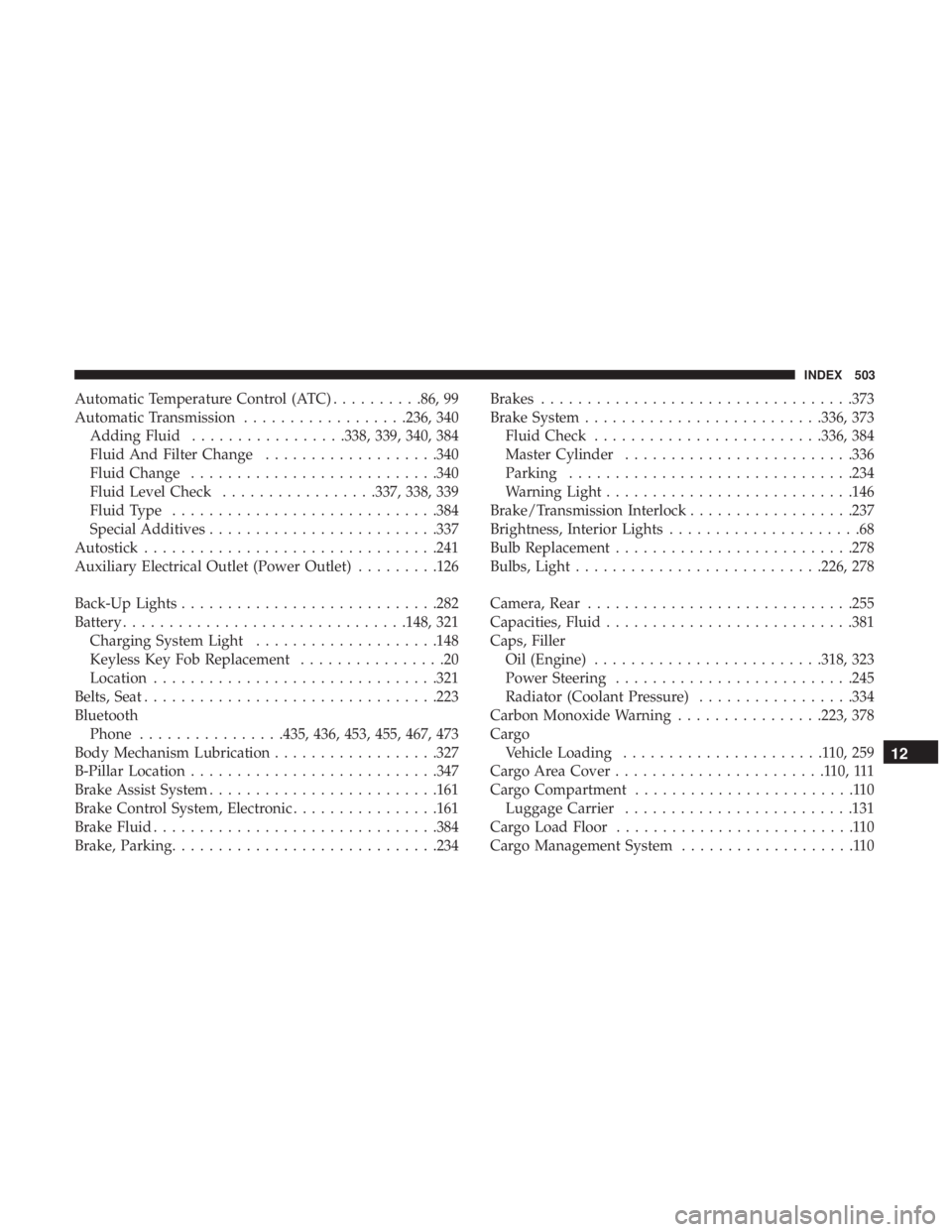
Automatic Temperature Control (ATC)..........86, 99
Automatic Transmission ..................236, 340
Adding Fluid .................338, 339, 340, 384
Fluid And Filter Change ...................340
Fluid Change .......................... .340
Fluid Level Check .................337, 338, 339
Fluid Type ............................ .384
Special Additives ........................ .337
Autostick ............................... .241
Auxiliary Electrical Outlet (Power Outlet) .........126
Back-Up Lights ........................... .282
Battery .............................. .148, 321
Charging System Light ....................148
Keyless Key Fob Replacement ................20
Location .............................. .321
Belts, Seat ............................... .223
Bluetooth Phone ................435, 436, 453, 455, 467, 473
Body Mechanism Lubrication ..................327
B-Pillar Location .......................... .347
Brake Assist System ........................ .161
Brake Control System, Electronic ................161
Brake Fluid .............................. .384
Brake, Parking ............................ .234Brakes
................................. .373
Brake System ......................... .336, 373
Fluid Check ........................ .336, 384
Master Cylinder ........................ .336
Parking .............................. .234
Warning Light .......................... .146
Brake/Transmission Interlock ..................237
Brightness, Interior Lights .....................68
Bulb Replacement ......................... .278
Bulbs, Light .......................... .226, 278
Camera, Rear ............................ .255
Capacities, Fluid .......................... .381
Caps,
Filler
Oil (Engine) ........................ .318, 323
Power Steering ......................... .245
Radiator (Coolant Pressure) .................334
Carbon Monoxide Warning ................223, 378
Cargo Vehicle Loading ......................110,259
Cargo Area Cover .......................110,111
Cargo Compartment ........................110
Luggage Carrier ........................ .131
Cargo Load Floor ..........................110
Cargo Management System ...................110
12
INDEX 503
Page 513 of 524
New Vehicle Break-In Period..................233
Occupant Restraints ........................ .174
Octane Rating, Gasoline (Fuel) ..............375, 382
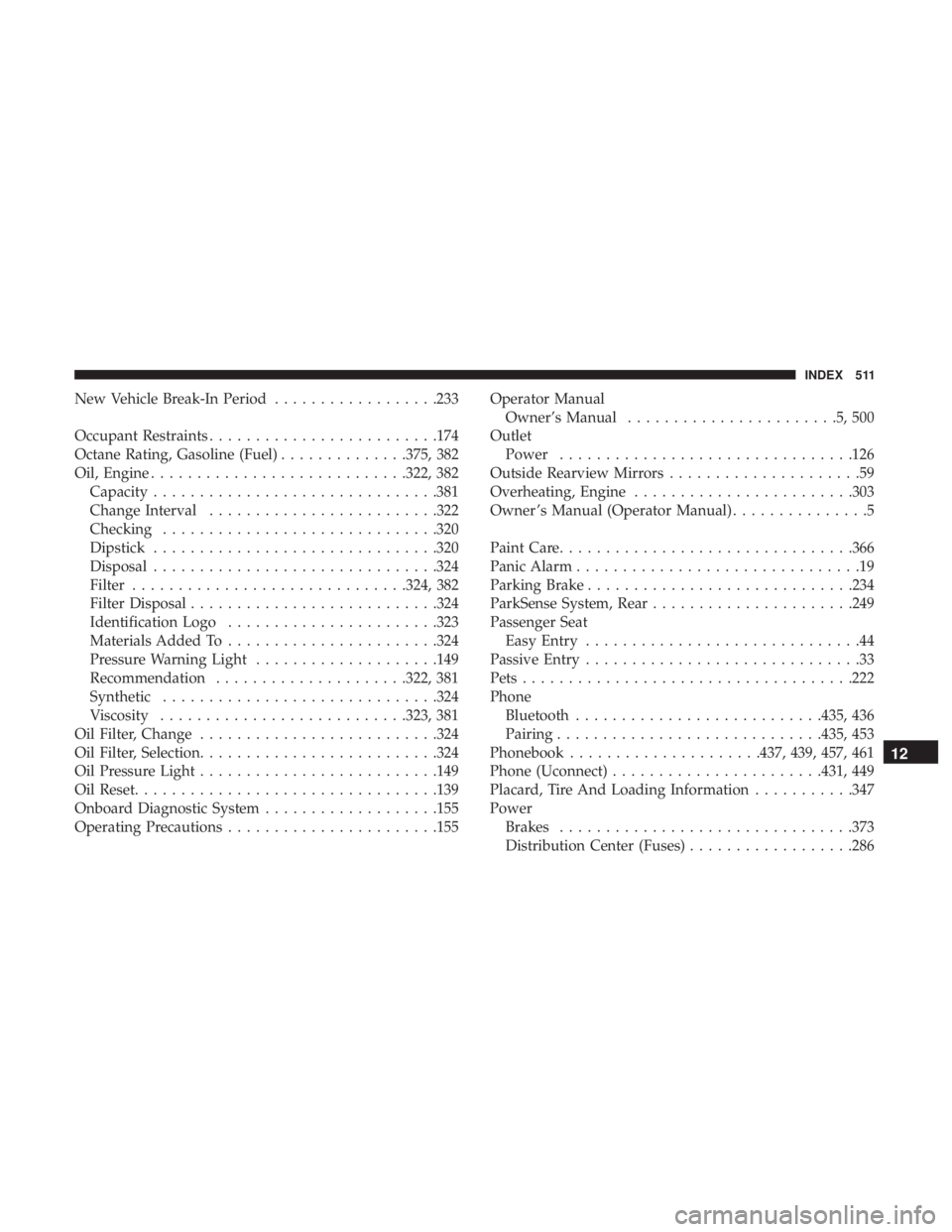
Oil, Engine ........................... .322, 382
Capacity .............................. .381
Change Interval ........................ .322
Checking ............................. .320
Dipstick .............................. .320
Disposal .............................. .324
Filter ............................. .324, 382
Filter Disposal .......................... .324
Identification Logo ...................... .323
Materials Added To ...................... .324
Pressure Warning Light ....................149
Recommendation .....................322, 381
Synthetic ............................. .324
Viscosity .......................... .323, 381
Oil Filter, Change ......................... .324
Oil Filter, Selection ......................... .324
Oil Pressure Light ......................... .149
Oil Reset ................................ .139
Onboard Diagnostic System ...................155
Operating Precautions ...................... .155Operator Manual
Owner’s Manual .......................5,500
Outlet Power ............................... .126
Outside Rearview Mirrors .....................59
Overheating, Engine ....................... .303
Owner ’s Manual (Operator Manual) ...............5
Paint Care ............................... .366
Panic Alarm ...............................19
Parking Brake ............................ .234
ParkSense System, Rear ..................... .249
Passenger Seat Easy Entry ..............................44
Passive Entry ..............................33
Pets ................................... .222
Phone Bluetooth .......................... .435,
436
Pairing ............................ .435, 453
Phonebook .....................437, 439, 457, 461
Phone (Uconnect) ...................... .431, 449
Placard, Tire And Loading Information ...........347
Power Brakes ............................... .373
Distribution Center (Fuses) ..................286
12
INDEX 511