door lock DODGE JOURNEY 2019 Owner's Manual
[x] Cancel search | Manufacturer: DODGE, Model Year: 2019, Model line: JOURNEY, Model: DODGE JOURNEY 2019Pages: 524, PDF Size: 5.29 MB
Page 40 of 524
3. Repeat steps 1 and 2 for the opposite rear door.
NOTE:When the Child-Protection Door lock system is
engaged, the door can be opened only by using the outside
door handle even though the inside door lock is in the
unlocked position.
WARNING!
Avoid trapping anyone in a vehicle in a collision.
Remember that the rear doors can only be opened from
the outside when the Child-Protection locks are en-
gaged. Failure to follow this warning may result in
serious injury or death.
NOTE: •After engaging the Child-Protection Door lock system,
always test the door from the inside to make certain it
is in the desired position.
• For emergency exit with the system engaged, move the
lock knob up to the unlock position, roll down the
window, and open the door with the outside door
handle. To Disengage The Child-Protection Door Lock System
1. Open the rear door.
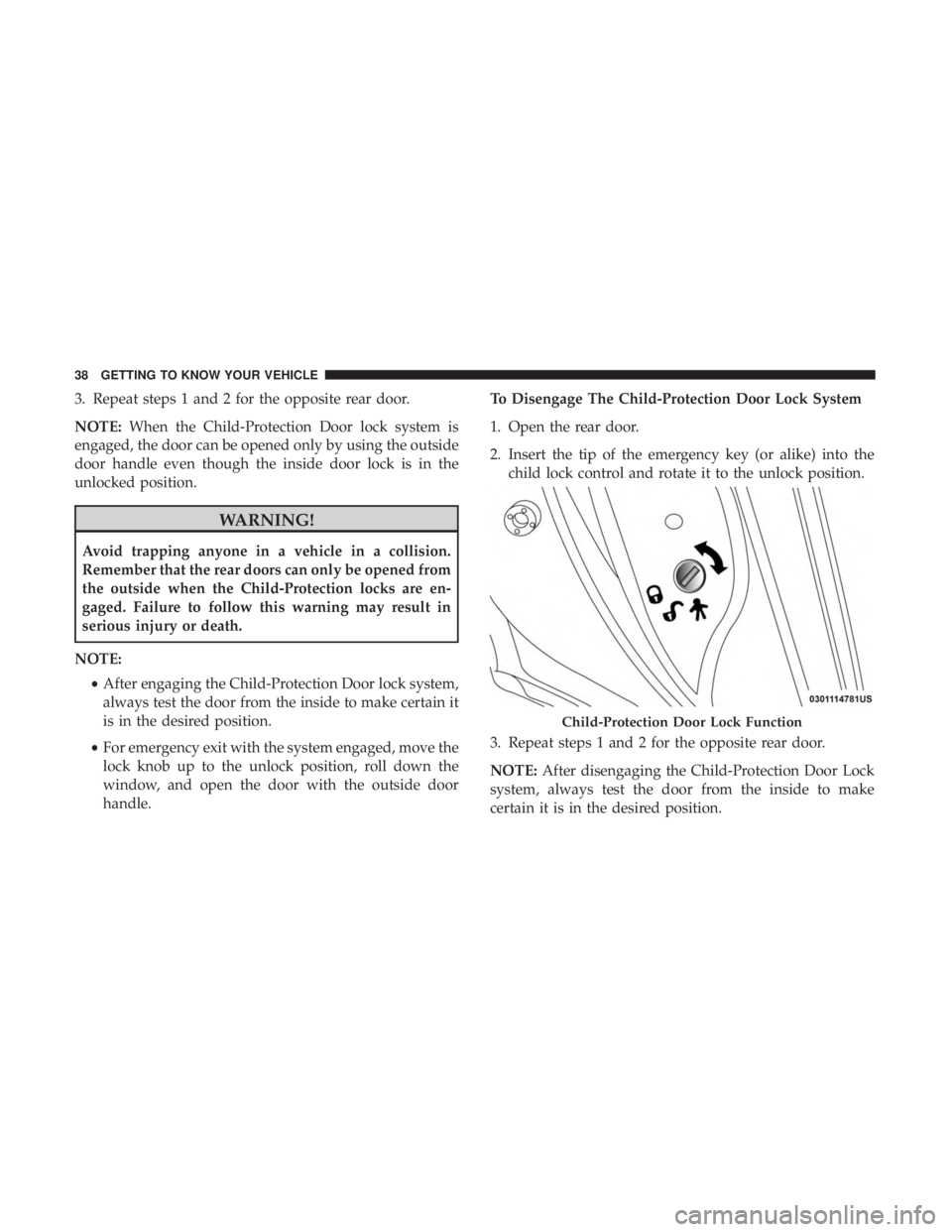
2. Insert the tip of the emergency key (or alike) into the
child lock control and rotate it to the unlock position.
3. Repeat steps 1 and 2 for the opposite rear door.
NOTE: After disengaging the Child-Protection Door Lock
system, always test the door from the inside to make
certain it is in the desired position.
Child-Protection Door Lock Function
38 GETTING TO KNOW YOUR VEHICLE
Page 47 of 524
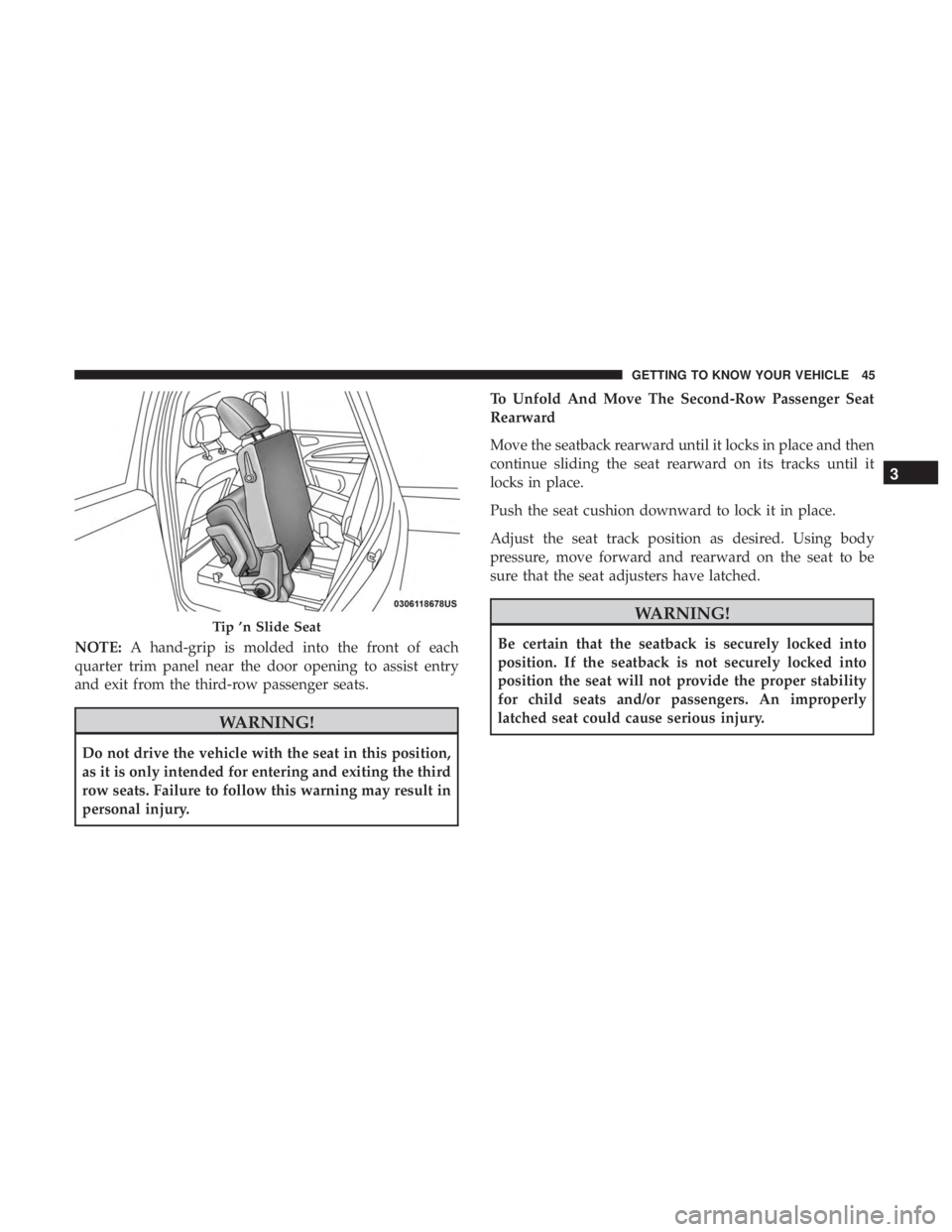
NOTE:A hand-grip is molded into the front of each
quarter trim panel near the door opening to assist entry
and exit from the third-row passenger seats.
WARNING!
Do not drive the vehicle with the seat in this position,
as it is only intended for entering and exiting the third
row seats. Failure to follow this warning may result in
personal injury. To Unfold And Move The Second-Row Passenger Seat
Rearward
Move the seatback rearward until it locks in place and then
continue sliding the seat rearward on its tracks until it
locks in place.
Push the seat cushion downward to lock it in place.
Adjust the seat track position as desired. Using body
pressure, move forward and rearward on the seat to be
sure that the seat adjusters have latched.
WARNING!
Be certain that the seatback is securely locked into
position. If the seatback is not securely locked into
position the seat will not provide the proper stability
for child seats and/or passengers. An improperly
latched seat could cause serious injury.
Tip ’n Slide Seat
3
GETTING TO KNOW YOUR VEHICLE 45
Page 69 of 524
INTERIOR LIGHTS
Courtesy/Interior Lighting
The interior lights come on when a door is opened.
To protect the battery, the interior lights will turn off
automatically 10 minutes after the ignition is placed in the
OFF position. This will occur if the interior lights were
switched on manually or are on because a door is open.
The Battery Protection also includes the glove compart-
ment light. To restore interior light operation after auto-
matic battery protection is enabled (Lights off), either place
the ignition in the ON/RUN position or cycle the light
switch.
Front Lights
The overhead console has two courtesy lights. The lights
turn on when a front door, a rear door or the liftgate is
opened. If your vehicle is equipped with Remote Keyless
Entry the lights will also turn on when the unlock button
on the key fob is pushed. The courtesy lights also function
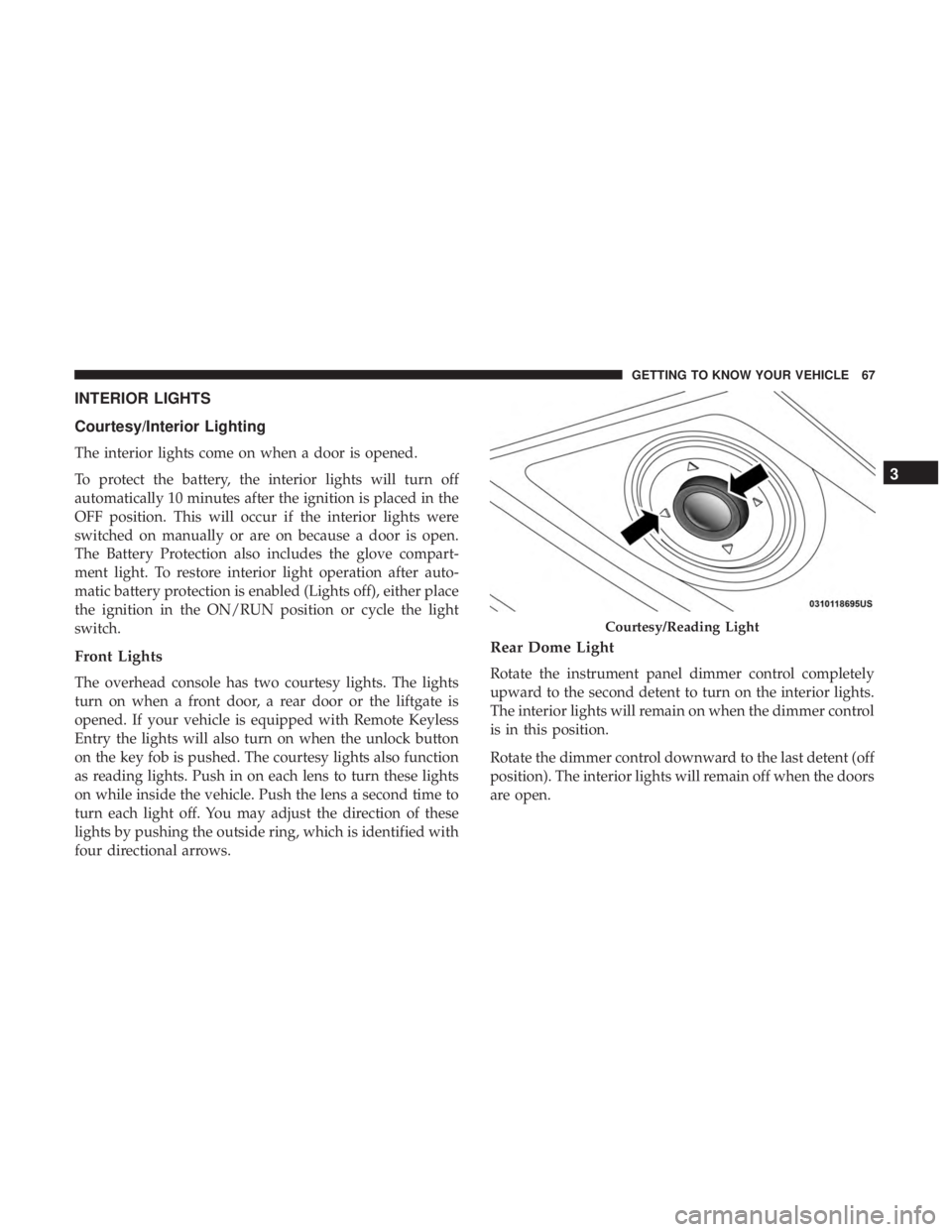
as reading lights. Push in on each lens to turn these lights
on while inside the vehicle. Push the lens a second time to
turn each light off. You may adjust the direction of these
lights by pushing the outside ring, which is identified with
four directional arrows.
Rear Dome Light
Rotate the instrument panel dimmer control completely
upward to the second detent to turn on the interior lights.
The interior lights will remain on when the dimmer control
is in this position.
Rotate the dimmer control downward to the last detent (off
position). The interior lights will remain off when the doors
are open.
Courtesy/Reading Light
3
GETTING TO KNOW YOUR VEHICLE 67
Page 106 of 524

Window Lockout Switch
The window lockout switch on the driver’s door trim panel
allows you to disable the window control on the rear
passenger doors. To disable the window controls, push and
release the window lockout button (setting it in the down
position). To enable the window controls, push and release
the window lockout button again (setting it in the up
position).
Wind Buffeting
Wind buffeting can be described as the perception of
pressure on the ears or a helicopter-type sound in the ears.
Your vehicle may exhibit wind buffeting with the windows
down, or the sunroof (if equipped) in certain open or
partially open positions. This is a normal occurrence and
can be minimized. If the buffeting occurs with the rear
windows open, open the front and rear windows together
to minimize the buffeting. If the buffeting occurs with the
sunroof open, adjust the sunroof opening to minimize the
buffeting or open any window.
Window Lockout Switch
104 GETTING TO KNOW YOUR VEHICLE
Page 111 of 524
CAUTION!
To prevent possible damage:
•Before closing hood, make sure the hood prop rod is
fully seated into its storage retaining clips.
• Do not slam the hood to close it. Use a firm down-
ward push at the center front edge of the hood to
ensure that both latches engage. Never drive your
vehicle unless the hood is fully closed, with both
latches engaged.
LIFTGATE
Opening
The liftgate can be unlocked or locked pushing the unlock
or lock button on the Remote Keyless Entry key fob, the
Keyless Enter-N-Go (Passive Entry) lock/unlock button
underneath the left side of the accent bar, which is located
on the liftgate below the glass or by activating the power
door lock switch located on either front door trim panel.
Refer to “Keyless Enter-N-Go” in “Getting To Know Your
Vehicle” for further information on Keyless Enter-N-Go
(Passive Entry). NOTE:
The liftgate cannot be unlocked or locked with the
manual door lock plungers on the door trim panels or the
door lock cylinder on the driver’s door.
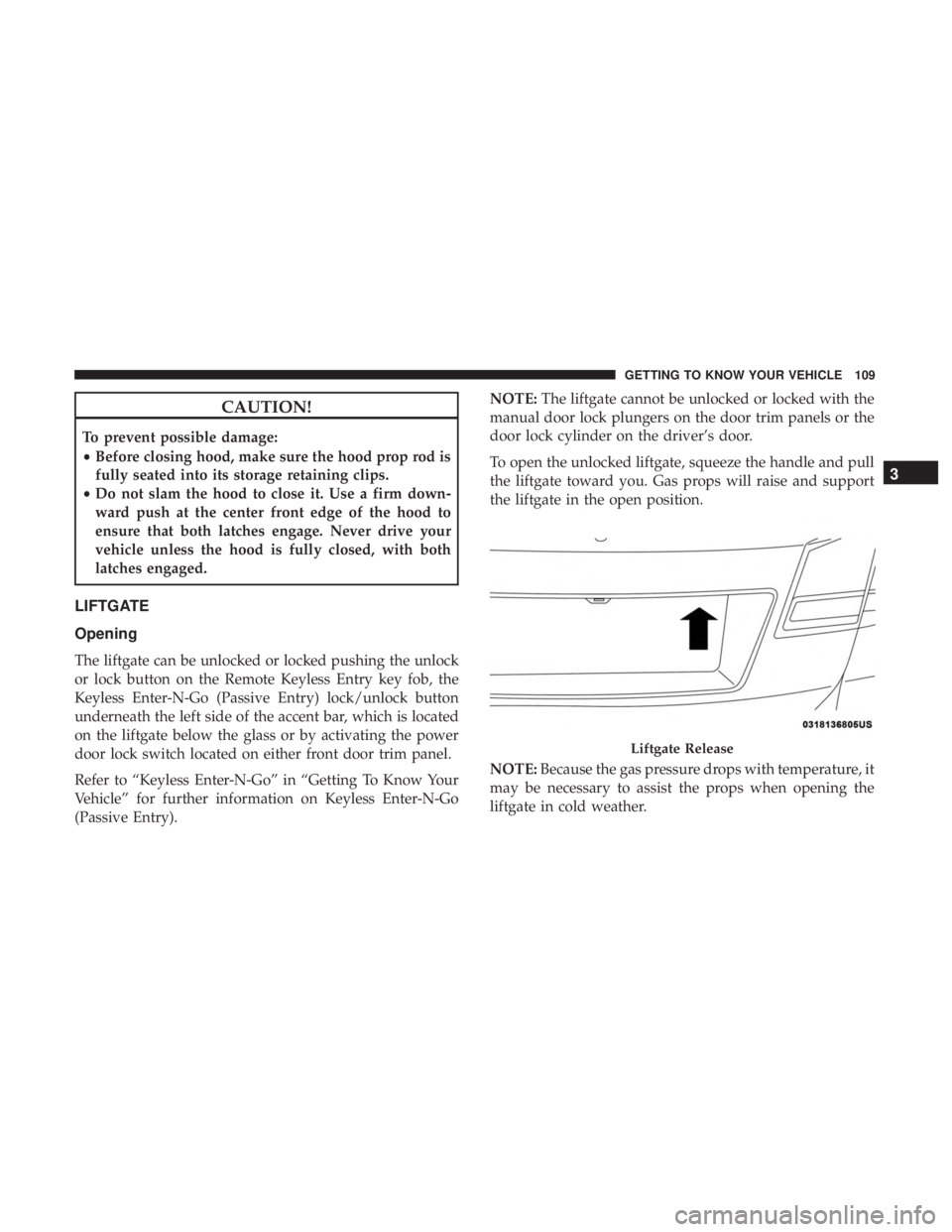
To open the unlocked liftgate, squeeze the handle and pull
the liftgate toward you. Gas props will raise and support
the liftgate in the open position.
NOTE: Because the gas pressure drops with temperature, it
may be necessary to assist the props when opening the
liftgate in cold weather.
Liftgate Release
3
GETTING TO KNOW YOUR VEHICLE 109
Page 120 of 524
4. Watch for the HomeLink indicator to change flash rates.When it changes, it is programmed. It may take up to 30
seconds or longer in rare cases. The garage door may
open and close while you are programming.
5. Push and hold the programmed HomeLink button and observe the indicator light.
NOTE: •If the indicator light stays on constantly, programming
is complete and the garage door/device should acti-
vate when the HomeLink button is pushed.
• To program the two remaining HomeLink buttons,
repeat each step for each remaining button. DO NOT
erase the channels.
If you unplugged the garage door opener/device for
programming, plug it back in at this time.
Using HomeLink
To operate, push and release the programmed HomeLink
button. Activation will now occur for the programmed
device (i.e. garage door opener, gate operator, security
system, entry door lock, home/office lighting, etc.) The
hand-held transmitter of the device may also be used at
any time.
Security
It is advised to erase all channels before you sell or turn in
your vehicle.
To do this, push and hold the two outside buttons for 20
seconds until the red indicator flashes.
NOTE: All channels will be erased. Individual channels
cannot be erased.
The HomeLink Universal Transceiver is disabled when the
Vehicle Security Alarm is active.
Troubleshooting Tips
If you are having trouble programming HomeLink, here
are some of the most common solutions:
• Replace the battery in the Garage Door Opener hand-
held transmitter.
• Push the LEARN button on the Garage Door Opener to
complete the training for a Rolling Code.
• Did you unplug the device for programming and re-
member to plug it back in?
118 GETTING TO KNOW YOUR VEHICLE
Page 200 of 524
•As the air bags deflate, you may see some smoke-like
particles. The particles are a normal by-product of the
process that generates the non-toxic gas used for air bag
inflation. These airborne particles may irritate the skin,
eyes, nose, or throat. If you have skin or eye irritation,
rinse the area with cool water. For nose or throat
irritation, move to fresh air. If the irritation continues,
see your doctor. If these particles settle on your clothing,
follow the garment manufacturer ’s instructions for
cleaning.
Do not drive your vehicle after the air bags have deployed.
If you are involved in another collision, the air bags will
not be in place to protect you.
WARNING!
Deployed air bags and seat belt pretensioners cannot
protect you in another collision. Have the air bags, seat
belt pretensioners, and the seat belt retractor assem-
blies replaced by an authorized dealer immediately.
Also, have the Occupant Restraint Controller System
serviced as well. NOTE:
•
Air bag covers may not be obvious in the interior trim,
but they will open during air bag deployment.
• After any collision, the vehicle should be taken to an
authorized dealer immediately.
Enhanced Accident Response System
In the event of an impact, if the communication network
remains intact, and the power remains intact, depending
on the nature of the event, the ORC will determine whether
to have the Enhanced Accident Response System perform
the following functions:
• Cut off fuel to the engine (If Equipped)
• Cut off battery power to the electric motor (If Equipped)
• Flash hazard lights as long as the battery has power
• Turn on the interior lights, which remain on as long as
the battery has power or for 15 minutes from the
intervention of the Enhanced Accident Response Sys-
tem.
• Unlock the power door locks.
198 SAFETY
Page 201 of 524
Your vehicle may also be designed to perform any of these
other functions in response to the Enhanced Accident
Response System:
•Turn off the Fuel Filter Heater, Turn off the HVAC
Blower Motor, Close the HVAC Circulation Door
• Cut off battery power to the:
• Engine
• Electric Motor (if equipped)
• Electric power steering
• Brake booster
• Electric park brake
• Automatic transmission gear selector
• Horn
• Front wiper
• Headlamp washer pump NOTE:
After an accident, remember to cycle the ignition
to the STOP (OFF/LOCK) position and remove the key
from the ignition switch to avoid draining the battery.
Carefully check the vehicle for fuel leaks in the engine
compartment and on the ground near the engine compart-
ment and fuel tank before resetting the system and starting
the engine. If there are no fuel leaks or damage to the
vehicle electrical devices (e.g. headlights) after an accident,
reset the system by following the procedure described
below. If you have any doubt, contact an authorized dealer.
Enhanced Accident Response System Reset
Procedure
In order to reset the Enhanced Accident Response System
functions after an event, the ignition switch must be
changed from ignition START or ON/RUN to ignition OFF.
Carefully check the vehicle for fuel leaks in the engine
compartment and on the ground near the engine compart-
ment and fuel tank before resetting the system and starting
the engine.
5
SAFETY 199
Page 209 of 524
WARNING!
Securely lock the seat cushion into position before
using the seat. Otherwise, the seat will not provide the
proper stability for child seats and/or passengers. An
improperly latched seat cushion could cause serious
injury or death.
WARNING!
In a severe collision, the booster seat may be damaged
and should be inspected by an authorized dealer and
possibly replaced before it is used again. The inte-
grated booster seat must be replaced following a colli-
sion that meets any of the following criteria:
•The vehicle cannot be driven away from the scene.
• The vehicle door nearest the seat has been damaged.
• At least one occupant was injured in the crash.
• At least one air bag in the vehicle deployed in the
crash.
Children Too Large For Booster Seats
Children who are large enough to wear the shoulder belt
comfortably, and whose legs are long enough to bend over
the front of the seat when their back is against the seatback,
should use the seat belt in a rear seat. Use this simple 5-step
test to decide whether the child can use the vehicle’s seat
belt alone:
1. Can the child sit all the way back against the back of the vehicle seat?
2. Do the child’s knees bend comfortably over the front of the vehicle seat – while the child is still sitting all the
way back?
3. Does the shoulder belt cross the child’s shoulder be- tween the neck and arm?
4. Is the lap part of the belt as low as possible, touching the child’s thighs and not the stomach?
5. Can the child stay seated like this for the whole trip?
5
SAFETY 207
Page 215 of 524
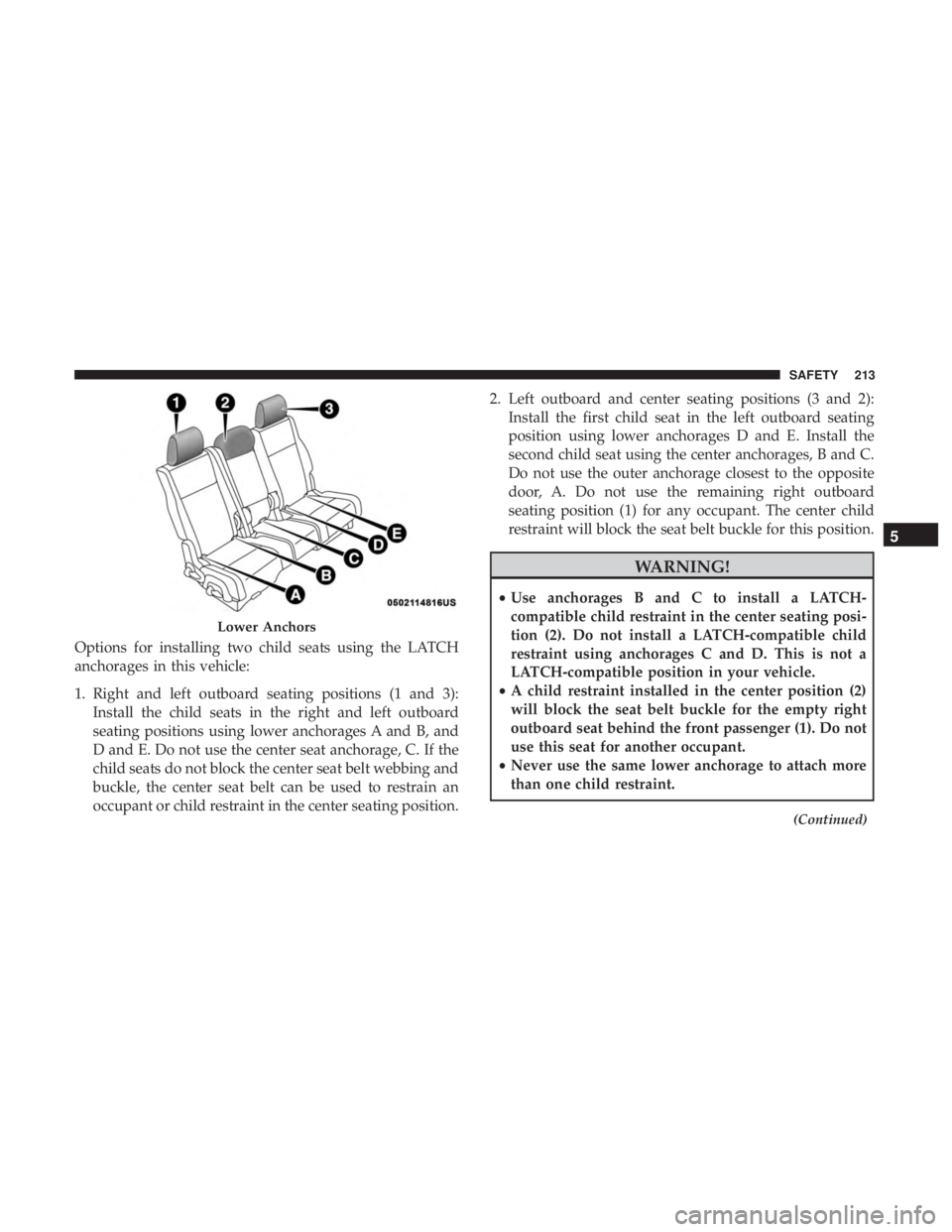
Options for installing two child seats using the LATCH
anchorages in this vehicle:
1. Right and left outboard seating positions (1 and 3):Install the child seats in the right and left outboard
seating positions using lower anchorages A and B, and
D and E. Do not use the center seat anchorage, C. If the
child seats do not block the center seat belt webbing and
buckle, the center seat belt can be used to restrain an
occupant or child restraint in the center seating position. 2. Left outboard and center seating positions (3 and 2):
Install the first child seat in the left outboard seating
position using lower anchorages D and E. Install the
second child seat using the center anchorages, B and C.
Do not use the outer anchorage closest to the opposite
door, A. Do not use the remaining right outboard
seating position (1) for any occupant. The center child
restraint will block the seat belt buckle for this position.
WARNING!
•Use anchorages B and C to install a LATCH-
compatible child restraint in the center seating posi-
tion (2). Do not install a LATCH-compatible child
restraint using anchorages C and D. This is not a
LATCH-compatible position in your vehicle.
• A child restraint installed in the center position (2)
will block the seat belt buckle for the empty right
outboard seat behind the front passenger (1). Do not
use this seat for another occupant.
• Never use the same lower anchorage to attach more
than one child restraint.
(Continued)
Lower Anchors
5
SAFETY 213