ECU DODGE MAGNUM 2008 1.G Owner's Manual
[x] Cancel search | Manufacturer: DODGE, Model Year: 2008, Model line: MAGNUM, Model: DODGE MAGNUM 2008 1.GPages: 482, PDF Size: 6.94 MB
Page 122 of 482

Folding Rear Seat
The rear seatbacks can be folded forward to provide an
additional storage area. Pull on the loops shown in the
illustration to fold down either or both seatbacks. These
loops can be tucked away when not in use.When the seatback is folded to the upright position, make
sure it is latched by strongly pulling on the top of the
seatback above the seat strap.
WARNING!
²Be certain that the seatback is securely locked into
position. If the seatback in not securely locked
into position the seat will not provide the proper
stability for child seats and/or passengers. An
improperly latched seat could cause serious injury.
²The cargo area in the rear of the vehicle (with the
rear seatbacks in the locked-up or folded down
position) should not be used as a play area by
children when the vehicle is in motion. They could
be seriously injured in an accident. Children
should be seated and using the proper restraint
system.
Folding Rear Seats
122 UNDERSTANDING THE FEATURES OF YOUR VEHICLE
Page 123 of 482

TO OPEN AND CLOSE THE HOOD
Two latches must be released to open the hood. First, pull
the hood release lever located under the left side of the
instrument panel.Next, move to the outside of the vehicle and push the
safety catch to the left. The safety catch is located under
the center front edge of the hood.
Use the hood prop rod (if equipped) to secure the hood in
the open position.
To prevent possible damage, do not slam the hood to
close it. Lower the hood until it is open approximately 6
Hood Release Lever
Hood Safety Catch
UNDERSTANDING THE FEATURES OF YOUR VEHICLE 123
3
Page 124 of 482
inches (15 cm), and then drop it. This should secure both
latches. Never drive your vehicle unless the hood is fully
closed, with both latches engaged.
WARNING!
If the hood is not fully latched, it could fly up when
the vehicle is moving and block your forward vision.
You could have a collision. Be sure all hood latches
are fully latched before driving.
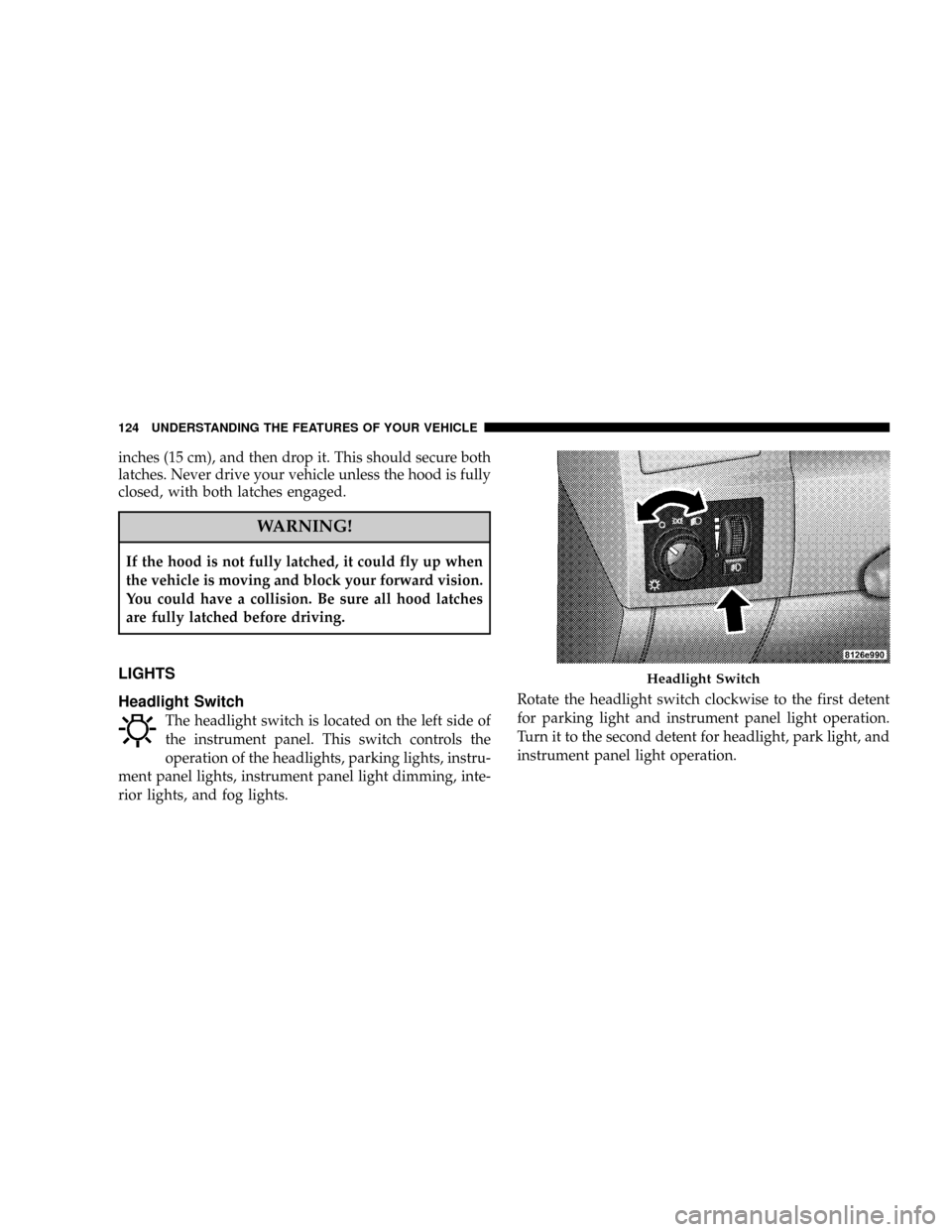
LIGHTS
Headlight Switch
The headlight switch is located on the left side of
the instrument panel. This switch controls the
operation of the headlights, parking lights, instru-
ment panel lights, instrument panel light dimming, inte-
rior lights, and fog lights.Rotate the headlight switch clockwise to the first detent
for parking light and instrument panel light operation.
Turn it to the second detent for headlight, park light, and
instrument panel light operation.
Headlight Switch
124 UNDERSTANDING THE FEATURES OF YOUR VEHICLE
Page 140 of 482

Courtesy/Reading Lights
At the forward end of the console are two courtesy/
reading lights.
Press the lens to turn on the light. Press it a second time
to turn off the light.
These lights also turn on when a door is opened, or when
the liftgate is opened, or when the unlock button on the
remote keyless entry transmitter is pressed, or when the
dimmer control is turned fully upward, past the second
detent.
Sunglasses Storage
At the rear of the console, a compartment is provided for
the storage of a pair of sunglasses.The storage compartment access is a9push/push9design.
Push the raised bar on the compartment door to open.
Push the raised bar to close.
GARAGE DOOR OPENER Ð IF EQUIPPED
HomeLinktreplaces up to three remote controls (hand
held transmitters) that operate devices such as garage
door openers, motorized gates, lighting, or home security
systems. The HomeLinktunit operates off of your vehi-
cle's battery.
NOTE:HomeLinktis disabled when the Vehicle Secu-
rity Alarm is active.
140 UNDERSTANDING THE FEATURES OF YOUR VEHICLE
Page 145 of 482

Then proceed with Step 4 under ªProgramming
HomeLink.º earlier in this section.
Using HomeLinkT
To operate, simply press and release the programmed
HomeLinktbutton. Activation will now occur for the
trained device (i.e. garage door opener, gate operator,
security system, entry door lock, home/office lighting,
etc. The hand-held transmitter of the device may also be
used at any time.
Reprogramming a Single HomeLinkTButton
To re-program a channel that has been previously
trained, follow these steps:
1. Turn the ignition switch to the ON/RUN position.
2. Press and hold the desired HomeLinktbutton for 20
seconds until the EVIC display states ªCHANNEL #
TRAINING.ºDo not release the button.3.Without releasing the button,proceed with PRO-
GRAMMING HOMELINK Step #2 and follow all remain-
ing steps.
Security
It is advised to erase all channels before you sell or turn
in your vehicle.
To do this, press and hold the two outside buttons for 20
seconds until the EVIC message states ªCHANNELS
CLEARED.º Note that all channels will be erased. Indi-
vidual channels cannot be erased.
The HomeLinktUniversal Transceiver is disabled when
the Vehicle Security Alarm is active.
Troubleshooting Tips
If you are having trouble programming HomeLinkt, here
are some of the most common solutions:
²Replace the battery in the original transmitter.
UNDERSTANDING THE FEATURES OF YOUR VEHICLE 145
3
Page 147 of 482

POWER SUNROOF Ð IF EQUIPPED
The power sunroof switch is located between the sun
visors on the overhead console.WARNING!
²Never leave children in a vehicle, with the keys in
the ignition switch. Occupants, particularly unat-
tended children, can become entrapped by the
power sunroof while operating the power sunroof
switch. Such entrapment may result in serious
injury or death.
²In an accident, there is a greater risk of being
thrown from a vehicle with an open sunroof. You
could also be seriously injured or killed. Always
fasten your seat belt properly and make sure all
passengers are properly secured too.
²Do not allow small children to operate the sun-
roof. Never allow fingers or other body parts, or
any object to project through the sunroof opening.
Injury may result.
Power Sunroof Controls
UNDERSTANDING THE FEATURES OF YOUR VEHICLE 147
3
Page 158 of 482

Rollaway Tonneau Cover Ð If Equipped
The removable rollaway tonneau cover mounts in the
cargo area behind the top of the rear seats.
The tonneau cover, when extended, covers the cargo area
to keep items out of sight. Notches in the trim panels near
the liftgate opening secure the extended tonneau cover in
place.
Load Floor Fully Folded
158 UNDERSTANDING THE FEATURES OF YOUR VEHICLE
Page 161 of 482

Cargo Organizer
The optional cargo organizer can also be placed into the
lower load floor. Lift the handle and pull to open the
cargo organizer.
Cargo Tie-Down Hooks
The tie-downs located on cargo area floor and on the rear
trim panels should be used to safely secure loads when
vehicle is moving.
Cargo Organizer Handle
UNDERSTANDING THE FEATURES OF YOUR VEHICLE 161
3
Page 164 of 482

3. Repeat Steps 1 and 2 on the opposite clamp on the
other side of the crossbar.
4. Pick up the crossbar and move it to the desired
location. Do not place the crossbar directly over the
sunroof glass (if equipped).
5. Turn the lower clamp until the round side of the clamp
completely faces the side rail.
6. Turn the lever clockwise to tighten the lower clamp to
the side rail. When tight, flip the lever downward.
7. Repeat Steps 5 and 6 on the opposite clamp on the
other side of the crossbar.
8. Attempt to move the crossbar to ensure that it is
locked in position.
NOTE:To reduce the amount of wind noise when the
crossbars are not in use, remove both crossbars from the
side rails and place them inside the vehicle.CAUTION!
²To avoid damage to the roof rack and vehicle, do
not exceed the maximum roof rack load capacity of
150 lbs (68 kg). Always distribute heavy loads as
evenly as possible and secure the load appropri-
ately.
²Long loads, which extend over the windshield,
such as wood panels or surfboards, or loads with
large frontal area should be secured to both the
front and rear of the vehicle.
²Travel at reduced speeds and turn corners carefully
when carrying large or heavy loads on the roof
rack. Wind forces, due to natural causes or nearby
truck traffic, can add sudden upward loads. This is
especially true on large flat loads and may result in
damage to the cargo or your vehicle.
²Do not use the pop-up feature of the sliding /
pop-up roof when positioning or placing luggage
above it, to prevent damage to the sliding / pop-up
roof panel.
164 UNDERSTANDING THE FEATURES OF YOUR VEHICLE
Page 165 of 482

WARNING!
Cargo must be securely tied before driving your
vehicle. Improperly secured loads can fly off the
vehicle, particularly at high speeds, resulting in per-
sonal injury or property damage. Follow the Roof
Rack Cautions when carrying cargo on your roof
rack.
LOAD LEVELING SYSTEM Ð IF EQUIPPED
The automatic load leveling system will provide a level-
riding vehicle under most passenger and cargo loading
conditions.A hydraulic pump contained within the shock absorbers
raises the rear of the vehicle to the correct height. It takes
approximately 1 mile (1.6 km) of driving for the leveling
to complete depending on road surface conditions.
If the leveled vehicle is not moved for approximately 15
hours, the leveling system will bleed itself down. The
vehicle must be driven to reset the system.
UNDERSTANDING THE FEATURES OF YOUR VEHICLE 165
3