ignition DODGE MAGNUM SRT 2008 1.G Manual Online
[x] Cancel search | Manufacturer: DODGE, Model Year: 2008, Model line: MAGNUM SRT, Model: DODGE MAGNUM SRT 2008 1.GPages: 476, PDF Size: 5.82 MB
Page 366 of 476
HAZARD WARNING FLASHER
The HAZARD switch is located in the switch bank
near the top center of the instrument panel. De-
press the switch to activate the flashers. When
activated, all directional turn signals will flash on and off
to warn oncoming traffic of an emergency. Push the
switch a second time to turn off the flashers.
This is an emergency warning system and it should not
be used when the vehicle is in motion. Use it when your
vehicle is disabled and it is creating a safety hazard for
other motorists.
When you must leave the vehicle to seek assistance, the
hazard warning flashers will continue to operate even
though the ignition switch is in the LOCK position.
NOTE:With extended use, the hazard earning flashers
may wear down your battery.
IF YOUR ENGINE OVERHEATS
In any of the following situations, you can reduce the
potential for overheating by taking the appropriate ac-
tion.
•On the highways — Slow down.
•In city traffic — While stopped, put transmission in
NEUTRAL, but do not increase engine idle speed.
NOTE:There are steps that you can take to slow down
an impending overheat condition. If your air conditioner
is on, turn it off. The air conditioning system adds heat to
the engine cooling system and turning off the A/C
removes this heat. You can also turn the temperature
control to maximum heat, the mode control to floor, and
the Fan control to HI. This allows the heater core to act as
a supplement to the radiator and aids in removing heat
from the engine cooling system.
364 WHAT TO DO IN EMERGENCIES
Page 373 of 476
JUMP-STARTING PROCEDURES
WARNING!
•Take care to avoid the radiator cooling fan whenever the hood is raised.
It can start anytime the ignition switch is ON. You can be hurt by the
fan.
•Do not attempt to push or tow your vehicle to get it started. Vehicles
equipped with an automatic transmission cannot be started this way.
Unburned fuel could enter the catalytic converter and once the engine
has started, ignite and damage the converter and vehicle. If the vehicle
has a discharged battery, booster cables may be used to obtain a start
from another vehicle. This type of start can be dangerous if done
improperly, so follow this procedure carefully.
•Battery fluid is a corrosive acid solution; do not allow battery fluid to
contact eyes, skin, or clothing. Don’t lean over battery when attaching
clamps or allow the clamps to touch each other. If acid splashes in eyes
or on skin, flush contaminated area immediately with large quantities
of water.
•A battery generates hydrogen gas, which is flammable and explosive.
Keep flame or spark away from the vent holes.
•Do not use a booster battery or any other booster source with an output
that exceeds 12 Volts.
•The battery in this vehicle has a vent hose that should not be discon-
nected and should only be replaced with a battery of the same type
(vented).
NOTE:The battery is stored under a hinged access
cover in the load floor in the cargo area. Remote battery
terminals are located in the engine compartment for
jump-starting.
1. Wear eye protection and remove any metal jewelry
such as watchbands or bracelets that might make an
inadvertent electrical contact.
2. When boost is provided by a battery in another
vehicle, park that vehicle within booster cable reach, but
do not allow the vehicles to touch one another.
WARNING!
Do not permit vehicles to touch each other as this
could establish a ground connection and personal
injury could result.
WHAT TO DO IN EMERGENCIES 371
6
Page 374 of 476
3. Set the parking brake, place the automatic transmis-
sion in PARK, and turn the ignition switch to the LOCK
position on both vehicles.
4. Turn off the heater, radio, and all unnecessary electri-
cal loads.
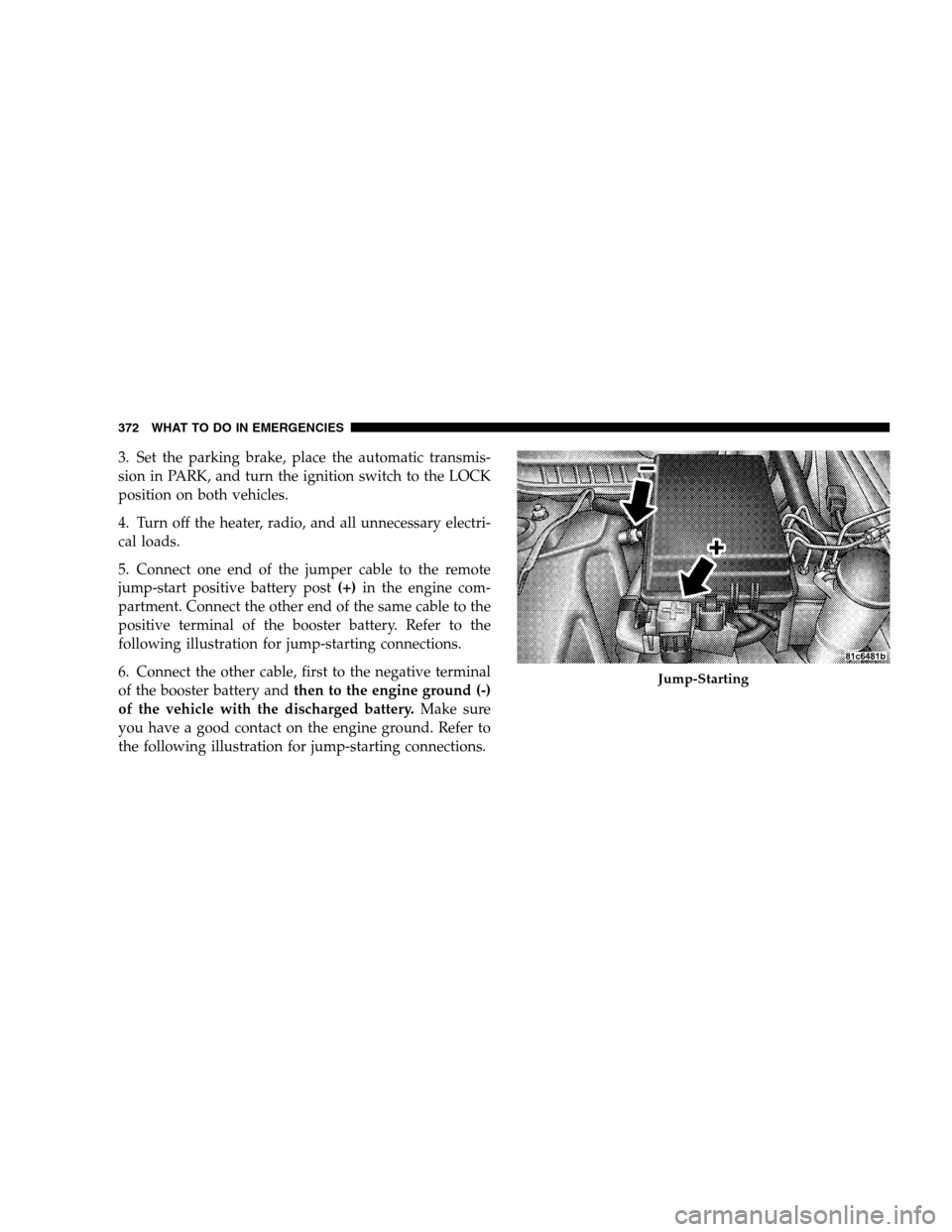
5. Connect one end of the jumper cable to the remote
jump-start positive battery post(+)in the engine com-
partment. Connect the other end of the same cable to the
positive terminal of the booster battery. Refer to the
following illustration for jump-starting connections.
6. Connect the other cable, first to the negative terminal
of the booster battery andthen to the engine ground (-)
of the vehicle with the discharged battery.Make sure
you have a good contact on the engine ground. Refer to
the following illustration for jump-starting connections.
Jump-Starting
372 WHAT TO DO IN EMERGENCIES
Page 377 of 476
WARNING!
Fast spinning tires can be dangerous. Forces gener-
ated by excessive wheel speeds may cause tire dam-
age or failure. A tire could explode and injure some-
one. Do not spin your vehicle’s wheels faster than 35
mph (55 km/h) when you are stuck, and don’t let
anyone near a spinning wheel, no matter what the
speed.
TOWING A DISABLED VEHICLE
Without The Ignition Key
Special care must be taken when the vehicle is towed
with the ignition in the LOCK position. The only ap-
proved method of towing without the ignition key is
with a flat-bed truck. Proper towing equipment is neces-
sary to prevent damage to the vehicle.
Towing This Vehicle Behind Another Vehicle (Flat
Towing With All Four Wheels On The Ground)
Flat towing of vehicles equipped with an automatic
transmission, is only permitted within the following
limitations
With The Ignition Key
Your vehicle may be towed under the following condi-
tions: The shift lever must be in NEUTRAL, the distance
to be traveled must not exceed 30 mi (48 km), and the
towing speed must not exceed 30 mph (48 km/h).
Exceeding these towing limits may cause a transmission
geartrain failure. If the transmission is not operative or if
the vehicle is to be towed more than 30 mi (48 km), the
vehicle must be transported using a flat-bed truck.
WHAT TO DO IN EMERGENCIES 375
6
Page 384 of 476
Loose Fuel Filler Cap
If the vehicle diagnostic system determines that the fuel
filler cap is loose, improperly installed, or damaged, a
“Check Gascap” message will display in the Electronic
Vehicle Information Center (EVIC) (if equipped). If this
occurs, tighten the fuel filler cap properly and press the
TRIP ODOMETER button to turn off the message. If the
problem continues, the message will appear the next time
the vehicle is started.
A loose, improperly installed, or damaged fuel filler cap
may also turn on the MIL.
EMISSIONS INSPECTION AND MAINTENANCE
PROGRAMS
In some localities, it may be a legal requirement to pass
an inspection of your vehicle’s emissions control system.
Failure to pass could prevent vehicle registration.For states that require an I/M (Inspection and
Maintenance), this check verifies the MIL is func-
tioning and is not on when the engine is running,
and that the OBD II system is ready for testing.
Normally, the OBD system will be ready. The OBD II
system maynotbe ready if your vehicle was recently
serviced or recently had a dead battery or had a battery
replacement. If the OBD II system should be determined
not ready for the I/M test, your vehicle may fail the test.
Your vehicle has a simple ignition key-actuated test,
which you can use prior to going to the test station. To
check if your vehicle’s OBD II system is ready, you must
do the following:
1. Insert your ignition key into the ignition switch.
2. Turn the ignition to the ON position, but do not crank
or start the engine.
382 MAINTAINING YOUR VEHICLE
Page 385 of 476
3. If you crank or start the engine, you will have to start
this test over.
4. As soon as you turn your key to the ON position, you
will see the MIL symbol come on as part of a normal bulb
check.
5. Approximately 15 seconds later, one of two things will
happen:
a. The MIL will flash for about 10 seconds and then
return to being fully illuminated until you turn OFF
the ignition key or start the engine. This means that
your vehicle’s OBD II system isnot readyand you
shouldnotproceed to the I/M station.
b. The MIL will not flash at all and will remain fully
illuminated until you turn OFF the ignition key or start
the engine. This means that your vehicle’s OBD II
system isready, and you can proceed to the I/M
station.If your OBD II system isnot ready,you should see your
authorized dealer or repair facility. If your vehicle was
recently serviced or had a battery failure or replacement,
you may need to do nothing more than drive your
vehicle as you normally would in order for your OBD II
system to update. A recheck with the above test routine
may then indicate that the system is now ready.
Regardless of whether your vehicle’s OBD II system is
ready or not ready, if the MIL is illuminated during
normal vehicle operation, you should have your vehicle
serviced before going to the I/M station. The I/M station
can fail your vehicle because the MIL is on with the
engine running.
MAINTAINING YOUR VEHICLE 383
7
Page 392 of 476
WARNING!
A hot exhaust system can start a fire if you park over
materials that can burn. Such materials might be
grass or leaves coming into contact with your exhaust
system. Do not park or operate your vehicle in areas
where your exhaust system can contact anything that
can burn.
In unusual situations involving grossly malfunctioning
engine operation, a scorching odor may indicate severe
and abnormal catalyst overheating. If this should occur,
safely bring the vehicle to a complete stop, shut the
engine OFF, and allow the vehicle to cool. Thereafter,
obtain service, including a tune-up to manufacturer’s
specifications immediately.To minimize the possibility of catalyst damage:•Do not shut off the engine or interrupt the ignition
when the transmission is in gear and the vehicle is in
motion.
•Do not try to start the engine by pushing or towing the
vehicle.
•Do not idle the engine with any spark plug wires
disconnected or removed, such as when diagnostic
testing, or for prolonged periods during very rough
idling or malfunctioning operating conditions.
Maintenance-Free Battery
The top of the maintenance-free battery is permanently
sealed. You will never have to add water, nor is periodic
maintenance required.
390 MAINTAINING YOUR VEHICLE
Page 399 of 476
damaged, have a competent mechanic inspect the com-
plete exhaust system and adjacent body areas for broken,
damaged, deteriorated, or mispositioned parts. Open
seams or loose connections could permit exhaust fumes
to seep into the passenger compartment. In addition,
inspect the exhaust system each time the vehicle is raised
for lubrication or oil change. Replace as required.
WARNING!
Exhaust gases can injure or kill. They contain carbon
monoxide (CO), which is colorless and odorless.
Breathing it can make you unconscious and can
eventually poison you. To avoid breathing CO, refer
to “Exhaust Gas” under “Safety Tips” in Section 2.
Cooling System
WARNING!
•When working near the radiator cooling fan, dis-
connect the fan motor lead or turn the ignition
switch to the LOCK position. The fan is tempera-
ture controlled and can start at any time the
ignition switch is in the ON position.
•You or others can be badly burned by hot coolant
or steam from your radiator. If you see or hear
steam coming from under the hood, don’t open the
hood until the radiator has had time to cool. Never
try to open a cooling system pressure cap when the
radiator is hot.
MAINTAINING YOUR VEHICLE 397
7
Page 416 of 476
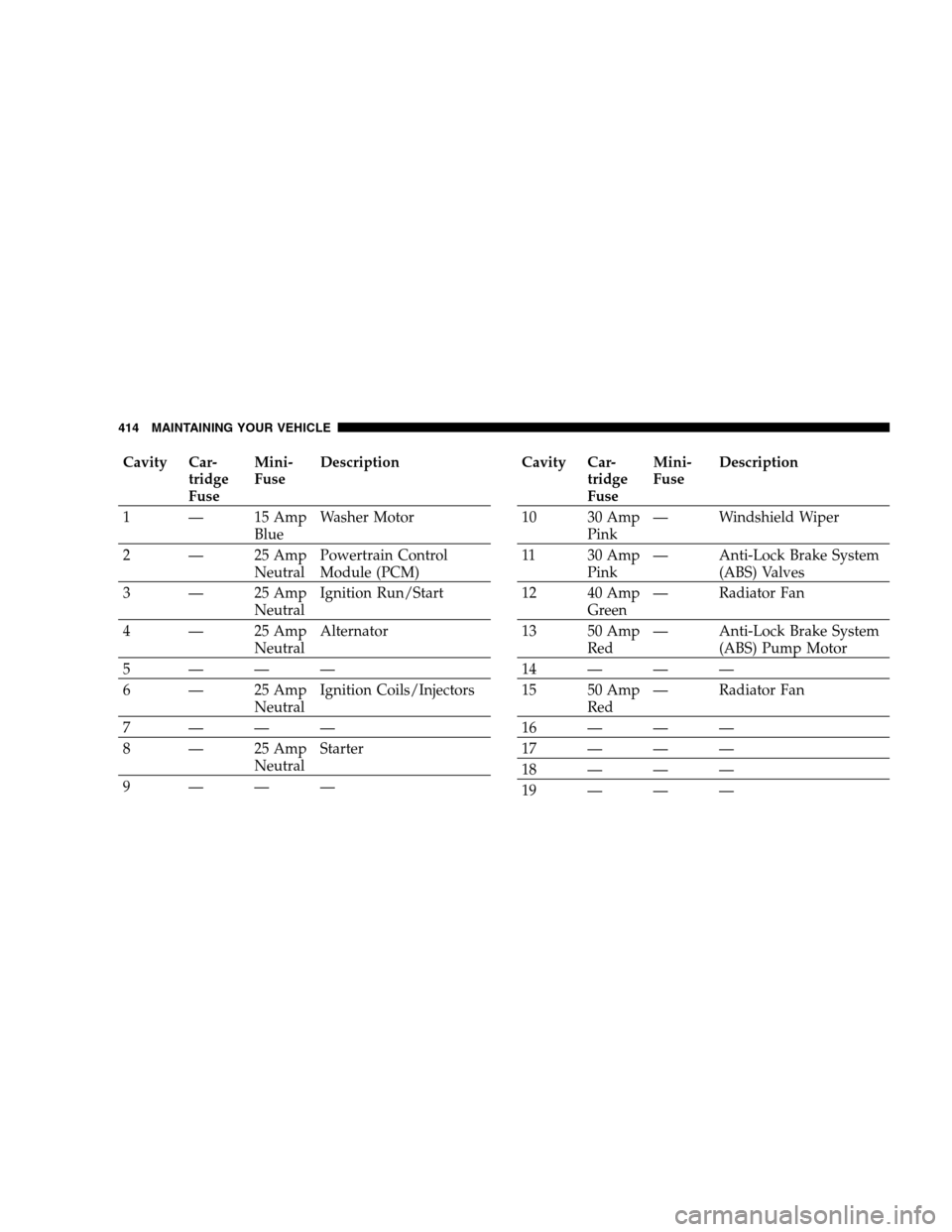
Cavity Car-
tridge
FuseMini-
FuseDescription
1 — 15 Amp
BlueWasher Motor
2 — 25 Amp
NeutralPowertrain Control
Module (PCM)
3 — 25 Amp
NeutralIgnition Run/Start
4 — 25 Amp
NeutralAlternator
5———
6 — 25 Amp
NeutralIgnition Coils/Injectors
7———
8 — 25 Amp
NeutralStarter
9———Cavity Car-
tridge
FuseMini-
FuseDescription
10 30 Amp
Pink— Windshield Wiper
11 30 Amp
Pink— Anti-Lock Brake System
(ABS) Valves
12 40 Amp
Green— Radiator Fan
13 50 Amp
Red— Anti-Lock Brake System
(ABS) Pump Motor
14 — — —
15 50 Amp
Red— Radiator Fan
16 — — —
17 — — —
18 — — —
19 — — —
414 MAINTAINING YOUR VEHICLE
Page 419 of 476
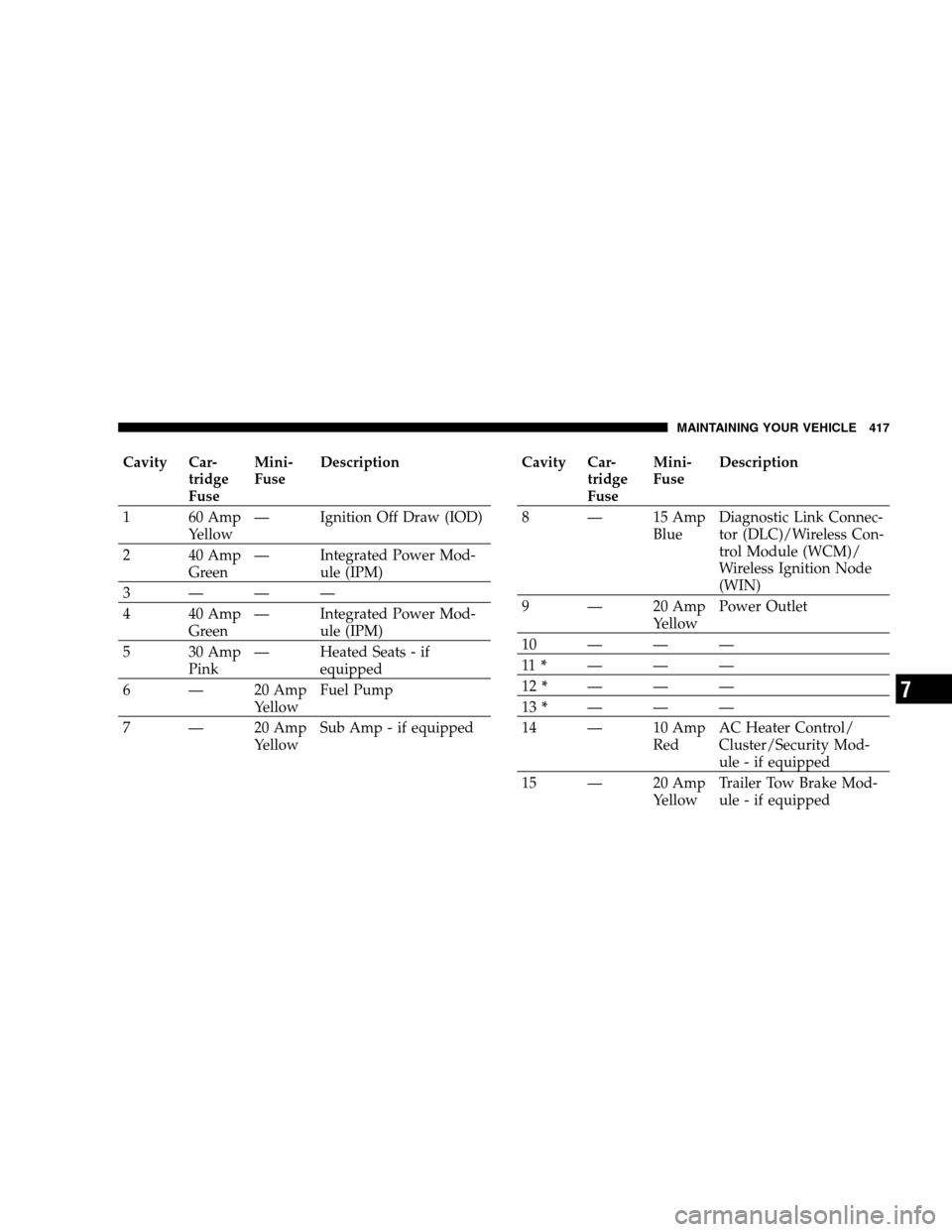
Cavity Car-
tridge
FuseMini-
FuseDescription
1 60 Amp
Yellow— Ignition Off Draw (IOD)
2 40 Amp
Green— Integrated Power Mod-
ule (IPM)
3———
4 40 Amp
Green— Integrated Power Mod-
ule (IPM)
5 30 Amp
Pink— Heated Seats - if
equipped
6 — 20 Amp
YellowFuel Pump
7 — 20 Amp
YellowSub Amp - if equippedCavity Car-
tridge
FuseMini-
FuseDescription
8 — 15 Amp
BlueDiagnostic Link Connec-
tor (DLC)/Wireless Con-
trol Module (WCM)/
Wireless Ignition Node
(WIN)
9 — 20 Amp
YellowPower Outlet
10 — — —
11*———
12*———
13*———
14 — 10 Amp
RedAC Heater Control/
Cluster/Security Mod-
ule - if equipped
15 — 20 Amp
YellowTrailer Tow Brake Mod-
ule - if equipped
MAINTAINING YOUR VEHICLE 417
7