torque strut DODGE NEON 2000 Service Owner's Manual
[x] Cancel search | Manufacturer: DODGE, Model Year: 2000, Model line: NEON, Model: DODGE NEON 2000Pages: 1285, PDF Size: 29.42 MB
Page 61 of 1285
hex on the end of the strut shaft. While holding the
strut shaft from turning, tighten the strut shaft
retaining nut to a torque of 75 N´m (55 ft. lbs.).
(10) Slowly release the tension from the coil spring
by backing off the compressor drive completely. As
the tension is relieved, make sure the upper mount's
seat aligns properly with the coil spring.
(11) Verify the arrow on the upper mount is point-
ing in the same direction as the strut clevis bracket
as mentioned in step 9.
(12) Remove the clamp from the lower end of the
coil spring and strut. Push back the spring compres-
sor upper and lower hooks, then remove the strut
assembly from the spring compressor.
(13) Install the strut assembly on the vehicle.
Refer to REMOVAL AND INSTALLATION in this
section for the required procedure.
SPECIFICATIONS
REAR SUSPENSION FASTENER TORQUE
SPECIFICATIONS
DESCRIPTION TORQUE
STRUT ASSEMBLY:
Tower Attaching Nuts..... 34N´m(300 in. lbs.)
Knuckle Attaching Bolts.... 88N´m(65ft.lbs.)
Strut Assembly Shaft Nut . . . 75 N´m (55 ft. lbs.)
Brake Hose Bracket Mounting Bolt..... 31N´m
(275 in. lbs.)
KNUCKLE:
Brake Support Plate Mounting Bolts.... 75N´m
(55 ft. lbs.)
Disc Brake Adapter Mounting Bolts.... 75N´m
(55 ft. lbs.)
HUB AND BEARING:
To Knuckle Retaining Nut........... 217N´m
(160 ft. lbs.)
Wheel Mounting Nuts...........109-150 N´m
(80-110 ft. lbs.)
LATERAL ARM:
Nut At Crossmember....... 88N´m(65ft.lbs.)
Nut At Knuckle........... 95N´m(70ft.lbs.)
TENSION STRUT:
Rear Nut................ 95N´m(70ft.lbs.)
Frame Rail Bolts.......... 95N´m(70ft.lbs.)
Parking Brake Cable Nut . . 28 N´m (250 in. lbs.)
STABILIZER BAR:
Cushion Retainer Bolts.... 34N´m(300 in. lbs.)
Link Bolt Nut........... 23N´m(200 in. lbs.)
SPECIAL TOOLS
REAR SUSPENSION
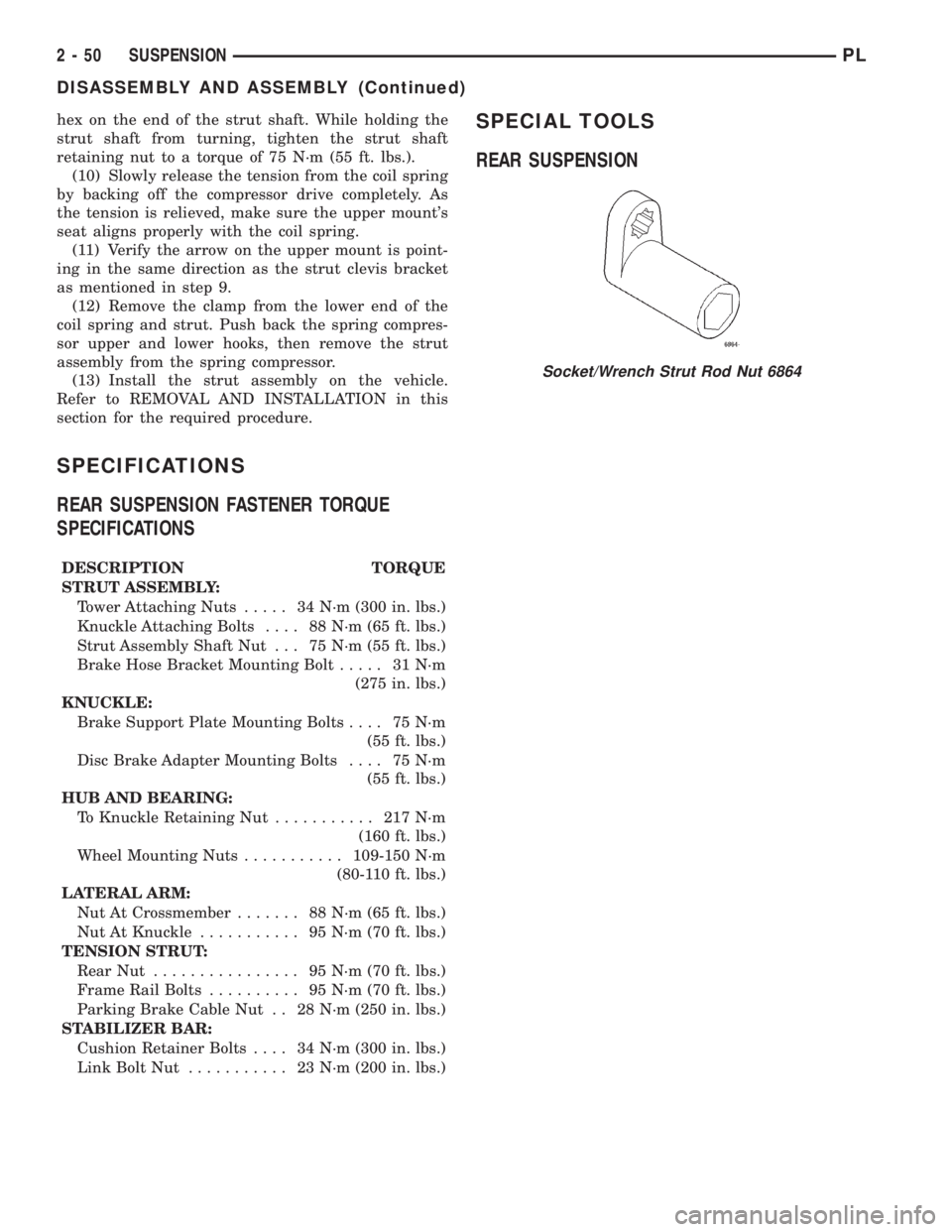
Socket/Wrench Strut Rod Nut 6864
2 - 50 SUSPENSIONPL
DISASSEMBLY AND ASSEMBLY (Continued)
Page 110 of 1285
CAUTION: Discard the used retaining clip, it is not
to be reused. Replace the clip with a new one on
reassembly.
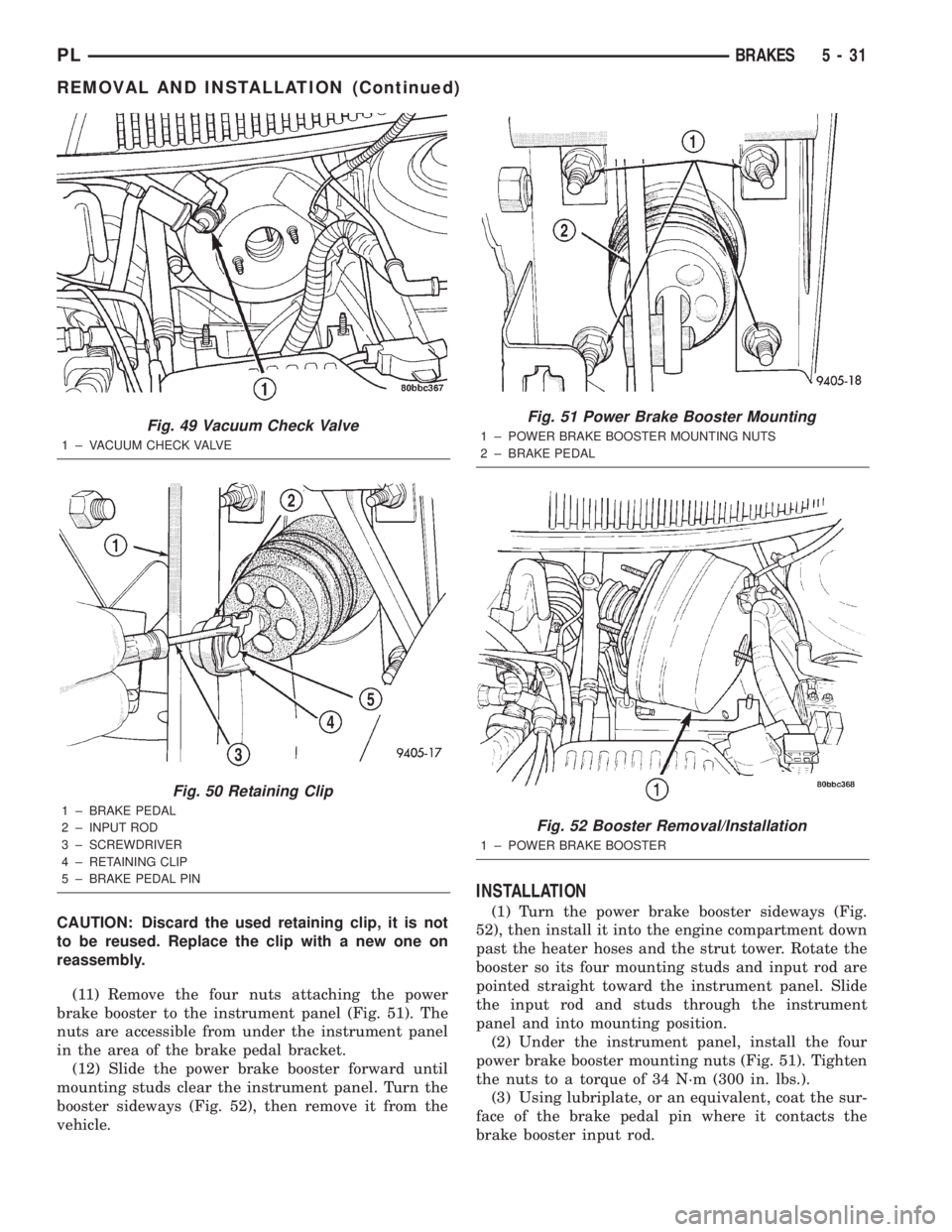
(11) Remove the four nuts attaching the power
brake booster to the instrument panel (Fig. 51). The
nuts are accessible from under the instrument panel
in the area of the brake pedal bracket.
(12) Slide the power brake booster forward until
mounting studs clear the instrument panel. Turn the
booster sideways (Fig. 52), then remove it from the
vehicle.
INSTALLATION
(1) Turn the power brake booster sideways (Fig.
52), then install it into the engine compartment down
past the heater hoses and the strut tower. Rotate the
booster so its four mounting studs and input rod are
pointed straight toward the instrument panel. Slide
the input rod and studs through the instrument
panel and into mounting position.
(2) Under the instrument panel, install the four
power brake booster mounting nuts (Fig. 51). Tighten
the nuts to a torque of 34 N´m (300 in. lbs.).
(3) Using lubriplate, or an equivalent, coat the sur-
face of the brake pedal pin where it contacts the
brake booster input rod.
Fig. 49 Vacuum Check Valve
1 ± VACUUM CHECK VALVE
Fig. 50 Retaining Clip
1 ± BRAKE PEDAL
2 ± INPUT ROD
3 ± SCREWDRIVER
4 ± RETAINING CLIP
5 ± BRAKE PEDAL PIN
Fig. 51 Power Brake Booster Mounting
1 ± POWER BRAKE BOOSTER MOUNTING NUTS
2 ± BRAKE PEDAL
Fig. 52 Booster Removal/Installation
1 ± POWER BRAKE BOOSTER
PLBRAKES 5 - 31
REMOVAL AND INSTALLATION (Continued)
Page 112 of 1285
INSTALLATION
(1) Lubricate the O-ring on the proportioning
valve. Make sure the O-ring on the proportioning
valve is new.
(2) Install the proportioning valve in its master
cylinder port. Tighten the proportioning valve to a
torque of 40 N´m (30 ft. lbs.).
(3) Connect the brake tube to the proportioning
valve (Fig. 54). Tighten the tube nut to a torque of 17
N´m (145 in. lbs.).
(4) Remove the brake pedal holder (Fig. 53).
(5) Bleed the affected brake line. See BASE
BRAKE BLEEDING in the SERVICE PROCE-
DURES section in this service manual group.
(6) Road test the vehicle to ensure proper opera-
tion of the brakes.
BRAKES TUBES AND HOSES
NOTE: Brake hoses for each brake are unique and
are not interchangeable.
Always use Mopartreplacement brake hoses to
ensure quality, correct length and superior fatigue
life. Care should be taken to make sure that the tube
and hose mating surfaces are clean and free from
nicks and burrs.
Use new copper seal washers on all connections
using banjo bolts and tighten all the fittings to their
specified torques.
Follow the procedures in the next three paragraphs
to reduce the potential for twisting the brake hose
during installation.
The flexible front hydraulic brake hose should
always be installed on the vehicle by first attaching
the banjo fitting to the disc brake caliper. Attach the
hose to the brake tubing before attaching it to the
front frame rail. Tighten all brake line fittings to the
specified torque.
On vehicles equipped with rear drum brakes,
loosely install the rear brake hose to the wheel cylin-
der first, then bolt the intermediate routing bracket
to the strut. Next, loosely install the hose to the steel
tube coming from the master cylinder. Attach the
hose bracket to the body. Finally, tighten the tube
nuts at each end of the brake hose.
On vehicles equipped with rear disc brakes, attach
the brake hose banjo fitting to the caliper first, then
loosely install the hose to the steel tube coming from
the master cylinder. Next, attach the brake hose
bracket to the body. Finally, tighten the tube nut at
the each of the end of the brake hose connecting to
the steel tube coming from the master cylinder.Only double wall 4.75 mm (3/16 in.) steel brake
line tubing with Nygal coating should be used for
replacement along with its special tube nuts. Care
must be taken when replacing brake tubing; to be
sure, use the proper bending and flaring tools, and
procedures to avoid kinking. Do not route the tubes
against sharp edges, moving components, or into hot
areas. All tubes should be properly attached with the
recommended retaining clips.
DISC BRAKE CALIPER (FRONT)
NOTE: Before proceeding with this procedure,
review SERVICE WARNINGS AND CAUTIONS at the
beginning of REMOVAL AND INSTALLATION in this
section.
REMOVAL
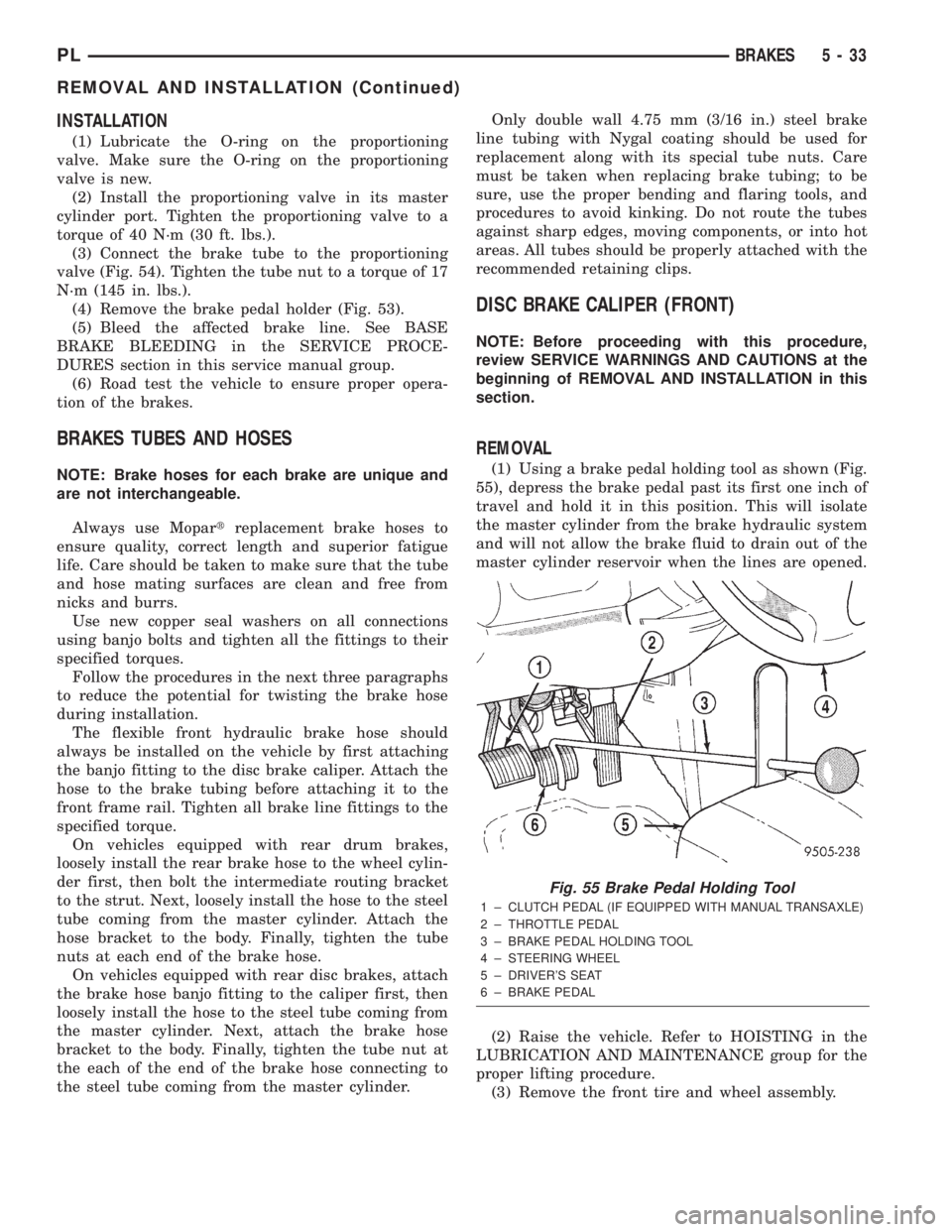
(1) Using a brake pedal holding tool as shown (Fig.
55), depress the brake pedal past its first one inch of
travel and hold it in this position. This will isolate
the master cylinder from the brake hydraulic system
and will not allow the brake fluid to drain out of the
master cylinder reservoir when the lines are opened.
(2) Raise the vehicle. Refer to HOISTING in the
LUBRICATION AND MAINTENANCE group for the
proper lifting procedure.
(3) Remove the front tire and wheel assembly.
Fig. 55 Brake Pedal Holding Tool
1 ± CLUTCH PEDAL (IF EQUIPPED WITH MANUAL TRANSAXLE)
2 ± THROTTLE PEDAL
3 ± BRAKE PEDAL HOLDING TOOL
4 ± STEERING WHEEL
5 ± DRIVER'S SEAT
6 ± BRAKE PEDAL
PLBRAKES 5 - 33
REMOVAL AND INSTALLATION (Continued)
Page 130 of 1285
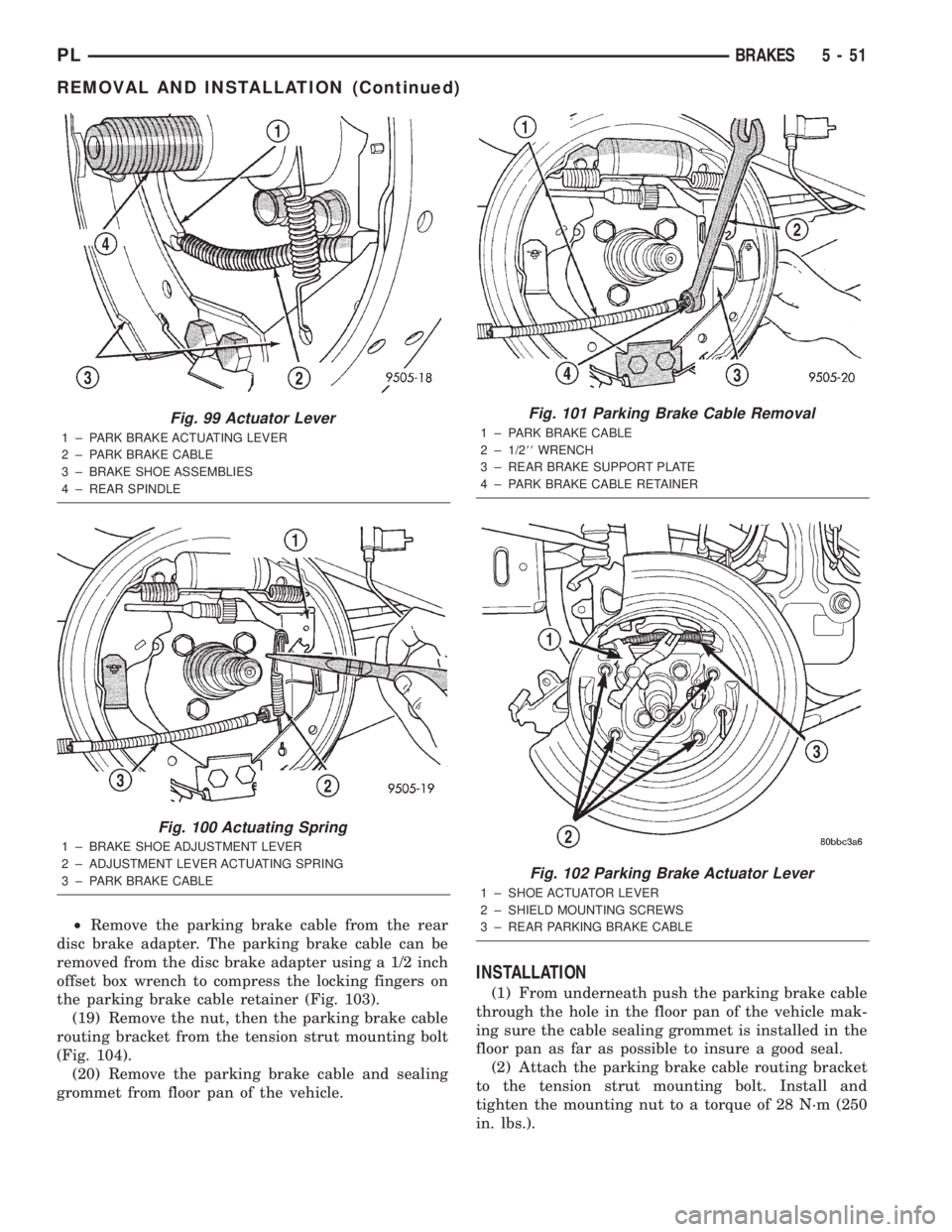
²Remove the parking brake cable from the rear
disc brake adapter. The parking brake cable can be
removed from the disc brake adapter using a 1/2 inch
offset box wrench to compress the locking fingers on
the parking brake cable retainer (Fig. 103).
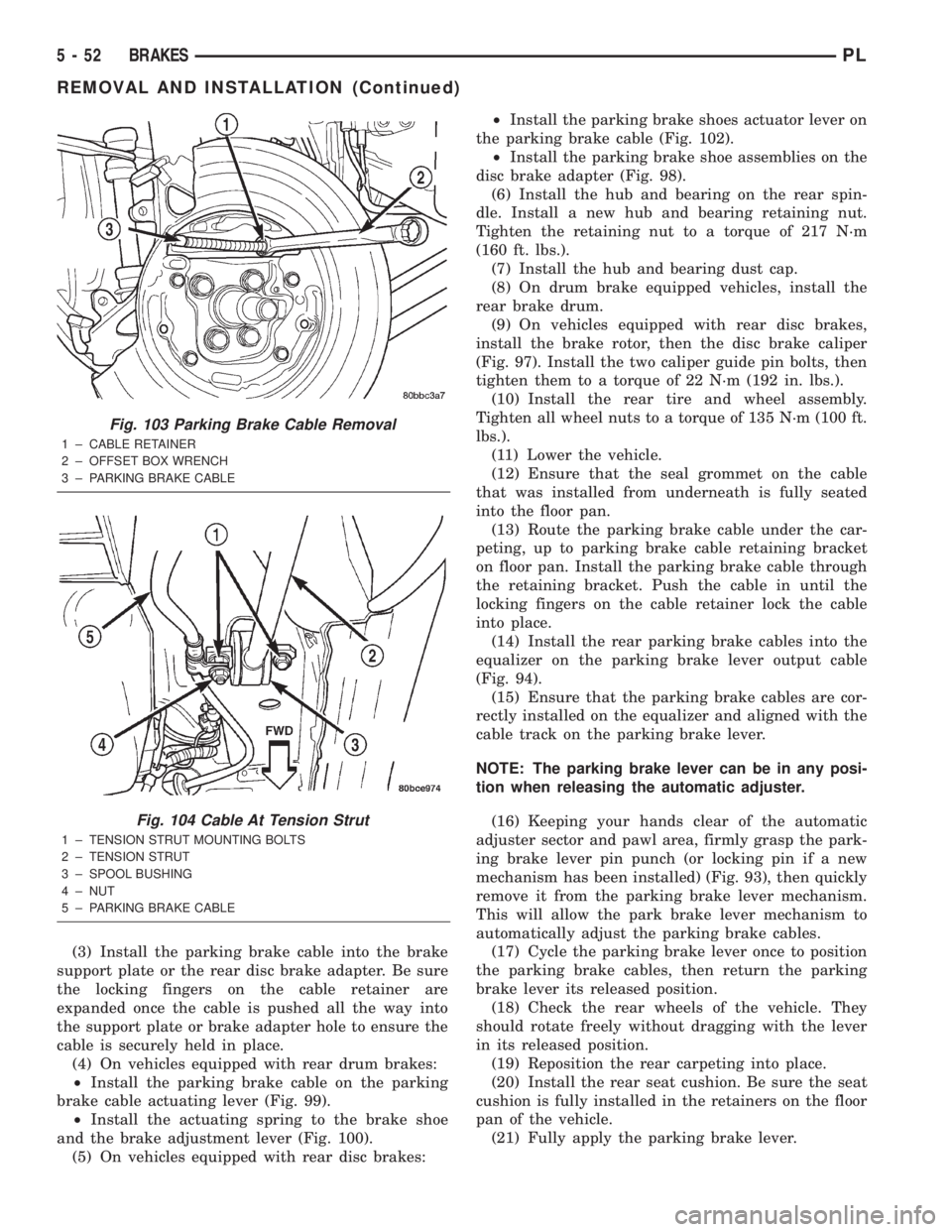
(19) Remove the nut, then the parking brake cable
routing bracket from the tension strut mounting bolt
(Fig. 104).
(20) Remove the parking brake cable and sealing
grommet from floor pan of the vehicle.
INSTALLATION
(1) From underneath push the parking brake cable
through the hole in the floor pan of the vehicle mak-
ing sure the cable sealing grommet is installed in the
floor pan as far as possible to insure a good seal.
(2) Attach the parking brake cable routing bracket
to the tension strut mounting bolt. Install and
tighten the mounting nut to a torque of 28 N´m (250
in. lbs.).
Fig. 99 Actuator Lever
1 ± PARK BRAKE ACTUATING LEVER
2 ± PARK BRAKE CABLE
3 ± BRAKE SHOE ASSEMBLIES
4 ± REAR SPINDLE
Fig. 100 Actuating Spring
1 ± BRAKE SHOE ADJUSTMENT LEVER
2 ± ADJUSTMENT LEVER ACTUATING SPRING
3 ± PARK BRAKE CABLE
Fig. 101 Parking Brake Cable Removal
1 ± PARK BRAKE CABLE
2 ± 1/288WRENCH
3 ± REAR BRAKE SUPPORT PLATE
4 ± PARK BRAKE CABLE RETAINER
Fig. 102 Parking Brake Actuator Lever
1 ± SHOE ACTUATOR LEVER
2 ± SHIELD MOUNTING SCREWS
3 ± REAR PARKING BRAKE CABLE
PLBRAKES 5 - 51
REMOVAL AND INSTALLATION (Continued)
Page 131 of 1285
(3) Install the parking brake cable into the brake
support plate or the rear disc brake adapter. Be sure
the locking fingers on the cable retainer are
expanded once the cable is pushed all the way into
the support plate or brake adapter hole to ensure the
cable is securely held in place.
(4) On vehicles equipped with rear drum brakes:
²Install the parking brake cable on the parking
brake cable actuating lever (Fig. 99).
²Install the actuating spring to the brake shoe
and the brake adjustment lever (Fig. 100).
(5) On vehicles equipped with rear disc brakes:²Install the parking brake shoes actuator lever on
the parking brake cable (Fig. 102).
²Install the parking brake shoe assemblies on the
disc brake adapter (Fig. 98).
(6) Install the hub and bearing on the rear spin-
dle. Install a new hub and bearing retaining nut.
Tighten the retaining nut to a torque of 217 N´m
(160 ft. lbs.).
(7) Install the hub and bearing dust cap.
(8) On drum brake equipped vehicles, install the
rear brake drum.
(9) On vehicles equipped with rear disc brakes,
install the brake rotor, then the disc brake caliper
(Fig. 97). Install the two caliper guide pin bolts, then
tighten them to a torque of 22 N´m (192 in. lbs.).
(10) Install the rear tire and wheel assembly.
Tighten all wheel nuts to a torque of 135 N´m (100 ft.
lbs.).
(11) Lower the vehicle.
(12) Ensure that the seal grommet on the cable
that was installed from underneath is fully seated
into the floor pan.
(13) Route the parking brake cable under the car-
peting, up to parking brake cable retaining bracket
on floor pan. Install the parking brake cable through
the retaining bracket. Push the cable in until the
locking fingers on the cable retainer lock the cable
into place.
(14) Install the rear parking brake cables into the
equalizer on the parking brake lever output cable
(Fig. 94).
(15) Ensure that the parking brake cables are cor-
rectly installed on the equalizer and aligned with the
cable track on the parking brake lever.
NOTE: The parking brake lever can be in any posi-
tion when releasing the automatic adjuster.
(16) Keeping your hands clear of the automatic
adjuster sector and pawl area, firmly grasp the park-
ing brake lever pin punch (or locking pin if a new
mechanism has been installed) (Fig. 93), then quickly
remove it from the parking brake lever mechanism.
This will allow the park brake lever mechanism to
automatically adjust the parking brake cables.
(17) Cycle the parking brake lever once to position
the parking brake cables, then return the parking
brake lever its released position.
(18) Check the rear wheels of the vehicle. They
should rotate freely without dragging with the lever
in its released position.
(19) Reposition the rear carpeting into place.
(20) Install the rear seat cushion. Be sure the seat
cushion is fully installed in the retainers on the floor
pan of the vehicle.
(21) Fully apply the parking brake lever.
Fig. 103 Parking Brake Cable Removal
1 ± CABLE RETAINER
2 ± OFFSET BOX WRENCH
3 ± PARKING BRAKE CABLE
Fig. 104 Cable At Tension Strut
1 ± TENSION STRUT MOUNTING BOLTS
2 ± TENSION STRUT
3 ± SPOOL BUSHING
4 ± NUT
5 ± PARKING BRAKE CABLE
5 - 52 BRAKESPL
REMOVAL AND INSTALLATION (Continued)
Page 161 of 1285
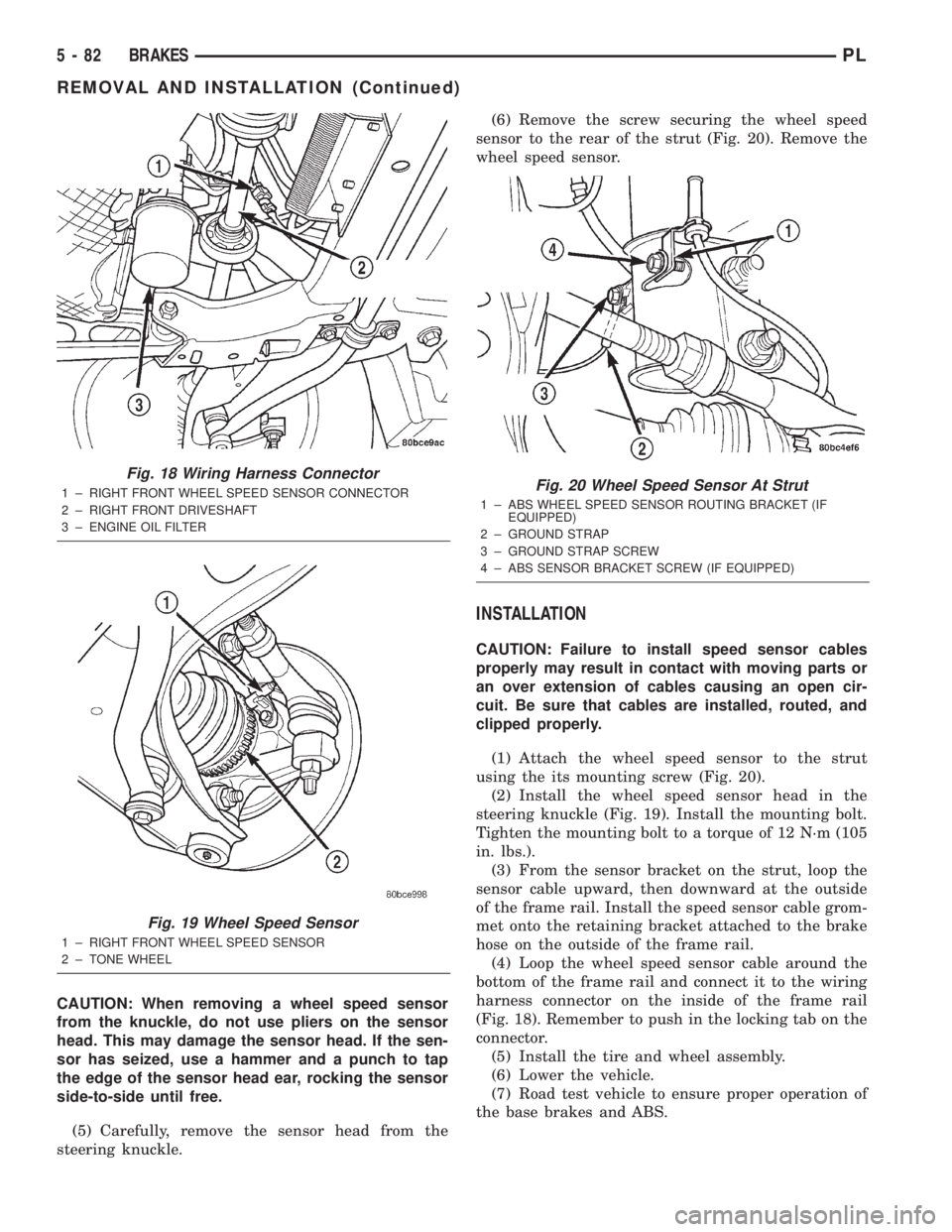
CAUTION: When removing a wheel speed sensor
from the knuckle, do not use pliers on the sensor
head. This may damage the sensor head. If the sen-
sor has seized, use a hammer and a punch to tap
the edge of the sensor head ear, rocking the sensor
side-to-side until free.
(5) Carefully, remove the sensor head from the
steering knuckle.(6) Remove the screw securing the wheel speed
sensor to the rear of the strut (Fig. 20). Remove the
wheel speed sensor.
INSTALLATION
CAUTION: Failure to install speed sensor cables
properly may result in contact with moving parts or
an over extension of cables causing an open cir-
cuit. Be sure that cables are installed, routed, and
clipped properly.
(1) Attach the wheel speed sensor to the strut
using the its mounting screw (Fig. 20).
(2) Install the wheel speed sensor head in the
steering knuckle (Fig. 19). Install the mounting bolt.
Tighten the mounting bolt to a torque of 12 N´m (105
in. lbs.).
(3) From the sensor bracket on the strut, loop the
sensor cable upward, then downward at the outside
of the frame rail. Install the speed sensor cable grom-
met onto the retaining bracket attached to the brake
hose on the outside of the frame rail.
(4) Loop the wheel speed sensor cable around the
bottom of the frame rail and connect it to the wiring
harness connector on the inside of the frame rail
(Fig. 18). Remember to push in the locking tab on the
connector.
(5) Install the tire and wheel assembly.
(6) Lower the vehicle.
(7) Road test vehicle to ensure proper operation of
the base brakes and ABS.
Fig. 18 Wiring Harness Connector
1 ± RIGHT FRONT WHEEL SPEED SENSOR CONNECTOR
2 ± RIGHT FRONT DRIVESHAFT
3 ± ENGINE OIL FILTER
Fig. 19 Wheel Speed Sensor
1 ± RIGHT FRONT WHEEL SPEED SENSOR
2 ± TONE WHEEL
Fig. 20 Wheel Speed Sensor At Strut
1 ± ABS WHEEL SPEED SENSOR ROUTING BRACKET (IF
EQUIPPED)
2 ± GROUND STRAP
3 ± GROUND STRAP SCREW
4 ± ABS SENSOR BRACKET SCREW (IF EQUIPPED)
5 - 82 BRAKESPL
REMOVAL AND INSTALLATION (Continued)
Page 162 of 1285
WHEEL SPEED SENSOR (REAR)
NOTE: Before proceeding with this procedure,
review SERVICE WARNINGS AND CAUTIONS at the
beginning of REMOVAL AND INSTALLATION in this
section.
REMOVAL
(1) Raise the vehicle. Refer to HOISTING in the
LUBRICATION AND MAINTENANCE group for the
proper lifting procedure.
(2) Remove the tire and wheel assembly from the
vehicle.
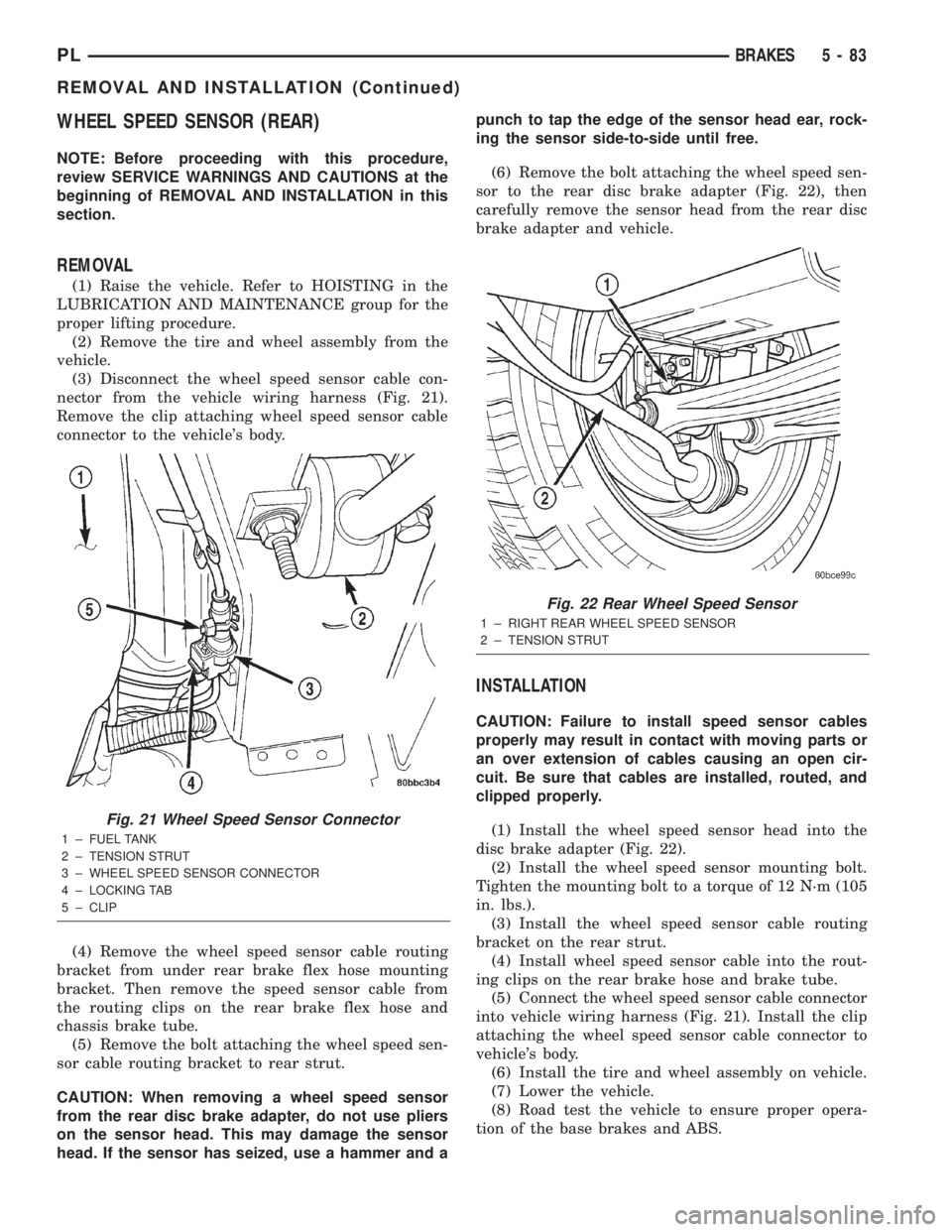
(3) Disconnect the wheel speed sensor cable con-
nector from the vehicle wiring harness (Fig. 21).
Remove the clip attaching wheel speed sensor cable
connector to the vehicle's body.
(4) Remove the wheel speed sensor cable routing
bracket from under rear brake flex hose mounting
bracket. Then remove the speed sensor cable from
the routing clips on the rear brake flex hose and
chassis brake tube.
(5) Remove the bolt attaching the wheel speed sen-
sor cable routing bracket to rear strut.
CAUTION: When removing a wheel speed sensor
from the rear disc brake adapter, do not use pliers
on the sensor head. This may damage the sensor
head. If the sensor has seized, use a hammer and apunch to tap the edge of the sensor head ear, rock-
ing the sensor side-to-side until free.
(6) Remove the bolt attaching the wheel speed sen-
sor to the rear disc brake adapter (Fig. 22), then
carefully remove the sensor head from the rear disc
brake adapter and vehicle.
INSTALLATION
CAUTION: Failure to install speed sensor cables
properly may result in contact with moving parts or
an over extension of cables causing an open cir-
cuit. Be sure that cables are installed, routed, and
clipped properly.
(1) Install the wheel speed sensor head into the
disc brake adapter (Fig. 22).
(2) Install the wheel speed sensor mounting bolt.
Tighten the mounting bolt to a torque of 12 N´m (105
in. lbs.).
(3) Install the wheel speed sensor cable routing
bracket on the rear strut.
(4) Install wheel speed sensor cable into the rout-
ing clips on the rear brake hose and brake tube.
(5) Connect the wheel speed sensor cable connector
into vehicle wiring harness (Fig. 21). Install the clip
attaching the wheel speed sensor cable connector to
vehicle's body.
(6) Install the tire and wheel assembly on vehicle.
(7) Lower the vehicle.
(8) Road test the vehicle to ensure proper opera-
tion of the base brakes and ABS.
Fig. 21 Wheel Speed Sensor Connector
1 ± FUEL TANK
2 ± TENSION STRUT
3 ± WHEEL SPEED SENSOR CONNECTOR
4 ± LOCKING TAB
5 ± CLIP
Fig. 22 Rear Wheel Speed Sensor
1 ± RIGHT REAR WHEEL SPEED SENSOR
2 ± TENSION STRUT
PLBRAKES 5 - 83
REMOVAL AND INSTALLATION (Continued)
Page 198 of 1285
COOLING SYSTEMÐDRAINING
NOTE: Drain, flush, and fill the cooling system at
the mileage or time intervals specified in Group 0,
Lubrication and Maintenance. If the solution is dirty,
rusty, or contains a considerable amount of sedi-
ment; clean and flush with a reliable cooling system
cleaner. Care should be taken in disposing of the
used engine coolant from your vehicle. Check gov-
ernmental regulations for disposal of used engine
coolant.
Without removing radiator pressure cap and
with system not under pressure:
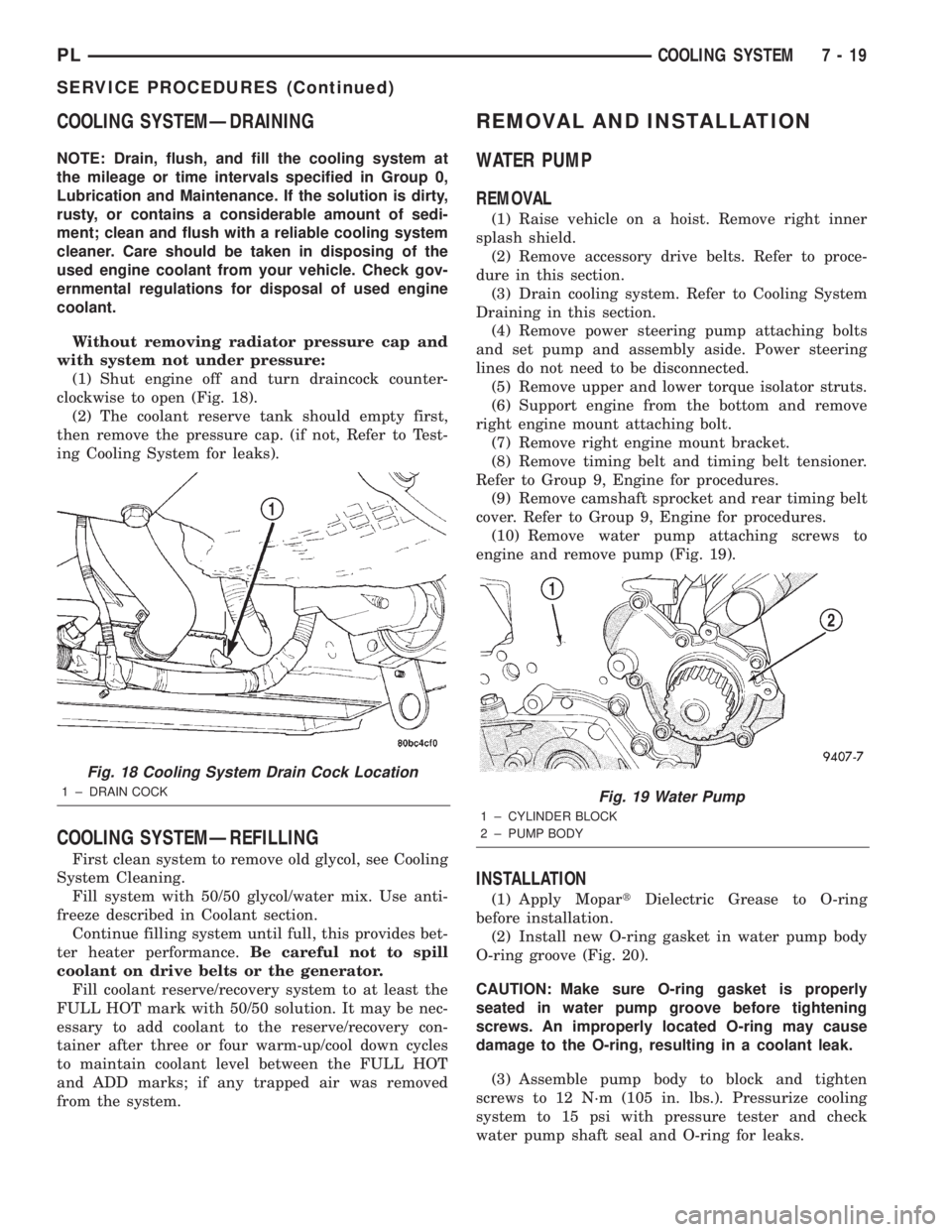
(1) Shut engine off and turn draincock counter-
clockwise to open (Fig. 18).
(2) The coolant reserve tank should empty first,
then remove the pressure cap. (if not, Refer to Test-
ing Cooling System for leaks).
COOLING SYSTEMÐREFILLING
First clean system to remove old glycol, see Cooling
System Cleaning.
Fill system with 50/50 glycol/water mix. Use anti-
freeze described in Coolant section.
Continue filling system until full, this provides bet-
ter heater performance.Be careful not to spill
coolant on drive belts or the generator.
Fill coolant reserve/recovery system to at least the
FULL HOT mark with 50/50 solution. It may be nec-
essary to add coolant to the reserve/recovery con-
tainer after three or four warm-up/cool down cycles
to maintain coolant level between the FULL HOT
and ADD marks; if any trapped air was removed
from the system.
REMOVAL AND INSTALLATION
WATER PUMP
REMOVAL
(1) Raise vehicle on a hoist. Remove right inner
splash shield.
(2) Remove accessory drive belts. Refer to proce-
dure in this section.
(3) Drain cooling system. Refer to Cooling System
Draining in this section.
(4) Remove power steering pump attaching bolts
and set pump and assembly aside. Power steering
lines do not need to be disconnected.
(5) Remove upper and lower torque isolator struts.
(6) Support engine from the bottom and remove
right engine mount attaching bolt.
(7) Remove right engine mount bracket.
(8) Remove timing belt and timing belt tensioner.
Refer to Group 9, Engine for procedures.
(9) Remove camshaft sprocket and rear timing belt
cover. Refer to Group 9, Engine for procedures.
(10) Remove water pump attaching screws to
engine and remove pump (Fig. 19).
INSTALLATION
(1) Apply MopartDielectric Grease to O-ring
before installation.
(2) Install new O-ring gasket in water pump body
O-ring groove (Fig. 20).
CAUTION: Make sure O-ring gasket is properly
seated in water pump groove before tightening
screws. An improperly located O-ring may cause
damage to the O-ring, resulting in a coolant leak.
(3) Assemble pump body to block and tighten
screws to 12 N´m (105 in. lbs.). Pressurize cooling
system to 15 psi with pressure tester and check
water pump shaft seal and O-ring for leaks.
Fig. 18 Cooling System Drain Cock Location
1 ± DRAIN COCKFig. 19 Water Pump
1 ± CYLINDER BLOCK
2 ± PUMP BODY
PLCOOLING SYSTEM 7 - 19
SERVICE PROCEDURES (Continued)
Page 199 of 1285
(4) Rotate pump by hand to check for freedom of
movement.
(5) Install rear timing belt cover and camshaft
sprocket.
(6) Install timing belt tensioner and timing belt.
Refer to Group 9, Engine for procedure.
(7) Install right engine mount bracket. Refer to
Group 9, Engine for procedure.
(8) Install upper and lower torque isolator struts.
Refer to Group 9, Engine for procedure.
(9) Fill cooling system. Refer to procedures in this
section.
(10) Install accessory drive belts. Refer to proce-
dure in this section.
(11) Perform camshaft and crankshaft timing
relearn procedure as follows:
²Connect the DRB scan tool to the data link
(diagnostic) connector. This connector is located in
the passenger compartment; at the lower edge of
instrument panel; near the steering column.
²Turn the ignition switch on and access the ªmis-
cellaneousº screen.
²Select ªre-learn cam/crankº option and follow
directions on DRB screen.
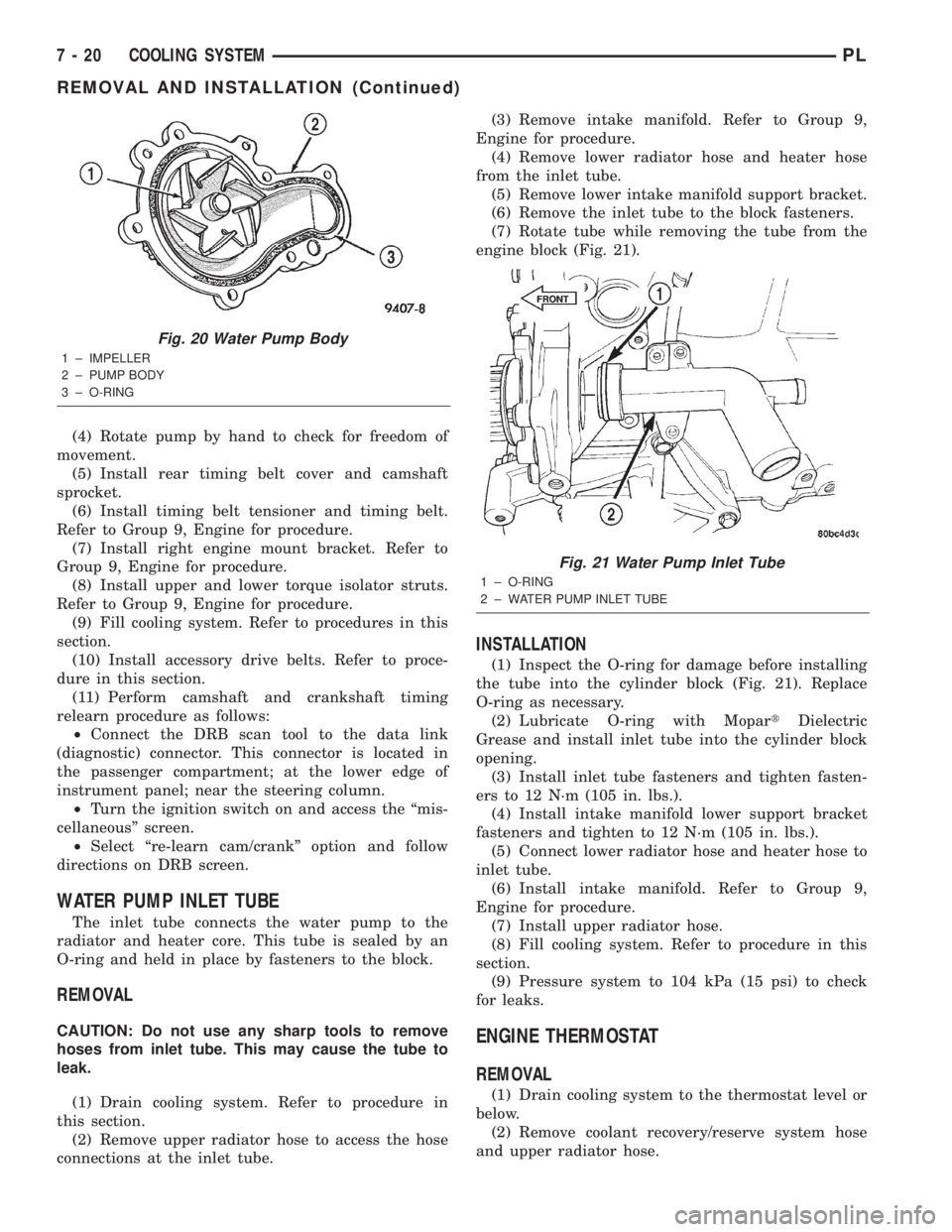
WATER PUMP INLET TUBE
The inlet tube connects the water pump to the
radiator and heater core. This tube is sealed by an
O-ring and held in place by fasteners to the block.
REMOVAL
CAUTION: Do not use any sharp tools to remove
hoses from inlet tube. This may cause the tube to
leak.
(1) Drain cooling system. Refer to procedure in
this section.
(2) Remove upper radiator hose to access the hose
connections at the inlet tube.(3) Remove intake manifold. Refer to Group 9,
Engine for procedure.
(4) Remove lower radiator hose and heater hose
from the inlet tube.
(5) Remove lower intake manifold support bracket.
(6) Remove the inlet tube to the block fasteners.
(7) Rotate tube while removing the tube from the
engine block (Fig. 21).
INSTALLATION
(1) Inspect the O-ring for damage before installing
the tube into the cylinder block (Fig. 21). Replace
O-ring as necessary.
(2) Lubricate O-ring with MopartDielectric
Grease and install inlet tube into the cylinder block
opening.
(3) Install inlet tube fasteners and tighten fasten-
ers to 12 N´m (105 in. lbs.).
(4) Install intake manifold lower support bracket
fasteners and tighten to 12 N´m (105 in. lbs.).
(5) Connect lower radiator hose and heater hose to
inlet tube.
(6) Install intake manifold. Refer to Group 9,
Engine for procedure.
(7) Install upper radiator hose.
(8) Fill cooling system. Refer to procedure in this
section.
(9) Pressure system to 104 kPa (15 psi) to check
for leaks.
ENGINE THERMOSTAT
REMOVAL
(1) Drain cooling system to the thermostat level or
below.
(2) Remove coolant recovery/reserve system hose
and upper radiator hose.
Fig. 20 Water Pump Body
1 ± IMPELLER
2 ± PUMP BODY
3 ± O-RING
Fig. 21 Water Pump Inlet Tube
1 ± O-RING
2 ± WATER PUMP INLET TUBE
FRONT
7 - 20 COOLING SYSTEMPL
REMOVAL AND INSTALLATION (Continued)
Page 210 of 1285
BATTERY
TABLE OF CONTENTS
page page
GENERAL INFORMATION
INTRODUCTION..........................1
DESCRIPTION AND OPERATION
BATTERY IGNITION OFF DRAW (IOD).........2
CHARGING TIME REQUIRED................2
DIAGNOSIS AND TESTING
BATTERY BUILT-IN TEST INDICATOR.........3
BATTERY IGNITION OFF DRAW (IOD).........4
BATTERY LOAD TEST......................6
BATTERY OPEN CIRCUIT VOLTAGE...........7
SERVICE PROCEDURES
BATTERY CHARGING......................7CHARGING COMPLETELY DISCHARGED
BATTERY..............................8
VISUAL INSPECTION......................9
REMOVAL AND INSTALLATION
BATTERY...............................10
BATTERY THERMOWRAP..................10
BATTERY TRAY..........................11
SPECIFICATIONS
BATTERY SPECIFICATIONS................11
TORQUE...............................11
GENERAL INFORMATION
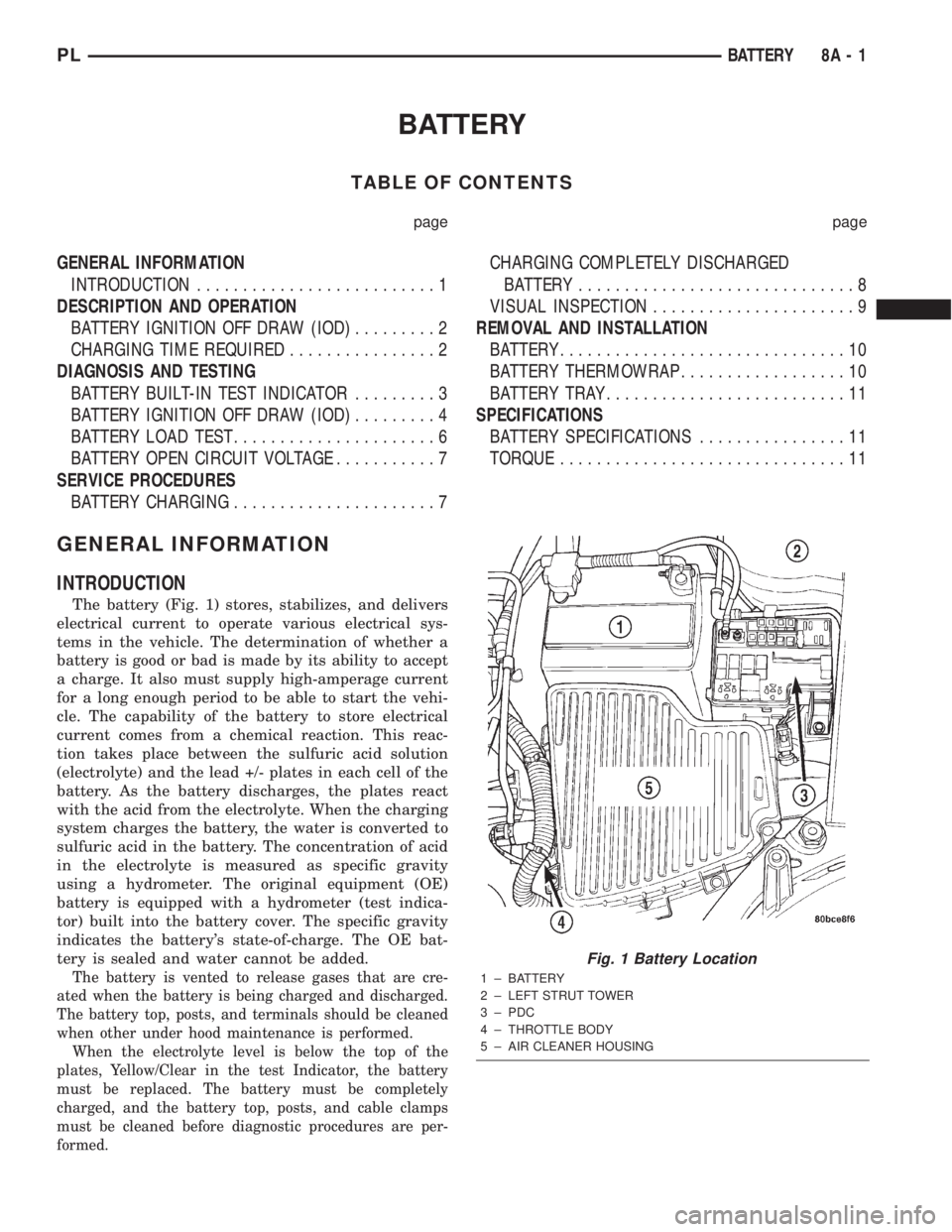
INTRODUCTION
The battery (Fig. 1) stores, stabilizes, and delivers
electrical current to operate various electrical sys-
tems in the vehicle. The determination of whether a
battery is good or bad is made by its ability to accept
a charge. It also must supply high-amperage current
for a long enough period to be able to start the vehi-
cle. The capability of the battery to store electrical
current comes from a chemical reaction. This reac-
tion takes place between the sulfuric acid solution
(electrolyte) and the lead +/- plates in each cell of the
battery. As the battery discharges, the plates react
with the acid from the electrolyte. When the charging
system charges the battery, the water is converted to
sulfuric acid in the battery. The concentration of acid
in the electrolyte is measured as specific gravity
using a hydrometer. The original equipment (OE)
battery is equipped with a hydrometer (test indica-
tor) built into the battery cover. The specific gravity
indicates the battery's state-of-charge. The OE bat-
tery is sealed and water cannot be added.
The battery is vented to release gases that are cre-
ated when the battery is being charged and discharged.
The battery top, posts, and terminals should be cleaned
when other under hood maintenance is performed.
When the electrolyte level is below the top of the
plates, Yellow/Clear in the test Indicator, the battery
must be replaced. The battery must be completely
charged, and the battery top, posts, and cable clamps
must be cleaned before diagnostic procedures are per-
formed.
Fig. 1 Battery Location
1 ± BATTERY
2 ± LEFT STRUT TOWER
3 ± PDC
4 ± THROTTLE BODY
5 ± AIR CLEANER HOUSING
PLBATTERY 8A - 1