ESP DODGE NEON 2004 2.G User Guide
[x] Cancel search | Manufacturer: DODGE, Model Year: 2004, Model line: NEON, Model: DODGE NEON 2004 2.GPages: 241, PDF Size: 3.75 MB
Page 143 of 241

country during the winter months to reduce carbon
monoxide emissions. Fuels blended with these oxygen-
ates may be used in your vehicle.
CAUTION!
DO NOT use gasolines containing Methanol. Gaso-
line containing methanol may damage critical fuel
system components.
Problems that result from using methanol/gasoline
blends are not the responsibility of The manufacturer and
may not be covered by the vehicle warranty. While MTBE
is an oxygenate made from Methanol, it does not have
the negative effects of Methanol.
MMT in Gasoline
MMT is a manganese containing metallic additive that is
blended into some gasoline to increase octane. Gasolines
blended with MMT provide no performance advantage
beyond gasolines of the same octane number without
MMT. Gasolines blended with MMT have shown to
reduce spark plug life and reduce emission systemperformance in some vehicles. The manufacturer recom-
mends that gasolines free of MMT be used in your
vehicle. The MMT content of gasoline may not be indi-
cated on the gasoline pump, therefore you should ask
your gasoline retailer whether or not his/her gasoline
contains MMT.
It is even more important to look for gasolines without
MMT in Canada because MMT can be used at higher
levels than allowed in the United States.
MMT is prohibited in both Federal and California refor-
mulated gasolines.
Sulfur in Gasoline
Your vehicle may have been designed to meet California
low emission standards with cleaner burning California
reformulated gasoline with low sulfur. This vehicle may
be sold nationwide. Your vehicle will operate satisfacto-
rily on fuels meeting Federal specifications, but emission
control system performance may be adversely affected.
Gasoline sold outside of California is permitted to have
higher sulfur levels which may affect the performance of
the vehicle's catalytic converter. This may cause the
STARTING AND OPERATING 143
5
Page 145 of 241

resulting from the use of such fuels or additives is not
the responsibility of the manufacturer and may not be
covered under the New Vehicle Warranty.
NOTE:Intentional tampering with emissions control
systems can result in civil penalties being assessed
against you.
Carbon Monoxide Warnings
WARNING!
Carbon monoxide (CO) in exhaust gases is deadly.
Follow the precautions below to prevent carbon
monoxide poisoning:
²Do not inhale exhaust gases. They contain carbon
monoxide, a colorless and odorless gas which can kill.
Never run the engine in a closed area, such as a
garage, and never sit in a parked vehicle with the
engine running for an extended period. If the vehicle is
stopped in an open area with the engine running for
more than a short period, adjust the ventilation system
to force fresh, outside air into the vehicle.
²Guard against carbon monoxide with proper mainte-
nance. Have the exhaust system inspected every time
the vehicle is raised. Have any abnormal conditions
repaired promptly. Until repaired, drive with all side
windows fully open.
²Keep the liftgate closed when driving your vehicle to
prevent carbon monoxide and other poisonous ex-
haust gases from entering the vehicle.
ADDING FUEL
NOTE:
The fuel tank filler tube has a restricting door
about 2 inches (50 mm) down from the opening. If fuel is
poured from a portable container, the container should
have a flexible nozzle long enough to force open the
restricting door.
Fuel Tank Filler Cap
The gas cap is behind the fuel filler door, on the passen-
ger's side of the vehicle. If the gas cap is lost or damaged,
be sure the replacement cap has been designed for use
with this vehicle.
STARTING AND OPERATING 145
5
Page 182 of 241

CAUTION!
Mixing of coolants other than specified (non-
HOAT), may result in engine damage that may not
be covered under the new vehicle warranty, and
decreased corrosion protection. If a non-HOAT cool-
ant is introduced into the cooling system in an
emergency, it should be replaced with the specified
coolant as soon as possible.
Do not use plain water alone or alcohol base anti-
freeze products. Do not use additional rust inhibi-
tors or antirust products, as they may not be compat-
ible with the radiator coolant and may plug the
radiator.
This vehicle has not been designed for use with
Propylene Glycol based coolants. Use of Propylene
Glycol based coolants is not recommended.
Adding Coolant
When adding coolant, a minimum solution of 50% eth-
ylene glycol antifreeze coolant in water should be used.
Use higher concentrations (not to exceed 70%) if tempera-
tures below ±34ÉF (-37ÉC) are anticipated.
Use only high purity water such as distilled or deionized
water when mixing the water/antifreeze solution. The
use of lower quality water will reduce the amount of
corrosion protection in the engine cooling system.
Please note that it is the owner's responsibility to main-
tain the proper level of protection against freezing ac-
cording to the temperatures occurring in the area where
the vehicle is operated.
NOTE:Mixing coolant types will decrease the life of the
engine coolant and will require more frequent coolant
changes.
Cooling System Pressure Cap
The cap must be fully tightened to prevent loss of
coolant, and to insure that coolant will return to the
radiator from the coolant reserve tank.
182 MAINTAINING YOUR VEHICLE
Page 191 of 241

Washing
²
Wash your vehicle regularly. Always wash your ve-
hicle in the shade using a mild car wash soap, and
rinse the panels completely with clear water.
²If insects, tar or other similar deposits have accumu-
lated on your vehicle, wash it as soon as possible.
²Use Mopar auto polish to remove road film and stains
and to polish your vehicle. Take care never to scratch
the paint.
²Avoid using abrasive compounds and power buffing
that may diminish the gloss or thin out the paint
finish.
CAUTION!
Do not use abrasive or strong cleaning materials
such as steel wool or scouring powder, which will
scratch metal and painted surfaces. Many wheel
cleaners contain acids that may harm the wheel
surface.
Special Care
²
If you drive on salted or dusty roads or if you drive
near the ocean, hose off the undercarriage at least once
a month.
²It is important that the drain holes in the lower edges
of the doors, rocker panels and rear deck lid be kept
clear and open.
²If you detect any stone chips or scratches in the paint,
touch them up immediately. The cost of such repairs is
considered the responsibility of the owner.
²Use Mopar touch up paint on scratches or chips as
soon as possible. Your dealer has touch up paint to
match the color of your vehicle.
MAINTAINING YOUR VEHICLE 191
7
Page 192 of 241

²If your vehicle is damaged due to an accident or
similar cause which destroys the paint and protective
coating, have your vehicle repaired as soon as pos-
sible. The cost of such repairs is considered the respon-
sibility of the owner.
²If you carry special cargo such as chemicals, fertilizers,
deicer salt, etc., be sure that such materials are well
packaged and sealed.
²If a lot of driving is done on gravel roads, consider
mud or stone shields behind each wheel.
Wheel And Wheel Trim Care
All wheels and wheel trim, especially Aluminum and
Chrome plated, should be cleaned regularly, using mild
soap and water to maintain their luster and to prevent
corrosion. Wash them with the same soap solution as the
body of your vehicle. Rinse wheels thoroughly.
When cleaning extremely dirty wheels, care must be
taken in the selection of tire and wheel cleaning chemi-
cals and equipment to prevent damage to the wheels.Only Mopar Wheel Cleaners are recommended. Any of
the ªDO NOT USEº items listed below can damage
wheels and wheel trim.
DO NOT USE:
²Any abrasive cleaner
²Any abrasive cleaning pad (such as steel wool) or
abrasive brush
²Any cleaner that contains an acid which can react with
and discolor the chrome surface.
CAUTION!
Many wheel cleaners contain acids that may harm
the wheel surface.
²Oven cleaner
²A car wash that uses carbide-tipped wheel cleaning
brushes or acidic solutions.
192 MAINTAINING YOUR VEHICLE
Page 193 of 241
Interior Care
Use Mopar Fabric Cleaner to clean fabric upholstery and
carpeting.
Use Mopar Vinyl Cleaner to clean vinyl upholstery.
Mopar Vinyl Cleaner is specifically recommended for
vinyl trim.
Your leather upholstery can be best preserved by regular
cleaning with a damp soft cloth. Small particles of dirt
can act as an abrasive and damage the leather upholstery
and should be removed promptly with a damp cloth.
Stubborn soils can be removed easily with a soft cloth
and Mopar Total Clean. Care should be taken to avoid
soaking your leather upholstery with any liquid. Please
do not use polishes, oils, cleaning fluids, solvents, deter-
gents, or ammonia based cleaners to clean your leather
upholstery. Application of a leather conditioner is not
required to maintain the original condition.WARNING!
Do not use volatile solvents for cleaning purposes.
Many are potentially flammable, and if used in
closed areas they may cause respiratory harm.
Cleaning Headlights
Your vehicle has plastic headlights that are lighter and
less susceptible to stone breakage than glass headlights.
Plastic is not as scratch resistant as glass and therefore
different lens cleaning procedures must be followed.
To minimize the possibility of scratching the lenses and
reducing light output, avoid wiping with a dry cloth. To
remove road dirt, wash with a mild soap solution fol-
lowed by rinsing.
Do not use abrasive cleaning components, solvents, steel
wool or other aggressive material to clean the lenses.
MAINTAINING YOUR VEHICLE 193
7
Page 209 of 241
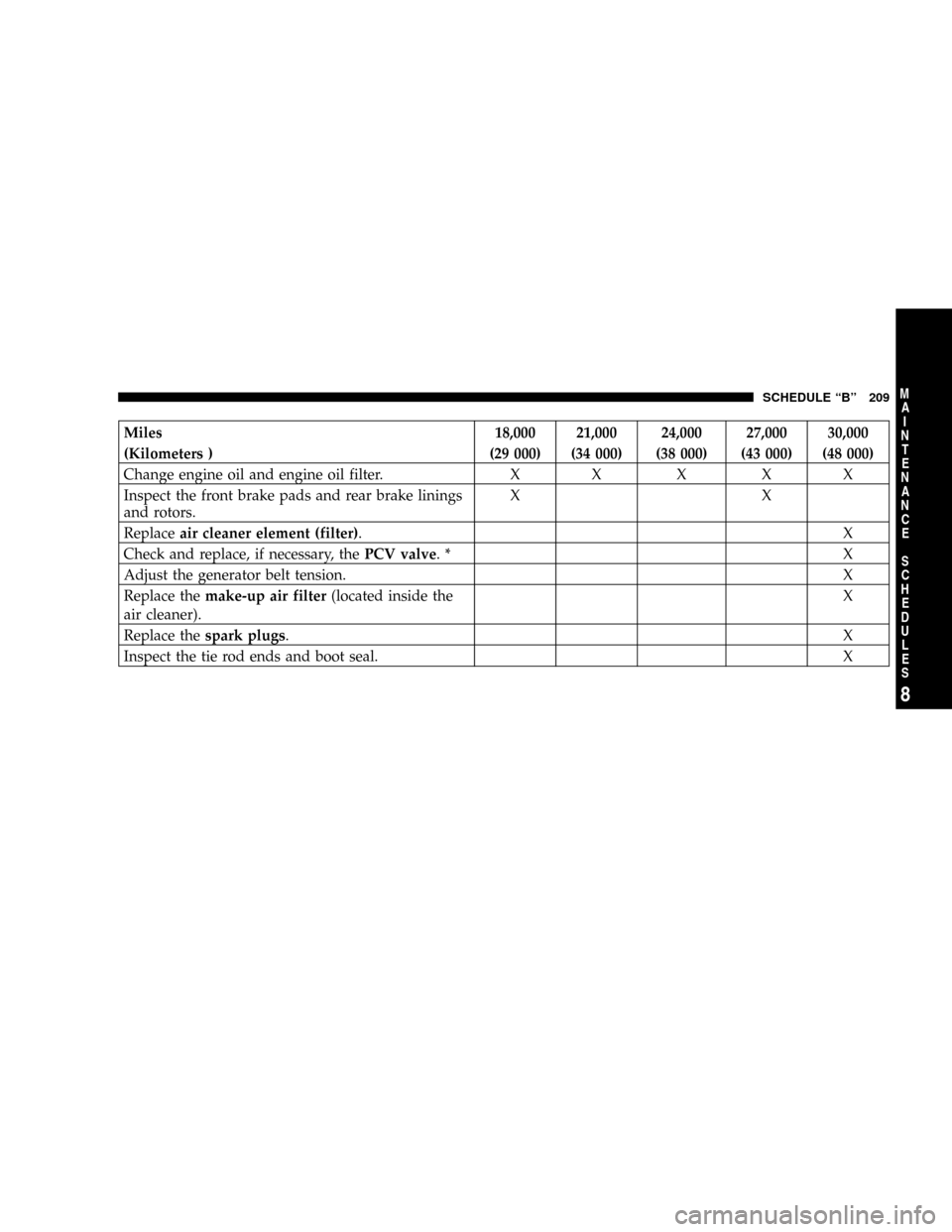
Miles 18,000 21,000 24,000 27,000 30,000
(Kilometers ) (29 000) (34 000) (38 000) (43 000) (48 000)
Change engine oil and engine oil filter. X X X X X
Inspect the front brake pads and rear brake linings
and rotors.XX
Replaceair cleaner element (filter).X
Check and replace, if necessary, thePCV valve.* X
Adjust the generator belt tension.X
Replace themake-up air filter(located inside the
air cleaner).X
Replace thespark plugs.X
Inspect the tie rod ends and boot seal. X
SCHEDULE ªBº 209
8
M
A
I
N
T
E
N
A
N
C
E
S
C
H
E
D
U
L
E
S
Page 211 of 241
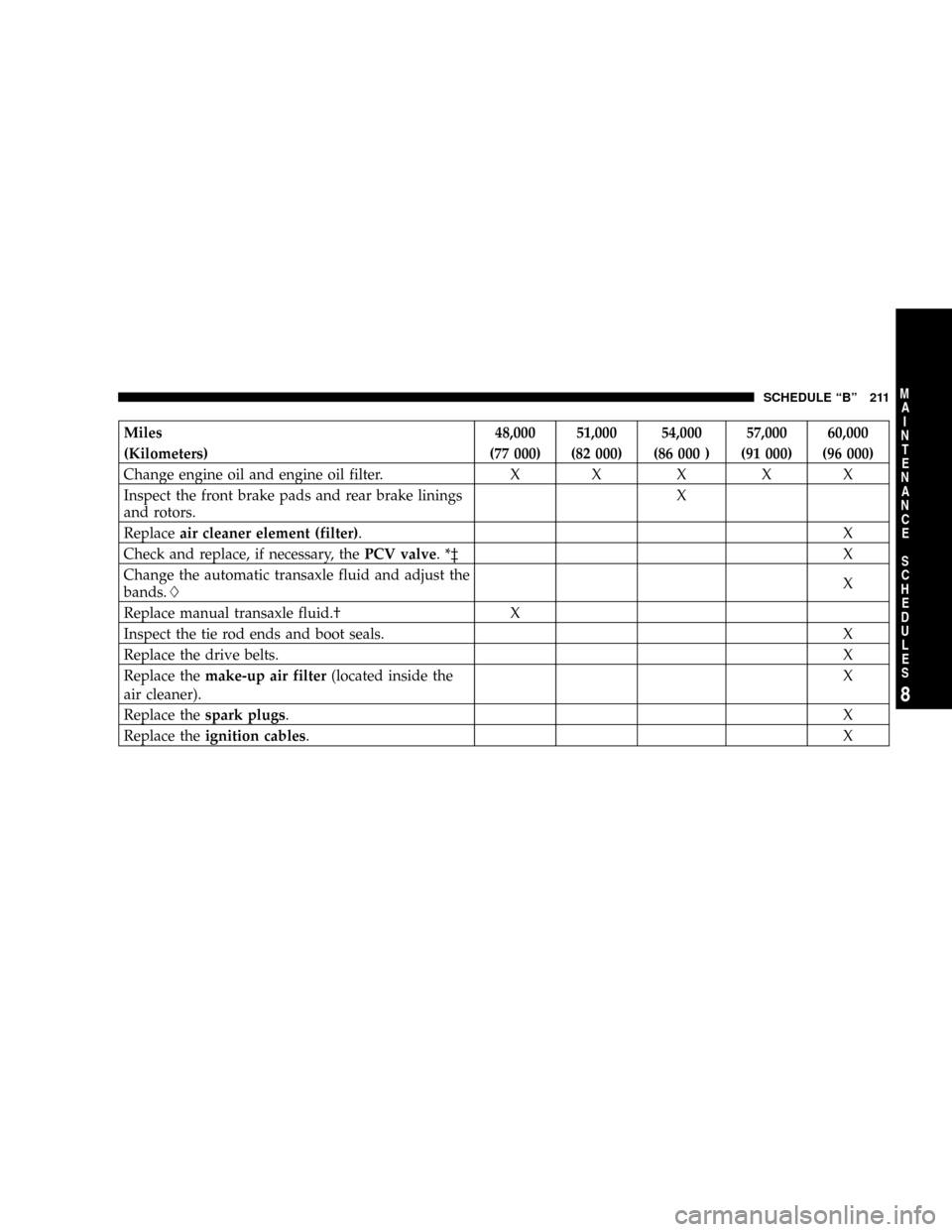
Miles 48,000 51,000 54,000 57,000 60,000
(Kilometers) (77 000) (82 000) (86 000 ) (91 000) (96 000)
Change engine oil and engine oil filter. X X X X X
Inspect the front brake pads and rear brake linings
and rotors.X
Replaceair cleaner element (filter).X
Check and replace, if necessary, thePCV valve.*³ X
Change the automatic transaxle fluid and adjust the
bands.LX
Replace manual transaxle fluid.² X
Inspect the tie rod ends and boot seals. X
Replace the drive belts.X
Replace themake-up air filter(located inside the
air cleaner).X
Replace thespark plugs.X
Replace theignition cables.X
SCHEDULE ªBº 211
8
M
A
I
N
T
E
N
A
N
C
E
S
C
H
E
D
U
L
E
S
Page 213 of 241
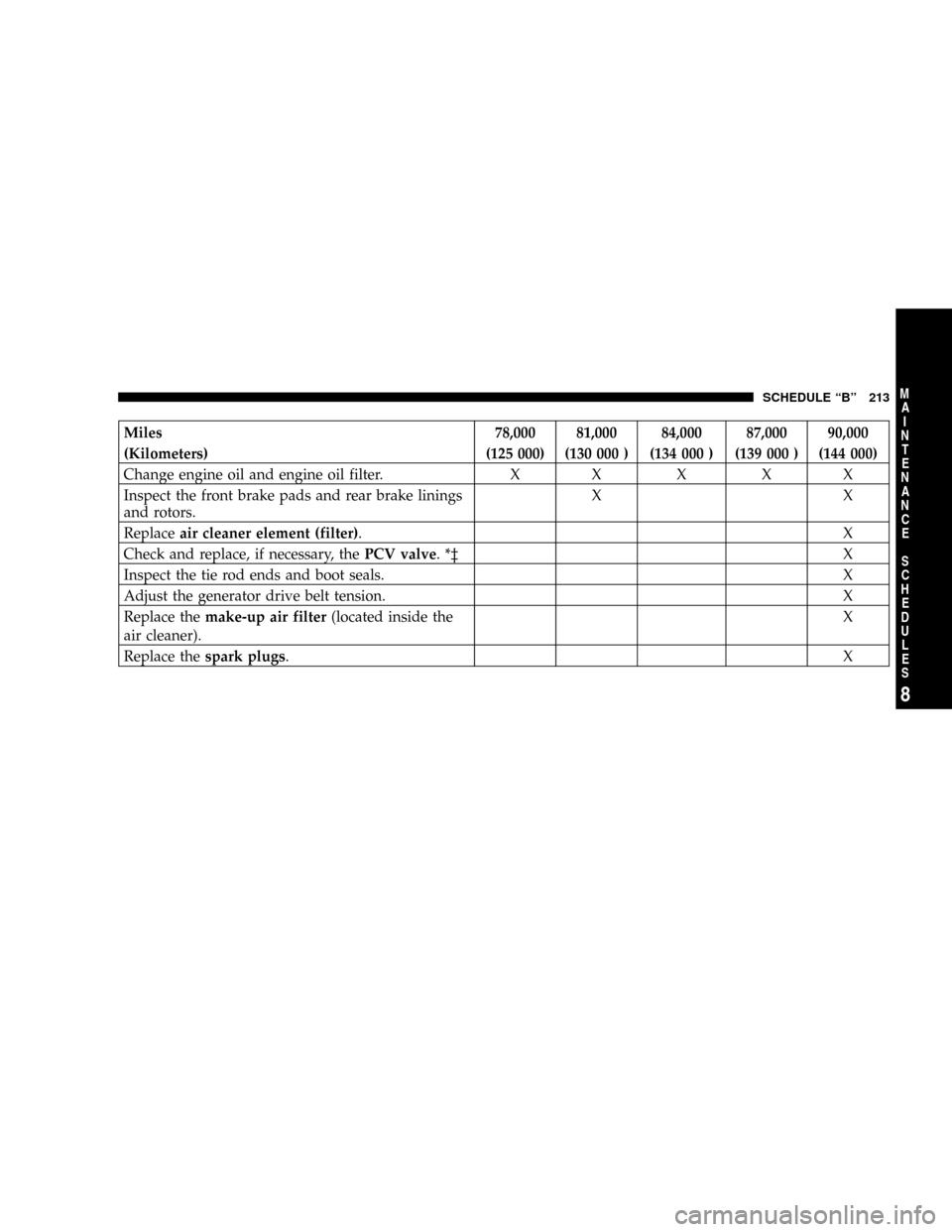
Miles 78,000 81,000 84,000 87,000 90,000
(Kilometers) (125 000) (130 000 ) (134 000 ) (139 000 ) (144 000)
Change engine oil and engine oil filter. X X X X X
Inspect the front brake pads and rear brake linings
and rotors.XX
Replaceair cleaner element (filter).X
Check and replace, if necessary, thePCV valve.*³ X
Inspect the tie rod ends and boot seals. X
Adjust the generator drive belt tension. X
Replace themake-up air filter(located inside the
air cleaner).X
Replace thespark plugs.X
SCHEDULE ªBº 213
8
M
A
I
N
T
E
N
A
N
C
E
S
C
H
E
D
U
L
E
S
Page 215 of 241
![DODGE NEON 2004 2.G User Guide Schedule ªAº
Miles 6,000 12,000 18,000 24,000 30,000 36,000
(Kilometers) (10 000) (19 000) (29 000) (38 000) (48 000) (58 000)
[Months] [6] [12] [18] [24] [30] [36]
Change engine oil and engine oil](/img/12/5661/w960_5661-214.png "DODGE NEON 2004 2.G User Guide Schedule ªAº
Miles 6,000 12,000 18,000 24,000 30,000 36,000
(Kilometers) (10 000) (19 000) (29 000) (38 000) (48 000) (58 000)
[Months] [6] [12] [18] [24] [30] [36]
Change engine oil and engine oil")
Schedule ªAº
Miles 6,000 12,000 18,000 24,000 30,000 36,000
(Kilometers) (10 000) (19 000) (29 000) (38 000) (48 000) (58 000)
[Months] [6] [12] [18] [24] [30] [36]
Change engine oil and engine oil filter. XXXXXX
Inspect the brake linings. X X
Replace theengine air cleaner filter.X
Replace thespark plugs.X
Inspect the tie rod ends and boot seals. X
Replace themake-up air filter(located inside
the air cleaner).X
Adjust generator drive belt tension X
SCHEDULE ªAº 215
8
M
A
I
N
T
E
N
A
N
C
E
S
C
H
E
D
U
L
E
S