cooling DODGE NEON 2004 2.G User Guide
[x] Cancel search | Manufacturer: DODGE, Model Year: 2004, Model line: NEON, Model: DODGE NEON 2004 2.GPages: 241, PDF Size: 3.75 MB
Page 184 of 241

of the engine compartment. This is normally a result of
moisture from rain, snow, or high humidity accumula-
tion on the radiator and being vaporized when the
thermostat opens, allowing hot water to enter the radia-
tor.
If an examination of your engine compartment shows no
evidence of radiator or hose leaks, the vehicle may be
safely driven. The vapor will soon dissipate.
A. Do not overfill the coolant bottle.
B. Check coolant freeze point in the system.
C. If frequent coolant additions are required, the cooling
system should be pressure tested for leaks.
D. Maintain coolant concentration at 50% ethylene glycol
antifreeze (minimum) in water for proper corrosion pro-
tection of your engine which contains aluminum compo-
nents.
E. Make sure that the radiator and coolant bottle hoses
are not kinked or obstructed.F. Keep the front of the radiator clean. If your vehicle has
air conditioning, keep the front of the condenser clean,
also.
G. Do not change the thermostat for summer or winter
operation. If replacement is ever necessary, install ONLY
the correct type thermostat. Other designs may result in
unsatisfactory coolant performance, poor gas mileage,
and increased emissions.
Hoses And Vacuum/Vapor Harnesses
Inspect surfaces of hoses and nylon tubing for evidence
of heat and mechanical damage. Hard or soft spots,
brittle rubber, cracking, checking, tear, cuts, abrasions,
and excessive swelling indicate deterioration of the rub-
ber.
Pay particular attention to the hoses nearest to high heat
sources such as the exhaust manifold. Inspect hose rout-
ing to be sure hoses do not touch any heat source or
moving component that may cause heat damage or
mechanical wear.
Insure nylon tubing in these areas has not melted or
collapsed.
184 MAINTAINING YOUR VEHICLE
Page 200 of 241
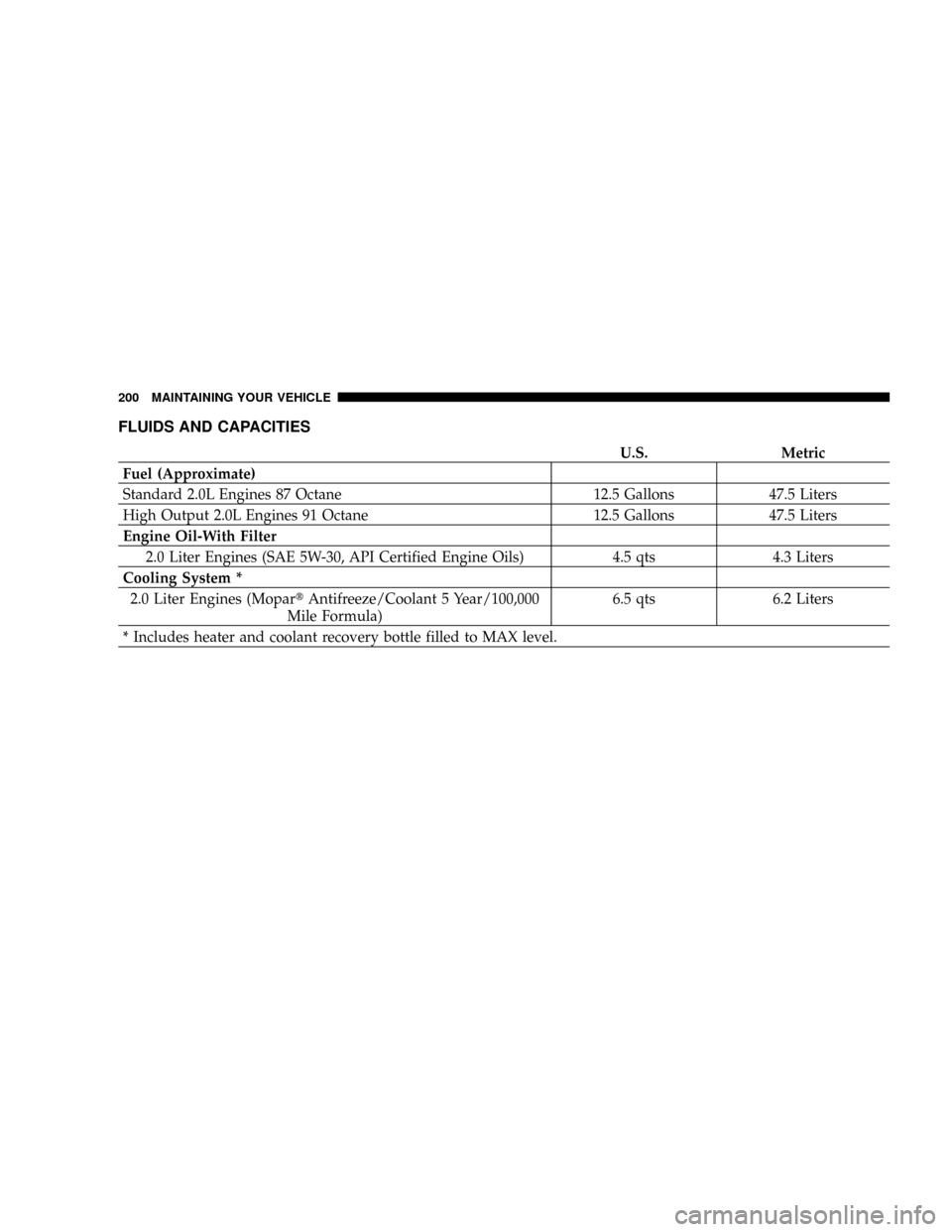
FLUIDS AND CAPACITIES
U.S. Metric
Fuel (Approximate)
Standard 2.0L Engines 87 Octane 12.5 Gallons 47.5 Liters
High Output 2.0L Engines 91 Octane 12.5 Gallons 47.5 Liters
Engine Oil-With Filter
2.0 Liter Engines (SAE 5W-30, API Certified Engine Oils) 4.5 qts 4.3 Liters
Cooling System *
2.0 Liter Engines (MopartAntifreeze/Coolant 5 Year/100,000
Mile Formula)6.5 qts 6.2 Liters
* Includes heater and coolant recovery bottle filled to MAX level.
200 MAINTAINING YOUR VEHICLE
Page 232 of 241

Console............................... 69
Contract, Service....................... 222
Coolant........................181,200,201
Cooling System........................ 180
Adding Coolant (Antifreeze)............. 182
Coolant Level.....................180,183
Disposal of Used Coolant............... 181
Drain, Flush, and Refill................. 181
Inspection........................... 183
Points to Remember................182,183
Pressure Cap........................ 182
Rubber and Plastic Components.......... 184
Selection of Coolant................... 181
Corrosion Protection.................... 190
Crankcase Emission Control System......... 174
Cruise Light........................... 82
Cup Holder............................ 69
Customer Assistance.................... 220
Daytime Brightness, Interior Lights.......... 61
Daytime Running Lights.................. 62
Dealer Service......................... 168
Defroster, Rear Window.................. 110Defroster, Windshield...............48,103,106
Deploying, Airbag....................... 37
Diagnostic System, Onboard............... 166
Dimmer Control........................ 60
Dimmer Switch, Headlight................. 62
Disarming, Theft System.................. 21
Disposal
Engine Oil.......................... 172
Domelight............................. 61
Door Locks............................ 14
Door Locks, Automatic................... 16
Downshifting.......................... 121
Drive Belts............................ 173
Driving
On Slippery Surfaces.................. 159
Electric Remote Mirrors................... 54
Electronic Speed Control.................. 65
Emergency, In Case of
Jacking............................. 153
Jump Starting........................ 157
Towing............................. 161
Emergency Trunk Release................. 22
232 INDEX
Page 233 of 241

Emission Control System Maintenance....167,204
Engine............................... 165
Break-In Recommendations............... 46
Checking Oil Level.................... 169
Compartment........................ 165
Cooling............................ 180
Exhaust Gas Caution.................. 145
Jump Starting........................ 157
Oil ..........................169,200,201
Oil Change Interval................... 170
Oil Filter............................ 201
Oil Selection......................... 171
Oil Synthetic......................... 172
Overheating......................... 152
Temperature Gauge.................... 82
Timing Belt.......................... 174
Engine Oil Viscosity Chart................ 171
Exhaust Gas Caution..................47,145
Exhaust Pipes......................... 179
Exhaust System........................ 179
Extender, Seat Belt....................... 31Filters
Air Cleaner.......................... 175
Automatic Transaxle................... 189
Engine Fuel......................... 175
Engine Oil.......................172,201
Flashers
Hazard Warning...................... 152
Flooded Engine Starting.................. 115
Fluid, Brake........................... 201
Fluid Capacities........................ 200
Fluid Leaks............................ 48
Fluid Level Checks
Automatic Transaxle................... 187
Manual Transaxle..................... 189
Fog Lights...........................62,78
Folding Rear Seat....................... 57
Freeing A Stuck Vehicle.................. 160
Front Suspension Ball Joints............... 178
Fuel..............................141,201
Adding............................. 145
Capacity............................ 200
Filler Cap........................... 145
Filter.............................. 175
INDEX 233
10