engine oil DODGE NEON 2004 2.G User Guide
[x] Cancel search | Manufacturer: DODGE, Model Year: 2004, Model line: NEON, Model: DODGE NEON 2004 2.GPages: 241, PDF Size: 3.75 MB
Page 181 of 241
Check the front of the radiator for an accumulation of
bugs, leaves, etc. Clean the radiator by gently spraying
water from a garden hose at the back of the core.
Check the recovery bottle tank tubing for condition and
tightness of connection at the bottle and radiator. Inspect
the entire system for leaks.
With the engine at normal operating temperature (but
not running), check the cooling system pressure cap for
proper vacuum sealing by draining a small amount of
coolant from the radiator drain cock. If the cap is sealing
properly, the coolant will begin to drain from the reserve
tank. Do not remove the cap when the cooling system is
hot.
Cooling System Ð Drain, Flush and Refill
At the intervals shown on the Maintenance Schedules,
the system should be drained, flushed and refilled.
If the solution is dirty and contains a considerable
amount of sediment, clean and flush with a reliable
cooling system cleaner. Follow with a thorough rinsing to
remove all deposits and chemicals. Discard oil antifreeze
solution.
Engine Coolant Disposal
Used ethylene glycol based engine coolant is a regulated
substance requiring proper disposal. Check with your
local authorities to determine the disposal rules for your
community. Do not store ethylene glycol based engine
coolant in open containers or allow it to remain in
puddles on the ground. Prevent ingestion by animals or
children. If ingested by a child, contact a physician
immediately.
Selection Of Coolant
Use only the manufacturers recommended coolant, refer
to Recommended Fluids, Lubricants and Genuine Parts
for correct coolant type.
MAINTAINING YOUR VEHICLE 181
7
Page 186 of 241
NOTE:Inspection of brake hoses should be done
whenever the brake system is serviced and every engine
oil change.
WARNING!
Worn brake hoses can burst and cause brake failure.
You could have an accident. If you see any signs of
cracking, scuffing, or worn spots, have the brake
hoses replaced immediately.
Brake Master Cylinder
The fluid level in the master cylinder should be checked
when performing under hood services, or immediately if
the brake system warning lamp is on.
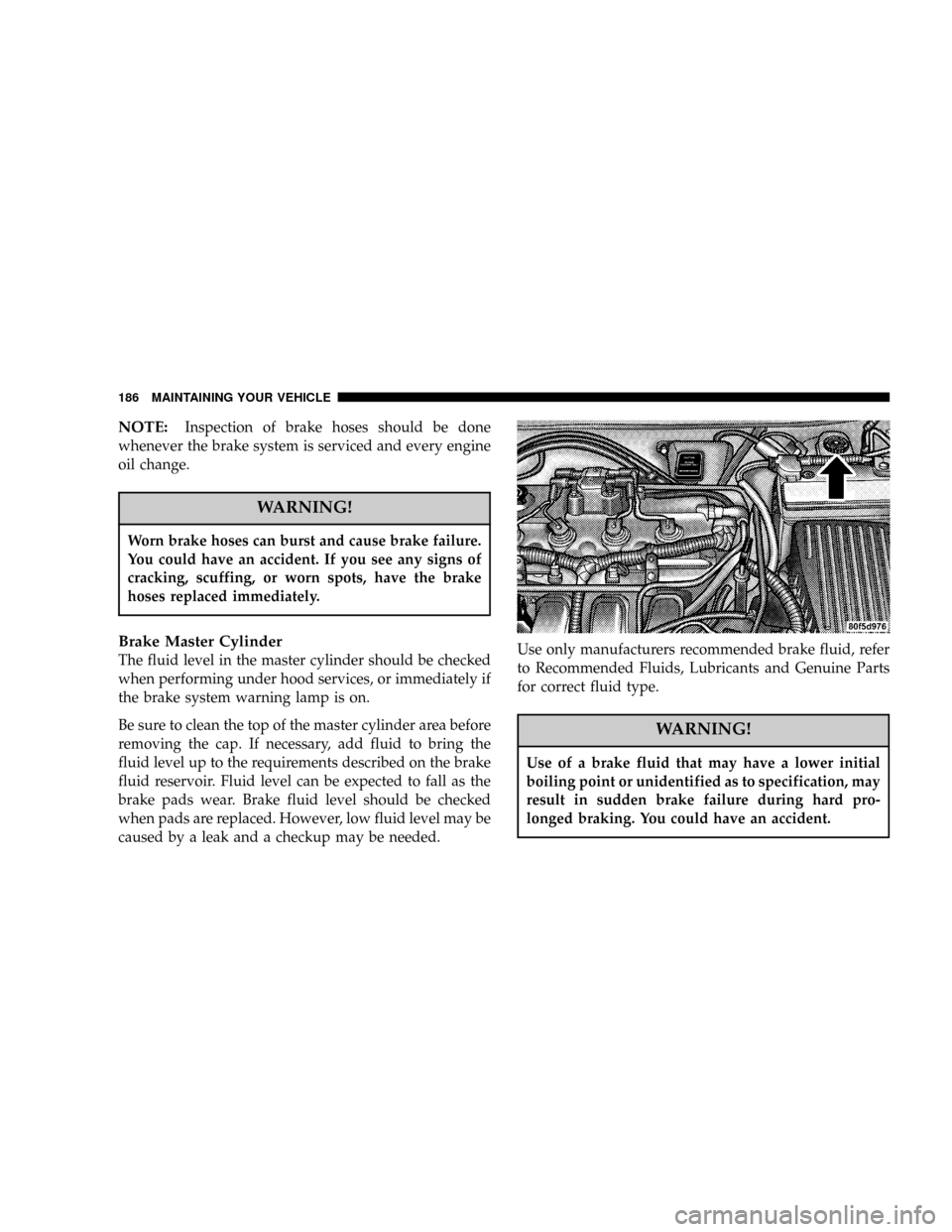
Be sure to clean the top of the master cylinder area before
removing the cap. If necessary, add fluid to bring the
fluid level up to the requirements described on the brake
fluid reservoir. Fluid level can be expected to fall as the
brake pads wear. Brake fluid level should be checked
when pads are replaced. However, low fluid level may be
caused by a leak and a checkup may be needed.Use only manufacturers recommended brake fluid, refer
to Recommended Fluids, Lubricants and Genuine Parts
for correct fluid type.
WARNING!
Use of a brake fluid that may have a lower initial
boiling point or unidentified as to specification, may
result in sudden brake failure during hard pro-
longed braking. You could have an accident.
186 MAINTAINING YOUR VEHICLE
Page 200 of 241
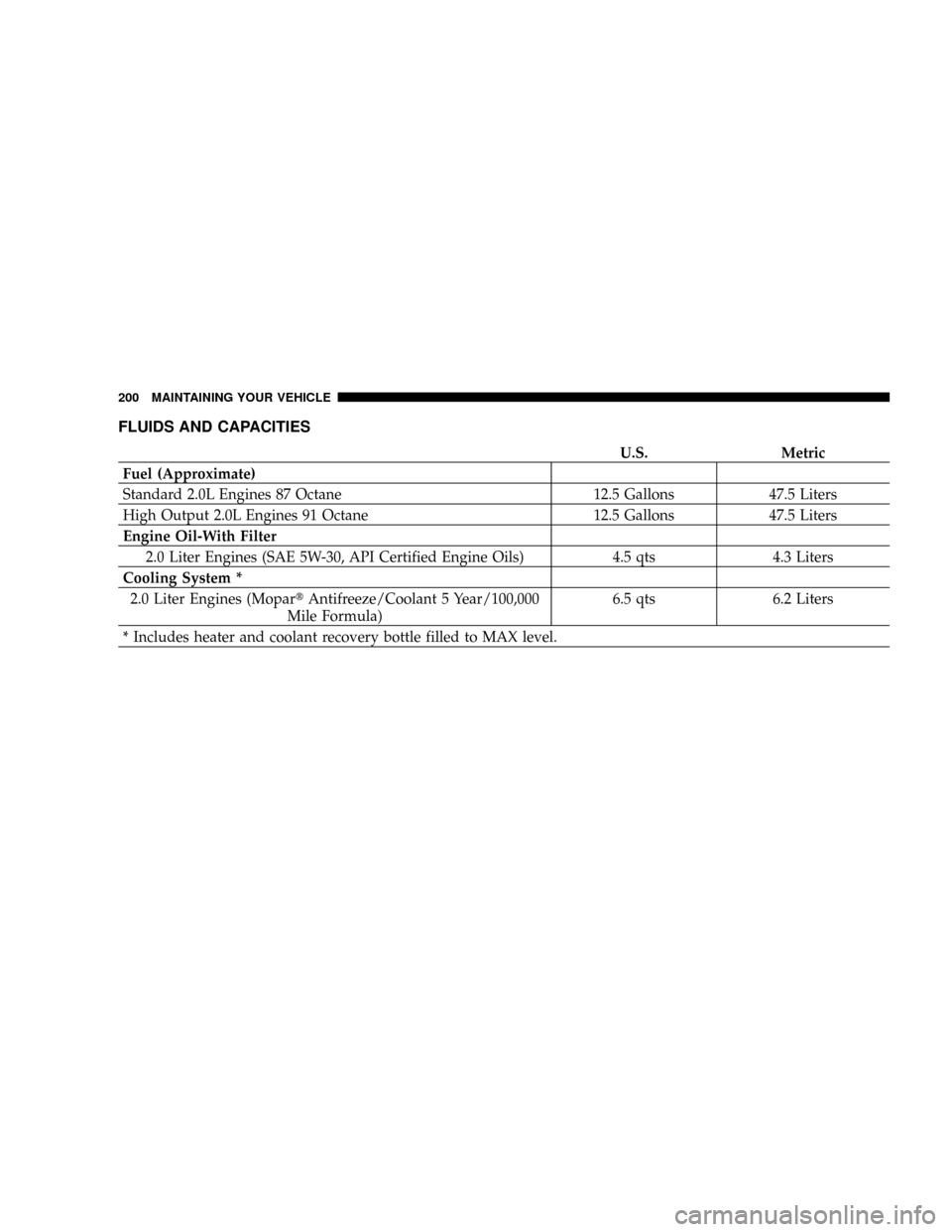
FLUIDS AND CAPACITIES
U.S. Metric
Fuel (Approximate)
Standard 2.0L Engines 87 Octane 12.5 Gallons 47.5 Liters
High Output 2.0L Engines 91 Octane 12.5 Gallons 47.5 Liters
Engine Oil-With Filter
2.0 Liter Engines (SAE 5W-30, API Certified Engine Oils) 4.5 qts 4.3 Liters
Cooling System *
2.0 Liter Engines (MopartAntifreeze/Coolant 5 Year/100,000
Mile Formula)6.5 qts 6.2 Liters
* Includes heater and coolant recovery bottle filled to MAX level.
200 MAINTAINING YOUR VEHICLE
Page 201 of 241
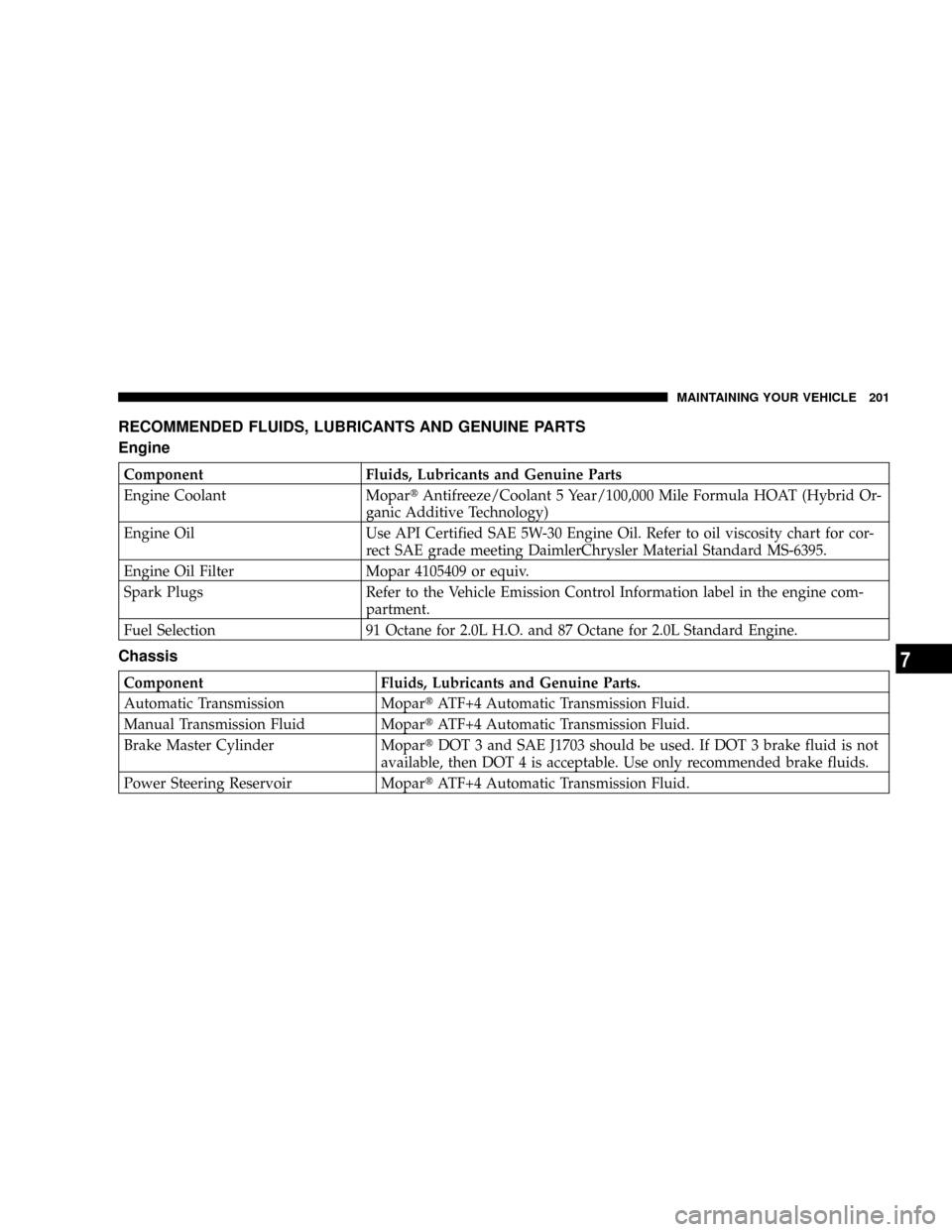
RECOMMENDED FLUIDS, LUBRICANTS AND GENUINE PARTS
Engine
Component Fluids, Lubricants and Genuine Parts
Engine Coolant MopartAntifreeze/Coolant 5 Year/100,000 Mile Formula HOAT (Hybrid Or-
ganic Additive Technology)
Engine Oil Use API Certified SAE 5W-30 Engine Oil. Refer to oil viscosity chart for cor-
rect SAE grade meeting DaimlerChrysler Material Standard MS-6395.
Engine Oil Filter Mopar 4105409 or equiv.
Spark Plugs Refer to the Vehicle Emission Control Information label in the engine com-
partment.
Fuel Selection 91 Octane for 2.0L H.O. and 87 Octane for 2.0L Standard Engine.
Chassis
Component Fluids, Lubricants and Genuine Parts.
Automatic Transmission MopartATF+4 Automatic Transmission Fluid.
Manual Transmission Fluid MopartATF+4 Automatic Transmission Fluid.
Brake Master Cylinder MopartDOT 3 and SAE J1703 should be used. If DOT 3 brake fluid is not
available, then DOT 4 is acceptable. Use only recommended brake fluids.
Power Steering Reservoir MopartATF+4 Automatic Transmission Fluid.
MAINTAINING YOUR VEHICLE 201
7
Page 205 of 241
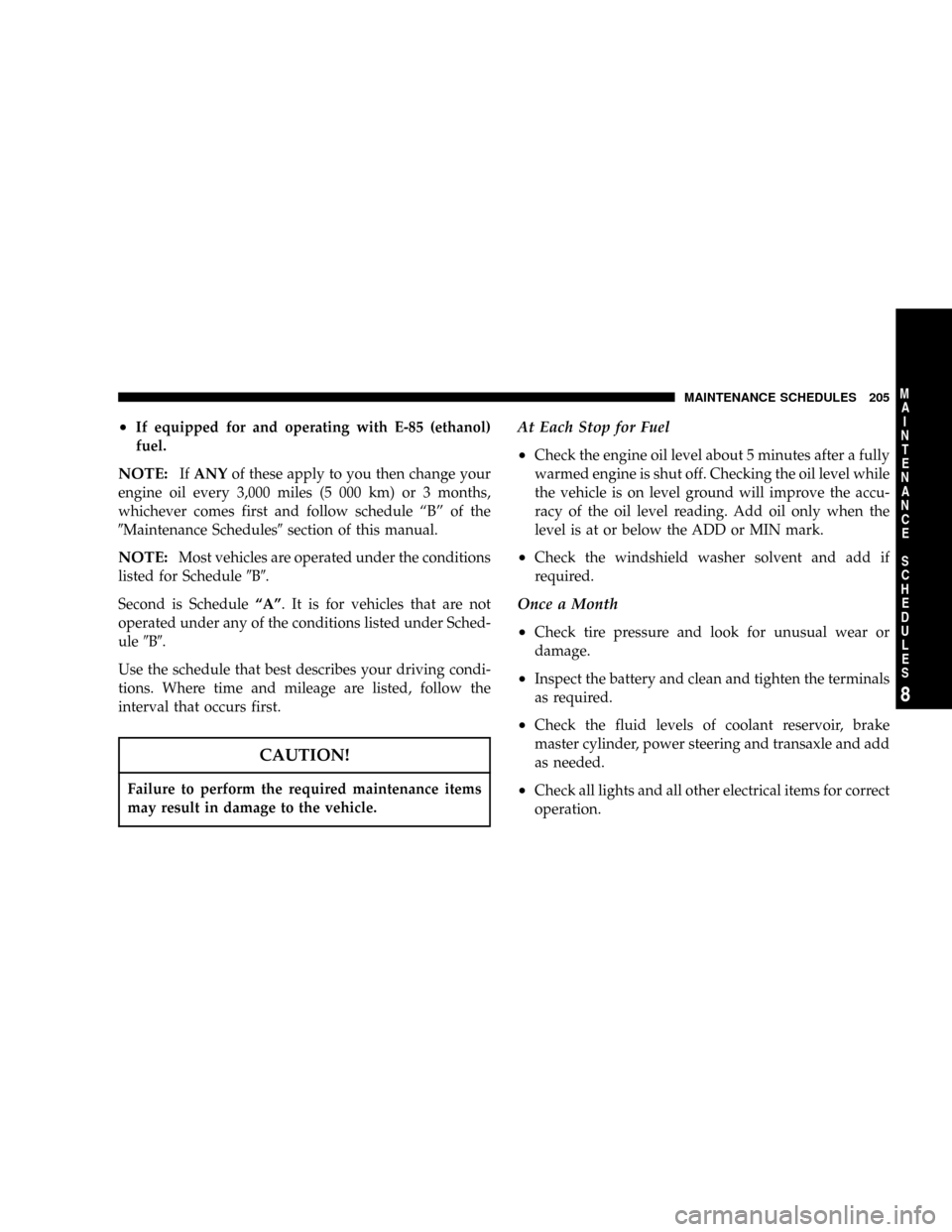
²If equipped for and operating with E-85 (ethanol)
fuel.
NOTE:IfANYof these apply to you then change your
engine oil every 3,000 miles (5 000 km) or 3 months,
whichever comes first and follow schedule ªBº of the
9Maintenance Schedules9section of this manual.
NOTE:Most vehicles are operated under the conditions
listed for Schedule9B9.
Second is ScheduleªAº. It is for vehicles that are not
operated under any of the conditions listed under Sched-
ule9B9.
Use the schedule that best describes your driving condi-
tions. Where time and mileage are listed, follow the
interval that occurs first.
CAUTION!
Failure to perform the required maintenance items
may result in damage to the vehicle.
At Each Stop for Fuel
²
Check the engine oil level about 5 minutes after a fully
warmed engine is shut off. Checking the oil level while
the vehicle is on level ground will improve the accu-
racy of the oil level reading. Add oil only when the
level is at or below the ADD or MIN mark.
²Check the windshield washer solvent and add if
required.
Once a Month
²
Check tire pressure and look for unusual wear or
damage.
²Inspect the battery and clean and tighten the terminals
as required.
²Check the fluid levels of coolant reservoir, brake
master cylinder, power steering and transaxle and add
as needed.
²Check all lights and all other electrical items for correct
operation.
MAINTENANCE SCHEDULES 205
8
M
A
I
N
T
E
N
A
N
C
E
S
C
H
E
D
U
L
E
S
Page 206 of 241
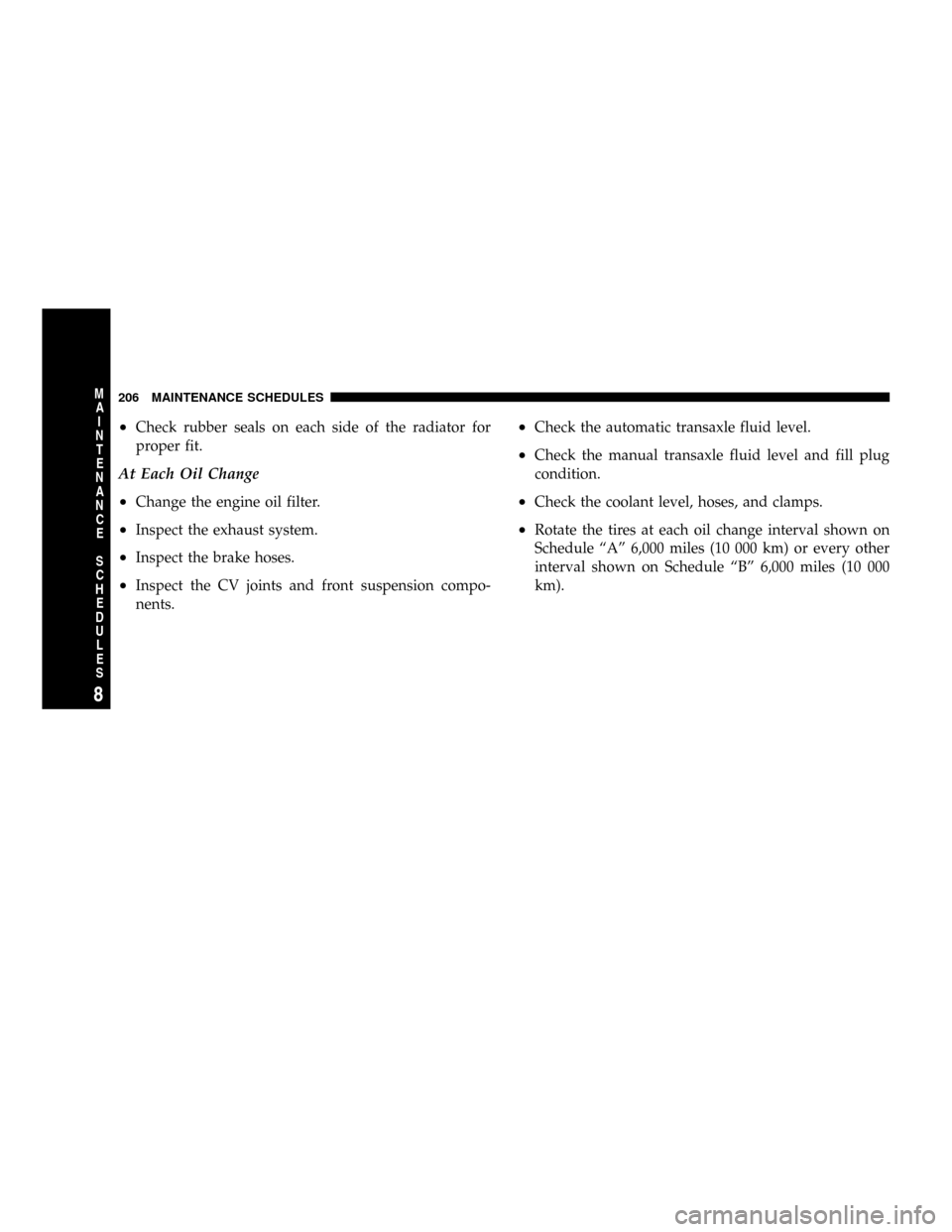
²Check rubber seals on each side of the radiator for
proper fit.
At Each Oil Change
²
Change the engine oil filter.
²Inspect the exhaust system.
²Inspect the brake hoses.
²Inspect the CV joints and front suspension compo-
nents.
²Check the automatic transaxle fluid level.
²Check the manual transaxle fluid level and fill plug
condition.
²Check the coolant level, hoses, and clamps.
²Rotate the tires at each oil change interval shown on
Schedule ªAº 6,000 miles (10 000 km) or every other
interval shown on Schedule ªBº 6,000 miles (10 000
km).
206 MAINTENANCE SCHEDULES
8
M
A
I
N
T
E
N
A
N
C
E
S
C
H
E
D
U
L
E
S
Page 207 of 241
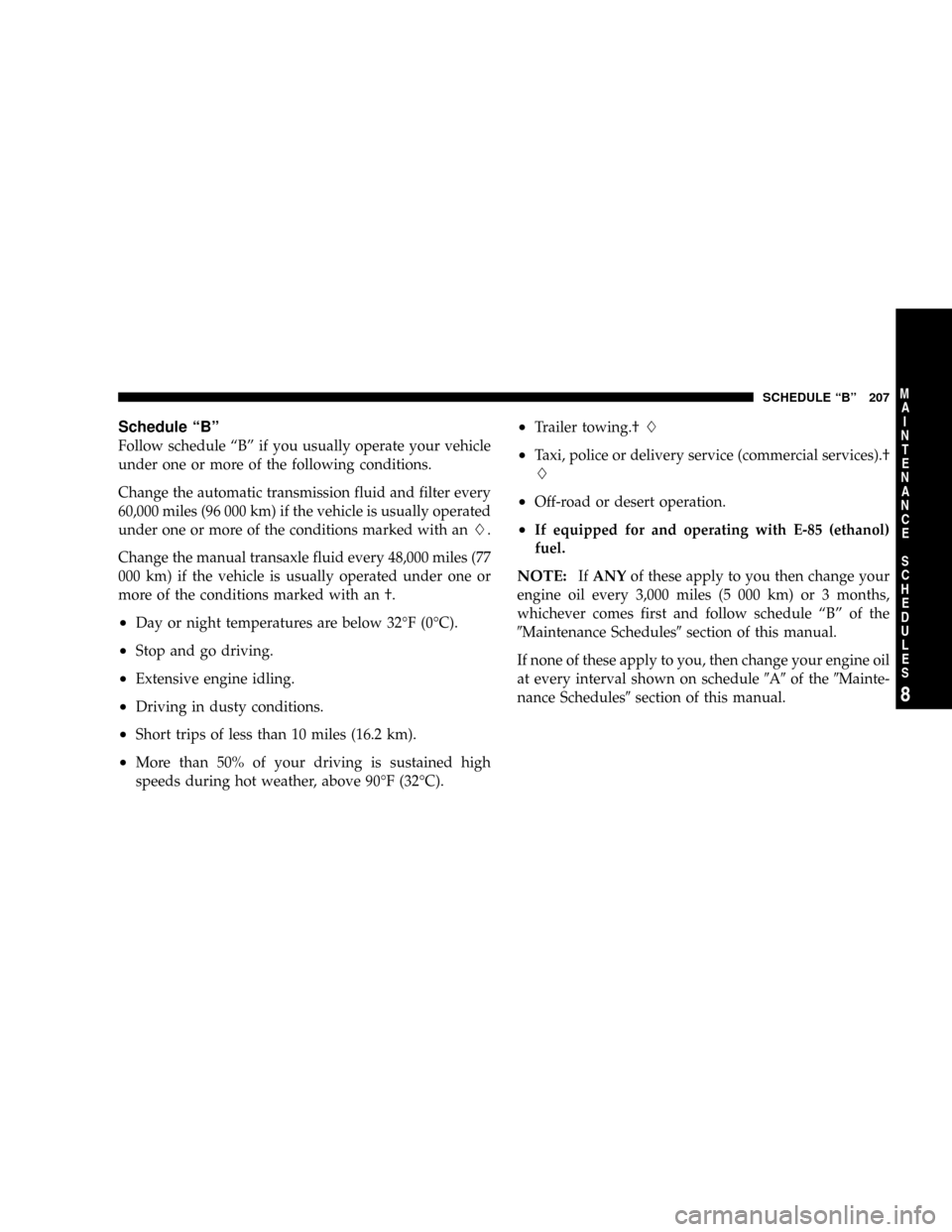
Schedule ªBº
Follow schedule ªBº if you usually operate your vehicle
under one or more of the following conditions.
Change the automatic transmission fluid and filter every
60,000 miles (96 000 km) if the vehicle is usually operated
under one or more of the conditions marked with anL.
Change the manual transaxle fluid every 48,000 miles (77
000 km) if the vehicle is usually operated under one or
more of the conditions marked with an ².
²Day or night temperatures are below 32ÉF (0ÉC).
²Stop and go driving.
²Extensive engine idling.
²Driving in dusty conditions.
²Short trips of less than 10 miles (16.2 km).
²More than 50% of your driving is sustained high
speeds during hot weather, above 90ÉF (32ÉC).
²Trailer towing.²L
²Taxi, police or delivery service (commercial services).²
L
²Off-road or desert operation.
²If equipped for and operating with E-85 (ethanol)
fuel.
NOTE:IfANYof these apply to you then change your
engine oil every 3,000 miles (5 000 km) or 3 months,
whichever comes first and follow schedule ªBº of the
9Maintenance Schedules9section of this manual.
If none of these apply to you, then change your engine oil
at every interval shown on schedule9A9of the9Mainte-
nance Schedules9section of this manual.
SCHEDULE ªBº 207
8
M
A
I
N
T
E
N
A
N
C
E
S
C
H
E
D
U
L
E
S
Page 208 of 241
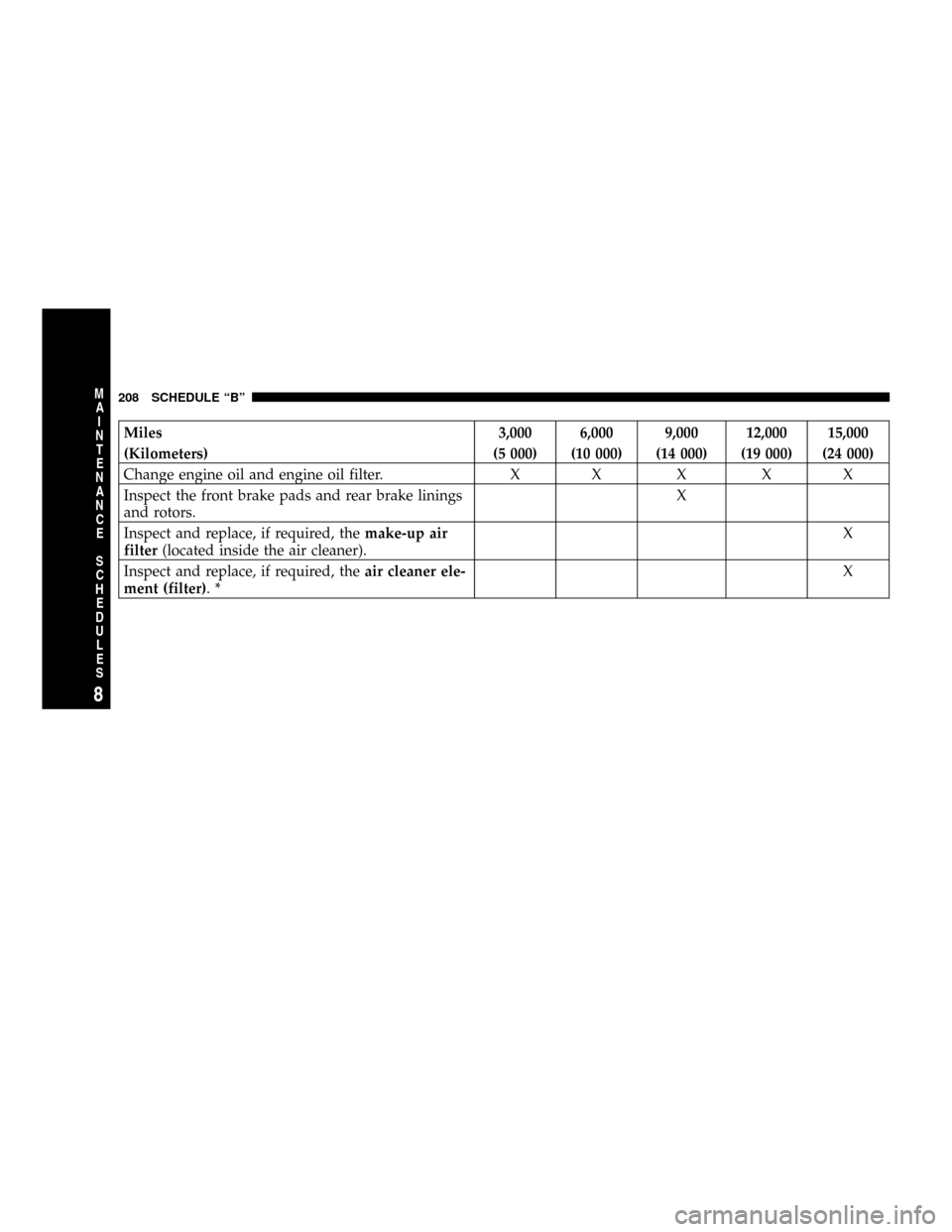
Miles 3,000 6,000 9,000 12,000 15,000
(Kilometers) (5 000) (10 000) (14 000) (19 000) (24 000)
Change engine oil and engine oil filter. X X X X X
Inspect the front brake pads and rear brake linings
and rotors.X
Inspect and replace, if required, themake-up air
filter(located inside the air cleaner).X
Inspect and replace, if required, theair cleaner ele-
ment (filter).*X
208 SCHEDULE ªBº
8
M
A
I
N
T
E
N
A
N
C
E
S
C
H
E
D
U
L
E
S
Page 209 of 241
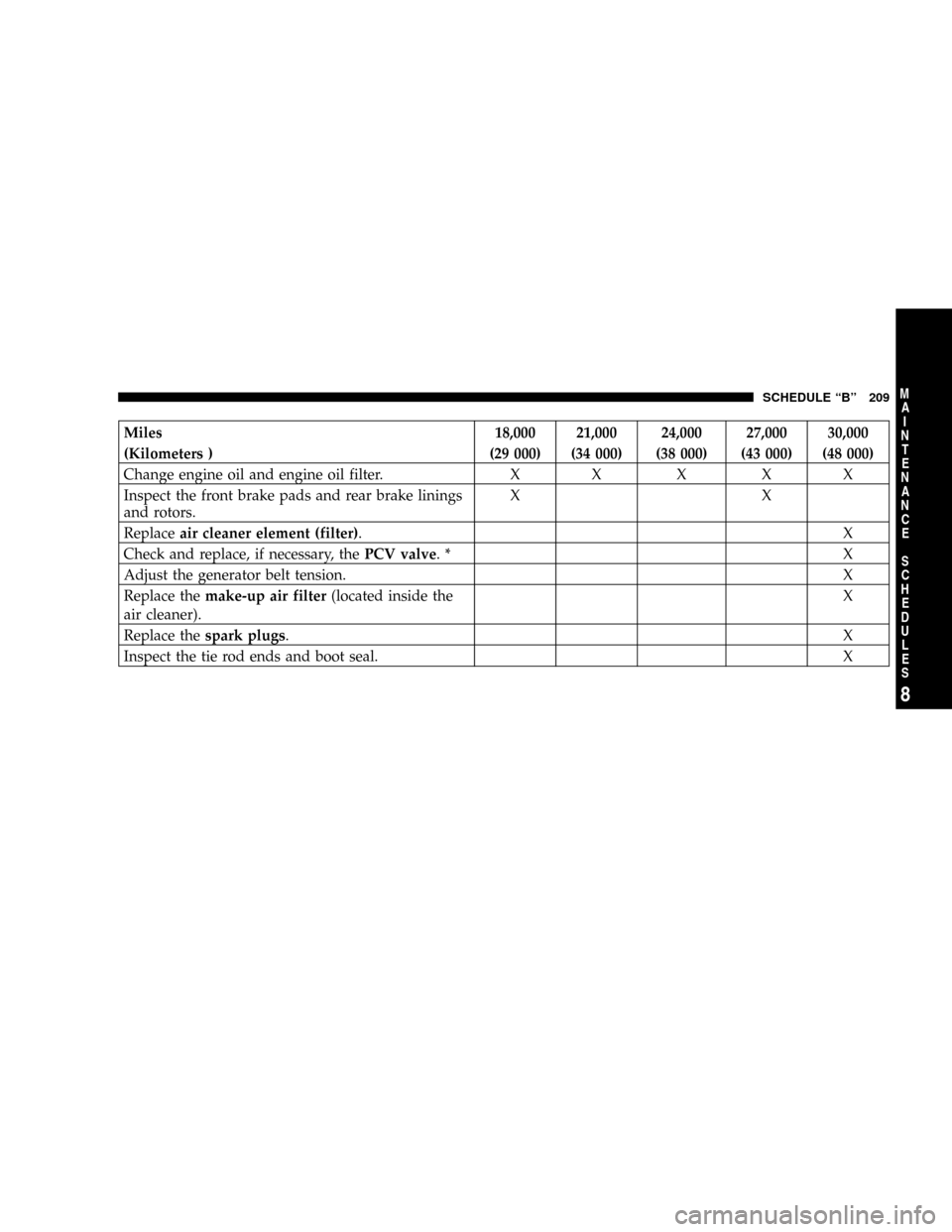
Miles 18,000 21,000 24,000 27,000 30,000
(Kilometers ) (29 000) (34 000) (38 000) (43 000) (48 000)
Change engine oil and engine oil filter. X X X X X
Inspect the front brake pads and rear brake linings
and rotors.XX
Replaceair cleaner element (filter).X
Check and replace, if necessary, thePCV valve.* X
Adjust the generator belt tension.X
Replace themake-up air filter(located inside the
air cleaner).X
Replace thespark plugs.X
Inspect the tie rod ends and boot seal. X
SCHEDULE ªBº 209
8
M
A
I
N
T
E
N
A
N
C
E
S
C
H
E
D
U
L
E
S
Page 210 of 241
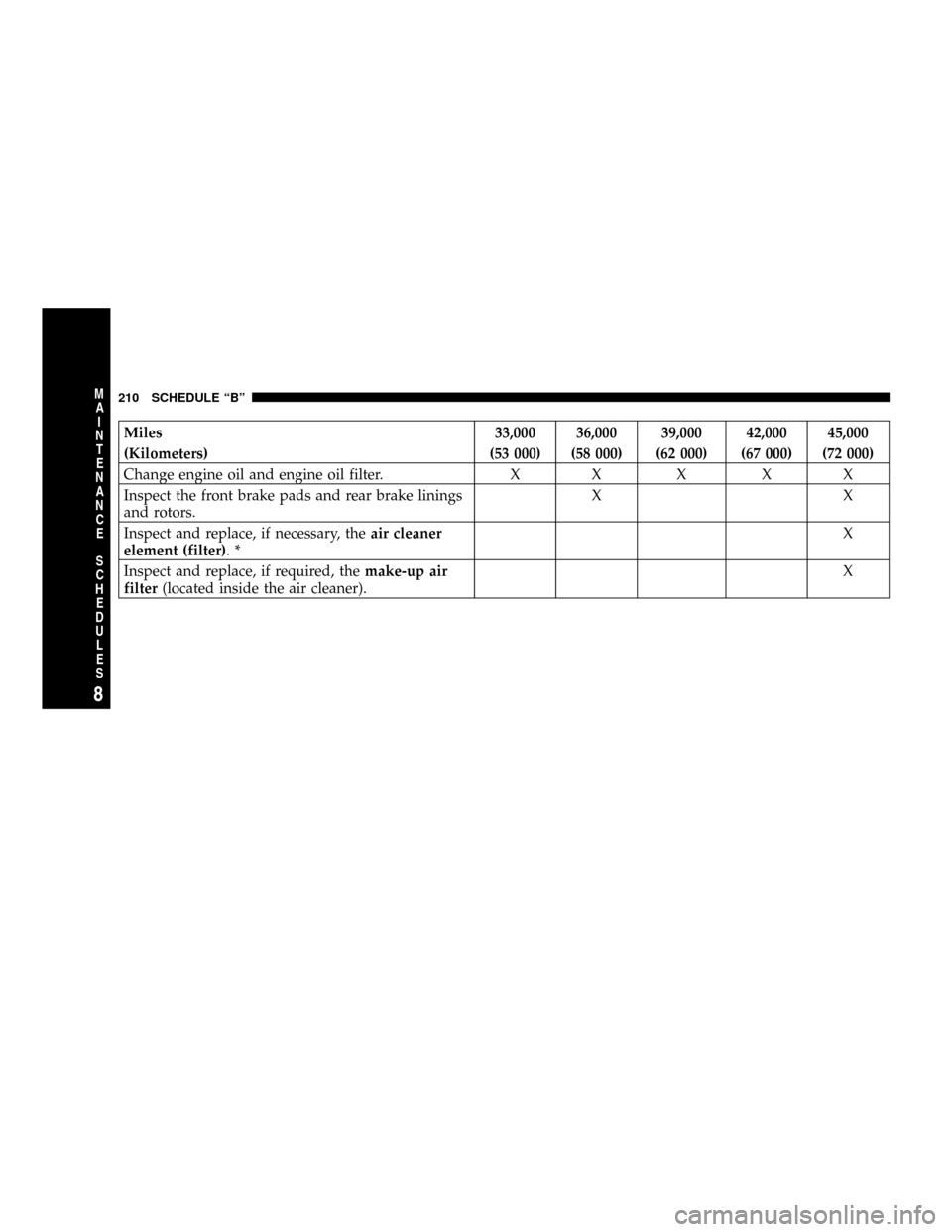
Miles 33,000 36,000 39,000 42,000 45,000
(Kilometers) (53 000) (58 000) (62 000) (67 000) (72 000)
Change engine oil and engine oil filter. X X X X X
Inspect the front brake pads and rear brake linings
and rotors.XX
Inspect and replace, if necessary, theair cleaner
element (filter).*X
Inspect and replace, if required, themake-up air
filter(located inside the air cleaner).X
210 SCHEDULE ªBº
8
M
A
I
N
T
E
N
A
N
C
E
S
C
H
E
D
U
L
E
S