radiator DODGE NEON 2004 2.G User Guide
[x] Cancel search | Manufacturer: DODGE, Model Year: 2004, Model line: NEON, Model: DODGE NEON 2004 2.GPages: 241, PDF Size: 3.75 MB
Page 183 of 241
The cap should be inspected and cleaned if there is any
accumulation of foreign material on the sealing surfaces.
WARNING!
The warning words ªDO NOT OPEN HOTº on the
cooling system pressure cap are a safety precaution.
never add coolant when the engine is overheated. Do
not loosen or remove the cap to cool an overheated
engine. Heat causes pressure to build up in the
cooling system. To prevent scalding or injury, do not
remove the pressure cap while the system is hot or
under pressure.
Coolant Level
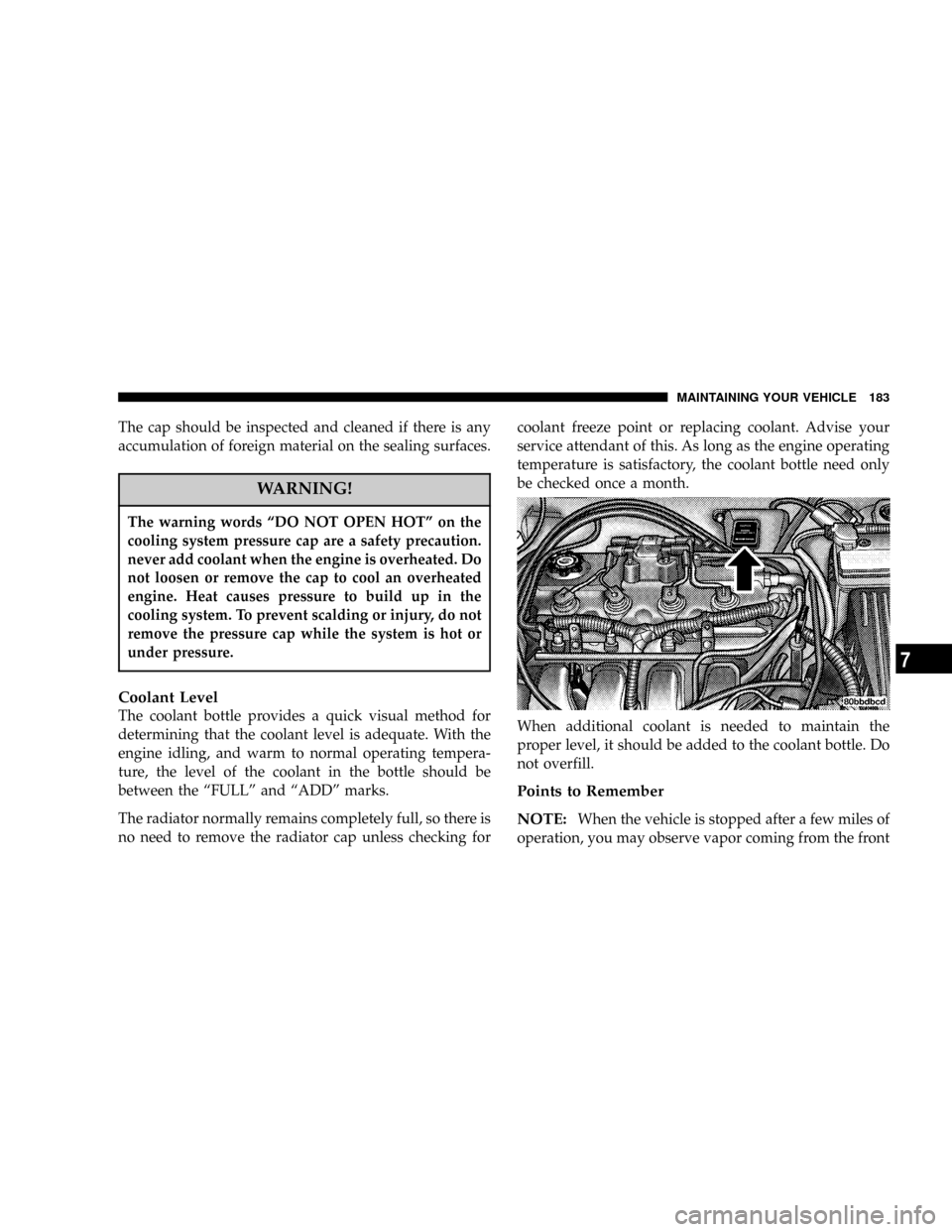
The coolant bottle provides a quick visual method for
determining that the coolant level is adequate. With the
engine idling, and warm to normal operating tempera-
ture, the level of the coolant in the bottle should be
between the ªFULLº and ªADDº marks.
The radiator normally remains completely full, so there is
no need to remove the radiator cap unless checking forcoolant freeze point or replacing coolant. Advise your
service attendant of this. As long as the engine operating
temperature is satisfactory, the coolant bottle need only
be checked once a month.
When additional coolant is needed to maintain the
proper level, it should be added to the coolant bottle. Do
not overfill.
Points to Remember
NOTE:
When the vehicle is stopped after a few miles of
operation, you may observe vapor coming from the front
MAINTAINING YOUR VEHICLE 183
7
Page 184 of 241

of the engine compartment. This is normally a result of
moisture from rain, snow, or high humidity accumula-
tion on the radiator and being vaporized when the
thermostat opens, allowing hot water to enter the radia-
tor.
If an examination of your engine compartment shows no
evidence of radiator or hose leaks, the vehicle may be
safely driven. The vapor will soon dissipate.
A. Do not overfill the coolant bottle.
B. Check coolant freeze point in the system.
C. If frequent coolant additions are required, the cooling
system should be pressure tested for leaks.
D. Maintain coolant concentration at 50% ethylene glycol
antifreeze (minimum) in water for proper corrosion pro-
tection of your engine which contains aluminum compo-
nents.
E. Make sure that the radiator and coolant bottle hoses
are not kinked or obstructed.F. Keep the front of the radiator clean. If your vehicle has
air conditioning, keep the front of the condenser clean,
also.
G. Do not change the thermostat for summer or winter
operation. If replacement is ever necessary, install ONLY
the correct type thermostat. Other designs may result in
unsatisfactory coolant performance, poor gas mileage,
and increased emissions.
Hoses And Vacuum/Vapor Harnesses
Inspect surfaces of hoses and nylon tubing for evidence
of heat and mechanical damage. Hard or soft spots,
brittle rubber, cracking, checking, tear, cuts, abrasions,
and excessive swelling indicate deterioration of the rub-
ber.
Pay particular attention to the hoses nearest to high heat
sources such as the exhaust manifold. Inspect hose rout-
ing to be sure hoses do not touch any heat source or
moving component that may cause heat damage or
mechanical wear.
Insure nylon tubing in these areas has not melted or
collapsed.
184 MAINTAINING YOUR VEHICLE
Page 206 of 241

²Check rubber seals on each side of the radiator for
proper fit.
At Each Oil Change
²
Change the engine oil filter.
²Inspect the exhaust system.
²Inspect the brake hoses.
²Inspect the CV joints and front suspension compo-
nents.
²Check the automatic transaxle fluid level.
²Check the manual transaxle fluid level and fill plug
condition.
²Check the coolant level, hoses, and clamps.
²Rotate the tires at each oil change interval shown on
Schedule ªAº 6,000 miles (10 000 km) or every other
interval shown on Schedule ªBº 6,000 miles (10 000
km).
206 MAINTENANCE SCHEDULES
8
M
A
I
N
T
E
N
A
N
C
E
S
C
H
E
D
U
L
E
S