steering DODGE NEON 2004 2.G Owner's Manual
[x] Cancel search | Manufacturer: DODGE, Model Year: 2004, Model line: NEON, Model: DODGE NEON 2004 2.GPages: 241, PDF Size: 3.75 MB
Page 160 of 241
WARNING!
Rapid acceleration on slippery surfaces is danger-
ous. Unequal traction can cause sudden pulling of
the front wheels. You could lose control of the
vehicle and possibly have an accident. Accelerate
slowly and carefully whenever there is likely to be
poor traction (ice, snow, wet, mud, loose sand, etc.).
Traction
When driving on wet or slushy roads, it is possible for a
wedge of water to build up between the tire and road
surface. This is hydroplaning and may cause partial or
complete loss of vehicle control and stopping ability. To
reduce this possibility, the following precautions should
be observed:
1. Slow down during rainstorms or when roads are
slushy.
2. Slow down if road has standing water or puddles.
3. Replace tires when tread wear indicators first become
visible.4. Keep tires properly inflated.
5. Maintain enough distance between your vehicle and
the vehicle in front of you to avoid a collision in a sudden
stop.
FREEING A STUCK VEHICLE
If your vehicle becomes stuck in mud, sand or snow, it
can often be moved by a rocking motion. Turn your
steering wheel right and left to clear the area around the
front wheels. Then shift back and forth between Reverse
and First gear. Usually the least accelerator pedal pres-
sure to maintain the rocking motion without spinning the
wheels is most effective.
160 WHAT TO DO IN EMERGENCIES
Page 161 of 241
WARNING!
Fast spinning tires can be dangerous. Forces gener-
ated by excessive wheel speeds may cause tire dam-
age or failure. A tire could explode and injure
someone. Do not spin your vehicle's wheels faster
than 35 mph (55km/h) when you are stuck. And don't
let anyone near a spinning wheel, no matter what the
speed.
CAUTION!
Racing the engine or spinning the wheels too fast
may lead to transaxle overheating and failure. It can
also damage the tires. Do not spin the wheels above
35 mph (55km/h).
TOWING A DISABLED VEHICLE
With Ignition Key
Four Speed Automatic Transaxle
Your vehicle may be towed under the following condi-
tions: The steering column must be unlocked and the
gear selector must be in NEUTRAL, the distance to be
towed must not exceed 100 miles (160 km), and the
towing speed must not exceed 44 mph (72 km/h). If the
transaxle is not operative, or if the vehicle is to be towed
more than 100 miles (160 km), the vehicle must be towed
with the front wheels off the ground to avoid damage to
the transaxle.
Manual Transaxle
Your vehicle may be towed if the gearshift lever is in
NEUTRAL. If the transaxle is not operative, the vehicle
must be towed with the front wheels off the ground.
WHAT TO DO IN EMERGENCIES 161
6
Page 162 of 241

All Transaxles
CAUTION!
If the vehicle being towed requires steering, the
ignition switch must be in the OFF position, not in
the LOCK or ACCESSORY positions.
If it is necessary to use the accessories while being towed
(wipers, defrosters, etc.), the key must be in the ON
position, not the ACCESSORY position. Make certain the
transaxle remains in NEUTRAL.
Without The Ignition Key
Special care must be taken when the vehicle is towed
with the ignition in the LOCK position. A dolly should be
used under the front wheels if the rear wheels are raised.
Proper towing equipment is necessary to prevent dam-
age to the vehicle.
Towing This Vehicle Behind Another Vehicle (Flat
Towing With All Four Wheels On The Ground)
If your vehicle is equipped with a manual transaxle, it
may be towed at any legal highway speed, for any
distance, if the transaxle is in neutral.
If the ignition key is not available, vehicles with auto-
matic transaxles can not be flat towed at any time.
162 WHAT TO DO IN EMERGENCIES
Page 163 of 241

MAINTAINING YOUR VEHICLE
CONTENTS
m2.0L Engine Compartment...............165
mOnboard Diagnostic System Ð OBD II......166
mEmissions Inspection And Maintenance
Programs
............................167
mReplacement Parts.....................168
mDealer Service........................168
mMaintenance Procedures.................169
NEngine Oil..........................169
NIgnition Wiring System.................174
NCrankcase Emission Control System........174
NFuel Filter..........................175
NAir Cleaner Element (Filter)..............175NMaintenance-Free Battery................175
NAir Conditioner......................176
NPower Steering Fluid Check..............177
NFront Suspension Ball Joints..............178
NBody Lubrication.....................178
NWindshield Wiper Blades................178
NWindshield Wiper Blade Replacement.......179
NWindshield Washer Aiming..............179
NWindshield Washer Reservoir.............179
NExhaust System......................179
NCooling System.......................180
7
Page 177 of 241
a gentle water spray from behind the radiator and
through the condenser as required. Fabric front fascia
protectors may reduce air flow to the condenser, reducing
air conditioning performance.
WARNING!
The air conditioning system contains refrigerant
under high pressure. To avoid risk of personal injury
or damage to the system, adding refrigerant or any
repair requiring lines to be disconnected should be
done by an experienced repairman.
Refrigerant Recovery And Recycling
The air conditioning system of your vehicle contains
R-134a, a refrigerant that does not deplete the ozone layer
in the upper atmosphere, the manufacturer recommends
that air conditioning service be done by facilities using
refrigerant recycling and recovery equipment that meets
SAE standard J1991.
NOTE:Air Conditioning systems found to be contami-
nated with A/C System Sealers, Stop Leak Products, SealConditioners, Compressor Oils, or Refrigerants not ap-
proved by the manufacturer, voids the warranty for the
Air Conditioning system.
Power Steering Fluid Check
Checking the power steering fluid level at a defined
service interval is not required. The fluid should only be
checked if a leak is suspected, abnormal noises are
apparent, and/or the system is not functioning as antici-
pated. Coordinate inspection efforts through a certified
DaimlerChrysler Dealership.
WARNING!
Fluid level should be checked on a level surface and
with the engine off to prevent injury from moving
parts and to insure accurate fluid level reading. Do
not overfill. Use only manufacturers recommended
power steering fluid.
MAINTAINING YOUR VEHICLE 177
7
Page 185 of 241
Inspect all hose connections such as clamps and cou-
plings to make sure they are secure and no leaks are
present.
Components should be replaced immediately if there is
any evidence of degradation that could cause failure.
Brake System
In order to assure brake system performance, all brake
system components should be inspected periodically.
Suggested service intervals can be found in the Mainte-
nance Section.
WARNING!
Riding the brakes can lead to brake failure and
possibly an accident. Driving with your foot resting
or riding on the brake pedal can result in abnormally
high brake temperatures, excessive lining wear, and
possible brake damage. You wouldn't have your full
braking capacity in an emergency.
Brake and Power Steering System Hoses
When servicing the vehicle for scheduled maintenance,
inspect surface of hoses and nylon tubing for evidence of
heat and mechanical damage. Hard and brittle rubber,
cracking, checking, tears, cuts, abrasions, and excessive
swelling suggest deterioration of the rubber. Particular
attention should be made to examining those hose sur-
faces nearest to high heat sources, such as the exhaust
manifold.
Inspect all hose clamps and couplings to make sure they
are secure and no leaks are present.
Insure nylon tubing in these areas has not melted or
collapsed.
NOTE:Often, fluids such as oil, power steering fluid,
and brake fluid are used during assembly plant opera-
tions to ease the assembly of hoses to couplings. There-
fore, oil wetness at the hose-coupling area is not neces-
sarily an indication of leakage. Actual dripping of hot
fluid when systems are under pressure (during vehicle
operation) should be noted before hose is replaced based
on leakage.
MAINTAINING YOUR VEHICLE 185
7
Page 201 of 241
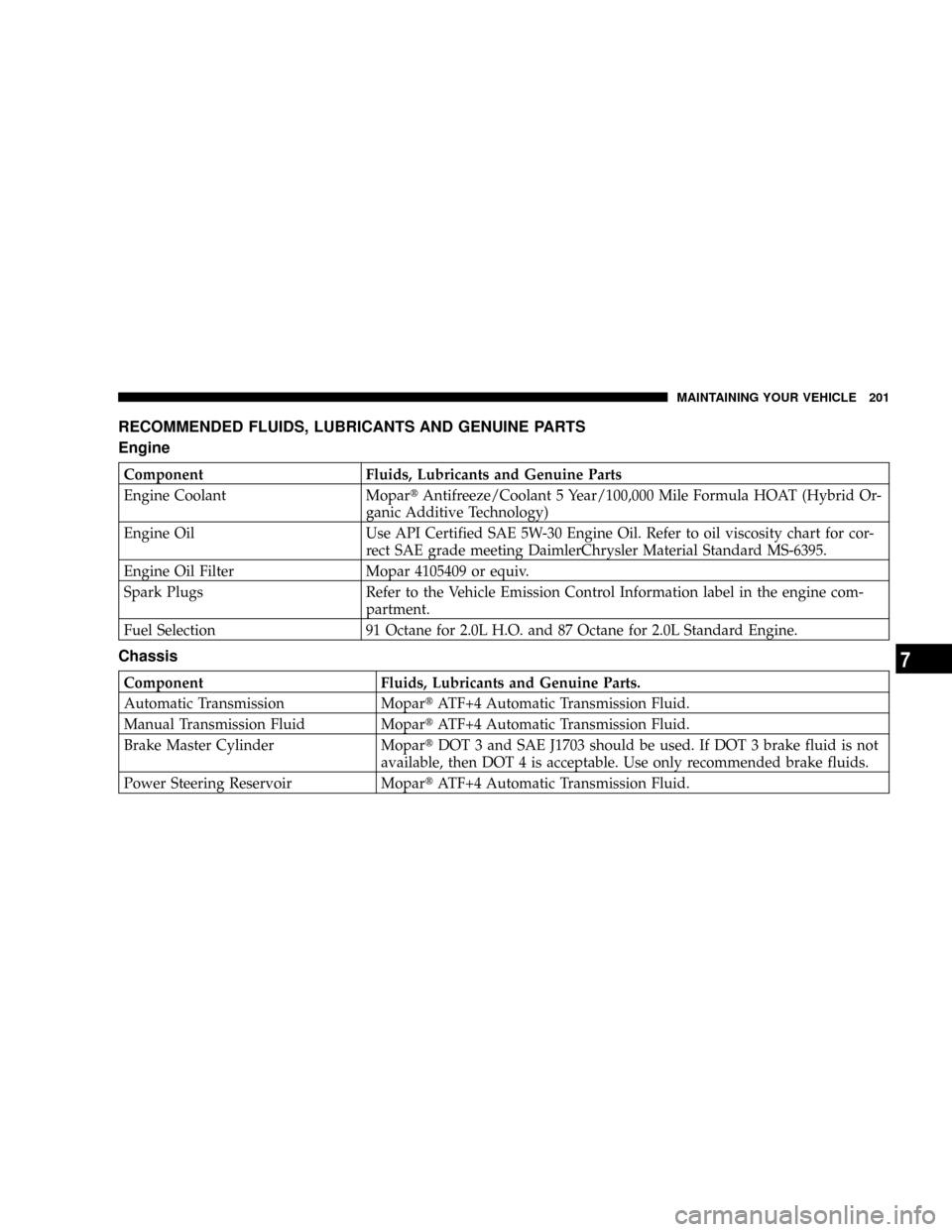
RECOMMENDED FLUIDS, LUBRICANTS AND GENUINE PARTS
Engine
Component Fluids, Lubricants and Genuine Parts
Engine Coolant MopartAntifreeze/Coolant 5 Year/100,000 Mile Formula HOAT (Hybrid Or-
ganic Additive Technology)
Engine Oil Use API Certified SAE 5W-30 Engine Oil. Refer to oil viscosity chart for cor-
rect SAE grade meeting DaimlerChrysler Material Standard MS-6395.
Engine Oil Filter Mopar 4105409 or equiv.
Spark Plugs Refer to the Vehicle Emission Control Information label in the engine com-
partment.
Fuel Selection 91 Octane for 2.0L H.O. and 87 Octane for 2.0L Standard Engine.
Chassis
Component Fluids, Lubricants and Genuine Parts.
Automatic Transmission MopartATF+4 Automatic Transmission Fluid.
Manual Transmission Fluid MopartATF+4 Automatic Transmission Fluid.
Brake Master Cylinder MopartDOT 3 and SAE J1703 should be used. If DOT 3 brake fluid is not
available, then DOT 4 is acceptable. Use only recommended brake fluids.
Power Steering Reservoir MopartATF+4 Automatic Transmission Fluid.
MAINTAINING YOUR VEHICLE 201
7
Page 205 of 241
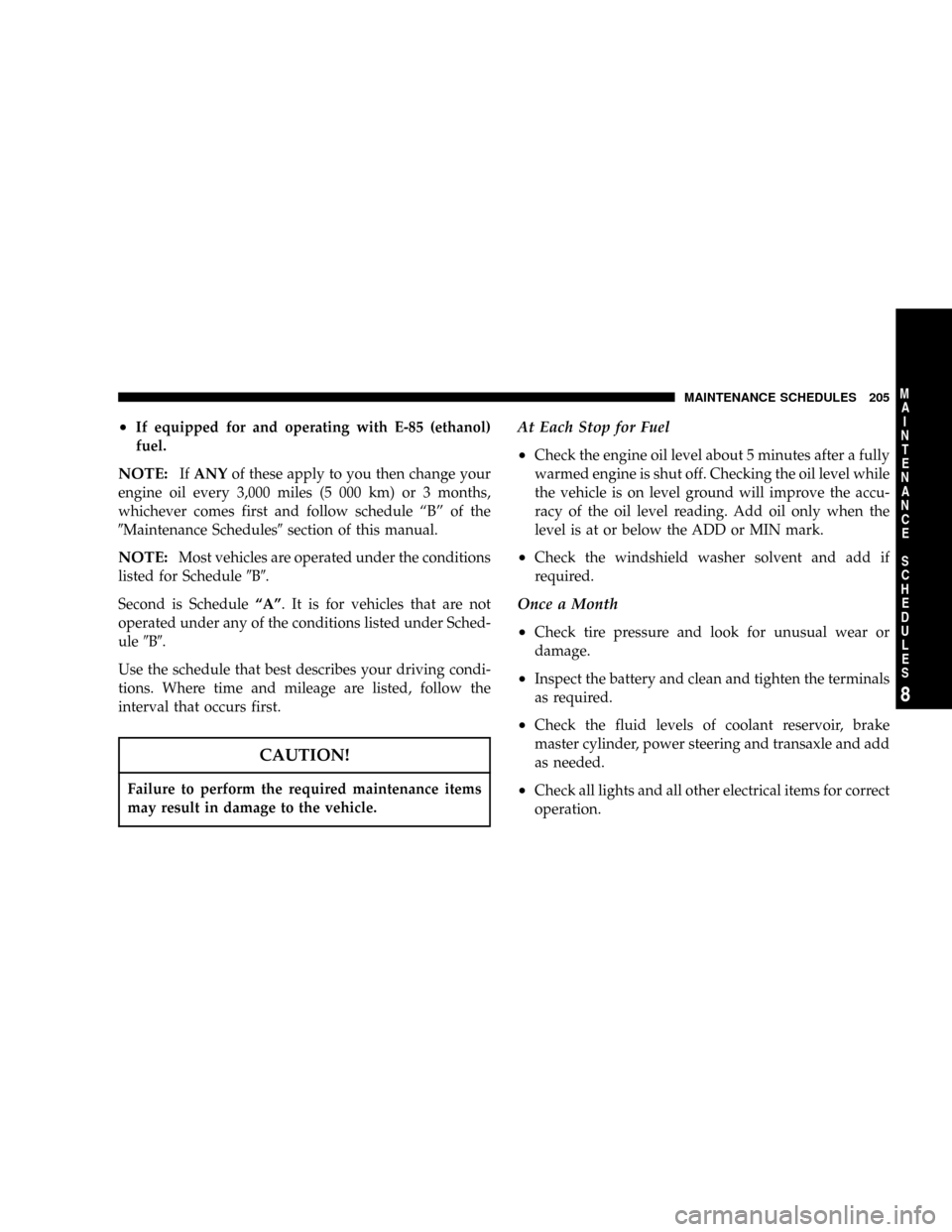
²If equipped for and operating with E-85 (ethanol)
fuel.
NOTE:IfANYof these apply to you then change your
engine oil every 3,000 miles (5 000 km) or 3 months,
whichever comes first and follow schedule ªBº of the
9Maintenance Schedules9section of this manual.
NOTE:Most vehicles are operated under the conditions
listed for Schedule9B9.
Second is ScheduleªAº. It is for vehicles that are not
operated under any of the conditions listed under Sched-
ule9B9.
Use the schedule that best describes your driving condi-
tions. Where time and mileage are listed, follow the
interval that occurs first.
CAUTION!
Failure to perform the required maintenance items
may result in damage to the vehicle.
At Each Stop for Fuel
²
Check the engine oil level about 5 minutes after a fully
warmed engine is shut off. Checking the oil level while
the vehicle is on level ground will improve the accu-
racy of the oil level reading. Add oil only when the
level is at or below the ADD or MIN mark.
²Check the windshield washer solvent and add if
required.
Once a Month
²
Check tire pressure and look for unusual wear or
damage.
²Inspect the battery and clean and tighten the terminals
as required.
²Check the fluid levels of coolant reservoir, brake
master cylinder, power steering and transaxle and add
as needed.
²Check all lights and all other electrical items for correct
operation.
MAINTENANCE SCHEDULES 205
8
M
A
I
N
T
E
N
A
N
C
E
S
C
H
E
D
U
L
E
S
Page 236 of 241

Theft Alarm.......................... 80
Turn Signal.....................62,79,199
Voltage.............................. 80
Warning (Instrument Cluster Description).... 78
Loading Vehicle........................ 147
Tires ............................... 129
Locks................................ 14
Child Protection....................... 16
Door............................... 14
Power Door.......................... 15
Steering Wheel........................ 13
Lubrication, Body....................... 178
Maintenance.......................169,204
Maintenance, Airbag..................... 39
Maintenance Free Battery................. 175
Maintenance Procedures.................. 169
Maintenance Schedule................... 204
Schedule9A9......................... 215
Schedule9B9......................... 207
Maintenance, Sunroof.................... 69
Malfunction Indicator Light.............81,167
Manual, Service........................ 225Manual Transaxle...............67,114,119,189
Downshifting........................ 121
Fluid Level Check..................... 189
Frequency of Fluid Change.............. 190
Lubricant Selection.................... 189
Map/Reading Lights..................... 60
Master Cylinder........................ 186
Mirrors............................... 51
Compass/Temperature.................. 51
Electric Remote....................... 54
Outside............................. 54
Rearview............................ 51
Modifications/Alterations, Vehicle............ 6
Mopar Parts........................168,224
Multi-Function Control Lever.............61,62
Occupant Restraints...................... 23
Odometer
Trip ................................ 81
Oil, Engine.........................169,200
Capacity............................ 200
Change Interval...................... 170
Checking........................... 169
236 INDEX
Page 237 of 241

Disposal............................ 172
Filter.............................. 172
Identification Logo.................... 171
Materials Added to.................... 172
Quality............................. 171
Recommendation..................171,200
Synthetic........................... 172
Viscosity............................ 171
Oil Pressure Light....................... 80
Onboard Diagnostic System............166,167
Operator Manuals........................ 4
Outside Air Intake...................104,109
Outside Rearview Mirrors................. 54
Overdrive............................ 118
Overheating, Engine..................... 152
Owner's Manual......................4,225
Paint Care............................ 190
Panic Alarm........................... 18
Parking Brake......................... 121
Passing Light........................... 62
Pets.................................. 46
Phone, Cellular........................ 102Placard, Tire and Loading Information....... 129
Power
Door Locks.......................... 15
Steering.........................125,177
Steering, Checking.................... 177
Sunroof............................. 68
Windows............................ 23
Power Steering Fluid.................... 201
Pregnant Women and Seat Belts............. 30
Preparation for Jacking................... 154
Programming Transmitters................. 19
Radial Ply Tires........................ 136
Radio............................83,84,89
Radio Broadcast Signals................... 83
Radio Operation......................84,89
Radio, Satellite.......................... 95
Rear Window Defroster.................. 110
Reclining Front Seats..................... 56
Recommended Fluids, Lubricants and Genuine
Parts............................... 201
Reformulated Gasoline................... 142
Refrigerant............................ 177
INDEX 237
10