warning DODGE NEON 2004 2.G Owner's Manual
[x] Cancel search | Manufacturer: DODGE, Model Year: 2004, Model line: NEON, Model: DODGE NEON 2004 2.GPages: 241, PDF Size: 3.75 MB
Page 41 of 241
²Children who weigh more than 20 lbs (9 kg) and who
are older than one year can ride forward-facing in the
vehicle. Forward-facing child seats and convertible
child seats used in the forward-facing direction are for
children who weigh 20 to 40 lbs (9 to 18 kg) and who
are older than one year. These child seats are also held
in the vehicle by the lap/shoulder belt or the LATCH
child restraint anchorage system.
²The belt-positioning booster seat is for children weigh-
ing more than 18 kg (40 lbs), but who are still too small
to fit the vehicle's seat belts properly. If the child
cannot sit with knees bent over the vehicle's seat
cushion while the child's back is against the seat back;
they should use a Belt Positioning Booster Seat. The
child and booster seat are held in the vehicle by the
lap/shoulder belt. (Some booster seats are equipped
with a front shield and are held in the vehicle by the
lap portion.)
NOTE:For additional information refer to
www.seatcheck.org.
WARNING!
²Improper installation can lead to failure of an
infant or child restraint. It could come loose in a
collision. The child could be badly injured or
killed. Follow the manufacturer's directions ex-
actly when installing an infant or child restraint.
²A rearward facing infant restraint should only be
used in a rear seat. A rearward facing infant
restraint in the front seat may be struck by a
deploying passenger airbag which may cause se-
vere or fatal injury to the infant.
Here are some tips on getting the most out of your child
restraint:
²Before buying any restraint system, make sure that it
has a label certifying that it meets all applicable Safety
Standards. We also recommend that you make sure
that you can install the child restraint in the vehicle
where you will use it before you buy it.
THINGS TO KNOW BEFORE STARTING YOUR VEHICLE 41
2
Page 44 of 241
3. Attach the tether strap hook (A) of the child restraint to
the anchor (B) and remove slack in the tether strap
according to the child restraint manufacturer's instruc-
tions.
WARNING!
An incorrectly anchored tether strap could lead to
increased head motion and possible injury to the
child. Use only the anchor positions directly behind
the child seat to secure a child restraint top tether
strap.
Child restraint systems having attachments designed to
connect to the lower anchorages are now available. Child
restraints having tether straps and hooks for connection
to the top tether anchorage have been available for some
time. In fact, many child restraint manufacturers will
provide add-on tether strap kits for some of their older
products. Tether anchorage kits are also available for
most older vehicles.Because the lower anchorages are to be introduced to
passenger carrying vehicles over a period of years, child
restraint systems having attachments for those anchor-
ages will continue to have features for installation in
vehicles using the lap or lap/shoulder belt. They will also
have tether straps, and you are urged to take advantage
of all of the available attachments provided with your
child restraint in any vehicle.
Installing the Child Restraint System
While there are LATCH anchorages at all three rear
seating positions, do not install child restraints at all three
positions at the same time. The anchorages are not
designed to restrain three child restraints at one time.
Instead, you may install one child restraint at the center
position, or two child restraints at the right and left
positions.
44 THINGS TO KNOW BEFORE STARTING YOUR VEHICLE
Page 45 of 241
WARNING!
Do not install child restraint systems equipped with
LATCH attachments at all three rear seating posi-
tions at one time. The LATCH anchorages are de-
signed to restrain no more than two child restraints
at a time in the event of a collision.
We urge that you carefully follow the directions of the
manufacturer when installing your child restraint. Many,
but not all, restraint systems will be equipped with
separate straps on each side, with each having a hook or
connector and a means for adjusting the tension in the
strap. Forward-facing toddler restraints and some
rearward-facing infant restraints will also be equipped
with a tether strap, a hook and means for adjusting the
tension in the strap.
In general, you will first loosen the adjusters on the lower
straps and tether straps so that you can more easily attach
the hook or connector to the lower anchorages and tether
anchorages. Then tighten all three straps as you push the
child restraint rearward and downward into the seat.Not all child restraint systems will be installed as we
have described here. Again, carefully follow the instruc-
tions that come with the child restraint system.
NOTE:If your child restraint seat is not LATCH
compatible, install the restraint using the vehicle seat
belts.
WARNING!
Improper installation of a child restraint to the
LATCH anchorages can lead to failure of an infant or
child restraint. The child could be badly injured or
killed. Follow the manufacturer's directions exactly
when installing an infant or child restraint.
Children Too Large For Booster Seats
Children who are large enough to wear the shoulder belt
comfortably, and whose legs are long enough to bend
over the front of the seat when their back is against the
seat back, should use the lap/shoulder belt in a rear seat.
²Make sure that the child is upright in the seat.
THINGS TO KNOW BEFORE STARTING YOUR VEHICLE 45
2
Page 47 of 241
SAFETY TIPS
Exhaust Gas
WARNING!
Exhaust gases can injure or kill. They contain carbon
monoxide (CO) which is colorless and odorless.
Breathing it can make you unconscious and can
eventually poison you. To avoid breathing (CO)
follow the safety tips below.
Do not run the engine in a closed garage or in confined
areas any longer than needed to move your vehicle in or
out of the area.
If it is necessary to sit in a parked vehicle with the engine
running, adjust your heating or cooling controls to force
outside air into the vehicle. Set the blower at high speed.
To avoid drawing exhaust gases into the vehicle, close the
trunk while driving. However, if for some reason it mustremain open, close all windows. Adjust the heating or
cooling system to force outside air into the vehicle. Set
the blower at high speed.
Safety Checks You Should Make Inside The
Vehicle
Seat Belts
Inspect the belt system periodically, checking for cuts,
frays and loose parts. Damaged parts must be replaced
immediately. Do not disassemble or modify the system.
Front seat belt assemblies must be replaced after a
collision. Rear seat belt assemblies must be replaced after
a collision if they have been damaged (bent retractor, torn
webbing, etc.). If there is any question regarding belt or
retractor condition, replace the belt.
Airbag Light
The light should come on and remain on for 6 to
8 seconds as a bulb check when the ignition
switch is first turned to ON/RUN. If the bulb is
not lit during starting, have it replaced. If the light stays
on or comes on while driving, have the system checked
by an authorized dealer.
THINGS TO KNOW BEFORE STARTING YOUR VEHICLE 47
2
Page 54 of 241
Compass Calibration
If ªCALº is not displayed, press and hold the ªLeftº
button for 10±15 seconds, or until ªCALº appears in the
display, then release the button. The compass is now in
calibration mode.
The mirror can be calibrated in one of two ways
²
Drive the vehicle in circles at less then 5mph (8 km/h)
until ªCALº no longer appears in the display.
²Drive the vehicle under normal operating conditions.
Outside Mirror Ð Driver's Side
Adjust the outside mirror to center on the adjacent lane of
traffic, with a slight overlap of the view obtained on the
inside mirror.
Outside Mirror Ð Passenger's Side
Adjust the convex outside mirror so you can just see the
side of your vehicle in the part of the mirror closest to the
vehicle.
WARNING!
Vehicles and other objects seen in the passenger side
convex mirror will look smaller and farther away
than they really are. Relying too much on your
passenger side mirror could cause you to collide
with another vehicle or other object. Use your inside
mirror when judging the size or distance of a vehicle
seen in this convex mirror.
Electric Remote-Control Mirrors Ð If Equipped
Use the mirror select switch, located on the drivers door
trim panel, to adjust the view obtained in the outside
mirrors. Press the rocker knob to the L or R for Left or
Right mirror selection. Use the center off position to
guard against accidentally moving a mirror position.
54 UNDERSTANDING THE FEATURES OF YOUR VEHICLE
Page 56 of 241
WARNING!
²Adjusting a seat while the vehicle is moving is
dangerous. The sudden movement of the seat
could cause you to lose control. The seat belt
might not be properly adjusted and you could be
injured. Adjust the seat only while the vehicle is
parked.
²Do not ride with the seatback reclined so that the
shoulder belt is no longer resting against your
chest. In a collision you could slide under the seat
belt and be seriously or even fatally injured. Use
the recliner only when the vehicle is parked.
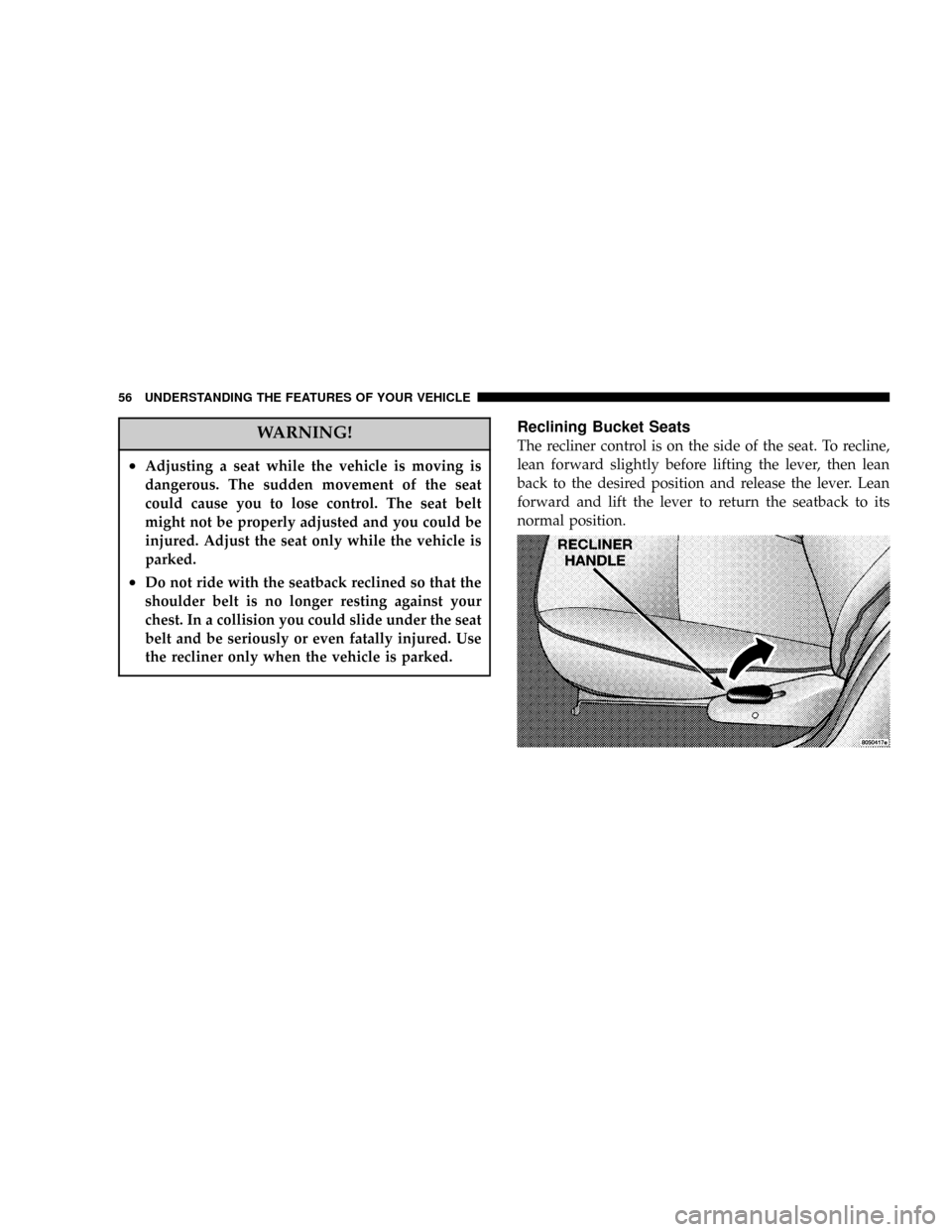
Reclining Bucket Seats
The recliner control is on the side of the seat. To recline,
lean forward slightly before lifting the lever, then lean
back to the desired position and release the lever. Lean
forward and lift the lever to return the seatback to its
normal position.
56 UNDERSTANDING THE FEATURES OF YOUR VEHICLE
Page 58 of 241
WARNING!
²It is extremely dangerous to ride in a cargo area,
inside or outside of a vehicle. In a collision,
people riding in these areas are more likely to be
seriously injured or killed.
²Do not allow people to ride in any area of your
vehicle that is not equipped with seats and seat-
belts
²Be sure that everyone in your vehicle is in a seat
and using a seatbelt properly.
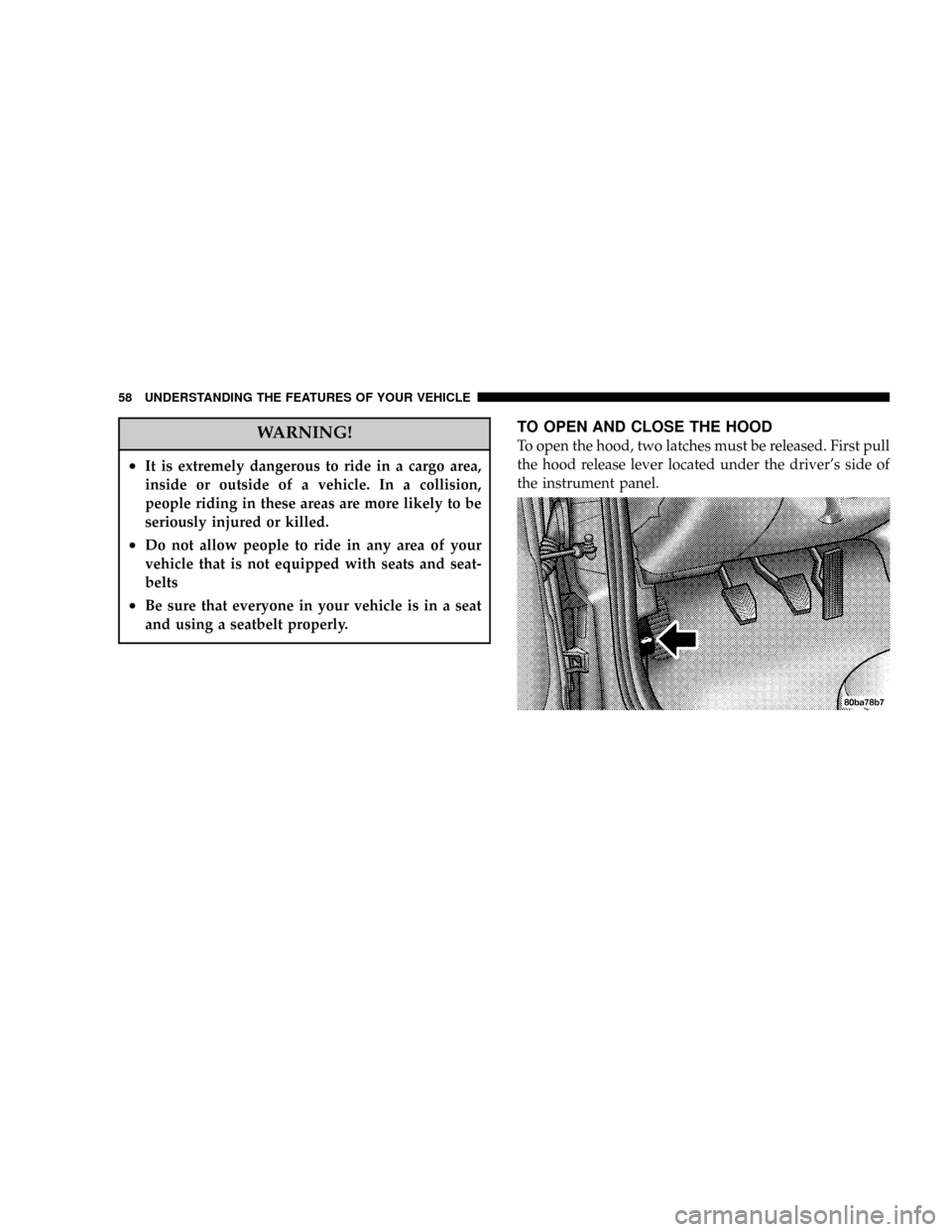
TO OPEN AND CLOSE THE HOOD
To open the hood, two latches must be released. First pull
the hood release lever located under the driver's side of
the instrument panel.
58 UNDERSTANDING THE FEATURES OF YOUR VEHICLE
Page 59 of 241
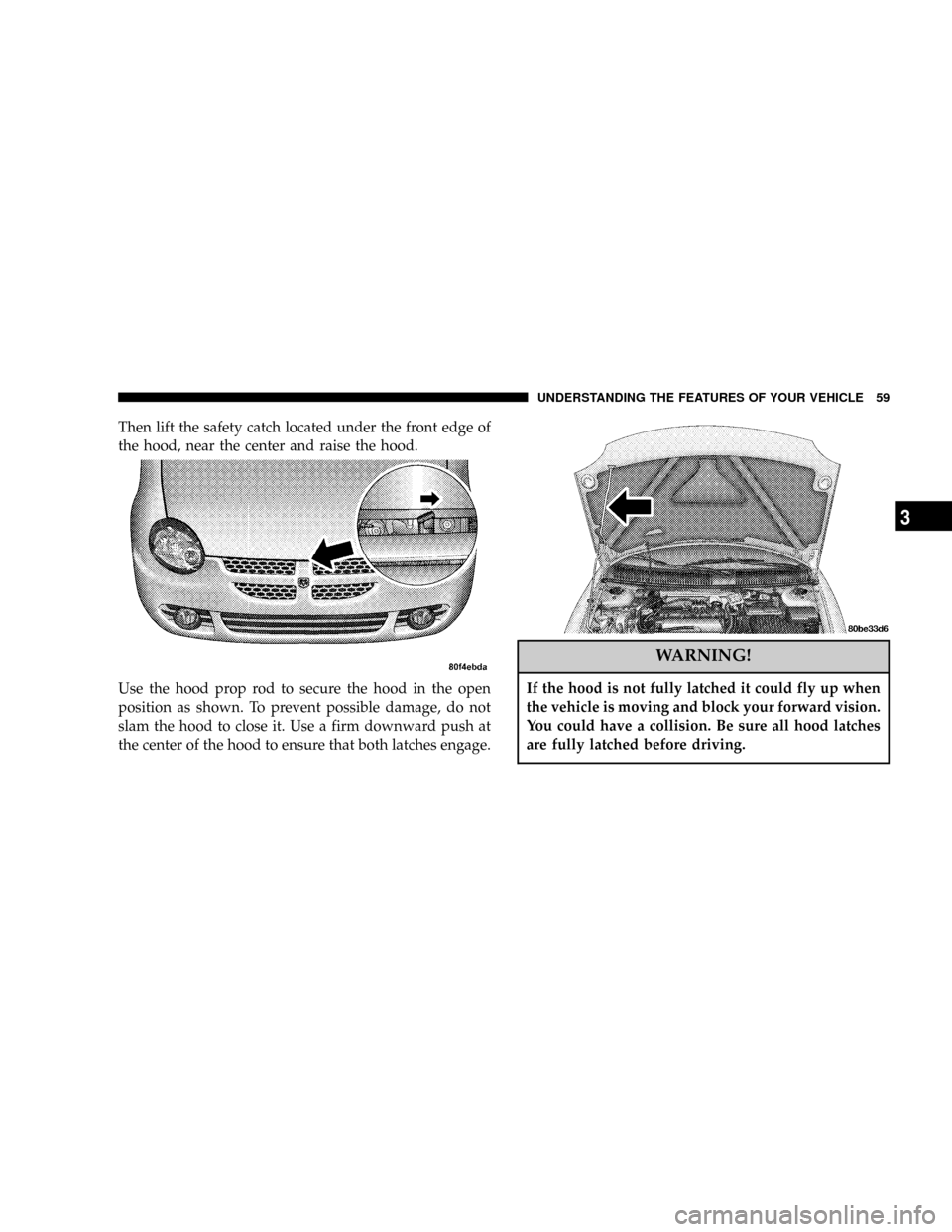
Then lift the safety catch located under the front edge of
the hood, near the center and raise the hood.
Use the hood prop rod to secure the hood in the open
position as shown. To prevent possible damage, do not
slam the hood to close it. Use a firm downward push at
the center of the hood to ensure that both latches engage.
WARNING!
If the hood is not fully latched it could fly up when
the vehicle is moving and block your forward vision.
You could have a collision. Be sure all hood latches
are fully latched before driving.
UNDERSTANDING THE FEATURES OF YOUR VEHICLE 59
3
Page 65 of 241
WARNING!
Tilting the steering column while the vehicle is
moving is dangerous. Without a stable steering col-
umn, you could lose control of the vehicle and have
an accident. Adjust the column only while the ve-
hicle is stopped. Be sure it is locked before driving.
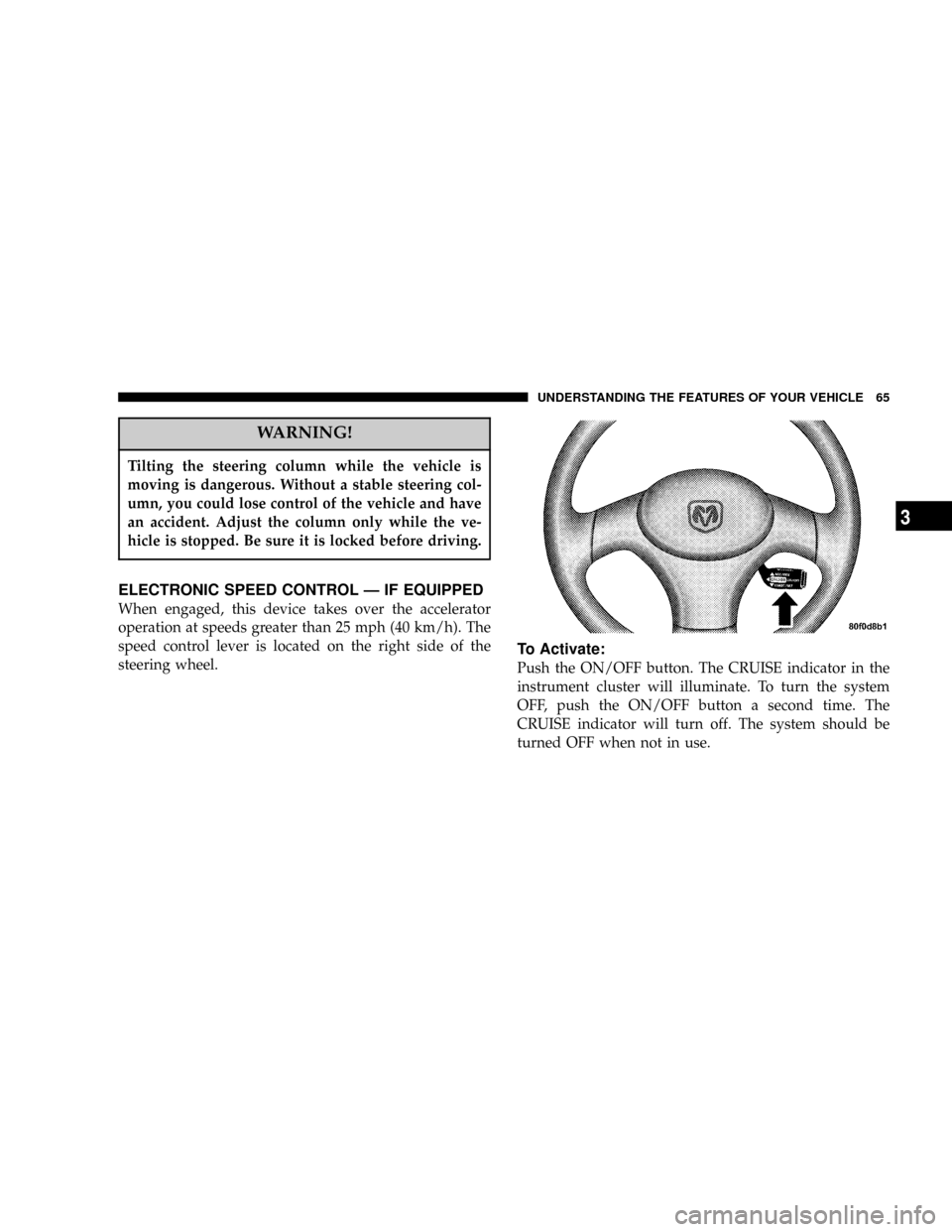
ELECTRONIC SPEED CONTROL Ð IF EQUIPPED
When engaged, this device takes over the accelerator
operation at speeds greater than 25 mph (40 km/h). The
speed control lever is located on the right side of the
steering wheel.
To Activate:
Push the ON/OFF button. The CRUISE indicator in the
instrument cluster will illuminate. To turn the system
OFF, push the ON/OFF button a second time. The
CRUISE indicator will turn off. The system should be
turned OFF when not in use.
UNDERSTANDING THE FEATURES OF YOUR VEHICLE 65
3
Page 66 of 241
WARNING!
Leaving the Electronic Speed Control system on
when not in use is dangerous. You could accidentally
set the system or cause it to go faster than you want.
You could lose control and have an accident. Always
leave the system OFF when you are not using it.
To Set At A Desired Speed:
When the vehicle has reached the desired speed, press
down on the lever and release. Release the accelerator
and the vehicle will operate at the selected speed.
NOTE:The vehicle should be traveling at a steady
speed and on level ground before pressing the SET lever.
To Deactivate:
A soft tap on the brake pedal, pulling the speed control
lever towards you ªCANCELº, or normal brake or clutch
pressure while slowing the vehicle will deactivate speed
control without erasing the set speed memory. Pressing
the ON/OFF button or turning off the ignition switch
erases the set speed memory.
To Resume Speed:
To resume a previously set speed, push the ªACC/RESº
lever up and release. Resume can be used at any speed
above 32 km/h (20 mph).
To Vary The Speed Setting:
When the speed control is ON, speed can be increased by
pushing up and holding ªACC/RESº. Release the lever
when the desired speed is reached, and the new speed
will be set.
Tapping ªACC/RESº once will result in a 2 mph (3
km/h) speed increase. Each time the lever is tapped,
speed increases so that tapping the lever three times will
increase speed by 6 mph (10 km/h), etc.
To decrease speed while speed control is ON, push down
and hold ªCOAST/SETº. Release the lever when the
desired speed is reached, and the new speed will be set.
Tapping the ªCOAST/SETº button once will result in a 1
mph (2 km/h) speed decrease. Each time the button is
tapped, speed decreases.
66 UNDERSTANDING THE FEATURES OF YOUR VEHICLE