battery DODGE NEON 2005 2.G User Guide
[x] Cancel search | Manufacturer: DODGE, Model Year: 2005, Model line: NEON, Model: DODGE NEON 2005 2.GPages: 246, PDF Size: 3.69 MB
Page 163 of 246
MAINTAINING YOUR VEHICLE
CONTENTS
m2.0L Engine Compartment...............165
mOnboard Diagnostic System Ð OBD II......166
mEmissions Inspection And Maintenance
Programs
............................167
mReplacement Parts.....................168
mDealer Service........................168
mMaintenance Procedures.................169
NEngine Oil..........................169
NIgnition Wiring System.................175
NCrankcase Emission Control System........175
NFuel Filter..........................175
NAir Cleaner Element (Filter)..............175NMaintenance-Free Battery................176
NAir Conditioner......................177
NPower Steering Fluid Check..............178
NFront Suspension Ball Joints..............178
NBody Lubrication.....................178
NWindshield Wiper Blades................179
NWindshield Wiper Blade Replacement.......179
NWindshield Washer Aiming..............180
NWindshield Washer Reservoir.............180
NExhaust System......................180
NCooling System.......................181
7
Page 167 of 246

EMISSIONS INSPECTION AND MAINTENANCE
PROGRAMS
In some localities, it may be a legal requirement to pass
an inspection of your vehicle's emissions control system.
Failure to pass could prevent vehicle registration.
For states which have an I/M (Inspection and
Maintenance) requirement, this check verifies the
following: the MIL (Malfunction Indicator Lamp)
is functioning and is not on when the engine is running,
and that the OBD (On Board Diagnostic) system is ready
for testing.
Normally, the OBD system will be ready. The OBD
system maynotbe ready if your vehicle was recently
serviced, if you recently had a dead battery, or a battery
replacement. If the OBD system should be determined
not ready for the I/M test, your vehicle may fail the test.
Your vehicle has a simple ignition key actuated test
which you can use prior to going to the test station. To
check if your vehicle's OBD system is ready, you must do
the following:
1. Insert your ignition key into the ignition switch.2. Turn the ignition to the ON position, but do not crank
or start the engine.
3. If you crank or start the engine, you will have to start
this test over.
4. As soon as you turn your key to the ON position, you
will see your MIL symbol come on as part of a normal
bulb check.
5. Approximately 15 seconds later, one of two things will
happen:
a. The MIL will flash for about 10 seconds and then
return to being fully illuminated until you turn off
the ignition key or start the engine. This means that
your vehicle's OBD system isnot readyand you
shouldnotproceed to the I/M station.
b. The MIL will not flash at all and will remain fully
illuminated until you turn off the ignition key or
start the engine. This means that your vehicle's OBD
system isreadyand you can proceed to the I/M
station.
MAINTAINING YOUR VEHICLE 167
7
Page 168 of 246

If your OBD system isnot ready,you should see your
authorized dealer or repair facility. If your vehicle was
recently serviced or had a battery failure or replacement,
you may need to do nothing more than drive your
vehicle as you normally would in order for your OBD
system to update. A recheck with the above test routine
may then indicate that the system is now ready.
Regardless of whether your vehicle's OBD system is
ready or not ready, if the MIL symbol is illuminated
during normal vehicle operation, you should have your
vehicle serviced before going to the I/M station. The I/M
station can fail your vehicle because the MIL symbol is on
with the engine running.REPLACEMENT PARTS
Use of genuine Mopar parts for normal/scheduled main-
tenance and repairs is highly recommended to insure the
designed performance. Damage or failures caused by the
use of non-Mopar parts for maintenance and repairs will
not be covered by the manufacturer warranty.
DEALER SERVICE
Your dealer has the qualified service personnel, special
tools and equipment to perform all service operations in
an expert manner. Service manuals are available which
include detailed service information for your vehicle.
Refer to these manuals before attempting any procedure
yourself.
NOTE:Intentional tampering with emissions control
systems can result in civil penalties being assessed
against you.
168 MAINTAINING YOUR VEHICLE
Page 176 of 246
Maintenance-Free Battery
The top of the MAINTENANCE-FREE battery is perma-
nently sealed. You will never have to add water, nor is
periodic maintenance required.
CAUTION!
When servicing the battery, always reinstall the
battery thermowrap. The thermowrap provides bat-
tery heat protection and will extend overall battery
life. Failure to reinstall the thermowrap can result in
evaporative loss of the battery fluid.
WARNING!
Battery posts, terminals and related accessories con-
tain lead and lead compounds. Wash hands after
handling.
Battery fluid is a corrosive acid solution and can
burn or even blind you. Don't allow battery fluid to
contact your eyes, skin or clothing. Don't lean over a
battery when attaching clamps. If acid splashes in
eyes or on skin, flush the area immediately with
large amounts of water.
Battery gas is flammable and explosive. Keep flame
or sparks away from the battery. Don't use a booster
battery or any other booster source with an output
greater than 12 volts. Don't allow cable clamps to
touch each other.
176 MAINTAINING YOUR VEHICLE
Page 177 of 246
CAUTION!
It is essential when replacing the cables on the
battery that the positive cable is attached to the
positive post and the negative cable is attached to the
negative post. Battery posts are marked positive (+)
and negative (-) and identified on the battery case.
Cable clamps should be tight on the terminal posts
and free of corrosion. Apply grease to posts and
clamps after tightening.
If a ªfast chargerº is used while the battery is in the
vehicle, disconnect both vehicle battery cables be-
fore connecting the charger to battery. Do not use a
ªfast chargerº to provide starting voltage as battery
damage can result.
Air Conditioner
Check the air conditioning system at the start of the
warm weather season.
NOTE:If your air conditioning performance seems
lower than expected, check the front of the A/C con-
denser for an accumulation of dirt or insects. Clean witha gentle water spray from behind the radiator and
through the condenser as required. Fabric front fascia
protectors may reduce air flow to the condenser, reducing
air conditioning performance.
WARNING!
The air conditioning system contains refrigerant
under high pressure. To avoid risk of personal injury
or damage to the system, adding refrigerant or any
repair requiring lines to be disconnected should be
done by an experienced repairman.
Refrigerant Recovery And Recycling
The air conditioning system of your vehicle contains
R-134a, a refrigerant that does not deplete the ozone layer
in the upper atmosphere, the manufacturer recommends
that air conditioning service be done by facilities using
refrigerant recycling and recovery equipment that meets
SAE standard J1991.
MAINTAINING YOUR VEHICLE 177
7
Page 195 of 246

Cleaning Plastic Instrument Cluster Lenses
The lenses in front of the instruments in the vehicle are
molded in clear plastic. When cleaning the lenses, care
must be taken to avoid scratching the plastic.
1. Clean with a wet soft rag. A mild soap solution may be
used, but do not use high alcohol content of abrasive
cleaners. If soap is used, wipe clean with a clean damp
rag.
2. Dry with a soft tissue.
Seat Belt Maintenance
Do not bleach, dye or clean the belts with chemical
solvents or abrasive cleaners. This will weaken the fabric.
Sun damage will also weaken the fabric.
If the belts need cleaning, use a mild soap solution or
lukewarm water. Do not remove the belts from the
vehicle to wash them.
Replace the belts if they appear frayed or worn or if the
buckles do not work properly.
FUSES
Underhood Fuses (Power Distribution Center)
A Power Distribution Center is located in the engine
compartment; next to the battery. A label identifying the
components and circuits is located on the underside of
the cover.
Underhood Fuses (Power Distribution Center)
MAINTAINING YOUR VEHICLE 195
7
Page 198 of 246
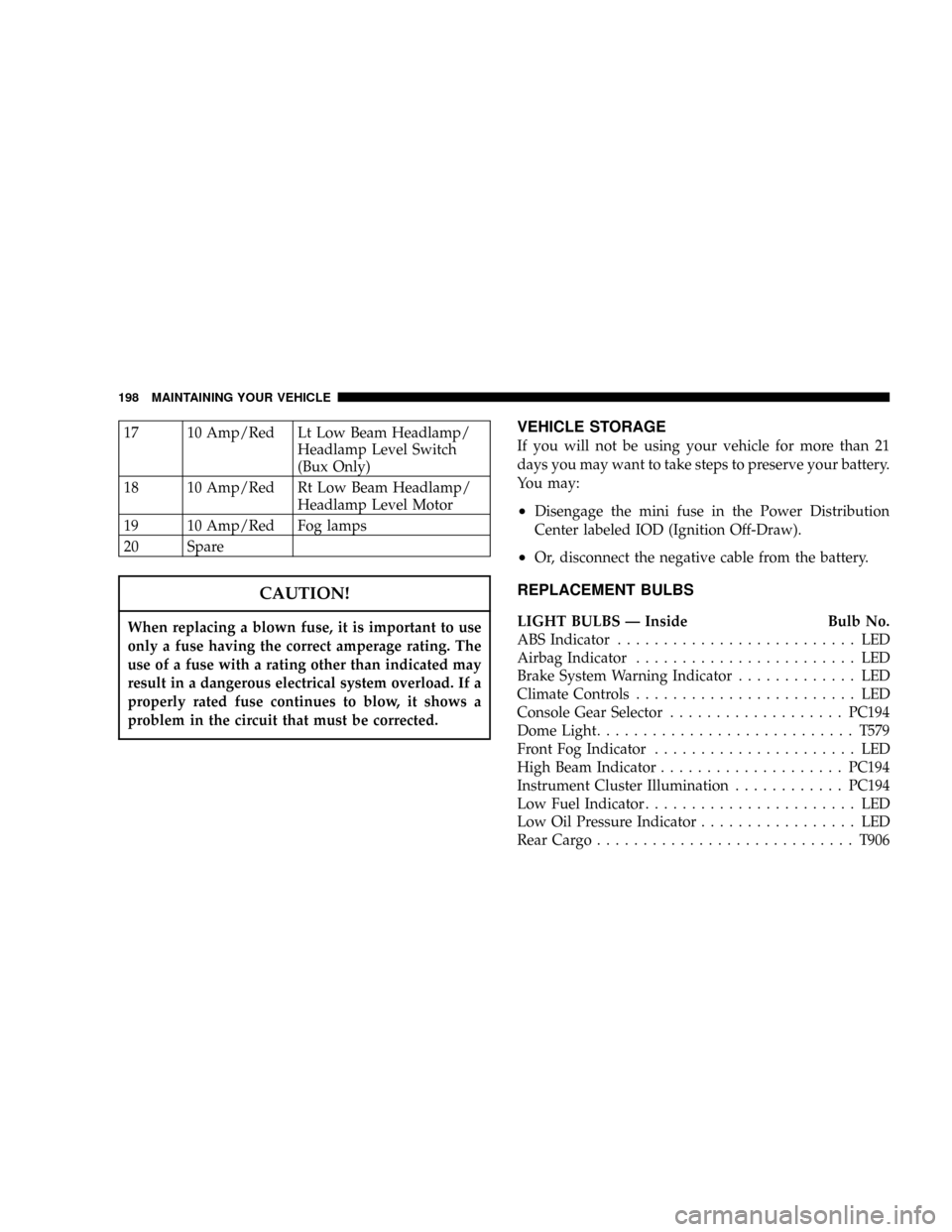
17 10 Amp/Red Lt Low Beam Headlamp/
Headlamp Level Switch
(Bux Only)
18 10 Amp/Red Rt Low Beam Headlamp/
Headlamp Level Motor
19 10 Amp/Red Fog lamps
20 Spare
CAUTION!
When replacing a blown fuse, it is important to use
only a fuse having the correct amperage rating. The
use of a fuse with a rating other than indicated may
result in a dangerous electrical system overload. If a
properly rated fuse continues to blow, it shows a
problem in the circuit that must be corrected.
VEHICLE STORAGE
If you will not be using your vehicle for more than 21
days you may want to take steps to preserve your battery.
You may:
²Disengage the mini fuse in the Power Distribution
Center labeled IOD (Ignition Off-Draw).
²Or, disconnect the negative cable from the battery.
REPLACEMENT BULBS
LIGHT BULBS Ð Inside Bulb No.
ABS Indicator.......................... LED
Airbag Indicator........................ LED
Brake System Warning Indicator............. LED
Climate Controls........................ LED
Console Gear Selector...................PC194
Dome Light............................T579
Front Fog Indicator...................... LED
High Beam Indicator....................PC194
Instrument Cluster Illumination............PC194
Low Fuel Indicator....................... LED
Low Oil Pressure Indicator................. LED
Rear Cargo............................T906
198 MAINTAINING YOUR VEHICLE
Page 207 of 246
²If equipped for and operating with E-85 (ethanol)
fuel.
NOTE:IfANYof these apply to you then change your
engine oil every 3,000 miles (5 000 km) or 3 months,
whichever comes first and follow schedule ªBº of the
9Maintenance Schedules9section of this manual.
NOTE:IFANYof these apply to you then flush and
replace the engine coolant every 102,000 miles (163 000
km) or 60 months, whichever comes first, and follow
schedule ªBº of the9Maintenance Schedules9section of
this manual.
NOTE:Most vehicles are operated under the conditions
listed for Schedule9B9.
Second is ScheduleªAº. It is for vehicles that are not
operated under any of the conditions listed under Sched-
ule9B9.
Use the schedule that best describes your driving condi-
tions. Where time and mileage are listed, follow the
interval that occurs first.
CAUTION!
Failure to perform the required maintenance items
may result in damage to the vehicle.
At Each Stop for Fuel
²
Check the engine oil level about 5 minutes after a fully
warmed engine is shut off. Checking the oil level while
the vehicle is on level ground will improve the accu-
racy of the oil level reading. Add oil only when the
level is at or below the ADD or MIN mark.
²Check the windshield washer solvent and add if
required.
Once a Month
²
Check tire pressure and look for unusual wear or
damage.
²Inspect the battery and clean and tighten the terminals
as required.
MAINTENANCE SCHEDULES 207
8
M
A
I
N
T
E
N
A
N
C
E
S
C
H
E
D
U
L
E
S
Page 234 of 246

ABS (Anti-Lock Brake) System............. 123
Adding Engine Coolant (Antifreeze)......... 183
Adding Fuel.......................... 144
Air Cleaner, Engine (Engine Air Cleaner Filter) . 175
Air Conditioning....................103,177
Air Conditioning Controls................ 103
Air Conditioning Refrigerant.............. 177
Air Conditioning System................. 177
Air Pressure, Tires...................... 133
Airbag................................ 31
Airbag Deployment...................... 36
Airbag Light.......................39,47,79
Airbag Maintenance...................... 38
Airbag, Side........................... 37
Alarm, Panic........................... 20
Alarm System........................22,79
Alignment and Balance.................. 139
Alterations/Modifications, Vehicle............ 6
Antenna, Satellite Radio................... 96
Antifreeze (Engine Coolant).........182,202,203
Capacities........................... 202
Disposal............................ 184
Anti-Lock Brake System (ABS)............. 123Anti-Lock Warning Light.................. 77
Anti-Theft Security Alarm................. 22
Appearance Care....................... 191
Arming Theft System..................... 22
Ashtrays and Lighter..................... 70
Automatic Door Locks.................... 16
Automatic Transaxle........... 9,114,116,117,188
Fluid and Filter Changes................ 190
Fluid Level Check..................... 188
Interlock System....................14,116
Reset Mode.......................... 117
Selection Of Lubricant................. 188
Shifting............................. 117
Special Additives..................... 190
Ball Joints............................ 178
Battery............................... 176
Keyless Transmitter Replacement.......... 21
Belts, Drive........................... 173
Belts, Engine.......................... 174
Body Mechanism Lubrication.............. 178
B-Pillar Location....................... 128
Brake Fluid........................... 203
234 INDEX
Page 240 of 246

Rear Servicing....................... 201
Rear Tail............................ 201
Seat Belt Reminder..................... 79
Security Alarm........................ 22
Side Marker......................... 201
Theft Alarm.......................... 79
Turn Signal.....................62,78,201
Voltage.............................. 79
Warning (Instrument Cluster Description).... 77
Loading Vehicle........................ 146
Tires ............................... 128
Locks................................ 14
Child Protection....................... 17
Door............................... 14
Power Door.......................... 15
Steering Wheel........................ 13
Lubrication, Body....................... 178
Maintenance.......................169,206
Maintenance, Airbag..................... 38
Maintenance Free Battery................. 176
Maintenance Procedures.................. 169
Maintenance Schedule................... 206Schedule9A9......................... 218
Schedule9B9......................... 209
Maintenance, Sunroof.................... 69
Malfunction Indicator Light.............80,167
Manual, Service........................ 229
Manual Transaxle...............67,114,119,190
Downshifting........................ 120
Fluid Level Check..................... 190
Frequency of Fluid Change.............. 191
Lubricant Selection.................... 190
Map/Reading Lights..................... 60
Master Cylinder........................ 187
Mirrors............................... 51
Compass/Temperature.................. 51
Electric Remote....................... 55
Outside............................. 54
Rearview............................ 51
Modifications/Alterations, Vehicle............ 6
Mopar Parts........................168,229
Multi-Function Control Lever.............61,62
Occupant Restraints...................... 24
240 INDEX