belt DODGE NEON 2005 2.G Owner's Manual
[x] Cancel search | Manufacturer: DODGE, Model Year: 2005, Model line: NEON, Model: DODGE NEON 2005 2.GPages: 246, PDF Size: 3.69 MB
Page 79 of 246

The light does not show the quantity of oil in the engine.
This can be determined using the procedure shown in
Section 7. (See page 169 for more information.)
9. Seat Belt Reminder Light
When the ignition key is first turned on, this
light will come on for about six seconds. A
chime will sound if you have not pulled the
shoulder belt out of the retractor. This is a reminder to
ªbuckle upº. If you do not buckle up, the light will
remain on.
10. Charging System Light
This light shows the status of the electrical
charging system. The light should come on
briefly when the ignition is first turned on and remain
on briefly as a bulb check. If the light stays on or
comes on while driving, it means that there is a
problem with the charging system. Obtain SERVICE
IMMEDIATELY.
11. Airbag Light
The light comes on and remains on for 6 to 8
seconds as a bulb check when the ignition
switch is first turned ON. If the light does notcome on during starting, stays on, or comes on while
driving, have the system checked by an authorized
dealer. (See page 39 for more information.)
12. Theft Alarm Light Ð If Equipped
This light will flash rapidly for several seconds when the
alarm system is arming. The light will begin to flash
slowly indicating that the system is armed. (See page 22
for more information.)
13. Fuel Door Reminder
This symbol is a reminder that the Fuel Filler Door is
located on the passenger's side of the vehicle.
14. Fuel Gauge
When the ignition key is in the ON position, the
pointer will show the level of fuel remaining in
the fuel tank.
15. Low Fuel Light Ð If Equipped
NOTE:
The Low Fuel Light and Chime feature only
functions on vehicles equipped with a tachometer.
When the fuel level drops to about 1/8 tank, the
fuel symbol will light and a single chime will
sound. The light will remain on until fuel is
UNDERSTANDING YOUR INSTRUMENT PANEL 79
4
Page 114 of 246

STARTING PROCEDURES
Before starting your vehicle, adjust your seat, adjust both
inside and outside mirrors, and fasten your seat belts.
CAUTION!
Long periods of engine idling, especially at high
engine speeds can cause excessive exhaust tempera-
tures which can damage your vehicle. Do not leave
your vehicle unattended with the engine running.
WARNING!
Do not leave children or animals inside parked
vehicles in hot weather. Interior heat build up may
cause serious injury or death.
Automatic Transaxle
The gear selector must be in the NEUTRAL or PARK
position before you can start the engine.
NOTE:You must press the brake pedal before shifting
out of Park.
Manual Transaxle
Place the gear selector in NEUTRAL, press the clutch
pedal to the floor, and fully apply the parking brake
before starting the engine.
NOTE:The engine will not start unless the clutch pedal
is pressed to the floor.
Normal Starting
Normal Starting of either a cold or a warm engine does
not require pumping or depressing the accelerator pedal.
Simply turn the key to the START position and release
when the engine starts. If the engine has not started
within 5 seconds, slightly depress the accelerator pedal
while continuing to crank. If the engine fails to start
within 15 seconds, turn the key to the OFF position, wait
10 to 15 seconds, then repeat the normal starting proce-
dure.
114 STARTING AND OPERATING
Page 158 of 246

8. When removing the jumper cables, reverse the above
sequence exactly. Be careful of the moving belts and fan.
WARNING!
Any procedure other than above could result in:
1. Personal injury caused by electrolyte squirting
out the battery vent;
2. Personal injury or property damage due to battery
explosion;
3. Damage to charging system of booster vehicle or
of immobilized vehicle.
DRIVING ON SLIPPERY SURFACES
Acceleration
Rapid acceleration on snow covered, wet, or other slip-
pery surfaces may cause the front wheels to pull errati-
cally to the right or left. This phenomenon occurs when
there is a difference in the surface traction under the front
(driving) wheels, particularly with high output engines.
WARNING!
Rapid acceleration on slippery surfaces is danger-
ous. Unequal traction can cause sudden pulling of
the front wheels. You could lose control of the
vehicle and possibly have an accident. Accelerate
slowly and carefully whenever there is likely to be
poor traction (ice, snow, wet, mud, loose sand, etc.).
158 WHAT TO DO IN EMERGENCIES
Page 173 of 246

Engine Oil Filter
The engine oil filter should be replaced at every engine
oil change.
Engine Oil Filter Selection
All of this manufacturers engines have a full-flow type
disposable oil filter. Use a filter of this type for replace-
ment. The quality of replacement filters varies consider-
ably. Only high quality filters should be used to assure
most efficient service. Mopar Engine Oil Filters are high
quality oil filters and are recommended.
Drive Belts Ð Check Condition and Tension
At the mileage shown in the maintenance schedules,
check all drive belts for condition and proper tension.
Improper belt tension can cause belt slippage and failure.
Inspect the drive belts for evidence of cuts, cracks, or
glazing and replace them if there is any sign of damage
which could result in belt failure. If adjustment is re-
quired, adjust the belts according to the specifications
and procedures shown in the Service Manual.Special tools are required to properly measure tension
and to restore belt tension to factory specifications. Also,
check belt routing to make sure there is no interference
between the belts and other engine components.
Spark Plugs
Spark plugs must fire properly to assure engine perfor-
mance and emission control. New plugs should be in-
stalled at the specified mileage. The entire set should be
replaced if there is any malfunction due to a faulty spark
plug. Check the specifications section for the proper type
of spark plug for use in your vehicle.
Catalytic Converter
The catalytic converter requires the use of unleaded fuel
only. Leaded gasoline will destroy the effectiveness of the
catalyst as an emission control device.
Under normal operating conditions, the catalytic con-
verter will not require maintenance. However, it is im-
portant to keep the engine properly tuned to assure
proper catalyst operation and prevent possible catalyst
damage.
MAINTAINING YOUR VEHICLE 173
7
Page 174 of 246

CAUTION!
Damage to the catalytic converter can result if your
vehicle is not kept in proper operating condition. In
the event of engine malfunction, particularly involv-
ing engine misfire or other apparent loss of perfor-
mance, have your vehicle serviced promptly. Contin-
ued operation of your vehicle with a severe
malfunction could cause the converter to overheat,
resulting in possible damage to the converter and the
vehicle.
WARNING!
A hot exhaust system can start a fire if you park over
materials that can burn. Such materials might be
grass or leaves coming into contact with your ex-
haust system. Do not park or operate your vehicle in
areas where your exhaust system can contact any-
thing that can burn.
In unusual situations involving grossly malfunctioning
engine operation, a scorching odor may suggest severe
and abnormal catalyst overheating. If this occurs, stop
the vehicle, turn off the engine and allow it to cool.
Service, including a tune up to manufacturers specifica-
tions, should be obtained immediately.
To minimize the possibility of catalyst damage:
²Do not shut off the engine or interrupt the ignition
when the transaxle is in gear and the vehicle is in
motion.
²Do not try to start the engine by pushing or towing the
vehicle.
²Do not idle the engine with any spark plug wires
disconnected for prolonged period.
Engine Timing Belt
Replace the engine timing belt at the intervals described
in the appropriate maintenance schedule.
174 MAINTAINING YOUR VEHICLE
Page 195 of 246

Cleaning Plastic Instrument Cluster Lenses
The lenses in front of the instruments in the vehicle are
molded in clear plastic. When cleaning the lenses, care
must be taken to avoid scratching the plastic.
1. Clean with a wet soft rag. A mild soap solution may be
used, but do not use high alcohol content of abrasive
cleaners. If soap is used, wipe clean with a clean damp
rag.
2. Dry with a soft tissue.
Seat Belt Maintenance
Do not bleach, dye or clean the belts with chemical
solvents or abrasive cleaners. This will weaken the fabric.
Sun damage will also weaken the fabric.
If the belts need cleaning, use a mild soap solution or
lukewarm water. Do not remove the belts from the
vehicle to wash them.
Replace the belts if they appear frayed or worn or if the
buckles do not work properly.
FUSES
Underhood Fuses (Power Distribution Center)
A Power Distribution Center is located in the engine
compartment; next to the battery. A label identifying the
components and circuits is located on the underside of
the cover.
Underhood Fuses (Power Distribution Center)
MAINTAINING YOUR VEHICLE 195
7
Page 199 of 246

LIGHT BULBS Ð Inside Bulb No.
Seat Belt Indicator....................... LED
Security Alarm Indicator................... LED
Malfunction Indicator Light................ LED
Turn Signal Indicator....................PC194
Voltage Indicator........................ LED
All the inside bulbs are brass or glass wedge base.
Aluminum base bulbs are not approved and should not
be used for replacement.
LIGHTS BULBS Ð Outside Bulb No.
Headlight.............................9007
Front Park/Turn Signal Light.............3457AK
Front Side Marker Light.................... 168
Front Fog Light.......................... 899
Center High Mounted Stop Light (CHMSL).....921±
W16W
Rear Tail/Stop/Turn Signal Light......3157±P27/7W
Backup Light......................921±W16W
License Light........................... 168BULB REPLACEMENT
Headlight Bulb Replacement
CAUTION!
Do not touch the new headlight bulb with your
fingers. Oil contamination will severely shorten
bulb life.
1. Remove the three upper fascia screws.
MAINTAINING YOUR VEHICLE 199
7
Page 211 of 246
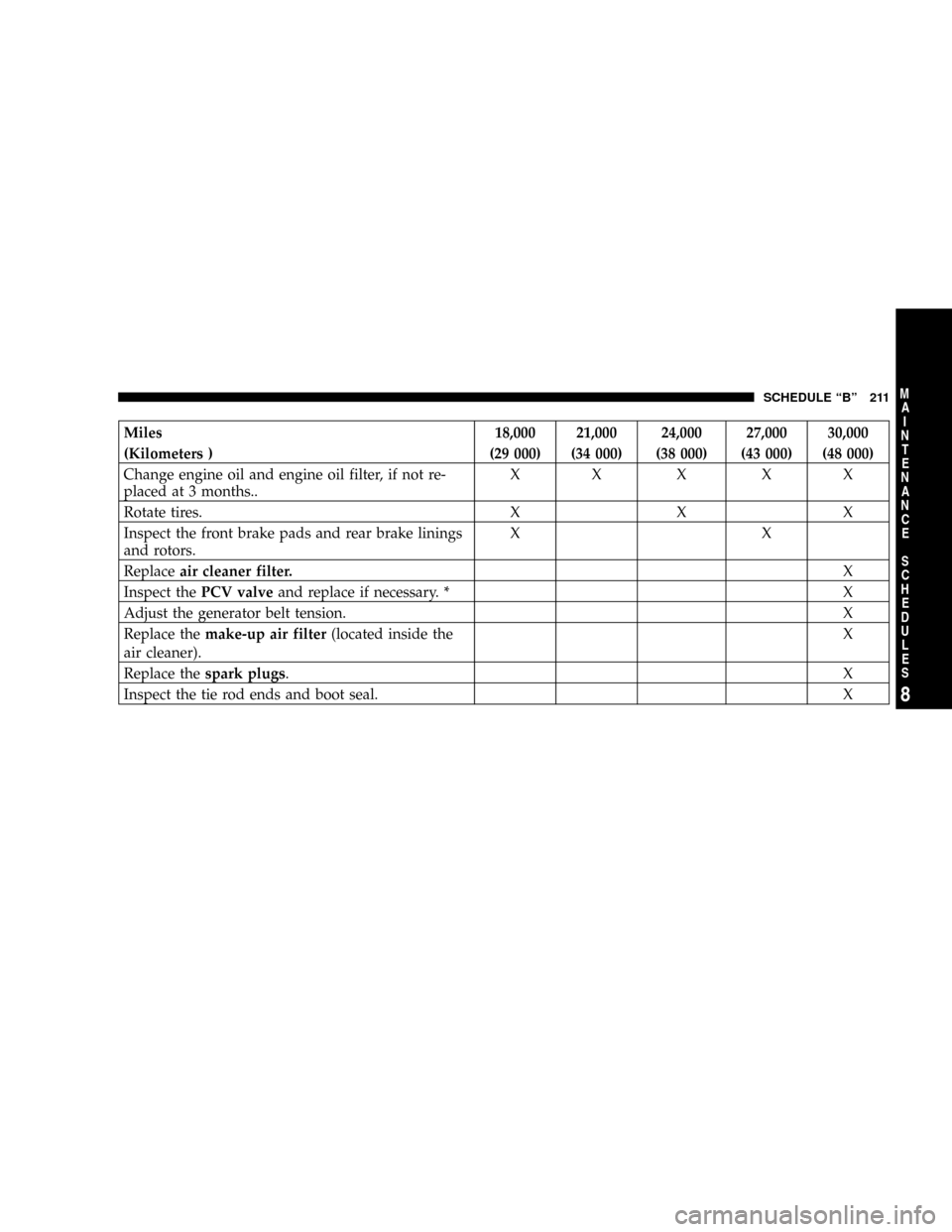
Miles 18,000 21,000 24,000 27,000 30,000
(Kilometers ) (29 000) (34 000) (38 000) (43 000) (48 000)
Change engine oil and engine oil filter, if not re-
placed at 3 months..XX X XX
Rotate tires. X X X
Inspect the front brake pads and rear brake linings
and rotors.XX
Replaceair cleaner filter.X
Inspect thePCV valveand replace if necessary. * X
Adjust the generator belt tension.X
Replace themake-up air filter(located inside the
air cleaner).X
Replace thespark plugs.X
Inspect the tie rod ends and boot seal. X
SCHEDULE ªBº 211
8
M
A
I
N
T
E
N
A
N
C
E
S
C
H
E
D
U
L
E
S
Page 213 of 246
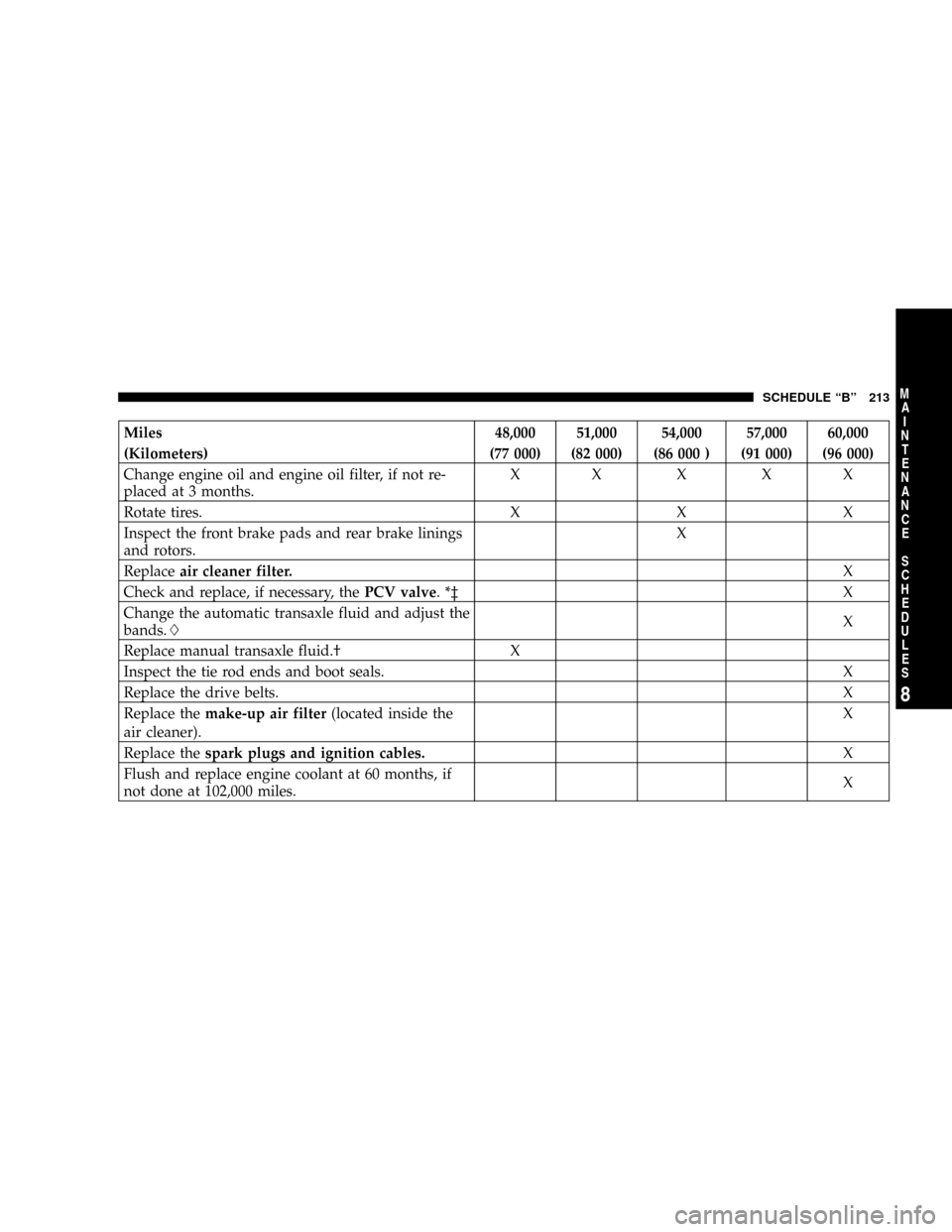
Miles 48,000 51,000 54,000 57,000 60,000
(Kilometers) (77 000) (82 000) (86 000 ) (91 000) (96 000)
Change engine oil and engine oil filter, if not re-
placed at 3 months.XX X XX
Rotate tires. X X X
Inspect the front brake pads and rear brake linings
and rotors.X
Replaceair cleaner filter.X
Check and replace, if necessary, thePCV valve.*³ X
Change the automatic transaxle fluid and adjust the
bands.LX
Replace manual transaxle fluid.² X
Inspect the tie rod ends and boot seals. X
Replace the drive belts.X
Replace themake-up air filter(located inside the
air cleaner).X
Replace thespark plugs and ignition cables.X
Flush and replace engine coolant at 60 months, if
not done at 102,000 miles.X
SCHEDULE ªBº 213
8
M
A
I
N
T
E
N
A
N
C
E
S
C
H
E
D
U
L
E
S
Page 215 of 246
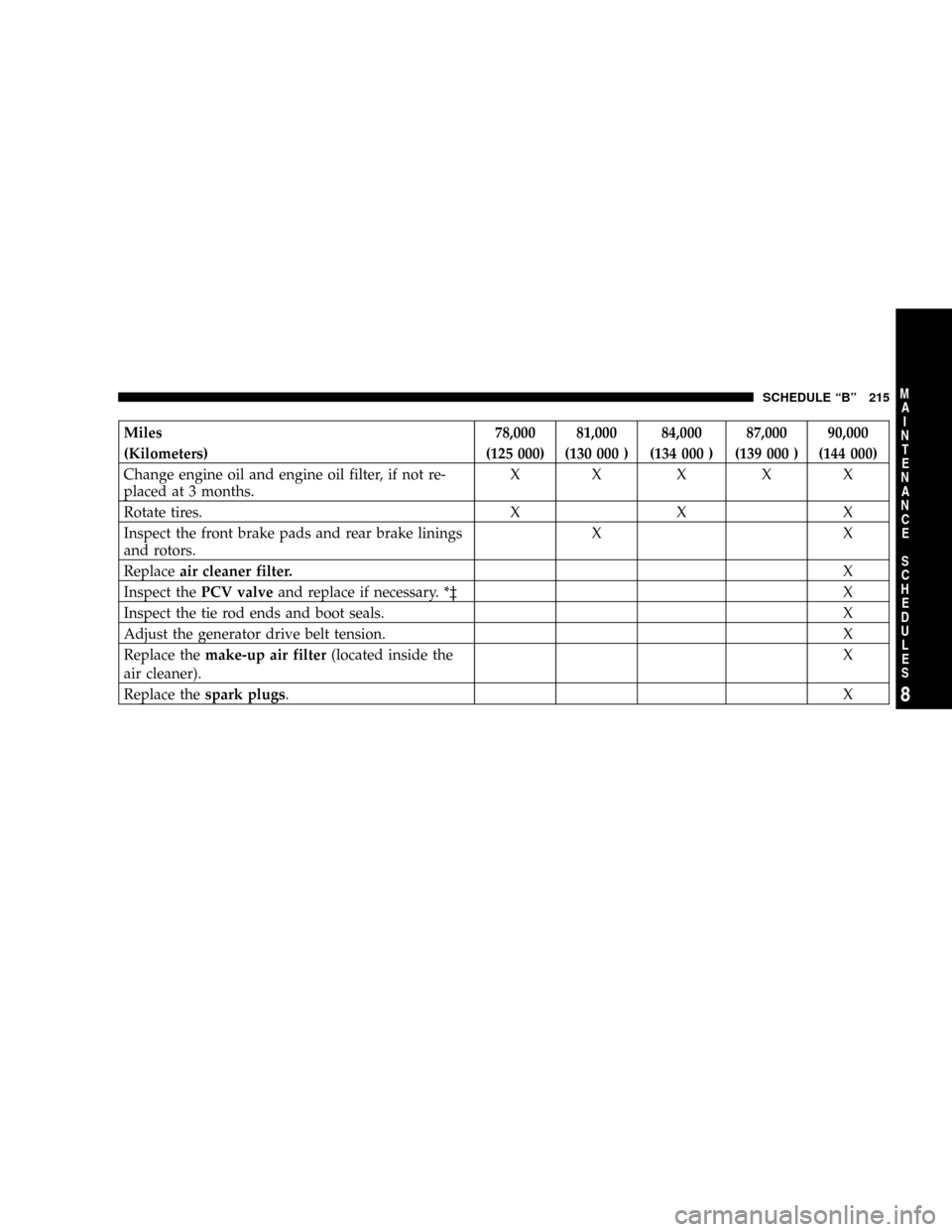
Miles 78,000 81,000 84,000 87,000 90,000
(Kilometers) (125 000) (130 000 ) (134 000 ) (139 000 ) (144 000)
Change engine oil and engine oil filter, if not re-
placed at 3 months.XX X XX
Rotate tires. X X X
Inspect the front brake pads and rear brake linings
and rotors.XX
Replaceair cleaner filter.X
Inspect thePCV valveand replace if necessary. *³ X
Inspect the tie rod ends and boot seals. X
Adjust the generator drive belt tension. X
Replace themake-up air filter(located inside the
air cleaner).X
Replace thespark plugs.X
SCHEDULE ªBº 215
8
M
A
I
N
T
E
N
A
N
C
E
S
C
H
E
D
U
L
E
S