engine DODGE NEON SRT 2004 2.G Workshop Manual
[x] Cancel search | Manufacturer: DODGE, Model Year: 2004, Model line: NEON SRT, Model: DODGE NEON SRT 2004 2.GPages: 200, PDF Size: 3.23 MB
Page 147 of 200
Windshield Washer Reservoir
The washer fluid reservoir is located in the engine
compartment and should be checked for fluid level at
regular intervals. Fill the reservoir with windshield
washer solvent (not radiator antifreeze)
Exhaust System
The best protection against carbon monoxide entry into
the vehicle body is a properly maintained engine exhaust
system.
If you notice a change in the sound of the exhaust system;
or if exhaust fumes can be detected inside the vehicle; or
when the underside or rear of the vehicle is damaged;
have a competent mechanic inspect the complete exhaust
system and adjacent body areas of broken, damaged,
deteriorated, or mispositioned parts. Open seams or
loose connections could permit exhaust fumes to seep
into the passenger compartment. In addition, inspect the
exhaust system each time the vehicle is raised for lubri-
cation or oil change. Replace as required.
WARNING!
Exhaust gases can injure or kill. They contain carbon
monoxide which is colorless and odorless. Breathing
it can make you unconscious and can eventually
poison you. Follow the above precautions to keep
your exhaust system as safe as possible.
MAINTAINING YOUR VEHICLE 147
7
Page 148 of 200
Cooling System
WARNING!
²When working near the radiator cooling fan, dis-
connect the fan motor lead or turn the ignition key
to the OFF position. The fan is temperature con-
trolled and can start at any time the ignition key is
in the ON position.
²You or others can be badly burned by hot coolant
or steam from your radiator. If you see or hear
steam coming from under the hood, don't open
the hood until the radiator has had time to cool.
Never try to open a cooling system pressure cap
when the radiator is hot.
Coolant Checks
Check coolant protection every 12 months (before the
onset of freezing weather, where applicable). If coolant is
dirty or rusty in appearance, the system should be
drained, flushed and refilled with fresh coolant.Check the front of the radiator for an accumulation of
bugs, leaves, etc. Clean the radiator by gently spraying
water from a garden hose at the back of the core.
Check the recovery bottle tank tubing for condition and
tightness of connection at the bottle and radiator. Inspect
the entire system for leaks.
With the engine at normal operating temperature (but
not running), check the cooling system pressure cap for
proper vacuum sealing by draining a small amount of
coolant from the radiator drain cock. If the cap is sealing
properly, the coolant will begin to drain from the reserve
tank. Do not remove the cap when the cooling system is
hot.
Cooling System Ð Drain, Flush and Refill
At the intervals shown on the Maintenance Schedules,
the system should be drained, flushed and refilled.
If the solution is dirty and contains a considerable
amount of sediment, clean and flush with a reliable
cooling system cleaner. Follow with a thorough rinsing to
remove all deposits and chemicals. Discard oil antifreeze
solution.
148 MAINTAINING YOUR VEHICLE
Page 149 of 200
Engine Coolant Disposal
Used ethylene glycol based engine coolant is a regulated
substance requiring proper disposal. Check with your
local authorities to determine the disposal rules for your
community. Do not store ethylene glycol based engine
coolant in open containers or allow it to remain in
puddles on the ground. Prevent ingestion by animals or
children. If ingested by a child, contact a physician
immediately.
Selection Of Coolant
Use only the manufacturers recommended coolant, refer
to Recommended Fluids, Lubricants and Genuine Parts
for correct coolant type.
CAUTION!
Mixing of coolants other than specified (non-
HOAT), may result in engine damage that may not
be covered under the new vehicle warranty, and
decreased corrosion protection. If a non-HOAT cool-
ant is introduced into the cooling system in an
emergency, it should be replaced with the specified
coolant as soon as possible.
Do not use plain water alone or alcohol base anti-
freeze products. Do not use additional rust inhibi-
tors or antirust products, as they may not be compat-
ible with the radiator coolant and may plug the
radiator.
This vehicle has not been designed for use with
Propylene Glycol based coolants. Use of Propylene
Glycol based coolants is not recommended.
MAINTAINING YOUR VEHICLE 149
7
Page 150 of 200
Adding Coolant
When adding coolant, a minimum solution of 50% eth-
ylene glycol antifreeze coolant in water should be used.
Use higher concentrations (not to exceed 70%) if tempera-
tures below ±34ÉF (-37ÉC) are anticipated.
Use only high purity water such as distilled or deionized
water when mixing the water/antifreeze solution. The
use of lower quality water will reduce the amount of
corrosion protection in the engine cooling system.
Please note that it is the owner's responsibility to main-
tain the proper level of protection against freezing ac-
cording to the temperatures occurring in the area where
the vehicle is operated.
NOTE:Mixing coolant types will decrease the life of the
engine coolant and will require more frequent coolant
changes.
Cooling System Pressure Cap
The cap must be fully tightened to prevent loss of
coolant, and to insure that coolant will return to the
radiator from the coolant reserve tank.The cap should be inspected and cleaned if there is any
accumulation of foreign material on the sealing surfaces.
WARNING!
The warning words ªDO NOT OPEN HOTº on the
cooling system pressure cap are a safety precaution.
Never add coolant when the engine is overheated.
Do not loosen or remove the cap to cool an over-
heated engine. Heat causes pressure to build up in
the cooling system. To prevent scalding or injury, do
not remove the pressure cap while the system is hot
or under pressure.
Coolant Level
The coolant bottle provides a quick visual method for
determining that the coolant level is adequate. With the
engine idling, and warm to normal operating tempera-
ture, the level of the coolant in the bottle should be
between the ªFULLº and ªADDº marks.
150 MAINTAINING YOUR VEHICLE
Page 151 of 200

The radiator normally remains completely full, so there is
no need to remove the radiator cap unless checking for
coolant freeze point or replacing coolant. Advise your
service attendant of this. As long as the engine operating
temperature is satisfactory, the coolant bottle need only
be checked once a month.
When additional coolant is needed to maintain the
proper level, it should be added to the coolant bottle. Do
not overfill.Points to Remember
NOTE:
When the vehicle is stopped after a few miles of
operation, you may observe vapor coming from the front
of the engine compartment. This is normally a result of
moisture from rain, snow, or high humidity accumula-
tion on the radiator and being vaporized when the
thermostat opens, allowing hot water to enter the radia-
tor.
If an examination of your engine compartment shows no
evidence of radiator or hose leaks, the vehicle may be
safely driven. The vapor will soon dissipate.
A. Do not overfill the coolant bottle.
B. Check coolant freeze point in the system.
C. If frequent coolant additions are required, the cooling
system should be pressure tested for leaks.
D. Maintain coolant concentration at 50% ethylene glycol
antifreeze (minimum) in water for proper corrosion pro-
tection of your engine which contains aluminum compo-
nents.
MAINTAINING YOUR VEHICLE 151
7
Page 153 of 200
Brake System
In order to assure brake system performance, all brake
system components should be inspected periodically.
Suggested service intervals can be found in the Mainte-
nance Section.
WARNING!
Riding the brakes can lead to brake failure and
possibly an accident. Driving with your foot resting
or riding on the brake pedal can result in abnormally
high brake temperatures, excessive lining wear, and
possible brake damage. You wouldn't have your full
braking capacity in an emergency.
Brake and Power Steering System Hoses
When servicing the vehicle for scheduled maintenance,
inspect surface of hoses and nylon tubing for evidence of
heat and mechanical damage. Hard and brittle rubber,
cracking, checking, tears, cuts, abrasions, and excessive
swelling suggest deterioration of the rubber. Particularattention should be made to examining those hose sur-
faces nearest to high heat sources, such as the exhaust
manifold.
Inspect all hose clamps and couplings to make sure they
are secure and no leaks are present.
Insure nylon tubing in these areas has not melted or
collapsed.
NOTE:Often, fluids such as oil, power steering fluid,
and brake fluid are used during assembly plant opera-
tions to ease the assembly of hoses to couplings. There-
fore, oil wetness at the hose-coupling area is not neces-
sarily an indication of leakage. Actual dripping of hot
fluid when systems are under pressure (during vehicle
operation) should be noted before hose is replaced based
on leakage.
NOTE:Inspection of brake hoses should be done
whenever the brake system is serviced and every engine
oil change.
MAINTAINING YOUR VEHICLE 153
7
Page 155 of 200
WARNING!
Overfilling the brake fluid reservoir can result in
spilling brake fluid on hot engine parts and the
brake fluid catching fire.
Use only brake fluid that has been in a tightly closed
container to avoid contamination from foreign matter.
Do not allow petroleum based fluid to contaminate the
brake fluid as seal damage will result!
Manual Transaxle
Lubricant Selection
Use only manufacturers recommended transmission
fluid, refer to Recommended Fluids, Lubricants and
Genuine Parts for correct fluid type.
Fluid Level Check
Check the fluid level by removing the fill plug. The fluid
level should be between the bottom of the fill hole and a
point not more that 3/16º (4.76 mm) below the bottom of
the hole.Add fluid, if necessary, to maintain the proper level.
Frequency of Fluid Change
Under normal operating conditions, the fluid installed at
the factory will give satisfactory lubrication for the life of
the vehicle. Fluid changes are not necessary unless the
following conditions exist:
²The lubricant has become contaminated with water. If
contaminated with water, the fluid should be changed
immediately.
²If severe usage has occurred, refer to Maintenance
Schedule ªBº in Section 8 of this manual.
Appearance Care and Protection from Corrosion
Protection of Body and Paint from Corrosion
Vehicle body car requirements vary according to geo-
graphic locations and usage. Chemicals that make roads
passable in snow and ice, and those that are sprayed on
trees and road surfaces during other seasons, are highly
corrosive to the metal in you vehicle. Outside parking,
which exposes your vehicle to airborne contaminants,
road surfaces on which the vehicle is operated, extreme
MAINTAINING YOUR VEHICLE 155
7
Page 160 of 200

Seat Belt Maintenance
Do not bleach, dye or clean the belts with chemical
solvents or abrasive cleaners. This will weaken the fabric.
Sun damage will also weaken the fabric.
If the belts need cleaning, use a mild soap solution or
lukewarm water. Do not remove the belts from the
vehicle to wash them.
Replace the belts if they appear frayed or worn or if the
buckles do not work properly.
FUSES
Underhood Fuses (Power Distribution Center)
A Power Distribution Center is located in the engine
compartment; next to the battery. A label identifying the
components and circuits is located on the underside of
the cover.
160 MAINTAINING YOUR VEHICLE
Page 165 of 200
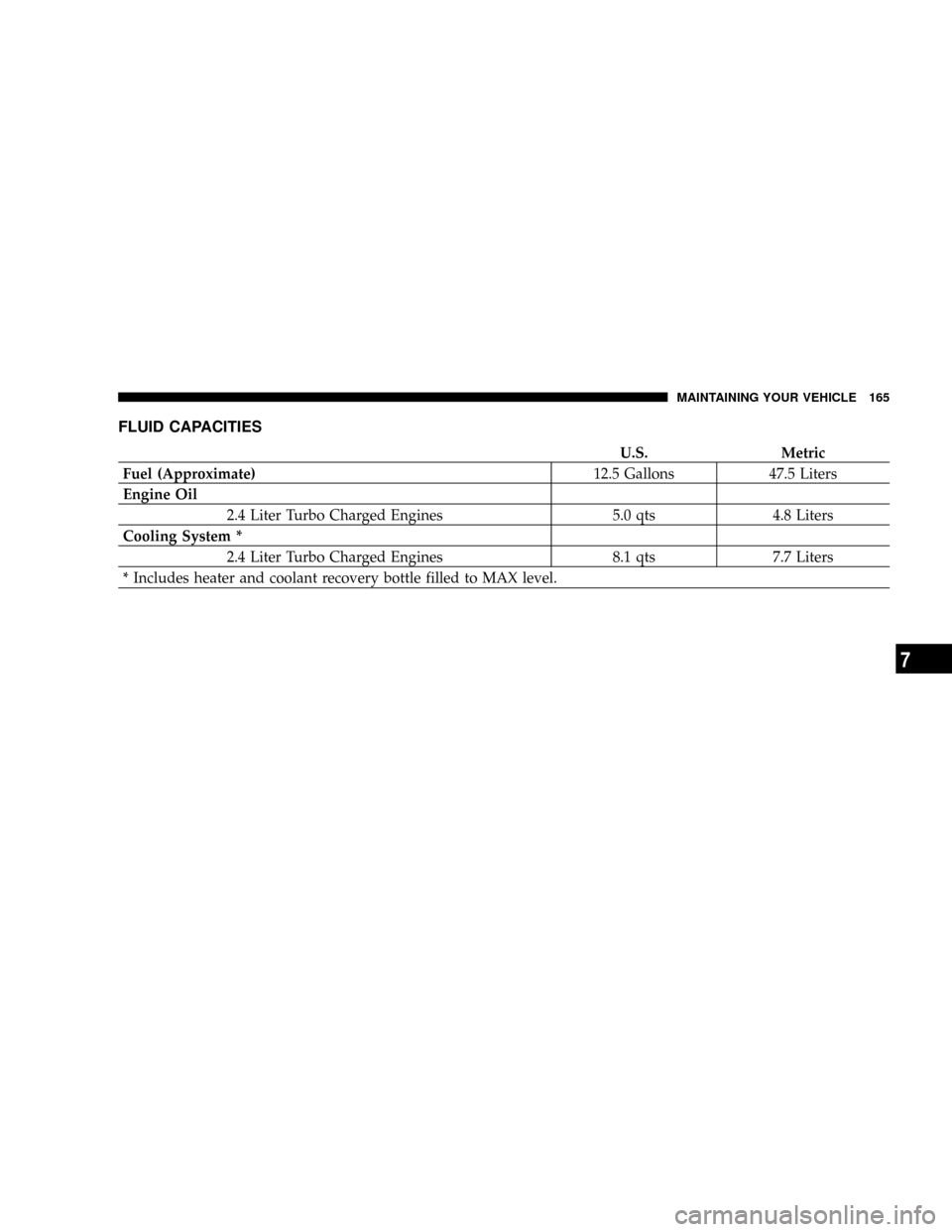
FLUID CAPACITIES
U.S. Metric
Fuel (Approximate)12.5 Gallons 47.5 Liters
Engine Oil
2.4 Liter Turbo Charged Engines 5.0 qts 4.8 Liters
Cooling System *
2.4 Liter Turbo Charged Engines 8.1 qts 7.7 Liters
* Includes heater and coolant recovery bottle filled to MAX level.
MAINTAINING YOUR VEHICLE 165
7
Page 166 of 200
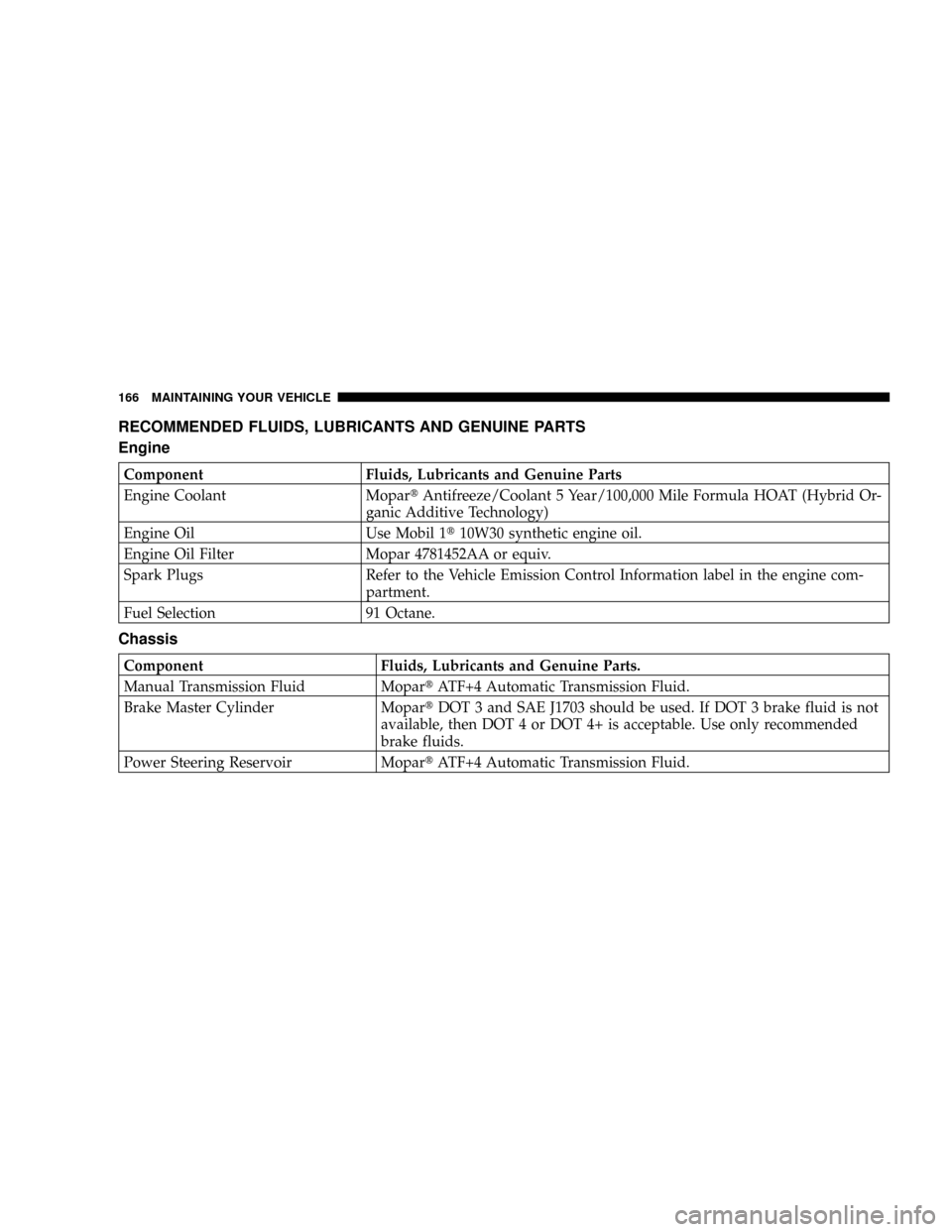
RECOMMENDED FLUIDS, LUBRICANTS AND GENUINE PARTS
Engine
Component Fluids, Lubricants and Genuine Parts
Engine Coolant MopartAntifreeze/Coolant 5 Year/100,000 Mile Formula HOAT (Hybrid Or-
ganic Additive Technology)
Engine Oil Use Mobil 1t10W30 synthetic engine oil.
Engine Oil Filter Mopar 4781452AA or equiv.
Spark Plugs Refer to the Vehicle Emission Control Information label in the engine com-
partment.
Fuel Selection 91 Octane.
Chassis
Component Fluids, Lubricants and Genuine Parts.
Manual Transmission Fluid MopartATF+4 Automatic Transmission Fluid.
Brake Master Cylinder MopartDOT 3 and SAE J1703 should be used. If DOT 3 brake fluid is not
available, then DOT 4 or DOT 4+ is acceptable. Use only recommended
brake fluids.
Power Steering Reservoir MopartATF+4 Automatic Transmission Fluid.
166 MAINTAINING YOUR VEHICLE