airbag DODGE NEON SRT 2005 2.G User Guide
[x] Cancel search | Manufacturer: DODGE, Model Year: 2005, Model line: NEON SRT, Model: DODGE NEON SRT 2005 2.GPages: 216, PDF Size: 7.18 MB
Page 38 of 216

Airbag Light
You will want to have the airbags ready to inflate for your
protection in an impact. While the airbag system is
designed to be maintenance free, if any of the following
occurs, have an authorized dealer service the system
immediately:
•The AIRBAG light does not come on or flickers during
the 6 to 8 seconds when the ignition switch is first
turned on.
•The light remains on or flickers after the 6 to 8 second
interval.
•The light flickers or comes on and remains on while
driving.
Child Restraint
Everyone in your vehicle needs to be buckled up at all
times—babies and children, too. Every state in the
United States and all Canadian provinces require that
small children ride in proper restraint systems. This is the
law, and you can be prosecuted for ignoring it.Children 12 years and under should ride properly buck-
led up in a rear seat, if available. According to crash
statistics, children are safer when properly restrained in
the rear seats, rather than in the front.
WARNING!
In a collision, an unrestrained child, even a tiny
baby, can become a missile inside the vehicle. The
force required to hold even an infant on your lap
could become so great that you could not hold the
child, no matter how strong you are. The child and
others could be badly injured. Any child riding in
your vehicle should be in a proper restraint for the
child’s size.
Infants And Small Children
There are different sizes and types of restraints for
children from newborn size to the child almost large
enough for an adult safety belt. Always check the child
seat Owner’s Manual to ensure you have the right seat
for your child. Use the restraint that is correct for your
child:
38 THINGS TO KNOW BEFORE STARTING YOUR VEHICLE
Page 39 of 216

•Safety experts recommend that children ride
rearward-facing in the vehicle until they are at least
one year oldandweigh at least 20 lbs (9 kg). Two types
of child restraints can be used rearward-facing: infant
carriers and“convertible”child seats. Both types of
child restraints are held in the vehicle by the lap/
shoulder belt or the LATCH child restraint anchorage
system.
•The infant carrier is only used rearward-facing in the
vehicle. It is recommended for children who weigh up
to about 20 lbs (9 kg).“Convertible”child seats can be
used either rearward-facing or forward-facing in the
vehicle. Convertible child seats often have a higher
weight limit in the rearward-facing direction than
infant carriers do, so they can be used rearward-facing
by children who weigh more than 20 lbs (9 kg) but are
less than one year old.
•Rearward-facing child seats mustNEVERbe used in
the front seat of a vehicle with the front passenger
airbag. An airbag deployment could cause severe
injury or death to infants in this position.
•Children who weigh more than 20 lbs (9 kg) and who
are older than one year can ride forward-facing in the
vehicle. Forward-facing child seats and convertible
child seats used in the forward-facing direction are for
children who weigh 20 to 40 lbs (9 to 18 kg) and who
are older than one year. These child seats are also held
in the vehicle by the lap/shoulder belt or the LATCH
child restraint anchorage system.
•The belt-positioning booster seat is for children weigh-
ing more than 40 lbs (18 kg), but who are still too small
to fit the vehicle’s seat belts properly. If the child
cannot sit with knees bent over the vehicle’s seat
cushion while the child’s back is against the seat back;
they should use a Belt Positioning Booster Seat. The
child and booster seat are held in the vehicle by the
lap/shoulder belt. (Some booster seats are equipped
with a front shield and are held in the vehicle by the
lap portion).
NOTE:For additional information refer to
www.seatcheck.org.
THINGS TO KNOW BEFORE STARTING YOUR VEHICLE 39
2
Page 40 of 216
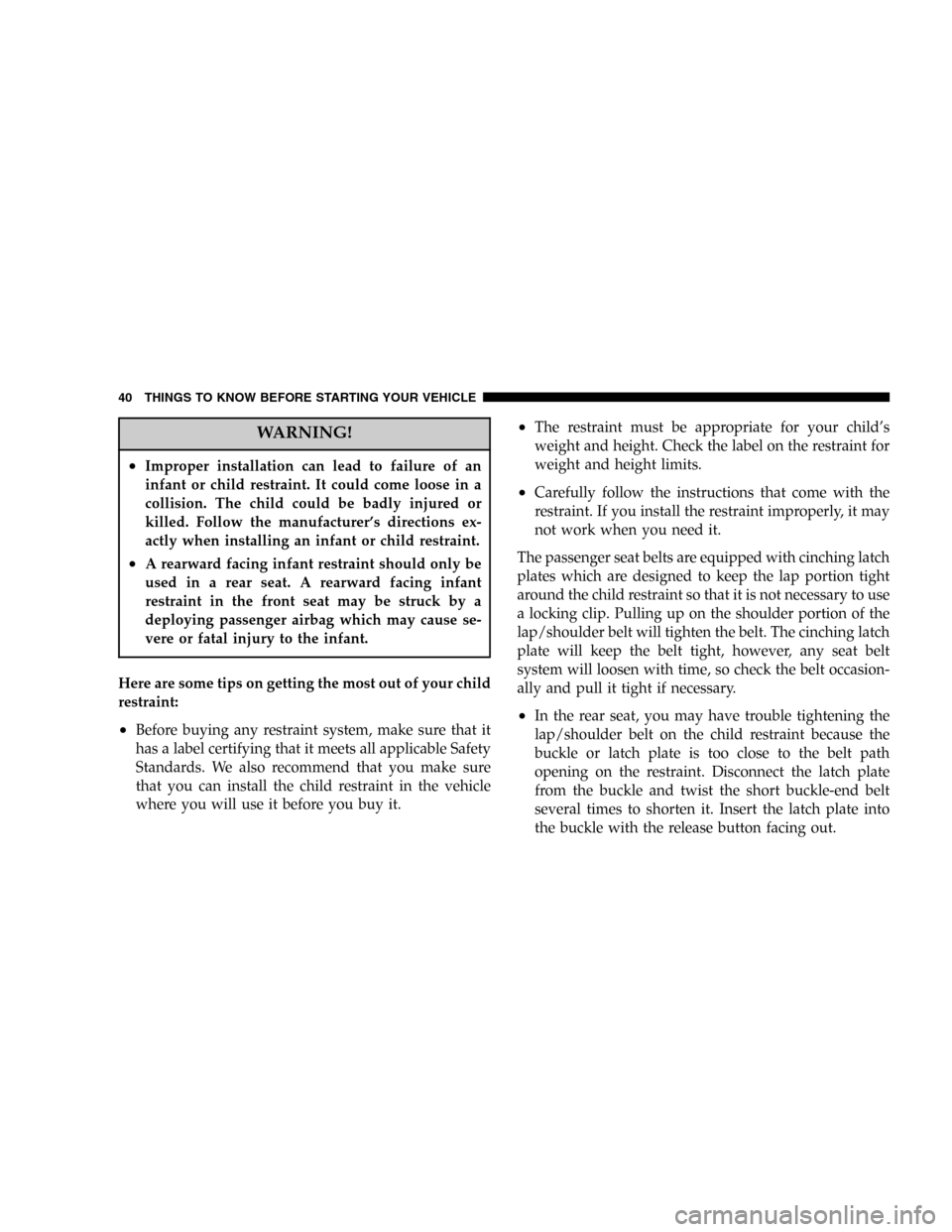
WARNING!
•Improper installation can lead to failure of an
infant or child restraint. It could come loose in a
collision. The child could be badly injured or
killed. Follow the manufacturer’s directions ex-
actly when installing an infant or child restraint.
•A rearward facing infant restraint should only be
used in a rear seat. A rearward facing infant
restraint in the front seat may be struck by a
deploying passenger airbag which may cause se-
vere or fatal injury to the infant.
Here are some tips on getting the most out of your child
restraint:
•Before buying any restraint system, make sure that it
has a label certifying that it meets all applicable Safety
Standards. We also recommend that you make sure
that you can install the child restraint in the vehicle
where you will use it before you buy it.
•The restraint must be appropriate for your child’s
weight and height. Check the label on the restraint for
weight and height limits.
•Carefully follow the instructions that come with the
restraint. If you install the restraint improperly, it may
not work when you need it.
The passenger seat belts are equipped with cinching latch
plates which are designed to keep the lap portion tight
around the child restraint so that it is not necessary to use
a locking clip. Pulling up on the shoulder portion of the
lap/shoulder belt will tighten the belt. The cinching latch
plate will keep the belt tight, however, any seat belt
system will loosen with time, so check the belt occasion-
ally and pull it tight if necessary.
•In the rear seat, you may have trouble tightening the
lap/shoulder belt on the child restraint because the
buckle or latch plate is too close to the belt path
opening on the restraint. Disconnect the latch plate
from the buckle and twist the short buckle-end belt
several times to shorten it. Insert the latch plate into
the buckle with the release button facing out.
40 THINGS TO KNOW BEFORE STARTING YOUR VEHICLE
Page 44 of 216

Not all child restraint systems will be installed as we
have described here. Again, carefully follow the instruc-
tions that come with the child restraint system.
WARNING!
Improper installation of a child restraint to the
LATCH anchorages can lead to failure of an infant or
child restraint. The child could be badly injured or
killed. Follow the manufacturer’s directions exactly
when installing an infant or child restraint.
NOTE:If your child restraint seat is not LATCH
compatible, install the restraint using the vehicle seat
belts.
Children Too Large For Booster Seats
Children who are large enough to wear the shoulder belt
comfortably, and whose legs are long enough to bend
over the front of the seat when their back is against the
seat back, should use the lap/shoulder belt in a rear seat.
•Make sure that the child is upright in the seat.
•The lap portion should be low on the hips and as snug
as possible.
•Check belt fit periodically. A child’s squirming or
slouching can move the belt out of position.
•If the shoulder belt contacts the face or neck, move the
child closer to the center of the vehicle. Never allow a
child to put the shoulder belt under an arm or behind
their back.
Transporting Pets
Airbags deploying in the front seat could harm your pet.
An unrestrained pet will be thrown about and possibly
injured, or injure a passenger during panic braking or in
a collision.
Pets should be restrained in the rear seat in pet harnesses
or pet carriers that are secured by seat belts.
44 THINGS TO KNOW BEFORE STARTING YOUR VEHICLE
Page 46 of 216

Safety Checks You Should Make Inside The
Vehicle
Seat Belts
Inspect the belt system periodically, checking for cuts,
frays and loose parts. Damaged parts must be replaced
immediately. Do not disassemble or modify the system.
Front seat belt assemblies must be replaced after a
collision. Rear seat belt assemblies must be replaced after
a collision if they have been damaged (bent retractor, torn
webbing, etc.). If there is any question regarding belt or
retractor condition, replace the belt.
Airbag Light
The light should come on and remain on for 6 to
8 seconds as a bulb check when the ignition
switch is first turned to ON/RUN. If the bulb is
not lit during starting, have it replaced. If the light stays
on or comes on while driving, have the system checked
by an authorized dealer.
Defrosters
Check operation by selecting the defrost mode and place
the blower control on high speed. You should be able to
feel the air directed against the windshield.
Periodic Safety Checks You Should Make Outside
The Vehicle
Tires
Examine tires for excessive tread wear or uneven wear
patterns. Check for stones, nails, glass, or other objects
lodged in the tread. Inspect for tread cuts or sidewall
cracks. Check wheel nuts for tightness, and tires (includ-
ing spare) for proper pressure.
Lights
Have someone observe the operation of exterior lights
while you work the controls. Check turn signal and high
beam indicator lights on the instrument panel.
Fluid Leaks
Check area under vehicle after overnight parking for fuel,
water, oil, or other fluid leaks. Also, if gasoline fumes are
present, the cause should be corrected immediately.
46 THINGS TO KNOW BEFORE STARTING YOUR VEHICLE
Page 71 of 216

The light does not show the quantity of oil in the engine.
This can be determined using the procedure shown in
Section 7.
9. Seat Belt Reminder Light
When the ignition key is first turned on, this
light will come on for about six seconds. A
chime will sound if you have not pulled the
shoulder belt out of the retractor. This is a reminder to
“buckle up”. If you do not buckle up, the light will
remain on.
10. Charging System Light
This light shows the status of the electrical
charging system. The light should come on
briefly when the ignition is first turned on and remain
on briefly as a bulb check. If the light stays on or
comes on while driving, it means that there is a
problem with the charging system. Obtain SERVICE
IMMEDIATELY.
11. Airbag Light
The light comes on and remains on for 6 to 8
seconds as a bulb check when the ignition
switch is first turned ON. If the light does notcome on during starting, stays on, or comes on while
driving, have the system checked by an authorized
dealer.
12. Theft Alarm Light
This light will flash rapidly for several seconds when the
alarm system is arming. The light will begin to flash
slowly indicating that the system is armed.
13. Fuel Door Reminder
This symbol is a reminder that the Fuel Filler Door is
located on the passenger’s side of the vehicle
14. Fuel Gauge
When the ignition key is in the ON position, the
pointer will show the level of fuel remaining in
the fuel tank.
15. Low Fuel Light
When the fuel level drops to about 1/8 tank, the
fuel symbol will light and a single chime will
sound. The light will remain on until fuel is
added. If the fuel level drops to about 1/2 gallon, the
fuel symbol will begin to flash and the chime will
sound several times.
UNDERSTANDING YOUR INSTRUMENT PANEL 71
4
Page 172 of 216
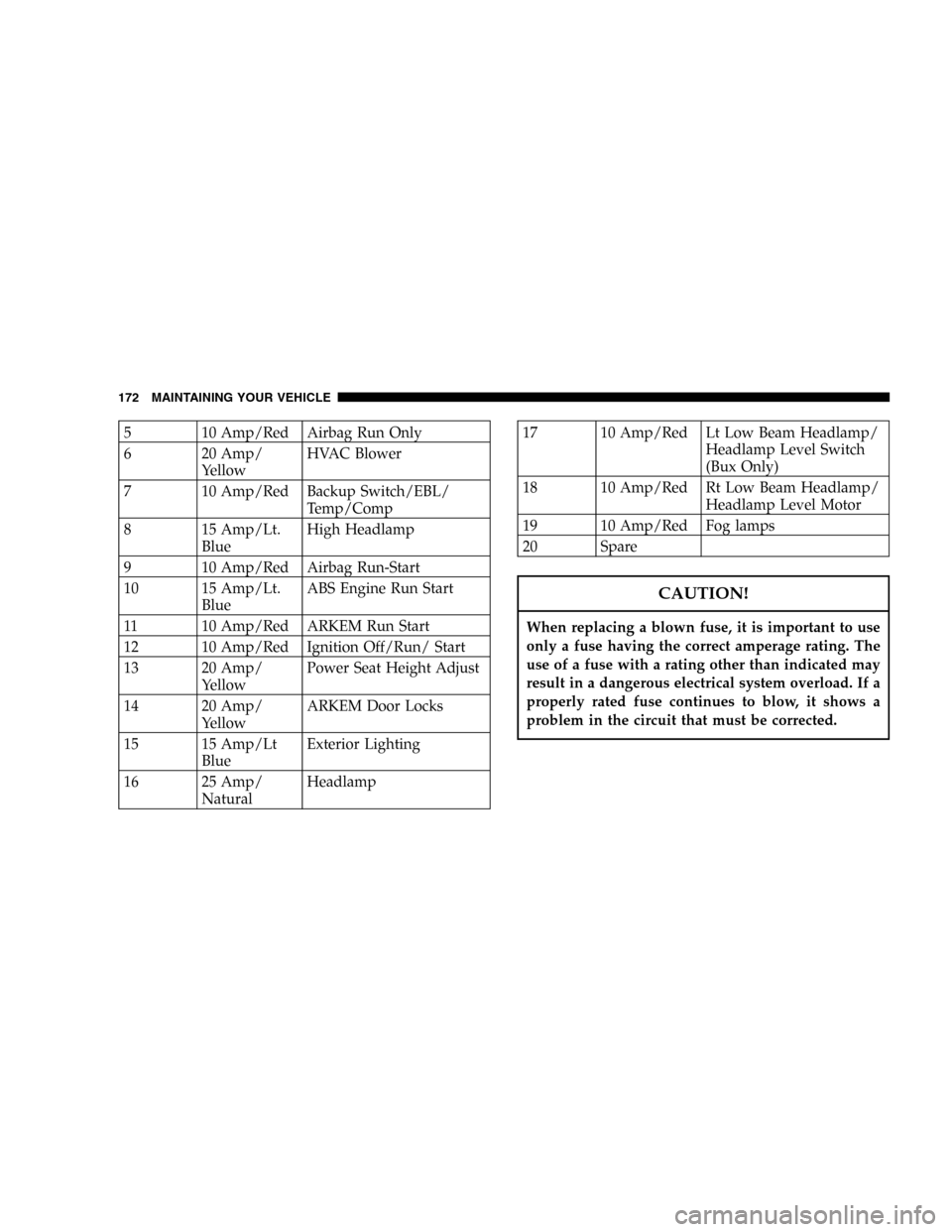
5 10 Amp/Red Airbag Run Only
6 20 Amp/
YellowHVAC Blower
7 10 Amp/Red Backup Switch/EBL/
Temp/Comp
8 15 Amp/Lt.
BlueHigh Headlamp
9 10 Amp/Red Airbag Run-Start
10 15 Amp/Lt.
BlueABS Engine Run Start
11 10 Amp/Red ARKEM Run Start
12 10 Amp/Red Ignition Off/Run/ Start
13 20 Amp/
YellowPower Seat Height Adjust
14 20 Amp/
YellowARKEM Door Locks
15 15 Amp/Lt
BlueExterior Lighting
16 25 Amp/
NaturalHeadlamp17 10 Amp/Red Lt Low Beam Headlamp/
Headlamp Level Switch
(Bux Only)
18 10 Amp/Red Rt Low Beam Headlamp/
Headlamp Level Motor
19 10 Amp/Red Fog lamps
20 Spare
CAUTION!
When replacing a blown fuse, it is important to use
only a fuse having the correct amperage rating. The
use of a fuse with a rating other than indicated may
result in a dangerous electrical system overload. If a
properly rated fuse continues to blow, it shows a
problem in the circuit that must be corrected.
172 MAINTAINING YOUR VEHICLE
Page 173 of 216

VEHICLE STORAGE
If you will not be using your vehicle for more than 21
days you may want to take steps to preserve your battery.
You may:
•Disengage the mini fuse in the Power Distribution
Center labeled IOD (Ignition Off-Draw).
•Or, disconnect the negative cable from the battery.
REPLACEMENT BULBS
LIGHT BULBS—Inside Bulb No.
ABS Indicator.......................... LED
Airbag Indicator........................ LED
Brake System Warning Indicator............. LED
Climate Controls........................ LED
Console Gear Selector...................PC194
Dome Light............................T579
Glove Box............................PC194
Front Fog Indicator...................... LED
High Beam Indicator....................PC194
Instrument Cluster Illumination............PC194
Low Fuel Indicator....................... LEDLow Oil Pressure Indicator................. LED
Rear Cargo............................T906
Seat Belt Indicator....................... LED
Security Alarm Indicator................... LED
Malfunction Indicator Light................ LED
TRAC OFF Indicator..................... LED
Turn Signal Indicator....................PC194
Voltage Indicator........................ LED
All the inside bulbs are brass or glass wedge base.
Aluminum base bulbs are not approved and should not
be used for replacement.
LIGHTS BULBS—Outside Bulb No.
Headlight.............................9007
Front Park/Turn Signal Light.............3457AK
Front Side Marker Light.................... 168
Front Fog Light......................9145/H10
Center High Mounted Stop Light
(CHMSL).........................921–W16W
Rear Tail/Stop/Turn Signal Light......3157–P27/7W
Backup Light......................921–W16W
License Light........................... 168
MAINTAINING YOUR VEHICLE 173
7
Page 204 of 216

ABS (Anti-Lock Brake) System............. 102
Adding Engine Coolant (Antifreeze)......... 159
Adding Fuel.......................... 124
Air Cleaner, Engine (Engine Air Cleaner Filter) . 151
Air Conditioner Maintenance.............. 153
Air Conditioning........................ 84
Air Conditioning Controls................. 84
Air Conditioning Refrigerant...........153,154
Air Conditioning System................. 153
Air Pressure, Tires...................... 113
Airbag................................ 30
Airbag Deployment...................... 35
Airbag Light.......................38,46,71
Airbag Maintenance...................... 37
Airbag, Side........................... 36
Alarm, Panic........................... 19
Alarm System........................21,71
Alignment and Balance.................. 118
Alterations/Modifications, Vehicle............ 6
Antenna, Satellite Radio................... 83
Antifreeze (Engine Coolant).........158,176,177
Capacities........................... 176
Anti-Lock Brake System (ABS)............. 102Anti-Lock Warning Light.................. 69
Anti-Theft Security Alarm................. 21
Appearance Care....................... 165
Arming Theft System..................... 21
Ashtrays and Lighter..................... 63
Automatic Door Locks.................... 15
Ball Joints............................ 154
Battery............................... 152
Keyless Transmitter Replacement.......... 20
Belts, Drive........................... 149
Belts, Engine.......................... 150
Body Mechanism Lubrication.............. 155
B-Pillar Location....................... 108
Brake Fluid........................... 177
Brake, Parking......................... 100
Brake System.......................102,162
Anti-Lock........................... 102
Hoses.............................. 162
Master Cylinder...................... 163
Parking............................ 100
Warning Light........................ 69
Brakes............................102,162
204 INDEX
Page 206 of 216

Cup Holder............................ 62
Customer Assistance.................... 196
Daytime Running Lights.................. 57
Dealer Service......................... 144
Defroster, Rear Window................... 90
Defroster, Windshield..................46,86
Deploying, Airbag....................... 35
Diagnostic System, Onboard............... 142
Dimmer Control........................ 55
Dimmer Switch, Headlight................. 57
Disarming, Theft System.................. 22
Disposal
Engine Oil.......................... 148
Door Locks............................ 13
Door Locks, Automatic................... 15
Downshifting.......................... 100
Drive Belts............................ 149
Driving
On Slippery Surfaces.................. 136
Electric Remote Mirrors................... 50Emergency, In Case of
Jacking............................. 130
Jump Starting........................ 133
Towing............................. 138
Emergency Trunk Release................. 17
Emission Control System Maintenance....... 180
Engine............................... 141
Break-In Recommendations............... 45
Checking Oil Level.................... 145
Compartment........................ 141
Cooling............................ 157
Exhaust Gas Caution.................. 123
Jump Starting........................ 133
Oil ..........................145,176,177
Oil Change Interval................... 146
Oil Filler Cap........................ 148
Oil Filter............................ 177
Oil Selection......................... 147
Oil Synthetic......................... 148
Overheating......................... 128
Temperature Gauge.................... 73
Timing Belt.......................... 150
Exhaust Gas Caution..................45,123
206 INDEX