tires DODGE NEON SRT 2005 2.G User Guide
[x] Cancel search | Manufacturer: DODGE, Model Year: 2005, Model line: NEON SRT, Model: DODGE NEON SRT 2005 2.GPages: 216, PDF Size: 7.18 MB
Page 116 of 216

CAUTION!
Because of the reduced ground clearance, do not take
your vehicle through an automatic car wash with the
compact spare installed. Damage to the vehicle may
result.
Tire Spinning
When stuck in mud, sand, snow, or ice conditions, do not
spin your vehicle’s wheels above 35 mph (55 km/h).
See the paragraph on Freeing A Stuck Vehicle in Section
6 of this manual.
WARNING!
Fast spinning tires can be dangerous. Forces gener-
ated by excessive wheel speeds may cause tire dam-
age or failure. A tire could explode and injure
someone. Do not spin your vehicle’s wheels faster
than 35 mph (55km/h) when you are stuck. And don’t
let anyone near a spinning wheel, no matter what the
speed.
116 STARTING AND OPERATING
Page 117 of 216

Tread Wear Indicators
Tread wear indicators are in the original equipment tires
to help you in determining when your tires should be
replaced.
These indicators are molded into the bottom of the tread
grooves and will appear as bands when the tread depth
becomes 1/16 inch (2 mm). When the indicators appear
in 2 or more adjacent grooves, the tire should be replaced.
Many states have laws requiring tire replacement at this
point.
Replacement Tires
The tires on your new vehicle provide a balance of many
characteristics. They should be inspected regularly for
wear and correct cold tire inflation pressure. The manu-
facturer strongly recommends that you use tires equiva-
lent to the originals in size, quality and performance
when replacement is needed (see the paragraph on tread
wear indicators). Refer to the Tire and Loading Informa-
tion placard for the size designation of your tire. The
service description and load identification will be found
on the original equipment tire. Failure to use equivalent
replacement tires may adversely affect the safety, han-
dling, and ride of your vehicle. We recommend that you
contact your original equipment or an authorized tire
dealer with any questions you may have on tire specifi-
cations or capability.
STARTING AND OPERATING 117
5
Page 118 of 216

WARNING!
•Do not use a tire, wheel size or rating other than
that specified for your vehicle. Some combina-
tions of unapproved tires and wheels may change
suspension dimensions and performance charac-
teristics, resulting in changes to steering, han-
dling, and braking of your vehicle. This can cause
unpredictable handling and stress to steering and
suspension components. You could lose control
and have an accident resulting in serious injury or
death. Use only the tire and wheel sizes with load
ratings approved for your vehicle.
•Never use a tire with a smaller load index or
capacity, other than what was originally equipped
on your vehicle. Using a tire with a smaller load
index could result in tire overloading and failure.
You could lose control and have an accident.
•Failure to equip your vehicle with tires having
adequate speed capability can result in sudden
tire failure and loss of vehicle control.
CAUTION!
Replacing original tires with tires of a different size
may result in false speedometer and odometer read-
ings.
Alignment And Balance
Poor suspension alignment may result in:
•fast tire wear;
•uneven tire wear, such as feathering and one-sided
wear;
•vehicle pull to right or left.
Tires may also cause the vehicle to pull to the left or right.
Alignment will not correct this condition. See your dealer
for proper diagnosis.
Improper alignment will not cause vehicle vibration.
Vibration may be a result of tire and wheel out-of-
balance. Proper balancing will reduce vibration and
avoid tire cupping and spotty wear.
118 STARTING AND OPERATING
Page 119 of 216

Tire Chains
Due to limited clearance, tire chains are not recom-
mended.
CAUTION!
Damage to the vehicle may result if tire chains are
used.
Snow Tires
Some areas of the country require the use of snow tires
during winter. Some standard tires are of the all season
type and satisfy this requirement as indicated by the M+S
designation on the tire sidewall.
WARNING!
The SRT-4 is equipped with tires that are optimized
for driving in dry and wet weather conditions.
However, these tires have reduced traction capability
in snow and ice. When driving an SRT–4 in these
conditions with these tires, you must take special
care to maintain control and avoid accidents. We
recommend that you equip your vehicle with
“SNOW”or“ALL SEASON”tires on all four wheels
for driving in snowy and icy conditions. It is neces-
sary to select tires equivalent in size and load rating
to the original equipment tires.“SNOW”tires may
have lower speed rating than factory equipped tires
and may not match the maximum vehicle speed. Do
not use tires or wheels other than the size recom-
mended by the manufacturer for this vehicle.
If you need snow tires, select tires equivalent in size and
load rating to the original equipment tires. Refer to the
tire pressure label for inflation pressure.
STARTING AND OPERATING 119
5
Page 120 of 216

Snow tires generally have lower speed ratings than what
was originally equipped with your vehicle and should
not be operated at sustained speeds over 75 mph (120
km/h).
Tire Rotation Recommendations
Tires on the front and rear axles of vehicles operate at
different loads and perform different steering, driving
and braking functions. For these reasons, they wear at
unequal rates, and tend to develop irregular wear pat-
terns.
These effects can be reduced by timely rotation of tires.
The benefits of rotation are especially worthwhile with
aggressive tread designs such as those on all season type
tires. Rotation will increase tread life, help to maintain
mud, snow and wet traction levels, and contribute to a
smooth, quiet ride.
Follow the recommended tire rotation frequency for your
type of driving found in the“Maintenance Schedules”
Section of this manual. More frequent rotation is permis-
sible if desired.Your SRT-4 is equipped with directional tread pattern
tires. These tires are designed to optimize dry handling as
well as wet performance. To obtain the full benefits of
this design, the tires must be installed so that they rotate
in the correct direction. The rotation direction of this type
of tire is indicated by arrows on the side wall of the tire.
The required rotation method for directional tires is to
swap the front tire with the rear on the same side of the
vehicle. Do not cross switch tires without dismounting
the tires and re-mounting them in the correct rotational
direction.
120 STARTING AND OPERATING
Page 136 of 216

WARNING!
Any procedure other than above could result in:
1. Personal injury caused by electrolyte squirting
out the battery vent;
2. Personal injury or property damage due to battery
explosion;
3. Damage to charging system of booster vehicle or
of immobilized vehicle.
DRIVING ON SLIPPERY SURFACES
Acceleration
Rapid acceleration on snow covered, wet, or other slip-
pery surfaces may cause the front wheels to pull errati-
cally to the right or left. This phenomenon occurs when
there is a difference in the surface traction under the front
(driving) wheels, particularly with high output engines.
WARNING!
Rapid acceleration on slippery surfaces is danger-
ous. Unequal traction can cause sudden pulling of
the front wheels. You could lose control of the
vehicle and possibly have an accident. Accelerate
slowly and carefully whenever there is likely to be
poor traction (ice, snow, wet, mud, loose sand, etc.).
Traction
When driving on wet or slushy roads, it is possible for a
wedge of water to build up between the tire and road
surface. This is hydroplaning and may cause partial or
complete loss of vehicle control and stopping ability. To
reduce this possibility, the following precautions should
be observed:
1. Slow down during rainstorms or when roads are
slushy.
2. Slow down if road has standing water or puddles.
3. Replace tires when tread wear indicators first become
visible.
136 WHAT TO DO IN EMERGENCIES
Page 137 of 216

4. Keep tires properly inflated.
5. Maintain enough distance between your vehicle and
the vehicle in front of you to avoid a collision in a sudden
stop.
FREEING A STUCK VEHICLE
If your vehicle becomes stuck in mud, sand or snow, it
can often be moved by a rocking motion. Turn your
steering wheel right and left to clear the area around the
front wheels. Then shift back and forth between Reverse
and First gear. Usually the least accelerator pedal pres-
sure to maintain the rocking motion without spinning the
wheels is most effective.
WARNING!
Fast spinning tires can be dangerous. Forces gener-
ated by excessive wheel speeds may cause tire dam-
age or failure. A tire could explode and injure
someone. Do not spin your vehicle’s wheels faster
than 35 mph (55km/h) when you are stuck. And don’t
let anyone near a spinning wheel, no matter what the
speed.
CAUTION!
Racing the engine or spinning the wheels too fast
may lead to transaxle overheating and failure. It can
also damage the tires. Do not spin the wheels above
35 mph (55km/h).
WHAT TO DO IN EMERGENCIES 137
6
Page 184 of 216
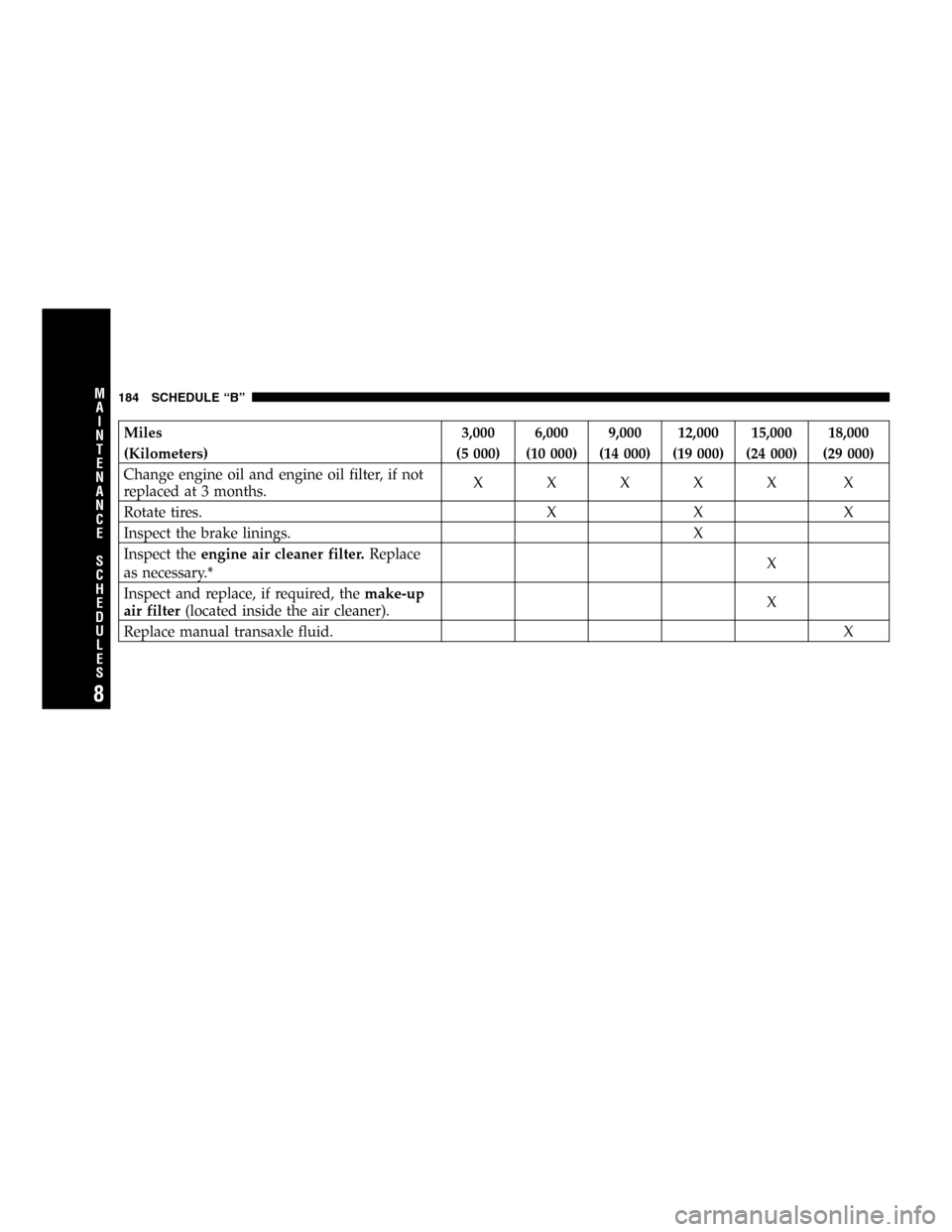
Miles 3,000 6,000 9,000 12,000 15,000 18,000
(Kilometers) (5 000) (10 000) (14 000) (19 000) (24 000) (29 000)
Change engine oil and engine oil filter, if not
replaced at 3 months.XXXXX X
Rotate tires. X X X
Inspect the brake linings. X
Inspect theengine air cleaner filter.Replace
as necessary.*X
Inspect and replace, if required, themake-up
air filter(located inside the air cleaner).X
Replace manual transaxle fluid.X
184 SCHEDULE“B”
8
M
A
I
N
T
E
N
A
N
C
E
S
C
H
E
D
U
L
E
S
Page 185 of 216
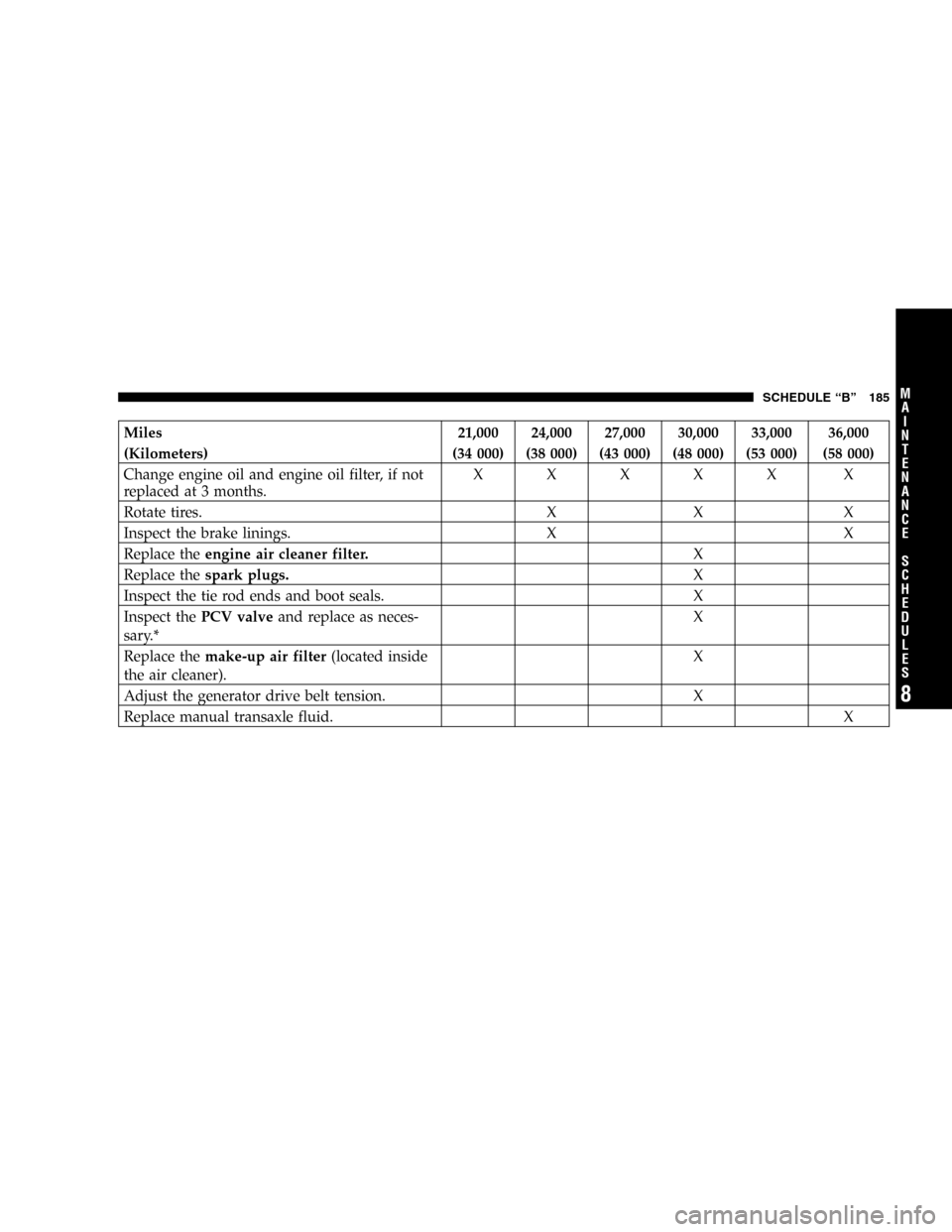
Miles 21,000 24,000 27,000 30,000 33,000 36,000
(Kilometers) (34 000) (38 000) (43 000) (48 000) (53 000) (58 000)
Change engine oil and engine oil filter, if not
replaced at 3 months.XXXXX X
Rotate tires. X X X
Inspect the brake linings. X X
Replace theengine air cleaner filter.X
Replace thespark plugs.X
Inspect the tie rod ends and boot seals. X
Inspect thePCV valveand replace as neces-
sary.*X
Replace themake-up air filter(located inside
the air cleaner).X
Adjust the generator drive belt tension. X
Replace manual transaxle fluid.X
SCHEDULE“B”185
8
M
A
I
N
T
E
N
A
N
C
E
S
C
H
E
D
U
L
E
S
Page 186 of 216
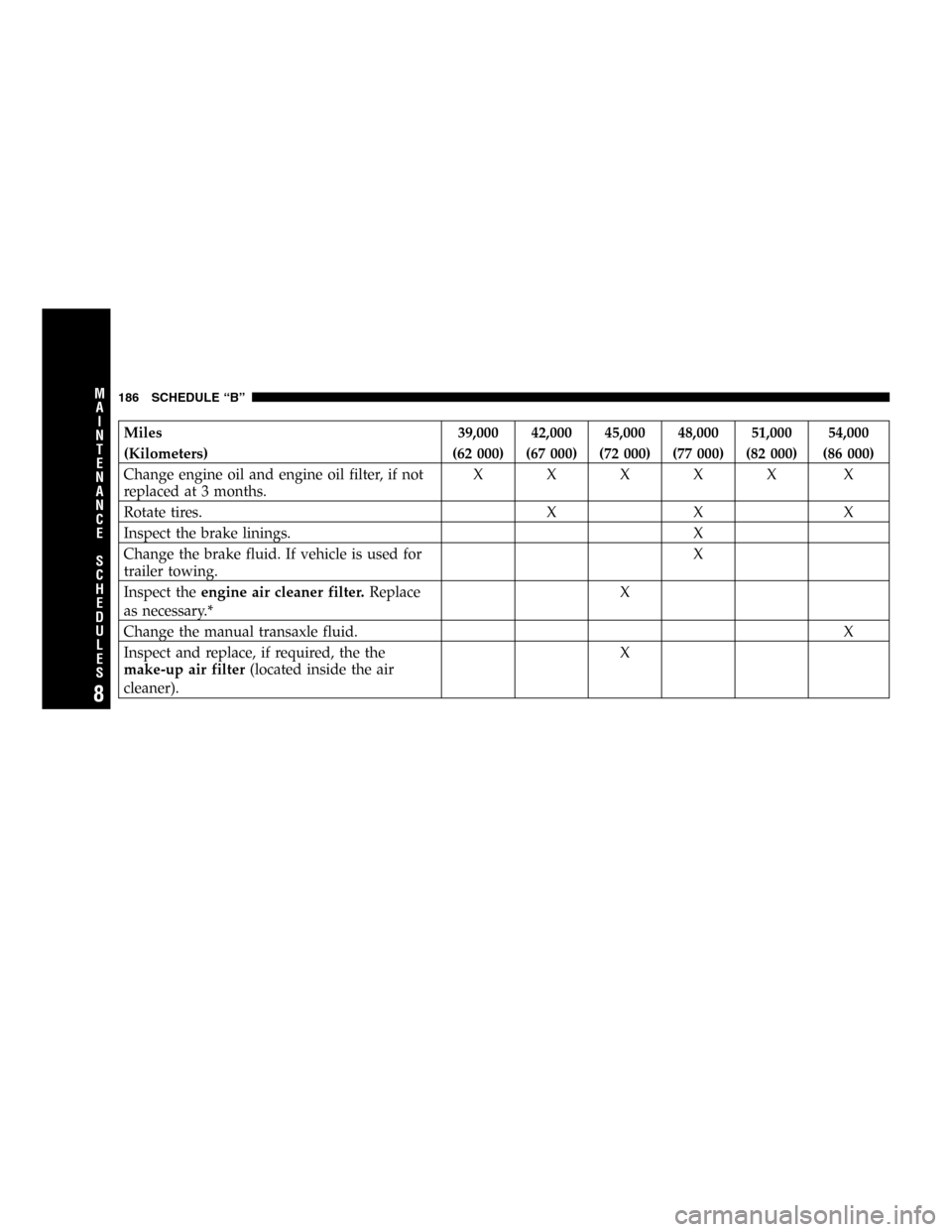
Miles 39,000 42,000 45,000 48,000 51,000 54,000
(Kilometers) (62 000) (67 000) (72 000) (77 000) (82 000) (86 000)
Change engine oil and engine oil filter, if not
replaced at 3 months.XXXXX X
Rotate tires. X X X
Inspect the brake linings. X
Change the brake fluid. If vehicle is used for
trailer towing.X
Inspect theengine air cleaner filter.Replace
as necessary.*X
Change the manual transaxle fluid.X
Inspect and replace, if required, the the
make-up air filter(located inside the air
cleaner).X
186 SCHEDULE“B”
8
M
A
I
N
T
E
N
A
N
C
E
S
C
H
E
D
U
L
E
S