light DODGE NITRO 2008 1.G Owners Manual
[x] Cancel search | Manufacturer: DODGE, Model Year: 2008, Model line: NITRO, Model: DODGE NITRO 2008 1.GPages: 434, PDF Size: 6.2 MB
Page 311 of 434
CAUTION!
Damage to the fuel system or emission control sys-
tem could result from using an improper fuel cap
(gas cap). A poorly fitting cap could let impurities
into the fuel system. Also, a poorly fitting after-
market cap can cause the MIL (Malfunction Indicator
Light) to illuminate, due to fuel vapors escaping from
the system.
CAUTION!
A poorly fitting gas cap may cause the Malfunction
Indicator Light to turn on.
CAUTION!
To avoid fuel spillage and overfilling, do not ªtop
offº the fuel tank after filling.
NOTE:When the fuel nozzle ªclicksº or shuts off, the
fuel tank is full.
WARNING!
²Never have any smoking materials lit in or near
the vehicle when the gas cap is removed or the
tank filled.
²Never add fuel when the engine is running. This is
in violation of most state and federal fire regula-
tions and will cause the malfunction indicator
light to turn on.
STARTING AND OPERATING 311
5
Page 312 of 434

NOTE:Tighten the gas cap about 1/4 turn until you
hear one click. This is an indication that cap is properly
tightened.
If the gas cap is not tighten properly, the Malfunction
Indicator Light will come on. Be sure the gas cap is
tightened every time the vehicle is refueled.
WARNING!
A fire may result if gasoline is pumped into a
portable container that is inside of a vehicle. You
could be burned. Always place gas containers on the
ground while filling.
Loose Fuel Filler Cap Message
If the vehicle diagnostic system determines that the fuel
filler cap is loose, improperly installed, or damaged, a
ªCHECK GASCAPº message will be displayed in the
EVIC (Electronic Vehicle Information Center). Refer to
ªElectronic Vehicle Information Centerº in Section 4 of
this manual. Tighten the fuel filler cap until a ªclickingº
sound is heard. This is an indication that the fuel filler
cap is properly tightened. Refer to ªOnboard Diagnostic
System Ð OBDIIº in Section 7 of this manual for more
information.
CAUTION!
Damage to the fuel system or emission control sys-
tem could result from using an improper fuel tank
filler cap (gas cap). A poorly fitting cap could let
impurities into the fuel system.
312 STARTING AND OPERATING
Page 319 of 434
Trailer Hitch Classification
Your vehicle is capable of towing trailers up to 2,000 lbs
(907 kg) without added equipment or alterations to the
standard equipment. Your vehicle may be factory
equipped for safe towing of trailers weighing over 2,000
lbs (907 kg) with the optional Trailer Tow Prep Package.
See your dealer for package content.The following chart provides the industry standard for
the maximum trailer weight a given trailer hitch class can
tow and should be used to assist you in selecting the
correct trailer hitch for your intended towing condition.
Refer to the Trailer Towing Weights (Maximum Trailer
Weight Ratings) chart for the Max. GTW towable for your
given drivetrain.
Trailer Hitch Classification
Class Max. GTW
(Gross Trailer Wt.)
Class I - Light Duty 2,000 lbs (907 kg)
Class II - Medium Duty 3,500 lbs (1 587 kg)
Class III - Heavy Duty 5,000 lbs (2 268 kg)
Class IV - Extra Heavy Duty 10,000 lbs (4 540 kg)
All trailer hitches should be professionally installed on
your vehicle.
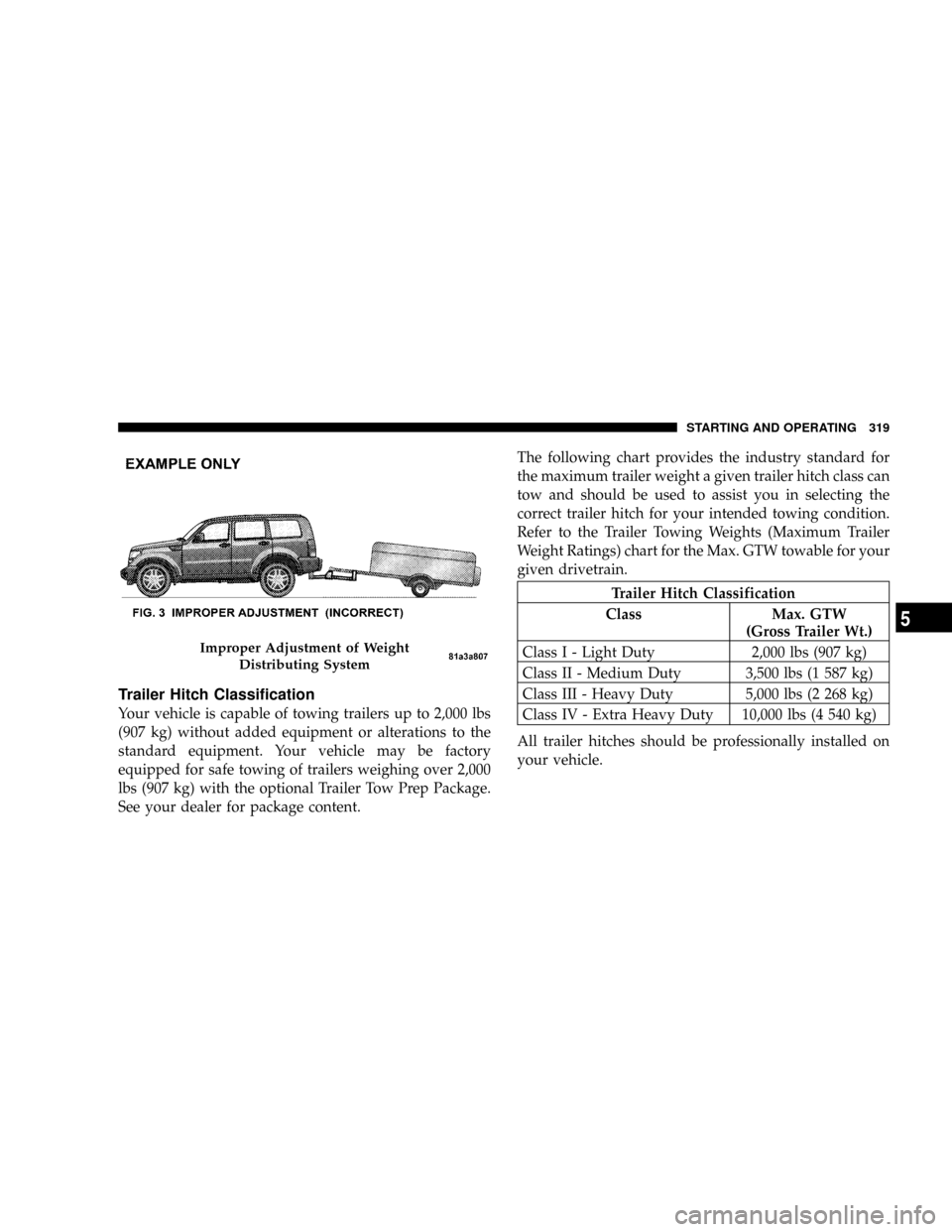
Improper Adjustment of Weight
Distributing System
STARTING AND OPERATING 319
5
Page 327 of 434
WARNING!
Do not connect trailer brakes to your vehicle's hy-
draulic brake lines. It can overload your brake sys-
tem and cause it to fail. You might not have brakes
when you need them and could have an accident.
Towing any trailer will increase your stopping dis-
tance. When towing you should allow for additional
space between your vehicle and the vehicle in front
of you. Failure to do so could result in an accident.
Towing Requirements Ð Trailer Lights & Wiring
Whenever you pull a trailer, regardless of the trailer size,
stop lights and turn signals on the trailer are required for
motoring safety.
The Trailer Tow Package may includea4and7pin
wiring harness. Use a factory approved trailer harness
and connector.
NOTE:Do not cut or splice wiring into the vehicles
wiring harness.
STARTING AND OPERATING 327
5
Page 330 of 434

þUse speed control in flat terrain and with light loads to
maximize fuel efficiency.
Towing Tips Ð Cooling System
To reduce potential for engine and transmission over-
heating, take the following actions:
þCity Driving
When stopped for short periods of time, put transmission
in neutral and increase engine idle speed.
þHighway Driving
Reduce speed.
þAir Conditioning
Turn off temporarily.
þrefer to Cooling System Operating information in the
Maintenance section of this manual for more informa-
tion.
RECREATIONAL TOWING (BEHIND
MOTORHOME, ETC.)
Towing ± 2WD Models
Recreational towing (all four wheels on the
ground)
Recreational towing is allowedONLYif the driveshaft is
removed. Towing with the rear wheels on the ground
while the driveshaft is connected can result in severe
transmission damage.
NOTE:This vehicle may be towed on a flatbed or
vehicle trailer provided all four wheels areOFFthe
ground.
330 STARTING AND OPERATING
Page 340 of 434

5. Raise the vehicle by turning the jack screw to the right.
Raise the vehicle only until the tire just clears the surface
and enough clearance is obtained to install the spare tire.
Minimum tire lift provides maximum stability.
WARNING!
Raising the vehicle higher than necessary can make
the vehicle less stable and cause an accident. It could
slip off the jack and hurt someone near it. Raise the
vehicle only enough to remove the tire.
6. Remove the lug nuts and wheel.
7. Position the spare wheel/tire on the vehicle and install
lug nuts with cone-shaped end toward wheel. Lightly
tighten the nuts. To avoid the risk of forcing the vehicle
off the jack, do not tighten the nuts fully until the vehicle
has been lowered.
8. Lower the vehicle by turning the jack screw to the left,
and remove the jack and wheel blocks.
Rear Jacking Location
340 WHAT TO DO IN EMERGENCIES
Page 346 of 434

NPower Steering Fluid Check..............363
NDriveline And Steering Component
Lubrication..........................364
NBody Lubrication.....................364
NWindshield Wiper Blades................365
NWindshield Washers...................365
NExhaust System......................366
NCooling System.......................366
NHoses And Vacuum/Vapor Harnesses.......371
NBrake System........................372
NAutomatic Transmission................374
NHydraulic Clutch Fluid Ð Manual
Transmission........................375
NManual Transmission..................375NTransfer Case........................376
NFront/Rear Axle Fluid..................377
NAppearance Care And Protection From
Corrosion...........................377
mFuses (Integrated Power Module)...........381
mReplacement Light Bulbs.................389
mBulb Replacement......................389
NHead Light..........................389
NLeft Front Turn Signal..................390
NRight Front Turn Signal.................391
NFront Side Marker.....................391
NFront Fog Light (Front Fascia Mounted).....391
NRear Tail, Stop, Turn Signal, And Back-Up
Lights.............................392
346 MAINTAINING YOUR VEHICLE
Page 347 of 434

NCenter High Mounted Stop Light (CHMSL) . . . 393
mFluid Capacities........................394
mFluids, Lubricants And Genuine Parts........395NEngine.............................395
NChassis............................396
MAINTAINING YOUR VEHICLE 347
7
Page 350 of 434

ONBOARD DIAGNOSTIC SYSTEM Ð OBD II
Your vehicle is equipped with a sophisticated onboard
diagnostic system called OBD II. This system monitors
the performance of the emissions, engine, and automatic
transmission control systems. When these systems are
operating properly, your vehicle will provide excellent
performance and fuel economy, as well as engine emis-
sions well within current government regulations.
If any of these systems require service, the OBD II system
will turn on the ªMalfunction Indicator Light.º It will
also store diagnostic codes and other information to
assist your service technician in making repairs. Al-
though your vehicle will usually be drivable and not
need towing, see your dealer for service as soon as
possible.CAUTION!
²Prolonged driving with the ªMalfunction Indica-
tor Lightº on could cause further damage to the
emission control system. It could also affect fuel
economy and driveability. The vehicle must be
serviced before any emissions tests can be per-
formed.
²If the ªMalfunction Indicator Lightº is flashing
while the engine is running, severe catalytic con-
verter damage and power loss will soon occur.
Immediate service is required.
350 MAINTAINING YOUR VEHICLE
Page 351 of 434

Loose Fuel Filler Cap Message
After fuel is added, the vehicle diagnostic system can
determine if the fuel filler cap is possibly loose, improp-
erly installed, or damaged. A loose fuel filler cap message
will be displayed in the instrument cluster. Tighten the
gas cap until a9clicking9sound is heard. This is an
indication that the gas cap is properly tightened. Press
the odometer reset button to turn the message off. If the
problem persists, the message will appear the next time
the vehicle is started. This might indicate a damaged cap.
If the problem is detected twice in a row, the system will
turn on the Malfunction Indicator Light (MIL). Resolving
the problem will turn the MIL light off.
EMISSIONS INSPECTION AND MAINTENANCE
PROGRAMS
In some localities, it may be a legal requirement to pass
an inspection of your vehicle's emissions control system.
Failure to pass could prevent vehicle registration.
For states, which have an I/M (Inspection and
Maintenance) requirement, this check verifies the
following: the MIL (Malfunction Indicator Light)
is functioning and is not on when the engine is running,
and that the OBD (On Board Diagnostic) system is ready
for testing.
Normally, the OBD system will be ready. The OBD
system maynotbe ready if your vehicle was recently
serviced, if you recently had a dead battery, or a battery
replacement. If the OBD system should be determined
not ready for the I/M test, your vehicle may fail the test.
MAINTAINING YOUR VEHICLE 351
7