service DODGE NITRO 2008 1.G Workshop Manual
[x] Cancel search | Manufacturer: DODGE, Model Year: 2008, Model line: NITRO, Model: DODGE NITRO 2008 1.GPages: 434, PDF Size: 6.2 MB
Page 364 of 434
WARNING!
Fluid level should be checked on a level surface with
the engine off to prevent injury from moving parts,
and to insure accurate fluid level reading. Do not
overfill. Use only the manufacturer's recommended
fluid.
If necessary, add fluid to restore to the proper indicated
level. With a clean cloth, wipe any spilled fluid from all
surfaces. Refer to Fluids, Lubricants, and Genuine Parts
for correct fluid type.
NOTE:Upon initial start-up in cold weather, the power
steering pump may make noise for a short period of time.
This is due to the cold, thick fluid in the steering system.
This noise should be considered normal, and does not in
any way damage the steering system.
Driveline And Steering Component Lubrication
All driveline and steering components are sealed and do
not require lubrication. Driveshafts are not serviceable.
Body Lubrication
Locks and all body pivot points, including such items as
seat tracks, doors, tailgate and hood hinges, should be
lubricated periodically to assure quiet, easy operation
and to protect against rust and wear. Prior to the appli-
cation of any lubricant, the parts concerned should be
wiped clean to remove dust and grit; after lubricating
excess oil and grease should be removed. Particular
attention should also be given to hood latching compo-
nents to insure proper function. When performing other
underhood services, the hood latch, release mechanism
and safety catch should be cleaned and lubricated.
The external lock cylinders should be lubricated twice a
year, preferably in the fall and spring. Apply a small
364 MAINTAINING YOUR VEHICLE
Page 370 of 434

children, do not store ethylene glycol based antifreeze/
coolant in open containers or allow it to remain in
puddles on the ground. If ingested by a child, contact a
physician immediately. Clean up any ground spills im-
mediately.
Engine Coolant Level
The coolant bottle provides a quick visual method for
determining that the coolant level is adequate. With the
engine idling, and warm to normal operating tempera-
ture, the level of the antifreeze/coolant in the bottle
should be between the ranges indicated on the bottle.
The radiator normally remains completely full, so there is
not need to remove the radiator cap unless checking for
antifreeze/coolant freeze point or replacing antifreeze/
coolant. Advise your service attendant of this. As long as
the engine operating temperature is satisfactory, the
coolant bottle need only be checked once a month.When additional antifreeze/coolant is needed to main-
tain the proper level, it should be added to the coolant
bottle. Do not overfill.
Points To Remember
NOTE:When the vehicle is stopped after a few miles of
operation, you may observe vapor coming from the front
of the engine compartment. This is normally a result of
moisture from rain, snow, or high humidity accumulat-
ing on the radiator and being vaporized when the
thermostat opens, allowing hot antifreeze/coolant to
enter the radiator.
If an examination of your engine compartment shows no
evidence of radiator or hose leaks, the vehicle may be
safely driven. The vapor will soon dissipate.
²Do not overfill the coolant bottle.
370 MAINTAINING YOUR VEHICLE
Page 372 of 434
are present. Components should be replaced immedi-
ately if there is any evidence of degradation that could
cause failure.
Brake System
In order to assure brake system performance, all brake
system components should be inspected periodically.
Refer to the appropriate ªMaintenance Scheduleº in
Section 8 for suggested service intervals.
WARNING!
Riding the brakes can lead to brake failure and
possibly an accident. Driving with your foot resting
or riding on the brake pedal can result in abnormally
high brake temperatures, excessive lining wear, and
possible brake damage. You wouldn't have your full
braking capacity in an emergency.
Brake and Power Steering System Hoses
When servicing the vehicle for scheduled maintenance,
inspect surface of hoses for evidence of heat and me-
chanical damage. Hard and brittle rubber, cracking, tears,
cuts, abrasion, and excessive swelling suggest deteriora-
tion of the rubber. Particular attention should be made to
examining those hose surfaces nearest to high heat
sources, such as the exhaust manifold.
Inspect all hose clamps and couplings to make sure they
are secure and no leaks are present.
NOTE:Inspection of brake hoses should be done when-
ever the brake system is serviced and every engine oil
change.
372 MAINTAINING YOUR VEHICLE
Page 373 of 434
WARNING!
Worn brake hoses can burst and cause brake failure.
You could have an accident. If you see any signs of
cracking, scuffing, or worn spots, have the brake
hoses replaced immediately.
Brake Master Cylinder
The fluid level in the master cylinder should be checked
when performing under hood services, or immediately if
the BRAKE warning light shows system failure
Be sure to clean the top of the master cylinder area before
removing the cap. If necessary, add fluid to bring the
fluid level up to the requirements described on the brake
fluid reservoir. With disc brakes, fluid level can be
expected to fall as the brake pads wear. Brake fluid levelshould be checked when pads are replaced. However,
low fluid level may be caused by a leak and a checkup
may be needed.
Use only manufacturer's recommended brake fluid, refer
to Fluids, Lubricants, and Genuine Parts for correct fluid
type.
WARNING!
²Use of a brake fluid that may have a lower initial
boiling point or unidentified as to specification,
may result in sudden brake failure during hard
prolonged braking. You could have an accident.
²Overfilling the brake fluid reservoir can result in
spilling brake fluid on hot engine parts and the
brake fluid catching fire.
MAINTAINING YOUR VEHICLE 373
7
Page 398 of 434
EMISSION CONTROL SYSTEM MAINTENANCE
The ªScheduledº maintenance services, listed inbold
typemust be done at the times or mileages specified to
assure the continued proper functioning of the emission
control system. These, and all other maintenance services
included in this manual, should be done to provide best
vehicle performance and reliability. More frequent main-
tenance may be needed for vehicles in severe operating
conditions such as dusty areas and very short trip
driving.
Inspection and service also should be done any time a
malfunction is suspected.
NOTE:Maintenance, replacement, or repair of the emis-
sion control devices and systems on your vehicle may be
performed by any automotive repair establishment or
individual using any automotive part, which has been
certified pursuant to U.S. EPA or, in the State of Califor-
nia, California Air Resources Board regulations.
MAINTENANCE SCHEDULE
The oil change indicator system will remind you that it is
time to take your vehicle in for scheduled maintenance.
On Electronic Vehicle Information Center (EVIC)
equipped vehicles ªOil Change Requiredº will be dis-
played in the EVIC and a single chime will sound,
indicating that an oil change is necessary.
On Non-EVIC equipped vehicles ªChange Oilº will flash
in the instrument cluster odometer and a single chime
will sound, indicating that an oil change is necessary.
Based on engine operation condition the oil change
indicator message will illuminate, this means that service
is required for your vehicle. Have your vehicle serviced
as soon as possible, within the next 500 miles (805 km).
398 MAINTENANCE SCHEDULES
8
M
A
I
N
T
E
N
A
N
C
E
S
C
H
E
D
U
L
E
S
Page 402 of 434
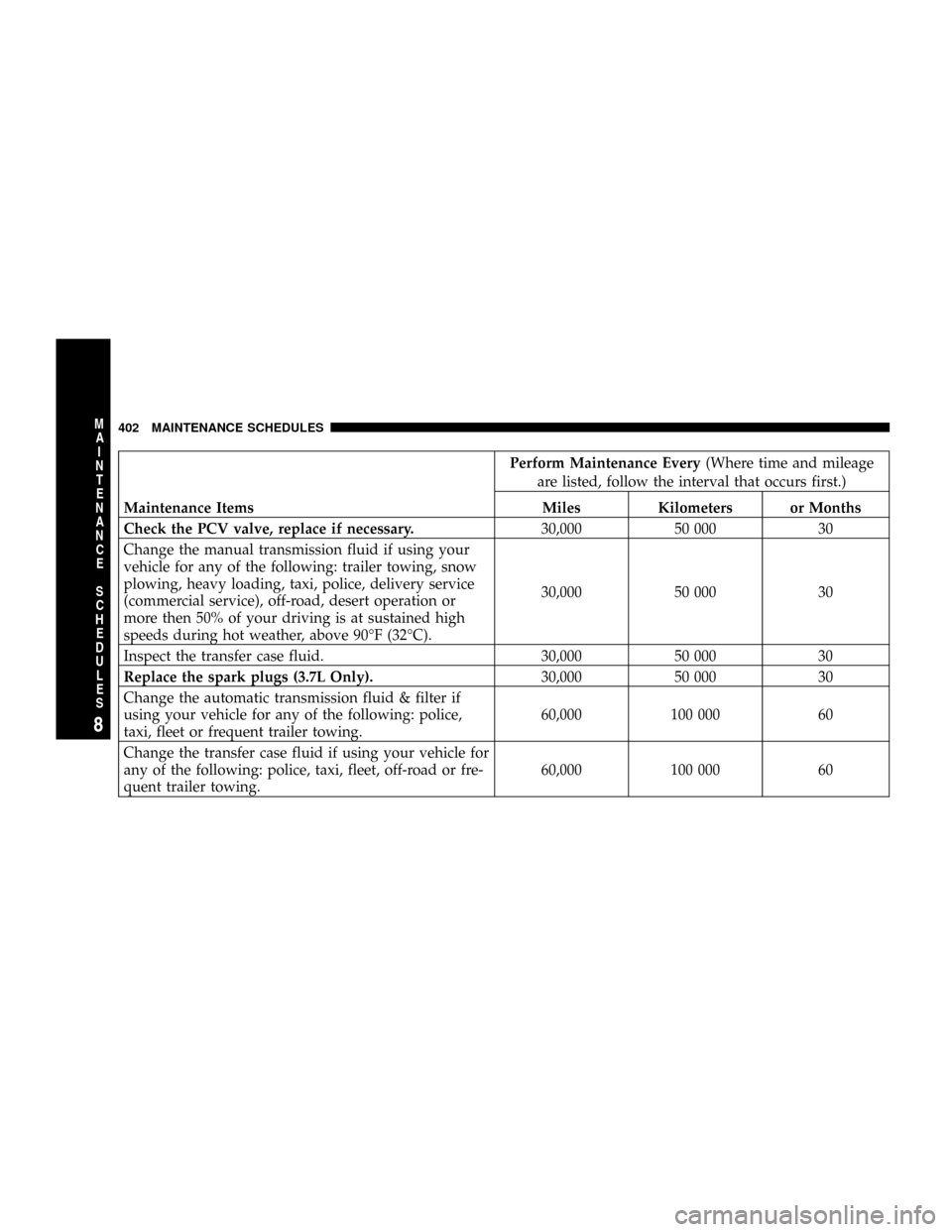
Perform Maintenance Every(Where time and mileage
are listed, follow the interval that occurs first.)
Maintenance Items Miles Kilometers or Months
Check the PCV valve, replace if necessary.30,000 50 000 30
Change the manual transmission fluid if using your
vehicle for any of the following: trailer towing, snow
plowing, heavy loading, taxi, police, delivery service
(commercial service), off-road, desert operation or
more then 50% of your driving is at sustained high
speeds during hot weather, above 90ÉF (32ÉC).30,000 50 000 30
Inspect the transfer case fluid. 30,000 50 000 30
Replace the spark plugs (3.7L Only).30,000 50 000 30
Change the automatic transmission fluid & filter if
using your vehicle for any of the following: police,
taxi, fleet or frequent trailer towing.60,000 100 000 60
Change the transfer case fluid if using your vehicle for
any of the following: police, taxi, fleet, off-road or fre-
quent trailer towing.60,000 100 000 60
402 MAINTENANCE SCHEDULES
8
M
A
I
N
T
E
N
A
N
C
E
S
C
H
E
D
U
L
E
S
Page 403 of 434
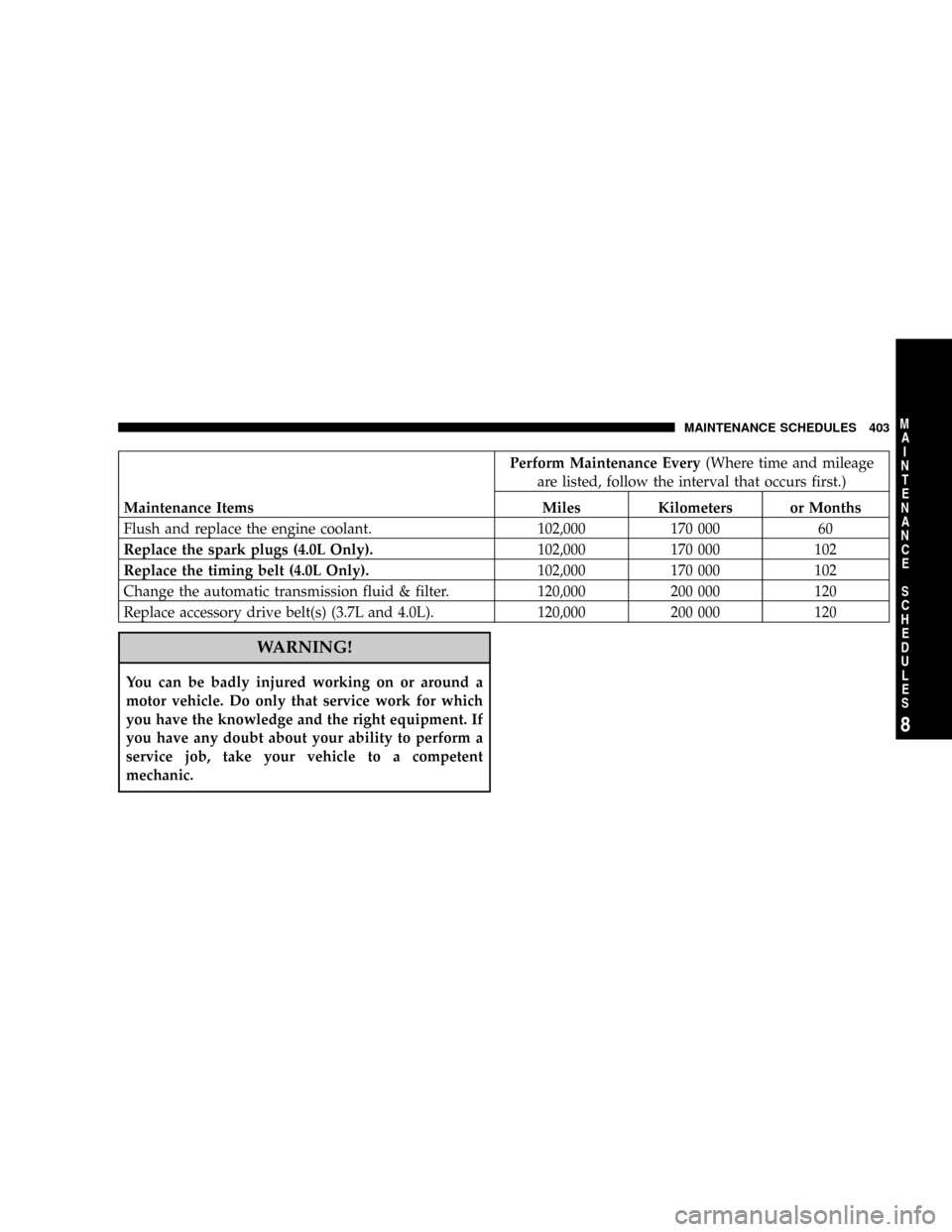
Perform Maintenance Every(Where time and mileage
are listed, follow the interval that occurs first.)
Maintenance Items Miles Kilometers or Months
Flush and replace the engine coolant. 102,000 170 000 60
Replace the spark plugs (4.0L Only).102,000 170 000 102
Replace the timing belt (4.0L Only).102,000 170 000 102
Change the automatic transmission fluid & filter. 120,000 200 000 120
Replace accessory drive belt(s) (3.7L and 4.0L). 120,000 200 000 120
WARNING!
You can be badly injured working on or around a
motor vehicle. Do only that service work for which
you have the knowledge and the right equipment. If
you have any doubt about your ability to perform a
service job, take your vehicle to a competent
mechanic.
MAINTENANCE SCHEDULES 403
8
M
A
I
N
T
E
N
A
N
C
E
S
C
H
E
D
U
L
E
S
Page 405 of 434

IF YOU NEED CONSUMER ASSISTANCE
CONTENTS
mSuggestions For Obtaining Service For Your
Vehicle..............................406
NPrepare For The Appointment............406
NPrepare A List........................406
NBe Reasonable With Requests.............406
mIf You Need Assistance...................406
mWarranty Information (U.S. Vehicles Only).....409
mMopartParts.........................409mReporting Safety Defects..................409
NIn Canada..........................410
mPublication Order Forms..................410
mDepartment Of Transportation Uniform Tire
Quality Grades........................412
NTreadwear..........................412
NTraction Grades......................412
NTemperature Grades...................413
9
Page 406 of 434

SUGGESTIONS FOR OBTAINING SERVICE FOR
YOUR VEHICLE
Prepare For The Appointment
If you're having warranty work done, be sure to have the
right papers with you. Take your warranty folder. All
work to be performed may not be covered by the
warranty, discuss additional charges with the service
manager. Keep a maintenance log of your vehicle's
service history. This can often provide a clue to the
current problem.
Prepare A List
Make a written list of your vehicle's problems or the
specific work you want done. If you've had an accident,
or work done that is not on your maintenance log, let the
service advisor know.
Be Reasonable With Requests
If you list a number of items, and you must have your
vehicle by the end of the day, discuss the situation with
the service advisor and list the items in order of priority.
At many dealers, you may obtain a rental vehicle at a
minimal daily charge. If you need a rental, it is advisable
to make these arrangements when you call for an ap-
pointment.
IF YOU NEED ASSISTANCE
The manufacturer and its dealers are vitally interested in
your satisfaction. We want you to be happy with our
products and services.
Warranty service must be done by an authorized
Chrysler, Dodge, or Jeep dealer. We strongly recommend
that you take your vehicle to your selling dealer. They
know you and your vehicle best, and are most concerned
that you get prompt and high quality service. The
manufacturer's dealers have the facilities, factory-trained
406 IF YOU NEED CONSUMER ASSISTANCE
Page 407 of 434

technicians, special tools, and the latest information to
assure your vehicle is fixed correctly and in a timely
manner.
This is why you should always talk to your dealer's
service manager first. Most matters can be resolved with
this process.
²If for some reason you are still not satisfied, talk to the
general manager or owner of the dealership. They
want to know if you need assistance.
²If your dealership is unable to resolve the concern, you
may contact the Manufacturer's Customer Center.
Any communication to the Manufacturer's Customer
Center should include the following information:
²Owner's name and address
²Owner's telephone number (home and office)
²Dealership name
²Vehicle identification number
²Vehicle delivery date and mileage
DaimlerChrysler Motors Corporation Customer Center
P.O. Box 21±8004
Auburn Hills, MI 48321±8004
Phone: (800) 992-1997
DaimlerChrysler Canada Inc. Customer Center
P.O. Box 1621
Windsor, Ontario N9A 4H6
Phone: (800) 465±2001
In Mexico contact:
Av. Prolongacion Paseo de la Reforma, 1240
Sante Fe C.P. 05109
Mexico, D. F.
In Mexico (915) 729±1248 or 729±1240
Outside Mexico (525) 729±1248 or 729±1240
IF YOU NEED CONSUMER ASSISTANCE 407
9