change wheel DODGE NITRO 2008 1.G Owners Manual
[x] Cancel search | Manufacturer: DODGE, Model Year: 2008, Model line: NITRO, Model: DODGE NITRO 2008 1.GPages: 434, PDF Size: 6.2 MB
Page 124 of 434

To change the brightness of the instrument panel lights,
rotate the center portion of the multi-function control
lever up or down.
NOTE:If the driver's door is left open, and the head-
lights or parking lights are left on, the ªHigh Beam
Indicator Lightº will flash and a chime will sound.
Lights-On Reminder
If the headlights or parking lights are on after the ignition
is turned off, a chime will sound when the driver's door
is opened.
Headlight Dimmer Switch
Push the multi-function control lever away from you to
switch the headlights to high beam. Pull the lever to-
wards you to switch the headlights back to low beam.
Passing Light
You can signal another vehicle with your headlights by
lightly pulling the multi-function control lever toward
the steering wheel. This will cause the headlights to turn
on at high beam and remain on until the lever is released.
Front Fog Lights Ð If Equipped
The front fog light switch is in the multi-function
control lever. To activate the front fog lights, turn
on the parking or low beam headlights and pull
out the end of the lever.
NOTE:The fog lights will only operate with the parking
lights or the headlights on low beam. Selecting high
beam headlights will turn off the fog lights.
124 UNDERSTANDING THE FEATURES OF YOUR VEHICLE
Page 133 of 434
WARNING!
BAS (Brake Assist System) cannot prevent the natu-
ral laws of physics from acting on the vehicle, nor can
it increase the traction afforded by prevailing road
conditions. BAS cannot prevent accidents, including
those resulting from excessive speed in turns, driving
on very slippery surfaces, or hydroplaning. Only a
safe, attentive, and skillful driver can prevent acci-
dents. The capabilities of a BAS-equipped vehicle
must never be exploited in a reckless or dangerous
manner which could jeopardize the user's safety or
the safety of others.
ERM (Electronic Roll Mitigation)
This system anticipates the potential for wheel lift by
monitoring the driver 's steering wheel input and the
speed of the vehicle. When ERM determines that the rate
of change of the steering wheel angle and vehicles speed
are sufficient to potentially cause wheel lift, it applies the
appropriate brake and may reduce engine power to
lessen the chance that wheel lift will occur. ERM will only
intervene during very severe or evasive driving maneu-
vers. ERM can only reduce the chance of wheel lift
occurring during severe or evasive driving maneuvers. It
can not prevent wheel lift due to other factors such as
road conditions, leaving the roadway or striking objects
or other vehicles.
UNDERSTANDING THE FEATURES OF YOUR VEHICLE 133
3
Page 185 of 434

Vehicles equipped with steering wheel mounted buttons
(described in this section) are also equipped with the
EVIC. The EVIC consists of the following:
²System Status
²Vehicle information warning message displays
²Tire Pressure Monitor System (If Equipped)
²Personal Settings (Customer Programmable Features)
²Compass display
²Outside temperature display
²Trip computer functions
²UConnectŸ hands-free communication system dis-
plays (If Equipped)
²Navigation system screens (If Equipped)
²Audio mode displayThe system allows the driver to select information by
pressing the following buttons mounted on the steering
wheel:
Press and release the MENU button and the
mode displayed will change between Trip
Functions, Navigation (if equipped), System
Status, Personal Settings, and Telephone (if
equipped).
Press the FUNCTION SELECT button to accept
a selection. Also, the FUNCTION SELECT but-
ton changes the current CD track being played
(if so equipped) when the EVIC is in the
Compass/Temp/Audio screen.
Press the SCROLL button to scroll through Trip
Functions, Navigation (if equipped), System
Status Messages, and Personal Settings (Cus-
tomer Programmable Features).
INSTRUMENT PANEL AND CONTROLS 185
4
Page 197 of 434

AM Reception
AM sound is based on wave amplitude, so AM reception
can be disrupted by such things as lightning, power lines
and neon signs.
FM Reception
Because FM transmission is based on frequency varia-
tions, interference that consists of amplitude variations
can be filtered out, leaving the reception relatively clear,
which is the major feature of FM radio.
NOTE:The radio, steering wheel radio controls (if
equipped), and 6 disc CD/DVD changer (if equipped)
will remain active for up to 10 minutes after the ignition
switch has been turned off. Opening a vehicle front door
will cancel this feature.
SALES CODE REQ Ð AM/FM STEREO RADIO
AND 6±DISC CD/DVD CHANGER (MP3/WMA AUX
JACK)
NOTE:The radio sales code is located on the lower right
side of your radio faceplate.
REQ Radio
INSTRUMENT PANEL AND CONTROLS 197
4
Page 293 of 434
WARNING!
²Do not use a tire, wheel size or rating other than that
specified for your vehicle. Some combinations of
unapproved tires and wheels may change suspension
dimensions and performance characteristics, result-
ing in changes to steering, handling, and braking of
your vehicle. This can cause unpredictable handling
and stress to steering and suspension components.
You could lose control and have an accident resulting
in serious injury or death. Use only the tire and wheel
sizes with load ratings approved for your vehicle.
²Never use a tire with a smaller load index or capacity,
other than what was originally equipped on your
vehicle. Using a tire with a smaller load index could
result in tire overloading and failure. You could lose
control and have an accident.
²Failure to equip your vehicle with tires having ad-
equate speed capability can result in sudden tire
failure and loss of vehicle control.
CAUTION!
Replacing original tires with tires of a different size
may result in false speedometer and odometer
readings.
Alignment and Balance
Poor suspension alignment may result in:
²Fast tire wear.
²Uneven tire wear, such as feathering and one-sided
wear.
²Vehicle pull to right or left.
Tires may also cause the vehicle to pull left or right.
Alignment will not correct this problem. See your autho-
rized dealer for proper diagnosis.
STARTING AND OPERATING 293
5
Page 299 of 434

²Seasonal temperature changes will affect tire pressure,
and the TPMS will monitor the actual tire pressure in
the tire.
Base System Ð If Equipped
The Tire Pressure Monitor System (TPMS) uses wireless
technology with wheel rim mounted electronic sensors to
monitor tire pressure levels. Sensors, mounted to each
wheel as part of the valve stem, transmit tire pressure
readings to the Receiver Module.
NOTE:It is particularly important for you to check the
tire pressure in all of the tires on your vehicle monthly
and to maintain the proper pressure.
The TPMS consists of the following components:
²Receiver Module
²4 Tire Pressure Monitoring Sensors
²Tire Pressure Monitoring Telltale LightThe matching full size spare wheel and tire assembly (if
equipped) has a tire pressure monitoring sensor. The
matching full size spare can be used in place of any of the
four road tires. The TPMS will only monitor the pressure
in the full size spare when it is used in place of a road tire.
Otherwise, a spare with a pressure below the low-
pressure limit will not cause the Tire Pressure Monitoring
Telltale Light to illuminate or the chime to sound.
Tire Pressure Monitoring Low Pressure Warnings
The Tire Pressure Monitoring Telltale Light will
illuminate in the instrument cluster and a chime
will sound when tire pressure is low in one or
more of the four active road tires. Should this occur, you
should stop as soon as possible, check the inflation
pressure of each tire on your vehicle, and inflate each tire
to the vehicle's recommended cold placard pressure
value. Once the system receives the updated tire pres-
sures, the system will automatically update and the Tire
Pressure Monitoring Telltale Light will turn off. The
STARTING AND OPERATING 299
5
Page 338 of 434
CAUTION!
The winch mechanism is designed for use with the
jack extension tube only. Use of an air wrench or
other power tools is not recommended and they can
damage the winch.
When the spare is clear, tilt the retainer at the end of the
cable, and pull it through the center of the wheel.
Preparations For Jacking
²
Park the vehicle on a firm level surface as far from the
edge of the roadway as possible. Avoid icy or slippery
areas.
²Set the parking brakeand place the gear selector in
PARK (automatic transmission) or REVERSE (manual
transmission).
²Turn the ignition to the LOCK position.
WARNING!
Do not attempt to change a tire on the side of the
vehicle close to moving traffic. Pull far enough off
the road to avoid being hit when operating the jack
or changing the wheel.
²Turn on the Hazard Warning Flasher.
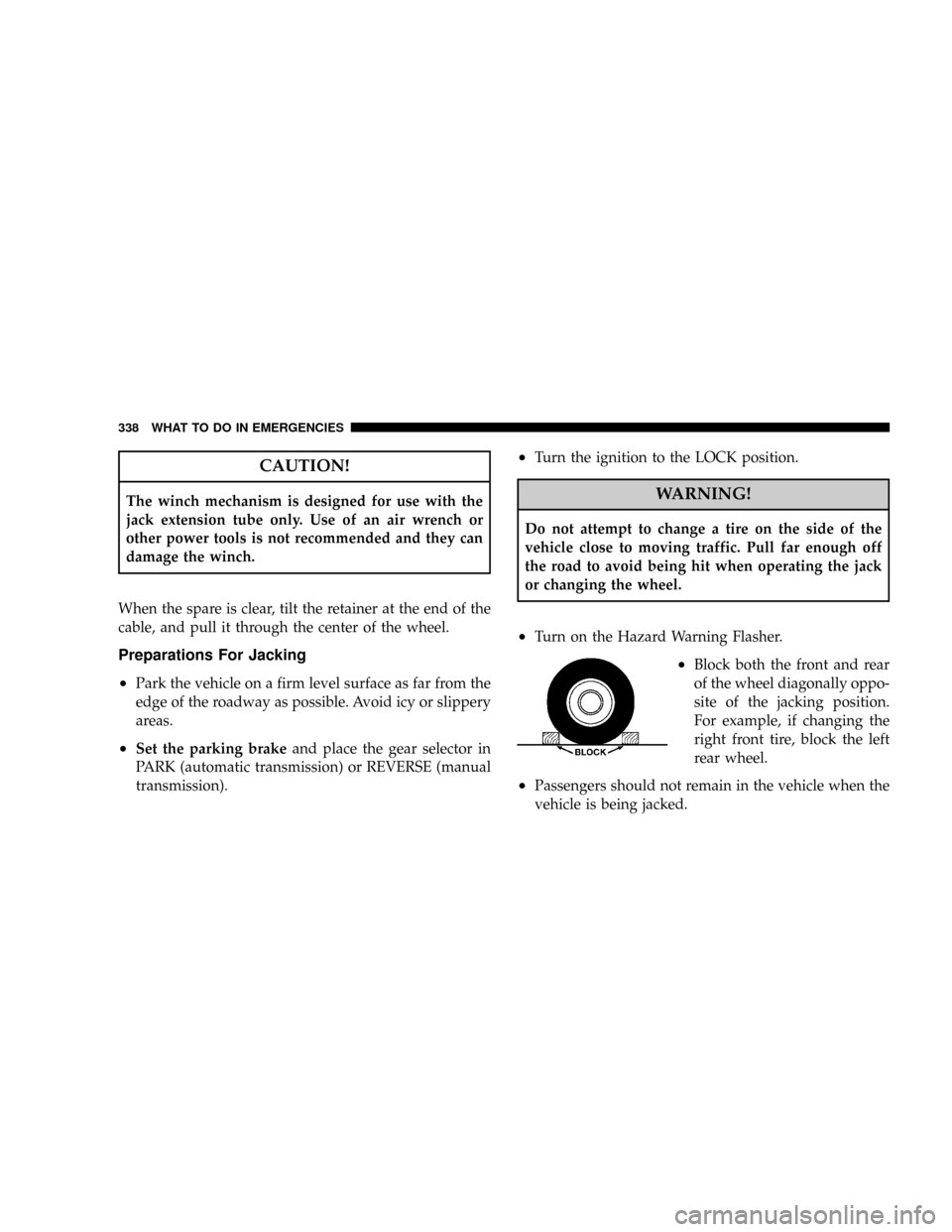
²Block both the front and rear
of the wheel diagonally oppo-
site of the jacking position.
For example, if changing the
right front tire, block the left
rear wheel.
²Passengers should not remain in the vehicle when the
vehicle is being jacked.
338 WHAT TO DO IN EMERGENCIES
Page 339 of 434

Jacking Instructions
1. Remove spare tire.
2. Loosen (but do not remove) the wheel lug nuts by
turning them to the left one turn while the wheel is still
on the ground.
3. Remove jack and tools from mounting bracket. As-
semble the tools by connecting the driver to the exten-
sion, and then to the lug wrench.
4. Locate the jack as shown. For the front tires, place it in
the notch on the body weld seam behind wheel to be
changed. For the rear tires, place it under the axle by the
wheel to be changed. Position the jack handle on the jack.
Do not raise the vehicle until you are sure the jack is
fully engaged.
Front Jacking Location
WHAT TO DO IN EMERGENCIES 339
6
Page 434 of 434
INTRODUCTION INTRODUCTION ROLLOVER WARNING HOW TO USE THIS MANUAL WARNINGS AND CAUTIONS VEHICLE IDENTIFICATION NUMBER VEHICLE MODIFICATIONS/ALTERATIONS THINGS TO KNOW BEFORE STARTING YOUR VEHICLE A WORD
ABOUT YOUR KEYS Ignition Key RemovalKey-In-Ignition ReminderSENTRY KEY Replacement KeysCustomer Key ProgrammingGeneral InformationSTEERING WHEEL LOCK - IF EQUIPPED To Manually Lock the Steering WheelTo Release the Steering Wheel Lock
SECURITY ALARM SYSTEM - IF EQUIPPED To Arm the SystemTo Disarm the SystemILLUMINATED ENTRY REMOTE KEYLESS ENTRY To Unlock the Doors and LiftgateTo Lock the Doors and LiftgateUsing the Panic AlarmProgramming Additional TransmittersBattery
ReplacementGeneral InformationREMOTE STARTING SYSTEM - IF EQUIPPED DOOR LOCKS Manual Door LocksPower Door LocksAutomatic Door LocksAutomatic Unlock Doors on ExitChild-Protection Door Lock System (Rear Doors)WINDOWS Power WindowsWind
BuffetingLIFTGATE OCCUPANT RESTRAINTS Lap/Shoulder BeltsLap/Shoulder Belt Operating InstructionsAdjustable Upper Shoulder Belt AnchorageAutomatic Locking Mode - If EquippedEnergy Management FeatureSeat Belt PretensionersEnhanced Seat Belt Use
Reminder System (BeltAlert)Seat Belts and Pregnant WomenSeat Belt ExtenderDriver And Front Passenger Supplemental Restraint Systems (SRS) ChildRestraintENGINE BREAK-IN RECOMMENDATIONS SAFETY TIPS Exhaust GasSafety Checks You Should Make
Inside The VehicleSafety Checks You Should Make Outside The VehicleUNDERSTANDING THE FEATURES OF YOUR VEHICLE MIRRORS Inside Day/Night MirrorAutomatic Dimming Mirror - If EquippedOutside MirrorsExterior Mirrors Folding FeaturePower Remote Control
MirrorsIlluminated Vanity Mirrors - If EquippedHANDS-FREE COMMUNICATION (UConnect) - IF EQUIPPED OperationPhone Call FeaturesUConnect System FeaturesAdvanced Phone ConnectivityThings You Should Know About Your UConnect SystemGeneral Information
SEATS Front Manual Seat AdjustmentFront Seat Adjustment - Recline6-Way Drivers Power Seat with Manual ReclinerFold Flat Front Passenger SeatHead RestraintsHeated Seats - If Equipped60/40 Split Folding Rear Seat with Fold Flat FeatureTO OPEN AND CLOSE
THE HOOD LIGHTS Interior LightsMulti-Function Control LeverParking Lights, Instrument Panel Lights, and HeadlightsLights-On ReminderHeadlight Dimmer SwitchPassing LightFront Fog Lights - If EquippedTurn SignalsDaytime Running Lights - If EquippedWINDSHIELD
WIPERS AND WASHERS Intermittent Wiper SystemWindshield Wiper OperationWindshield WashersMist FeatureTILT STEERING COLUMN ELECTRONIC SPEED CONTROL - IF EQUIPPED Electronic Speed Control OperationTo ActivateTo Set At A Desired SpeedTo
DeactivateTo Resume SpeedTo Vary The Speed SettingManual TransmissionTo Accelerate For PassingELECTRONIC BRAKE CONTROL SYSTEM ABS (Anti-Lock Brake System)TCS (Traction Control System)BAS (Brake Assist System)ERM (Electronic Roll Mitigation)
ESP (Electronic Stability Program)ESP/BAS Warning LampGARAGE DOOR OPENER - IF EQUIPPED Programming HomeLinkGate Operator/Canadian ProgrammingUsing HomeLinkReprogramming a Single HomeLink ButtonSecurityTroubleshooting TipsGeneral
InformationPOWER SUNROOF - IF EQUIPPED Opening Sunroof - ExpressClosing Sunroof - ExpressPinch Protect FeaturePinch Protect OverrideVenting Sunroof - ExpressSunshade OperationWind BuffetingSunroof MaintenanceELECTRICAL POWER OUTLET Electrical
Outlet Use With Engine OffPOWER INVERTER CUP HOLDERS STORAGE Front Storage CompartmentConsole Storage CompartmentCARGO AREA FEATURES Cargo LightCargo Tie-Down HooksCargo Load Floor - If EquippedRear Cargo Slide Out System (LOAD N
GO) - If EquippedREAR WINDOW FEATURES Rear Window Wiper/Washer - If EquippedRear Window Defroster - If EquippedROOF LUGGAGE RACK- NON FUNCTIONAL INSTRUMENT PANEL AND CONTROLS INSTRUMENT PANEL AND CONTROLS INSTRUMENT
CLUSTER INSTRUMENT CLUSTER DESCRIPTION COMPASS AND TRIP COMPUTER - IF EQUIPPED Control ButtonsTrip ConditionsCompass/Temperature DisplayELECTRONIC VEHICLE INFORMATION CENTER (EVIC) - IF EQUIPPED Electronic Vehicle Information
Center (EVIC) DisplaysOil Change RequiredTrip FunctionsCompass DisplayTelephone - If EquippedPersonal Settings (Customer Programmable Features)RADIO GENERAL INFORMATION Radio Broadcast SignalsTwo Types of SignalsElectrical DisturbancesAM Reception
FM ReceptionSALES CODE REQ - AM/FM STEREO RADIO AND 6-DISC CD/DVD CHANGER (MP3/WMA AUX JACK) Operating Instructions - Radio ModeOperation Instructions - (DISC MODE for CD and MP3/WMA Audio Play, DVD-VIDEO)Notes On Playing MP3/WMA
FilesLIST Button (DISC Mode for MP3/WMA Play)INFO Button (DISC Mode for MP3/WMA Play)SALES CODE RES - AM/FM STEREO RADIO WITH CD PLAYER (MP3 AUX JACK) Operating Instructions - Radio ModeOperation Instructions - CD MODE for CD and MP3
Audio PlayNotes On Playing MP3 FilesLIST Button (CD Mode for MP3 Play)INFO Button (CD Mode for MP3 Play)SALES CODE RER - AM/FM/CD/DVD RADIO WITH NAVIGATION SYSTEM - IF EQUIPPED Operating Instructions - Satellite RadioClock Setting Procedure
SATELLITE RADIO (RSC) - IF EQUIPPED (RER/REQ/REN RADIOS ONLY) System ActivationElectronic Serial Number/Sirius Identification Number (ENS/SID)Selecting Satellite ModeSatellite AntennaReception QualityOperating Instructions - Satellite ModeOperating
Instructions - Hands Free Phone (If Equipped)Operating Instructions - Video Entertainment System (VES) (If Equipped)VIDEO ENTERTAINMENT SYSTEM (SALES CODE XRV) - IF EQUIPPED REMOTE SOUND SYSTEM CONTROLS - IF EQUIPPED Radio Operation
CD PlayerCD/DVD DISC MAINTENANCE CLIMATE CONTROLS Manual Air Conditioning and Heating SystemOperating TipsSTARTING AND OPERATING STARTING PROCEDURES Manual TransmissionAutomatic TransmissionNormal StartingExtreme Cold Weather
(below -20 degrees F or -29 degrees C)If Engine Fails to StartAfter StartingENGINE BLOCK HEATER - IF EQUIPPED MANUAL TRANSMISSION - IF EQUIPPED 6-Speed Manual TransmissionAUTOMATIC TRANSMISSION Shift Lock Manual Override - If Equipped
Brake/Transmission Interlock System4-Speed Automatic Transmission (3.7L Engine)5-Speed Automatic Transmission (4.0L Engine)Gear RangesFOUR-WHEEL DRIVE OPERATION MP 143 Single-Speed Part-Time Transfer Case - If EquippedShifting Procedure -
Electronically Shifted Transfer CaseMP 140 Single-Speed Full-Time Transfer Case - If EquippedON-ROAD DRIVING TIPS OFF-ROAD DRIVING TIPS When To Use 4L or 4LO (Low) RangeDriving Through WaterDriving In Snow, Mud and SandHill ClimbingTraction Downhill
After Driving Off-RoadPARKING BRAKE ANTI-LOCK BRAKE SYSTEM POWER STEERING TIRE SAFETY INFORMATION Tire Markings Tire Identification Number (TIN)Tire Loading and Tire PressureTIRES - GENERAL INFORMATION Tire PressureTire Inflation Pressures
Tire Pressures for High Speed OperationRadial-Ply TiresTire SpinningTread Wear IndicatorsLife of TireReplacement TiresAlignment and BalanceTIRE CHAINS TIRE ROTATION RECOMMENDATIONS TIRE PRESSURE MONITOR SYSTEM (TPMS) - IF EQUIPPED Base
System - If EquippedPremium System - If EquippedGeneral InformationFUEL REQUIREMENTS 3.7L Engine (If Equipped)4.0L Engine (If Equipped)Reformulated GasolineGasoline/Oxygenate BlendsMMT In GasolineMaterials Added To FuelFuel System CautionsCarbon
Monoxide WarningsADDING FUEL Fuel Filler Cap (Gas Cap)Loose Fuel Filler Cap MessageVEHICLE LOADING Certification LabelTRAILER TOWING Common Towing DefinitionsTrailer Hitch ClassificationTrailer Towing Weights (Maximum Trailer Weight Ratings)Trailer
and Tongue WeightTowing RequirementsTowing TipsRECREATIONAL TOWING (BEHIND MOTORHOME, ETC.) Towing - 2WD ModelsTowing - 4WD or All-Wheel Drive ModelsWHAT TO DO IN EMERGENCIES HAZARD WARNING FLASHERS IF YOUR ENGINE
OVERHEATS JACKING AND TIRE CHANGING Jack LocationSpare Tire StowageSpare Tire RemovalPreparations For JackingJacking InstructionsJUMP STARTING TOWING A DISABLED VEHICLE Two-Wheel Drive VehiclesFour-Wheel Drive VehiclesMAINTAINING YOUR
VEHICLE ENGINE COMPARTMENT - 3.7L ENGINE COMPARTMENT - 4.0L ONBOARD DIAGNOSTIC SYSTEM - OBD II Loose Fuel Filler Cap MessageEMISSIONS INSPECTION ANDMAINTENANCE PROGRAMS REPLACEMENT PARTS DEALER SERVICE
MAINTENANCE PROCEDURES Engine OilDrive Belts - Check Condition and TensionSpark PlugsCatalytic ConverterCrankcase Emission Control SystemFuelFilterEngine Air Cleaner FilterMaintenance-Free BatteryAir Conditioner MaintenancePower Steering Fluid Check
Driveline And Steering Component LubricationBody LubricationWindshield Wiper BladesWindshield WashersExhaust SystemCooling SystemHoses andVacuum/Vapor HarnessesBrake SystemAutomatic TransmissionHydraulic Clutch Fluid - Manual TransmissionManual
TransmissionTransfer CaseFront/Rear Axle FluidAppearance Care And Protection From CorrosionFUSES (INTEGRATED POWER MODULE) REPLACEMENT LIGHTBULBS BULB REPLACEMENT Head LightLeft Front Turn SignalRight Front Turn SignalFront Side Marker
Front Fog Light (Front Fascia Mounted)Rear Tail, Stop, Turn Signal, and Back-Up LightsCenter High Mounted Stop Light (CHMSL)FLUID CAPACITIES FLUIDS, LUBRICANTS AND GENUINE PARTS EngineChassisMAINTENANCE SCHEDULES EMISSION CONTROL
SYSTEM MAINTENANCE MAINTENANCE SCHEDULE Required Maintenance IntervalsIF YOU NEED CONSUMER ASSISTANCE SUGGESTIONS FOR OBTAINING SERVICE FOR YOUR VEHICLE Prepare For The AppointmentPrepare A ListBe Reasonable With
RequestsIF YOU NEED ASSISTANCE WARRANTY INFORMATION (U.S. Vehicles Only) MOPAR PARTS REPORTING SAFETY DEFECTS In CanadaPUBLICATION ORDER FORMS DEPARTMENT OF TRANSPORTATION UNIFORM TIRE QUALITY GRADES Treadwear
Traction GradesTemperature GradesINDEX