clutch DODGE NITRO 2008 1.G Owners Manual
[x] Cancel search | Manufacturer: DODGE, Model Year: 2008, Model line: NITRO, Model: DODGE NITRO 2008 1.GPages: 434, PDF Size: 6.2 MB
Page 129 of 434

To Set At A Desired Speed
When the vehicle has reached the desired speed, press
down on the lever and release. Release the accelerator
and the vehicle will operate at the selected speed.
NOTE:The vehicle should be traveling at a steady
speed and on level ground before pressing the SET lever.
To Deactivate
A soft tap on the brake pedal, pulling the speed control
lever towards you ªCANCELº, or normal brake or clutch
pressure while slowing the vehicle will deactivate speed
control without erasing the set speed memory. Pressing
the ON/OFF button or turning off the ignition switch
erases the set speed memory.
To Resume Speed
To resume a previously set speed, push the ªRESUME
ACCELº lever up and release. Resume can be used at any
speed above 25 mph (40 km/h).
To Vary The Speed Setting
When the speed control is ON, speed can be increased by
pushing up and holding ªRESUME ACCELº. Release the
lever when the desired speed is reached, and the new
speed will be set.
Tapping ªRESUME ACCELº once will result ina1mph
(2 km/h) speed increase. Each time the lever is tapped,
speed increases so that tapping the lever three times will
increase speed by 3 mph (6 km/h), etc.
To decrease speed while speed control is ON, push down
and hold ªSET DECELº. Release the lever when the
desired speed is reached, and the new speed will be set.
UNDERSTANDING THE FEATURES OF YOUR VEHICLE 129
3
Page 130 of 434

Tapping the ªSET DECELº button once will result in a 1
mph (2 km/h) speed decrease. Each time the button is
tapped, speed decreases.
NOTE:The Speed Control system has been designed to
shut down if multiple speed control switch functions are
operated simultaneously in order to ensure proper op-
eration. If this occurs, the system can be reactivated by
pushing the speed control switch ON/OFF button and
re-setting the desired vehicle SET speed.
Manual Transmission
Depressing the clutch pedal will disengage the speed
control. A slight increase in engine RPM before the speed
control disengages is normal.
Vehicles equipped with manual transmissions may need
to be shifted into a lower gear to climb hills without
speed loss.
WARNING!
Speed Control can be dangerous where the system
can't maintain a constant speed. Your vehicle could
go too fast for the conditions, and you could lose
control. An accident could be the result. Don't use
Speed Control in heavy traffic or on roads that are
winding, icy, snow-covered, or slippery.
To Accelerate For Passing
Depress the accelerator as you would normally. When the
pedal is released, the vehicle will return to the set speed.
Using Speed Control On Hills
NOTE:The speed control system maintains speed up
and down hills. A slight speed change on moderate hills
is normal.
130 UNDERSTANDING THE FEATURES OF YOUR VEHICLE
Page 245 of 434

STARTING PROCEDURES
Before starting your vehicle, adjust your seat, adjust both
inside and outside mirrors, and fasten your seat belts.
CAUTION!
Long periods of engine idling, especially at high
engine speeds can cause excessive exhaust tempera-
tures which can damage your vehicle. Do not leave
your vehicle unattended with the engine running.
WARNING!
Do not leave children or animals inside parked
vehicles in hot weather. Interior heat build up may
cause serious injury or death.
Manual Transmission
Apply the parking brake, place the gearshift control lever
in ªNº (Neutral) and depress the clutch pedal before
starting vehicle. This vehicle is equipped with a clutch
interlocking ignition system. It will not start unless the
clutch pedal is pressed to the floor.
Automatic Transmission
Start the engine with the selector lever in the ªNº
(Neutral) or ªPº (Park) position. Apply the brake before
shifting to any driving range.
Normal Starting
Normal starting of either a cold or a warm engine is
obtained without pumping or depressing the accelerator
pedal. Turn the key to the START position and release
when the engine starts. If the engine fails to start within
10 seconds, turn the key to the OFF position, wait 5
seconds, then repeat the normal starting procedure.
STARTING AND OPERATING 245
5
Page 250 of 434

WARNING!
When parking your vehicle, always leave a manual
transmission in first gear and apply the parking
brake fully to guard against vehicle movement and
possible injury or damage. Never use any gear as a
substitute for the parking brake.
CAUTION!
To drive as safely as possible and to prolong the life
of your manual transmission, follow these tips:
²Before shifting from a forward gear into reverse, or
from reverse to a forward gear, stop vehicle com-
pletely. Otherwise, accelerated transmission wear may
result.
²Do not operate at sustained high engine or road
speeds in lower gears. Engine damage may result.
²Do not downshift into a low gear while traveling at too
high a speed for that gear. Engine, clutch, or transmis-
sion damage may result.
²Do not rest your foot on the clutch pedal. This causes
heat buildup and damages the clutch.
²When you slow down or go up a grade, downshift as
speed requires or the engine may overheat.
²Never hold the vehicle stopped on a hill by using the
clutch pedal. The clutch may be damaged.
²During cold weather, you may experience increased
effort in shifting until the transmission fluid warms
up. This is normal.
²Push in the clutch pedal completely when shifting.
Otherwise, transmission or clutch damage may result.
250 STARTING AND OPERATING
Page 251 of 434
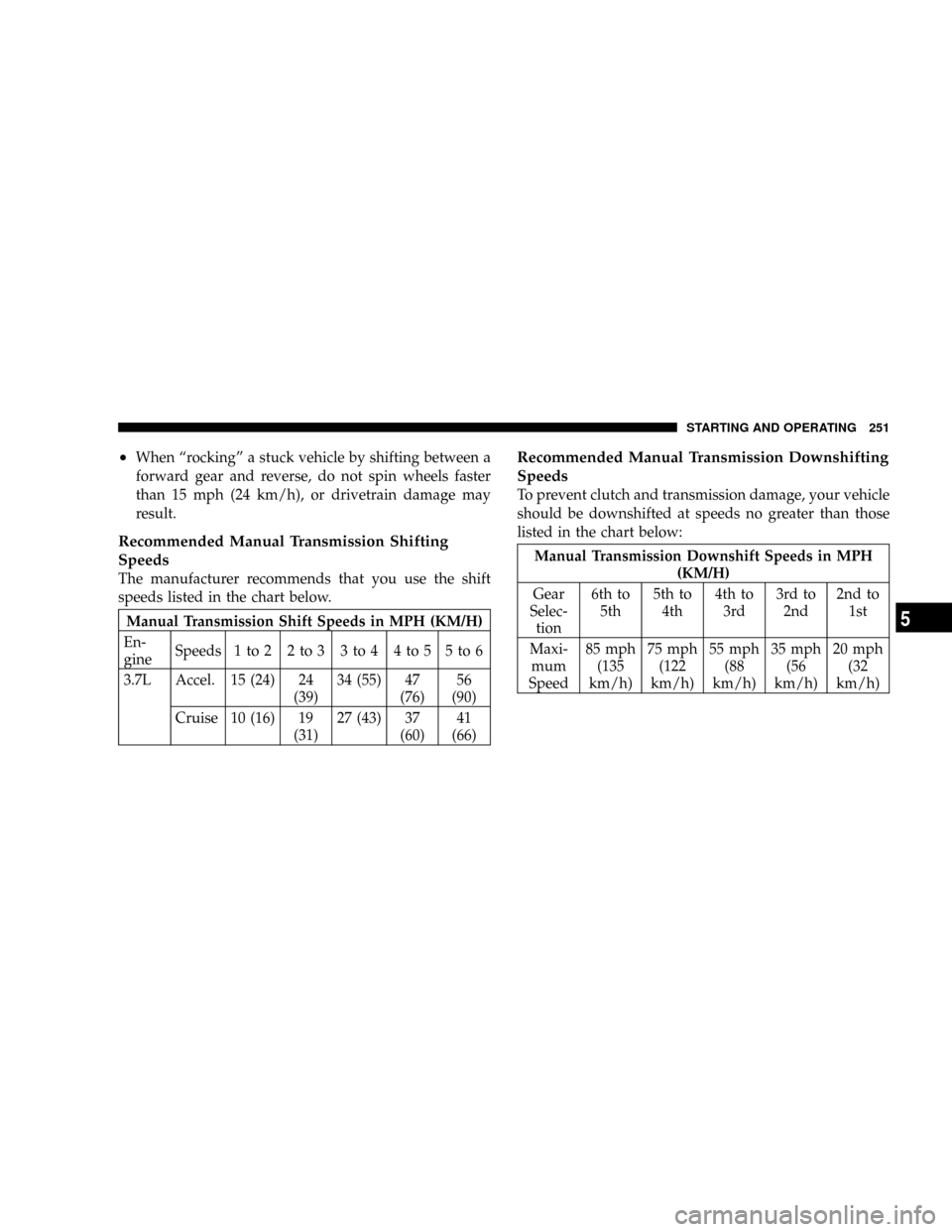
²When ªrockingº a stuck vehicle by shifting between a
forward gear and reverse, do not spin wheels faster
than 15 mph (24 km/h), or drivetrain damage may
result.
Recommended Manual Transmission Shifting
Speeds
The manufacturer recommends that you use the shift
speeds listed in the chart below.
Manual Transmission Shift Speeds in MPH (KM/H)
En-
gineSpeeds 1 to 2 2 to 3 3 to 4 4 to 5 5 to 6
3.7L Accel. 15 (24) 24
(39)34 (55) 47
(76)56
(90)
Cruise 10 (16) 19
(31)27 (43) 37
(60)41
(66)
Recommended Manual Transmission Downshifting
Speeds
To prevent clutch and transmission damage, your vehicle
should be downshifted at speeds no greater than those
listed in the chart below:
Manual Transmission Downshift Speeds in MPH
(KM/H)
Gear
Selec-
tion6th to
5th5th to
4th4th to
3rd3rd to
2nd2nd to
1st
Maxi-
mum
Speed85 mph
(135
km/h)75 mph
(122
km/h)55 mph
(88
km/h)35 mph
(56
km/h)20 mph
(32
km/h)
STARTING AND OPERATING 251
5
Page 252 of 434

CAUTION!
Failure to follow the recommended downshifting
speeds may cause the engine to over speed and/or
damage the clutch disc even if the clutch pedal is
depressed.
AUTOMATIC TRANSMISSION
CAUTION!
Damage to the transmission may occur if the follow-
ing precautions are not observed:
²Shift into P (Park) only after the vehicle has come
to a complete stop.
²Shift into or out of R (Reverse) only after the
vehicle has come to a complete stop and the engine
is at idle speed.
²Do not shift from R (Reverse), P (Park), or N
(Neutral) into any forward gear when the engine is
above idle speed.
²Before shifting into any gear, make sure your foot
is firmly on the brake pedal.
252 STARTING AND OPERATING
Page 257 of 434

1 (First)
For hard pulling at low speeds in mud, sand, snow, or on
steep grades. Begins and stays in low gear with no
upshift. Provides engine compression braking at low
speeds.
Overdrive Operation
The overdrive automatic transmission contains an elec-
tronically controlled fourth and fifth speed (Overdrive).
The transmission will automatically shift from 3rd gear to
Overdrive if the following conditions are present:
²the transmission selector is in D (Drive);
²the engine coolant has reached normal operating tem-
perature;
²vehicle speed is above approximately 30 mph (48
km/h);
²the ªTOW/HAULº button has not been activated;
²transmission has reached normal operating tempera-
ture.
NOTE:If the vehicle is started in extremely cold tem-
peratures, the transmission may not shift into Overdrive
and will automatically select the most desirable gear for
operation at this temperature. Normal operation will
resume when the transmission fluid temperature has
risen to a suitable level. Refer also to the Note under
torque converter clutch, later in this section.
If the transmission temperature gets extremely hot, the
transmission will automatically select the most desirable
gear for operation at this temperature. If the transmission
temperature becomes hot enough the ªTransmission
Temperature Warning Lightº may illuminate and the
transmission may downshift out of Overdrive until the
transmission cools down. After cooldown, the transmis-
sion will resume normal operation.
STARTING AND OPERATING 257
5
Page 259 of 434

Transmission Limp Home Mode
Transmission function is monitored for abnormal condi-
tions. If a condition is detected that could result in
transmission damage, the transmission limp home mode
will be engaged. In this mode, the transmission will
remain in the current gear until the vehicle is brought to
a stop.
To reset the transmission, use the following procedure:
1. Stop the vehicle.
2. Move the shift lever to the P (Park) position.
3. Turn off the engine, be sure to turn the key to the
LOCK position.
4. Wait approximately 10 seconds, then restart the en-
gine.
5. Move the shift lever to the desired gear range.If the problem is no longer detected, the transmission will
return to normal operation. If the problem persists, P
(Park), R (Reverse), and N (Neutral) will continue to
operate. Only Second gear range will operate in the D
(Drive) shifter position. Have the transmission checked at
your authorized dealer as soon as possible.
Torque Converter Clutch
A feature designed to improve fuel economy has been
added to the automatic transmission of this vehicle. A
clutch within the torque converter engages automatically
at calibrated speeds. This may result in a slightly differ-
ent feeling or response during normal operation in high
gear. When the vehicle speed drops or during accelera-
tion, the clutch automatically and smoothly disengages.
STARTING AND OPERATING 259
5
Page 263 of 434

Overdrive Operation
The overdrive automatic transmission contains an elec-
tronically controlled 5th speed (Overdrive). The trans-
mission will automatically shift from 4th gear to Over-
drive if the following conditions are present:
²the transmission selector is in D (Drive);
²the engine coolant has reached normal operating tem-
perature;
²vehicle speed is above approximately 30 mph (48
km/h);
²transmission has reached normal operating tempera-
ture.
NOTE:If the vehicle is started in extremely cold tem-
peratures, the transmission may not shift into Overdrive
and will automatically select the most desirable gear for
operation at this temperature. Normal operation will
resume when the transmission fluid temperature hasrisen to a suitable level. Refer also to the Note under
torque converter clutch, later in this section.
During cold temperature operation, you may notice
delayed upshifts depending on engine and transmission
temperature. This feature improves the warm up time of
the engine and transmission.
During cold temperature operation, the transmission
may not downshift from 2nd (2) gear to 1st (1) gear after
the initial 1st (1) to 2nd (2) gear upshift.
Transmission Limp Home Mode
Transmission function is monitored for abnormal condi-
tions. If a condition is detected that could result in
transmission damage, the transmission limp home mode
will be engaged. In this mode, the transmission will
remain in the current gear until the vehicle is brought to
a stop.
To reset the transmission, use the following procedure:
STARTING AND OPERATING 263
5
Page 264 of 434

1. Stop the vehicle.
2. Move the shift lever to the P (Park) position.
3. Turn off the engine, be sure to turn the key to the
LOCK position.
4. Wait approximately 10 seconds, then restart the en-
gine.
5. Move the shift lever to the desired gear range.
If the problem is no longer detected, the transmission will
return to normal operation. If the problem persists, P
(Park), R (Reverse), and N (Neutral) will continue to
operate. Only Second gear range will operate in the D
(Drive) shifter position. Have the transmission checked at
your authorized dealer as soon as possible.
Torque Converter Clutch
A feature, designed to improve fuel economy, has been
included in the automatic transmission on your vehicle.A clutch within the torque converter engages automati-
cally at a calibrated speed at light throttle. It engages at
higher speeds under heavier acceleration. This may re-
sult in a slightly different feeling or response during
normal operation in high gear. When the vehicle speed
drops below a calibrated speed, or during acceleration,
the clutch automatically and smoothly disengages. The
feature is operational in Overdrive and in Drive.
NOTE:The torque converter clutch will not engage
until the transmission fluid and engine coolant are warm
[usually after 1-3 miles (1.6 - 4.8 km) of driving]. Because
the engine speed is higher when the torque converter
clutch is not engaged, it may seem as if the transmission
is not shifting into Overdrive when cold. This is normal.
NOTE:If the vehicle has not been driven in several
days, the first few seconds of operation after shifting the
transmission into gear may seem sluggish. This is due to
the fluid partially draining from the torque converter into
264 STARTING AND OPERATING