brake DODGE NITRO 2009 1.G User Guide
[x] Cancel search | Manufacturer: DODGE, Model Year: 2009, Model line: NITRO, Model: DODGE NITRO 2009 1.GPages: 459, PDF Size: 6.82 MB
Page 265 of 459
CAUTION! (Continued)
•Shift into or out of REVERSE only after the
vehicle has come to a complete stop and the engine
is at idle speed.
•Do not shift from REVERSE, PARK, or NEUTRAL
into any forward gear when the engine is above
idle speed.
•Before shifting into any gear, make sure your foot
is firmly on the brake pedal.
WARNING!
It is dangerous to move the shift lever out of PARK or
NEUTRAL if the engine speed is higher than idle
speed. If your foot is not firmly on the brake pedal,
the vehicle could accelerate quickly forward or in
REVERSE. You could lose control of the vehicle and
hit someone or something. Only shift into gear when
the engine is idling normally and when your foot is
firmly on the brake pedal.
Brake/Transmission Interlock System
This system prevents you from moving the shift lever out
of PARK and into any gear unless the brake pedal is
pressed. Always depress thebrake pedal first,before
moving the shift lever out of PARK.
STARTING AND OPERATING 263
5
Page 266 of 459
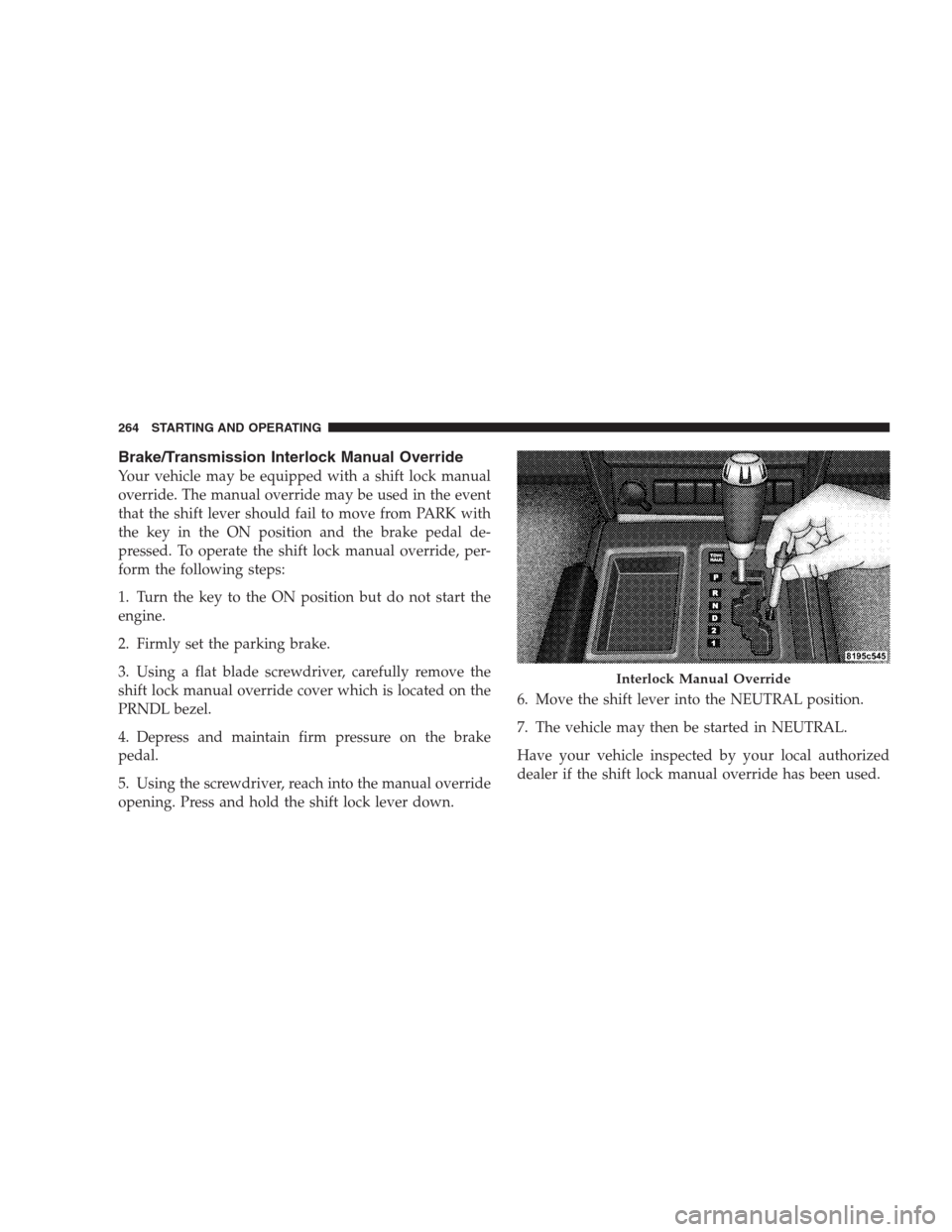
Brake/Transmission Interlock Manual Override
Your vehicle may be equipped with a shift lock manual
override. The manual override may be used in the event
that the shift lever should fail to move from PARK with
the key in the ON position and the brake pedal de-
pressed. To operate the shift lock manual override, per-
form the following steps:
1. Turn the key to the ON position but do not start the
engine.
2. Firmly set the parking brake.
3. Using a flat blade screwdriver, carefully remove the
shift lock manual override cover which is located on the
PRNDL bezel.
4. Depress and maintain firm pressure on the brake
pedal.
5. Using the screwdriver, reach into the manual override
opening. Press and hold the shift lock lever down.6. Move the shift lever into the NEUTRAL position.
7. The vehicle may then be started in NEUTRAL.
Have your vehicle inspected by your local authorized
dealer if the shift lock manual override has been used.
Interlock Manual Override
264 STARTING AND OPERATING
Page 267 of 459
4–Speed Automatic Transmission (3.7L Engine)
NOTE:Under extreme cold temperatures (-6°F (-21°C)
and when in DRIVE, transmission operation may be
briefly limited to only 2nd gear operation. Normal op-
eration will resume once the transmission temperature
has risen to a suitable level.
Shifting from DRIVE to PARK or REVERSE should be
done only after the accelerator pedal is released and the
vehicle is stopped. Be sure to keep your foot on the brake
when moving the shift lever between these gears.
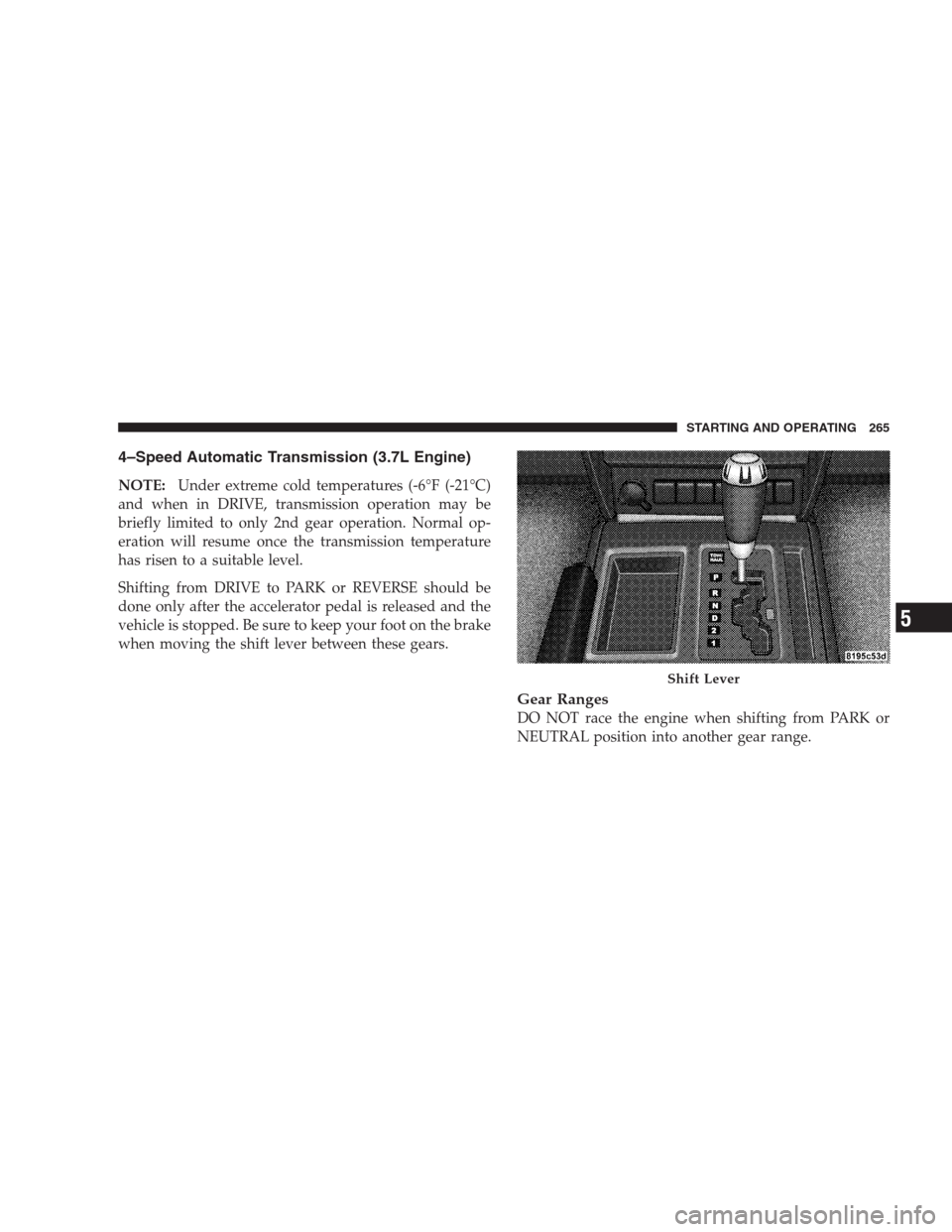
Gear Ranges
DO NOT race the engine when shifting from PARK or
NEUTRAL position into another gear range.
Shift Lever
STARTING AND OPERATING 265
5
Page 268 of 459
PARK
This gear position supplements the parking brake by
locking the transmission. The engine can be started in
this range. Never use PARK while the vehicle is in
motion. Apply the parking brake when leaving the
vehicle in this range. Always apply the parking brake
first, then place the shift lever in the PARK position.
WARNING!
•Never use the PARK position as a substitute for
the parking brake. Always apply the parking
brake fully when parked to guard against vehicle
movement and possible injury or damage.
(Continued)
WARNING! (Continued)
•It is dangerous to move the shift lever out of PARK
or NEUTRAL if the engine speed is higher than
idle speed. If your foot is not firmly on the brake
pedal, the vehicle could accelerate quickly forward
or in REVERSE. You could lose control of the
vehicle and hit someone or something. Only shift
into gear when the engine is idling normally and
when your right foot is firmly on the brake pedal.
REVERSE
Use this range only after the vehicle has come to a
complete stop.
266 STARTING AND OPERATING
Page 269 of 459
NEUTRAL
Move the shift lever into this gear only after the vehicle
has come to a complete stop. Always depress and main-
tain firm pressure on the brake pedal while in this range.
Apply the parking brake when leaving the vehicle in this
range for extended periods of time. The engine may be
started in this range.
NOTE:Towing the vehicle, coasting, or driving for any
other reason with shift lever in NEUTRAL can result in
severe transmission damage. Refer to “Recreational Tow-
ing” in Section 5 and “Towing a Disabled Vehicle” in
Section 6 of this manual.
DRIVE
For most city and highway driving.
2 (Second)
For moderate grades and to assist braking on dry pavement
or in mud and snow. Begins at a stop in low gear with
automatic upshift to 2nd gear. Will not shift to 3rd gear.
1 (First)
For hard pulling at low speeds in mud, sand, snow, or on
steep grades. Begins and stays in low gear with no upshift.
Provides engine compression braking at low speeds.
Overdrive Operation
The overdrive automatic transmission contains an elec-
tronically controlled 4th speed (OVERDRIVE). The trans-
mission will automatically shift from 3rd gear to OVER-
DRIVE if the following conditions are present:
•the shift lever is in DRIVE
•the engine coolant has reached normal operating tem-
perature
•vehicle speed is above approximately 30 mph
(48 km/h)
•the TOW/HAUL button has not been activated
•the transmission has reached normal operating
temperature
STARTING AND OPERATING 267
5
Page 273 of 459
Gear Ranges
NOTE:After selecting any gear range, wait a moment to
allow the selected gear to engage before accelerating.
This is especially important when the engine is cold. If
there is a need to restart the engine, be sure to cycle the
key to the LOCK position before restarting. Transmission
gear engagement may be delayed after restarting the
engine if the key is not cycled to the LOCK position first.
PARK
This gear position supplements the parking brake by
locking the transmission. The engine can be started in
this range. Never use PARK while the vehicle is in
motion. Apply the parking brake when leaving the
vehicle in this range. Always apply the parking brake
first, then place the shift lever in the PARK position.
WARNING!
•Never use the PARK position as a substitute for
the parking brake. Always apply the parking
brake fully when parked to guard against vehicle
movement and possible injury or damage.
•It is dangerous to shift the selector lever out of
PARK or NEUTRAL if the engine speed is higher
than idle speed. If your foot is not firmly on the
brake pedal, the vehicle could accelerate quickly
forward or in REVERSE. You could lose control of
the vehicle and hit someone or something. Only
shift into gear when the engine is idling normally
and when your right foot is firmly on the brake
pedal.
REVERSE
Use this range only after the vehicle has come to a
complete stop.
STARTING AND OPERATING 271
5
Page 274 of 459
NEUTRAL
Shift into NEUTRAL when the vehicle is standing for
prolonged periods with the engine running. The engine
may be started in this range. Set the parking brake if you
must leave the vehicle.
NOTE:Towing the vehicle, coasting, or driving for any
other reason with the shift lever in NEUTRAL can result
in severe transmission damage. Refer to “Recreational
Towing” in Section 5 and “Towing a Disabled Vehicle” in
Section 6 of this manual.
DRIVE
The transmission automatically upshifts through 5th
gear. The DRIVE position provides optimum driving
characteristics under all normal operating conditions.
Electronic Range Select (ERS)Operation
The Electronic Range Select (ERS) shift control allows
you to move the shift lever left (-) or right (+) when the
shift lever is in the DRIVE position, allowing the selectionof the desired top gear. For example, if the driver shifts
the transmission into 3rd gear, the transmission will
never shift above 3rd gear, but can shift down to 2nd gear
or 1st gear, when needed.
WARNING!
Do not downshift for additional engine braking on a
slippery surface. The drive wheels could lose their
grip and the vehicle could skid.
Screen Display12 34D
Actual Gear(s) Al-
lowed1 1-2 1-3 1-4 1-5
NOTE:To select the proper gear position for maximum
deceleration (engine braking), move the shift lever to the
left “D (-)” and hold it there. The transmission will shift
to the range from which the vehicle can best be slowed
down.
272 STARTING AND OPERATING
Page 282 of 459
Hill Climbing
NOTE:Before attempting to climb a hill, determine the
conditions at the crest and/or on the other side.
Before climbing a steep hill,shift the transmission to a
lower gear and shift the transfer case to 4L or 4LO. Use
first gear and 4L or 4LO for very steep hills.
If you stall or begin to lose headwaywhile climbing a
steep hill, allow your vehicle to come to a stop and
immediately apply the brakes. Restart the engine and
shift to REVERSE. Back slowly down the hill allowing the
compression braking of the engine to help regulate your
speed. If the brakes are required to control vehicle speed,
apply them lightly and avoid locking or skidding the
tires.
WARNING!
If the engine stalls or you lose headway or cannot
make it to the top of a steep hill or grade, never
attempt to turn around. To do so may result in
tipping and rolling the vehicle. Always back straight
down a hill in REVERSE gear carefully. Never back
down a hill in NEUTRAL using only the brake.
Remember, never drive diagonally across a hill; always
drive straight up or down.
If the wheels start to slip as you approach the crest of a
hill, ease off the accelerator and maintain headway by
turning the front wheels slowly left and right. This may
provide a fresh “bite” into the surface and will usually
provide traction to complete the climb.
280 STARTING AND OPERATING
Page 283 of 459
Traction Downhill
Shift the transmission into a low gear and the transfer
case to 4L or 4LO range. Let the vehicle go slowly down
the hill with all four wheels turning against engine
compression drag. This will permit you to control the
vehicle speed and direction.
When descending mountains or hills, repeated braking
can cause brake fade with loss of braking control. Avoid
repeated heavy braking by downshifting the transmis-
sion whenever possible.
After Driving Off-Road
Off-road operation puts more stress on your vehicle than
most on-road driving. After going off-road, it is always a
good idea to check for damage. That way you can get any
problems taken care of right away and have your vehicle
ready when you need it.
•Completely inspect the underbody of your vehicle.
Check tires, body structure, steering, suspension, and
exhaust system for damage.
•Check threaded fasteners for looseness, particularly on
the chassis, drivetrain components, steering, and sus-
pension. Retighten them if required and torque to the
values specified in the Service Manual.
•Check for accumulations of plants or brush. These
things could be a fire hazard. They might hide damage
to fuel lines, brake hoses, axle pinion seals, and
propeller shafts.
•After extended operation in mud, sand, water, or
similar dirty conditions, have brake rotors, wheels,
brake linings, and axle yokes inspected and cleaned as
soon as possible.
STARTING AND OPERATING 281
5
Page 284 of 459
WARNING!
Abrasive material in any part of the brakes may cause
excessive wear or unpredictable braking. You might
not have full braking power when you need it to
prevent an accident. If you have been operating your
vehicle in dirty conditions, get your brakes checked
and cleaned as necessary.
•If you experience unusual vibration after driving in
mud, slush, or similar conditions, check the wheels for
impacted material. Impacted material can cause a
wheel imbalance and freeing the wheels of it will
correct the situation.
POWER STEERING
The standard power steering system will give you good
vehicle response and increased ease of maneuverability
in tight spaces. The system will provide mechanical
steering capability if power assist is lost.
If for some reason the power assist is interrupted, it will
still be possible to steer your vehicle. Under these condi-
tions, you will observe a substantial increase in steering
effort, especially at very low vehicle speeds and during
parking maneuvers.
NOTE:Increased noise levels at the end of the steering
wheel travel are considered normal and do not indicate
that there is a problem with the power steering system.
Upon initial start-up in cold weather, the power steering
pump may make noise for a short amount of time. This is
due to the cold, thick fluid in the steering system. This
noise should be considered normal, and it does not in any
way damage the steering system.
282 STARTING AND OPERATING