child restraint DODGE NITRO 2009 1.G User Guide
[x] Cancel search | Manufacturer: DODGE, Model Year: 2009, Model line: NITRO, Model: DODGE NITRO 2009 1.GPages: 459, PDF Size: 6.82 MB
Page 70 of 459
•In the rear seat, you may have trouble tightening the
lap/shoulder belt on the child restraint because the
buckle or latch plate is too close to the belt path
opening on the restraint. Disconnect the latch plate
from the buckle and twist the short buckle-end belt
several times to shorten it. Insert the latch plate into
the buckle with the release button facing out.
•If the belt still cannot be tightened, or if pulling and
pushing on the restraint loosens the belt, disconnect
the latch plate from the buckle, turn the buckle
around, and insert the latch plate into the buckle
again. If you still cannot make the child restraint
secure, try a different seating position.
•Buckle the child into the restraint exactly as the
manufacturer’s instructions tell you.
•When your child restraint is not in use, secure it in the
vehicle with the seat belt or remove it from the vehicle.
Do not leave it loose in the vehicle. In a sudden stop or
collision, it could strike the occupants or seatbacks and
cause serious personal injury.
NOTE:For additional information, refer to
www.seatcheck.org or call 1-866-SEATCHECK.
Older Children and Child Restraints
Children who weigh more than 20 lbs (9 kg) and who are
older than one year can ride forward-facing in the
vehicle. Forward-facing child seats and convertible child
seats used in the forward-facing direction are for children
who weigh 20 to 40 lbs (9 to 18 kg), and who are older
than one year. These child seats are also held in the
vehicle by the lap/shoulder belt or the LATCH child
restraint anchorage system (refer to LATCH — Child Seat
Anchorage System in this section.)
68 THINGS TO KNOW BEFORE STARTING YOUR VEHICLE
Page 71 of 459
The belt-positioning booster seat is for children weighing
more than 40 lbs (18 kg), but who are still too small to fit
the vehicle’s seat belts properly. If the child cannot sit
with knees bent over the vehicle’s seat cushion while the
child’s back is against the seatback, they should use a
belt-positioning booster seat. The child and belt-
positioning booster seat are held in the vehicle by the
lap/shoulder belt.
Children Too Large for Booster Seats
Children who are large enough to wear the shoulder belt
comfortably and whose legs are long enough to bend
over the front of the seat when their back is against the
seatback, should use the lap/shoulder belt in a rear seat.
•Make sure that the child is upright in the seat.
•The lap portion should be low on the hips and as snug
as possible.
•Check belt fit periodically. A child’s squirming or
slouching can move the belt out of position.
•If the shoulder belt contacts the face or neck, move the
child closer to the center of the vehicle. Never allow a
child to put the shoulder belt under an arm or behind
their back.
LATCH — Child Seat Anchorage System (Lower
Anchors and Tether for CHildren)
Your vehicle’s rear seat is equipped with the child
restraint anchorage system called LATCH. The LATCH
system provides for the installation of the child restraint
without using the vehicle’s seat belts, instead securing
the child restraint using lower anchorages and upper
tether straps from the child restraint to the vehicle
structure.
THINGS TO KNOW BEFORE STARTING YOUR VEHICLE 69
2
Page 72 of 459
LATCH-compatible child restraint systems are now avail-
able. However, because the lower anchorages are to be
introduced over a period of years, child restraint systems
having attachments for those anchorages will continue to
also have features for installation using the vehicle’s seat
belts. Child restraints having tether straps and hooks for
connection to the top tether anchorages have been avail-
able for some time. For some older child restraints, many
child restraint manufacturers offer add-on tether strap
kits or retro-fit kits. You are urged to take advantage of all
the available attachments provided with your child re-
straint in any vehicle.
All three rear seating positions have lower anchorages
that are capable of accommodating LATCH-compatible
child seats having fixed lower attachments or flexible
webbing-mounted lower attachments. Child seats withfixed lower attachments must be installed in the out-
board seating positions only. The center seating position
will accommodate LATCH-compatible lower anchorages
with flexible webbing mounted attachments only. Re-
gardless of the specific type of lower attachment,NEVER
install LATCH-compatible child seats so that two seats
share a common lower anchorage.
If you are installing LATCH-compatible child restraints
in adjacent rear seating positions, you can use the
LATCH anchors or the vehicle’s seat belt for the outboard
position, but you must use the vehicle’s seat belt at the
center position. If your child restraints are not LATCH-
compatible, you can only install the child restraints using
the vehicle’s seat belts. Please refer to the next section for
typical installation instructions.
70 THINGS TO KNOW BEFORE STARTING YOUR VEHICLE
Page 73 of 459
Installing the LATCH-Compatible Child Restraint
System
We urge that you carefully follow the directions of the
manufacturer when installing your child restraint. Not all
child restraint systems will be installed as described here.
Again, carefully follow the installation instructions that
were provided with the child restraint system.
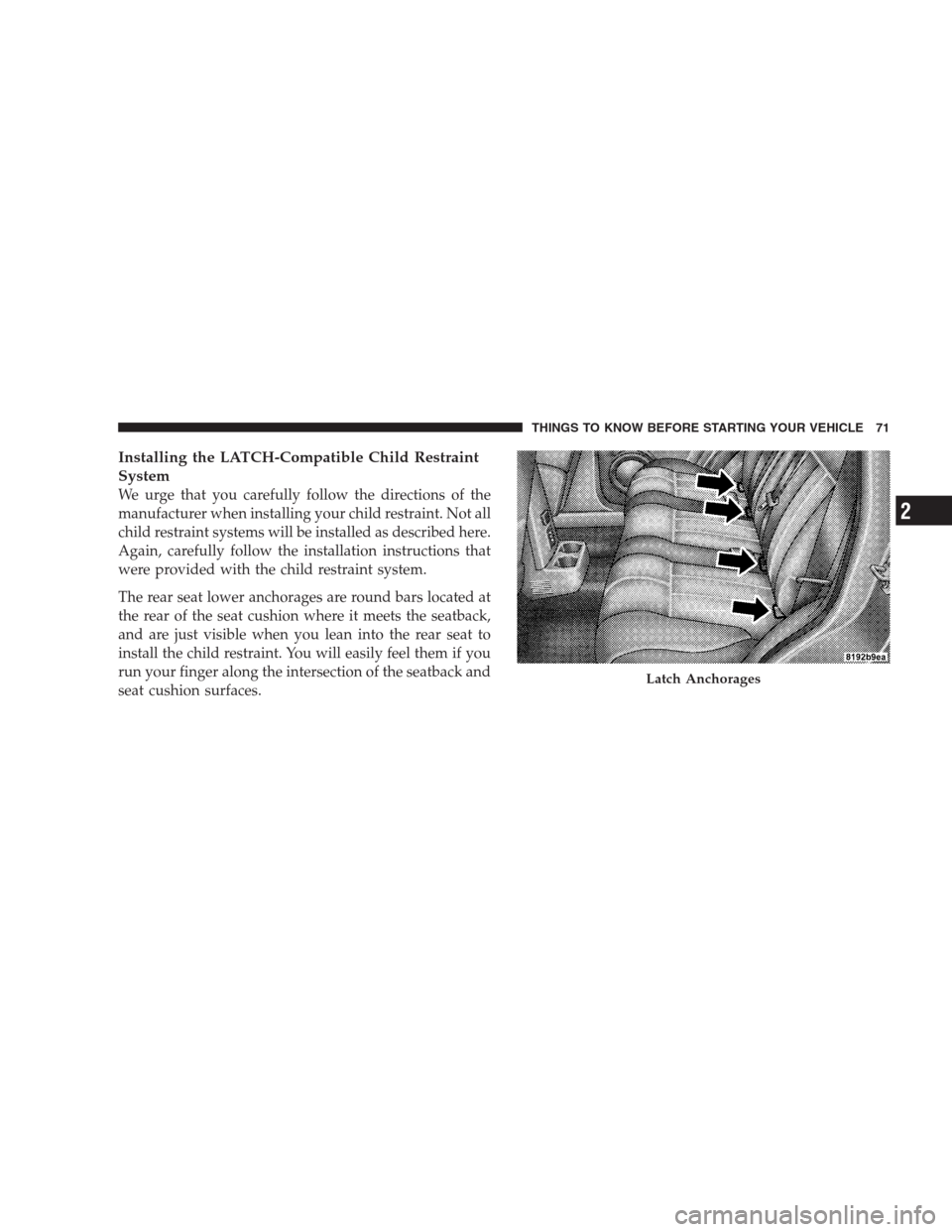
The rear seat lower anchorages are round bars located at
the rear of the seat cushion where it meets the seatback,
and are just visible when you lean into the rear seat to
install the child restraint. You will easily feel them if you
run your finger along the intersection of the seatback and
seat cushion surfaces.
Latch Anchorages
THINGS TO KNOW BEFORE STARTING YOUR VEHICLE 71
2
Page 74 of 459
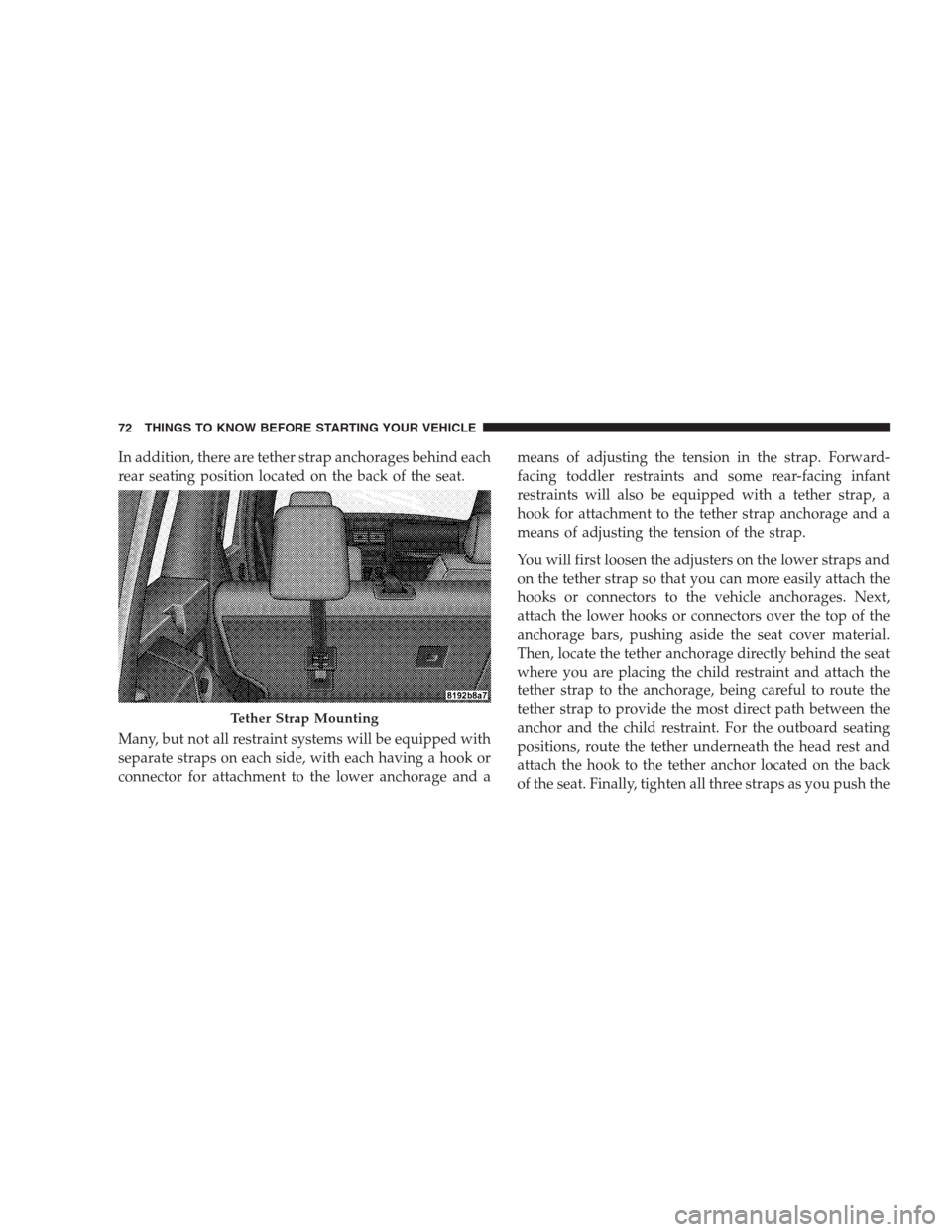
In addition, there are tether strap anchorages behind each
rear seating position located on the back of the seat.
Many, but not all restraint systems will be equipped with
separate straps on each side, with each having a hook or
connector for attachment to the lower anchorage and ameans of adjusting the tension in the strap. Forward-
facing toddler restraints and some rear-facing infant
restraints will also be equipped with a tether strap, a
hook for attachment to the tether strap anchorage and a
means of adjusting the tension of the strap.
You will first loosen the adjusters on the lower straps and
on the tether strap so that you can more easily attach the
hooks or connectors to the vehicle anchorages. Next,
attach the lower hooks or connectors over the top of the
anchorage bars, pushing aside the seat cover material.
Then, locate the tether anchorage directly behind the seat
where you are placing the child restraint and attach the
tether strap to the anchorage, being careful to route the
tether strap to provide the most direct path between the
anchor and the child restraint. For the outboard seating
positions, route the tether underneath the head rest and
attach the hook to the tether anchor located on the back
of the seat. Finally, tighten all three straps as you push the
Tether Strap Mounting
72 THINGS TO KNOW BEFORE STARTING YOUR VEHICLE
Page 75 of 459
child restraint rearward and downward into the seat,
removing slack in the straps according to the child
restraint manufacturer’s instructions.
WARNING!
Improper installation of a child restraint to the
LATCH anchorages can lead to failure of an infant or
child restraint. The child could be badly injured or
killed. Follow the manufacturer’s directions exactly
when installing an infant or child restraint.
Installing Child Restraints Using the Vehicle Seat
Belt
The passenger seat belts are equipped with either cinching
latch plates or automatic locking retractors, which are de-
signed to keep the lap portion tight around the child
restraint so that it is not necessary to use a locking clip. If the
seat belt has a cinching latch plate, pulling up on the
shoulder portion of the lap/shoulder belt will tighten thebelt. However, any seat belt system may loosen with time, so
check the belt occasionally and pull it tight if necessary.
If the seat belt has an automatic locking retractor, it will
have a distinctive label. Pull the belt from the retractor
until there is enough to allow it to pass through the child
restraint and slide the latch plate into the buckle. Then,
pull the belt until it is completely extracted from the
retractor. Allow the belt to return to the retractor, pulling
on the excess webbing to tighten the lap portion about
the child restraint. Refer to “Automatic Locking Mode”
earlier in this section.
In the rear seat, you may have trouble tightening the
lap/shoulder belt on the child restraint because the
buckle or latch plate is too close to the belt path opening
on the restraint. Disconnect the latch plate from the
buckle and twist the short buckle-end belt several times
to shorten it. Insert the latch plate into the buckle with the
release button facing out.
THINGS TO KNOW BEFORE STARTING YOUR VEHICLE 73
2
Page 76 of 459
If the belt still can’t be tightened, or if by pulling and
pushing on the restraint loosens the belt, you may need
to do something more. Disconnect the latch plate from
the buckle, turn the buckle around, and insert the latch
plate into the buckle again. If you still can’t make the
child restraint secure, try a different seating position.
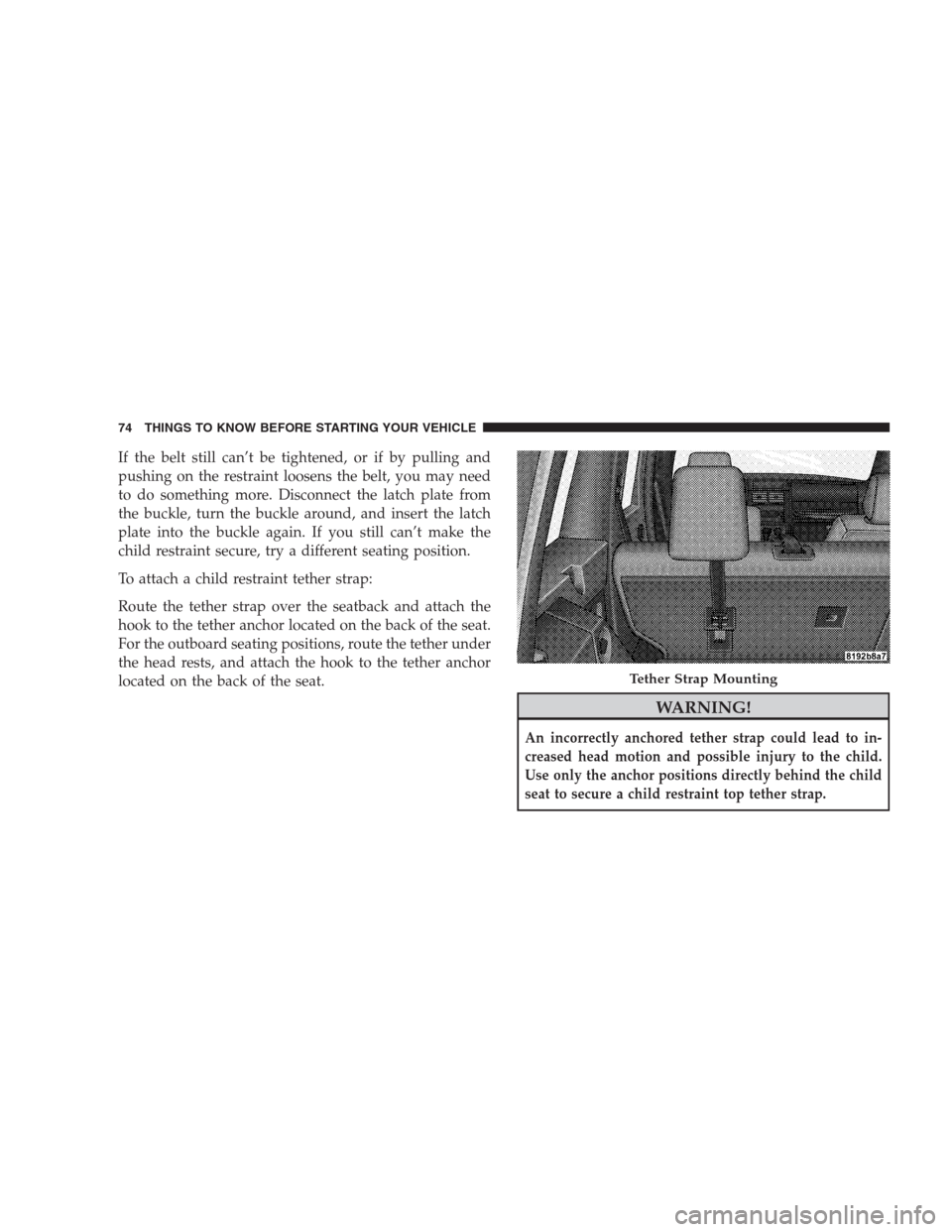
To attach a child restraint tether strap:
Route the tether strap over the seatback and attach the
hook to the tether anchor located on the back of the seat.
For the outboard seating positions, route the tether under
the head rests, and attach the hook to the tether anchor
located on the back of the seat.
WARNING!
An incorrectly anchored tether strap could lead to in-
creased head motion and possible injury to the child.
Use only the anchor positions directly behind the child
seat to secure a child restraint top tether strap.
Tether Strap Mounting
74 THINGS TO KNOW BEFORE STARTING YOUR VEHICLE
Page 442 of 459
Cargo Load Floor........................ 162
Cargo Slide Out System
LoadNGo .......................... 163
Cargo Tie-Downs........................ 160
Cargo (Vehicle Loading)................... 334
Cellular Phone.......................... 86
Center High Mounted Stop Light............ 407
Certification Label....................... 334
Changing A Flat Tire..................... 356
Charging.............................. 362
Chart, Tire Sizing........................ 298
Check Engine Light (Malfunction
Indicator Light)......................186,370
Checks, Safety.........................76,77
Child Restraint....................65,66,71,73
Child Restraint Tether Anchors.............69,71
Child Safety Locks........................ 31
Climate Control......................... 248
Clock........................202,216,220,229Coin Holder........................... 159
Compact Disc (CD) Maintenance............. 247
Compact Spare Tire...................... 308
Compass........................187,190,195
Compass Calibration..................190,196
Compass Variance....................189,197
Computer, Trip/Travel.................... 194
Console.............................. 159
Console, Floor.......................... 159
Contract, Service........................ 431
Cooling System......................... 382
Adding Coolant (Antifreeze).............. 384
Coolant Capacity...................... 408
Coolant Level......................... 386
Disposal of Used Coolant................ 386
Drain, Flush, and Refill.................. 383
Inspection........................... 383
Points to Remember.................... 387
Pressure Cap......................... 385
440 INDEX
Page 447 of 459
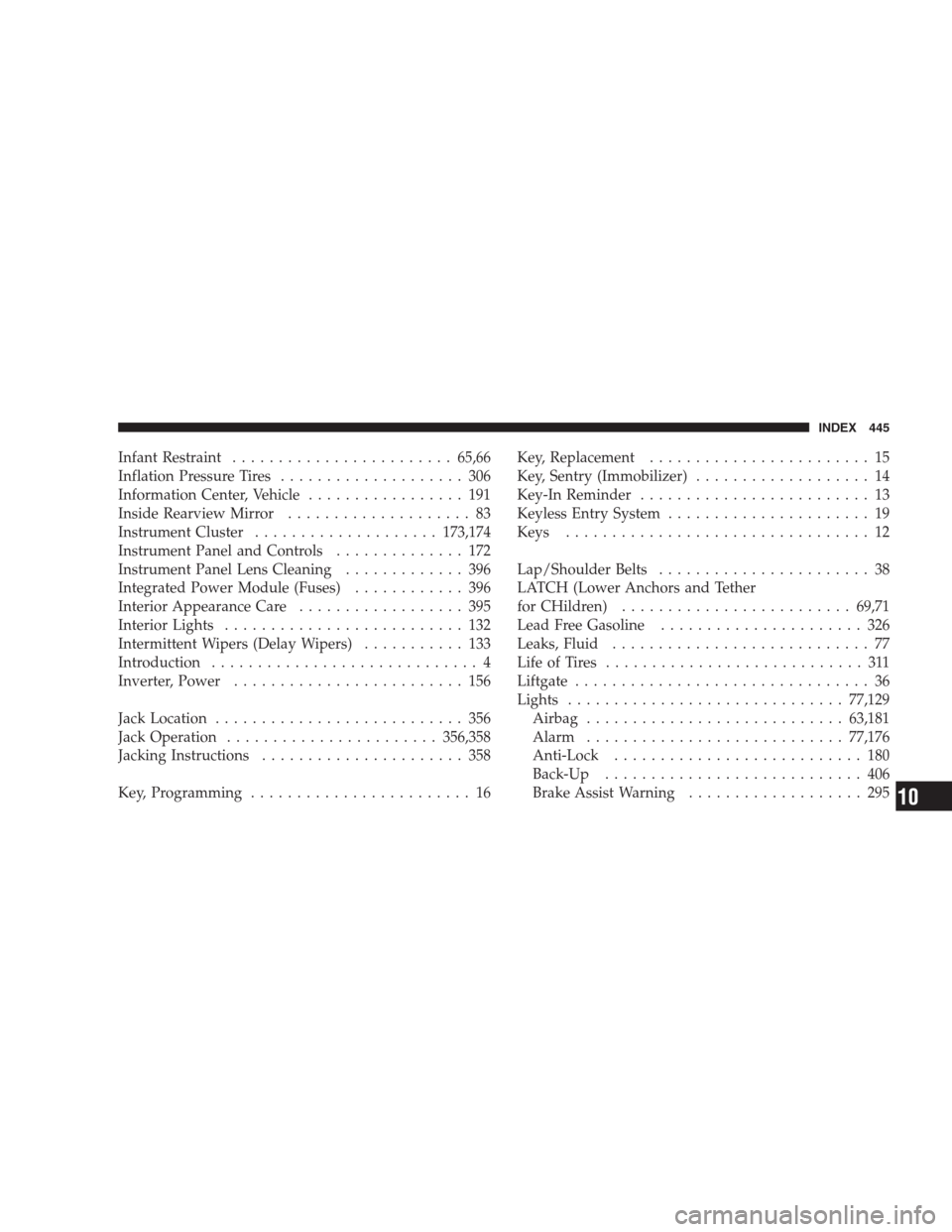
Infant Restraint........................65,66
Inflation Pressure Tires.................... 306
Information Center, Vehicle................. 191
Inside Rearview Mirror.................... 83
Instrument Cluster....................173,174
Instrument Panel and Controls.............. 172
Instrument Panel Lens Cleaning............. 396
Integrated Power Module (Fuses)............ 396
Interior Appearance Care.................. 395
Interior Lights.......................... 132
Intermittent Wipers (Delay Wipers)........... 133
Introduction............................. 4
Inverter, Power......................... 156
Jack Location........................... 356
Jack Operation.......................356,358
Jacking Instructions...................... 358
Key, Programming........................ 16Key, Replacement........................ 15
Key, Sentry (Immobilizer)................... 14
Key-In Reminder......................... 13
Keyless Entry System...................... 19
Keys................................. 12
Lap/Shoulder Belts....................... 38
LATCH (Lower Anchors and Tether
for CHildren).........................69,71
Lead Free Gasoline...................... 326
Leaks, Fluid............................ 77
Life of Tires............................ 311
Liftgate................................ 36
Lights..............................77,129
Airbag............................63,181
Alarm............................77,176
Anti-Lock........................... 180
Back-Up............................ 406
Brake Assist Warning................... 295
INDEX 445
10
Page 449 of 459
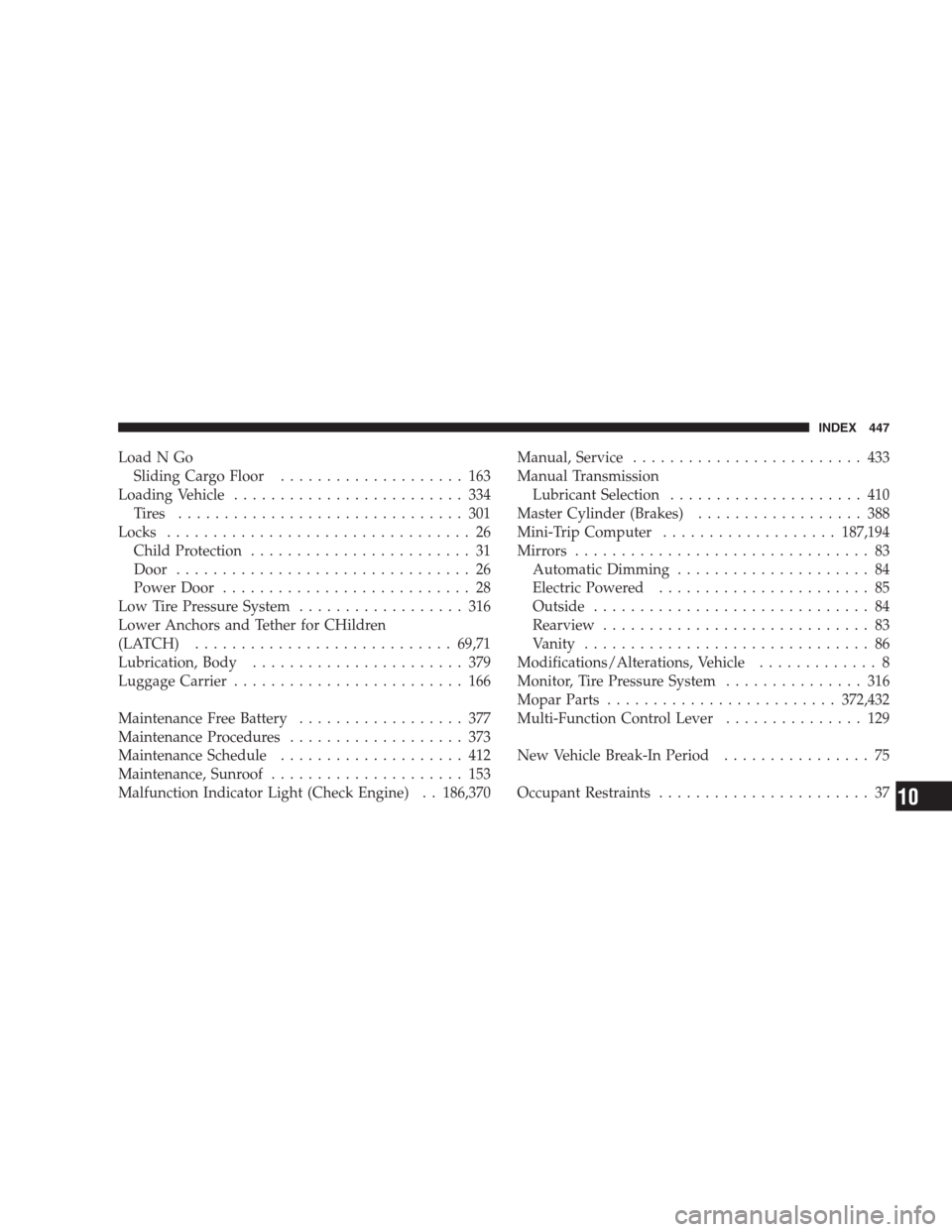
Load N Go
Sliding Cargo Floor.................... 163
Loading Vehicle......................... 334
Tires ............................... 301
Locks................................. 26
Child Protection........................ 31
Door................................ 26
Power Door........................... 28
Low Tire Pressure System.................. 316
Lower Anchors and Tether for CHildren
(LATCH)............................69,71
Lubrication, Body....................... 379
Luggage Carrier......................... 166
Maintenance Free Battery.................. 377
Maintenance Procedures................... 373
Maintenance Schedule.................... 412
Maintenance, Sunroof..................... 153
Malfunction Indicator Light (Check Engine) . . 186,370Manual, Service......................... 433
Manual Transmission
Lubricant Selection..................... 410
Master Cylinder (Brakes).................. 388
Mini-Trip Computer...................187,194
Mirrors................................ 83
Automatic Dimming..................... 84
Electric Powered....................... 85
Outside.............................. 84
Rearview............................. 83
Vanity............................... 86
Modifications/Alterations, Vehicle............. 8
Monitor, Tire Pressure System............... 316
Mopar Parts.........................372,432
Multi-Function Control Lever............... 129
New Vehicle Break-In Period................ 75
Occupant Restraints....................... 37
INDEX 447
10