inflation pressure DODGE NITRO 2009 1.G User Guide
[x] Cancel search | Manufacturer: DODGE, Model Year: 2009, Model line: NITRO, Model: DODGE NITRO 2009 1.GPages: 459, PDF Size: 6.82 MB
Page 318 of 459
These effects can be reduced by timely rotation of tires.
The benefits of rotation are especially worthwhile with
aggressive tread designs such as those on On/Off-Road
type tires. Rotation will increase tread life, help to main-
tain mud, snow, and wet traction levels, and contribute to
a smooth, quiet ride.
Follow the recommended tire rotation frequency for your
type of driving. Refer to “Maintenance Schedules” in
Section 8 of this manual. More frequent rotation is
permissible if desired. The reasons for any rapid or
unusual wear should be corrected prior to rotation being
performed.
NOTE:The premium Tire Pressure Monitor System will
automatically locate the pressure values displayed in the
correct vehicle position following a tire rotation.TIRE PRESSURE MONITOR SYSTEM (TPMS)
•
The Tire Pressure Monitor System (TPMS) will warn
the driver of a low tire pressure based on the vehicle
recommended cold placard pressure.
•The tire pressure will vary with temperature by about
1 psi (6.9 kPa) for every 12°F (6.5°C). This means that
when the outside temperature decreases, the tire pres-
sure will decrease. Tire pressure should always be set
based on cold inflation tire pressure. This is defined as
the tire pressure after the vehicle has not been driven
for at least three hours, or driven less than 1 mile
(1 km) after a three hour period. The cold tire inflation
pressure must not exceed the maximum inflation
pressure molded into the tire sidewall. Refer to the
“Tires – General Information” in this section for infor-
mation on how to properly inflate the vehicle’s tires.
316 STARTING AND OPERATING
Page 320 of 459
CAUTION!
•The TPMS has been optimized for the original
equipment tires and wheels. TPMS pressures and
warning have been established for the tire size
equipped on your vehicle. Undesirable system
operation or sensor damage may result when us-
ing replacement equipment that is not of the same
size, type, and/or style. Aftermarket wheels can
cause sensor damage. Do not use aftermarket tire
sealants or balance beads if your vehicle is
equipped with a TPMS, as damage to the sensors
may result.
•After inspecting or adjusting the tire pressure,
always reinstall the valve stem cap. This will
prevent moisture and dirt from entering the valve
stem, which could damage the Tire Pressure Moni-
toring Sensor.NOTE:
•The TPMS is not intended to replace normal tire care
and maintenance, or to provide warning of a tire
failure or condition.
•The TPMS should not be used as a tire pressure gauge
while adjusting your tire pressure.
•Driving on a significantly under-inflated tire causes
the tire to overheat and can lead to tire failure.
Under-inflation also reduces fuel efficiency and tire
tread life, and may affect the vehicle’s handling and
stopping ability.
•The TPMS is not a substitute for proper tire mainte-
nance, and it is the driver ’s responsibility to maintain
correct tire pressure using an accurate tire pressure
gauge, even if under-inflation has not reached the
level to trigger illumination of the Tire Pressure Moni-
toring Telltale light.
318 STARTING AND OPERATING
Page 321 of 459
•Seasonal temperature changes will affect tire pressure,
and the TPMS will monitor the actual tire pressure in
the tire.
Base System
The Tire Pressure Monitor System (TPMS) uses wireless
technology with wheel rim mounted electronic sensors to
monitor tire pressure levels. Sensors, mounted to each
wheel as part of the valve stem, transmit tire pressure
readings to the receiver module.
NOTE:It is particularly important for you to check the
tire pressure in all of the tires on your vehicle monthly
and to maintain the proper pressure.
The TPMS consists of the following components:
•Receiver Module
•Four Tire Pressure Monitoring Sensors
•Tire Pressure Monitoring Telltale lightThe matching full-size spare wheel and tire assembly (if
equipped) has a tire pressure monitoring sensor. The
matching full-size spare can be used in place of any of the
four road tires. The TPMS will only monitor the pressure
in the full-size spare when it is used in place of a road
tire. Otherwise, a spare with a pressure below the low-
pressure limit will not cause the Tire Pressure Monitoring
Telltale light to illuminate or the chime to sound.
Tire Pressure Monitoring Low Pressure Warnings
The Tire Pressure Monitoring Telltale light will illu-
minate in the instrument cluster and a chime will
sound when tire pressure is low in one or more of the
four active road tires. Should this occur, you should stop as
soon as possible, check the inflation pressure of each tire on
your vehicle, and inflate each tire to the vehicle’s recom-
mended cold placard pressure value. Once the system
receives the updated tire pressures, the system will auto-
matically update and the Tire Pressure Monitoring Telltale
STARTING AND OPERATING 319
5
Page 337 of 459
Tire Size
The tire size on the label represents the actual tire size on
your vehicle. Replacement tires must be equal to the load
capacity of this tire size.
Rim Size
This is the rim size that is appropriate for the tire size
listed.
Inflation Pressure
This is the cold tire inflation pressure for your vehicle for
all loading conditions up to full GAWR.
Curb Weight
The curb weight of a vehicle is defined as the total weight
of the vehicle with all fluids, including vehicle fuel, at full
capacity conditions, and with no occupants or cargo
loaded into the vehicle. The front and rear curb weight
values are determined by weighing your vehicle on a
commercial scale before any occupants or cargo are
added.
Loading
The actual total weight and the weight of the front and
rear of your vehicle at the ground can best be determined
by weighing it when it is loaded and ready for operation.
The entire vehicle should first be weighed on a commer-
cial scale to ensure that the GVWR has not been ex-
ceeded. The weight on the front and rear of the vehicle
should then be determined separately to be sure that the
load is properly distributed over front and rear axle.
Weighing the vehicle may show that the GAWR of either
the front or rear axles has been exceeded, but the total
load is within the specified GVWR. If so, weight must be
shifted from front to rear, or rear to front, as appropriate
until the specified weight limitations are met. Store the
heavier items down low and be sure that the weight is
distributed equally. Stow all loose items securely before
driving.
STARTING AND OPERATING 335
5
Page 349 of 459
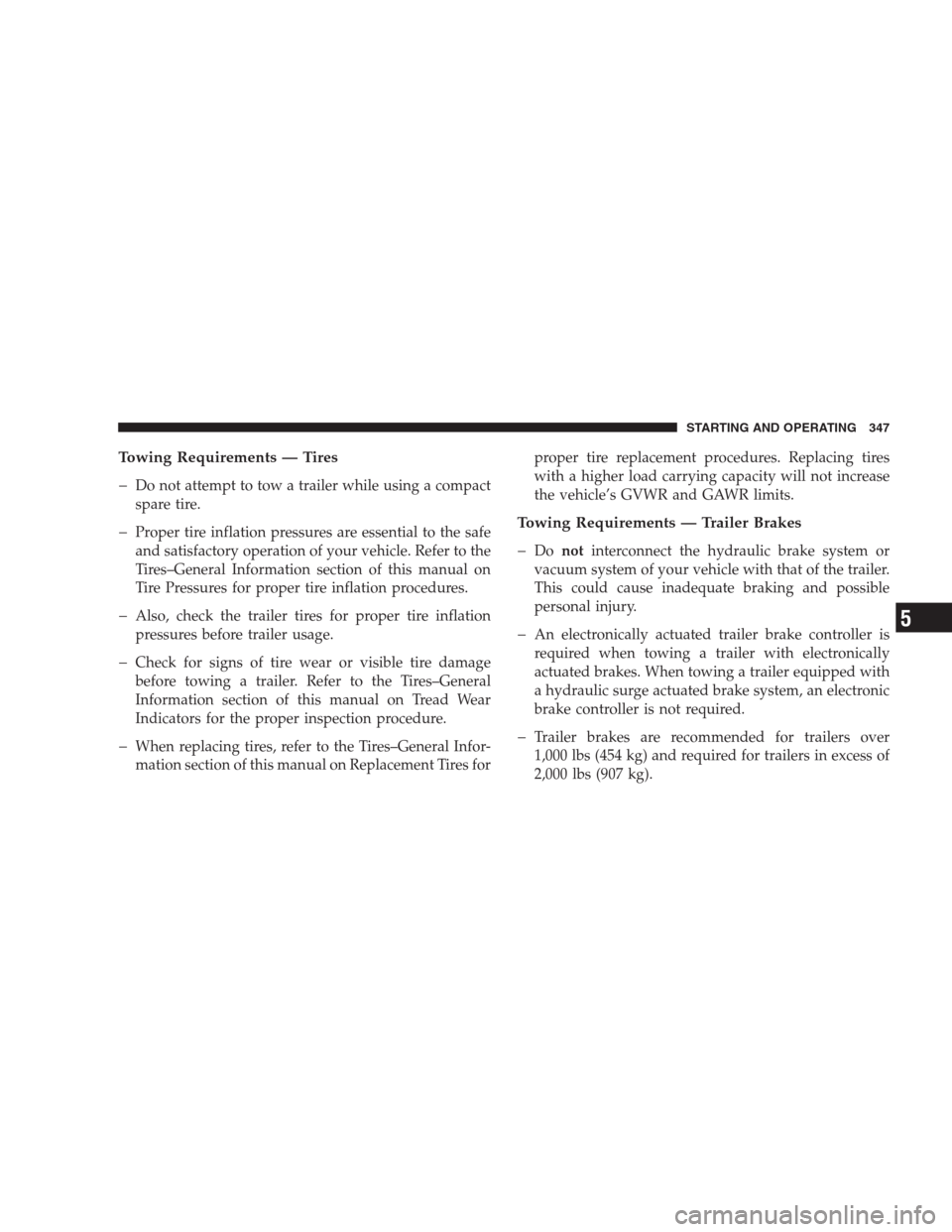
Towing Requirements — Tires
Do not attempt to tow a trailer while using a compact
spare tire.
Proper tire inflation pressures are essential to the safe
and satisfactory operation of your vehicle. Refer to the
Tires–General Information section of this manual on
Tire Pressures for proper tire inflation procedures.
Also, check the trailer tires for proper tire inflation
pressures before trailer usage.
Check for signs of tire wear or visible tire damage
before towing a trailer. Refer to the Tires–General
Information section of this manual on Tread Wear
Indicators for the proper inspection procedure.
When replacing tires, refer to the Tires–General Infor-
mation section of this manual on Replacement Tires forproper tire replacement procedures. Replacing tires
with a higher load carrying capacity will not increase
the vehicle’s GVWR and GAWR limits.
Towing Requirements — Trailer Brakes
Donotinterconnect the hydraulic brake system or
vacuum system of your vehicle with that of the trailer.
This could cause inadequate braking and possible
personal injury.
An electronically actuated trailer brake controller is
required when towing a trailer with electronically
actuated brakes. When towing a trailer equipped with
a hydraulic surge actuated brake system, an electronic
brake controller is not required.
Trailer brakes are recommended for trailers over
1,000 lbs (454 kg) and required for trailers in excess of
2,000 lbs (907 kg).
STARTING AND OPERATING 347
5
Page 447 of 459
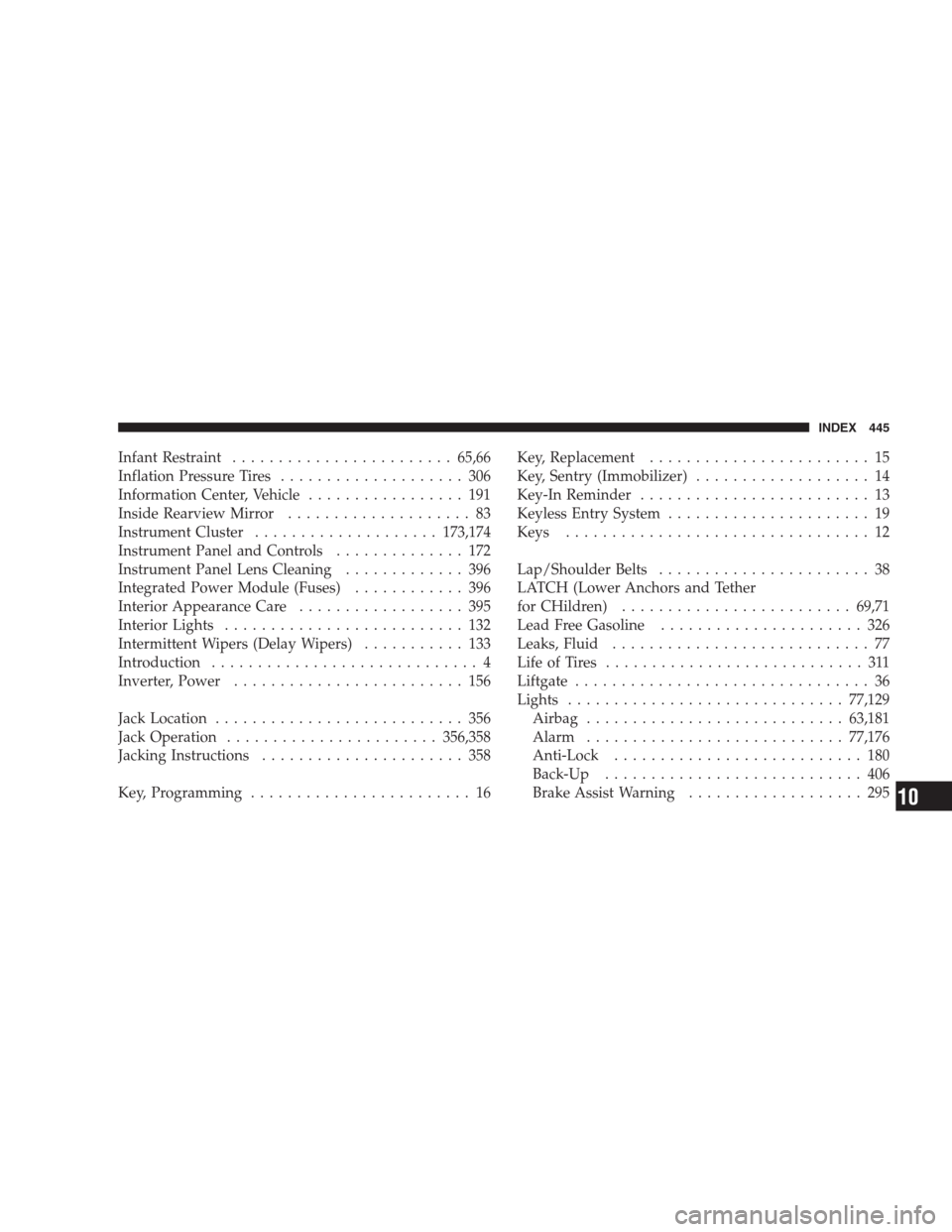
Infant Restraint........................65,66
Inflation Pressure Tires.................... 306
Information Center, Vehicle................. 191
Inside Rearview Mirror.................... 83
Instrument Cluster....................173,174
Instrument Panel and Controls.............. 172
Instrument Panel Lens Cleaning............. 396
Integrated Power Module (Fuses)............ 396
Interior Appearance Care.................. 395
Interior Lights.......................... 132
Intermittent Wipers (Delay Wipers)........... 133
Introduction............................. 4
Inverter, Power......................... 156
Jack Location........................... 356
Jack Operation.......................356,358
Jacking Instructions...................... 358
Key, Programming........................ 16Key, Replacement........................ 15
Key, Sentry (Immobilizer)................... 14
Key-In Reminder......................... 13
Keyless Entry System...................... 19
Keys................................. 12
Lap/Shoulder Belts....................... 38
LATCH (Lower Anchors and Tether
for CHildren).........................69,71
Lead Free Gasoline...................... 326
Leaks, Fluid............................ 77
Life of Tires............................ 311
Liftgate................................ 36
Lights..............................77,129
Airbag............................63,181
Alarm............................77,176
Anti-Lock........................... 180
Back-Up............................ 406
Brake Assist Warning................... 295
INDEX 445
10
Page 454 of 459
Supplemental Restraint System - Airbag........ 48
Synthetic Engine Oil...................... 375
System, Remote Starting.................... 25
Tachometer............................ 181
Temperature Gauge, Engine Coolant.......... 174
Tether Anchor, Child Restraint............... 69
Tie Down Hooks, Cargo................... 160
Tilt Steering Column..................... 134
Tip Start.............................. 259
Tire and Loading Information Placard......... 301
Tire Identification Number (TIN)............. 300
Tire Markings.......................... 296
Tire Safety Information.................... 296
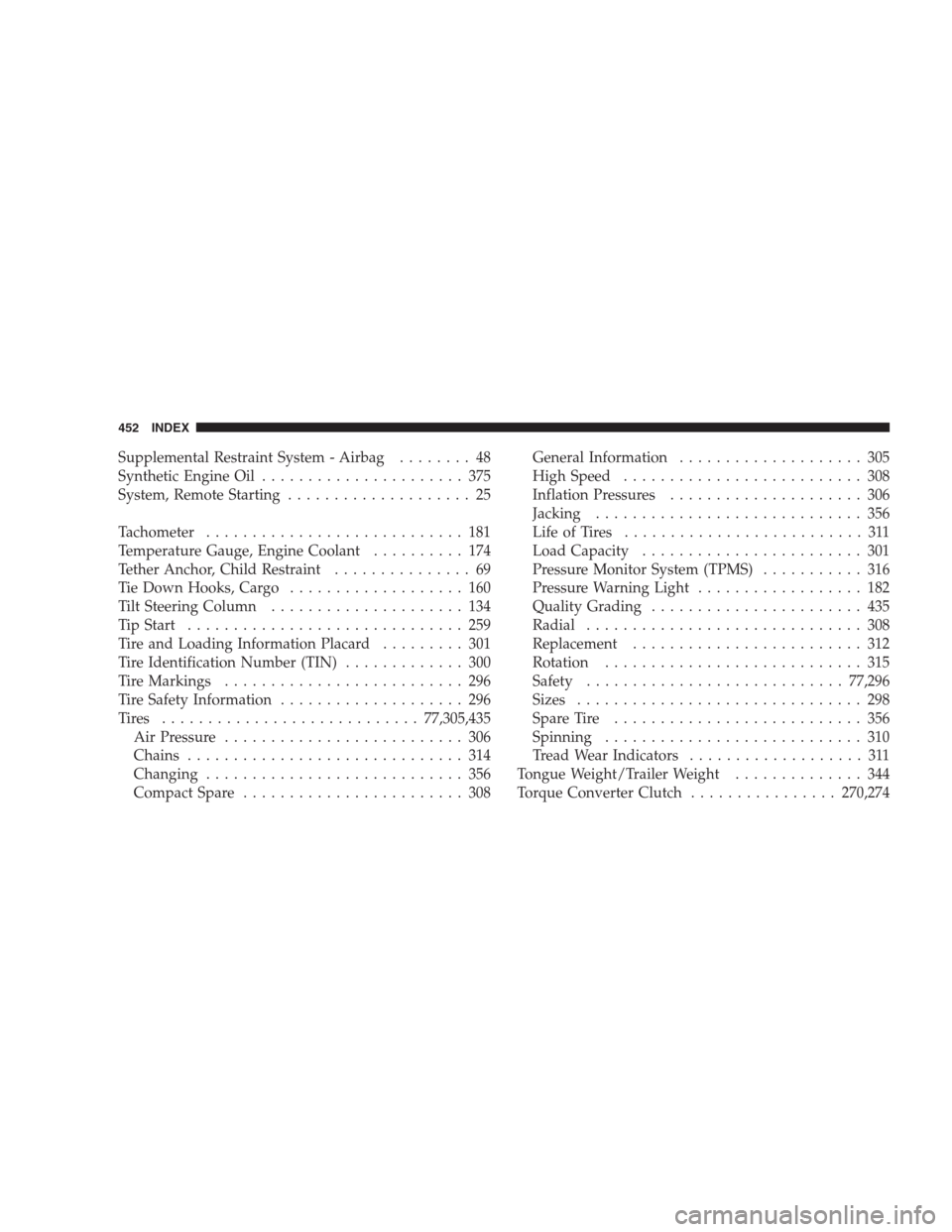
Tires ............................77,305,435
Air Pressure.......................... 306
Chains.............................. 314
Changing............................ 356
Compact Spare........................ 308General Information.................... 305
High Speed.......................... 308
Inflation Pressures..................... 306
Jacking............................. 356
Life of Tires.......................... 311
Load Capacity........................ 301
Pressure Monitor System (TPMS)........... 316
Pressure Warning Light.................. 182
Quality Grading....................... 435
Radial.............................. 308
Replacement......................... 312
Rotation............................ 315
Safety............................77,296
Sizes............................... 298
Spare Tire........................... 356
Spinning............................ 310
Tread Wear Indicators................... 311
Tongue Weight/Trailer Weight.............. 344
Torque Converter Clutch................270,274
452 INDEX