warning DODGE NITRO 2009 1.G User Guide
[x] Cancel search | Manufacturer: DODGE, Model Year: 2009, Model line: NITRO, Model: DODGE NITRO 2009 1.GPages: 459, PDF Size: 6.82 MB
Page 33 of 459
4. A single chime will indicate the completion of the
programming.
5. Repeat these steps if you want to return this feature to
its previous setting.
NOTE:Use the automatic unlock doors on exit feature
in accordance with local laws.
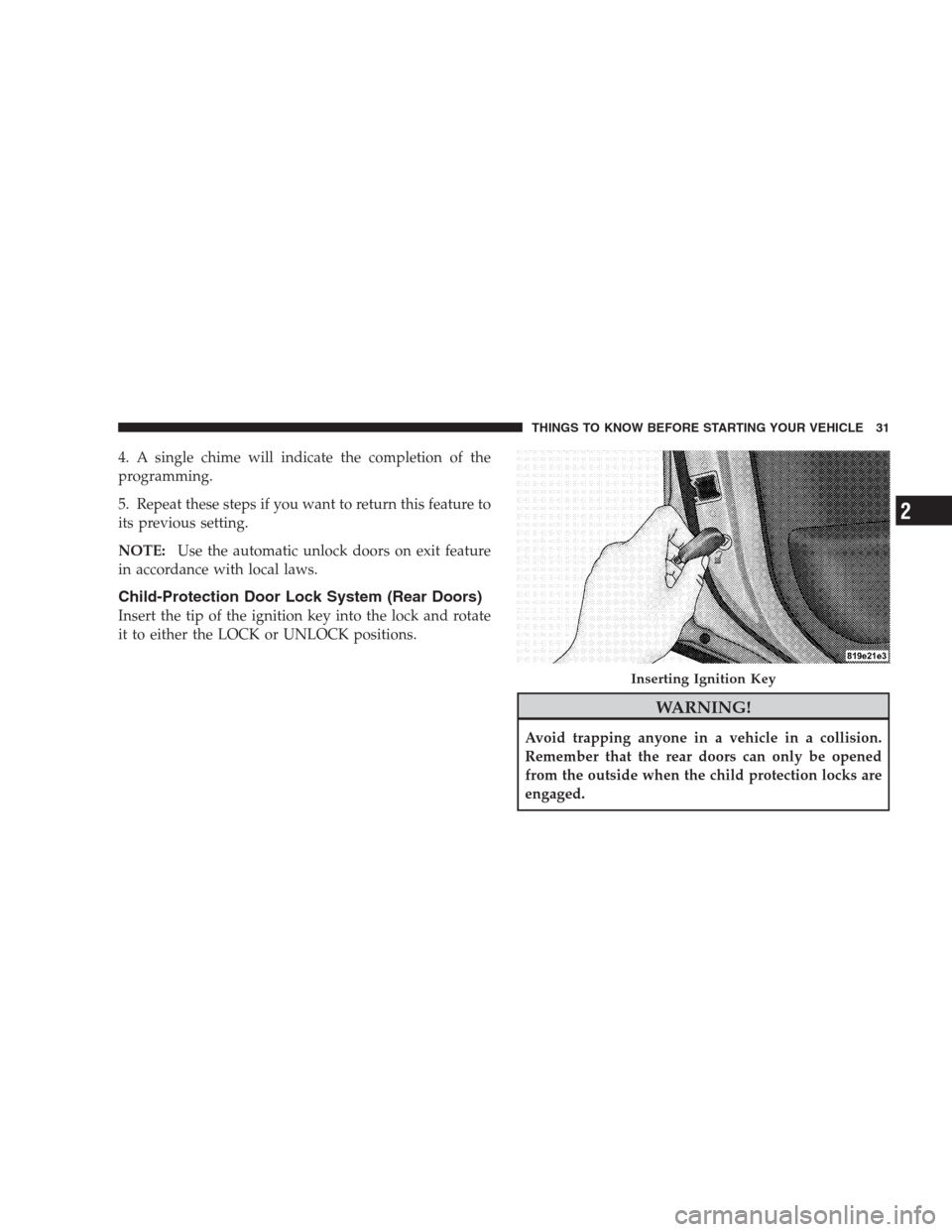
Child-Protection Door Lock System (Rear Doors)
Insert the tip of the ignition key into the lock and rotate
it to either the LOCK or UNLOCK positions.
WARNING!
Avoid trapping anyone in a vehicle in a collision.
Remember that the rear doors can only be opened
from the outside when the child protection locks are
engaged.
Inserting Ignition Key
THINGS TO KNOW BEFORE STARTING YOUR VEHICLE 31
2
Page 35 of 459
WARNING!
Never leave children in a vehicle with the keys in the
ignition switch. Occupants, particularly unattended
children, can become entrapped by the windows
while operating the power window switches. Such
entrapment may result in serious injury or death.
Auto Down Feature
The driver’s and front passenger’s (if equipped for pas-
senger side) power window switches have an “Auto
Down” feature. Press the window switch past the first
detent, release, and the window will go down automati-
cally.
To open the window part way, press the window switch
to the first detent and release it when you want the
window to stop.To stop the window from going all the way down during
the auto-down operation, pull up on the switch briefly.
For vehicles not equipped with the Electronic Vehicle
Information Center (EVIC), the power window switches
will remain active for 45 seconds after the ignition switch
is turned to the LOCK position. Opening either front
door will cancel this feature.
For vehicles equipped with the EVIC, the power window
switches will remain active for up to 10 minutes after the
ignition switch is turned to the LOCK position. Opening
either front door will cancel this feature. The time is
programmable. Refer to “Delay Power Off to Accessories
Until Exit” under “Personal Settings (Customer Program-
mable Features)” under “Electronic Vehicle Information
Center (EVIC)” in Section 4.
THINGS TO KNOW BEFORE STARTING YOUR VEHICLE 33
2
Page 37 of 459
WARNING!
There is no anti-pinch protection when the window
is almost closed. Be sure to clear all objects from the
window before closing.
Reset
At some point in time, it may be necessary to reactivate
the auto-up feature. To do so, perform the following
procedure:
1. Pull the window switch up to close window com-
pletely and continue to hold the switch up for an
additional two seconds after the window is closed.
2. Push the window switch down firmly to the second
detent to open the window completely and continue to
hold the switch down for an additional two seconds after
the window is fully open.
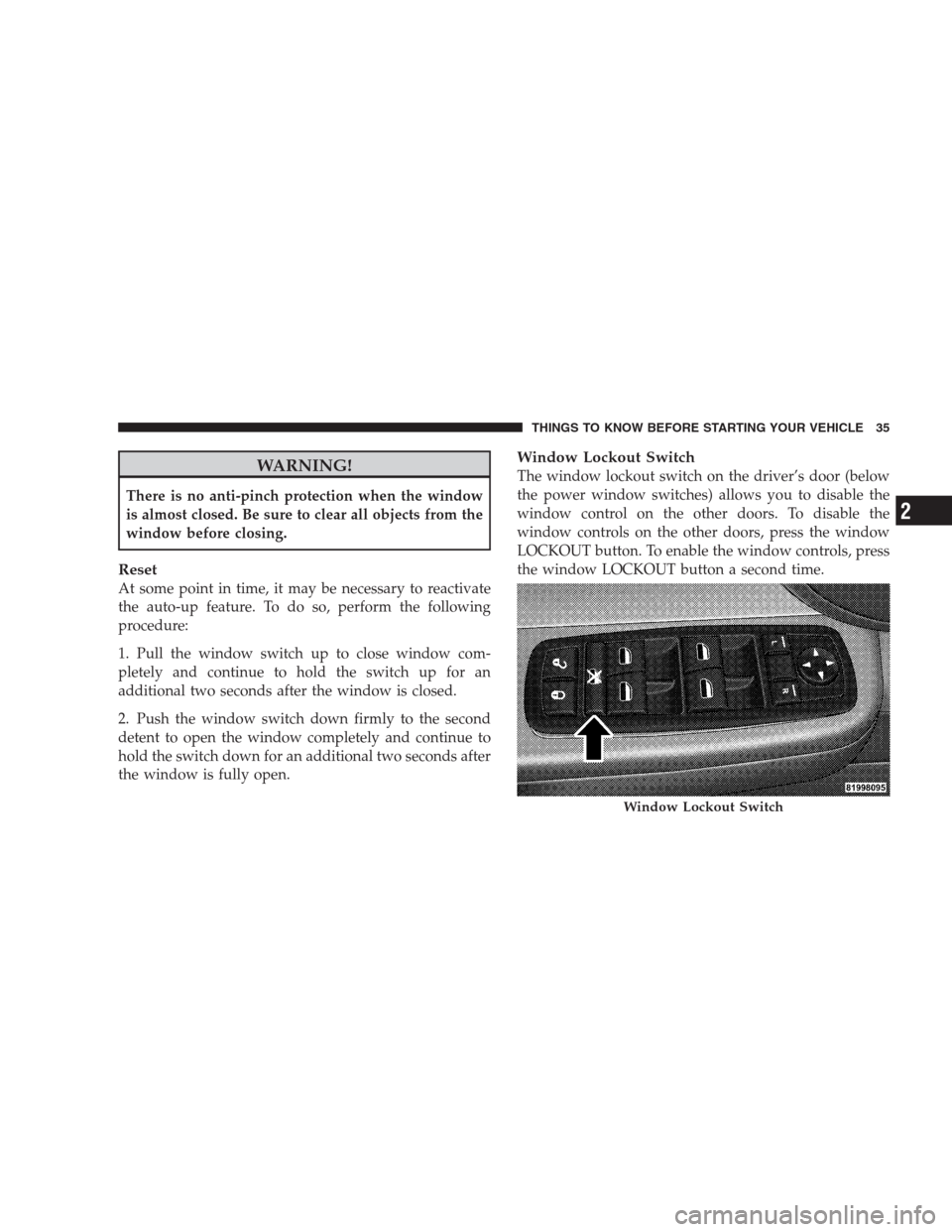
Window Lockout Switch
The window lockout switch on the driver’s door (below
the power window switches) allows you to disable the
window control on the other doors. To disable the
window controls on the other doors, press the window
LOCKOUT button. To enable the window controls, press
the window LOCKOUT button a second time.
Window Lockout Switch
THINGS TO KNOW BEFORE STARTING YOUR VEHICLE 35
2
Page 38 of 459
Wind Buffeting
Wind buffeting can be described as the perception of
pressure on the ears or a helicopter type sound in the
ears. Your vehicle may exhibit wind buffeting with the
windows down, or the sunroof (if equipped) in certain
open or partially open positions. This is a normal occur-
rence and can be minimized. If the buffeting occurs with
the sunroof open, adjust the sunroof opening to minimize
the buffeting.
LIFTGATE
The vacuum fluorescent (VF) display located in the
odometer area displays the word “GATE” as an indica-
tion of when the liftgate is not completely closed. When
the vehicle is not moving, and the liftgate is not com-
pletely closed, the VF display will show the word
“GATE”. On EVIC equipped vehicles, “GATE AJAR” will
be displayed.If any other active warnings are present, they will be
shown in the VF display and will also continue to cycle.
If the vehicle is moving, three single chimes will sound if
the rear liftgate is open (one chime for each complete
display cycle). After this, the VF display will continue to
sequence only (no chimes).
If the trip/reset button is pressed while the VF warnings
are being displayed, the VF display will revert back to
only displaying the odometer/trip odometer mileage.
To open the liftgate, pull up (squeeze) on the handle and
lift. Manually unlocking the vehicle doors with the
plunger or a key in the lock cylinder will not unlock the
liftgate.
36 THINGS TO KNOW BEFORE STARTING YOUR VEHICLE
Page 39 of 459
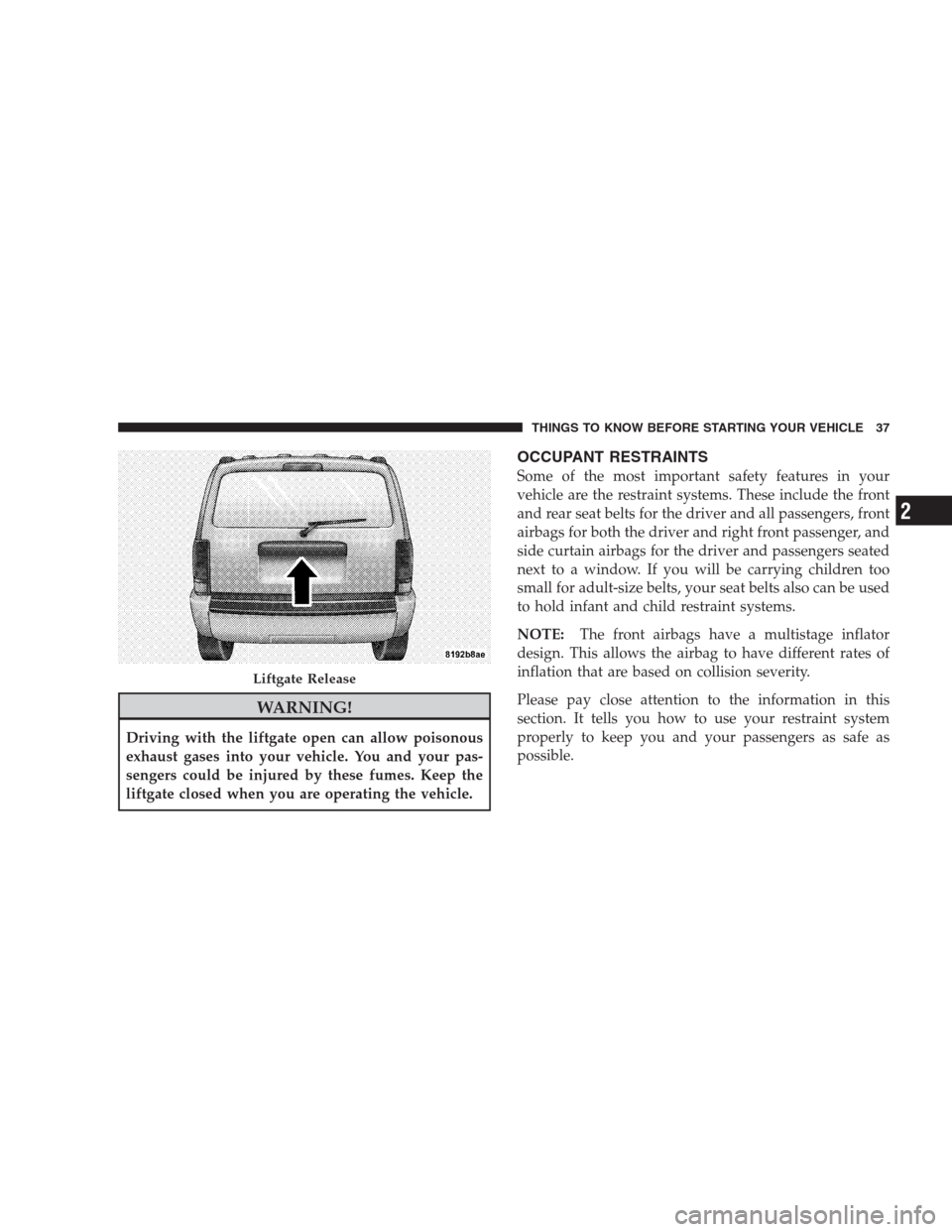
WARNING!
Driving with the liftgate open can allow poisonous
exhaust gases into your vehicle. You and your pas-
sengers could be injured by these fumes. Keep the
liftgate closed when you are operating the vehicle.
OCCUPANT RESTRAINTS
Some of the most important safety features in your
vehicle are the restraint systems. These include the front
and rear seat belts for the driver and all passengers, front
airbags for both the driver and right front passenger, and
side curtain airbags for the driver and passengers seated
next to a window. If you will be carrying children too
small for adult-size belts, your seat belts also can be used
to hold infant and child restraint systems.
NOTE:The front airbags have a multistage inflator
design. This allows the airbag to have different rates of
inflation that are based on collision severity.
Please pay close attention to the information in this
section. It tells you how to use your restraint system
properly to keep you and your passengers as safe as
possible.
Liftgate Release
THINGS TO KNOW BEFORE STARTING YOUR VEHICLE 37
2
Page 40 of 459
WARNING!
In a collision, you and your passengers can suffer
injuries, including fatalities, if you are not properly
buckled up. You can strike the interior of your
vehicle or other passengers, or you can be thrown out
of the vehicle. Always be sure you and others in your
vehicle are buckled up properly.
Buckle up even though you are an excellent driver, even
on short trips. Someone on the road may be a poor driver
and cause a collision which includes you. This can
happen far away from home or on your own street.
Research has shown that seat belts save lives, and they
can reduce the seriousness of injuries in a collision. Someof the worst injuries happen when people are thrown
from the vehicle. Seat belts reduce the possibility of
ejection and the risk of injury caused by striking the
inside of the vehicle.Everyonein a motor vehicle should
be belted at all times to reduce or prevent injuries.
Lap/Shoulder Belts
All seating positions in your vehicle have combination
lap/shoulder belts. The belt webbing retractor is de-
signed to lock during very sudden stops or collisions.
This feature allows the shoulder part of the belt to move
freely with you under normal conditions. But in a colli-
sion, the belt will lock and reduce the risk of you striking
the inside of the vehicle or being thrown out.
38 THINGS TO KNOW BEFORE STARTING YOUR VEHICLE
Page 41 of 459
WARNING!
•Wearing a seat belt incorrectly is dangerous. Seat
belts are designed to go around the large bones of
your body. These are the strongest parts of your
body and can take the forces of a collision the best.
Wearing your belt in the wrong place could make
your injuries in a collision much worse. You might
suffer internal injuries, or you could even slide out
of part of the belt. Follow these instructions to
wear your seat belt safely and to keep your pas-
sengers safe also.
•Two people should never be belted into a single
seat belt. People belted together can crash into one
another in an accident, hurting one another badly.
Never use a lap/shoulder belt or a lap belt for more
than one person, no matter what their size.
Lap/Shoulder Belt Operating Instructions
1. Enter the vehicle and close the door. Sit back and
adjust the seat.
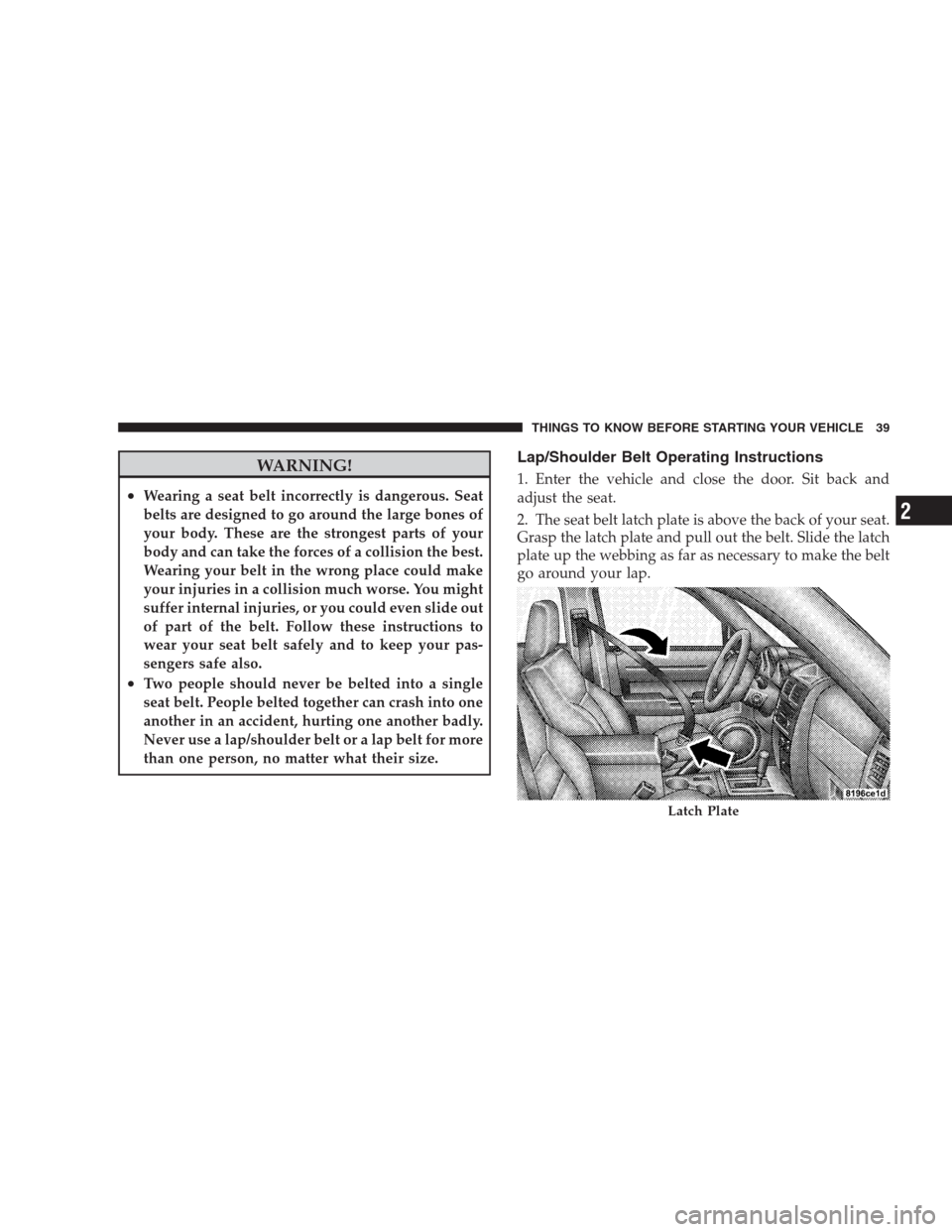
2. The seat belt latch plate is above the back of your seat.
Grasp the latch plate and pull out the belt. Slide the latch
plate up the webbing as far as necessary to make the belt
go around your lap.
Latch Plate
THINGS TO KNOW BEFORE STARTING YOUR VEHICLE 39
2
Page 42 of 459
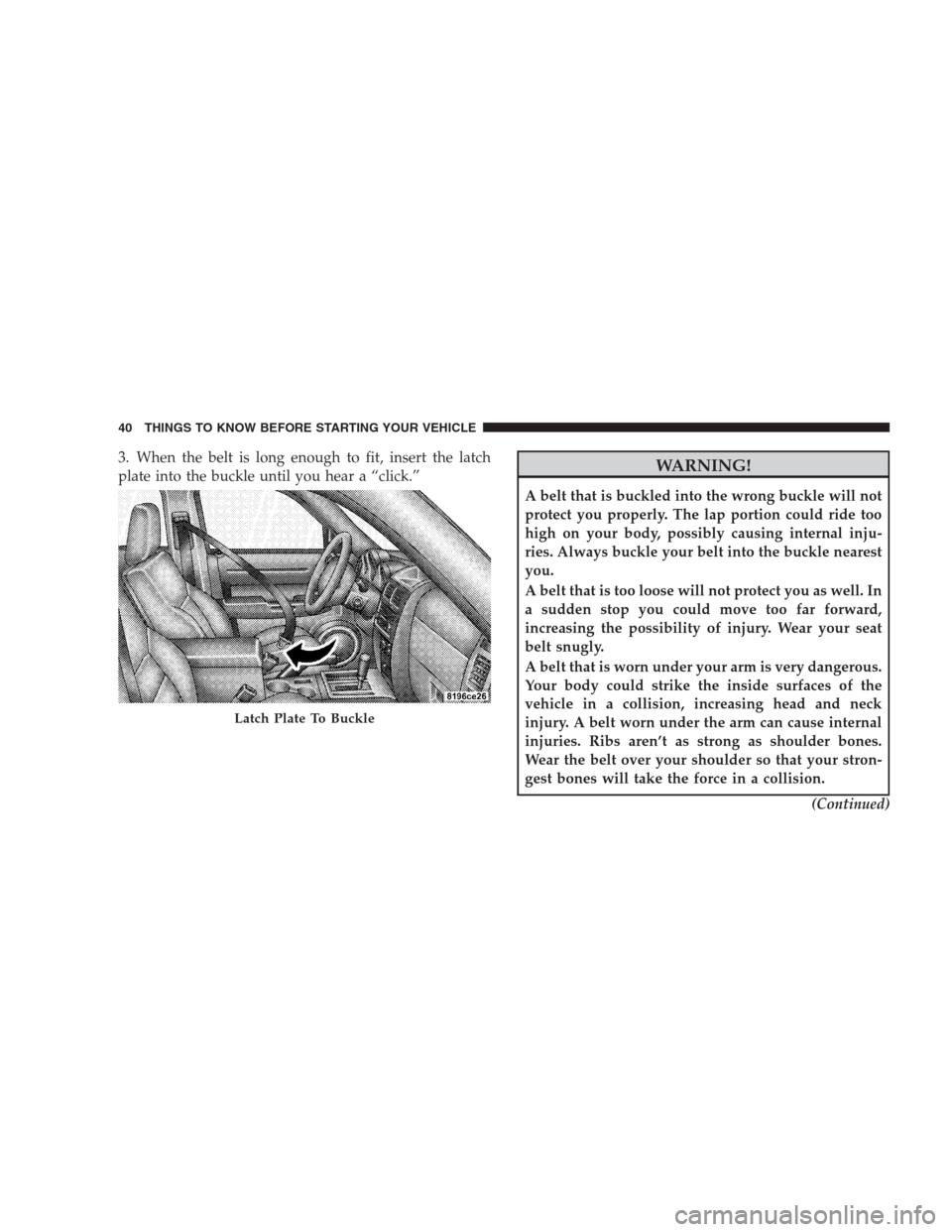
3. When the belt is long enough to fit, insert the latch
plate into the buckle until you hear a “click.”WARNING!
A belt that is buckled into the wrong buckle will not
protect you properly. The lap portion could ride too
high on your body, possibly causing internal inju-
ries. Always buckle your belt into the buckle nearest
you.
A belt that is too loose will not protect you as well. In
a sudden stop you could move too far forward,
increasing the possibility of injury. Wear your seat
belt snugly.
A belt that is worn under your arm is very dangerous.
Your body could strike the inside surfaces of the
vehicle in a collision, increasing head and neck
injury. A belt worn under the arm can cause internal
injuries. Ribs aren’t as strong as shoulder bones.
Wear the belt over your shoulder so that your stron-
gest bones will take the force in a collision.
(Continued)
Latch Plate To Buckle
40 THINGS TO KNOW BEFORE STARTING YOUR VEHICLE
Page 43 of 459
WARNING! (Continued)
A shoulder belt placed behind will not protect you
from injury during a collision. You are more likely to
hit your head in a collision if you do not wear your
shoulder belt. The lap and shoulder belt are meant to
be used together.
4. Position the lap belt across your thighs, below your
abdomen. To remove slack in the lap portion, pull up a
bit on the shoulder belt. To loosen the lap belt if it is too
tight, tilt the latch plate and pull on the lap belt. A snug
belt reduces the risk of sliding under the belt in a
collision.
WARNING!
A lap belt worn too high can increase the risk of
injury in a collision. The belt forces won’t be at the
strong hip and pelvic bones, but across your abdo-
men. Always wear the lap part of your seat belt as
low as possible and keep it snug.
A twisted belt can’t do its job as well. In a collision it
could even cut into you. Be sure the belt is straight. If
you can’t straighten a belt in your vehicle, take it to
your authorized dealer and have it fixed.
THINGS TO KNOW BEFORE STARTING YOUR VEHICLE 41
2
Page 44 of 459
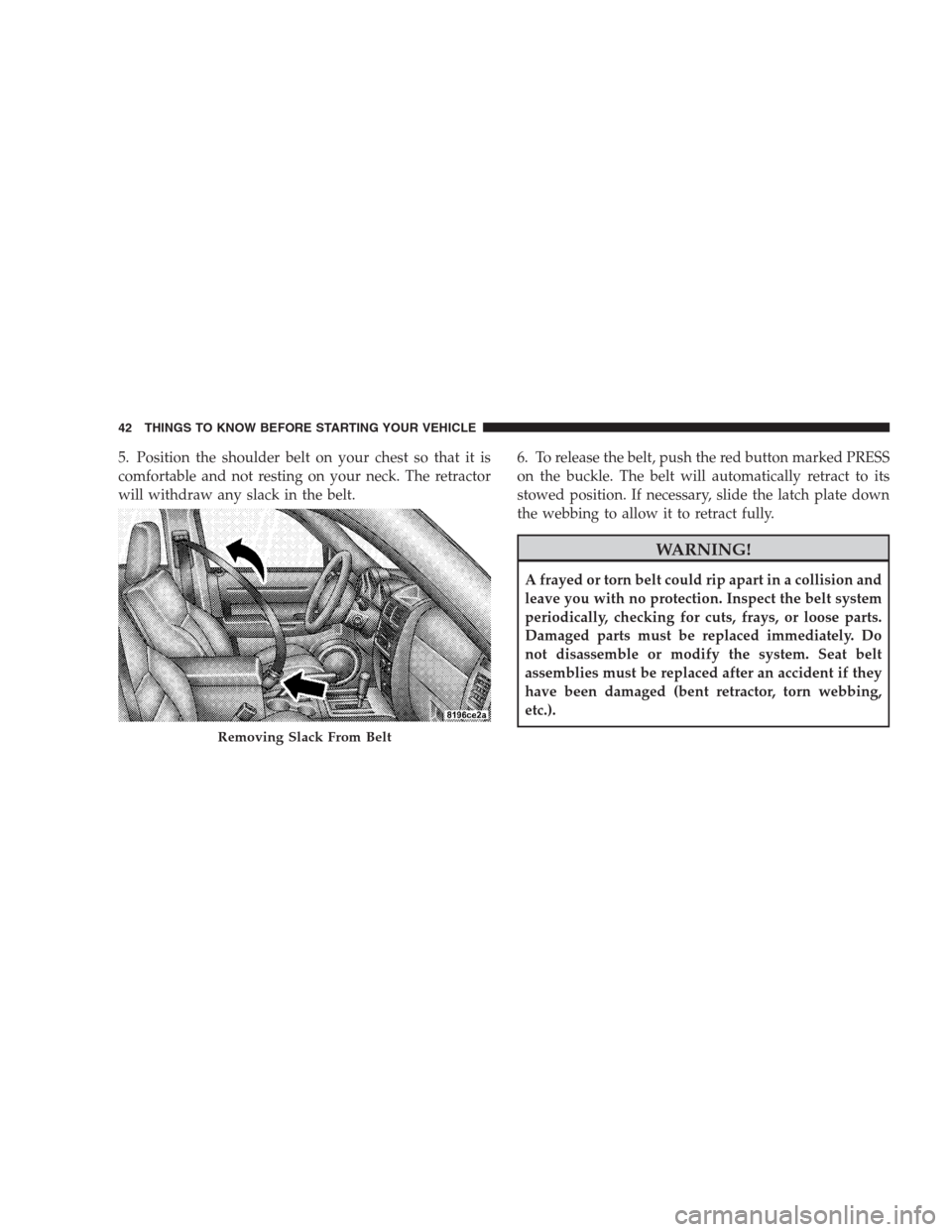
5. Position the shoulder belt on your chest so that it is
comfortable and not resting on your neck. The retractor
will withdraw any slack in the belt.6. To release the belt, push the red button marked PRESS
on the buckle. The belt will automatically retract to its
stowed position. If necessary, slide the latch plate down
the webbing to allow it to retract fully.
WARNING!
A frayed or torn belt could rip apart in a collision and
leave you with no protection. Inspect the belt system
periodically, checking for cuts, frays, or loose parts.
Damaged parts must be replaced immediately. Do
not disassemble or modify the system. Seat belt
assemblies must be replaced after an accident if they
have been damaged (bent retractor, torn webbing,
etc.).
Removing Slack From Belt
42 THINGS TO KNOW BEFORE STARTING YOUR VEHICLE