trailer DODGE NITRO 2009 1.G Owner's Manual
[x] Cancel search | Manufacturer: DODGE, Model Year: 2009, Model line: NITRO, Model: DODGE NITRO 2009 1.GPages: 459, PDF Size: 6.82 MB
Page 350 of 459
CAUTION!
If the trailer weighs more than 1,000 lbs (454 kg)
loaded, it should have its own brakes and they
should be of adequate capacity. Failure to do this
could lead to accelerated brake lining wear, higher
brake pedal effort, and longer stopping distances.
WARNING!
Do not connect trailer brakes to your vehicle’s hy-
draulic brake lines. It can overload your brake sys-
tem and cause it to fail. You might not have brakes
when you need them and could have an accident.
Towing any trailer will increase your stopping dis-
tance. When towing you should allow for additional
space between your vehicle and the vehicle in front
of you. Failure to do so could result in an accident.
Towing Requirements — Trailer Lights & Wiring
Whenever you pull a trailer, regardless of the trailer size,
stop lights and turn signals on the trailer are required for
motoring safety.
The trailer tow package may include a 4-pin and 7-pin
wiring harness. Use a factory approved trailer harness
and connector.
NOTE:Do not cut or splice wiring into the vehicles
wiring harness.
348 STARTING AND OPERATING
Page 351 of 459
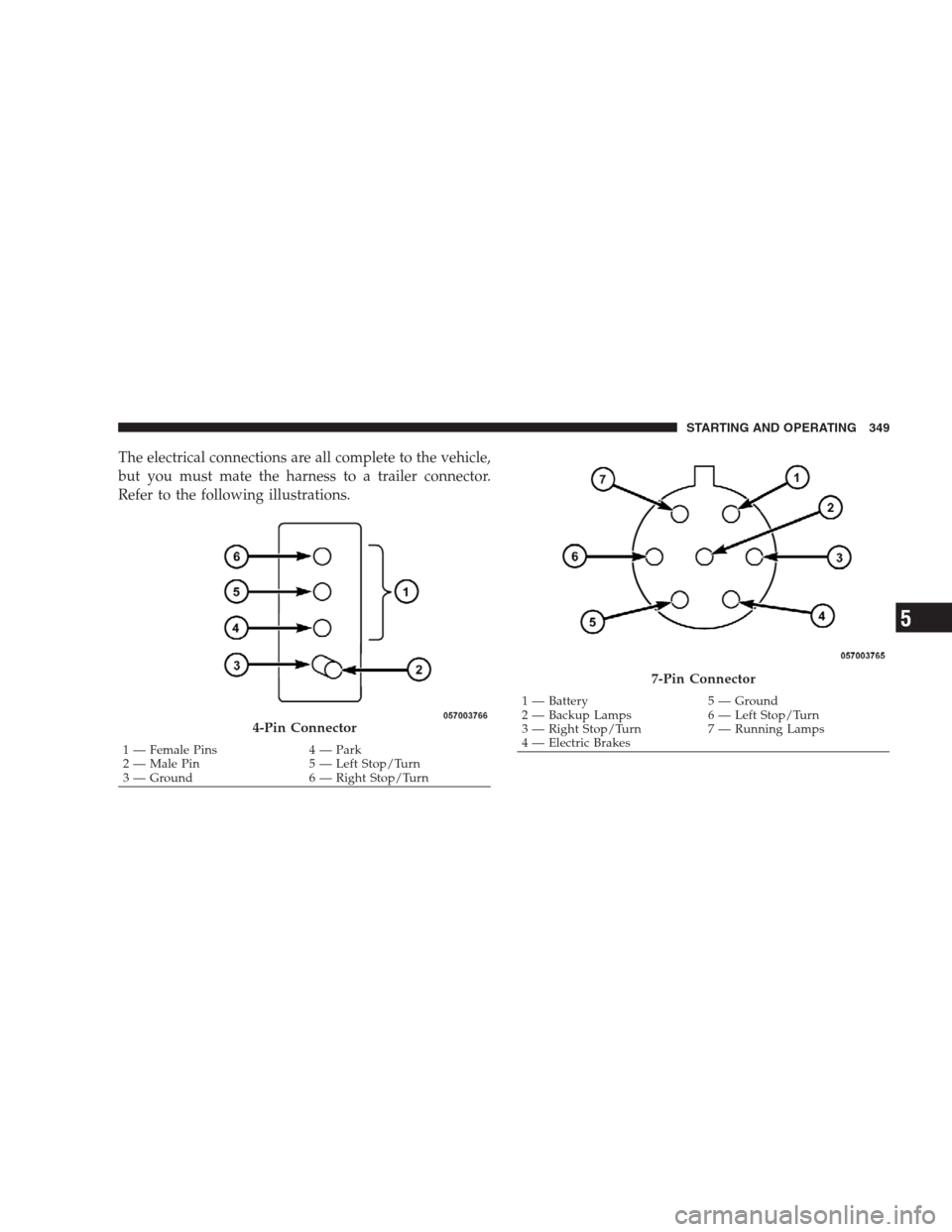
The electrical connections are all complete to the vehicle,
but you must mate the harness to a trailer connector.
Refer to the following illustrations.
4-Pin Connector
1 — Female Pins 4 — Park
2 — Male Pin 5 — Left Stop/Turn
3 — Ground 6 — Right Stop/Turn
7-Pin Connector
1 — Battery 5 — Ground
2 — Backup Lamps 6 — Left Stop/Turn
3 — Right Stop/Turn 7 — Running Lamps
4 — Electric BrakesSTARTING AND OPERATING 349
5
Page 352 of 459
Towing Tips
Before setting out on a trip, practice turning, stopping
and backing up the trailer in an area away from heavy
traffic.
Towing Tips — Automatic Transmission
The “D” range can be selected when towing. However, if
frequent shifting occurs while in this range, the TOW/
HAUL button should be selected.
NOTE:Using the TOW/HAUL button (3.7L engine) or
“4” range (4.0L engine) while operating the vehicle under
heavy operating conditions will improve performance
and extend transmission life by reducing excessive shift-
ing and heat build up. This action will also provide better
engine braking.
The automatic transmission fluid and filter should be
changed if you regularly tow a trailer for more than45 minutes of continuous operation. See Schedule B in
section 8 of this manual for transmission fluid change
intervals.
Towing Tips — TOW/HAUL (If Equipped)
To reduce potential for automatic transmission overheat-
ing, press the TOW HAUL button when driving in hilly
areas or shift the transmission to DRIVE position 2 on
more severe grades. Refer to “Transmission Shifting” in
this section.
Towing Tips — Electronic Speed Control (If
Equipped)
Do not use in hilly terrain or with heavy loads.
When using the speed control, if you experience speed
drops greater than 10 mph (16 km/h), disengage until
you can get back to cruising speed.
Use speed control in flat terrain and with light loads to
maximize fuel efficiency.
350 STARTING AND OPERATING
Page 353 of 459
Towing Tips — Cooling System
To reduce potential for engine and transmission over-
heating, take the following actions:
City Driving
When stopped for short periods of time, put the trans-
mission in NEUTRAL and increase engine idle speed.
Highway Driving
Reduce speed.
Air Conditioning
Turn off temporarily.
Refer to “Cooling System Operating” information in
the Maintenance section of this manual for more
information.
RECREATIONAL TOWING (BEHIND
MOTORHOME, ETC.)
Towing — 2WD Models
Recreational towing (all four wheels on the
ground)
Recreational towing is allowedONLYif the driveshaft is
removed. Towing with the rear wheels on the ground
while the driveshaft is connected can result in severe
transmission damage.
NOTE:This vehicle may be towed on a flatbed or
vehicle trailer provided all four wheels areOFFthe
ground.
STARTING AND OPERATING 351
5
Page 354 of 459
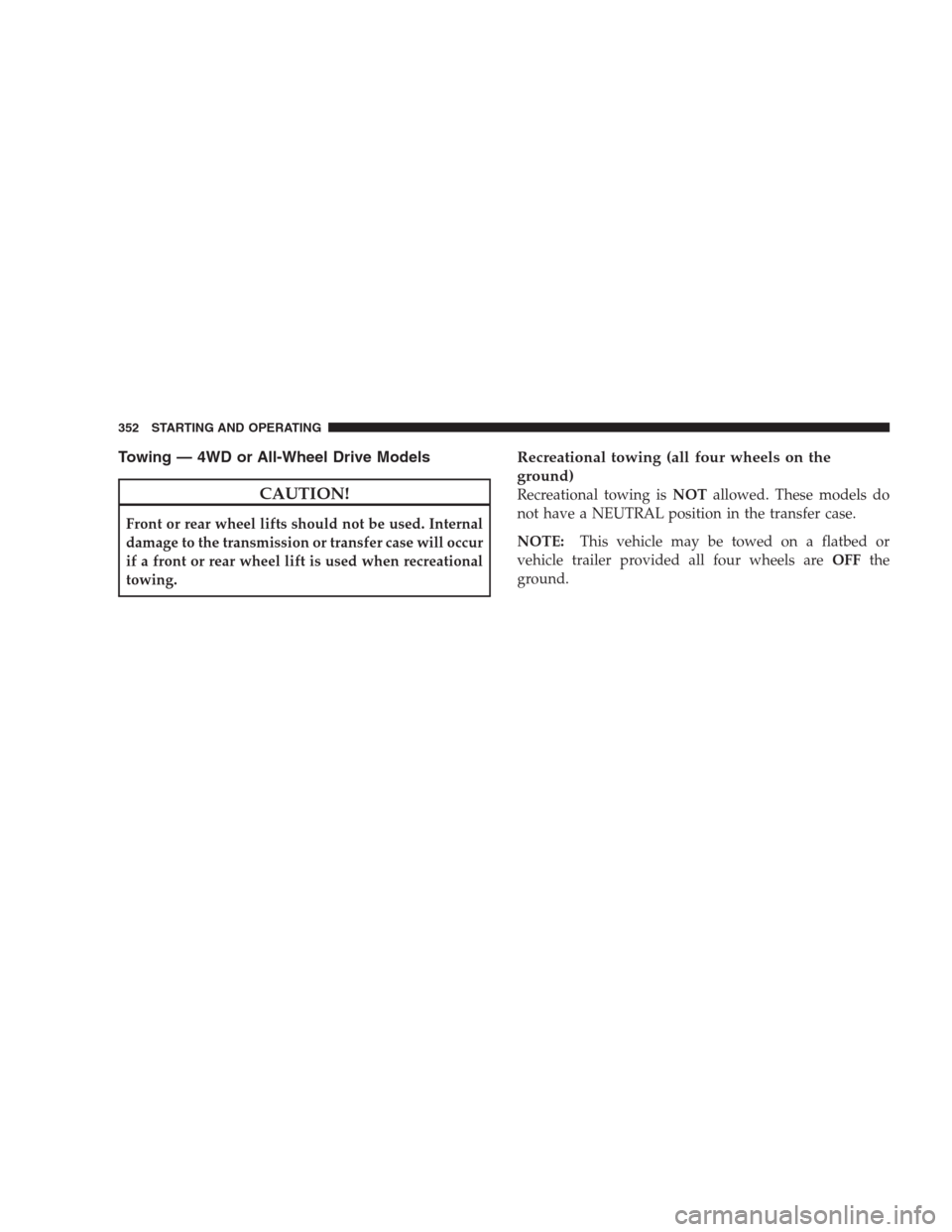
Towing — 4WD or All-Wheel Drive Models
CAUTION!
Front or rear wheel lifts should not be used. Internal
damage to the transmission or transfer case will occur
if a front or rear wheel lift is used when recreational
towing.
Recreational towing (all four wheels on the
ground)
Recreational towing isNOTallowed. These models do
not have a NEUTRAL position in the transfer case.
NOTE:This vehicle may be towed on a flatbed or
vehicle trailer provided all four wheels areOFFthe
ground.
352 STARTING AND OPERATING
Page 400 of 459
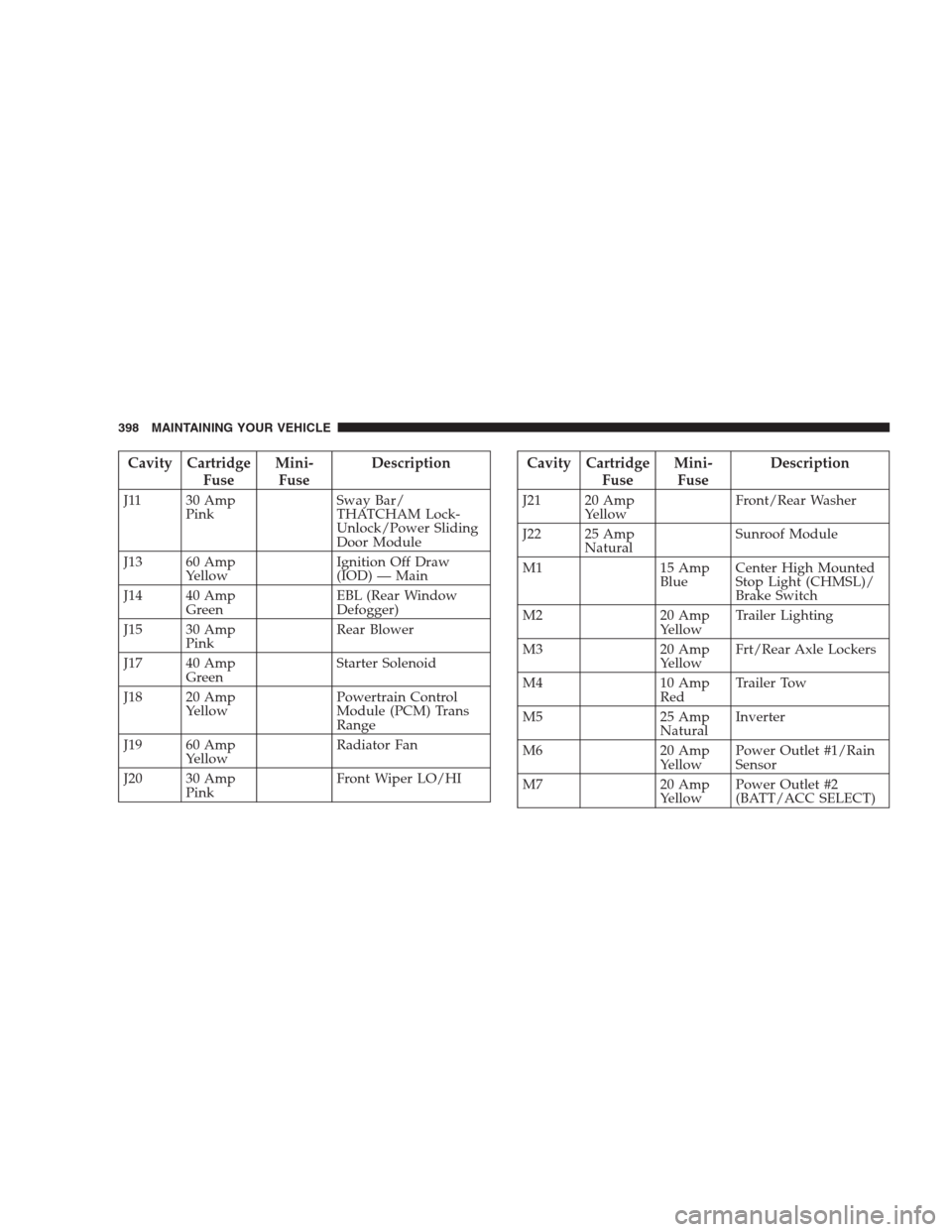
Cavity Cartridge
FuseMini-
FuseDescription
J11 30 Amp
PinkSway Bar/
THATCHAM Lock-
Unlock/Power Sliding
Door Module
J13 60 Amp
YellowIgnition Off Draw
(IOD) — Main
J14 40 Amp
GreenEBL (Rear Window
Defogger)
J15 30 Amp
PinkRear Blower
J17 40 Amp
GreenStarter Solenoid
J18 20 Amp
YellowPowertrain Control
Module (PCM) Trans
Range
J19 60 Amp
YellowRadiator Fan
J20 30 Amp
PinkFront Wiper LO/HI
Cavity Cartridge
FuseMini-
FuseDescription
J21 20 Amp
YellowFront/Rear Washer
J22 25 Amp
NaturalSunroof Module
M1 15 Amp
BlueCenter High Mounted
Stop Light (CHMSL)/
Brake Switch
M2 20 Amp
YellowTrailer Lighting
M3 20 Amp
YellowFrt/Rear Axle Lockers
M4 10 Amp
RedTrailer Tow
M5 25 Amp
NaturalInverter
M6 20 Amp
YellowPower Outlet #1/Rain
Sensor
M7 20 Amp
YellowPower Outlet #2
(BATT/ACC SELECT)
398 MAINTAINING YOUR VEHICLE
Page 401 of 459
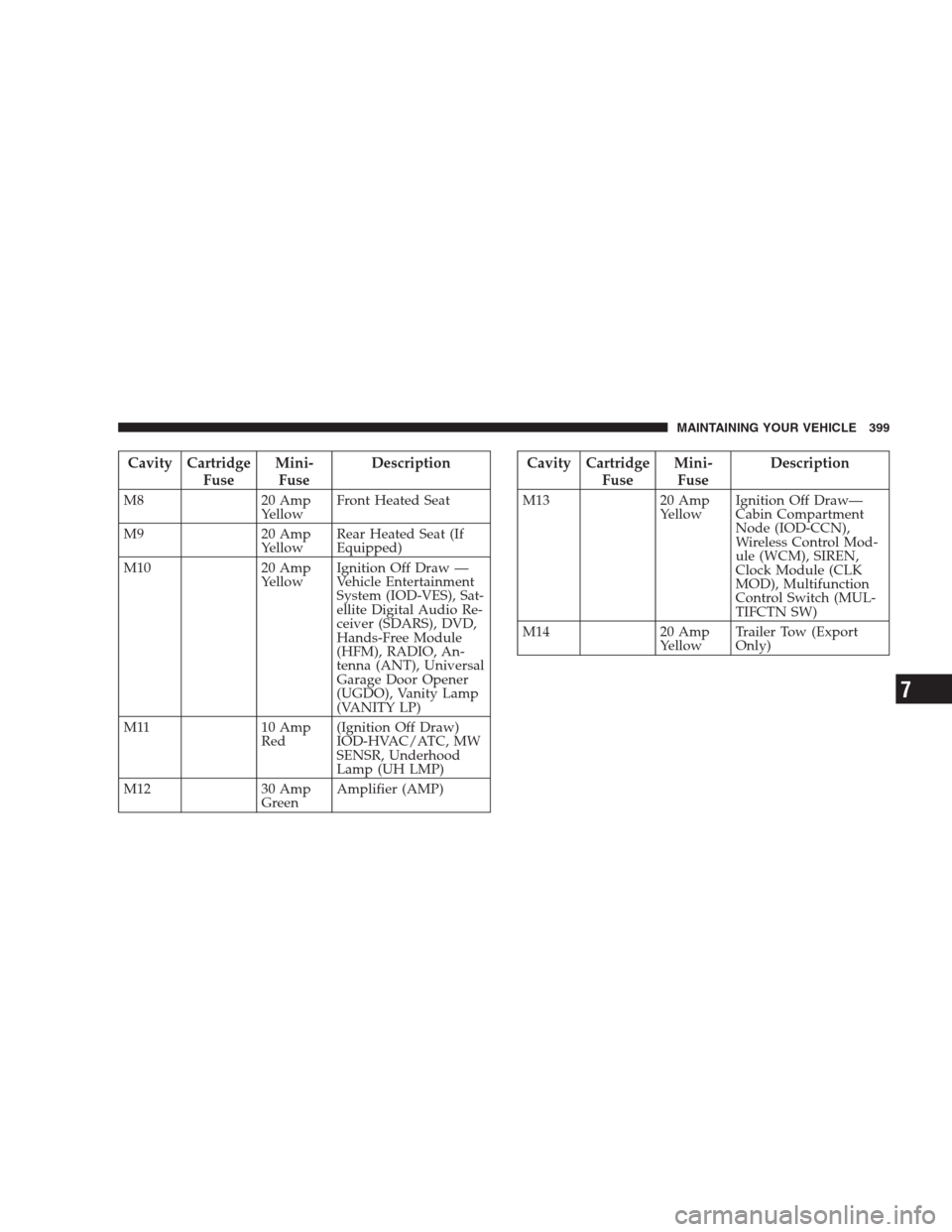
Cavity Cartridge
FuseMini-
FuseDescription
M8 20 Amp
YellowFront Heated Seat
M9 20 Amp
YellowRear Heated Seat (If
Equipped)
M10 20 Amp
YellowIgnition Off Draw —
Vehicle Entertainment
System (IOD-VES), Sat-
ellite Digital Audio Re-
ceiver (SDARS), DVD,
Hands-Free Module
(HFM), RADIO, An-
tenna (ANT), Universal
Garage Door Opener
(UGDO), Vanity Lamp
(VANITY LP)
M11 10 Amp
Red(Ignition Off Draw)
IOD-HVAC/ATC, MW
SENSR, Underhood
Lamp (UH LMP)
M12 30 Amp
GreenAmplifier (AMP)
Cavity Cartridge
FuseMini-
FuseDescription
M13 20 Amp
YellowIgnition Off Draw—
Cabin Compartment
Node (IOD-CCN),
Wireless Control Mod-
ule (WCM), SIREN,
Clock Module (CLK
MOD), Multifunction
Control Switch (MUL-
TIFCTN SW)
M14 20 Amp
YellowTrailer Tow (Export
Only)
MAINTAINING YOUR VEHICLE 399
7
Page 418 of 459
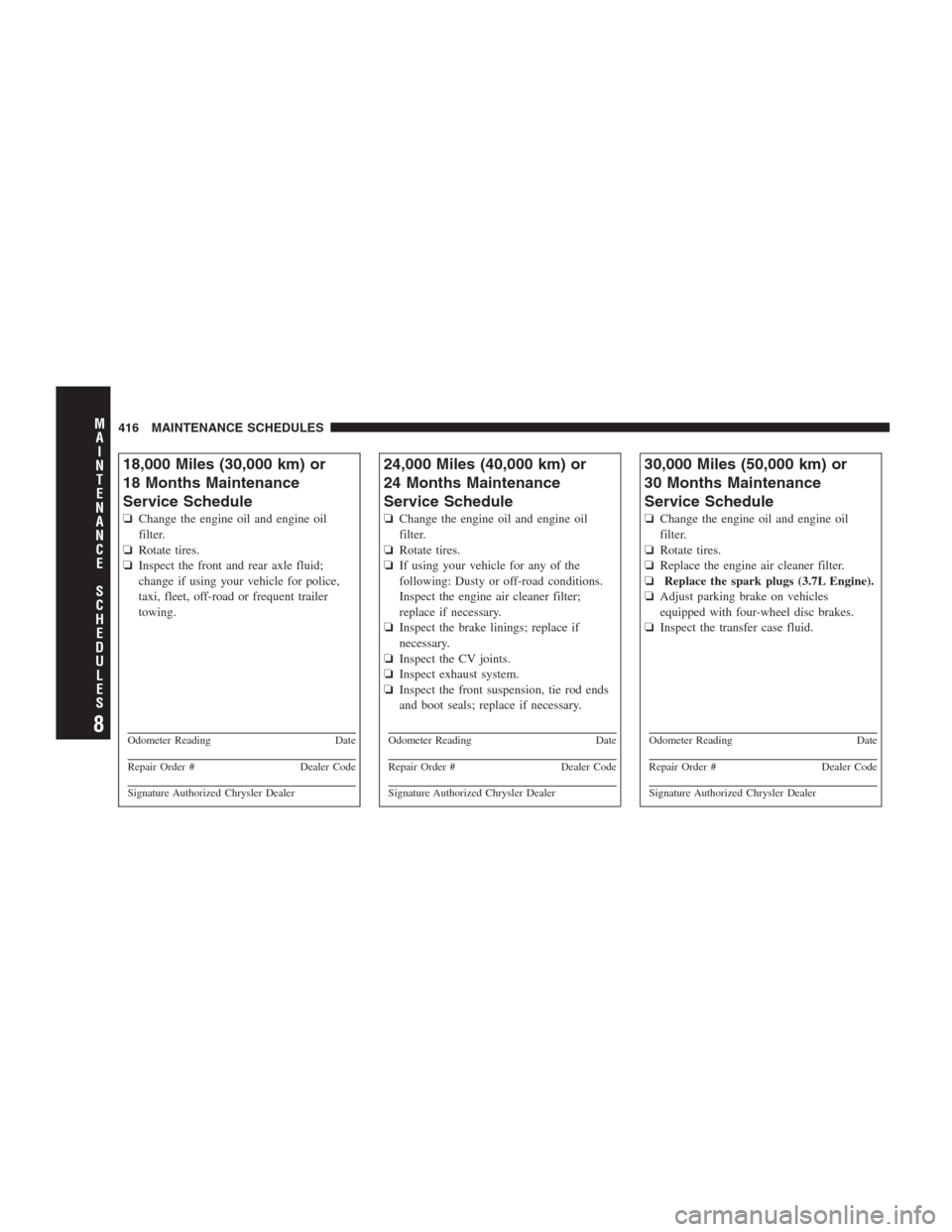
18,000 Miles (30,000 km) or
18 Months Maintenance
Service Schedule
❏Change the engine oil and engine oil
filter.
❏Rotate tires.
❏Inspect the front and rear axle fluid;
change if using your vehicle for police,
taxi, fleet, off-road or frequent trailer
towing.
Odometer Reading Date
Repair Order # Dealer Code
Signature Authorized Chrysler Dealer
24,000 Miles (40,000 km) or
24 Months Maintenance
Service Schedule
❏Change the engine oil and engine oil
filter.
❏Rotate tires.
❏If using your vehicle for any of the
following: Dusty or off-road conditions.
Inspect the engine air cleaner filter;
replace if necessary.
❏Inspect the brake linings; replace if
necessary.
❏Inspect the CV joints.
❏Inspect exhaust system.
❏Inspect the front suspension, tie rod ends
and boot seals; replace if necessary.
Odometer Reading Date
Repair Order # Dealer Code
Signature Authorized Chrysler Dealer
30,000 Miles (50,000 km) or
30 Months Maintenance
Service Schedule
❏Change the engine oil and engine oil
filter.
❏Rotate tires.
❏Replace the engine air cleaner filter.
❏Replace the spark plugs (3.7L Engine).
❏Adjust parking brake on vehicles
equipped with four-wheel disc brakes.
❏Inspect the transfer case fluid.
Odometer Reading Date
Repair Order # Dealer Code
Signature Authorized Chrysler Dealer
416 MAINTENANCE SCHEDULES
8
M
A
I
N
T
E
N
A
N
C
E
S
C
H
E
D
U
L
E
S
Page 419 of 459
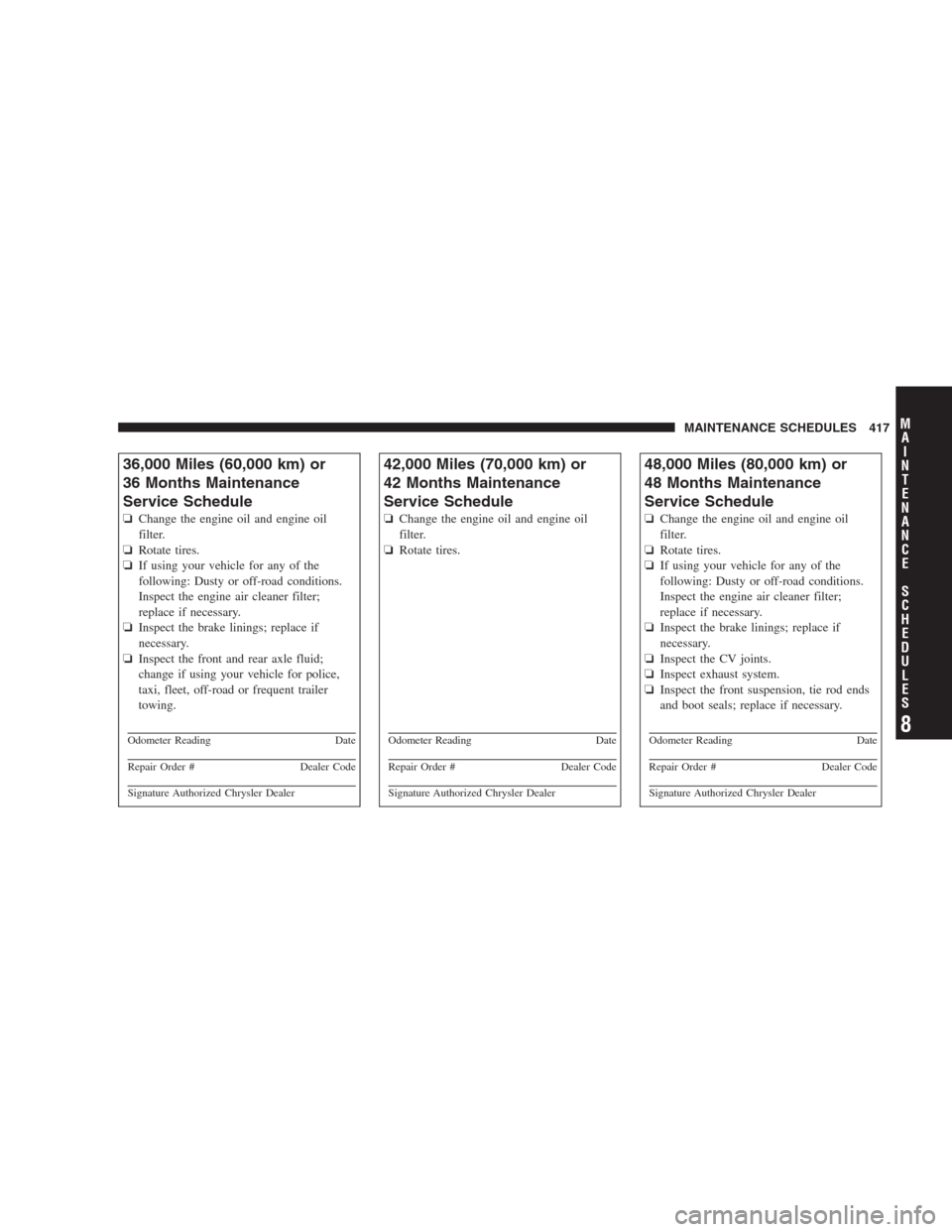
36,000 Miles (60,000 km) or
36 Months Maintenance
Service Schedule
❏Change the engine oil and engine oil
filter.
❏Rotate tires.
❏If using your vehicle for any of the
following: Dusty or off-road conditions.
Inspect the engine air cleaner filter;
replace if necessary.
❏Inspect the brake linings; replace if
necessary.
❏Inspect the front and rear axle fluid;
change if using your vehicle for police,
taxi, fleet, off-road or frequent trailer
towing.
Odometer Reading Date
Repair Order # Dealer Code
Signature Authorized Chrysler Dealer
42,000 Miles (70,000 km) or
42 Months Maintenance
Service Schedule
❏Change the engine oil and engine oil
filter.
❏Rotate tires.
Odometer Reading Date
Repair Order # Dealer Code
Signature Authorized Chrysler Dealer
48,000 Miles (80,000 km) or
48 Months Maintenance
Service Schedule
❏Change the engine oil and engine oil
filter.
❏Rotate tires.
❏If using your vehicle for any of the
following: Dusty or off-road conditions.
Inspect the engine air cleaner filter;
replace if necessary.
❏Inspect the brake linings; replace if
necessary.
❏Inspect the CV joints.
❏Inspect exhaust system.
❏Inspect the front suspension, tie rod ends
and boot seals; replace if necessary.
Odometer Reading Date
Repair Order # Dealer Code
Signature Authorized Chrysler Dealer
MAINTENANCE SCHEDULES 417
8
M
A
I
N
T
E
N
A
N
C
E
S
C
H
E
D
U
L
E
S
Page 420 of 459
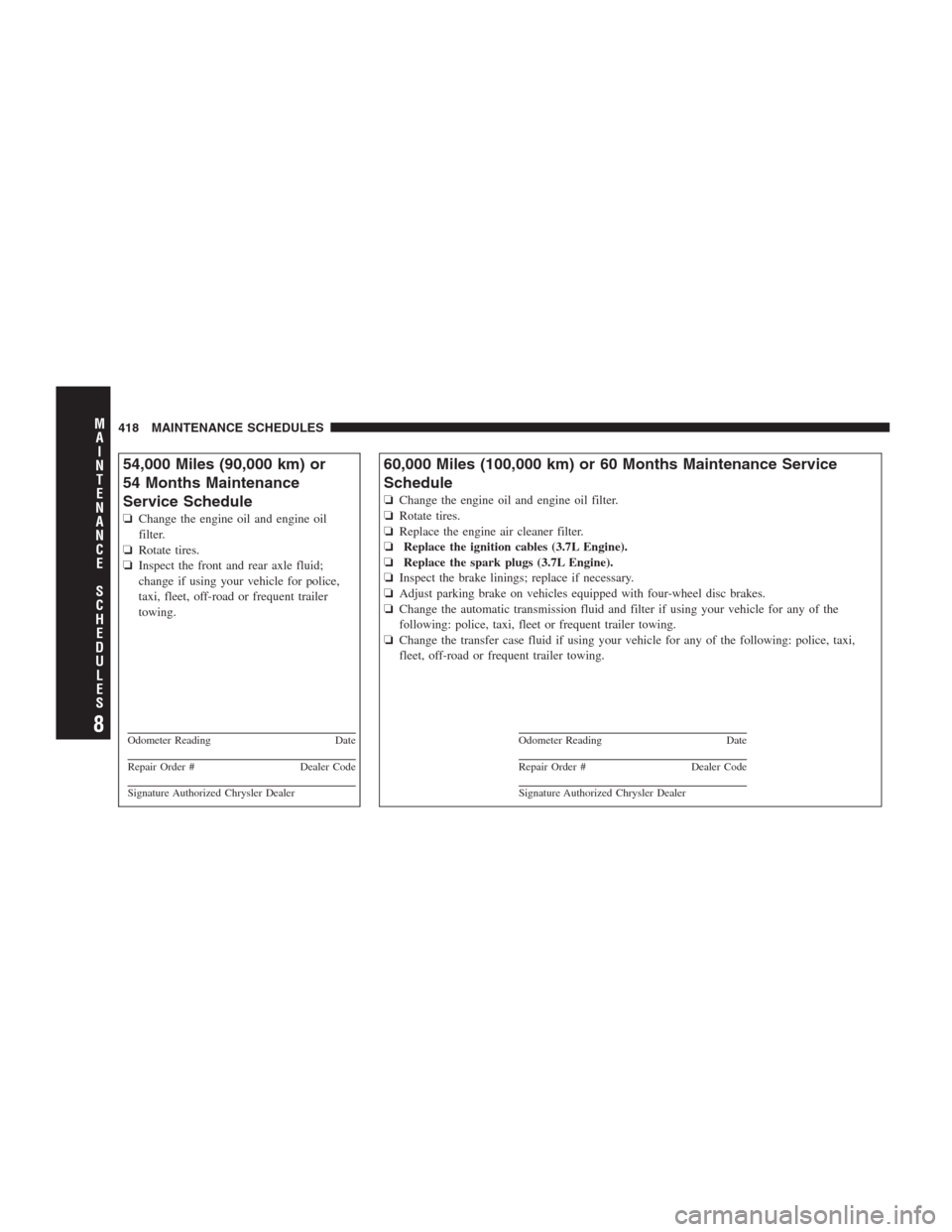
54,000 Miles (90,000 km) or
54 Months Maintenance
Service Schedule
❏Change the engine oil and engine oil
filter.
❏Rotate tires.
❏Inspect the front and rear axle fluid;
change if using your vehicle for police,
taxi, fleet, off-road or frequent trailer
towing.
Odometer Reading Date
Repair Order # Dealer Code
Signature Authorized Chrysler Dealer
60,000 Miles (100,000 km) or 60 Months Maintenance Service
Schedule
❏Change the engine oil and engine oil filter.
❏Rotate tires.
❏Replace the engine air cleaner filter.
❏Replace the ignition cables (3.7L Engine).
❏Replace the spark plugs (3.7L Engine).
❏Inspect the brake linings; replace if necessary.
❏Adjust parking brake on vehicles equipped with four-wheel disc brakes.
❏Change the automatic transmission fluid and filter if using your vehicle for any of the
following: police, taxi, fleet or frequent trailer towing.
❏Change the transfer case fluid if using your vehicle for any of the following: police, taxi,
fleet, off-road or frequent trailer towing.
Odometer Reading Date
Repair Order # Dealer Code
Signature Authorized Chrysler Dealer
418 MAINTENANCE SCHEDULES
8
M
A
I
N
T
E
N
A
N
C
E
S
C
H
E
D
U
L
E
S