warning DODGE NITRO 2010 1.G Owner's Manual
[x] Cancel search | Manufacturer: DODGE, Model Year: 2010, Model line: NITRO, Model: DODGE NITRO 2010 1.GPages: 498, PDF Size: 6.94 MB
Page 57 of 498
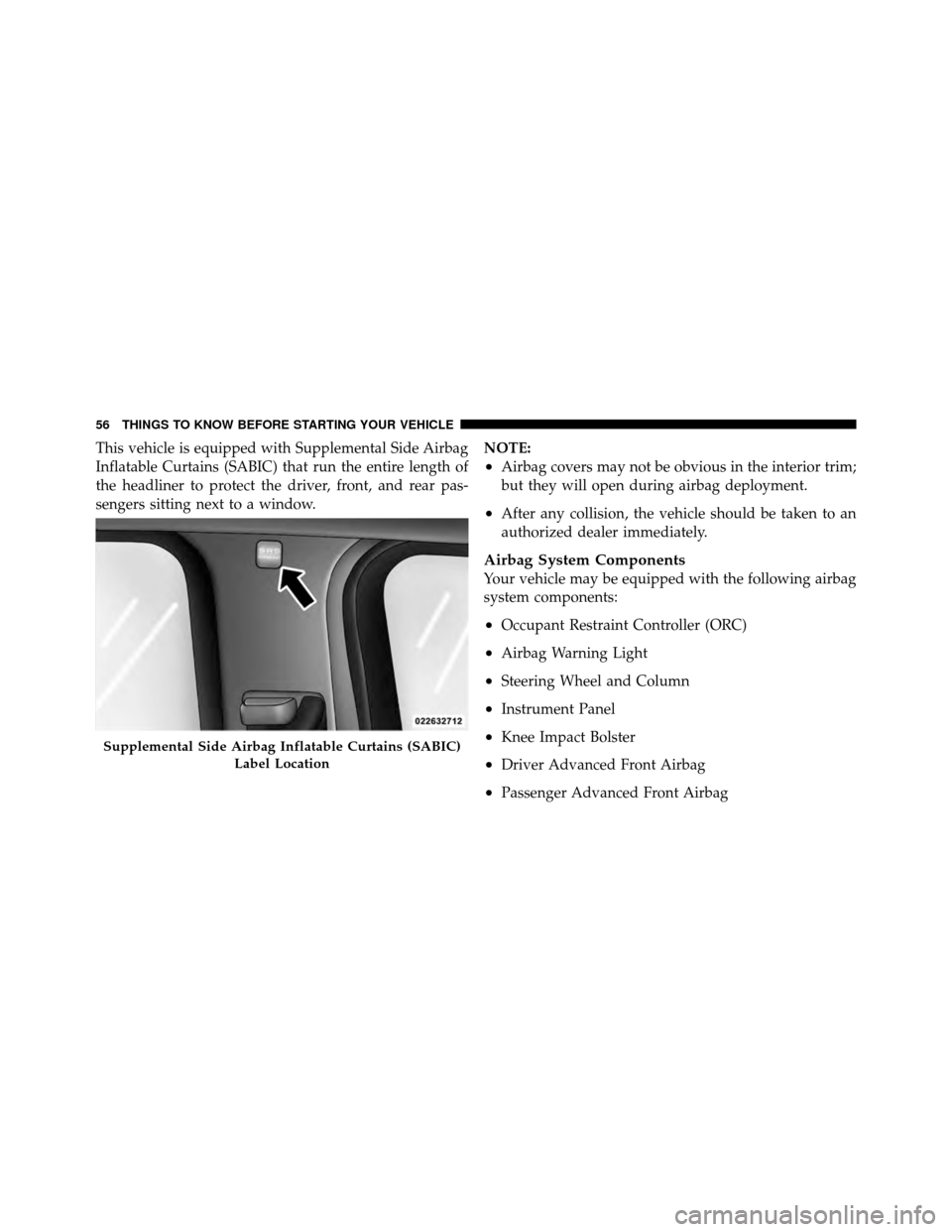
This vehicle is equipped with Supplemental Side Airbag
Inflatable Curtains (SABIC) that run the entire length of
the headliner to protect the driver, front, and rear pas-
sengers sitting next to a window.NOTE:
•Airbag covers may not be obvious in the interior trim;
but they will open during airbag deployment.
•After any collision, the vehicle should be taken to an
authorized dealer immediately.
Airbag System Components
Your vehicle may be equipped with the following airbag
system components:
•Occupant Restraint Controller (ORC)
•Airbag Warning Light
•Steering Wheel and Column
•Instrument Panel
•Knee Impact Bolster
•Driver Advanced Front Airbag
•Passenger Advanced Front Airbag
Supplemental Side Airbag Inflatable Curtains (SABIC)
Label Location
56 THINGS TO KNOW BEFORE STARTING YOUR VEHICLE
Page 59 of 498
WARNING!
•No objects should be placed over or near the
airbag on the instrument panel, because any such
objects could cause harm if the vehicle is in a
collision severe enough to cause the airbag to
inflate.
•Do not put anything on or around the Advanced
Front Airbag covers or attempt to manually open
them. You may damage the airbags and you could
be injured because the airbags may no longer be
functional. These protective covers for the airbag
cushions are designed to open only when the
airbags are inflating.
•Do not use accessory seat covers or place objects
between you and the side airbags; the performance
could be adversely affected and/or objects could
be pushed into you, causing serious injury.(Continued)
WARNING! (Continued)
•Do not drill, cut or tamper with the knee bolster in
any way.
•Do not mount any accessories to the knee bolster
such as alarm lights, stereos, citizen band radios,
etc.
•Do not have any accessory items installed which
will alter the roof, including adding a sunroof to
your vehicle. Do not add roof racks that require
permanent attachments (bolts or screws) for instal-
lation on the vehicle roof. Do not drill into the roof
of the vehicle for any reason.
58 THINGS TO KNOW BEFORE STARTING YOUR VEHICLE
Page 60 of 498
Supplemental Side Airbag Inflatable Curtain
(SABIC)
SABIC airbags may offer side-impact and vehicle rollover
protection to front and rear seat outboard occupants in
addition to that provided by the body structure. Each
airbag features inflated chambers placed adjacent to the
head of each outboard occupant that reduce the potential
for side-impact head injuries. The SABIC airbags deploy
downward, covering both windows on the impact side.
NOTE:
•Should a vehicle rollover occur, the pretensioners
and/or SABIC airbags on both sides of the vehicle
may deploy.
•Airbag covers may not be obvious in the interior trim;
but they will open during airbag deployment.The system includes side impact sensors adjacent to both
front and rear seat occupants that are calibrated to deploy
the SABIC airbags during impacts that require side
airbag occupant protection.
WARNING!
•If your vehicle is equipped with left and right
Supplemental Side Airbag Inflatable Curtain
(SABIC), do not stack luggage or other cargo up
high enough to block the location of the SABIC.
The area where the SABIC is located should re-
main free from any obstructions.
•Do not use accessory seat covers or place objects
between you and the side airbags; the performance
could be adversely affected and/or objects could
be pushed into you, causing serious injury.
(Continued)
2
THINGS TO KNOW BEFORE STARTING YOUR VEHICLE 59
Page 61 of 498
WARNING! (Continued)
•If your vehicle is equipped with SABIC airbags,
do not have any accessory items installed which
will alter the roof, including adding a sunroof to
your vehicle. Do not add roof racks that require
permanent attachments (bolts or screws) for instal-
lation on the vehicle roof. Do not drill into the roof
of the vehicle for any reason.
Knee Impact Bolsters
The Knee Impact Bolsters help protect the knees of the
driver and the front passenger, and position front occu-
pants for the best interaction with the Advanced Front
Airbag.
Along with seat belts and pretensioners, Advanced Front
Airbags work with the knee bolsters to provide improved
protection for the driver and front passenger. Side airbags
also work with seat belts to improve occupant protection.Here are some simple steps you can take to minimize the
risk of harm from a deploying airbag:
1. Children 12 years and younger should always ride
buckled up in a rear seat.
WARNING!
Infants in rear facing child restraints should NEVER
ride in the front seat of a vehicle with a passenger
airbag. An airbag deployment could cause severe
injury or death to infants in that position.
Children that are not big enough to properly wear the
vehicle seat belt should be secured in the rear seat, in a
child restraint or belt-positioning booster seat. Older
children who do not use child restraints or belt-
positioning booster seats should ride properly buckled
up in the rear seat. Never allow children to slide the
shoulder belt behind them or under their arm.
60 THINGS TO KNOW BEFORE STARTING YOUR VEHICLE
Page 62 of 498
If a child from 1 to 12 years old (not in a rear facing child
seat) must ride in the front passenger seat, move the seat
as far back as possible and use the proper child restraint.
(Refer to “Child Restraints”)
You should read the instructions provided with your
child restraint to make sure that you are using it properly.
2. All occupants should ALWAYS wear their lap and
shoulder belts properly.
3. The driver and front passenger seats should be moved
back as far as practical to allow the Advanced Front
Airbags room to inflate.
4. Do not lean against the door or window. If your
vehicle has side airbags, and deployment occurs, the side
airbags will inflate forcefully into the space between you
and the door.5. If the airbag system in this vehicle needs to be
modified to accommodate a disabled person, contact the
customer center. Phone numbers are provided under “If
You Need Assistance”.
WARNING!
•Relying on the airbags alone could lead to more
severe injuries in a collision. The airbags work
with your seat belt to restrain you properly. In
some collisions, the airbags won’t deploy at all.
Always wear your seat belts even though you have
airbags.
(Continued)
2
THINGS TO KNOW BEFORE STARTING YOUR VEHICLE 61
Page 63 of 498
WARNING! (Continued)
•Being too close to the steering wheel or instrument
panel during Advanced Front Airbag deployment
could cause serious injury, including death. Air-
bags need room to inflate. Sit back, comfortably
extending your arms to reach the steering wheel or
instrument panel.
•The Supplemental Side Airbag Inflatable Curtains
(SABIC) need room to inflate. Do not lean against
the door or window. Sit upright in the center of the
seat.
Airbag Deployment Sensors and Controls
Occupant Restraint Controller (ORC)
TheORC is part of a Federally regulated safety system
required for this vehicle. The ORC determines if deployment of the front and/or
side airbags in a frontal or side collision is required.
Based on the impact sensors signals, a central electronic
ORC deploys the Advanced Front Airbags, Supplemental
Side Airbag Inflatable Curtain (SABIC), and front seat
belt pretensioners, as required, depending on each type
of impact.
Advanced Front Airbags are designed to provide addi-
tional protection by supplementing the seat belts in
certain frontal collisions depending on the severity and
type of collision. Advanced Front Airbags are not ex-
pected to reduce the risk of injury in rear, side, or rollover
collisions.
The Advanced Front Airbags will not deploy in all frontal
collisions, including some that may produce substantial
vehicle damage — for example, some pole collisions,
truck underrides, and angle offset collisions. On the other
hand, depending on the type and location of impact,
62 THINGS TO KNOW BEFORE STARTING YOUR VEHICLE
Page 64 of 498
Advanced Front Airbags may deploy in crashes with
little vehicle front-end damage but that produce a severe
initial deceleration.
The SABIC will not deploy in all side collisions. SABIC
deployment will depend on the severity and type of
collision.
Because airbag sensors measure vehicle deceleration over
time, vehicle speed and damage by themselves are not
good indicators of whether or not an airbag should have
deployed.
Seat belts are necessary for your protection in all crashes,
and also are needed to help keep you in position, away
from an inflating airbag.
The ORC also monitors the readiness of the electronic
parts of the airbag system whenever the ignition switch is
in the START or ON positions. If the key is in the LOCKposition, in the ACC position, or not in the ignition, the
airbag system is not on and the airbags will not inflate.
The ORC contains a backup power supply system that
may deploy the airbags even if the battery loses power or
it becomes disconnected prior to deployment.
Also, the ORC turns on the “Airbag Warning
Light” for four to eight seconds for a self-check
when the ignition is first turned ON. After the
self-check, the “Airbag Warning Light” will
turn off. If the ORC detects a malfunction in any part of
the system, it turns on the “Airbag Warning Light” either
momentarily or continuously. A single chime will sound
if the light comes on again after initial startup.
It also includes diagnostics that will illuminate the instru-
ment cluster Airbag Warning Light if a malfunction is
noted that could affect the airbag system. The diagnostics
also record the nature of the malfunction.
2
THINGS TO KNOW BEFORE STARTING YOUR VEHICLE 63
Page 65 of 498
WARNING!
Ignoring the “Airbag Warning Light” in your instru-
ment panel could mean you won’t have the airbags to
protect you in a collision. If the light does not come
on, stays on after you start the vehicle, or if it comes
on as you drive, have an authorized dealer service the
airbag system immediately.
Occupant Classification System (OCS)
The OCS is part of a Federally regulated safety system
required for this vehicle. It is designed to turn off the
passenger Advanced Front Airbag for an empty seat and
for occupants classified in a category other than an adult.
This could be a child, teenager, or even an adult.
NOTE:Children 12 years and younger should always
ride buckled up in a rear seat in an appropriate child
restraint.
•Occupant Classification System (OCS)
The OCS is part of a Federally regulated safety system
required for this vehicle. It is designed to turn off the
passenger Advanced Front Airbag for an empty seat and
for occupants classified in a category other than an adult.
This could be a child, teenager, or even an adult.
NOTE: Children 12 years and younger should always
ride buckled up in a rear seat in an appropriate child
restraint.
•Occupant Classification Module (OCM)
The OCM is located beneath the front passenger seat. The
OCM classifies the occupant into categories based on the
measurements made by the seat weight sensors. The
OCM communicates with the ORC. The ORC uses the
occupant category to determine whether the passenger
Advanced Front Airbag should be turned off. It also
determines the rate of airbag inflation during a collision.
64 THINGS TO KNOW BEFORE STARTING YOUR VEHICLE
Page 67 of 498
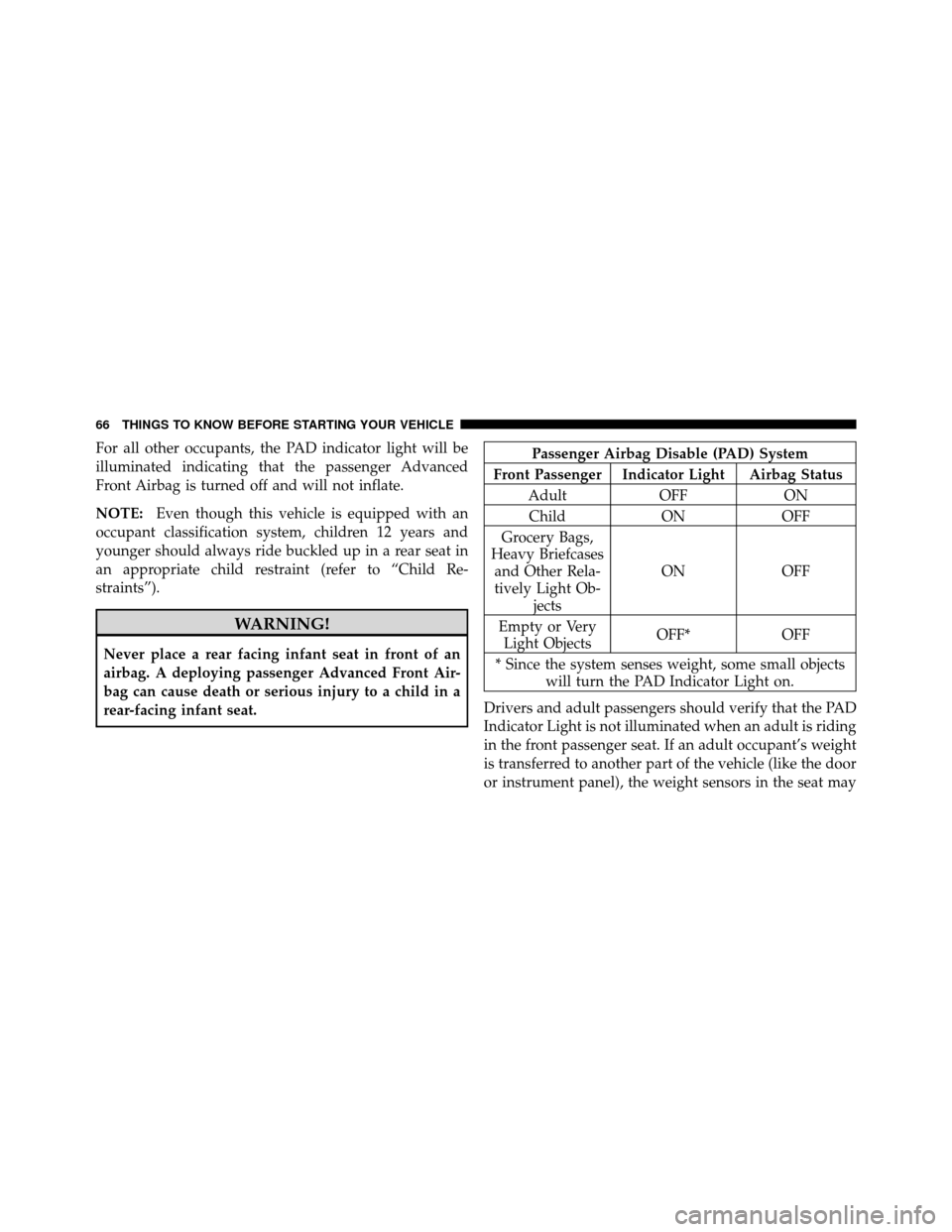
For all other occupants, the PAD indicator light will be
illuminated indicating that the passenger Advanced
Front Airbag is turned off and will not inflate.
NOTE:Even though this vehicle is equipped with an
occupant classification system, children 12 years and
younger should always ride buckled up in a rear seat in
an appropriate child restraint (refer to “Child Re-
straints”).
WARNING!
Never place a rear facing infant seat in front of an
airbag. A deploying passenger Advanced Front Air-
bag can cause death or serious injury to a child in a
rear-facing infant seat.
Passenger Airbag Disable (PAD) System
Front Passenger Indicator Light Airbag Status Adult OFFON
Child ONOFF
Grocery Bags,
Heavy Briefcases and Other Rela-
tively Light Ob- jects ON
OFF
Empty or Very Light Objects OFF*
OFF
* Since the system senses weight, some small objects will turn the PAD Indicator Light on.
Drivers and adult passengers should verify that the PAD
Indicator Light is not illuminated when an adult is riding
in the front passenger seat. If an adult occupant’s weight
is transferred to another part of the vehicle (like the door
or instrument panel), the weight sensors in the seat may
66 THINGS TO KNOW BEFORE STARTING YOUR VEHICLE
Page 68 of 498
not properly classify the occupant. Objects lodged under
the seat or between the seat and the center console can
prevent the occupant’s weight from being measured
properly and may result in the occupant being improp-
erly classified. Ensure that the front passenger seatback
does not touch anything placed on the second row of
seats because this can also affect occupant classification.
Also, if you fold down the seats in the second row check
to be sure they don’t touch the front passenger seat.
If the front passenger seat is damaged in any way, it
should only be serviced by an authorized dealer. If the
seat is removed (or even if the seat attachment bolts are
loosened or tightened in any way), take the vehicle to an
authorized dealer.If there is a fault present in the airbag system, the Airbag
Warning Light (a red light located in the center of the
instrument cluster directly in front of the driver) will be
turned on. This indicates that you should have an autho-
rized dealer service the system immediately. The Airbag
Warning Light is turned on whenever there is a fault that
can affect the operation of the airbag system. If there is a
fault present in the PAD Indicator Light, the Airbag
Warning Light will be illuminated to show that the
passenger Advanced Front Airbag may be turned off
until the fault is cleared. If the Airbag Warning Light is
illuminated, have an authorized dealer service the airbag
system immediately. If an object is lodged under the seat
and interferes with operation of the weight sensors, a
fault will occur which turns on both the PAD Indicator
Light and the Airbag Warning Light. Once the lodged
object is removed, the fault will be automatically cleared
after a short period of time.
2
THINGS TO KNOW BEFORE STARTING YOUR VEHICLE 67