engine DODGE NITRO 2010 1.G Workshop Manual
[x] Cancel search | Manufacturer: DODGE, Model Year: 2010, Model line: NITRO, Model: DODGE NITRO 2010 1.GPages: 498, PDF Size: 6.94 MB
Page 303 of 498
overheating or failure due to excessive shifting. When
operating in TOW/HAUL mode, the transmission will
shift into third gear.
NOTE:The TOW/HAUL mode locks out Overdrive.
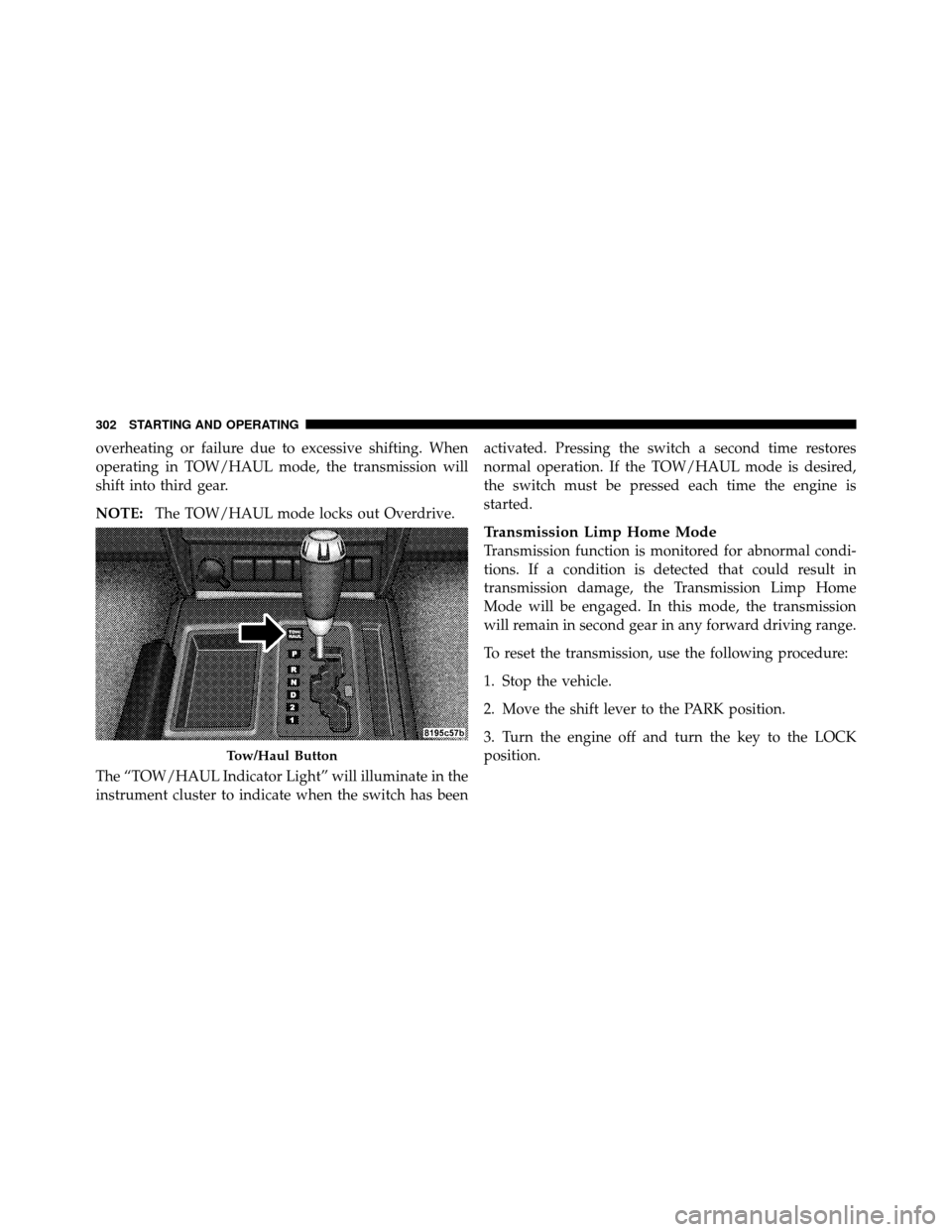
The “TOW/HAUL Indicator Light” will illuminate in the
instrument cluster to indicate when the switch has been activated. Pressing the switch a second time restores
normal operation. If the TOW/HAUL mode is desired,
the switch must be pressed each time the engine is
started.
Transmission Limp Home Mode
Transmission function is monitored for abnormal condi-
tions. If a condition is detected that could result in
transmission damage, the Transmission Limp Home
Mode will be engaged. In this mode, the transmission
will remain in second gear in any forward driving range.
To reset the transmission, use the following procedure:
1. Stop the vehicle.
2. Move the shift lever to the PARK position.
3. Turn the engine off and turn the key to the LOCK
position.
Tow/Haul Button
302 STARTING AND OPERATING
Page 304 of 498
4. Wait approximately 10 seconds, then restart the en-
gine.
5. Move the shift lever to the desired gear range.
If the problem is no longer detected, the transmission will
return to normal operation. If the problem persists,
PARK, REVERSE, and NEUTRAL will continue to oper-
ate. Only second gear range will operate in the DRIVE
position. Have the transmission checked at your autho-
rized dealer as soon as possible.
Torque Converter Clutch
A feature designed to improve fuel economy has been
added to the automatic transmission of this vehicle. A
clutch within the torque converter engages automatically
at calibrated speeds. This may result in a slightly differ-
ent feeling or response during normal operation in high
gear. When the vehicle speed drops or during accelera-
tion, the clutch automatically and smoothly disengages.Five–Speed Automatic Transmission – 4.0L Engine
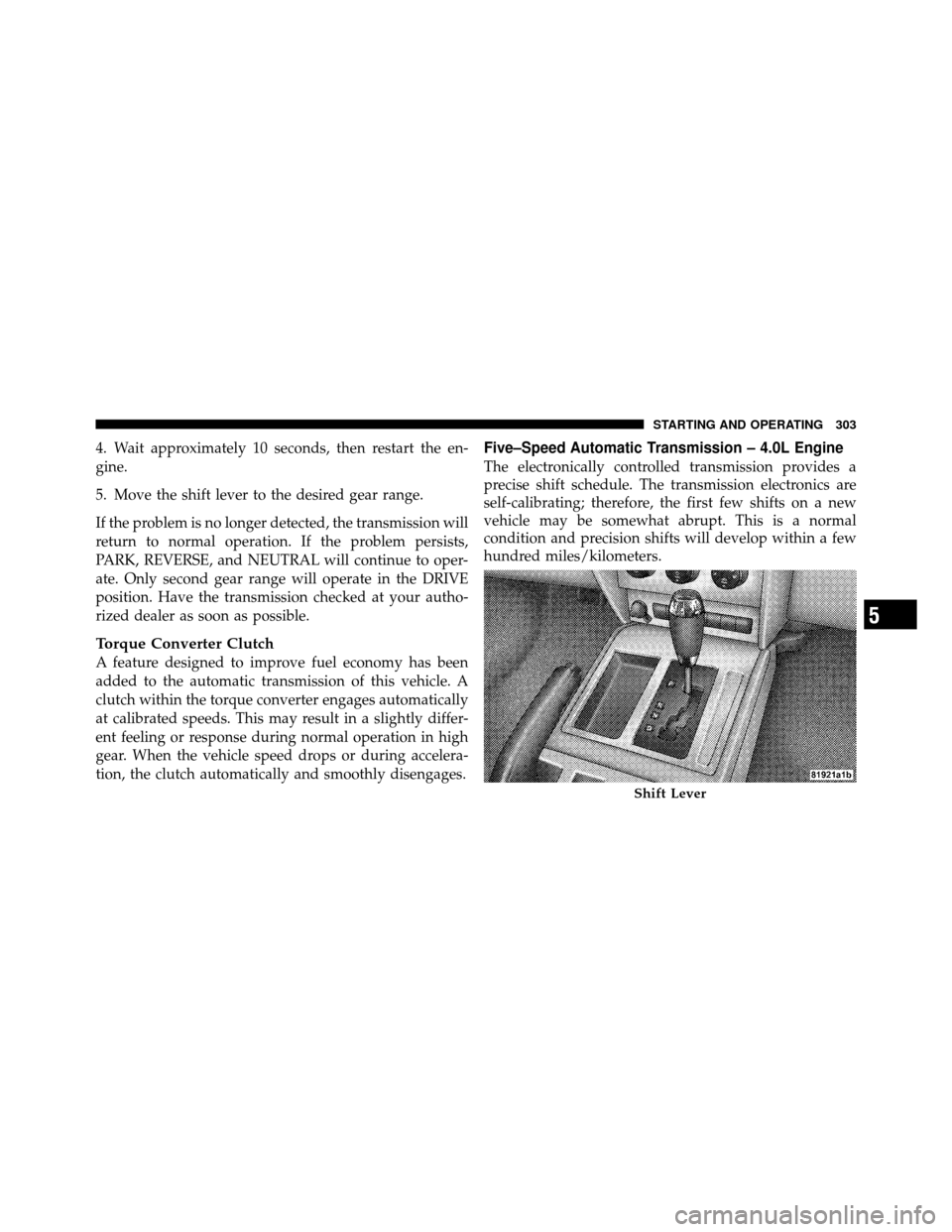
The electronically controlled transmission provides a
precise shift schedule. The transmission electronics are
self-calibrating; therefore, the first few shifts on a new
vehicle may be somewhat abrupt. This is a normal
condition and precision shifts will develop within a few
hundred miles/kilometers.
Shift Lever
5
STARTING AND OPERATING 303
Page 305 of 498
Gear Ranges
NOTE:After selecting any gear range, wait a moment to
allow the selected gear to engage before accelerating.
This is especially important when the engine is cold. If
there is a need to restart the engine, be sure to cycle the
key to the LOCK position before restarting. Transmission
gear engagement may be delayed after restarting the
engine if the key is not cycled to the LOCK position first.
PARK
This range supplements the parking brake by locking the
transmission. The engine can be started in this range.
Never use PARK while the vehicle is in motion. Apply
the parking brake when leaving the vehicle in this range.
Always apply the parking brake first, then place the shift
lever in the PARK position.
WARNING!
•Never use the PARK position as a substitute for
the parking brake. Always apply the parking
brake fully when parked to guard against vehicle
movement and possible injury or damage.
•It is dangerous to move the shift lever out of PARK
or NEUTRAL if the engine speed is higher than
idle speed. If your foot is not firmly on the brake
pedal, the vehicle could accelerate quickly forward
or in REVERSE. You could lose control of the
vehicle and hit someone or something. Only shift
into gear when the engine is idling normally and
when your right foot is firmly on the brake pedal.
REVERSE
This range is for moving the vehicle backward. Use this
range only after the vehicle has come to a complete stop.
304 STARTING AND OPERATING
Page 306 of 498
NEUTRAL
This range is used when vehicle is standing for pro-
longed periods with engine running. Engine may be
started in this range. Set the parking brake if you must
leave the vehicle.
NOTE:Towing the vehicle, coasting, or driving for any
other reason with the shift lever in NEUTRAL can result
in severe transmission damage. Refer to “Recreational
Towing” in “Starting and Operating” and “Towing a
Disabled Vehicle” in “What To Do In Emergencies” for
further information.
DRIVE
This range is used for most city and highway driving.
Electronic Range Select (ERS) Operation
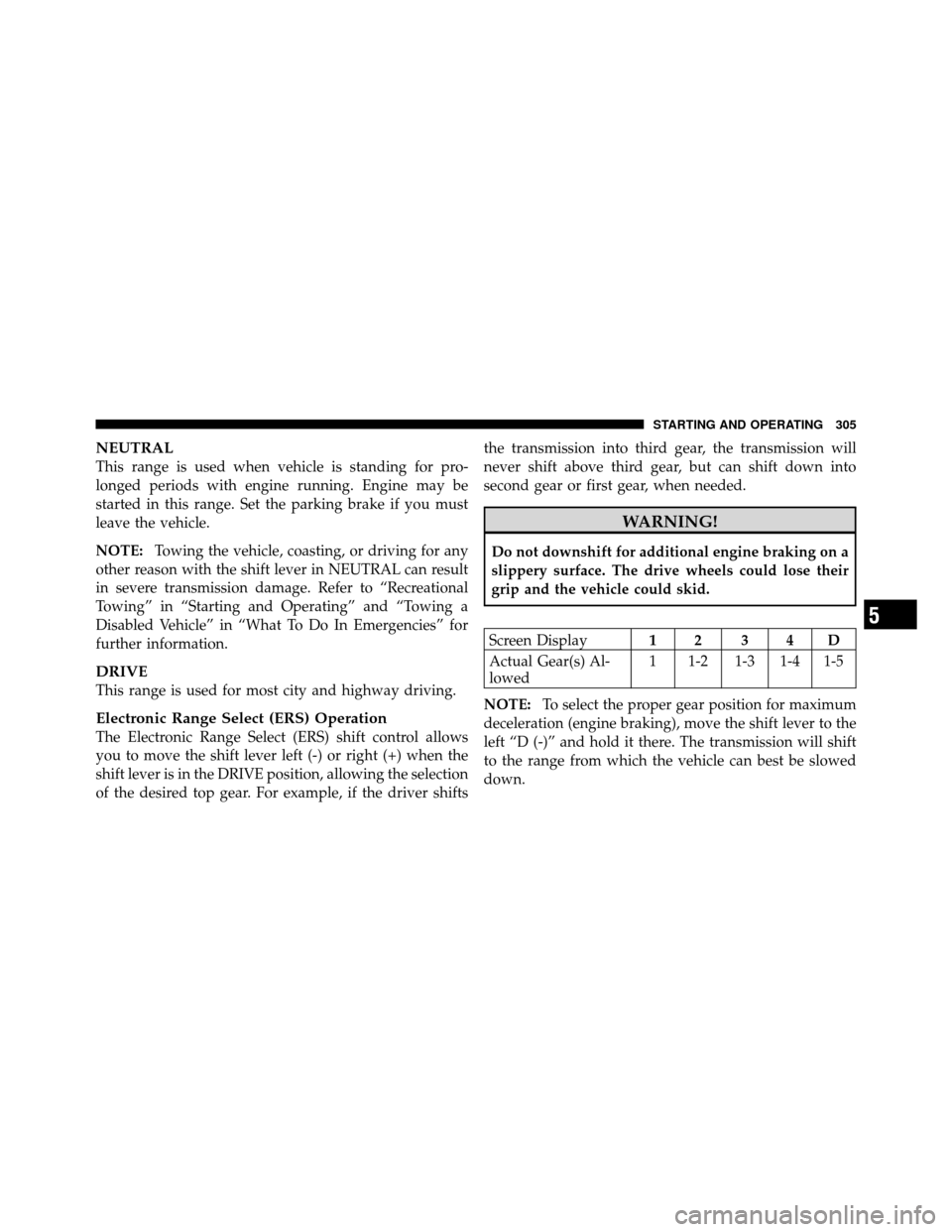
The Electronic Range Select (ERS) shift control allows
you to move the shift lever left (-) or right (+) when the
shift lever is in the DRIVE position, allowing the selection
of the desired top gear. For example, if the driver shifts the transmission into third gear, the transmission will
never shift above third gear, but can shift down into
second gear or first gear, when needed.
WARNING!
Do not downshift for additional engine braking on a
slippery surface. The drive wheels could lose their
grip and the vehicle could skid.
Screen Display
12 34D
Actual Gear(s) Al-
lowed 1 1-2 1-3 1-4 1-5
NOTE: To select the proper gear position for maximum
deceleration (engine braking), move the shift lever to the
left “D (-)” and hold it there. The transmission will shift
to the range from which the vehicle can best be slowed
down.
5
STARTING AND OPERATING 305
Page 307 of 498
Overdrive Operation
The overdrive automatic transmission contains an elec-
tronically controlled fifth gear (OVERDRIVE). The trans-
mission will automatically shift from fourth gear to
OVERDRIVE if the following conditions are present:
•the shift lever is in DRIVE
•the engine coolant has reached normal operating tem-
perature
•the vehicle speed is above approximately 30 mph
(48 km/h)
•the transmission has reached normal operating
temperature
NOTE: If the vehicle is started in extremely cold tem-
peratures, the transmission may not shift into OVER-
DRIVE and will automatically select the most desirable
gear for operation at this temperature. Normal operation
will resume when the transmission fluid temperature has risen to a suitable level. Refer to the “Note” under
“Torque Converter Clutch” later in this section.
During cold temperature operation, you may notice
delayed upshifts depending on engine and transmission
temperature. This feature improves the warm up time of
the engine and transmission.
During cold temperature operation, the transmission
may not downshift from second gear into first gear after
the initial first to second gear upshift.
Transmission Limp Home Mode
Transmission function is monitored for abnormal condi-
tions. If a condition is detected that could result in
transmission damage, the Transmission Limp Home
Mode will be engaged. In this mode, the transmission
will remain in the current gear until the vehicle is
brought to a stop.
306 STARTING AND OPERATING
Page 308 of 498
To reset the transmission, use the following procedure:
1. Stop the vehicle.
2. Move the shift lever to the PARK position.
3. Turn the engine off and turn the key to the LOCK
position.
4. Wait approximately 10 seconds, then restart the en-
gine.
5. Move the shift lever to the desired gear range.
If the problem is no longer detected, the transmission will
return to normal operation. If the problem persists,
PARK, REVERSE, and NEUTRAL will continue to oper-
ate. Only second gear will operate in the DRIVE position.
Have the transmission checked at your authorized dealer
as soon as possible.Torque Converter Clutch
A feature designed to improve fuel economy has been
included in the automatic transmission on your vehicle.
A clutch within the torque converter engages automati-
cally at a calibrated speed at light throttle. It engages at
higher speeds under heavier acceleration. This may re-
sult in a slightly different feeling or response during
normal operation in high gear. When the vehicle speed
drops below a calibrated speed, or during acceleration,
the clutch automatically and smoothly disengages. The
feature is operational in OVERDRIVE and in DRIVE.
NOTE:
•The torque converter clutch will not engage until the
transmission fluid and engine coolant are warm (usu-
ally after 1 to 3 miles (1.6 - 4.8 km) of driving). Because
the engine speed is higher when the torque converter
clutch is not engaged, it may seem as if the transmis-
sion is not shifting into OVERDRIVE when cold. This
is normal.
5
STARTING AND OPERATING 307
Page 311 of 498
Shifting Procedure – Electronically Shifted
Transfer Case
NOTE:If any of the requirements to select a new
transfer case position have not been met, the transfer case
will not shift. The “4WD Indicator Light” (located in the
display under the tachometer) will flash until all the
requirements for the selected position have been met. To
retry a shift, return the control knob back to the original
position, make certain all shift requirements have been
met, wait five seconds and try the shift again.
2WD⇔ 4WD LOCK
Rotate the transfer case switch to the desired position.
Shifts between 2WD and 4WD LOCK can be done with
the vehicle stopped or in motion. With the vehicle in
motion, the transfer case will engage/disengage faster if
you momentarily release the accelerator pedal after turn-
ing the switch. If the vehicle is stopped, the ignition key must be in the ON position with the engine either
RUNNING or OFF. This shift cannot be completed if the
key is in the ACC position.
NOTE:
•The four-wheel drive system will not allow shifts
between 2WD/4WD LOCK if the front and/or rear
wheels are spinning (no traction). In this situation, the
“4WD Indicator Light” (located in the display under
the tachometer) will flash. At this time, reduce speed
and stop spinning the wheels to complete the shift.
•Delayed shifting out of 4WD LOCK may be experi-
enced due to uneven tire wear, low tire pressure, or
excessive loading.
ON-ROAD DRIVING TIPS
Utility vehicles have higher ground clearance and a
narrower track to make them capable of performing in a
wide variety of off-road applications. Specific design
310 STARTING AND OPERATING
Page 313 of 498
drive through water, try to determine the depth and the
bottom condition (and location of any obstacles) prior to
entering. Proceed with caution and maintain a steady
controlled speed less than 5 mph (8 km/h) in deep water
to minimize wave effects.
Flowing Water
If the water is swift flowing and rising (as in storm
run-off) avoid crossing until the water level recedes
and/or the flow rate is reduced. If you must cross
flowing water, avoid depths in excess of 9 in (23 cm). The
flowing water can erode the streambed causing your
vehicle to sink into deeper water. Determine exit point(s)
that are downstream of your entry point to allow for
drifting.Standing Water
Avoid driving in standing water deeper than 20 in
(50 cm) and reduce speed appropriately to minimize
wave effects. Maximum speed in 20 in (50 cm) of water is
less than 5 mph (8 km/h).
Maintenance
After driving through deep water, inspect your vehicle
fluids and lubricants (engine, transmission, axle, transfer
case) to assure they have not been contaminated. Con-
taminated fluids and lubricants (milky, foamy in appear-
ance) should be flushed/changed as soon as possible to
prevent component damage.
Driving In Snow, Mud and Sand
In heavy snow, when pulling a load, or for additional
control at slower speeds, shift the transmission to a low
gear and shift the transfer case to 4L or 4LO if necessary.
Refer to “Four-Wheel Drive Operation” in “Starting and
Operating” for further information. Do not shift to a
312 STARTING AND OPERATING
Page 314 of 498
lower gear than necessary to maintain headway. Over-
revving the engine can spin the wheels and traction will
be lost.
Avoid abrupt downshifts on icy or slippery roads, be-
cause engine braking may cause skidding and loss of
control.
Hill Climbing
NOTE:Before attempting to climb a hill, determine the
conditions at the crest and/or on the other side.
Before climbing a steep hill, shift the transmission to a
lower gear and shift the transfer case to 4L or 4LO. Use
first gear and 4L or 4LO for very steep hills.
If you stall or begin to lose headway while climbing a
steep hill, allow your vehicle to come to a stop and
immediately apply the brakes. Restart the engine and shift
to REVERSE. Back slowly down the hill allowing the
compression braking of the engine to help regulate your speed. If the brakes are required to control vehicle speed,
apply them lightly and avoid locking or skidding the tires.
WARNING!
If the engine stalls or you lose headway or cannot
make it to the top of a steep hill or grade, never
attempt to turn around. To do so may result in
tipping and rolling the vehicle. Always back straight
down a hill in REVERSE gear carefully. Never back
down a hill in NEUTRAL using only the brake.
Remember, never drive diagonally across a hill; always
drive straight up or down.
If the wheels start to slip as you approach the crest of a
hill, ease off the accelerator and maintain headway by
turning the front wheels slowly left and right. This may
provide a fresh “bite” into the surface and will usually
provide traction to complete the climb.
5
STARTING AND OPERATING 313
Page 315 of 498
Traction Downhill
Shift the transmission into a low gear and the transfer
case to 4L or 4LO range. Let the vehicle go slowly down
the hill with all four wheels turning against engine
compression drag. This will permit you to control the
vehicle speed and direction.
When descending mountains or hills, repeated braking
can cause brake fade with loss of braking control. Avoid
repeated heavy braking by downshifting the transmis-
sion whenever possible.
After Driving Off-Road
Off-road operation puts more stress on your vehicle than
does most on-road driving. After going off-road, it is
always a good idea to check for damage. That way you
can get any problems taken care of right away and have
your vehicle ready when you need it.
•Completely inspect the underbody of your vehicle.
Check tires, body structure, steering, suspension, and
exhaust system for damage.
•Inspect the radiator for mud and debris and clean as
required.
•Check threaded fasteners for looseness, particularly on
the chassis, drivetrain components, steering, and sus-
pension. Retighten them, if required, and torque to the
values specified in the Service Manual.
•Check for accumulations of plants or brush. These
things could be a fire hazard. They might hide damage
to fuel lines, brake hoses, axle pinion seals, and
propeller shafts.
•After extended operation in mud, sand, water, or
similar dirty conditions, have the radiator, fan, brake
rotors, wheels, brake linings, and axle yokes inspected
and cleaned as soon as possible.
314 STARTING AND OPERATING