automatic transmission DODGE NITRO 2011 1.G User Guide
[x] Cancel search | Manufacturer: DODGE, Model Year: 2011, Model line: NITRO, Model: DODGE NITRO 2011 1.GPages: 497, PDF Size: 3.89 MB
Page 300 of 497
WARNING! (Continued)
•It is dangerous to move the shift lever out of PARK
or NEUTRAL if the engine speed is higher than
idle speed. If your foot is not firmly on the brake
pedal, the vehicle could accelerate quickly forward
or in REVERSE. You could lose control of the
vehicle and hit someone or something. Only shift
into gear when the engine is idling normally and
when your right foot is firmly on the brake pedal.
REVERSE
This range is for moving the vehicle backward. Use only
after the vehicle has come to a complete stop.
NEUTRAL
This range is used when vehicle is standing for pro-
longed periods with engine running. Engine may be
started in this range. Set the parking brake and shift the
transmission into PARK if you must leave the vehicle.NOTE:
Towing the vehicle, coasting, or driving for any
other reason with shift lever in NEUTRAL can result in
severe transmission damage. Refer to “Recreational Tow-
ing” in “Starting and Operating” and “Towing a Disabled
Vehicle” in “What To Do In Emergencies” for further
information.
DRIVE
This range is used for most city and highway driving.
2 (Second)
This range is used for moderate grades and to assist
braking on dry pavement or in mud and snow. Begins at
a stop in low gear with automatic upshift to second gear.
Will not shift into third gear.
1 (First)
This range is used for hard pulling at low speeds in mud,
sand, snow, or on steep grades. Begins and stays in low
gear with no upshift. Provides engine compression brak-
ing at low speeds.
5
STARTING AND OPERATING 297
Page 301 of 497
Overdrive Operation
The overdrive automatic transmission contains an elec-
tronically controlled fourth gear (OVERDRIVE). The
transmission will automatically shift from third gear into
OVERDRIVE if the following conditions are present:
•the shift lever is in DRIVE
•vehicle speed is above approximately 30 mph
(48 km/h)
•the TOW/HAUL button has not been activated
The transmission will downshift from OVERDRIVE to
DRIVE if the accelerator pedal is fully pressed at vehicle
speeds above approximately 35 mph (56 km/h).
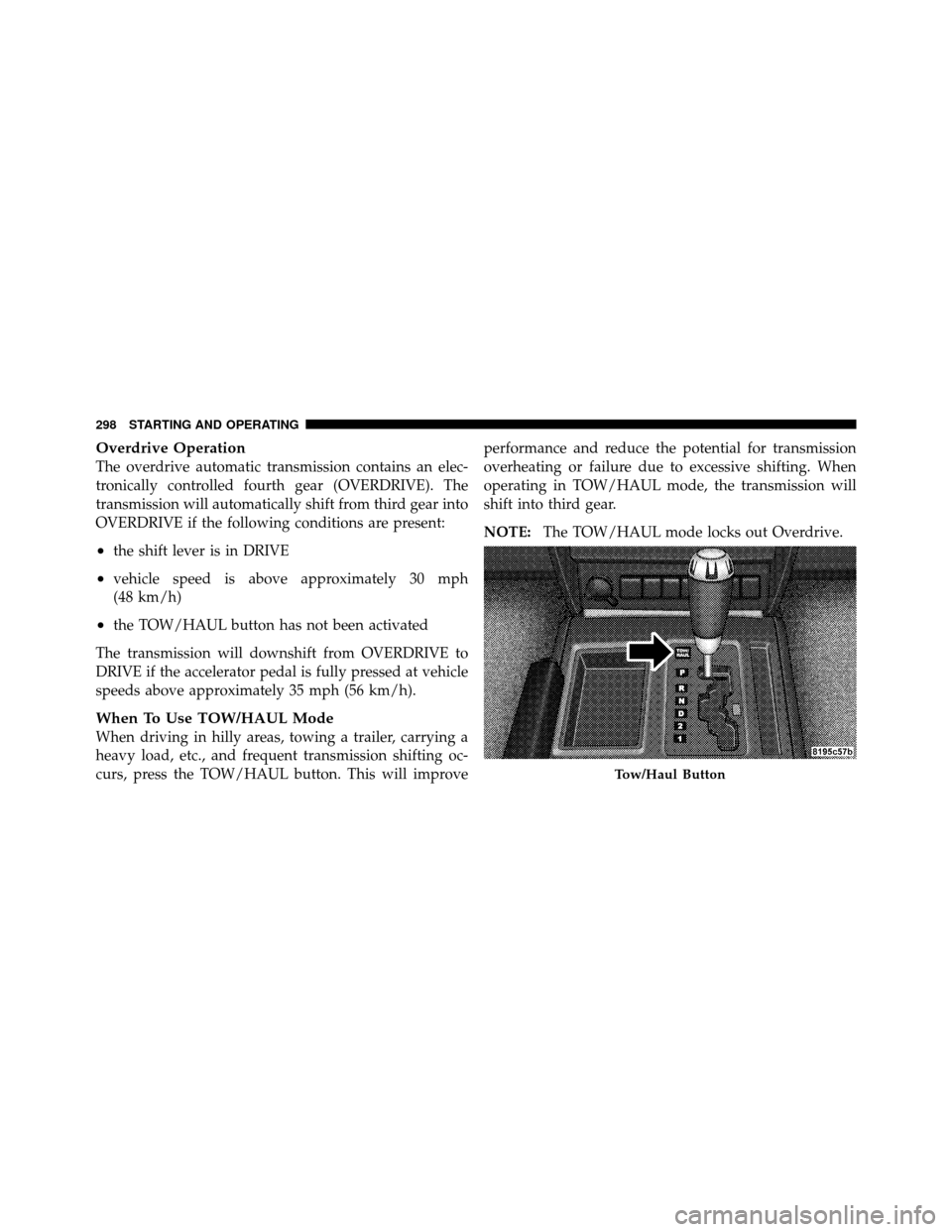
When To Use TOW/HAUL Mode
When driving in hilly areas, towing a trailer, carrying a
heavy load, etc., and frequent transmission shifting oc-
curs, press the TOW/HAUL button. This will improve performance and reduce the potential for transmission
overheating or failure due to excessive shifting. When
operating in TOW/HAUL mode, the transmission will
shift into third gear.
NOTE:
The TOW/HAUL mode locks out Overdrive.
Tow/Haul Button
298 STARTING AND OPERATING
Page 302 of 497
The “TOW/HAUL Indicator Light” will illuminate in the
instrument cluster to indicate when the switch has been
activated. Pressing the switch a second time restores
normal operation. If the TOW/HAUL mode is desired,
the switch must be pressed each time the engine is
started.
Transmission Limp Home Mode
Transmission function is monitored for abnormal condi-
tions. If a condition is detected that could result in
transmission damage, the Transmission Limp Home
Mode will be engaged. In this mode, the transmission
will remain in second gear in any forward driving range.
To reset the transmission, use the following procedure:
1. Stop the vehicle.
2. Move the shift lever to the PARK position.
3. Turn the engine off and turn the key to the LOCK
position.4. Wait approximately 10 seconds, then restart the en-
gine.
5. Move the shift lever to the desired gear range.
If the problem is no longer detected, the transmission will
return to normal operation. If the problem persists,
PARK, REVERSE, and NEUTRAL will continue to oper-
ate. Only second gear range will operate in the DRIVE
position. Have the transmission checked at your autho-
rized dealer as soon as possible.
Torque Converter Clutch
A feature designed to improve fuel economy has been
added to the automatic transmission of this vehicle. A
clutch within the torque converter engages automatically
at calibrated speeds. This may result in a slightly differ-
ent feeling or response during normal operation in high
gear. When the vehicle speed drops or during accelera-
tion, the clutch automatically and smoothly disengages.
5
STARTING AND OPERATING 299
Page 303 of 497
Five–Speed Automatic Transmission – 4.0L Engine
The electronically controlled transmission provides a
precise shift schedule. The transmission electronics are
self-calibrating; therefore, the first few shifts on a new
vehicle may be somewhat abrupt. This is a normal
condition and precision shifts will develop within a few
hundred miles/kilometers.
Gear Ranges
NOTE:After selecting any gear range, wait a moment to
allow the selected gear to engage before accelerating.
This is especially important when the engine is cold. If
there is a need to restart the engine, be sure to cycle the
key to the LOCK position before restarting. Transmission
gear engagement may be delayed after restarting the
engine if the key is not cycled to the LOCK position first.
PARK
This range supplements the parking brake by locking the
transmission. The engine can be started in this range.
Never use PARK while the vehicle is in motion. Apply
the parking brake when leaving the vehicle in this range.
Always apply the parking brake first, then place the shift
lever in the PARK position.
Shift Lever
300 STARTING AND OPERATING
Page 305 of 497
the transmission into third gear, the transmission will
never shift above third gear, but can shift down into
second gear or first gear, when needed.
WARNING!
Do not downshift for additional engine braking on a
slippery surface. The drive wheels could lose their
grip and the vehicle could skid.
Screen Display12 34D
Actual Gear(s) Allowed 1 1-2 1-3 1-4 1-5
NOTE: To select the proper gear position for maximum
deceleration (engine braking), move the shift lever to the
left “D (-)” and hold it there. The transmission will shift
to the range from which the vehicle can best be slowed
down.
Overdrive Operation
The overdrive automatic transmission contains an elec-
tronically controlled fifth gear (OVERDRIVE). The trans-
mission will automatically shift from fourth gear to
OVERDRIVE if the following conditions are present:
•the shift lever is in DRIVE
•the engine coolant has reached normal operating tem-
perature
•the vehicle speed is above approximately 30 mph
(48 km/h)
•the transmission has reached normal operating
temperature
NOTE: If the vehicle is started in extremely cold tem-
peratures, the transmission may not shift into OVER-
DRIVE and will automatically select the most desirable
gear for operation at this temperature. Normal operation
will resume when the transmission fluid temperature has
302 STARTING AND OPERATING
Page 307 of 497
Torque Converter Clutch
A feature designed to improve fuel economy has been
included in the automatic transmission on your vehicle.
A clutch within the torque converter engages automati-
cally at a calibrated speed at light throttle. It engages at
higher speeds under heavier acceleration. This may re-
sult in a slightly different feeling or response during
normal operation in high gear. When the vehicle speed
drops below a calibrated speed, or during acceleration,
the clutch automatically and smoothly disengages.
NOTE:If the vehicle has not been driven in several
days, the first few seconds of operation after shifting the
transmission into gear may seem sluggish. This is due to
the fluid partially draining from the torque converter into
the transmission. This condition is normal and will not
cause damage to the transmission. The torque converter
will refill within five seconds of starting the engine.
FOUR-WHEEL DRIVE OPERATION — IF EQUIPPED
Single-Speed Part-Time Transfer Case
Operating Information/Precautions
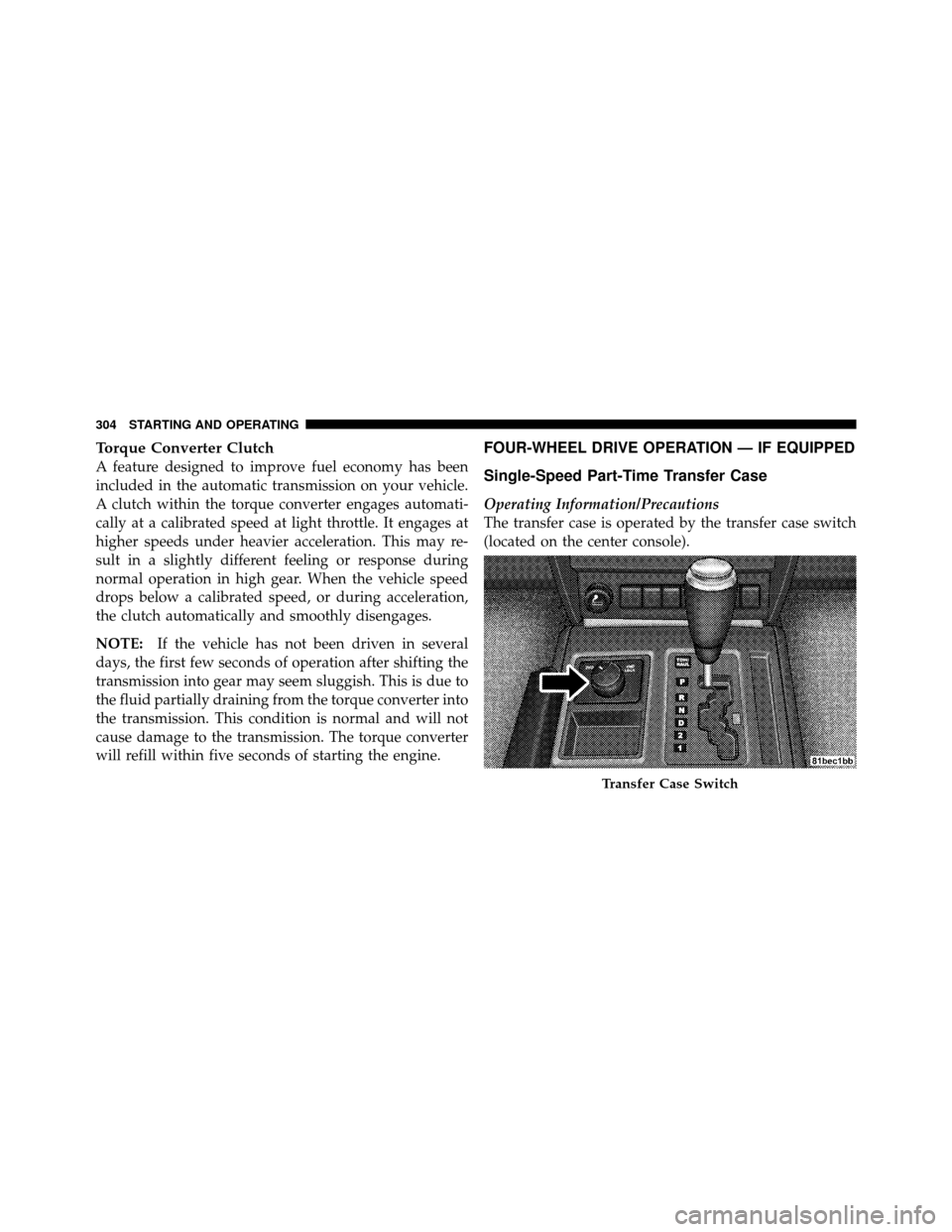
The transfer case is operated by the transfer case switch
(located on the center console).
Transfer Case Switch
304 STARTING AND OPERATING
Page 370 of 497
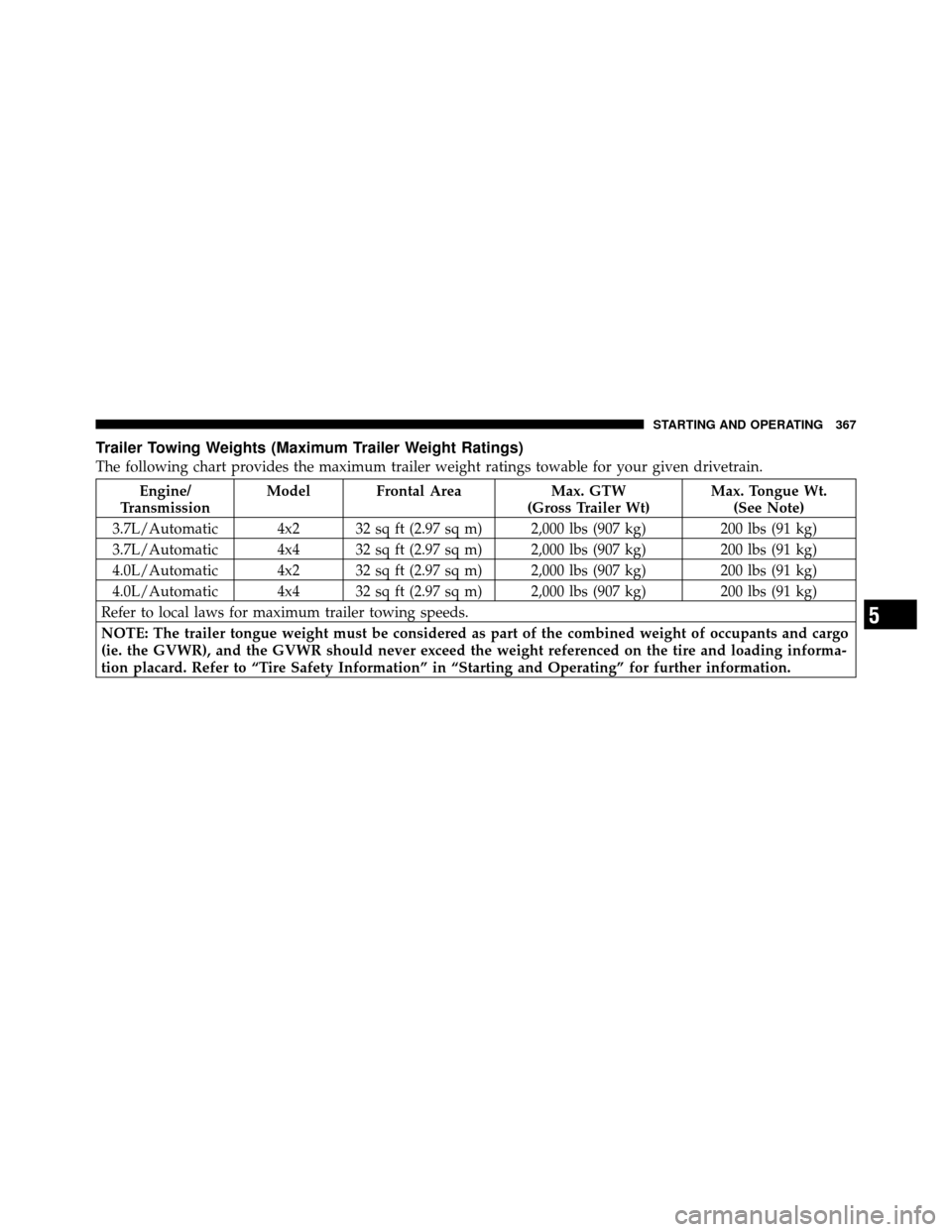
Trailer Towing Weights (Maximum Trailer Weight Ratings)
The following chart provides the maximum trailer weight ratings towable for your given drivetrain.
Engine/
Transmission Model Frontal Area Max. GTW
(Gross Trailer Wt)Max. Tongue Wt.
(See Note)
3.7L/Automatic 4x2 32 sq ft (2.97 sq m) 2,000 lbs (907 kg) 200 lbs (91 kg)
3.7L/Automatic 4x4 32 sq ft (2.97 sq m) 2,000 lbs (907 kg) 200 lbs (91 kg)
4.0L/Automatic 4x2 32 sq ft (2.97 sq m) 2,000 lbs (907 kg) 200 lbs (91 kg)
4.0L/Automatic 4x4 32 sq ft (2.97 sq m) 2,000 lbs (907 kg) 200 lbs (91 kg)
Refer to local laws for maximum trailer towing speeds.
NOTE: The trailer tongue weight must be considered as part of the combined weight of occupants and cargo
(ie. the GVWR), and the GVWR should never exceed the weight referenced on the tire and loading informa-
tion placard. Refer to “Tire Safety Information” in “Starting and Operating” for further information.
5
STARTING AND OPERATING 367
Page 371 of 497
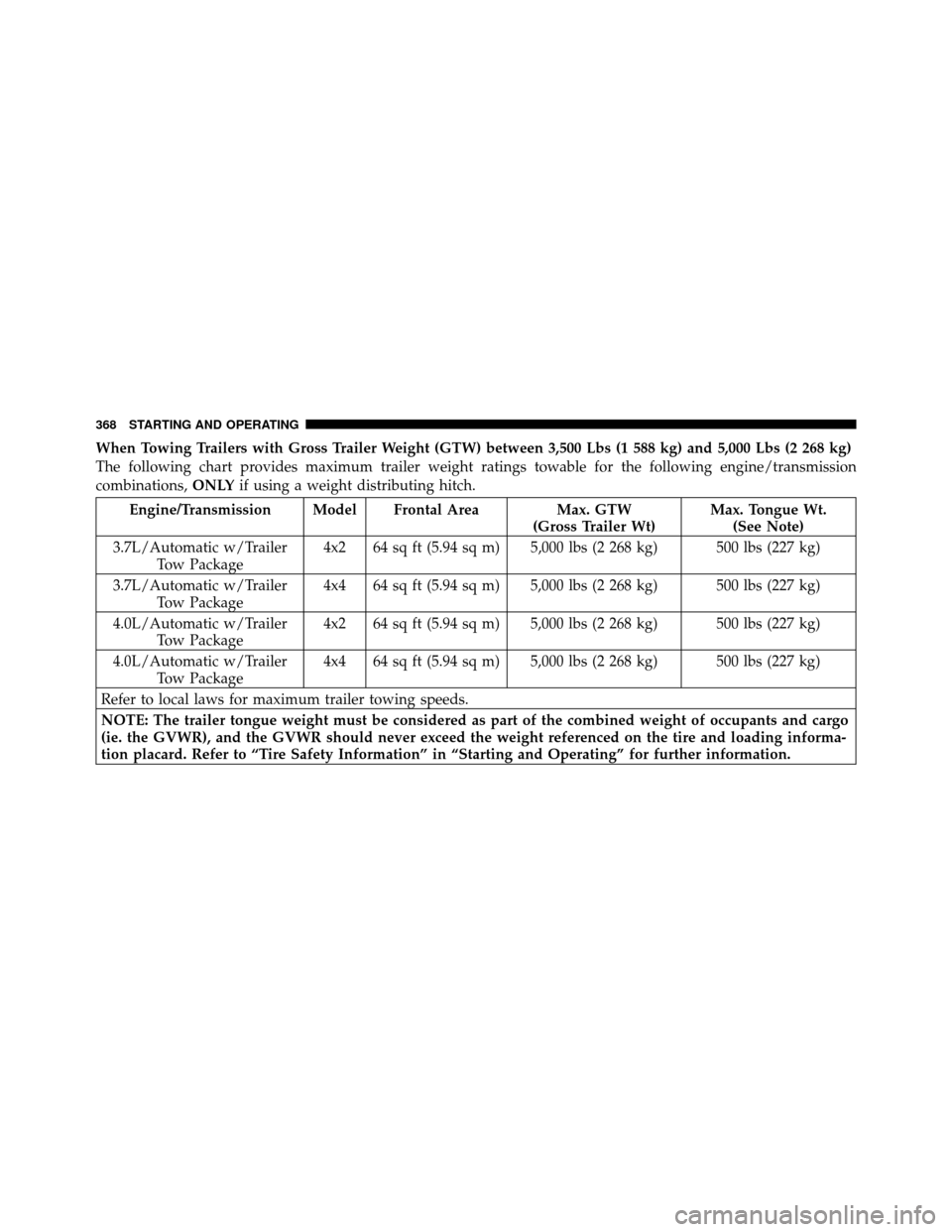
When Towing Trailers with Gross Trailer Weight (GTW) between 3,500 Lbs (1 588 kg) and 5,000 Lbs (2 268 kg)
The following chart provides maximum trailer weight ratings towable for the following engine/transmission
combinations,ONLYif using a weight distributing hitch.
Engine/Transmission Model Frontal Area Max. GTW
(Gross Trailer Wt) Max. Tongue Wt.
(See Note)
3.7L/Automatic w/Trailer Tow Package 4x2 64 sq ft (5.94 sq m) 5,000 lbs (2 268 kg) 500 lbs (227 kg)
3.7L/Automatic w/Trailer Tow Package 4x4 64 sq ft (5.94 sq m) 5,000 lbs (2 268 kg) 500 lbs (227 kg)
4.0L/Automatic w/Trailer Tow Package 4x2 64 sq ft (5.94 sq m) 5,000 lbs (2 268 kg) 500 lbs (227 kg)
4.0L/Automatic w/Trailer Tow Package 4x4 64 sq ft (5.94 sq m) 5,000 lbs (2 268 kg) 500 lbs (227 kg)
Refer to local laws for maximum trailer towing speeds.
NOTE: The trailer tongue weight must be considered as part of the combined weight of occupants and cargo
(ie. the GVWR), and the GVWR should never exceed the weight referenced on the tire and loading informa-
tion placard. Refer to “Tire Safety Information” in “Starting and Operating” for further information.
368 STARTING AND OPERATING
Page 378 of 497
Towing Tips
Before setting out on a trip, practice turning, stopping
and backing up the trailer in an area away from heavy
traffic.
Automatic Transmission
The “D” range can be selected when towing. However, if
frequent shifting occurs while in this range, the “TOW/
HAUL” button (if equipped) or a lower gear range
should be selected.
NOTE:Using the “TOW/HAUL” button (3.7L engine)
or “4” range (4.0L engine) while operating the vehicle
under heavy operating conditions will improve perfor-
mance and extend transmission life by reducing exces-
sive shifting and heat build up. This action will also
provide better engine braking. The automatic transmission fluid and filter should be
changed if you regularly tow a trailer for more than
45 minutes of continuous operation. Refer to “Mainte-
nance Schedule” for the proper maintenance intervals.
TOW/HAUL – If Equipped
To reduce potential for automatic transmission overheat-
ing, press the “TOW/HAUL” button when driving in
hilly areas or shift the transmission to DRIVE position 2
on more severe grades. Refer to “Automatic Transmis-
sion” in “Starting and Operating” for further
information.
5
STARTING AND OPERATING 375
Page 387 of 497
WARNING!
Do not attempt to change a tire on the side of the
vehicle close to moving traffic, pull far enough off
the road to avoid being hit when operating the jack
or changing the wheel.
2. Turn on the Hazard Warning flasher.
3. Set the parking brake.
4. Place the shift lever into PARK.
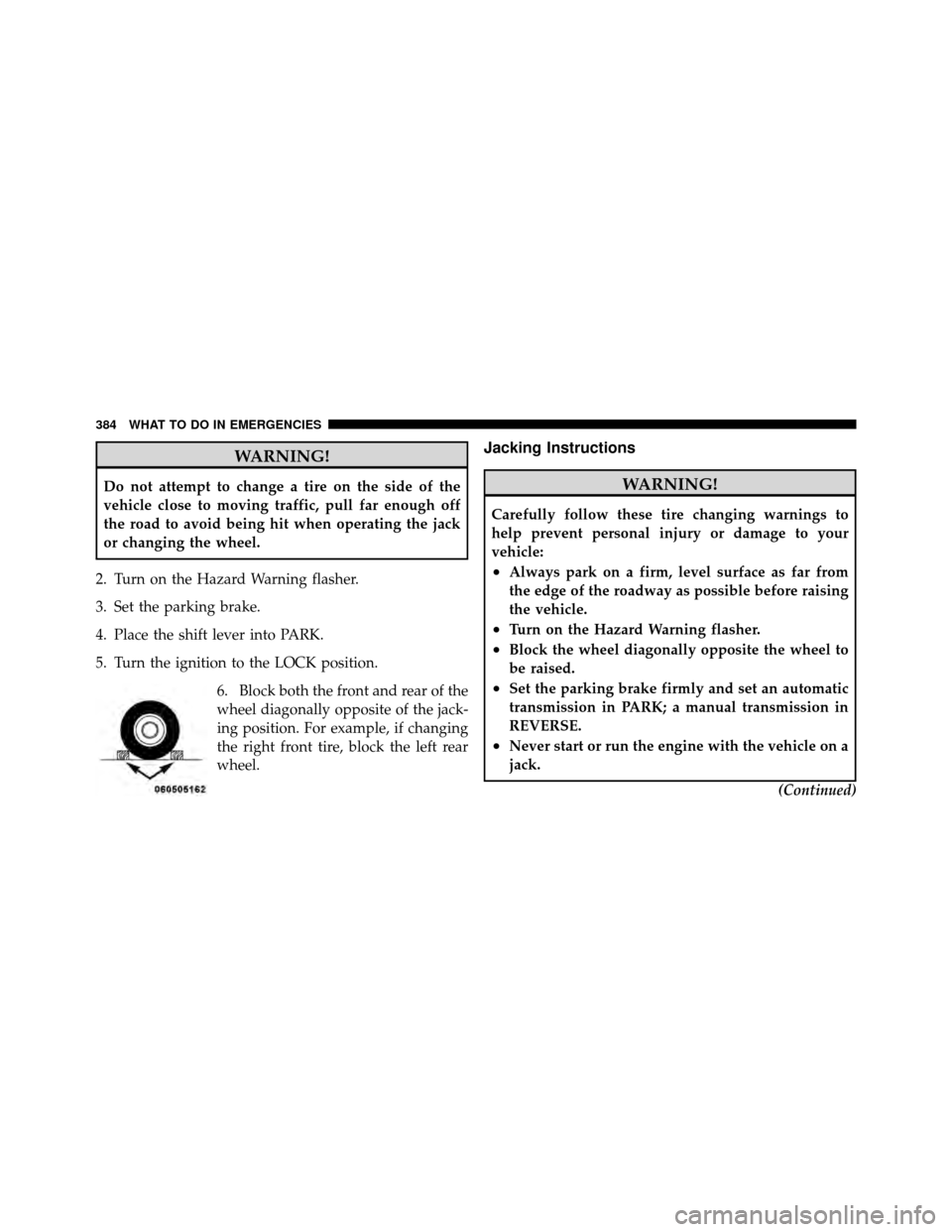
5. Turn the ignition to the LOCK position. 6. Block both the front and rear of the
wheel diagonally opposite of the jack-
ing position. For example, if changing
the right front tire, block the left rear
wheel.
Jacking Instructions
WARNING!
Carefully follow these tire changing warnings to
help prevent personal injury or damage to your
vehicle:
•Always park on a firm, level surface as far from
the edge of the roadway as possible before raising
the vehicle.
•Turn on the Hazard Warning flasher.
•Block the wheel diagonally opposite the wheel to
be raised.
•Set the parking brake firmly and set an automatic
transmission in PARK; a manual transmission in
REVERSE.
•Never start or run the engine with the vehicle on a
jack. (Continued)
384 WHAT TO DO IN EMERGENCIES