lock DODGE NITRO 2011 1.G Owner's Manual
[x] Cancel search | Manufacturer: DODGE, Model Year: 2011, Model line: NITRO, Model: DODGE NITRO 2011 1.GPages: 497, PDF Size: 3.89 MB
Page 35 of 497
Automatic Unlock Doors On Exit
The doors will unlock automatically on vehicles with
power door locks if:
1. The automatic unlock doors on exit feature is enabled.
2. The transmission was in gear and the vehicle speed
returned to 0 mph (0 km/h).
3. The transmission is in NEUTRAL or PARK.
4. The driver door is opened.
5. The doors were not previously unlocked.
6. The vehicle speed is 0 mph (0 km/h).
Automatic Unlock Doors On Exit Programming
The automatic unlock doors on exit feature can be
enabled or disabled as follows:
For vehicles equipped with an Electronic Vehicle Infor-
mation Center (EVIC), refer to “Electronic Vehicle Infor-
mation Center (EVIC)/Personal Settings (Customer-
Programmable Features)” in “Understanding Your
Instrument Panel” for further information.
For vehicles not equipped with the EVIC, perform the
following procedure:
1. Close all doors and place the key in the ignition.
2. Cycle the ignition switch between LOCK and ON/
RUN and then back to LOCK four times, ending up in the
LOCK position.
3. Press the power door UNLOCK switch to unlock the
doors.
32 THINGS TO KNOW BEFORE STARTING YOUR VEHICLE
Page 36 of 497
4. A single chime will indicate the completion of the
programming.
5. Repeat these steps if you want to return this feature to
its previous setting.
NOTE:Use the automatic unlock doors on exit feature
in accordance with local laws.
Child-Protection Door Lock System — Rear Doors
To provide a safer environment for small children riding
in the rear seats, the rear doors are equipped with a
Child-Protection Door Lock system.
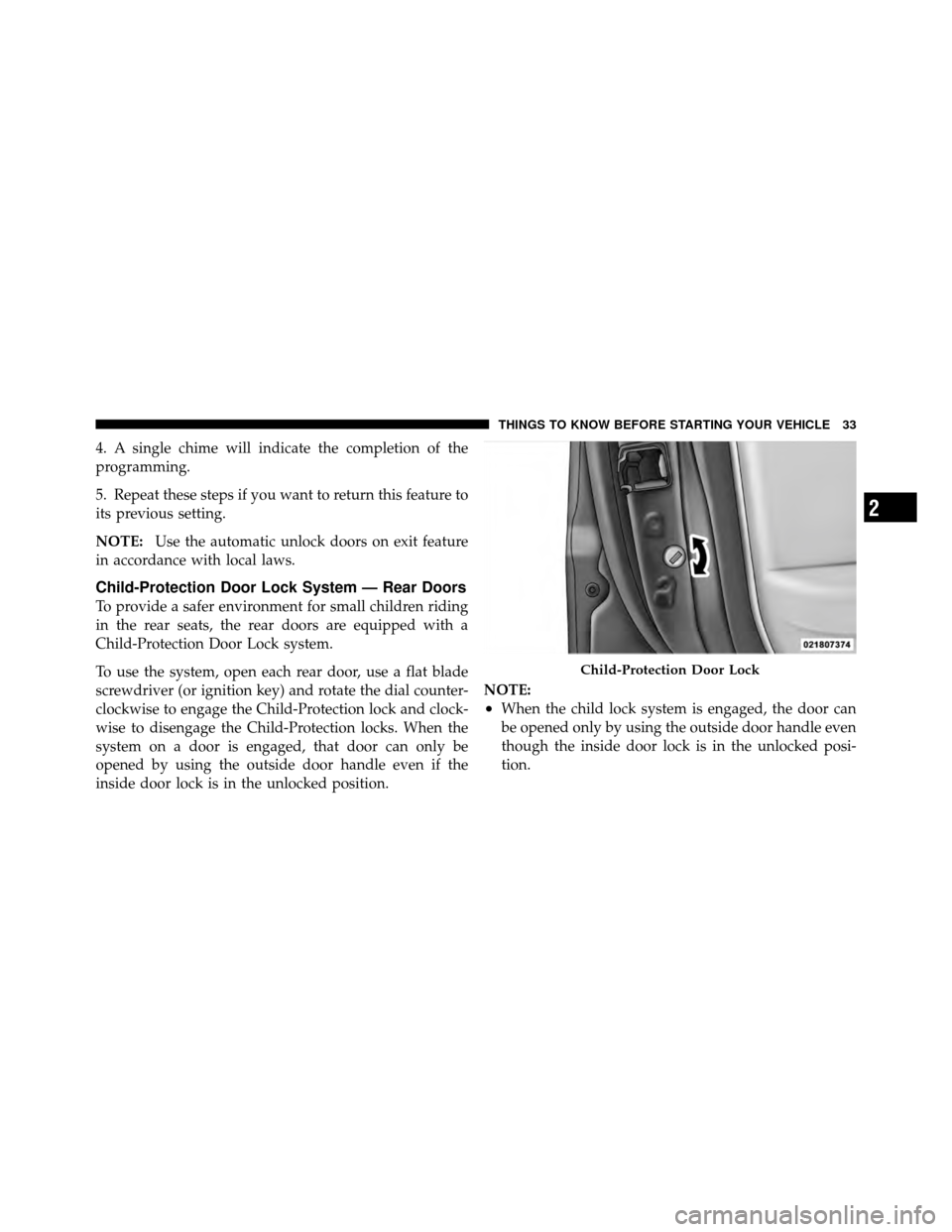
To use the system, open each rear door, use a flat blade
screwdriver (or ignition key) and rotate the dial counter-
clockwise to engage the Child-Protection lock and clock-
wise to disengage the Child-Protection locks. When the
system on a door is engaged, that door can only be
opened by using the outside door handle even if the
inside door lock is in the unlocked position. NOTE:
•When the child lock system is engaged, the door can
be opened only by using the outside door handle even
though the inside door lock is in the unlocked posi-
tion.
Child-Protection Door Lock
2
THINGS TO KNOW BEFORE STARTING YOUR VEHICLE 33
Page 37 of 497
•After disengaging the Child-Protection Door Lock
system, always test the door from the inside to make
certain it is in the desired position.
•After engaging the Child-Protection Door Lock sys-
tem, always test the door from the inside to make
certain it is in the desired position.
•For emergency exit with the system engaged, move
the lock knob up (unlocked position), roll down the
window, and open the door with the outside door
handle.
WARNING!
Avoid trapping anyone in a vehicle in a collision.
Remember that the rear doors can only be opened
from the outside when the Child-Protection locks are
engaged.
WINDOWS
Power Windows
The power window controls are located on the driver’s
door trim panel. There is a single switch on the front
passenger/rear passenger doors which operates the front
passenger/rear passenger door windows. The window
controls will operate only when the ignition switch is in
the ON/RUN or ACC position.
34 THINGS TO KNOW BEFORE STARTING YOUR VEHICLE
Page 39 of 497
To open the window part way, press the window switch
to the first detent and release it when you want the
window to stop.
To stop the window from going all the way down during
the Auto-Down operation, pull up on the switch briefly.
For vehicles not equipped with the Electronic Vehicle
Information Center (EVIC), the power window switches
will remain active for 45 seconds after the ignition switch
is turned to the LOCK position. Opening either front
door will cancel this feature.
For vehicles equipped with the EVIC, the power window
switches will remain active for up to 10 minutes after the
ignition switch is turned to the LOCK position. Opening
either front door will cancel this feature. The time is
programmable. Refer to “Electronic Vehicle Information
Center (EVIC)/Personal Settings (Customer-Program-
mable Features)” in “Understanding Your Instrument
Panel” for further information.Auto Up Feature With Anti-Pinch Protection —
If Equipped
On some models, the driver’s and front passenger’s (if
equipped for passenger side) power window switches
have an “Auto Up” feature. Pull the window switch fully
upward to the second detent, release, and the window
will go up automatically.
To stop the window from going all the way up during the
auto-up operation, push down on the switch briefly.
To close the window part way, pull the window switch
up to the first detent and release when you want the
window to stop.
For vehicles not equipped with the Electronic Vehicle
Information Center (EVIC), the power window switches
will remain active for 45 seconds after the ignition switch
is turned to the LOCK position. Opening either front
door will cancel this feature.
36 THINGS TO KNOW BEFORE STARTING YOUR VEHICLE
Page 40 of 497
For vehicles equipped with the EVIC, the power window
switches will remain active for up to 10 minutes after the
ignition switch is turned to the LOCK position. Opening
either front door will cancel this feature. The time is
programmable. Refer to “Electronic Vehicle Information
Center (EVIC)/Personal Settings (Customer-
Programmable Features)” in “Understanding Your In-
strument Panel” for further information.
NOTE:
•If the window runs into any obstacle during auto-
closure, it will reverse direction and then go back
down. Remove the obstacle and use the window
switch again to close the window.
•Any impact due to rough road conditions may trigger
the auto-reverse function unexpectedly during auto-
closure. If this happens, pull the switch lightly to the
first detent and hold to close window manually.
WARNING!
There is no anti-pinch protection when the window
is almost closed. Be sure to clear all objects from the
window before closing.
Reset
At some point in time, it may be necessary to reactivate
the auto-up feature. To do so, perform the following
procedure:
1. Pull the window switch up to close the window
completely and continue to hold the switch up for an
additional two seconds after the window is closed.
2. Push the window switch down firmly to the second
detent to open the window completely and continue to
hold the switch down for an additional two seconds after
the window is fully open.
2
THINGS TO KNOW BEFORE STARTING YOUR VEHICLE 37
Page 41 of 497
Window Lockout Button
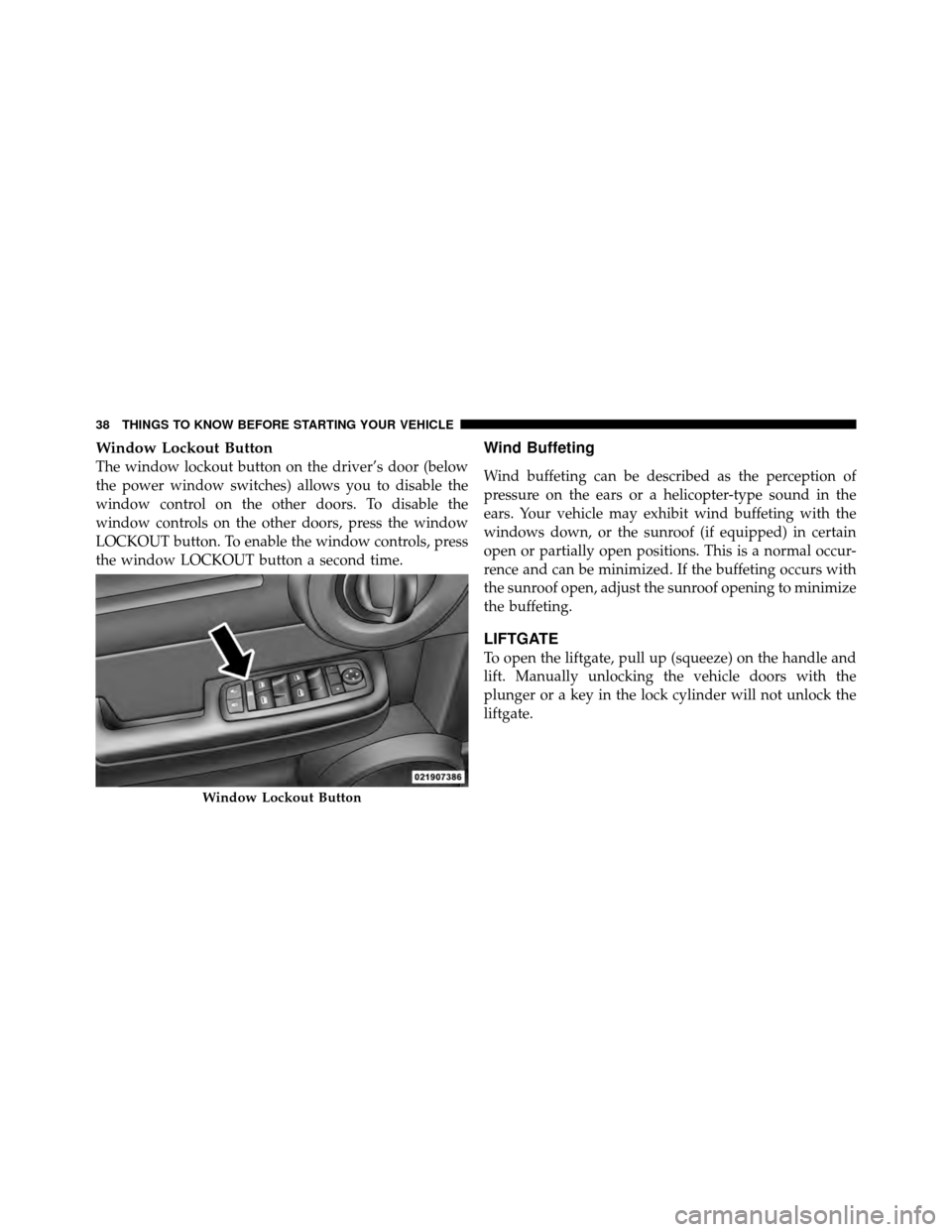
The window lockout button on the driver’s door (below
the power window switches) allows you to disable the
window control on the other doors. To disable the
window controls on the other doors, press the window
LOCKOUT button. To enable the window controls, press
the window LOCKOUT button a second time.
Wind Buffeting
Wind buffeting can be described as the perception of
pressure on the ears or a helicopter-type sound in the
ears. Your vehicle may exhibit wind buffeting with the
windows down, or the sunroof (if equipped) in certain
open or partially open positions. This is a normal occur-
rence and can be minimized. If the buffeting occurs with
the sunroof open, adjust the sunroof opening to minimize
the buffeting.
LIFTGATE
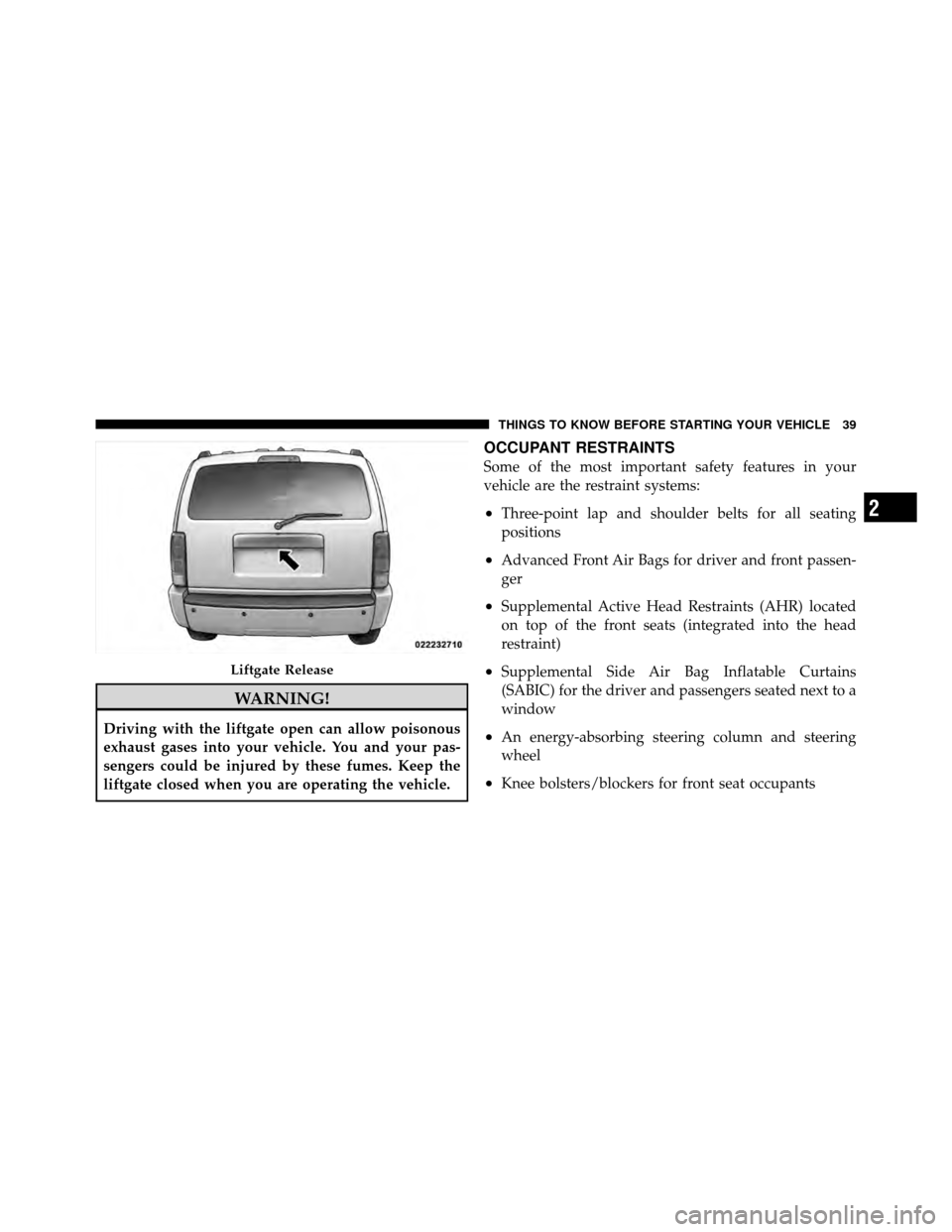
To open the liftgate, pull up (squeeze) on the handle and
lift. Manually unlocking the vehicle doors with the
plunger or a key in the lock cylinder will not unlock the
liftgate.
Window Lockout Button
38 THINGS TO KNOW BEFORE STARTING YOUR VEHICLE
Page 42 of 497
WARNING!
Driving with the liftgate open can allow poisonous
exhaust gases into your vehicle. You and your pas-
sengers could be injured by these fumes. Keep the
liftgate closed when you are operating the vehicle.
OCCUPANT RESTRAINTS
Some of the most important safety features in your
vehicle are the restraint systems:
•Three-point lap and shoulder belts for all seating
positions
•Advanced Front Air Bags for driver and front passen-
ger
•Supplemental Active Head Restraints (AHR) located
on top of the front seats (integrated into the head
restraint)
•Supplemental Side Air Bag Inflatable Curtains
(SABIC) for the driver and passengers seated next to a
window
•An energy-absorbing steering column and steering
wheel
•Knee bolsters/blockers for front seat occupants
Liftgate Release
2
THINGS TO KNOW BEFORE STARTING YOUR VEHICLE 39
Page 43 of 497
•Front seat belts incorporate pretensioners that may
enhance occupant protection by managing occupant
energy during an impact event
•All seat belt systems (except the driver’s and rear
center) include Automatic Locking Retractors (ALRs),
which lock the seat belt webbing into position by
extending the belt all the way out and then adjusting
the belt to the desired length to restrain a child seat or
secure a large item in a seat — if equipped
Please pay close attention to the information in this section.
It tells you how to use your restraint system properly, to
keep you and your passengers as safe as possible.
If you will be carrying children too small for adult-sized
seat belts, the seat belts or the Lower Anchors and Tether
for CHildren (LATCH) feature also can be used to hold
infant and child restraint systems. For more information
on LATCH, refer to Lower Anchors and Tether for
CHildren (LATCH).NOTE:
The Advanced Front Air Bags have a multistage
inflator design. This allows the air bag to have different
rates of inflation based on the severity and type of
collision.
Here are some simple steps you can take to minimize the
risk of harm from a deploying air bag:
1. Children 12 years old and under should always ride
buckled up in a rear seat.
WARNING!
Infants in rear facing child restraints should never
ride in the front seat of a vehicle with a passenger
Advanced Front Air Bag. An air bag deployment can
cause severe injury or death to infants in that posi-
tion.
Children that are not big enough to wear the vehicle seat
belt properly (see section on Child Restraints) should be
40 THINGS TO KNOW BEFORE STARTING YOUR VEHICLE
Page 46 of 497
Lap/Shoulder Belts
All seating positions in your vehicle are equipped with
lap/shoulder belts. The belt webbing retractor is de-
signed to lock during very sudden stops or accidents.
This feature allows the shoulder part of the belt to move
freely with you under normal conditions. However, in an
accident the belt will lock and reduce the risk of you
striking the inside of the vehicle or being thrown out.
WARNING!
•It is dangerous to ride in a cargo area, inside or
outside of a vehicle. In an accident, people riding
in these areas are more likely to be seriously
injured or killed.
•Do not allow people to ride in any area of your
vehicle that is not equipped with seats and seat
belts.(Continued)
WARNING! (Continued)
•Be sure everyone in your vehicle is in a seat and
using a seat belt properly.
•Wearing a seat belt incorrectly is dangerous. Seat
belts are designed to go around the large bones of
your body. These are the strongest parts of your
body and can take the forces of an accident the
best. Wearing your belt in the wrong place could
make your injuries in an accident much worse.
You might suffer internal injuries, or you could
even slide out of part of the belt. Follow these
instructions to wear your seat belt safely and to
keep your passengers safe too.
•Two people should never be belted into a single
seat belt. People belted together can crash into one
another in an accident, hurting one another badly.
Never use a lap/shoulder belt or a lap belt for more
than one person, no matter what their size.
2
THINGS TO KNOW BEFORE STARTING YOUR VEHICLE 43
Page 52 of 497
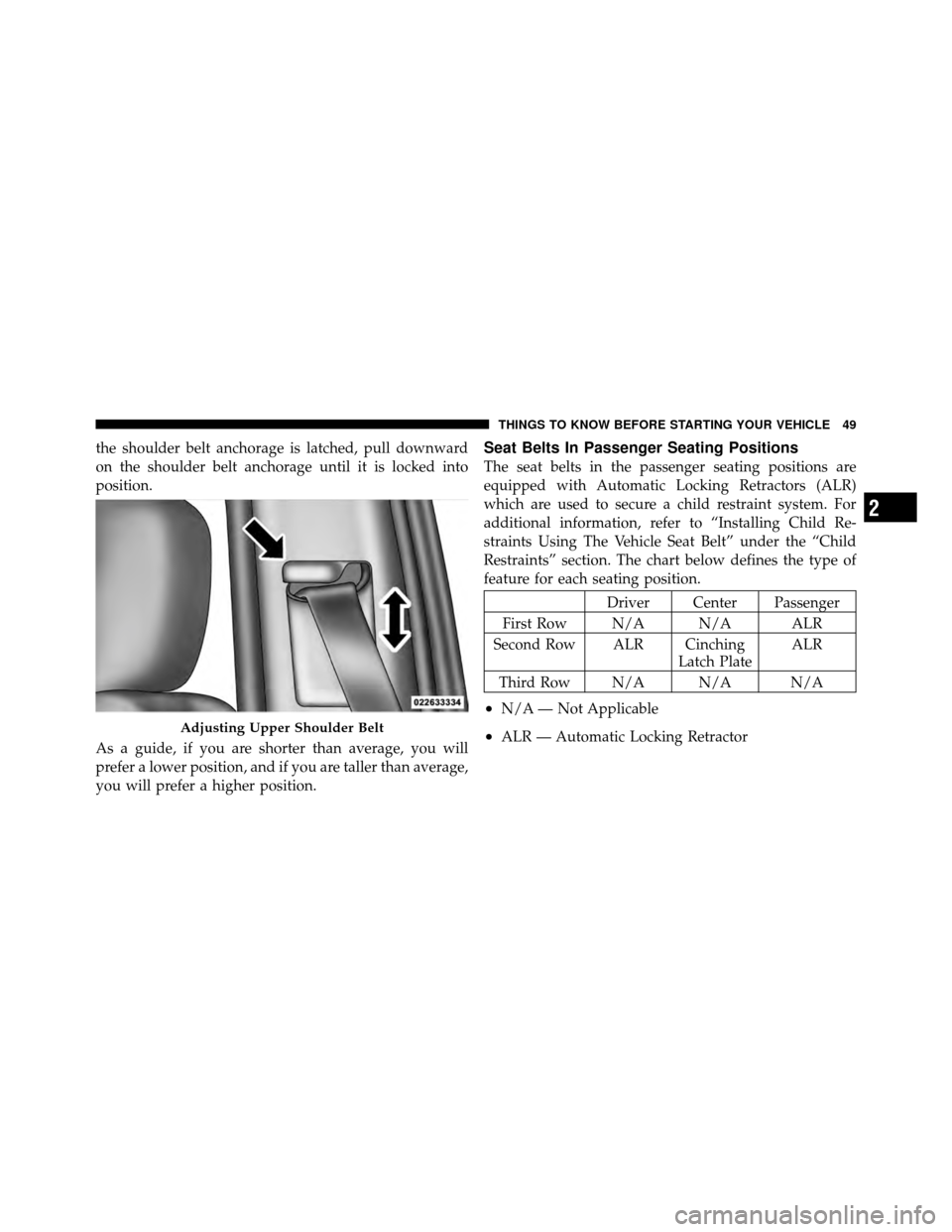
the shoulder belt anchorage is latched, pull downward
on the shoulder belt anchorage until it is locked into
position.
As a guide, if you are shorter than average, you will
prefer a lower position, and if you are taller than average,
you will prefer a higher position.Seat Belts In Passenger Seating Positions
The seat belts in the passenger seating positions are
equipped with Automatic Locking Retractors (ALR)
which are used to secure a child restraint system. For
additional information, refer to “Installing Child Re-
straints Using The Vehicle Seat Belt” under the “Child
Restraints” section. The chart below defines the type of
feature for each seating position.
Driver Center Passenger
First Row N/A N/A ALR
Second Row ALR Cinching Latch PlateALR
Third Row N/A N/A N/A
•N/A — Not Applicable
•ALR — Automatic Locking RetractorAdjusting Upper Shoulder Belt
2
THINGS TO KNOW BEFORE STARTING YOUR VEHICLE 49