engine DODGE POLARA 1965 3.G User Guide
[x] Cancel search | Manufacturer: DODGE, Model Year: 1965, Model line: POLARA, Model: DODGE POLARA 1965 3.GPages: 46, PDF Size: 8.12 MB
Page 17 of 46
AUTOMATIC TRANSMISSION '
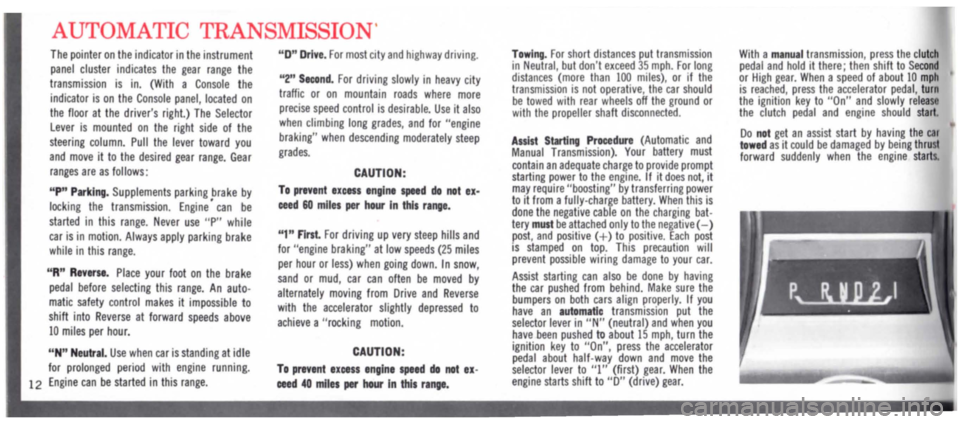
The pointer on the indicator in the instrument panel cluster indicates the gear range the
transmission is in. (With a Console the
indicator is on the Console panel, located on the floor at the driver's right.) The Selector Lever is mounted on the right side of the
steering column. Pull the lever toward you and move it to the desired gear range. Gear
ranges are as follows:
"P" Parking. Supplements parking brake by
locking the transmission. Engine' can be
started in this range. Never use " P " while
car is in motion. Always apply parking brake while in this range.
"R" Reverse. Place your foot on the brake
pedal before selecting this range. An auto· matic safety control makes it impossible to
shift into Reverse at forward speeds above 10 miles per hour.
"N " Neutral. Use when car is standing at idle for prolonged period with engine running.
12 Engine can be started in this range.
"0 " Drive. For most city and highway driving.
"2" Second. For driving slowly in heavy city
traffic or on mountain roads where more precise speed control is desirable. Use it also when climbing long grades, and for "engine
braking" when descending moderately steep grades.
CAUTION:
To prevent IICes s engine speed do not ex·
ceed 60 miles per hour In this range.
" 1" First. For driving up very steep hills and for "engine braking" at low speeds (25 miles
per hour or less) when going down. In snow,
sand or mud, car can often be moved by alternately moving from Drive and Reverse with the accelerator slightly depressed to
achieve a "rocking motion.
CAUTION:
To prevent excess engine speed do not ex
ceed 40 miles per hour In this range.
Towing. For short distances put transmission in Neutral, but don't exceed 35 mph. For long distances (more than 100 miles), or If the transmiSSion is not operative, the car should be towed with rear wheels off the ground or with the propeller shaft disconnected.
Assist Starting Procedure (Automatic and Manual Transmission). Your battery must contain an adequate charge to provide prompt starting power to the engine. If it does not, it may require "boosting" by transferring power t o it from a fully-charge battery. When this is done the negative cable on the charging battery must be attached only to the negative (- ) post, and positive (+ ) to positive. Each post IS stamped on top. This precaution will prevent possible wiring damage to your car.
Assist starting can also be done by having the car pushed from behind. Make sure the bumpers on both cars align properly. If you have an automatic transmission put the selector lever in "N" (neutral) and when you have been pushed to about 15 mph, turn the ignition key to "On", press the accelerator pedal about half-way down and move the selector lever to "I" (first) gear. When the engine starts shift to "0" (drive) gear.
With a m anual transmission, press the clutch pedal and hold it there; then shift to Second or High gear. When a speed of about 10 mph is reached, press the accelerator pedal, turn the ignition key to "On" and slowly release the clutch pedal and engine should start.
Do not get an assist start by having t h e cal towed as it could be damaged by being thrust forward suddenly when the engine starts.
Page 24 of 46
Resulting color mav rub off and webbing strength may be affected.
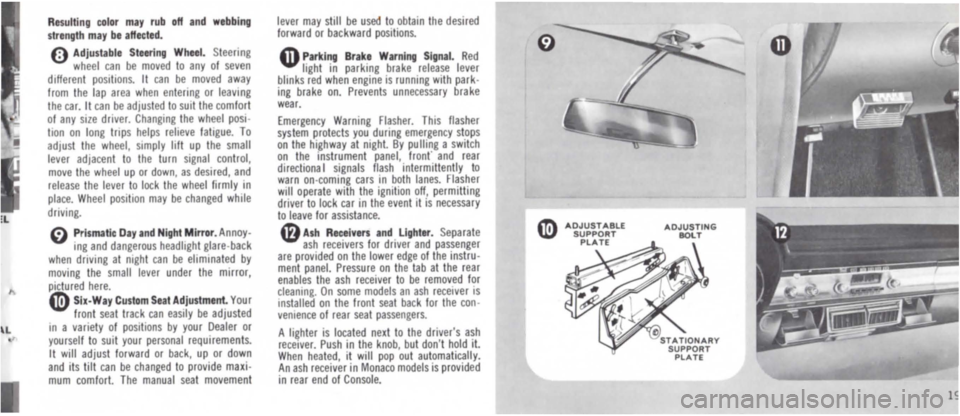
o Adjustable Steering Wheel. Steering wheel can be moved to any of seven different positions. It can be moved away from the lap area when entering or leaving the car. It can be adjusted to suit the comfort of any SIZe driver. Changing the wheel position on long trips helps relieve fatigue. To adjust the wheel, simply hft up the small lever adjacent to the turn signal control, move the wheel up or down, as desired, and release the lever to lock the wheel firmly in place. Wheel position may be changed while driving.
~ Prismatic Day and Night Mirror. Annoy-ing and dangerous headlight glare-back when driving at night can be elimmated by moving the small lever under the mirror, pictured here. o Six-Way Custom Seat Adjustment. Your front seat track can easily be adjusted In a variety of positions by your Dealer or yourself to suit your personal requirements. It will adjust forward or back, up or down and its tilt can be changed to provide maximum comfort. The manual seat movement
lever may still be used to obtain the desired forward or backward positions.
Q Parking Brake Warning S ignal. Red light in parking brake release lever blinks red when engine is running with parking brake on. Prevents unnecessary brake wear.
Emergency Warning Flasher. This flasher system protects you during emergency stops on the highway at night. By pu lIing a switch on the instrument panel, front' and rear directiona I signals flash intermittently to warn on-coming cars in both lanes. Flasher will operate with the ignition off, permitting driver \0 lock car in the event it is necessary to leave for assistance.
41) Ash Receivers and Lighter. Separate ash receivers for driver and passenger are provided on the lower edge of the instrument panel. Pressure on the tab at the rear enables the ash receiver to be removed for cleaning. On some models an ash receiver is Installed on the front seat back lor the convenience of rear seat passengers.
A lighter is located next to the driver's ash receiver. Push in the knob, but don't hold it. When heated, it will pop out automatically. An ash receiver in Monaco models is provided in rear end of Console.
AOJUSTING BOLT
1
Page 25 of 46
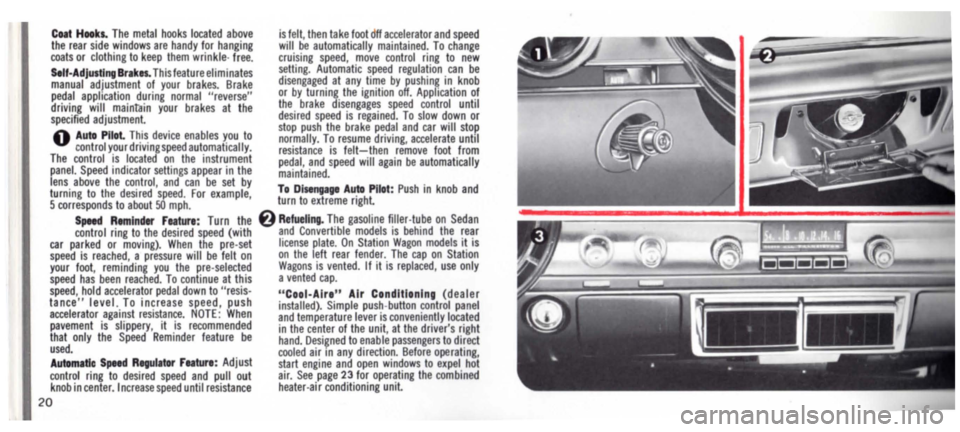
Coat Hookl. The metal hooks located above is felt. then take foot dff accelerator and speed the rear side windows are handy for hanging will be automatically maintained. To change coats or clothing to keep them wrinkle· free. cruising speed. move control ring to new Self-Adjusting Brakes. This feature eliminates setting. Automatic speed regulation can be manual adjustment of your brakes. Brake disengaged at any time by pushing in knob pedal application during normal "reverse" or by turning the ignition off. Application of driving will maintain your brakes at the the brake disengages speed control until specified adjustment. desired speed is regained. To slow down or stop push the brake pedal and car will stop' o Auto Pilot This device enables you to normally. To resume driving. accelerate until control yourdrivingspeed automatically. resistance is felt-then remove foot from The control is located on the instrument pedal. and speed will again be automatically panel. Speed indicator settings appear in the maintained. lens above the control. and can be set by . turning to the desired speed. For example. To Dlsen~ge A~ Pilot: Push In knob and 5 corresponds to about 50 mph. turn to extreme nght.
Speed Reminder reature: Turn the 6 Refuell"1-T~e gasoline ~lIer·tu.be on Sedan control ring to the desired speed (with ~nd Convertible mod~ls IS behind the ~e~r car parked or moving). When the pre-set license plate. On Stallon Wagon models I~ IS speed is reached. a pressure will be felt on on the I~ft rear fend~r .. The cap on Station your foot. reminding you the pre-selected Wagons IS vented. If It IS replaced. use only speed has been reached. To continue at this a vented cap. speed •• ~old accelera!or pedal down to "resis-" Cool-Air. " Air Conditioning (dealer tance level..T0 In~rease speed. push installed). Simple push-bullon control panel accelerator .agal~st resls~an~. NOTE: When and temperature lever is conveniently located pavement IS slippery. It .IS recommended in the center of the unit. at the driver's right that only the Speed Reminder feature be hand. Desi~ned to enable passengers to direct used. . cooled air In any direction. Before operating. Automatic Speed Rl9ulator reatur.: Adlust start engine and open windows to expel hot control ring to desired speed and pull out air. See page 23 for operating the combined knob in center. Increase speed until resistance heater-air conditioning unit.
20
Page 30 of 46
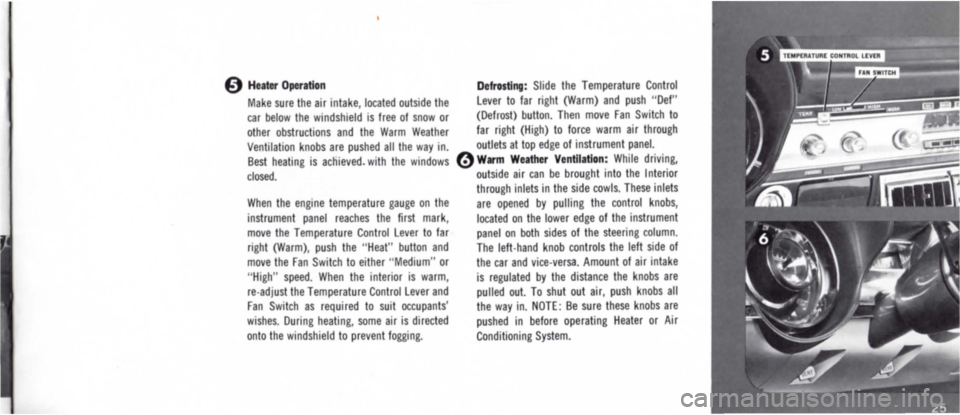
o Heater Operation
Make sure the air intake, located outside the car below the windshield is free of snow or
other obstructions and the Warm Weather
Ventilation knobs are pushed all the way in. Best heating is achieved. with the windows
closed.
When the engine temperature gauge on the
instrument panel reaches the first mark, move the Temperature Control lever to far right (Warm), push the "Heat" button and
move the Fan Switch to either "Medium" or
"High" speed. When the interior is warm,
re·adjust the Temperature Control lever and Fan Switch as required to suit occupants'
wishes. During heating, some air is directed
onto the windshield to prevent fogging.
Defrosting: Slide the Temperature Control
lever to far right (Warm) and push "Def" (Defrost) button. Then move Fan Switch to far right (High) to force warm air through
outlets at top edge of instrument panel.
<:) Warm Weather Ventilation: While driving, outside air can be brought into the Interior
through inlets in the side cowls. These inlets are opened by pulling the control knobs,
located on the lower edge of the instrument panel on both sides of the steering column.
The left·hand knob controls the left side of
the car and vice· versa. Amount of air intake
is regulated by the distance the knobs are pulled out. To shut out air, push knobs all the way in. NOTE: Be sure these knobs are
pushed in before operating Heater or Air
Conditioning System.
Page 36 of 46
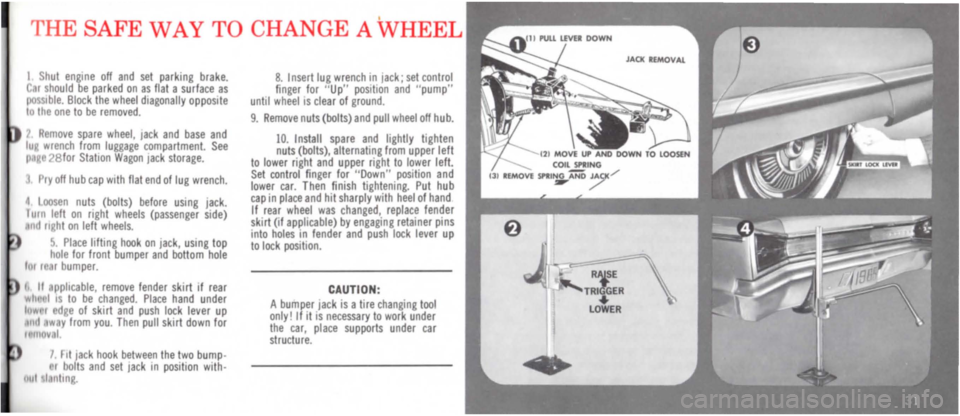
THE SAFE WAY TO CHANGE A WHEEL
I Shut engine off and set parking brake. C. r should be parked on as flat a surface as possible. Block the wheel diagonally opposite to the one to be removed.
7 R move spare wheel. lack and base and IUR wrench from luggage compartment. See II lie ;>8for StatIOn Wagon lack storage.
Pry off hub cap With flat end of lug wrench.
" Loosen nuts (bolts) before uSing lack. I urn left on right wheels (passenger side) nd ueht on left wheels.
5. Place lifting hook on lack, uSing top hole for front bumper and bottom hole till r ,r bumper.
! II applicable, remove fender skirt If rear ",II I IS to be changed. Place hand under 111"'1'1 dge of skirt and push lock lever up 1111 way from you. Then pull skirt down for I IIIOV I.
I r I t lack hook between the two bumpr bolts and set lack In position withlui I nling.
8. I nsert lug wrench In lack; set control finger for "Up" posllion and "pump" until wheelis clear of ground.
9 . Remove nuts (bolts) and pull wheel off hub.
10. Install spare and lightly tighten nuts (bolts), alternating from upper left to lower right and upper right to lower left . Set control finger for "Down" position and lower car. Then finish tightening. Put hub cap in place and hit sharply with heel of hand If rear wheel was changed, replace fender skirt (if applicable) by engaging retainer pins into holes in fender and push lock lever up to lock poslhon.
CAUTION: A bumper jack is a tire changing tool only! If It IS necessary to work under the car, place supports under car structure.
Page 39 of 46
Authorlled Dodge Service. Your new Dodge deserves the finest care to keep it performing like new. That means Authorized Dodge Service. You r Dodge Dealer's service department has technicians trained by Dodge t o care for you r car-genuine parts-tools especially designed for Dodge service. You won't find them anywhere else.
Genuine Chrysler Parts. When you need a replacement part, make sure that you get a part designed especially for your car by the manufacturer. That means Genuine Chrysler Parts-engineered and manufactured by Dodge just for your car. Only these parts give you assurance that your Dodge will be "good as new."
You • •• And Your Dodge ServIce Manager. Together ... you and your Dodge Service Manager can keep your Dodge as good lookmg, as great a performer, and as much fun to drive-as It is today. Check w ith him regularly, and check the next pages of this Owner's Guide for some t ips on keeping your car young and gay.
The car that gives you most for your money
3 4
Page 40 of 46
(CONTINUlU)
CAUTION: To prevent possible wiring damage, certain precautions should be observed: It IS essential when replacing the cables on the battery, or when uSing a "booster" battery, thai the positive cable IS attached to the positive post and the negative cable IS attached to Ihe negative post. The negative cable IS attached to the engine block. Battery posts are marked plus (+ ) and minus (-). Also, If a "fast charger" is used while battery IS in car, disconnect both car battery cables before connecting the charger to battery. Do not use a "fast charger" to provide starting voltage.
which requires the following service attention. Two types are used -one has a wrapper on the carburetor air cleaner, and other does not. With Wrapper: Do the following every 6 months-inspect venhlator valve operation, clean filler cap, InSpect and clean air cleaner element and wash outer wrapper In kerosene and shake or blot dry. Every year-replace ventilator valve. Every two years-replace air cleaner element and wrapper. Without Wrapper: Do the follOWing at each change of engine Oil-inspect ventilator valve operation, Inspect and clean air cleaner element. Every year-replace ventilator valve and replace air cleaner element. More frequent servicing Crankcase Ventilation System. The engine in may be required if the car IS used for short. your car was equipped at the factory with a trip driving and prolonged engine idling. posItive ventilating system to reduce the emission of harmful fumes into the at mos· Ant/·Freele. So that your cooling system Will phere. Periodic and proper inspection and operate without freezing and Without over· cleaning of thiS valve is essential for good heating due to rust formation, the following engine performance and durability. Valve procedures should be observed. operation should be checked every 6 months O . . . by your Dealer, and more frequently if car IS Fall. Open ~adlator dralncock and remo~e used for short-trip driVing and prolonged threaded drain plugs In engine block to drain engine idling. Replace valve once a year. cooling system. Mov~ heat~r selector lever to ''HI'' or "Heat" position (If so eqUipped) to A special crankcase ventilation system is permit draining the heater lines. Thoroughly used on cars built for the state of California flush cooling system with clear water, then
36
close radiator draincock and replace engine block drain plugs. Install MoPar Anti·Freeze (or other high-quality equivalent) to assure cooling system protection for the lowest anticipated temperature in the area where vehicle IS operated dUring the winter months. The cooling system should contain a minimum of 400:, anll-freeze for proper corrosion protection. I n geographiC areas where anli· freeze protecllon IS not necessary, after flushing, fill with clear water and add MoPar Rust ReSistor (or other hlgh·quality co~rosion inhibitor) to prevent the formation of rust deposits. This service IS reqUired annually.
It the vehicle was placed into service after January I , 1965, the first required Fall cooling system service may be eliminated. With the approach of cool weather, however, it IS very important to test the coolant for adequate anti-freeze protection and InSpect the system for eVidence of rust or leaks.
Only glycols and synthetic alcohol (Methanol) are acceptable bases for automobile antifreeze. Solutions containing salts, sugar, honey, glucose, mineral oils, kerosene or similar material should never be used in the cooling system.
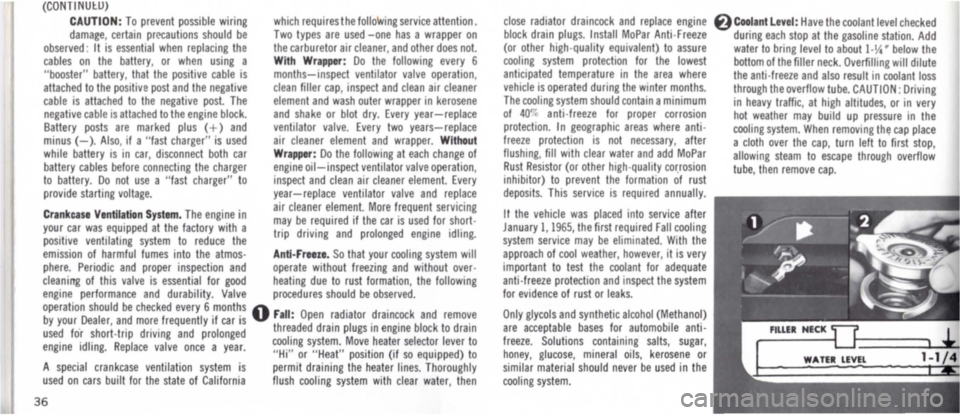
@Coolant Level: Have the coolant level checked during each stop at the gasoline station. Add water to bring level to about I-~' below the bottom of the filler neck. Overfilling Will dilute the anti-freeze and also result In coolant loss through the overflow tube. CAUTION: DriVing in heavy traffic, at high altitudes, or In very hot weather may build up pressure in the cooling system. When removing the cap place a cloth over the cap, turn left to first stop, allowing steam to escape through overflow tube, then remove cap.
Page 41 of 46
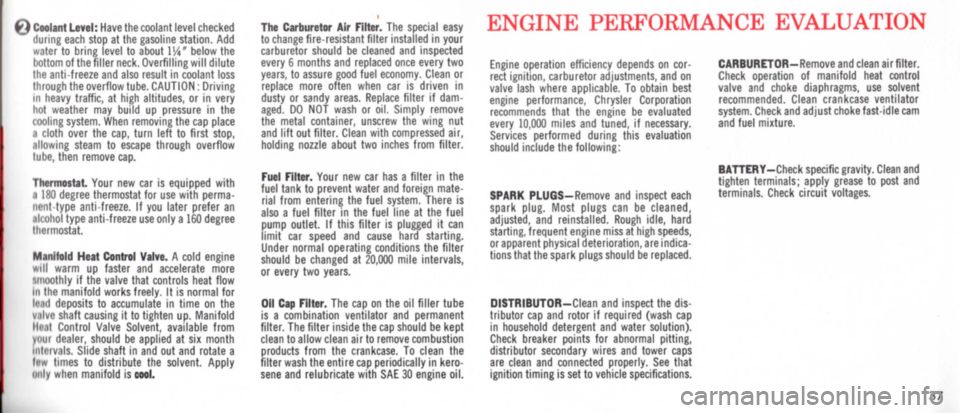
E) Coolant Level: Have the coolant level checked during each stop at the gasoline station. Add water to bring level to about 11,4' below the bottom of the filler neck. Overfilling will dilute the anti·freeze and also result in coolant loss through the overflow tube. CAUTION: Driving In heavy traffic, at high altitudes, or in very hot weather may build up pressure in the cooling system. When removing the cap place a cloth over the cap, turn left to first stop, allowing steam to escape through overflow tube, then remove cap.
Thermostat Your new car is equipped with 180 degree thermostat for use with perma· nenl-type anti-freeze. If you later prefer an lcohol type anti-freeze use only a 160 degree thormoslat.
Manifold Heal Control Valve_ A cold engine will warm up faster and accelerate more moothly if the valve that controls heat flow In the manifold works freely. It is normal for I d deposits to accumulate in time on the y lve shaft causing it to tighten up'. Manifold II t Control Valve Solvent, available from your dealer, should be applied a t six month lnt Iva Is. Slide shaft in and out and rotate a
, w times to distribute the solvent. Apply only when manifold is cool.
The Carburetor A ir Filter. The special easy to change fire-resistant filter installed in your carburetor should be cleaned and inspected every 6 months and replaced once every two years, to assure good fuel economy. Clean or replace more often when car is driven in dusty or sandy areas. Replace filter if damaged. DO NOT wash or oil. Simply remove the metal container, unscrew the wing nut and lift out filter. Clean with compressed air, holding nozzle about two inches from filter.
Fuel Filter. Your new car has a filter in the fuel tank to prevent water and foreign material from entering the fuel system. There is also a fuel filter in the fuel line at the fuel pump outlet. If this filter is plugged it can limit car speed and cause hard starling. Under normal operating conditions the filter should be changed at 20,000 mile intervals, or every two years.
011 Cap Filler. The cap on the oil filler tube is a combination ventilator and permanent filter. The filter inside the cap should be kept clean to allow clean air to remove combustion product s from the crankcase. To clean the filter wash the entire cap periodically in k ero sene and relubricate with SAE 30 engine oil.
ENGINE PERFORMANCE EVALUATION
Engine operation efficiency depends on correct ignition, carburetor adjustments, and on valve lash where applicable. To obtain best engine performance, Chrysler Corporation recommends that the engine be evaluated every 10,000 miles and tuned, if necessary. Services performed during this evaluation should include the following:
SPARK PLUGS-Remove and inspect each spark plug. Most plugs can be cleaned, adjusted, and reinstalled. Rough idle, hard starling, frequent engine miss at high speeds, or apparent physical deterioration, are indications that the spark plugs should be replaced.
DISTRIBUTOR-Clean and inspect the dis· tributor cap and rotor if required (wash cap in household detergent and water solution). Check breaker points for abnormal pitting. distributor secondary wires and tower caps are clean and connected properly. See that ignition timing is set to vehicle specifications.
CARBURETOR-Remove and clean air filter. Check operation of manifold heat control valve and choke diaphragms, use solvent recommended. Clean crankcase ventilator system. Check and adjust choke fast-idle cam and fuel mixture.
BATTERY-Check specific gravity. Clean and tighten terminals; apply grease to post and terminals. Check circuit voltages.
37
Page 42 of 46
ENGINE OIL REQUIREMENTS
FIRST OIL CHANGE. The engine oil installed in your car's engine at time of assembly is h igh quality, "For Service MS" oil and
need not be removed until the first scheduled
oil change_ "Break-in" or "Flush-type" oils are no longer required in you r car's advanced
design engine and m ust be avoided.
WHEN TO ADD OIL It is not unusual for
a new engine to use a certain amount of engine oil during the break-in period. Check
oil level during each stop for gasoline. Add oil only when level on dipstick is al or below
the "ADD OIL" mark.
WHEN TO CHANGE OIL Regul.,. 011 changes .,.e required to provide proper engine operation.
Highway Driving, combined with some short
trip, slower speed operations extends the 38
effectiveness of the engine oil and permits you to change 011 at 4,000 miles Intervals.
Short Trips (less than 10 miles) and slow speeds, such as to the store, school, work
etc. and home again before the engine warms up, causes harmful condensation and sludge formation. This is typical of car operation in
city traffic. Driving under these conditions re
quires that you change 011 every 3 months regardless of mileage.
Severe Operating Conditions, such as fre
quent driving on dusty roads, or in sandy geographic areas, or unusually short trip
driving in cold weather may reasonably require 011 changes more frequently than
every three months. Under these conditions, consult and follow the advice of any Authorized Chrysler Motors Corporation Dealer's
Service Manager.
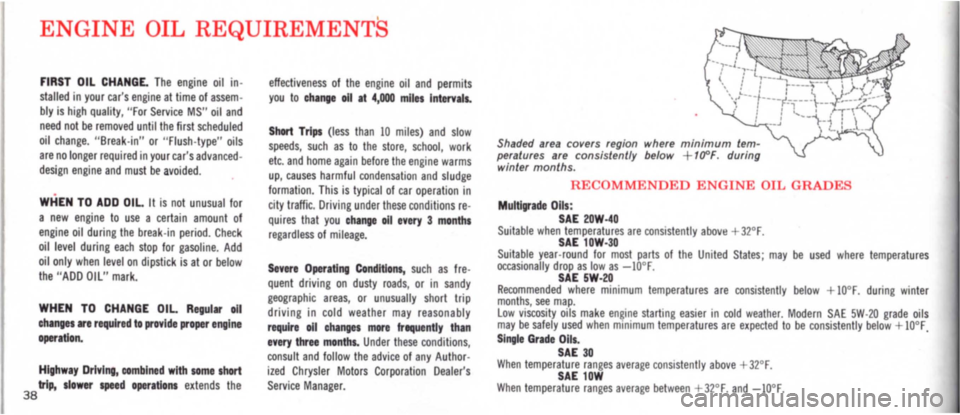
Shaded area covers region where minimum temperatures are consistently below + 10"F. during
winter months.
RE MMENDED ENGINE OIL GRADE
Multigrade Oils: SAE 20W-40 Suitable when temperatures are co nsistently abovl! + 32°F. SAE 10W·30 Suitable year-round for most parts of the United States; may be used where temperatures occasionally drop as low as -10°F . SAE 5W·20 Recommended where minimu m temperatures are consistently below + 10°F . durin g winter months, see map. Low viscosity o ils make en~ine starting easier in cold weather. Modern SAE 5W-20 grade oils may be safely used when minimum temperatures are expected to be consistently below + 10°F. Single Grade Oils. SAE 30 When temperature ranges averag e co nsistently above 32°F . SAE lOW When temperature ranges average between + 32° F . and -10°F .
Page 44 of 46
I 40
PERFECT
TEAMMATES
FOR
CHRVSLER
PARTS
YOUR m
CERTIFIED
CAR CARE
PROGRAM
For additional comfort and driving pleasure, your Dodge dealer
has available a full line of Air Conditioners , Radios, Mirrors, and many
o t
her accessories.
Your deale r, under the Certified Car Care Program, will keep your
car running
at utmost efficiency. For your protection he uses CHRYSLER
P A
RTS and MOPAR parts and accessories that are factory-approved
and enginee re d .
PARTS DIVISION, CHRYSLER MOTORS CORPORATION