check oil DODGE POWER WAGON 2006 2.G User Guide
[x] Cancel search | Manufacturer: DODGE, Model Year: 2006, Model line: POWER WAGON, Model: DODGE POWER WAGON 2006 2.GPages: 467, PDF Size: 1.93 MB
Page 390 of 467
The brake master cylinder has a translucent plastic
reservoir. On the outboard side of the reservoir, there is a
“MAX” dot and an “MIN” dot. The fluid level must be
kept within these two dots. Do not add fluid above the
MAX mark, because leakage may occur at the cap.
With disc brakes the fluid level can be expected to fall as
the brake linings wear. However, an unexpected drop in
fluid level may be caused by a leak and a system check
should be conducted.
Refer to Fluids, Lubricants and Genuine Parts for the
correct Fluid type.
WARNING!
Use of a brake fluid that may have a lower initial
boiling point, or is unidentified as to specification,
may result in sudden brake failure during hard
prolonged braking. You could have an accident.
WARNING!
Overfilling the brake fluid reservoir can result in
spilling brake fluid on hot engine parts and the
brake fluid catching fire.
Use only brake fluid that has been in a tightly closed
container to avoid contamination from foreign matter or
moisture.
CAUTION!
Do not allow a petroleum-base fluid to contaminate
the brake fluid. Seal damage may result.
390 MAINTAINING YOUR VEHICLE
Page 391 of 467
Brake Hoses
Inspection should be performed whenever the brake
system is serviced or at intervals specified. Inspect hy-
draulic brake hoses for surface cracking, scuffing or worn
spots. If there is any evidence of cracking, scuffing, or
worn spots, the hose should be replaced immediately!
Eventual deterioration of the hose can take place with
possible burst failure.
Clutch Hydraulic System
The clutch hydraulic system is a sealed maintenance-free
system. In the event of leakage or other malfunction, the
system must be replaced.
Clutch Linkage
If the clutch pedal linkage begins to squeak or grunt, the
clutch pedal pivot bushings should be lubricated. Refer
to Fluids, Lubricants and Genuine Parts for the correct
lubricant type.
Rear Axle And 4x4 Front Driving Axle Fluid Level
Refer to Fluids, Lubricants and Genuine Parts for the
correct Fluid type. For normal service, periodic fluid level
checks are not required. When the vehicle is serviced for
other reasons the exterior surfaces of the axle assembly
should be inspected. If gear oil leakage is suspected
inspect the fluid level.
This inspection should be made with the vehicle in a level
position. The fluid level should be even with the bottom
of the fill hole for the Manufacturer’s C205F HD Front
Axles. The fluid level should be 5/8” (16 mm) below on
9 1/4” Manufacturer’s Rear Axles.
For all 2500 Model axles, the fluid level should be 1/4” ±
1/4” (6.4 mm ± 6.4 mm) below the fill hole on the 9.25”
Front and 3/4”± 1/4” (19 mm ± 6.4 mm) on 10.5” Rear
axles.
MAINTAINING YOUR VEHICLE 391
7
Page 392 of 467

Drain and Refill
Vehicles operated in normal service do not have regularly
scheduled oil changes. If fluid has become contaminated
with water or to provide the correct viscosity grade, drain
and refill.
Lubricant Selection
Refer to Fluids, Lubricants and Genuine Parts for correct
fluid type.
NOTE:The presence of water in the gear lubricant will
result in corrosion and possible failure of differential
components. Operation of the vehicle in water, as may be
encountered in some off-highway types of service, will
require draining and refilling the axle to avoid damage.
Limited-Slip Differentials
Power Wagon AxlesDO NOT REQUIREany limited slip
oil additive (friction modifiers).
Transfer Case
Fluid Level Check
This fluid level can be checked by removing the filler
plug. The fluid level should be to the bottom edge of the
filler plug hole with the vehicle in a level position.
Lubricant Selection
Refer to Fluids, Lubricants and Genuine Parts for correct
fluid type.
Front Drive Shaft
The front drive shaft contains a grease fitting which
should be serviced at every oil change (see maintenance
schedule A/B).
Manual Transmission
Fluid Level Check
This fluid level can be checked by removing the filler
plug. If the level of the lubricant is more than 1/4” (6.4
mm) below the bottom of the filler hole while the vehicle
392 MAINTAINING YOUR VEHICLE
Page 394 of 467
5. Remove the dipstick, wipe it clean and reinsert it until
seated.
6. Remove the dipstick again and note the fluid level on
both sides. The fluid level should be between the “HOT”
(upper) reference holes on the dipstick at normal operat-
ing temperature. Verify that solid coating of oil is seen on
both sides of the dipstick. If the fluid is low, add as
required into the dipstick tube.Do not overfill.After
adding any quantity of oil through the oil fill tube, wait
a minimum of two (2) minutes for the oil to fully drain
into the transmission before rechecking the fluid level.
NOTE:If it is necessary to check the transmissionbelow
the operating temperature, the fluid level should be
between the two “COLD” (lower) holes on the dipstick
with the fluid at approximately 70°F (21°C) (room tem-
perature). If the fluid level is correctly established at
room temperature, it should be between the “HOT”(upper) reference holes when the transmission reaches
180°F (82°C). Remember it is best to check the level at the
normal operating temperature.
CAUTION!
Be aware that if the fluid temperature is below 50°F
(10°C) it may not register on the dipstick. Do not add
fluid until the temperature is elevated enough to
produce an accurate reading.
7. Check for leaks. Release parking brake.
To prevent dirt and water from entering the transmission
after checking or replenishing fluid, make certain that the
dipstick cap is properly reseated. It is normal for the
dipstick cap to spring back slightly from its fully seated
position, as long as its seal remains engaged in the
dipstick tube.
394 MAINTAINING YOUR VEHICLE
Page 424 of 467
At Each Stop for Fuel
•Check the engine oil level about 5 minutes after a fully
warmed engine is shut off. Checking the oil level while
the vehicle is on level ground will improve the accu-
racy of the oil level reading. Add oil only when the
level is at or below the ADD or MIN mark.
•Check the windshield washer solvent and add if
required.
Once a Month
•Check tire pressure and look for unusual wear or
damage.
•Inspect the battery and clean and tighten the terminals
as required.
•Check the fluid levels of coolant bottle, brake master
cylinder, and transmission and add as needed.
•Check all lights and all other electrical items for correct
operation.
At Each Oil Change
•Change the engine oil filter.
•Lubricate the front driveshaft grease fitting and tie rod
end links.
•Inspect the exhaust system.
•Inspect the brake hoses.
•Inspect the CV joints (if equipped) and front suspen-
sion components.
•Check the automatic transmission fluid level.
•Check the manual transmission fluid level.
•Check the coolant level, hoses, and clamps.
•Lubricate Front Drive Shaft Fitting.
424 MAINTENANCE SCHEDULES
8
M
A
I
N
T
E
N
A
N
C
E
S
C
H
E
D
U
L
E
S
Page 426 of 467
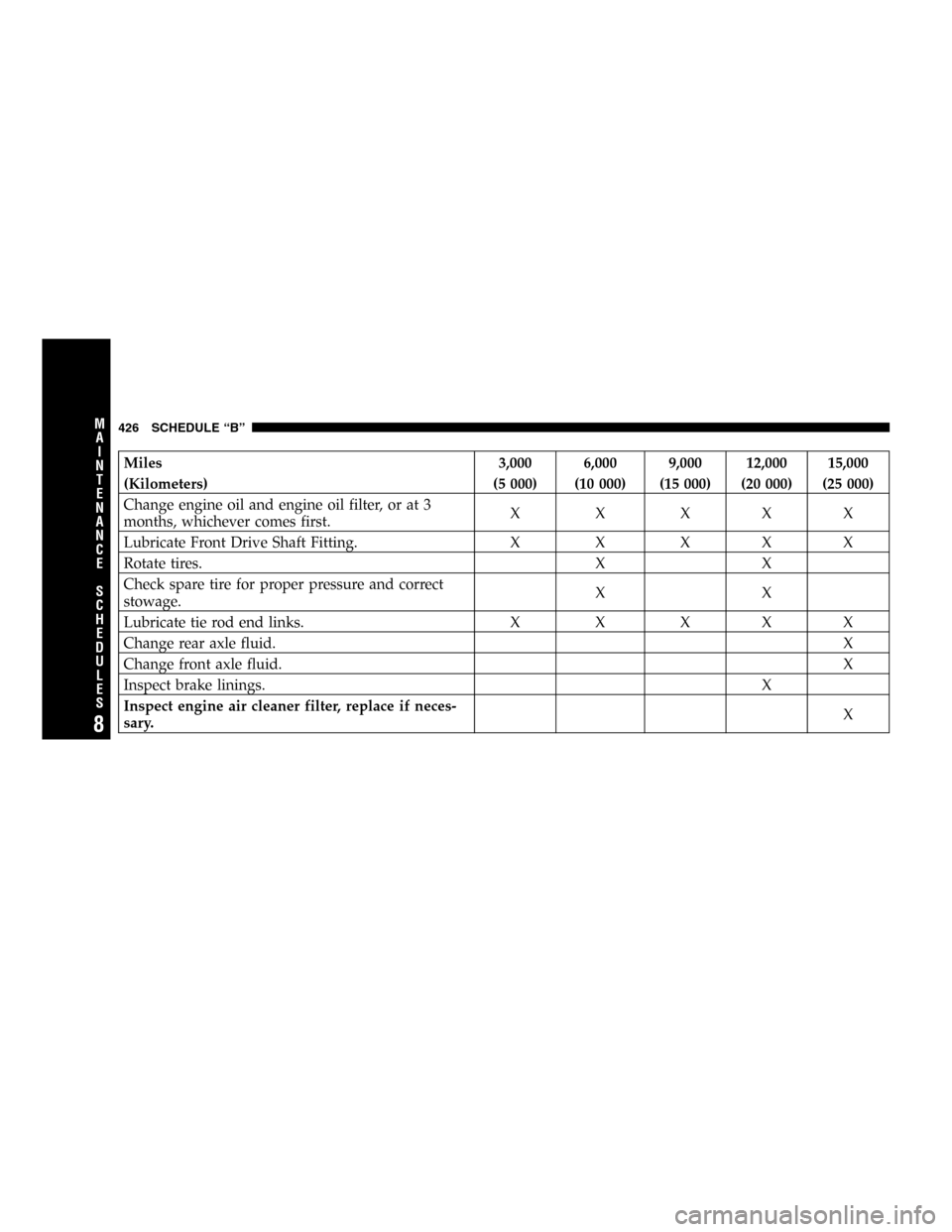
Miles 3,000 6,000 9,000 12,000 15,000
(Kilometers) (5 000) (10 000) (15 000) (20 000) (25 000)
Change engine oil and engine oil filter, or at 3
months, whichever comes first.X X XXX
Lubricate Front Drive Shaft Fitting. X X X X X
Rotate tires. X X
Check spare tire for proper pressure and correct
stowage.XX
Lubricate tie rod end links. X X X X X
Change rear axle fluid.X
Change front axle fluid.X
Inspect brake linings.X
Inspect engine air cleaner filter, replace if neces-
sary.X
426 SCHEDULE “B”
8
M
A
I
N
T
E
N
A
N
C
E
S
C
H
E
D
U
L
E
S
Page 427 of 467
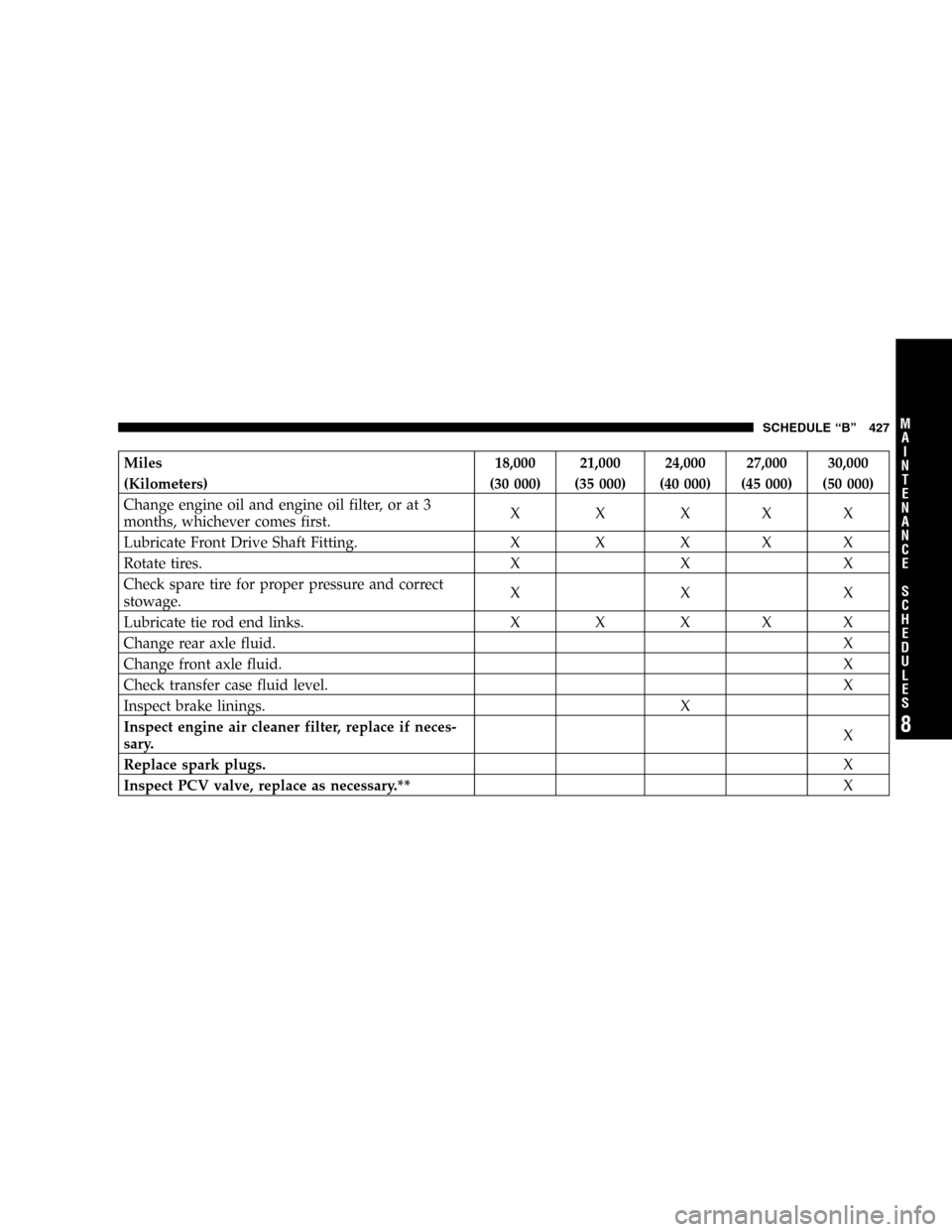
Miles 18,000 21,000 24,000 27,000 30,000
(Kilometers) (30 000) (35 000) (40 000) (45 000) (50 000)
Change engine oil and engine oil filter, or at 3
months, whichever comes first.X X XXX
Lubricate Front Drive Shaft Fitting. X X X X X
Rotate tires. X X X
Check spare tire for proper pressure and correct
stowage.XXX
Lubricate tie rod end links. X X X X X
Change rear axle fluid.X
Change front axle fluid.X
Check transfer case fluid level.X
Inspect brake linings. X
Inspect engine air cleaner filter, replace if neces-
sary.X
Replace spark plugs.X
Inspect PCV valve, replace as necessary.**X
SCHEDULE “B” 427
8
M
A
I
N
T
E
N
A
N
C
E
S
C
H
E
D
U
L
E
S
Page 428 of 467
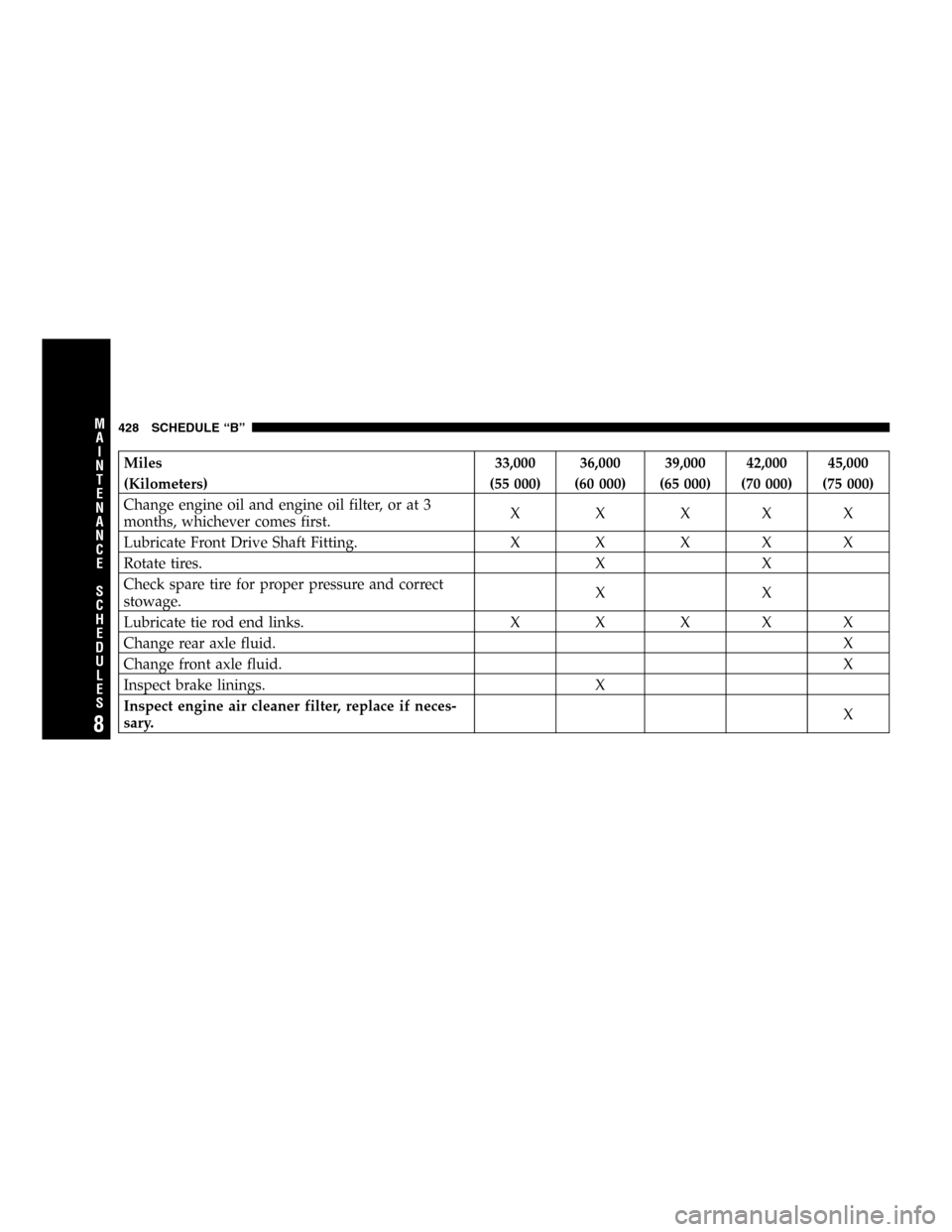
Miles 33,000 36,000 39,000 42,000 45,000
(Kilometers) (55 000) (60 000) (65 000) (70 000) (75 000)
Change engine oil and engine oil filter, or at 3
months, whichever comes first.X X XXX
Lubricate Front Drive Shaft Fitting. X X X X X
Rotate tires. X X
Check spare tire for proper pressure and correct
stowage.XX
Lubricate tie rod end links. X X X X X
Change rear axle fluid.X
Change front axle fluid.X
Inspect brake linings. X
Inspect engine air cleaner filter, replace if neces-
sary.X
428 SCHEDULE “B”
8
M
A
I
N
T
E
N
A
N
C
E
S
C
H
E
D
U
L
E
S
Page 429 of 467
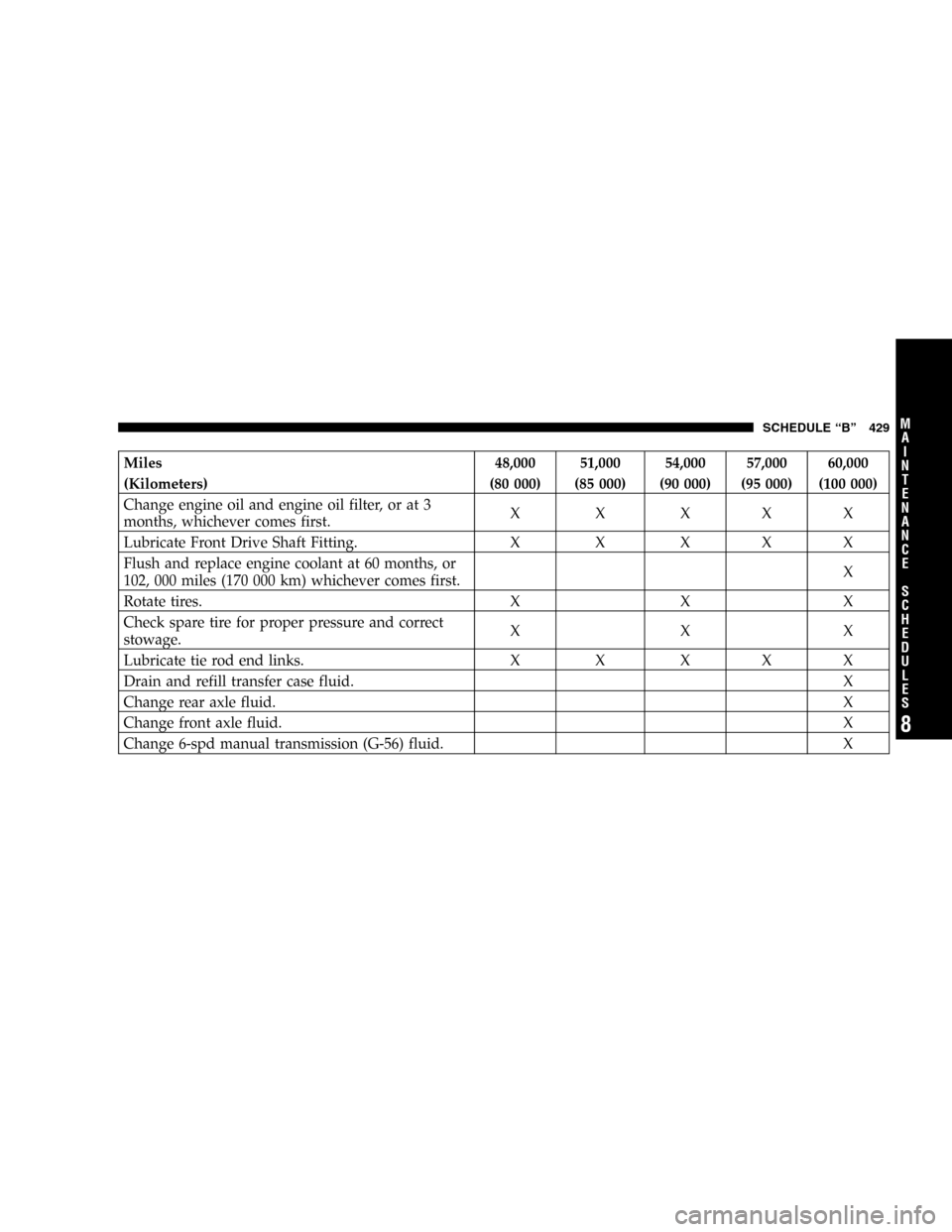
Miles 48,000 51,000 54,000 57,000 60,000
(Kilometers) (80 000) (85 000) (90 000) (95 000) (100 000)
Change engine oil and engine oil filter, or at 3
months, whichever comes first.X X XXX
Lubricate Front Drive Shaft Fitting. X X X X X
Flush and replace engine coolant at 60 months, or
102, 000 miles (170 000 km) whichever comes first.X
Rotate tires. X X X
Check spare tire for proper pressure and correct
stowage.XXX
Lubricate tie rod end links. X X X X X
Drain and refill transfer case fluid.X
Change rear axle fluid.X
Change front axle fluid.X
Change 6-spd manual transmission (G-56) fluid. X
SCHEDULE “B” 429
8
M
A
I
N
T
E
N
A
N
C
E
S
C
H
E
D
U
L
E
S
Page 431 of 467
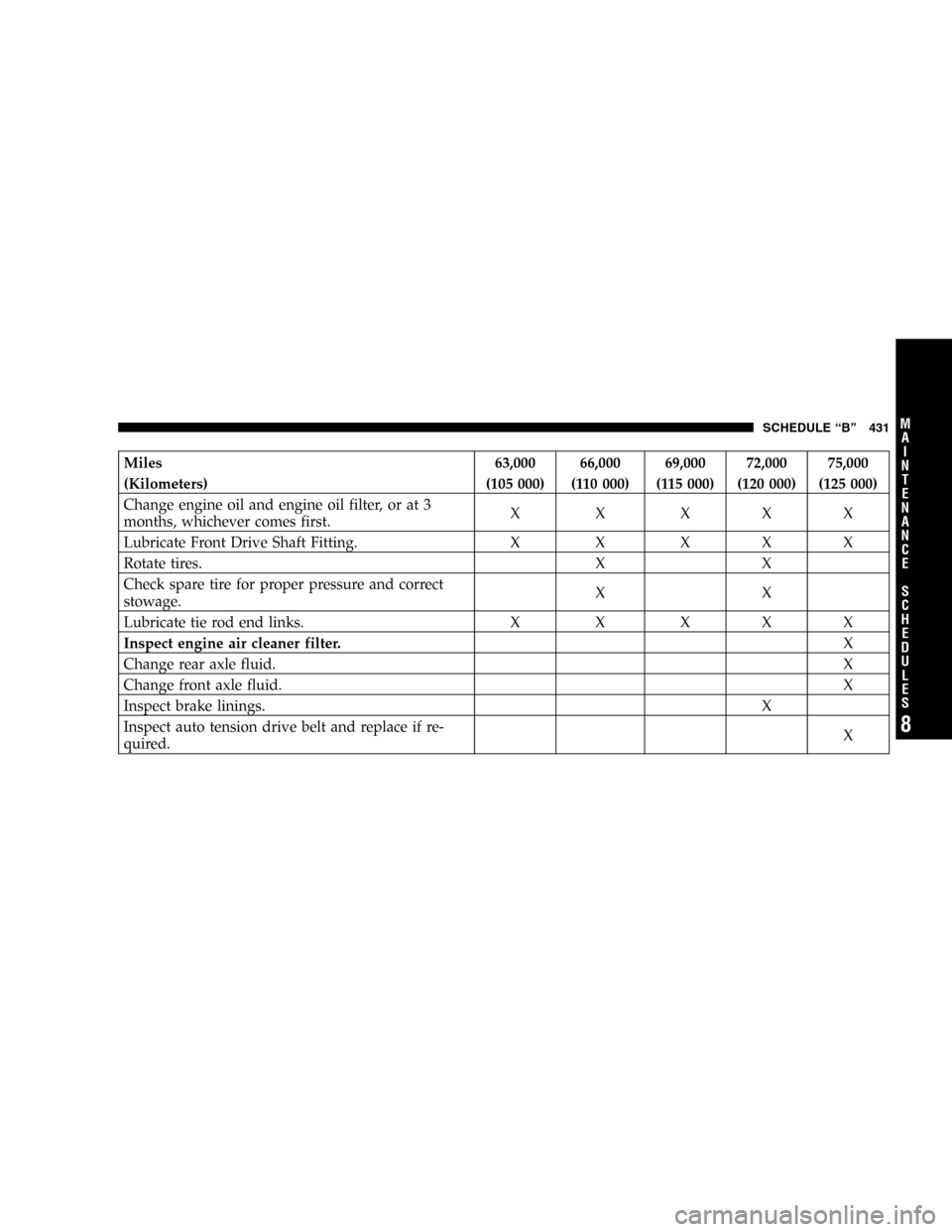
Miles 63,000 66,000 69,000 72,000 75,000
(Kilometers) (105 000) (110 000) (115 000) (120 000) (125 000)
Change engine oil and engine oil filter, or at 3
months, whichever comes first.X X XXX
Lubricate Front Drive Shaft Fitting. X X X X X
Rotate tires. X X
Check spare tire for proper pressure and correct
stowage.XX
Lubricate tie rod end links. X X X X X
Inspect engine air cleaner filter.X
Change rear axle fluid.X
Change front axle fluid.X
Inspect brake linings.X
Inspect auto tension drive belt and replace if re-
quired.X
SCHEDULE “B” 431
8
M
A
I
N
T
E
N
A
N
C
E
S
C
H
E
D
U
L
E
S