automatic transmission DODGE POWER WAGON 2007 2.G User Guide
[x] Cancel search | Manufacturer: DODGE, Model Year: 2007, Model line: POWER WAGON, Model: DODGE POWER WAGON 2007 2.GPages: 492, PDF Size: 8.25 MB
Page 251 of 492
WARNING!
It is dangerous to shift the selector lever out of ªPº or
ªNº if the engine speed is higher than idle speed. If
your foot is not firmly on the brake pedal, the
vehicle could accelerate quickly forward or in re-
verse. You could lose control of the vehicle and hit
someone or something. Only shift into gear when
the engine is idling normally and when your right
foot is firmly on the brake pedal.
Automatic Transmission with Overdrive
The gear shift selector display, located in the instrument
panel cluster, indicates the transmission gear range (the
selector is illuminated for night driving). The selector
lever is mounted on the right side of the steering column.
You must depress the brake pedal, to pull the selector
lever out of park (P) position (Brake Interlock System). To
drive, move the selector lever from Park or Neutral to thedesired drive position. Pull the selector lever toward you
when shifting into Reverse, Second, First or Park, or
when shifting out of Park.
Gear Ranges
DO NOT race the engine when shifting from Park or
Neutral position into another gear range.
ªPº Park
This gear position supplements the parking brake by
locking the transmission. The engine can be started in
this range. Never use Park while the vehicle is in motion.
Apply the parking brake when leaving the vehicle in this
range. Always apply parking brake first, then place the
selector in Park position. On 4-wheel-drive vehicles be
sure that the transfer case is in a drive position!
250 STARTING AND OPERATING
Page 253 of 492
ªNº Neutral
Shift to Neutral when the vehicle is standing for pro-
longed periods with the engine running. The engine may
be started in this range. Set the parking brake if you must
leave the vehicle.
NOTE:Towing the vehicle, coasting, or driving, with
the transmission in neutral (N) position, can cause severe
damage to the transmission.
ªDº Drive
This position provides all forward gears, including 3rd
gear direct and 4th and 5th (if equipped) gear overdrive
(see Overdrive Operation). Use this range for most city
and highway driving.
ª2º Second
Use this position for driving slowly in heavy city traffic
or on mountain roads where more precise speed controlis desirable. Use it also when climbing long grades, and
for engine braking when descending moderately steep
grades.
NOTE:Do not exceed maximum engine speed.
ª1º First
Use this position for driving up very steep hills and for
engine braking at low speeds (20 mph [32 km/h] or less)
when going downhill.
NOTE:Do not exceed maximum engine speed.
Overdrive Operation
The overdrive automatic transmission contains an elec-
tronically controlled fourth and fifth (if equipped) speed
(Overdrive). The transmission will automatically shift
from Drive to Overdrive if the following conditions are
present:
²the transmission selector is in Drive;
252 STARTING AND OPERATING
Page 254 of 492
²the engine coolant has reached normal operating tem-
perature;
²vehicle speed is above approximately 30 mph (48
km/h);
²the ªTOW HAUL O/D OFFº switch has not been
activated;
²transmission has reached normal operating tempera-
ture.
NOTE:If the vehicle is started in extremely cold tem-
peratures, the transmission may not shift into Overdrive
and will automatically select the most desirable gear for
operation at this temperature. Normal operation will
resume when the transmission fluid temperature has
risen to a suitable level. Refer also to the Note under
torque converter clutch, later in this section.If the transmission temperature gets extremely hot, the
transmission will automatically select the most desirable
gear for operation at this temperature. If the transmission
temperature becomes hot enough the TRANS TEMP light
may illuminate and the transmission may downshift out
of Overdrive until the transmission cools down. After
cooldown, the transmission will resume normal opera-
tion.
The transmission will downshift from Overdrive to Drive
if the accelerator pedal is fully depressed at vehicle
speeds above approximately 35 mph (56 km/h).
STARTING AND OPERATING 253
5
Page 255 of 492
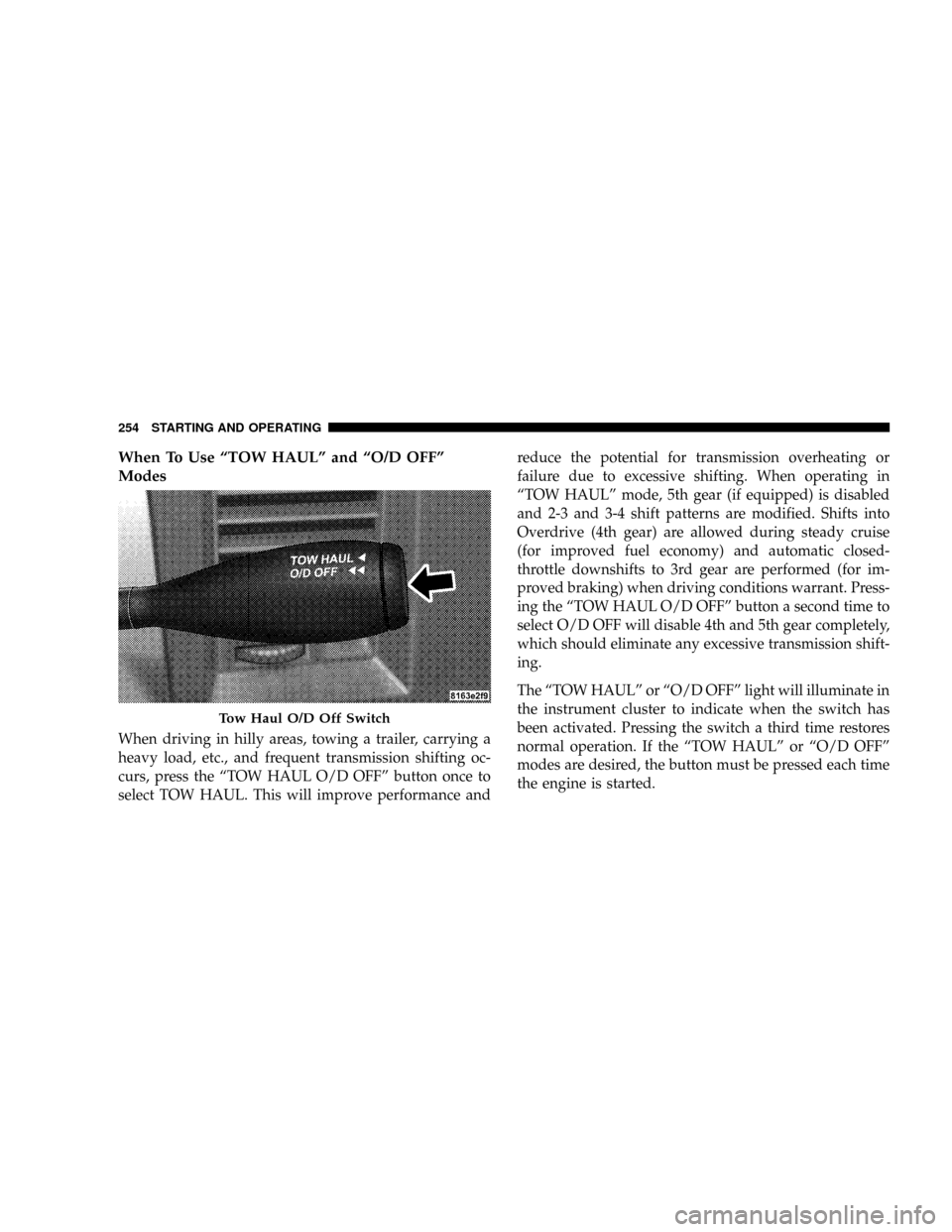
When To Use ªTOW HAULº and ªO/D OFFº
Modes
When driving in hilly areas, towing a trailer, carrying a
heavy load, etc., and frequent transmission shifting oc-
curs, press the ªTOW HAUL O/D OFFº button once to
select TOW HAUL. This will improve performance andreduce the potential for transmission overheating or
failure due to excessive shifting. When operating in
ªTOW HAULº mode, 5th gear (if equipped) is disabled
and 2-3 and 3-4 shift patterns are modified. Shifts into
Overdrive (4th gear) are allowed during steady cruise
(for improved fuel economy) and automatic closed-
throttle downshifts to 3rd gear are performed (for im-
proved braking) when driving conditions warrant. Press-
ing the ªTOW HAUL O/D OFFº button a second time to
select O/D OFF will disable 4th and 5th gear completely,
which should eliminate any excessive transmission shift-
ing.
The ªTOW HAULº or ªO/D OFFº light will illuminate in
the instrument cluster to indicate when the switch has
been activated. Pressing the switch a third time restores
normal operation. If the ªTOW HAULº or ªO/D OFFº
modes are desired, the button must be pressed each time
the engine is started.
Tow Haul O/D Off Switch
254 STARTING AND OPERATING
Page 256 of 492
Torque Converter Clutch
A feature, designed to improve fuel economy, has been
included in the automatic transmission on your vehicle.
A clutch within the torque converter engages automati-
cally at calibrated speeds. This may result in a slightly
different feeling or response during normal operation in
the upper gears. When the vehicle speed drops or during
acceleration when the transmission downshifts to second
gear, the clutch automatically disengages.
NOTE:The torque converter clutch will not engage
until the transmission fluid and engine coolant are warm
[usually after 1-3 miles (1.6 - 4.8 km) of driving]. Because
the engine speed is higher when the torque converter
clutch is not engaged, it may seem as if the transmission
is not shifting into Overdrive when cold. This is normal.
Pressing the ªTOW HAUL O/D OFFº button, when the
transmission is sufficiently warm, will demonstrate that
the transmission is able to shift into and out of overdrive.NOTE:If the vehicle has not been driven in several
days, the first few seconds of operation after shifting the
transmission into gear may seem sluggish. This is due to
the fluid partially draining from the torque converter into
the transmission. This condition is normal and will not
cause damage to the transmission. The torque converter
will refill within five seconds of shifting from Park into
any other gear position.
MANUAL TRANSMISSION
WARNING!
You or others could be injured if you leave the
vehicle unattended without having the parking
brake fully applied. The parking brake should al-
ways be applied when the driver is not in the
vehicle, especially on an incline.
STARTING AND OPERATING 255
5
Page 262 of 492
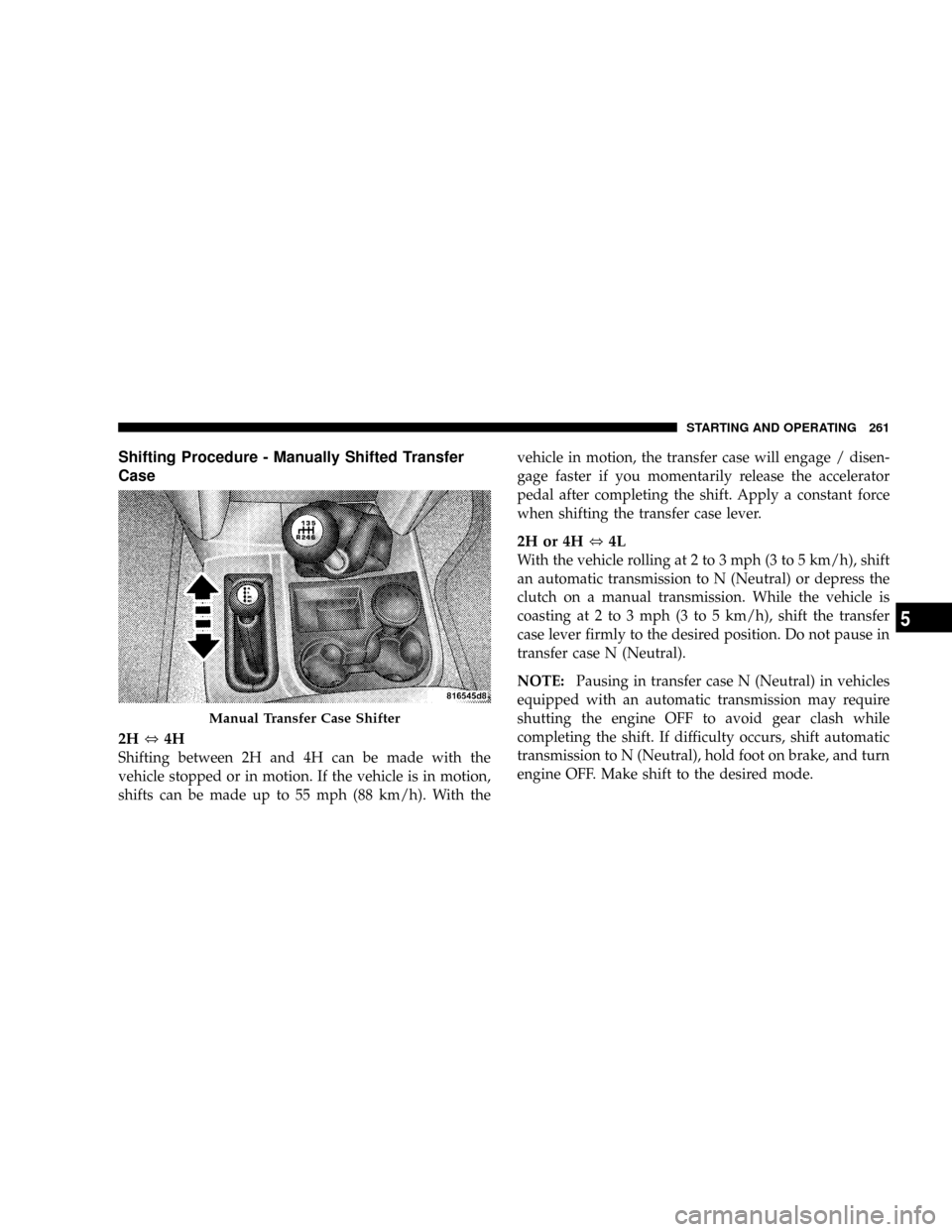
Shifting Procedure - Manually Shifted Transfer
Case
2H,4H
Shifting between 2H and 4H can be made with the
vehicle stopped or in motion. If the vehicle is in motion,
shifts can be made up to 55 mph (88 km/h). With thevehicle in motion, the transfer case will engage / disen-
gage faster if you momentarily release the accelerator
pedal after completing the shift. Apply a constant force
when shifting the transfer case lever.
2H or 4H,4L
With the vehicle rolling at 2 to 3 mph (3 to 5 km/h), shift
an automatic transmission to N (Neutral) or depress the
clutch on a manual transmission. While the vehicle is
coasting at 2 to 3 mph (3 to 5 km/h), shift the transfer
case lever firmly to the desired position. Do not pause in
transfer case N (Neutral).
NOTE:Pausing in transfer case N (Neutral) in vehicles
equipped with an automatic transmission may require
shutting the engine OFF to avoid gear clash while
completing the shift. If difficulty occurs, shift automatic
transmission to N (Neutral), hold foot on brake, and turn
engine OFF. Make shift to the desired mode.
Manual Transfer Case Shifter
STARTING AND OPERATING 261
5
Page 280 of 492
a1¤4turn quickly back and forth. This will provide a
fresh9bite9into the surface and will usually provide
enough traction to complete the climb. If you do not
make it to the top, place the vehicle in reverse and
back straight down the grade using engine resistance
along with the vehicle brakes.
WARNING!
Never attempt to climb a hill at an angle or turn
around on a steep grade. Driving across an incline
increases the risk of a roll over, which may result in
severe injury.
²Driving Down Hill± Before driving down a steep hill
you need to determine if it is too steep for a safe
descent. What is the surface traction? Is the grade too
steep to maintain a slow controlled descent? Are there
obstacles? Is it a straight descent? Is there plenty ofdistance at the base of the hill to regain control if the
vehicle descends to fast? If you feel confident in your
ability to proceed then make sure you are in 4L (Low)
with the transmission in 1st gear (manually select 1st
gear on automatic transmissions) and proceed with
caution. Allow engine braking to control the descent
and apply your brakes if necessary, but do not allow
the tires to lock.
WARNING!
Do not descend a steep grade in neutral. Use vehicle
brakes in conjunction with engine braking. De-
scending a grade too fast could cause you to lose
control and be seriously injured.
²Driving Across An Incline± If at all possible avoid
driving across an incline. If it is necessary, know your
vehicle's abilities. Driving across an incline places
STARTING AND OPERATING 279
5
Page 304 of 492
NOTE:Avoid overheating the winch motor. For ex-
tended winching, stop at reasonable intervals to allow
the winch motor to cool down.
NOTE: What to look for under load:The wire rope
must always spool onto the drum as indicated by the
drum rotation decal on the winch. As you power-in,
make sure the wire rope winds evenly and tightly on the
drum. This prevents the outer wire wraps from drawing
into the inner wraps, binding and damaging the wire
rope. Avoid shock loads by using the control switch
intermittently to take up wire rope slack. Shock loads can
momentarily far exceed the winch and wire rope ratings.
During side pulls the wire rope tends to stack up at oneend of the drum. This stack can become large enough to
cause serious damage to the winch. So, line up pulls as
straight ahead as possible and stop winching if the wire
rope comes close to the tie rods or mounting plate. To fix
an uneven stack, spool out that section of the rope and
reposition it to the opposite end of the drum, which will
free up space for continued winching.
16. Secure vehicle. Once recovery of the vehicle is com-
plete, be sure to secure the vehicle's brakes and put the
transmission in9park9(automatic) or9low9gear for
9manual9transmissions. Release tension in the wire rope.
17. Disconnect wire rope. Disconnect from the anchor.
STARTING AND OPERATING 303
5
Page 310 of 492
WARNING!
²Always fully apply the parking brake when leav-
ing your vehicle, or it may roll and cause damage
or injury. Also be certain to leave an automatic
transmission in Park, a manual transmission in
Reverse or First gear. Failure to do so may allow
the vehicle to roll and cause damage or injury.
²Never leave children alone in a vehicle. Leaving
children in a vehicle unattended is dangerous for
a number of reasons. A child or others could be
seriously or fatally injured. Don't leave the keys
in the ignition. A child could operate power
windows, other controls, or move the vehicle.
²Be sure the parking brake is fully disengaged
before driving, failure to do so can lead to brake
problems due to excessive heating of the rear
brakes.
When parking on a hill, turn the front wheels toward the
curb on a downhill grade and away from the curb on an
uphill grade.
The parking brake should always be applied whenever
the driver is not in the vehicle.
BRAKE SYSTEM
If power assist is lost for any reason (for example,
repeated brake applications with the engine off), the
brakes will still function. However, you will experience a
substantial increase in braking effort to stop the vehicle.
If either the front or rear hydraulic systems lose normal
capability, the remaining system will still function with
some loss of overall braking effectiveness. This will be
evident by increased pedal travel during application,
greater pedal force required to slow or stop, and activa-
tion of the BRAKE warning lamp and the ABS lamp (if
equipped) during brake use.
STARTING AND OPERATING 309
5
Page 354 of 492
²Safety chains must always be used between your
vehicle and trailer. Always connect the chains to the
frame or hook retainers of the vehicle hitch. Cross the
chains under the trailer tongue and allow enough
slack for turning corners.
²Vehicles with trailers should not be parked on a grade.
When parking, apply the parking brake on the tow
vehicle. Put the tow vehicle automatic transmission in
P for Park. With a manual transmission, shift the
transmission into reverse. And with four-wheel-drive
vehicles, make sure the transfer case is not in neutral.
Always, block or9chock9the trailer wheels.
²GCWR must not be exceeded.
²Total weight must be distributed between the tow
vehicle and the trailer such that the following four
ratings are not exceeded:
1. GVWR2. GTW
3. GAWR
4. Tongue weight rating for the trailer hitch utilized
(This requirement may limit the ability to always
achieve the 10% to 15% range of tongue weight as a
percentage of total trailer weight).
Towing Requirements Ð Tires
þ
Do not attempt to tow a trailer while using a compact
spare tire.
þProper tire inflation pressures are essential to the safe
and satisfactory operation of your vehicle. Refer to the
Tires±General Information section of this manual on
Tire Pressures for proper tire inflation procedures.
þAlso, check the trailer tires for proper tire inflation
pressures before trailer usage.
STARTING AND OPERATING 353
5