brakes DODGE POWER WAGON 2007 2.G User Guide
[x] Cancel search | Manufacturer: DODGE, Model Year: 2007, Model line: POWER WAGON, Model: DODGE POWER WAGON 2007 2.GPages: 492, PDF Size: 8.25 MB
Page 311 of 492
Brake Noise
During normal operation of the brake system certain
noises may be present from time to time. Occasional
9groan9or9squeal9noises may occur during normal
operation of the brake system which may not be indica-
tive of a problem. These noises may be heard at any time
the brakes are applied but may be more noticeable during
the first few brake applications in the morning. Moisture,
hot or cold temperature, dust, and or other debris may
also contribute to the noise condition. Repeated or con-
tinuous noises during braking may be an indication that
the brake linings are worn and in need of replacement.
Four-Wheel Anti-Lock Brake System (ABS)Ð If
Equipped
This Anti-lock Brake System is designed to aid the driver
in maintaining vehicle control under adverse braking
conditions. The system operates with a separate com-
puter to modulate hydraulic pressure to prevent wheel
lockup and help avoid skidding on slippery surfaces.The system's pump motor runs during an ABS stop to
provide regulated hydraulic pressure. The pump motor
makes a low humming noise during operation. This is
normal.
When you are in a severe braking condition involving
use of the Anti-lock Brake System, you will experience
some pedal drop as the vehicle comes to a complete stop.
This is the result of the system reverting to the base brake
system and is normal.
Engagement of the Anti-lock Brake System may be
accompanied by a pulsing sensation. You may also hear a
clicking noise. These occurrences are normal, and indi-
cate that the system is functioning.ABS Warning Light
The Anti-lock Brake System includes an amber warning
light. When the light is illuminated, the Anti-lock Brake
System is not functioning. The system reverts to standard
non-anti-lock brakes.
310 STARTING AND OPERATING
Page 312 of 492
WARNING!
Pumping of the anti-lock brakes will diminish their
effectiveness and may lead to an accident. Pumping
makes the stopping distance longer. Just press firmly
on your brake pedal when you need to slow down or
stop.
WARNING!
²Anti-lock system (ABS) cannot prevent the natu-
ral laws of physics from acting on the vehicle, nor
can it increase braking or steering efficiency be-
yond that afforded by the condition of the vehicle
brakes and tires or the traction afforded.
²The ABS cannot prevent accidents, including
those resulting from excessive speed in turns,
following another vehicle too closely, or hydro-
planing. Only a safe, attentive, and skillful driver
can prevent accidents.
²The capabilities of an ABS equipped vehicle must
never be exploited in a reckless or dangerous
manner which could jeopardize the user's safety
or the safety of others.
STARTING AND OPERATING 311
5
Page 344 of 492
Curb Weight
The curb weight of a vehicle is defined as the total weight
of the vehicle with all fluids, including vehicle fuel, at full
capacity conditions, and with no occupants or cargo
loaded into the vehicle. The front and rear curb weight
values are determined by weighing your vehicle on a
commercial scale before any occupants or cargo are
added.
Loading
The actual total weight and the weight of the front and
rear of your vehicle at the ground can best be determined
by weighing it when it is loaded and ready for operation.
The entire vehicle should first be weighed on a commer-
cial scale to insure that the GVWR has not been exceeded.
The weight on the front and rear of the vehicle should
then be determined separately to be sure that the load is
properly distributed over front and rear axle. Weighing
the vehicle may show that the GAWR of either the frontor rear axles has been exceeded but the total load is
within the specified GVWR. If so, weight must be shifted
from front to rear or rear to front as appropriate until the
specified weight limitations are met. Store the heavier
items down low and be sure that the weight is distributed
equally. Stow all loose items securely before driving.
Improper weight distributions can have an adverse effect
on the way your vehicle steers and handles and the way
the brakes operate.
CAUTION!
Do not load your vehicle any heavier than the
GVWR or the maximum front and rear GAWR. If
you do, parts on your vehicle can break, or it can
change the way your vehicle handles. This could
cause you to lose control. Also overloading can
shorten the life of your vehicle.
STARTING AND OPERATING 343
5
Page 353 of 492
CAUTION!
²Avoid towing a trailer for the first 500 miles (805
km) of vehicle operation. Doing so may damage
your axles, driveline and vehicle.
²During the first 500 miles (805 km) of trailer
towing, limit your speed to 50 mph (80 km/h).
Perform the maintenance listed in Section 8 of this
manual. When towing a trailer, never exceed the GAWR,
or GCWR, ratings.
WARNING!
Improper towing can lead to an injury accident.
Follow these guidelines to make your trailer towing
as safe as possible:
Make certain that the load is secured in the trailer
and will not shift during travel. When trailering
cargo that is not fully secured, dynamic load shifts
can occur that may be difficult for the driver to
control. You could lose control of your vehicle and
have an accident.
²When hauling cargo or towing a trailer, do not over-
load your vehicle or trailer. Overloading can cause a
loss of control, poor performance or damage to brakes,
axle, engine, transmission, steering, suspension, chas-
sis structure or tires.
352 STARTING AND OPERATING
Page 355 of 492
þCheck for signs of tire wear or visible tire damage
before towing a trailer. Refer to the Tires±General
Information section of this manual on Tread Wear
Indicators for the proper inspection procedure.
þWhen replacing tires refer to the Tires±General Infor-
mation section of this manual on Replacement Tires for
proper tire replacement procedures. Replacing tires
with a higher load carrying capacity will not increase
the vehicle's GVWR and GAWR limits.
Towing Requirements Ð Trailer Brakes
þ
Donotinterconnect the hydraulic brake system or
vacuum system of your vehicle with that of the trailer.
This could cause inadequate braking and possible
personal injury.
þAn electronically actuated trailer brake controller is
required when towing a trailer with electronicallyactuated brakes. When towing a trailer equipped with
a hydraulic surge actuated brake system, an electronic
brake controller is not required.
þTrailer brakes are recommended for trailers over 1,000
lbs (454 kg) and required for trailers in excess of 2,000
lbs (907 kg).
CAUTION!
If the trailer weighs more than 1,000 lbs (454 kg)
loaded, it should have its own brakes and they
should be of adequate capacity. Failure to do this
could lead to accelerated brake lining wear, higher
brake pedal effort, and longer stopping distances.
354 STARTING AND OPERATING
Page 356 of 492
WARNING!
Do not connect trailer brakes to your vehicle's hy-
draulic brake lines. It can overload your brake sys-
tem and cause it to fail. You might not have brakes
when you need them and could have an accident.
Towing any trailer will increase your stopping dis-
tance. When towing you should allow for additional
space between your vehicle and the vehicle in front
of you. Failure to do so could result in an accident.
Towing Requirements Ð Trailer Lights & Wiring
Whenever you pull a trailer, regardless of the trailer size,
stop lights and turn signals on the trailer are required for
motoring safety.
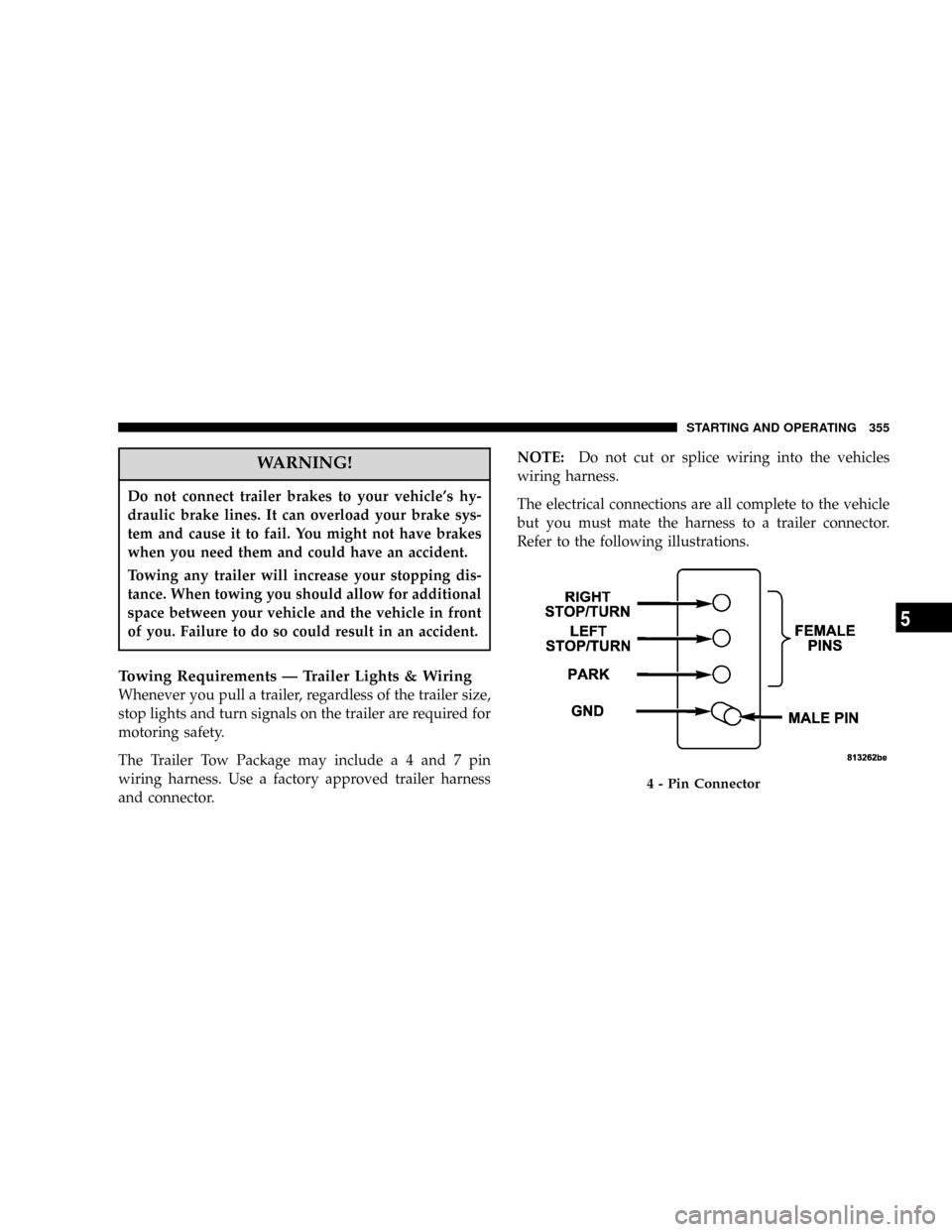
The Trailer Tow Package may includea4and7pin
wiring harness. Use a factory approved trailer harness
and connector.NOTE:Do not cut or splice wiring into the vehicles
wiring harness.
The electrical connections are all complete to the vehicle
but you must mate the harness to a trailer connector.
Refer to the following illustrations.
4 - Pin Connector
STARTING AND OPERATING 355
5
Page 410 of 492
Inspect all hose connections such as clamps and cou-
plings to make sure they are secure and no leaks are
present.
Components should be replaced immediately if there is
any evidence of wear or damage that could cause failure.
Brake System
Power Disc Brakes (front and rear)
Disc brakes do not require adjustment; however, several
hard stops during the break-in period are recommended
to seat the linings and wear off any foreign material.
Brake Master Cylinder
The fluid level of the master cylinder should be checked
when performing under the hood service, or immedi-
ately if the brake system warning lamp indicates system
failure.
The brake master cylinder has a translucent plastic
reservoir. On the outboard side of the reservoir, there is aªMAXº dot and an ªMINº dot. The fluid level must be
kept within these two dots. Do not add fluid above the
MAX mark, because leakage may occur at the cap.
With disc brakes the fluid level can be expected to fall as
the brake linings wear. However, an unexpected drop in
fluid level may be caused by a leak and a system check
should be conducted.
Refer to Fluids, Lubricants and Genuine Parts for the
correct Fluid type.
WARNING!
Use of a brake fluid that may have a lower initial
boiling point, or is unidentified as to specification,
may result in sudden brake failure during hard
prolonged braking. You could have an accident.
MAINTAINING YOUR VEHICLE 409
7
Page 476 of 492
Bar, Stabilizer/Sway System................ 267
Battery............................... 396
Emergency Starting..................... 375
Saving Feature (Protection)............... 120
Bearings.............................. 415
Belts, Drive............................ 393
Belts, Seat.............................. 34
Body Mechanism Lubrication............... 401
B-Pillar Location........................ 318
Brake Fluid............................ 443
Brake System........................309,409
Anti-Lock (ABS)....................... 310
Disc Brakes.......................... 409
Hoses.............................. 410
Master Cylinder....................... 409
Parking............................. 308
Warning Light........................ 178
Break-In Recommendations, New Vehicle........ 70
Bulb Replacement....................... 431Bulbs, Light............................ 430
Cab Top Clearance Lights.................. 438
Calibration, Compass..................... 136
Camper............................... 160
Capacities, Fluid........................ 441
Caps, Filler
Oil (Engine).......................... 391
Power Steering........................ 398
Radiator (Coolant Pressure)............... 406
Car Washes............................ 421
Carbon Monoxide Warning..............163,339
Cargo Light............................ 122
Cassette Tape and Player Maintenance......... 225
Catalytic Converter...................... 394
CD (Compact Disc) Player............183,191,204
Cellular Phone.......................... 87
Center High Mounted Stop Light............ 437
Center Lap Belts......................... 42
INDEX 475
10
Page 478 of 492

Data Recorder, Event...................... 56
Daytime Running Lights................... 121
Dealer Service.......................... 388
Defroster, Rear Window.................86,154
Defroster, Windshield...............163,229,232
Delay (Intermittent) Wipers................. 125
Differential............................. 78
Differential, Limited-Slip.................. 262
Digital Video Disc (DVD) Player.............. 78
Dipsticks
Automatic Transmission................. 413
Power Steering........................ 398
Disc Brakes............................ 409
Disposal
Antifreeze (Engine Coolant)............... 406
Door Ajar............................. 181
Door Locks............................. 26
Door Opener, Garage..................... 139
Drive Belts............................ 393Driving
Off-Pavement......................... 268
Off-Road............................ 268
Electric Rear Window Defrost.............86,154
Electrical Power Outlets................... 148
Electronic Speed Control (Cruise Control)...... 128
Emergency Brake........................ 308
Emergency, In Case of
Freeing Vehicle When Stuck............... 378
Hazard Warning Flasher................. 366
Jacking............................. 369
Jump Starting......................... 375
Tow Hooks.......................... 379
Towing............................. 380
Emission Control System Maintenance......... 446
Emission Related Components.............. 396
Engine............................... 384
Air Cleaner.......................... 393
INDEX 477
10