flat tire DODGE POWER WAGON 2007 2.G User Guide
[x] Cancel search | Manufacturer: DODGE, Model Year: 2007, Model line: POWER WAGON, Model: DODGE POWER WAGON 2007 2.GPages: 492, PDF Size: 8.25 MB
Page 331 of 492
Life of Tire
The service life of a tire is dependent upon varying
factors including but not limited to:
²Driving style
²Tire pressure
²Distance driven
WARNING!
Tires and spare tire should be replaced after six
years, regardless of the remaining tread. Failure to
follow this warning can result in sudden tire failure.
You could lose control and have an accident result-
ing in serious injury or death.
Keep dismounted tires in a cool, dry place with as little
exposure to light as possible. Protect tires from contact
with oil, grease, and gasoline.
Replacement Tires
The tires on your new vehicle provide a balance of many
characteristics. They should be inspected regularly for
wear and correct cold tire inflation pressure. The manu-
facturer strongly recommends that you use tires equiva-
lent to the originals in size, quality and performance
when replacement is needed (refer to the paragraph on
ªTread Wear Indicatorsº). Refer to the ªTire and Loading
Informationº placard for the size designation of your tire.
The service description and load identification will be
found on the original equipment tire. Failure to use
equivalent replacement tires may adversely affect the
safety, handling, and ride of your vehicle. We recommend
that you contact your original equipment or an autho-
rized tire dealer with any questions you may have on tire
specifications or capability.
330 STARTING AND OPERATING
Page 333 of 492
Improper alignment will not cause vehicle vibration.
Vibration may be a result of tire and wheel out-of-
balance. Proper balancing will reduce vibration and
avoid tire cupping and spotty wear.
SUPPLEMENTAL TIRE PRESSURE INFORMATION
± IF EQUIPPED
A light load vehicle condition is defined as two passen-
gers {150 lbs (68 kg) each} plus 200 lbs (91kg) of cargo.
Cold tire inflation pressures for a lightly loaded vehicle
will be found on the face of the driver's door.
TIRE CHAINS
Use ªClass Uº chains on Power Wagon models, or other
traction aids that meet SAE Type ªUº specifications.
NOTE:Chains must be the proper size for the vehicle,
as recommended by the chain manufacturer.
CAUTION!
To avoid damage to your vehicle, tires or chains, observe the
following precautions:
²Because of limited chain clearance between tires and other
suspension components, it is important that only chains
in good condition are used. Broken chains can cause
serious vehicle damage. Stop the vehicle immediately if
noise occurs that could suggest chain breakage. Remove
the damaged parts of the chain before further use.
²Install chains as tightly as possible and then retighten
after driving about 1/2 mile (0.8 km).
²Do not exceed 45 mph (72 km/h).
²Drive cautiously and avoid severe turns and large bumps,
especially with a loaded vehicle.
²Do not install tire chains on front wheels of 4x2 vehicles.
²Do not drive for a prolonged period on dry pavement.
²Observe the tire chain manufacturer's instructions on
method of installation, operating speed, and conditions
for usage. Always use the lower suggested operating
speed of the chain manufacturer if different than the
speed recommended by the manufacturer.
332 STARTING AND OPERATING
Page 334 of 492
These cautions apply to all chain traction devices, includ-
ing link and cable (radial) chains.
NOTE:On 4x4 Power Wagon models, class ªUº snow
chains are permitted on the rear wheels only of vehicles
equipped with LT285/70R17D.
CAUTION!
Do not use tire chains on the 4X4 front wheels of
Ram Trucks equipped with LT285/70R17D. There
may not be adequate clearance for the chains and
you are risking structural or body damage to your
vehicle.
SNOW TIRES
Snow tires should be of the same size and type construc-
tion as the front tires. Consult the manufacturer of the
snow tire to determine any maximum vehicle speed
requirement associated with the tire. These tires should
always be operated at the vehicle maximum capacity
inflation pressures under any load condition.
While studded tires improve performance on ice, skid
and traction capability on wet or dry surfaces may be
poorer than that of non-studded tires. Some states pro-
hibit studded tires; therefore, local laws should be
checked before using these tire types.
STARTING AND OPERATING 333
5
Page 343 of 492
included on this label and indicates the Month, Day and
Hour of manufacture. The bar code that appears on the
bottom of the label is your Vehicle Identification Number
(VIN).
Gross Vehicle Weight Rating (GVWR)
The GVWR is the total permissible weight of your vehicle
including driver, passengers, vehicle, options and cargo.
The label also specifies maximum capacities of front and
rear axle systems (GAWR). Total load must be limited so
GVWR and front and rear GAWR are not exceeded.
Payload
The payload of a vehicle is defined as the allowable load
weight a truck can carry, including the weight of the
driver, all passengers, options and cargo.
Gross Axle Weight Rating (GAWR)
The GAWR is the maximum permissible load on the front
and rear axles. The load must be distributed in the cargo
area so that the GAWR of each axle is not exceeded.Each axle GAWR is determined by the components in the
system with the lowest load carrying capacity (axle,
springs, tires or wheels). Heavier axles or suspension
components sometimes specified by purchasers for in-
creased durability does not necessarily increase the vehi-
cle's GVWR.
Tire Size
The tire size on the Label represents the actual tire size on
your vehicle. Replacement tires must be equal to the load
capacity of this tire size.
Rim Size
This is the rim size that is appropriate for the tire size
listed.
Inflation Pressure
This is the cold tire inflation pressure for your vehicle for
all loading conditions up to full GAWR.
342 STARTING AND OPERATING
Page 354 of 492
²Safety chains must always be used between your
vehicle and trailer. Always connect the chains to the
frame or hook retainers of the vehicle hitch. Cross the
chains under the trailer tongue and allow enough
slack for turning corners.
²Vehicles with trailers should not be parked on a grade.
When parking, apply the parking brake on the tow
vehicle. Put the tow vehicle automatic transmission in
P for Park. With a manual transmission, shift the
transmission into reverse. And with four-wheel-drive
vehicles, make sure the transfer case is not in neutral.
Always, block or9chock9the trailer wheels.
²GCWR must not be exceeded.
²Total weight must be distributed between the tow
vehicle and the trailer such that the following four
ratings are not exceeded:
1. GVWR2. GTW
3. GAWR
4. Tongue weight rating for the trailer hitch utilized
(This requirement may limit the ability to always
achieve the 10% to 15% range of tongue weight as a
percentage of total trailer weight).
Towing Requirements Ð Tires
þ
Do not attempt to tow a trailer while using a compact
spare tire.
þProper tire inflation pressures are essential to the safe
and satisfactory operation of your vehicle. Refer to the
Tires±General Information section of this manual on
Tire Pressures for proper tire inflation procedures.
þAlso, check the trailer tires for proper tire inflation
pressures before trailer usage.
STARTING AND OPERATING 353
5
Page 369 of 492
WARNING!
After using the jack and tools, always reinstall them
in the original carrier and location. While driving
you may experience, abrupt stopping, rapid accelera-
tion, or sharp turns. A loose jack, tools, bracket or
other objects in the vehicle may move around with
force, resulting in serious injury.
JACKING INSTRUCTIONS
Removing The Spare Tire
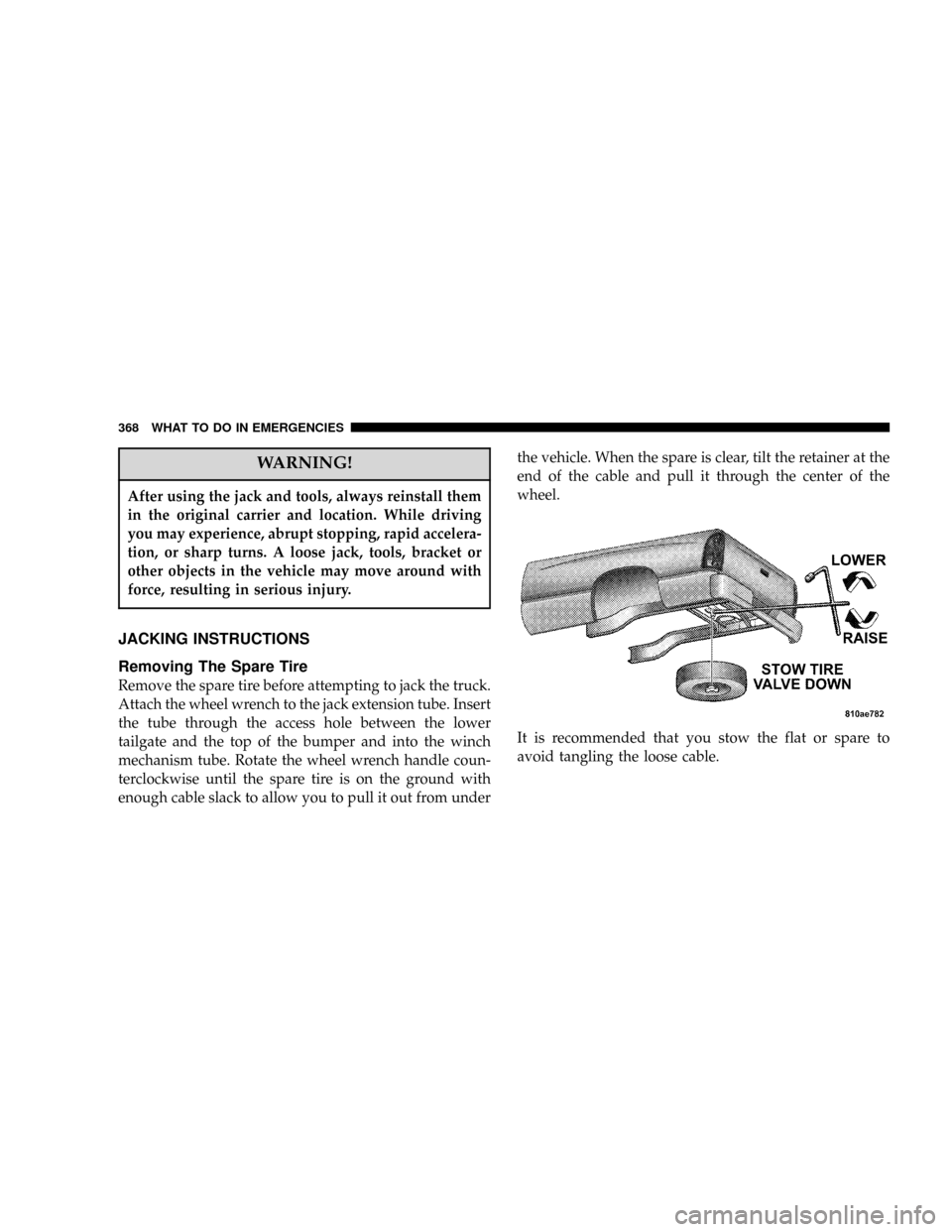
Remove the spare tire before attempting to jack the truck.
Attach the wheel wrench to the jack extension tube. Insert
the tube through the access hole between the lower
tailgate and the top of the bumper and into the winch
mechanism tube. Rotate the wheel wrench handle coun-
terclockwise until the spare tire is on the ground with
enough cable slack to allow you to pull it out from underthe vehicle. When the spare is clear, tilt the retainer at the
end of the cable and pull it through the center of the
wheel.
It is recommended that you stow the flat or spare to
avoid tangling the loose cable.
368 WHAT TO DO IN EMERGENCIES
Page 375 of 492
Wheel Nuts
All wheel nuts should be tightened occasionally to elimi-
nate the possibility of wheel studs being sheared or the
bolt holes in the wheels becoming elongated. This is
especially important during the first few hundred miles
of operation to allow the wheel nuts to become properly
set. All nuts should first be firmly seated against the
wheel. The nuts should then be tightened to recom-
mended torque. Tighten the nuts to final torque in
increments. Progress around the bolt circle, tightening
the nut opposite to the nut just previously tightened until
final torque is achieved. Recommended torques are
shown in the following chart.
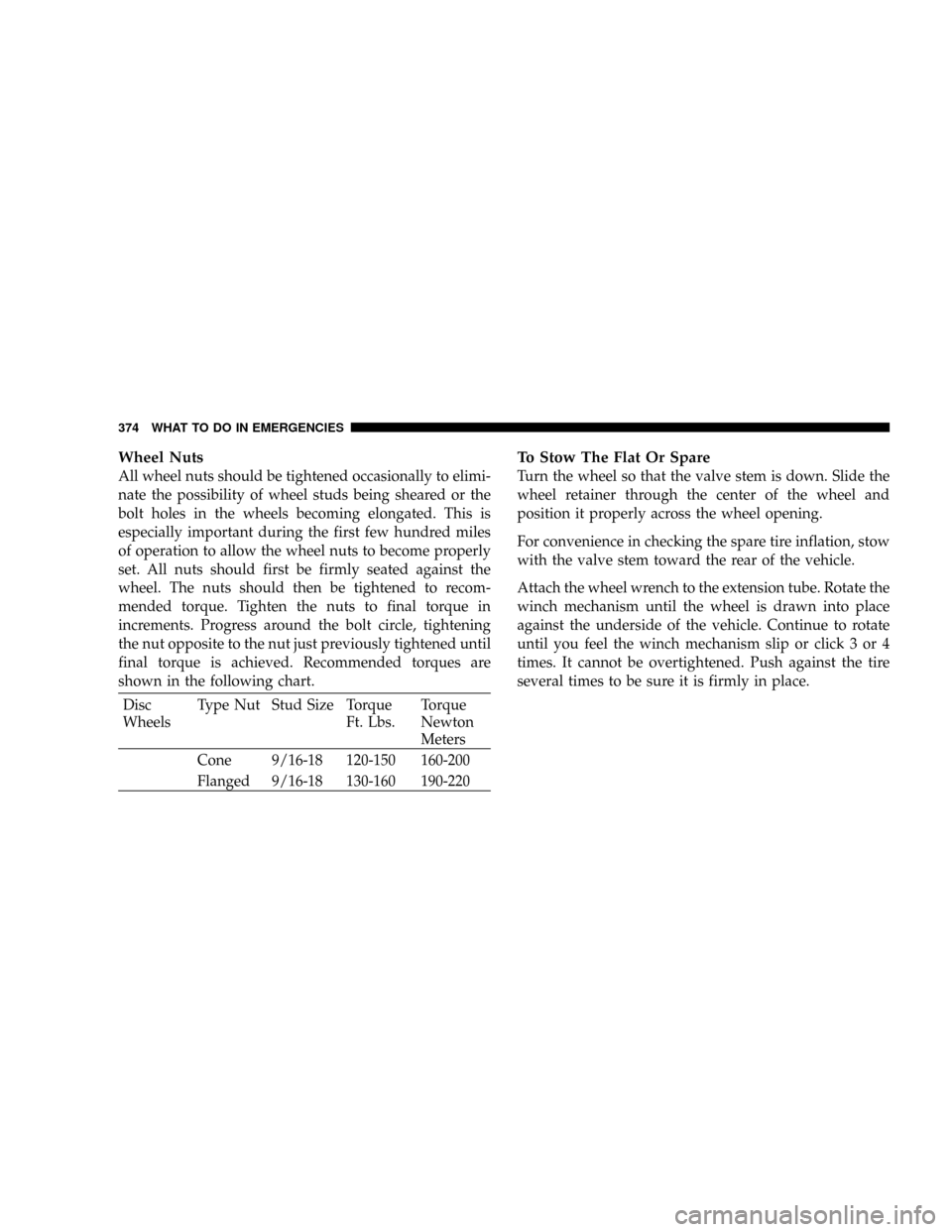
Disc
WheelsType Nut Stud Size Torque
Ft. Lbs.Torque
Newton
Meters
Cone 9/16-18 120-150 160-200
Flanged 9/16-18 130-160 190-220
To Stow The Flat Or Spare
Turn the wheel so that the valve stem is down. Slide the
wheel retainer through the center of the wheel and
position it properly across the wheel opening.
For convenience in checking the spare tire inflation, stow
with the valve stem toward the rear of the vehicle.
Attach the wheel wrench to the extension tube. Rotate the
winch mechanism until the wheel is drawn into place
against the underside of the vehicle. Continue to rotate
until you feel the winch mechanism slip or click 3 or 4
times. It cannot be overtightened. Push against the tire
several times to be sure it is firmly in place.
374 WHAT TO DO IN EMERGENCIES
Page 473 of 492
on specified government test surfaces of asphalt and
concrete. A tire marked C may have poor traction perfor-
mance.
WARNING!
The traction grade assigned to this tire is based on
straight-ahead braking traction tests, and does not
include acceleration, cornering, hydroplaning, or
peak traction characteristics.
Temperature Grades
The temperature grades are A (the highest), B, and C,
representing the tire's resistance to the generation of heat
and its ability to dissipate heat when tested under
controlled conditions on a specified indoor laboratory
test wheel. Sustained high temperature can cause the
material of the tire to degenerate and reduce tire life, and
excessive temperature can lead to sudden tire failure. Thegrade C corresponds to a level of performance which all
passenger car tires must meet under the Federal Motor
Vehicle Safety Standard No. 109. Grades B and A repre-
sent higher levels of performance on the laboratory test
wheel than the minimum required by law.
WARNING!
The temperature grade for this tire is established for
a tire that is properly inflated and not overloaded.
Excessive speed, under inflation, or excessive load-
ing, either separately or in combination, can cause
heat buildup and possible tire failure.
472 IF YOU NEED CONSUMER ASSISTANCE
Page 479 of 492
Block Heater......................... 249
Break-In Recommendations................ 70
Compartment Identification............... 384
Coolant (Antifreeze).................... 442
Exhaust Gas Caution.................... 339
Flooded, Starting...................... 246
Fuel Requirements..................... 441
Oil ...........................389,441,442
Oil Filler Cap......................... 391
Oil Selection.......................391,441
Oil Synthetic......................... 392
Temperature Gauge..................... 175
Equipment Identification Plate.............. 363
Event Data Recorder...................... 56
Exhaust Gas Caution................163,339,403
Exhaust System...................163,402,403
Exterior Lighting........................ 120
Fabric Care............................ 423Filters
Air Cleaner........................393,417
Engine Fuel.......................... 394
Engine Oil........................392,442
Engine Oil Disposal.................... 392
Flashers
Turn Signal.......................... 123
Flat Tire Stowage.....................368,374
Flooded Engine Starting................... 246
Fluid, Brake........................... 443
Fluid Capacities......................... 441
Fluid Level Checks
Automatic Transmission................. 413
Power Steering........................ 398
Fluids, Lubricants and Genuine Parts.......... 442
Fog Lights.......................122,179,440
Fold Flat Load Floor..................... 155
Four Wheel Drive....................... 258
Four-Way Hazard Flasher.................. 366
478 INDEX
Page 481 of 492
Passing............................. 124
Switch.............................. 120
Heated Mirrors.......................86,154
Heated Seats........................... 115
Heater............................... 230
Heater, Engine Block..................... 249
High Beam/Low Beam Select (Dimmer) Switch . . 124
Hitches
Trailer Towing........................ 349
Hoisting.............................. 375
HomeLinkt(Garage Door Opener) Transmitter . . . 139
Hood Release.......................... 117
Hoses................................ 408
Hub Caps............................. 373
Ignition............................... 13
Cables (Spark Plug Wires)................ 393
Key ...............................12,13
Wiring System (Spark Plug Wires).......... 393Ignition Key Removal..................... 13
Illuminated Entry........................ 20
Infant Restraint........................58,59
Inflation Pressure Tires.................... 332
Inside Rearview Mirror.................... 83
Instrument Cluster....................172,173
Instrument Panel and Controls.............. 171
Instrument Panel Lens Cleaning............. 424
Integrated Power Module (Fuses)............ 425
Interior Appearance Care.................. 423
Interior Lights.......................... 119
Intermittent Wipers (Delay Wipers)........... 125
Introduction............................. 4
Jack Location........................... 367
Jack Operation.......................... 369
Jump Starting.......................... 375
Key, Replacement........................ 17
480 INDEX