light DODGE POWER WAGON 2007 2.G User Guide
[x] Cancel search | Manufacturer: DODGE, Model Year: 2007, Model line: POWER WAGON, Model: DODGE POWER WAGON 2007 2.GPages: 492, PDF Size: 8.25 MB
Page 44 of 492
WARNING!
²A lap belt worn too loose or too high is dangerous.
²A belt worn too loose can allow you to slip down
and under the belt in a collision.
²A belt that is too loose or too high will apply crash
forces to the abdomen, not to the stronger hip
bones. In either case, the risk of internal injuries
is greater. Wear a lap belt low and snug.
Seat Belt Pretensioners
The seat belts for both front seating positions are
equipped with pretensioning devices that are designed to
remove slack from the seat belt system in the event of a
collision. These devices improve the performance of the
seat belt by assuring that the belt is tight about the
occupant early in a collision. Pretensioners work for all
size occupants, including those in child restraints.NOTE:These devices are not a substitute for proper seat
belt placement by the occupant. The seat belt still must be
worn snugly and positioned properly.
The pretensioners are triggered by the airbag control
module. Like the airbags, the pretensioners are single use
items. After a collision that is severe enough to deploy
the airbags and pretensioners, both must be replaced.
Enhanced Driver Seat Belt Reminder System
(BeltAlert)
If the driver's seat belt has not been buckled within 60
seconds of starting the vehicle and if the vehicle speed is
greater than 5 mph (8 km/h), the Enhanced Warning
System (BeltAlert) will alert the driver to buckle their seat
belt. The driver should also instruct all other occupants to
buckle their seat belts. Once the warning is triggered, the
Enhanced Warning System (BeltAlert) will continue to
chime and flash the Seat Belt Warning Light for 96
seconds or until the driver's seat belt is buckled. The
THINGS TO KNOW BEFORE STARTING YOUR VEHICLE 43
2
Page 45 of 492
Enhanced Warning System (BeltAlert) will be reactivated
if the driver's seat belt is unbuckled for more than 10
seconds and the vehicle speed is greater than 5 mph (8
km/h).
The Enhanced Warning System (BeltAlert) can be en-
abled or disabled by your authorized dealer or by
following these steps:
NOTE:The following steps must occur within the first
60 seconds of the ignition switch being turned to the ON
or START position. DaimlerChrysler does not recom-
mend deactivating the Enhanced Warning System
(BeltAlert).
1. With all doors closed and the ignition switch in any
position except On or Start, buckle the driver's seat belt.
2. Turn the ignition switch to the ON position and wait
for the Seat Belt Warning Light to turn off.3. Within 60 seconds of starting the vehicle, unbuckle
and then re-buckle the driver's seat belt at least three
times within 10 seconds, ending with the seat belt
buckled.
4. Turn off the engine. A single chime will sound to
signify that you have successfully completed the pro-
gramming.
The Enhanced Warning System (BeltAlert) can be reacti-
vated by repeating this procedure.
NOTE:Although the Enhanced Warning System
(BeltAlert) has been deactivated, the Seat Belt Warning
Light will continue to illuminate while the driver's seat
belt remains unbuckled.
44 THINGS TO KNOW BEFORE STARTING YOUR VEHICLE
Page 47 of 492
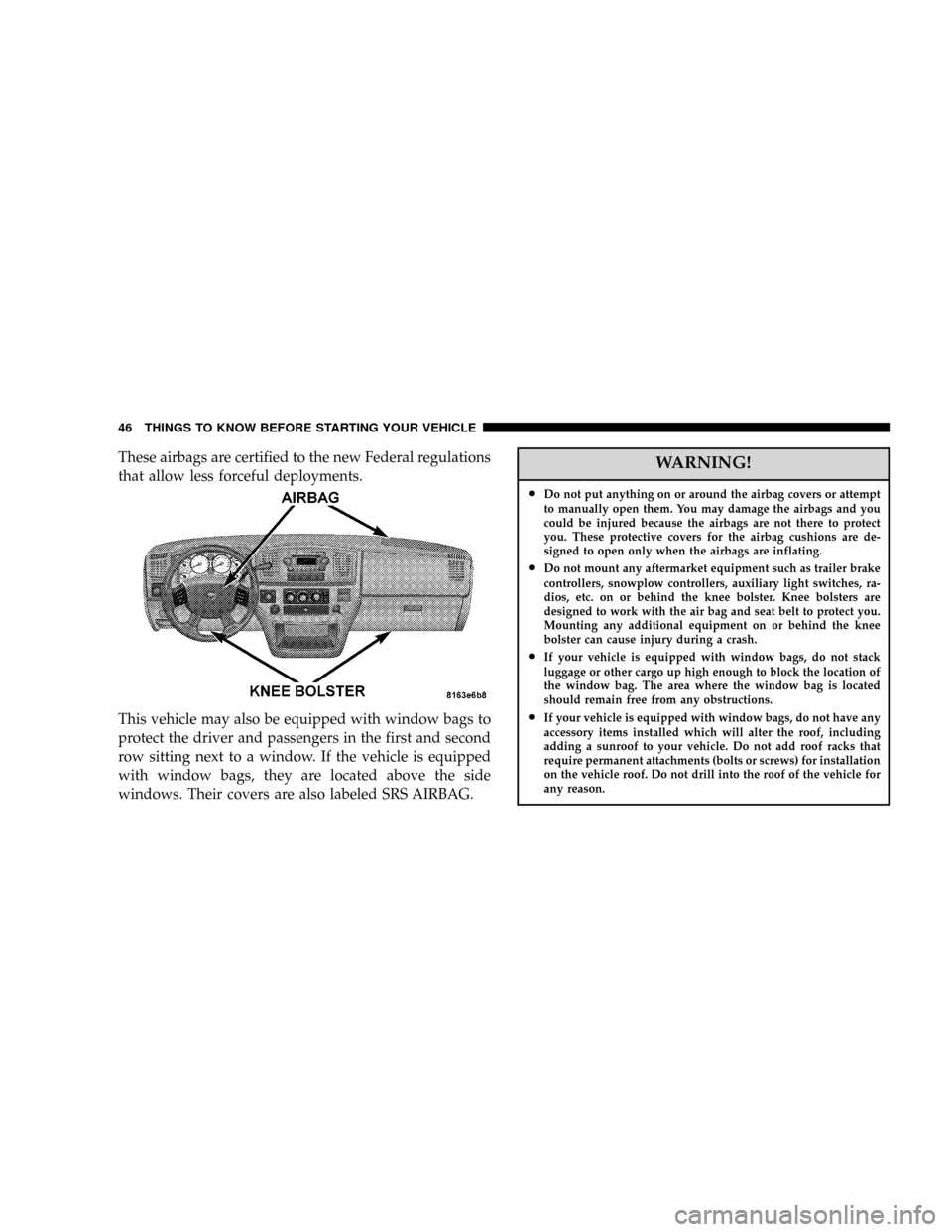
These airbags are certified to the new Federal regulations
that allow less forceful deployments.
This vehicle may also be equipped with window bags to
protect the driver and passengers in the first and second
row sitting next to a window. If the vehicle is equipped
with window bags, they are located above the side
windows. Their covers are also labeled SRS AIRBAG.WARNING!
²Do not put anything on or around the airbag covers or attempt
to manually open them. You may damage the airbags and you
could be injured because the airbags are not there to protect
you. These protective covers for the airbag cushions are de-
signed to open only when the airbags are inflating.
²Do not mount any aftermarket equipment such as trailer brake
controllers, snowplow controllers, auxiliary light switches, ra-
dios, etc. on or behind the knee bolster. Knee bolsters are
designed to work with the air bag and seat belt to protect you.
Mounting any additional equipment on or behind the knee
bolster can cause injury during a crash.
²If your vehicle is equipped with window bags, do not stack
luggage or other cargo up high enough to block the location of
the window bag. The area where the window bag is located
should remain free from any obstructions.
²If your vehicle is equipped with window bags, do not have any
accessory items installed which will alter the roof, including
adding a sunroof to your vehicle. Do not add roof racks that
require permanent attachments (bolts or screws) for installation
on the vehicle roof. Do not drill into the roof of the vehicle for
any reason.
46 THINGS TO KNOW BEFORE STARTING YOUR VEHICLE
Page 50 of 492
Airbag System Components
The airbag system consists of the following:
²Airbag Control Module
²AIRBAG Readiness Light
²Driver Airbag
²Passenger Airbag
²Steering Wheel and Column
²Instrument Panel
²Crash Sensor
²Interconnecting Wiring
²Knee Impact Bolsters
²Passenger Side Frontal Airbag ON/OFF Switch (Stan-
dard Cab Vehicles Only)The Window Airbag System, on vehicles equipped,
consists of the following:
²AIRBAG Readiness Light (shared with the front airbag
system)
²Window Bags Above the Side Windows.
²Airbag Control Module (shared with the front airbag
system)
²Side impact sensors
²Interconnecting Wiring
How The Airbag System Works
²
The airbag control module determines if a frontal
collision is severe enough to require the airbags to
inflate.
²The airbag control module will not detect roll over, or
rear collisions.
THINGS TO KNOW BEFORE STARTING YOUR VEHICLE 49
2
Page 51 of 492
²The airbag control module also monitors the readiness
of the electronic parts of the system whenever the
ignition switch is in the START or RUN positions.
These include all of the items listed above except the
knee bolsters, the instrument panel, and the steering
wheel and column. If the key is in the9Off9position, in
the ACC position or not in the ignition, the airbags are
not on and will not inflate
²The airbag control module also turns on the AIR BAG
light in the instrument panel for 6 to 8 seconds when
the ignition is first turned on, then turns the light off.
²If it detects a malfunction in any part of the
system, it turns on the light either momen-
tarily or continuously. The instrument clus-
ter will flash the seat belt indicator if it
detects a fault with the airbag indicator.
WARNING!
Ignoring the AIR BAG light in your instrument
panel could mean you won't have the airbags to
protect you in a collision. If the light does not come
on, stays on after you start the vehicle, or if it comes
on as you drive, have the airbag system checked
right away.
²When the airbag control module detects a collision
requiring the airbags, it signals the inflator units. A
large quantity of nontoxic gas is generated to inflate
the airbags. The airbag covers separate and fold out of
the way as the airbags inflate to their full size. The
airbags fully inflate in milliseconds. This is less time
than it takes you to blink your eyes. The airbags then
quickly deflate while helping to restrain the driver and
front passenger. The driver's front airbag deflates
through vents towards the instrument panel. The
50 THINGS TO KNOW BEFORE STARTING YOUR VEHICLE
Page 53 of 492
because the infant has a medical condition which
makes it necessary for the driver to be able to see the
infant,
²is a child, age 1 to 12 who must ride in the front seat
because there is no rear seat, because there is no rear
seat position available, or because the child has a
medical condition which makes it necessary for the
driver to be able to see the child,
²has a medical condition which makes passenger airbag
inflation (deployment) a greater risk for the passenger
than the risk of hitting the dashboard (instrument
panel) or windshield in a crash.
WARNING!
Whenever an airbag is turned off, even a lap/
shoulder belted passenger may hit their head, neck,
or chest on the dashboard (instrument panel) or
windshield in a crash. This may result in serious
injury or death.
To Shut Off the Passenger Airbag (Standard Cab Ve-
hicles Only)
Place the ignition key in the Passenger Airbag On/Off
Switch, push the key in and turn clockwise, and remove
the key from the switch. This will shut off the passenger
side airbag. The ªOffº light near the switch will illumi-
nate when the ignition switch is turned to the ON
position.
52 THINGS TO KNOW BEFORE STARTING YOUR VEHICLE
Page 54 of 492
To Turn On the Passenger Airbag (Standard Cab Ve-
hicles Only)
Place the ignition key in the Passenger Airbag On/Off
Switch, push the key in and turn counterclockwise, and
remove the key from the switch. This will turn on the
passenger airbag. The ªOffº light near the switch will be
off when the ignition switch is turned to the ON position.
If A Deployment Occurs
The airbag system is designed to deploy when the air bag
control module detects a moderate-to-severe frontal col-
lision, and then immediately to deflate.
NOTE:A frontal collision that is not severe enough to
need airbag protection will not activate the system. This
does not mean something is wrong with the airbag
system.If you do have a collision which deploys the airbags, any
or all of the following may occur:
²The nylon airbag material may sometimes cause abra-
sions and/or skin reddening to the driver and front
passenger as the airbags deploy and unfold. The
abrasions are similar to friction rope burns or those
you might get sliding along a carpet or gymnasium
floor. They are not caused by contact with chemicals.
They are not permanent and normally heal quickly.
However, if you haven't healed significantly within a
few days, or if you have any blistering, see your doctor
immediately.
²As the airbags deflate you may see some smoke-like
particles. The particles are a normal by-product of the
process that generates the nontoxic gas used for airbag
inflation. These airborne particles may irritate the skin,
eyes, nose, or throat. If you have skin or eye irritation,
rinse the area with cool water. For nose or throat
THINGS TO KNOW BEFORE STARTING YOUR VEHICLE 53
2
Page 55 of 492
irritation, move to fresh air. If the irritation continues,
see your doctor. If these particles settle on your
clothing, follow the garment manufacturer's instruc-
tions for cleaning.
²It is not advisable to drive your vehicle after the
airbags have deployed. If you are involved in another
collision, the airbags will not be in place to protect you.
WARNING!
Deployed airbags can't protect you in another colli-
sion. Have the airbags replaced by an authorized
dealer as soon as possible.
Window Airbags Supplemental Restraint System
(SRS)ÐIf Equipped
The window airbag control module determines if a side
collision is severe enough to require the side airbags to
inflate. The window airbag control module will not
detect roll over, front or rear collisions.
The airbag control module monitors the readiness of the
electronic parts of the system whenever the ignition
switch is in the9START9or9RUN9positions. These
include all of the items listed above. The airbag control
module also turns on the AIRBAG light in the instrument
panel for 6 to 8 seconds when the ignition is first turned
on as a diagnostic or system check, then turns the light
off. If it detects a malfunction in any part of the system,
it turns on the light either momentarily or continuously.
The side (window) impact SRS Airbags are designed to
activate only in certain side collisions. When the airbag
control module detects a collision requiring the window
54 THINGS TO KNOW BEFORE STARTING YOUR VEHICLE
Page 56 of 492
bags to inflate, it signals the inflators on the crash side of
the vehicle. A quantity of nontoxic gas is generated to
inflate the window bag. The inflating window bag
pushes the side pillar molding out of the way and covers
the window. The airbag inflates in about 30 milliseconds
(about one-quarter of the time it takes to blink your eyes)
with enough force to injure you if you are not belted and
seated properly, or if items are positioned in the area
where the window bag inflates. This especially applies to
children. The window bag is only about 3
1¤2inches (8.9
cm) thick when it is inflated.
Enhanced Accident Response System
If the airbags deploy after an impact and the electrical
system remains functional, vehicles equipped with
power door locks will unlock automatically. In addition,
approximately 10 seconds after the vehicle has stopped
moving, the interior lights will light until the ignition
switch is turned off.
Maintaining Your Airbag Systems
WARNING!
²Modifications to any part of the airbag system
could cause it to fail when you need it. You could
be injured because the airbags are not there to
protect you. Do not modify the components or
wiring, including adding any kind of badges or
stickers to the steering wheel hub trim cover or
the upper right side of the instrument panel. Do
not modify the front bumper, vehicle body struc-
ture, or frame.
²You need proper knee impact protection in a
collision. Do not mount or locate any aftermarket
equipment on or behind the knee bolster.
²It is dangerous to try to repair any part of the
airbag system yourself. Be sure to tell anyone who
works on your vehicle that it has airbags.
THINGS TO KNOW BEFORE STARTING YOUR VEHICLE 55
2
Page 57 of 492
Airbag Light
You will want to have the airbags ready to
inflate for your protection in an impact. While
the airbag system is designed to be mainte-
nance free, if any of the following occurs, have
an authorized dealer service the system promptly:
²The airbag light does not come on or flickers during
the 6 to 8 seconds when the ignition switch is first
turned on.
²The light remains on or flickers after the 6 to 8 second
interval.
²The light flickers or comes on and remains on while
driving.
NOTE:If the speedometer, tachometer or any engine
related gauges are not working, the airbag control mod-
ule may also be disabled. The airbags may not be readyto inflate for your protection. Promptly check fuse num-
bers 52 and 53 in the fuse and relay center. See your
dealer if the fuse is good.
Event Data Recorder (EDR)
In the event of an airbag deployment, your vehicle is
designed to record up to 2-seconds of specific vehicle
data parameters (see list below) in an event data recorder
prior to the moment of airbag deployment. Please note
that such data are ONLY recorded if an airbag deploys,
and are otherwise unavailable. In conjunction with other
data gathered during a complete accident investigation,
the electronic data may be used by DaimlerChrysler
Corporation and others to learn more about the possible
causes of crashes and associated injuries in order to
assess and improve vehicle performance. In addition to
56 THINGS TO KNOW BEFORE STARTING YOUR VEHICLE