seats DODGE POWER WAGON 2007 2.G User Guide
[x] Cancel search | Manufacturer: DODGE, Model Year: 2007, Model line: POWER WAGON, Model: DODGE POWER WAGON 2007 2.GPages: 492, PDF Size: 8.25 MB
Page 68 of 492
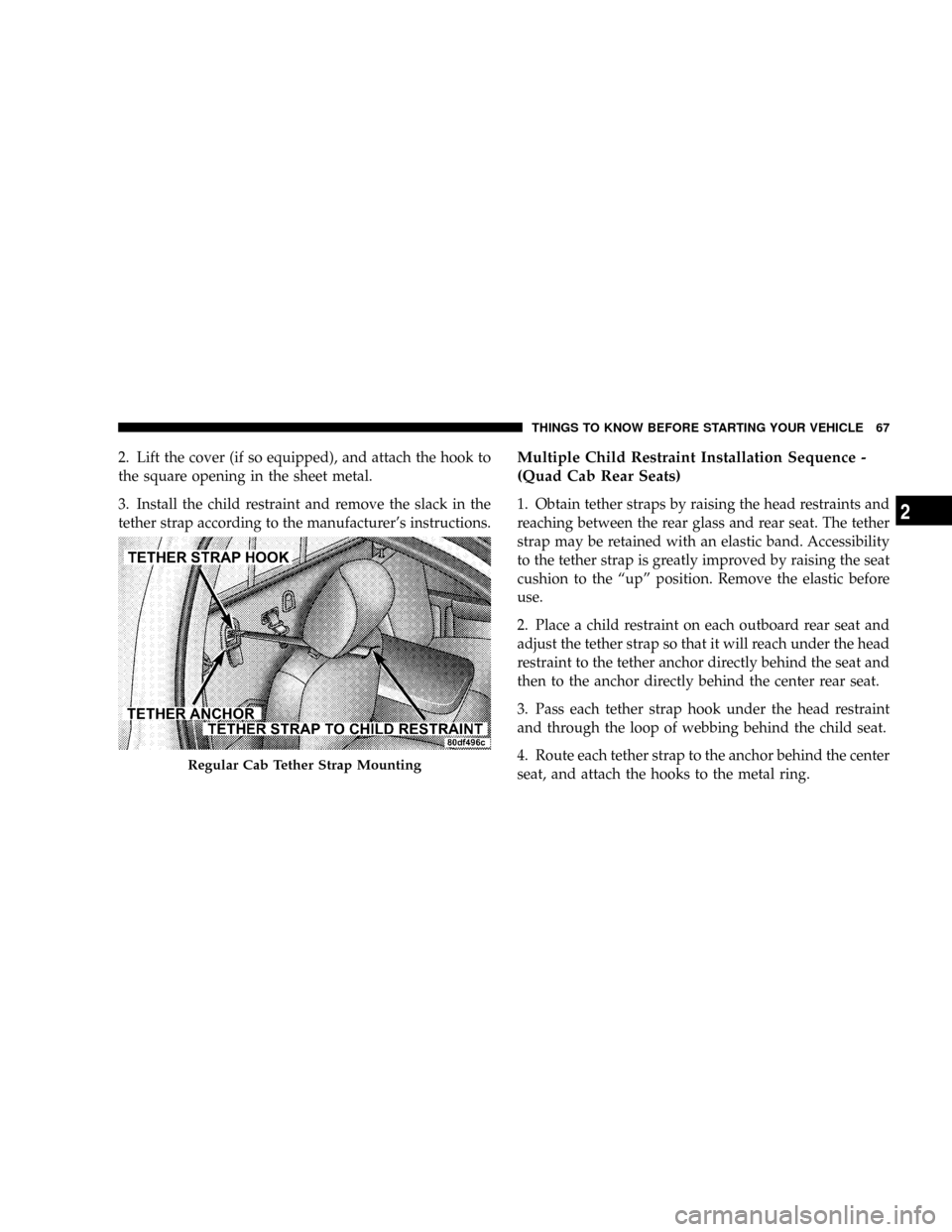
2. Lift the cover (if so equipped), and attach the hook to
the square opening in the sheet metal.
3. Install the child restraint and remove the slack in the
tether strap according to the manufacturer's instructions.Multiple Child Restraint Installation Sequence -
(Quad Cab Rear Seats)
1. Obtain tether straps by raising the head restraints and
reaching between the rear glass and rear seat. The tether
strap may be retained with an elastic band. Accessibility
to the tether strap is greatly improved by raising the seat
cushion to the ªupº position. Remove the elastic before
use.
2. Place a child restraint on each outboard rear seat and
adjust the tether strap so that it will reach under the head
restraint to the tether anchor directly behind the seat and
then to the anchor directly behind the center rear seat.
3. Pass each tether strap hook under the head restraint
and through the loop of webbing behind the child seat.
4. Route each tether strap to the anchor behind the center
seat, and attach the hooks to the metal ring.
Regular Cab Tether Strap Mounting
THINGS TO KNOW BEFORE STARTING YOUR VEHICLE 67
2
Page 71 of 492
Children Too Large for Booster Seats
Children who are large enough to wear the shoulder belt
comfortably, and whose legs are long enough to bend
over the front of the seat when their back is against the
seat back should use the lap/shoulder belt in a rear seat.
²Make sure that the child is upright in the seat.
²The lap portion should be low on the hips and as snug
as possible.
²Check belt fit periodically. A child's squirming or
slouching can move the belt out of position.
If the shoulder belt contacts the face or neck, move the
child closer to the center of the vehicle. Never allow a
child to put the shoulder belt under an arm or behind
their back.
ENGINE BREAK-IN RECOMMENDATIONS
A long break-in period is not required for the engine in
your new vehicle. Drive moderately during the first 300
miles (500 km). After the initial 60 miles (100 km), speeds
up to 50 or 55 mph (80 or 90 km/h) are desirable. While
cruising, brief full-throttle acceleration, within the limits
of local traffic laws, contributes to a good break-in.
Avoid wide open throttle acceleration in low gear.
The engine oil installed in the engine at the factory is a
high quality, energy conserving type lubricant. Oil
changes should be consistent with the anticipated cli-
matic conditions under which vehicle operation will
occur. The recommended viscosity and quality grades are
discussed in Section 7 under Maintenance Procedures,
Engine Oil.
NON-DETERGENT OR STRAIGHT MINERAL OILS
MUST NEVER BE USED.
70 THINGS TO KNOW BEFORE STARTING YOUR VEHICLE
Page 75 of 492
NExterior Mirrors Folding Feature...........85
NElectronic Power Mirrors ±If Equipped.......85
NElectric Rear Window Defroster And Heated
Sideview Mirrors ± If Equipped............86
NTrailer Towing Mirrors ± If Equipped........86
mHands±Free Communication (UConnectŸ) Ð
If Equipped............................87
NOperations...........................89
NPhone Call Features....................96
NUConnectŸ System Features..............98
NAdvanced Phone Connectivity............103
NThings You Should Know About Your
UConnectŸ System....................104
mSeats................................110N40-20-40 Front Seat....................111
NReclining Seats.......................112
NAdjustable Head Restraints..............112
NManual Rotary Lumbar Support Adjustment Ð
If Equipped.........................113
NPower Seats Ð If Equipped..............114
NHeated Seats Ð If Equipped.............115
mTo Open And Close The Hood.............117
mLights...............................118
NInterior Lights.......................119
NBattery Saver........................120
NHeadlamp Delay......................120
NHeadlights, Parking Lights, Panel Lights.....120
74 UNDERSTANDING THE FEATURES OF YOUR VEHICLE
Page 78 of 492
mElectrical Power Outlets..................148
mCigar Lighter And Ash Receiver............150
mCupholders...........................151
NFront Instrument Panel Cupholders........151
NRear Cupholder Ð Quad Cab Ð If Equipped . 151
mStorage..............................152
NCenter Storage Compartment Ð If Equipped . . 152
NStorage And Seats Ð If Equipped..........153
mRear Window Features...................154
NElectric Rear Window Defroster And Heated
Side View Mirrors Ð If Equipped..........154
NPower Sliding Rear WindowÐIf Equipped . . . 154
NSliding Rear WindowÐIf Equipped........155mFold Flat Load Floor Ð If Equipped.........155
mPickup Box...........................159
mSlide-In Campers.......................160
mEasy-Off Tailgate.......................160
mSafety Tips...........................162
NTransporting Passengers................162
NLock Your Vehicle.....................162
NExhaust Gas.........................163
NSafety Checks You Should Make Inside The
Vehicle.............................163
NSafety Checks You Should Make Outside The
Vehicle.............................164
UNDERSTANDING THE FEATURES OF YOUR VEHICLE 77
3
Page 111 of 492
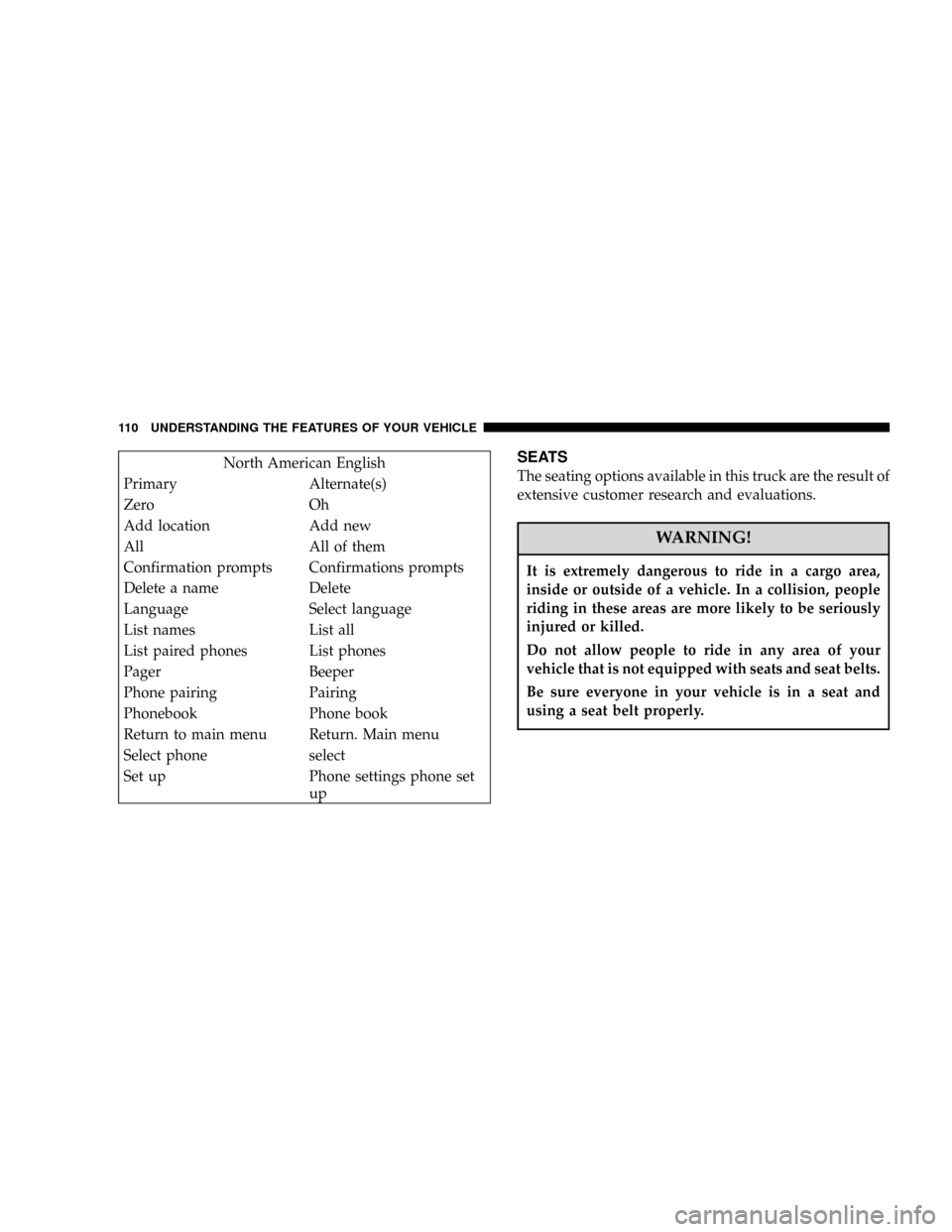
North American English
Primary Alternate(s)
Zero Oh
Add location Add new
All All of them
Confirmation prompts Confirmations prompts
Delete a name Delete
Language Select language
List names List all
List paired phones List phones
Pager Beeper
Phone pairing Pairing
Phonebook Phone book
Return to main menu Return. Main menu
Select phone select
Set up Phone settings phone set
upSEATS
The seating options available in this truck are the result of
extensive customer research and evaluations.
WARNING!
It is extremely dangerous to ride in a cargo area,
inside or outside of a vehicle. In a collision, people
riding in these areas are more likely to be seriously
injured or killed.
Do not allow people to ride in any area of your
vehicle that is not equipped with seats and seat belts.
Be sure everyone in your vehicle is in a seat and
using a seat belt properly.
110 UNDERSTANDING THE FEATURES OF YOUR VEHICLE
Page 113 of 492
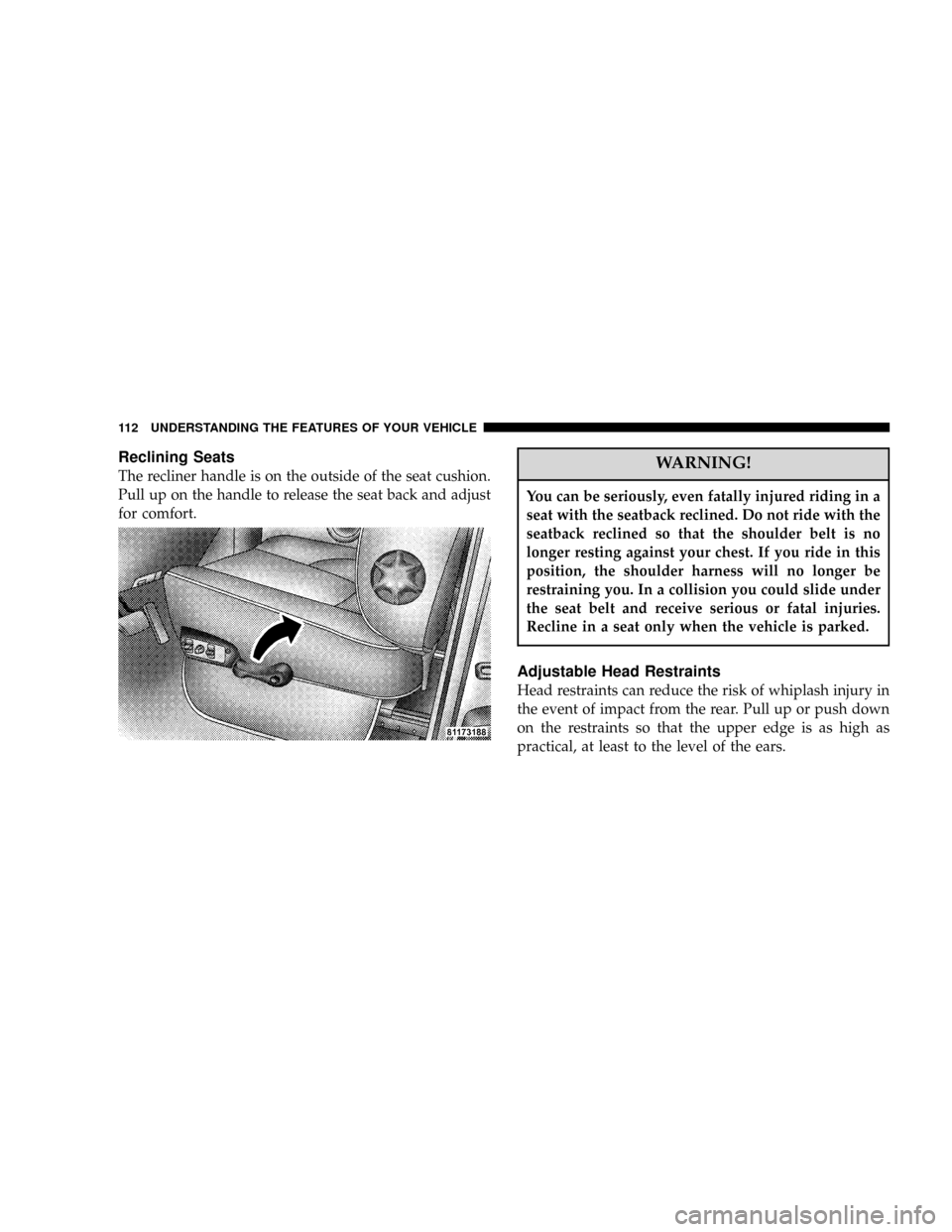
Reclining Seats
The recliner handle is on the outside of the seat cushion.
Pull up on the handle to release the seat back and adjust
for comfort.WARNING!
You can be seriously, even fatally injured riding in a
seat with the seatback reclined. Do not ride with the
seatback reclined so that the shoulder belt is no
longer resting against your chest. If you ride in this
position, the shoulder harness will no longer be
restraining you. In a collision you could slide under
the seat belt and receive serious or fatal injuries.
Recline in a seat only when the vehicle is parked.
Adjustable Head Restraints
Head restraints can reduce the risk of whiplash injury in
the event of impact from the rear. Pull up or push down
on the restraints so that the upper edge is as high as
practical, at least to the level of the ears.
112 UNDERSTANDING THE FEATURES OF YOUR VEHICLE
Page 115 of 492
Power Seats Ð If Equipped
CAUTION!
Don't put anything under a power seat. It may cause
damage to the seat controls.
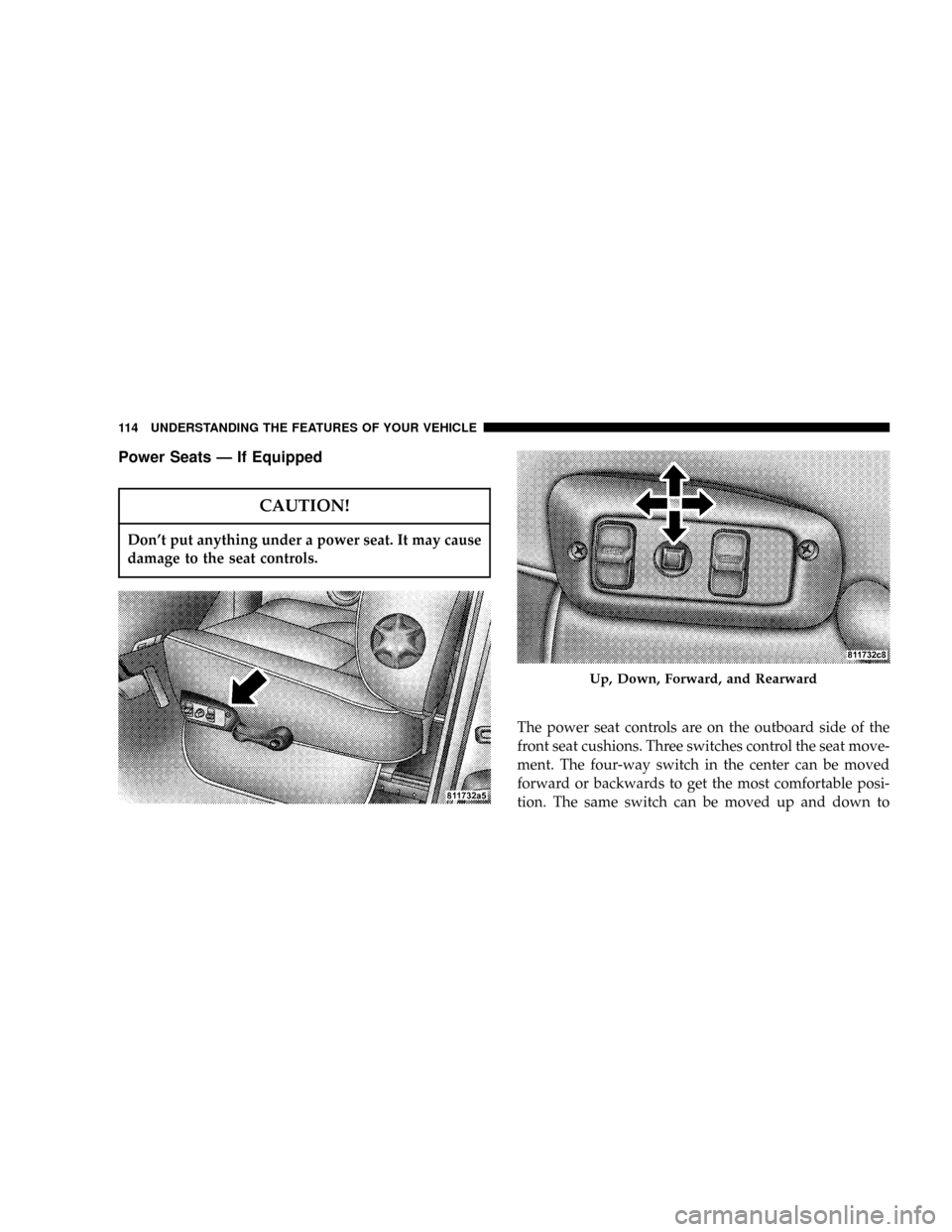
The power seat controls are on the outboard side of the
front seat cushions. Three switches control the seat move-
ment. The four-way switch in the center can be moved
forward or backwards to get the most comfortable posi-
tion. The same switch can be moved up and down to
Up, Down, Forward, and Rearward
114 UNDERSTANDING THE FEATURES OF YOUR VEHICLE
Page 116 of 492
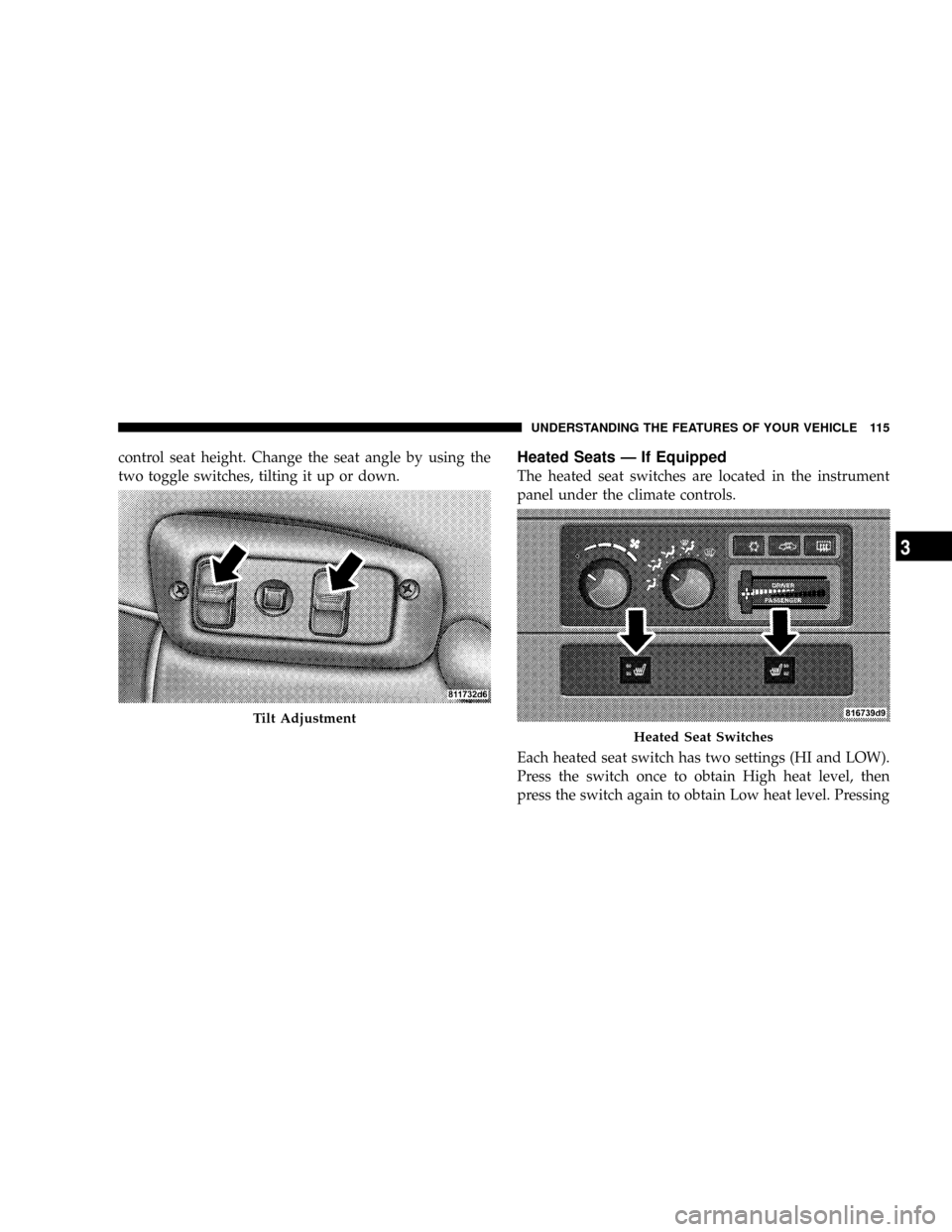
control seat height. Change the seat angle by using the
two toggle switches, tilting it up or down.Heated Seats Ð If Equipped
The heated seat switches are located in the instrument
panel under the climate controls.
Each heated seat switch has two settings (HI and LOW).
Press the switch once to obtain High heat level, then
press the switch again to obtain Low heat level. Pressing
Tilt Adjustment
Heated Seat Switches
UNDERSTANDING THE FEATURES OF YOUR VEHICLE 115
3
Page 117 of 492
the switch a third time will turn the heated seats OFF. If
you do not purposefully turn the switch OFF, the seat
heating level will automatically change to the next lower
level, or OFF. The High heat level operates for 30 minutes
(approximate), the Low heat level operates for 30 min-
utes (approximate). The seat heat will also turn OFF
when the ignition is turned OFF. Both of the indicators
ON identifies High heat level. The lower indicator On
only, identifies Low heat level. Flashing indicator lights
on the switch indicate that the Heated Seat System needs
servicing.WARNING!
Persons who are unable to feel pain to the skin
because of advanced age, chronic illness, diabetes,
spinal cord injury, medication, alcohol use, exhaus-
tion or other physical condition must exercise care
when using the seat heater. It may cause burns even
at low temperatures, especially if used for long
periods of time.
Do not place anything on the seat that insulates
against heat, such as a blanket or cushion. This may
cause the seat heater to overheat.
116 UNDERSTANDING THE FEATURES OF YOUR VEHICLE
Page 154 of 492
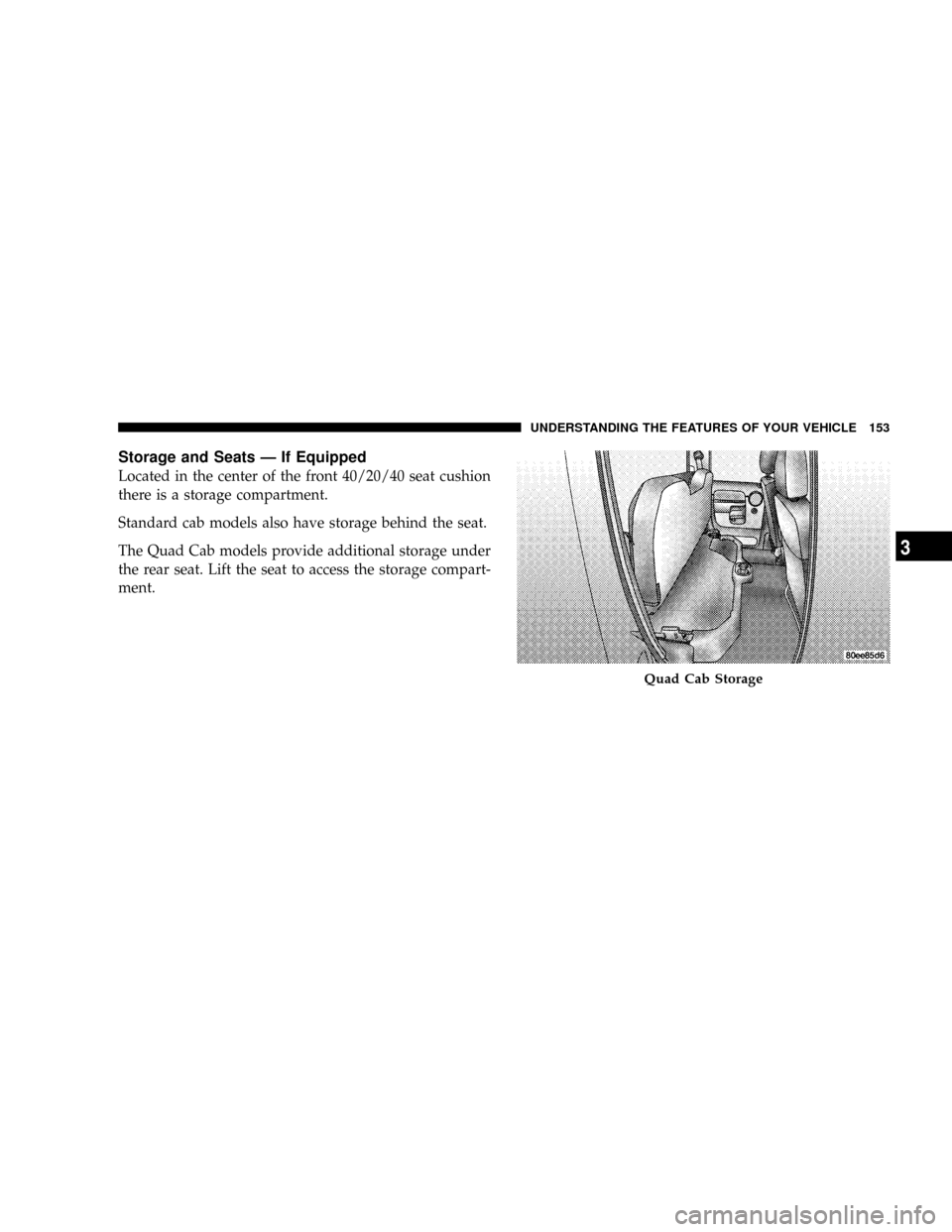
Storage and Seats Ð If Equipped
Located in the center of the front 40/20/40 seat cushion
there is a storage compartment.
Standard cab models also have storage behind the seat.
The Quad Cab models provide additional storage under
the rear seat. Lift the seat to access the storage compart-
ment.
Quad Cab Storage
UNDERSTANDING THE FEATURES OF YOUR VEHICLE 153
3